
Korean apartment interiors, decoded
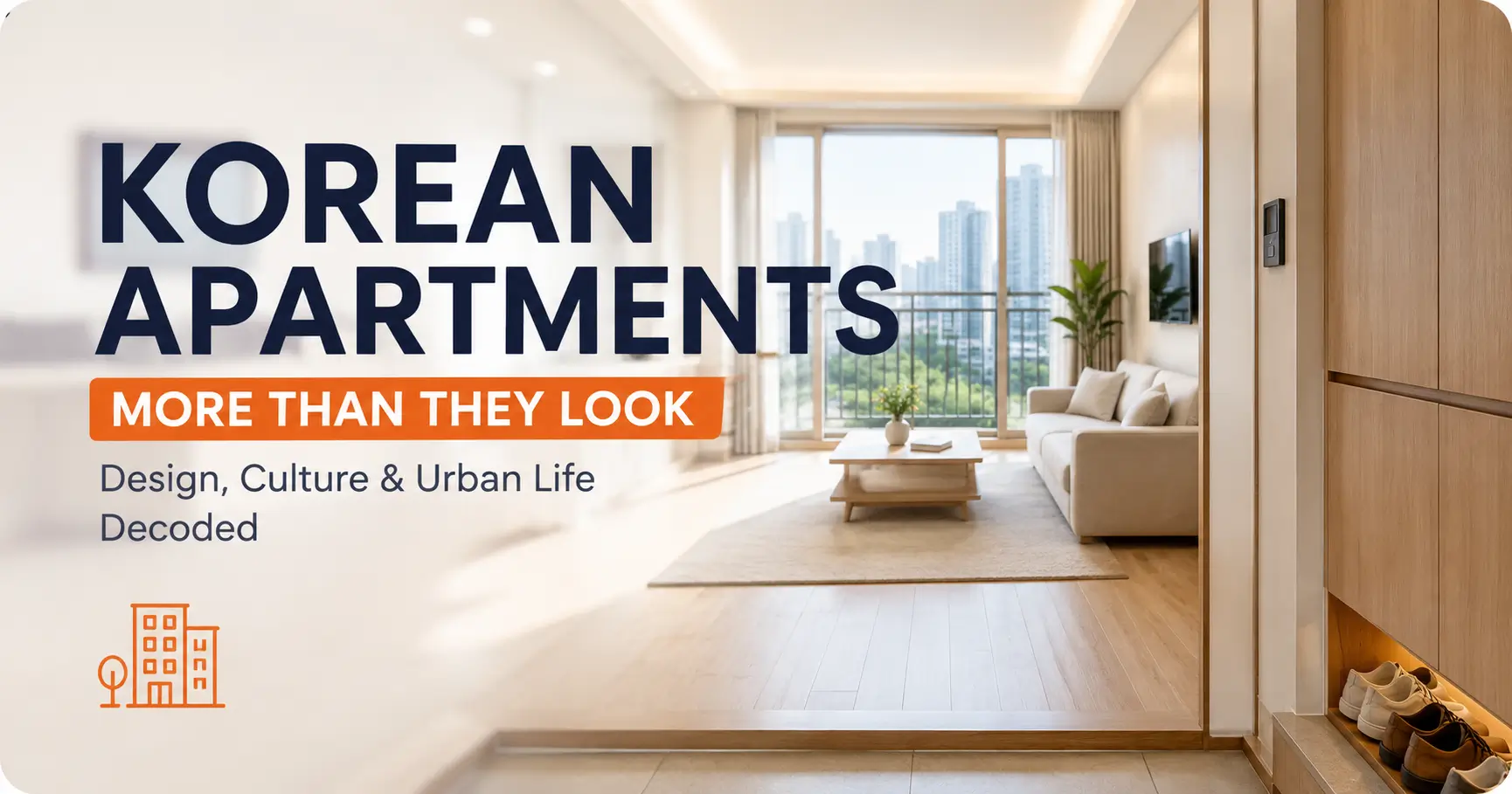
Step into enough Korean apartments and you may feel a strange kind of déjà vu. The entryway dips slightly for shoes. The living room opens wide and bright. A balcony, once fully outdoors, has often been absorbed into daily life. Pale floors, white walls, built-in cabinets, and sliding doors seem to return like a familiar chorus.
That sameness is easy to dismiss as plain taste or mass production. But the apartment is never only a container. In Korea, it is a family stage, a resale asset, a convenience machine, a social signal, and a tiny private island inside a dense city. Its floor plan carries the pressure of school mornings, delivery culture, aging parents, real-estate anxiety, and the quiet wish to live neatly among millions.
This guide explains why Korean apartment interiors feel standardized without flattening the people who live in them. We will read the apartment less like a showroom and more like a cultural map: where shoes stop, where family gathers, what gets hidden, what must stay neutral, and why convenience has become a design language of its own.
See the pattern
Understand the repeated floor plan, finishes, storage, and shared visual cues.
Read the culture
Connect interior design to density, family routines, resale value, and daily speed.
Avoid lazy takes
Move beyond “minimalism” and see how similar rooms hold different lives.
🏙️ The promise: after reading, you will be able to look at one Korean apartment tour and notice the social script hiding in plain sight.
Snapshot
This article is for travelers, expats, K-drama viewers, architecture students, and design-curious readers who wonder why many Korean apartments look so alike inside. You will learn the practical, economic, and cultural forces behind the pattern, then use a simple observation method to read a floor plan like a map of Korean urban life.
Contents — choose a section
The “Same Apartment” Feeling Is Not Your Imagination
If Korean apartments seem to share a family resemblance, you are noticing something real. Many interiors follow a recognizable formula: a shoe-removal entry, a bright living room, a kitchen that opens toward family activity, bedrooms arranged around efficiency, and built-in storage that tries to tame the daily avalanche of coats, bags, bedding, school supplies, and seasonal appliances.
The effect can feel especially strong to visitors from the United States or the United Kingdom, where detached houses, older flats, row houses, loft conversions, and rental units often vary wildly by age and neighborhood. In Korea, by contrast, large apartment complexes built by major developers have shaped what “normal housing” looks like for millions of urban families.
That does not mean every home is identical. It means the baseline is more legible. A visitor can often predict where the living room is, where the main bedroom sits, where laundry is handled, and where the shoe cabinet lives before the host even turns on the light.
Why white walls, pale floors, and sliding doors keep showing up
White walls and pale floors are not just decorative choices. They make apartments feel brighter, easier to photograph, easier to sell, and easier to personalize without making permanent changes. In a dense city where many homes compete in the same real-estate search results, brightness becomes a kind of visual currency.
Sliding doors, glass partitions, and simple built-ins also help small or medium-sized homes behave like flexible spaces. A room can be a study today, a child’s bedroom tomorrow, and a storage zone during a move. When a floor plan must serve changing family needs, fixed drama gives way to quiet adaptability.
There is also a practical reason these features repeat: they reduce friction. Neutral finishes do not fight with furniture. Pale floors reflect light. Sliding doors save swing space. Built-ins keep edges clean. The home feels less like a personal art project and more like a system that helps the day move forward.
Key takeaway
Korean apartment interiors often look similar because they are optimized for brightness, flexibility, maintenance, resale, and everyday speed. The look is not only aesthetic. It is a practical response to dense urban life.
The floor plan rhythm: entryway, living room, balcony, bedrooms
The most recognizable rhythm begins at the front door. Many Korean homes have a lower entry area where outdoor shoes stop. This space is not a quaint detail. It marks a boundary between the public city and the private home.
From there, the apartment often opens into a central living and dining zone. The living room receives the strongest light, the television usually has a clear wall, and the sofa faces a shared family axis. Even when the decor is restrained, the layout quietly says: gather here.
The balcony, or what used to be a balcony before expansion, often acts as a bright edge between home and city. It may hold plants, laundry tools, storage shelves, a desk, or simply the light that makes the room feel larger. Bedrooms then branch away as more private zones, though even these rooms often carry several jobs at once.
The hidden pattern visitors notice before residents do
Residents often stop noticing the pattern because it works. The entryway accepts shoes. The kitchen keeps meals moving. The living room handles guests, children, television, studying, snacks, folded laundry, and late-night phone scrolling. The cabinets swallow clutter before it embarrasses anyone.
Visitors, especially those seeing several homes in a short period, notice the repetition faster. They are not yet inside the routine. They see the frame before they see the family rhythm inside it.
A useful way to read Korean apartment sameness is to ask: what problem does this repeated feature solve? Most answers are not about fashion. They are about speed, cleanliness, storage, privacy, family coordination, and future resale.
Apartment Uniformity Began as a Practical Urban Solution
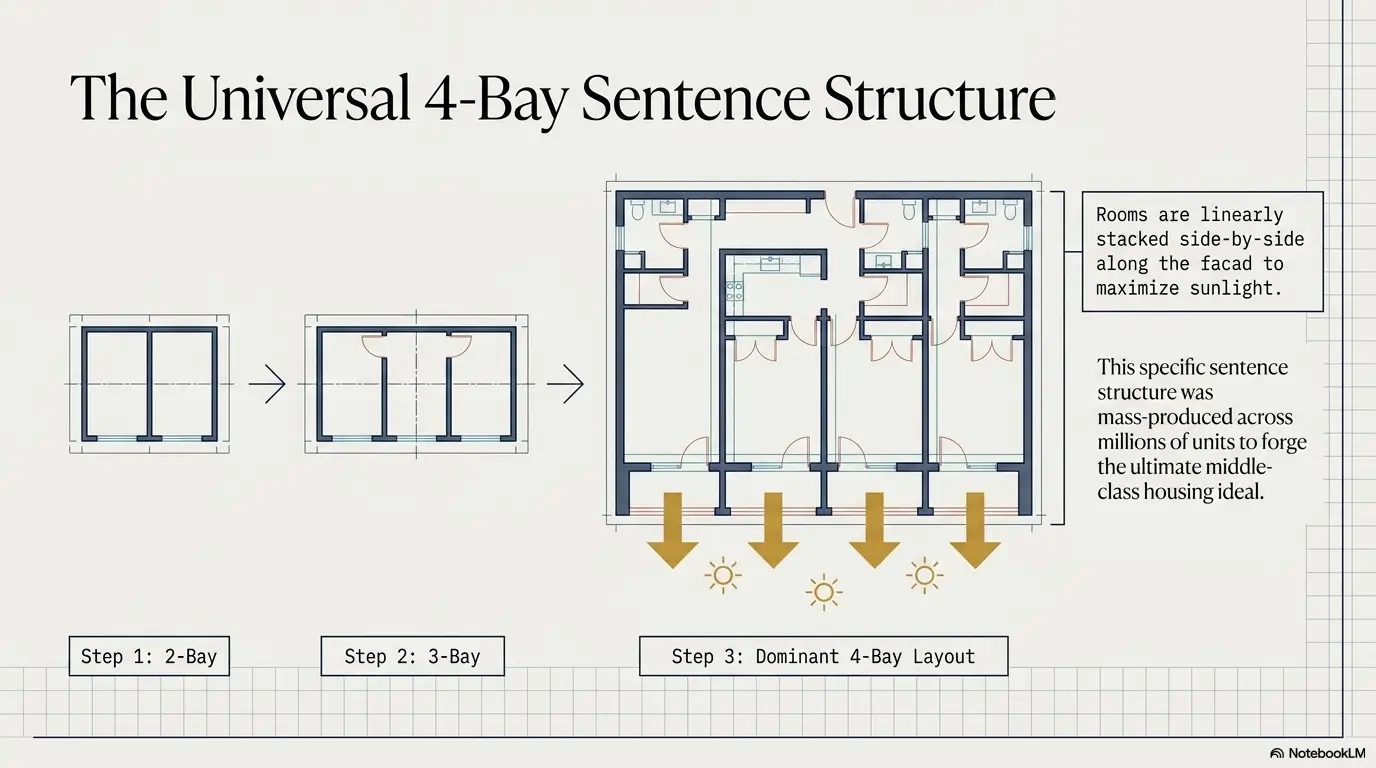
To understand Korean apartment interiors, start outside the home. South Korea urbanized quickly. Cities needed huge amounts of housing near jobs, schools, transit, hospitals, and shopping. The apartment complex became a powerful answer because it could house many families on limited land while providing shared infrastructure.
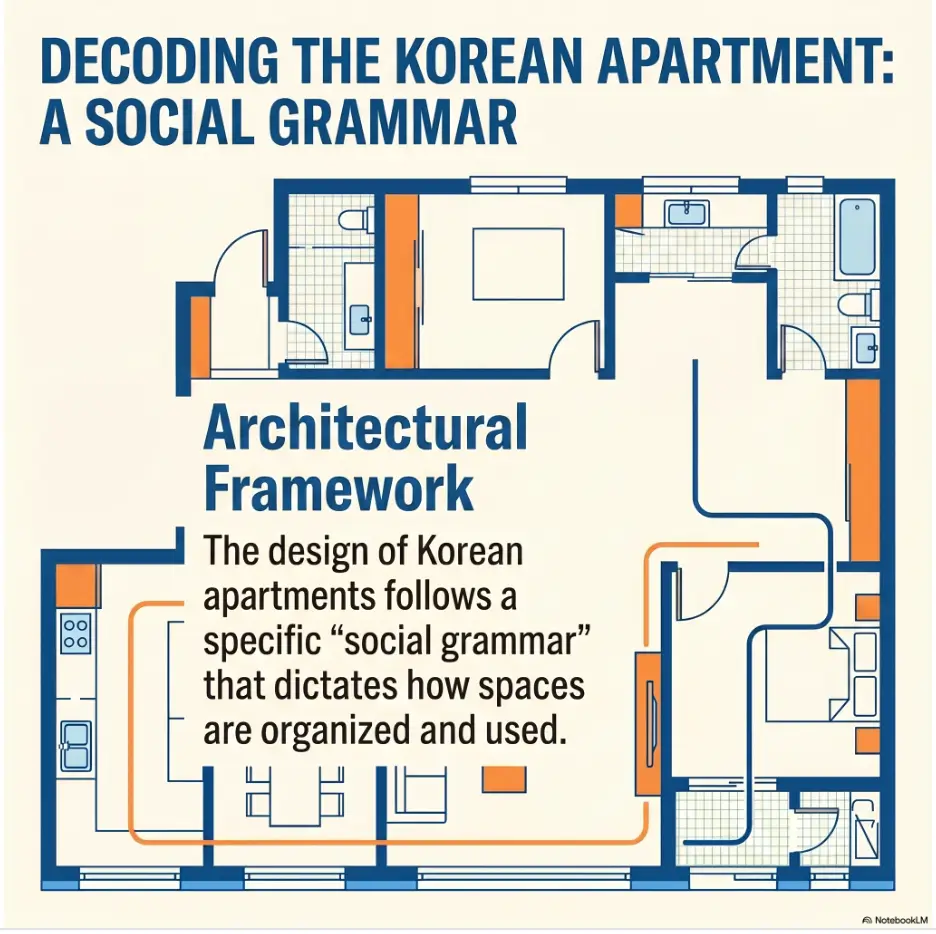
Once housing is built at scale, repetition becomes useful. Developers repeat what sells. Buyers learn what looks safe. Families compare layouts with relatives and neighbors. Renovation companies standardize packages. Real-estate listings reward rooms that look bright, clean, and familiar. Over time, the apartment becomes not only a building type but a social grammar.
This is why the similarity should not be read as a lack of imagination. It is the afterimage of rapid urban change, a housing market organized around comparability, and a culture where the apartment is often the most important household asset.
Fast housing for fast-growing cities
When a city grows quickly, housing cannot remain a slow craft object for each household. It becomes a system. Apartment towers allow planners and developers to repeat foundations, elevators, utilities, parking, corridors, and floor plans. That repetition lowers uncertainty and allows neighborhoods to grow with predictable services.
For residents, the repeated apartment form offers a certain promise. You may not get eccentric charm, but you get plumbing that makes sense, elevators, heating systems, nearby schools, shops, and a layout most furniture makers understand. In daily life, predictability can feel less poetic than a crooked old house, but it can save a remarkable amount of time.
There is also a social comfort in knowing the basic rules of a home before entering it. The guest knows where to remove shoes. The delivery worker knows where parcels go. The child knows where the elevator leads. The apartment complex becomes a small city with familiar steps.
Density made repetition useful, not accidental
In dense housing, every design choice must work harder. A badly placed cabinet is not just annoying. It blocks circulation. A dark living room is not just moody. It can make a compact home feel smaller. A lack of storage is not just messy. It turns daily routines into a scavenger hunt.
Repetition helps solve these problems because successful solutions are copied. Once a certain living room width, kitchen arrangement, or storage wall proves useful, it spreads. Developers, renovation firms, and homeowners all learn the same tune.
That is why the Korean apartment often feels more standardized than older Western housing stock. It is not only because tastes are similar. It is because density rewards solutions that can be repeated without needing heroic improvisation each morning before school.
When “efficient” became a national design language
Efficiency in a Korean apartment is not cold by default. It can be tender in disguise. A shoe cabinet means fewer frantic mornings. A laundry zone means fewer damp towels wandering through the house. A visible kitchen means a parent can cook while monitoring homework, television, or a toddler experimenting with gravity.
When millions of people live within tight schedules, good design often looks like fewer steps. The apartment becomes a choreography of small savings: one less door to open, one less corner to clean, one less object to leave in plain sight.
For a deeper cultural contrast, you can compare this apartment logic with Korea’s older architectural ideals in traditional hanok design. Hanok often emphasizes courtyards, thresholds, seasonal airflow, and relation to the land. The modern apartment answers a different question: how do many families live near the city’s engines without collapsing into chaos?
The Korean Floor Plan Has a Social Script
A floor plan is never neutral. It tells people where to pause, where to gather, where to hide clutter, and what kind of family life is easiest to perform. Korean apartments often center the living room not just as a lounge but as a shared family stage.
This does not mean every family behaves the same way. It means the apartment makes certain behaviors easier. Watching television together, eating at a table near the kitchen, supervising children, welcoming guests into a bright central zone, and keeping bedrooms more private all become part of the everyday script.
If you are a foreign resident moving into a Korean apartment, this script can be surprisingly helpful. Once you understand the logic, the home starts to feel less mysterious. You can make better choices about furniture, storage, cleaning routines, and guest etiquette.
The living room as family stage, not private lounge
In many Korean apartments, the living room is the home’s public face. It is where visitors sit, where children sprawl, where snacks appear, where relatives gather, and where the household quietly announces its standard of order. Even when the family is not formal, the room carries social weight.
This helps explain why many living rooms remain visually calm. A neutral sofa, simple media wall, pale flooring, and minimal clutter create a setting that can shift between family use and guest readiness. It is not showroom living. It is a flexible stage that must be presentable on short notice.
For US or UK readers used to more casual dens, playrooms, or separate sitting rooms, this may feel slightly exposed. The Korean living room often has to be both everyday and ceremonial. It holds the cereal crumbs and the visiting aunt, sometimes within the same hour.
Kitchens built for visibility, movement, and daily speed
Korean apartment kitchens are frequently arranged for speed and oversight. Many are semi-open to the dining and living area. This supports the rhythm of rice cookers, side dishes, quick breakfasts, school schedules, and late dinners after long workdays.
The kitchen is also shaped by the reality of Korean food storage. Kimchi, banchan, soups, sauces, grains, delivery containers, and bulk groceries can require serious organization. What looks like a simple kitchen may hide a dense system of refrigerators, pantry zones, and containers.
Visibility matters too. A parent can cook while staying connected to the family area. A guest can sit nearby without being sealed away. The kitchen becomes a command center, not a remote workshop.
Bedrooms that flex between sleep, study, storage, and status
Korean bedrooms often work harder than their square footage suggests. A child’s room may be a sleeping space, study zone, storage area, and symbol of educational care. A main bedroom may hold wardrobes, bedding, beauty products, seasonal clothing, and sometimes a small work setup.
This multifunctional pressure helps explain why built-ins and neutral walls are so common. The more jobs a room must do, the less visual noise it can tolerate. Strong personal decoration is possible, of course, but the base layer often remains calm so the room can change roles over time.
For a foreign student or expat, this flexible logic can be useful. Instead of asking, “What is this room supposed to be?” ask, “What jobs does this household need this room to handle?” That question reveals far more about Korean apartment living than paint color alone.
Utility block: Korean apartment room-reading checklist
- Where does the home create a public-facing zone for guests?
- Where does the family hide shoes, coats, bedding, cleaning tools, and seasonal goods?
- Can the kitchen see the living room or dining area?
- Which room has the best light, and what activity is placed there?
- Does a bedroom seem designed for sleep only, or also study, storage, and work?
- What part of the home feels most “presentable”?
Resale Value Quietly Designs the Room
One of the biggest reasons Korean apartment interiors feel similar is that resale value sits silently in the room. Even when a family plans to stay for years, the apartment is often treated as a major financial asset. A bold renovation may express personality, but it can also make future buyers hesitate.
This creates a powerful incentive toward safe design. White, beige, gray, pale wood, hidden storage, simple lighting, and broadly acceptable layouts feel market-friendly. They make the home easier to imagine as someone else’s future home.
In markets where real estate is emotionally and financially intense, taste becomes cautious. The walls whisper: do not scare the buyer who has not arrived yet.
Why bold interiors can feel financially risky
A jewel-toned kitchen, patterned tile, dramatic wallpaper, or custom built-in bookshelf can be beautiful. But in a resale-focused apartment market, beauty that is too specific can become a negotiation point. The buyer may see not personality but removal cost.
This does not mean Koreans dislike bold design. Cafes, boutiques, restaurants, and studios across Seoul prove otherwise. The issue is not imagination. The issue is where risk is allowed to live. In a home that may represent family savings, design choices often become more conservative.
Renters feel this too. A tenant may avoid permanent changes because restoration costs can be painful. Even owners may prefer furniture, rugs, lighting, art, and small objects as safer outlets for taste.
Neutral finishes are not boring when the market is watching
Neutral design can be a strategy. It lowers the home’s visual temperature so buyers, renters, family members, and visitors can project their own lives into it. That projection matters in real estate. People do not only buy walls. They buy the feeling that their future routines will fit.
In Korean apartments, neutral finishes also photograph well. Online listings, real-estate apps, and renovation portfolios reward clean surfaces and bright rooms. The camera likes pale floors and white walls. The market learns from the camera.
There is a quiet irony here. A neutral apartment may seem less personal in photos, but it can be deeply personal in use. The family’s personality often appears in habits, food, shoes, study materials, laundry rhythms, and objects that are moved before the listing photos are taken.
Do not assume similarity means lack of taste
The fastest mistake is to equate visual similarity with cultural sameness. That reading is too thin. It misses the economic pressure behind neutral choices and the small ways people personalize within constraints.
A family may choose the same pale flooring as their neighbors but use the space completely differently. One household may turn the living room into a child-centered learning zone. Another may create a minimalist adult retreat. Another may fill the same layout with plants, books, exercise gear, pet supplies, and delivery boxes.
If you want to understand Korean apartment interiors, train your eye to separate the shell from the life inside it. The shell may be standardized. The life is not.
Key takeaway
In Korean apartments, resale value often edits the design before the homeowner does. Neutral interiors are not always a lack of personality. They can be a financial safety blanket folded neatly over the room.
Built-In Storage Explains More Than You Think
Storage is one of the least glamorous and most important clues in Korean apartment design. If you only look at the sofa and wall color, you miss the hidden machinery of the home. Shoe cabinets, wardrobe walls, utility closets, laundry zones, balcony cabinets, and kitchen storage shape how daily life feels.
Korean apartments often need to absorb a large number of objects into a limited footprint. Seasonal bedding, winter coats, school supplies, food containers, small appliances, sports gear, cleaning tools, umbrellas, slippers, skincare, recycling, and gifts all need somewhere to go.
Good storage does not merely hold things. It protects the feeling of order. In a compact home, visible clutter can make the whole apartment feel smaller, louder, and more tiring.
Wardrobes, shoe cabinets, and utility zones reduce visual chaos
The shoe cabinet near the entryway is a perfect example. It handles a practical problem, but it also protects the dignity of the home. Without it, the first view inside might be a crowd of sneakers, boots, sandals, slippers, umbrellas, and delivery bags staging a tiny coup.
Wardrobe walls perform a similar service. Korean homes often use wardrobes and built-ins to store clothing without relying on large walk-in closets. This keeps bedrooms visually quiet and allows rooms to change purpose as family needs shift.
Utility zones are equally important. Laundry, cleaning supplies, recycling, and rarely used objects need containment. When these systems work well, the apartment appears simple. When they fail, the home quickly shows every secret.
The apartment as a machine for small-space order
A well-designed Korean apartment can feel like a small machine for order. Each zone has a duty. The entryway catches the city. The kitchen processes food and family schedules. The living room hosts shared life. The balcony edge handles light, air, plants, laundry tools, or overflow storage. Bedrooms absorb personal routines.
When people call these interiors “minimalist,” they often miss this machine-like quality. The goal is not always fewer possessions. Sometimes the goal is making many possessions disappear behind clean surfaces.
That distinction matters. A Korean apartment may look sparse in a real-estate photo but contain an elaborate hidden geography of things. Open the cabinets and you may find the real biography of the household.
Storage can become identity
Here is what no one tells you: storage can become a form of identity. A household that stores things well appears disciplined, prepared, and calm. A home with visible clutter may feel not only messy but socially vulnerable.
This is not unique to Korea, but dense apartment life sharpens the effect. When space is limited, order carries emotional force. A well-organized home tells its residents, “We are managing.” That message can be comforting after a long commute, a competitive school day, or a week of family obligations.
If you are moving into a Korean apartment, storage should be part of your first plan, not an afterthought. For practical move-in details, this Korean apartment move-in checklist can help you think through the less glamorous parts of setting up a home.
Convenience Culture Lives in the Layout
Korean apartment life does not begin at the front door. It begins in the elevator, the parcel area, the parking garage, the playground, the recycling station, the management office, the convenience store nearby, and sometimes the gym, reading room, daycare facility, or community room inside the complex.
This matters because the interior is designed in relation to a larger system. The home is not a detached island. It plugs into a building and neighborhood network that supports daily speed. That network changes how the inside feels.
A family living in a large Korean apartment complex may receive deliveries easily, send children to nearby hagwons, use elevators constantly, sort recycling by strict categories, and move between private home and shared facilities several times a day. The apartment interior becomes the private cockpit for a highly organized urban machine.
Elevators, parcel rooms, parking, gyms, and playgrounds shape the interior
When buildings include reliable elevators and parcel systems, homes can receive a steady flow of online orders. That affects interior storage. Boxes, groceries, meal kits, bottled water, and household supplies need landing zones. The apartment must process the outside world quickly.
Parking also shapes home routines. Families may move groceries, strollers, luggage, sports gear, and children through elevator routes. This makes entryway organization more important. The home needs a place to receive the day’s cargo without looking defeated.
Playgrounds and shared spaces influence the interior too. If children can play downstairs, the home may not need to serve every recreational function. If a gym or study room exists inside the complex, the apartment can remain more focused on family, rest, and storage.
Why the home feels connected to the apartment complex outside
In many Western contexts, people talk about home as a private property separated from the street. In Korean apartment culture, the boundary is more layered. The unit is private, but the complex is part of daily identity. People may mention the apartment brand, district, school zone, subway access, and nearby amenities as part of what the home means.
This connection affects interiors in subtle ways. A home in a highly convenient complex may prioritize calm recovery from the city. The outside provides services and movement. The inside provides order, rest, family coordination, and social acceptability.
The more active the surrounding system, the more valuable a calm interior can feel. A pale living room after the elevator, lobby, road, school, subway, and convenience store is not necessarily bland. It may be the visual equivalent of lowering the volume.
The “inside” of Korean apartment life starts before the front door
To read a Korean apartment properly, include the spaces outside the unit. The lobby, corridor, elevator, security office, parcel area, recycling point, and parking garage are all part of the home’s extended nervous system.
This is why apartment complexes can feel so socially important. They are not simply stacks of private boxes. They are managed environments where convenience, status, maintenance, security, and community overlap.
That larger system helps explain why interiors may appear restrained. When so much urban energy circulates just beyond the door, the apartment often becomes a place to simplify, reset, and keep the household machine from overheating.
Key takeaway
The Korean apartment interior is shaped by the building around it. Elevators, parcel systems, parking, recycling, schools, and shared amenities all influence what the private home needs to do.
Similar Interiors Can Still Hold Very Different Lives
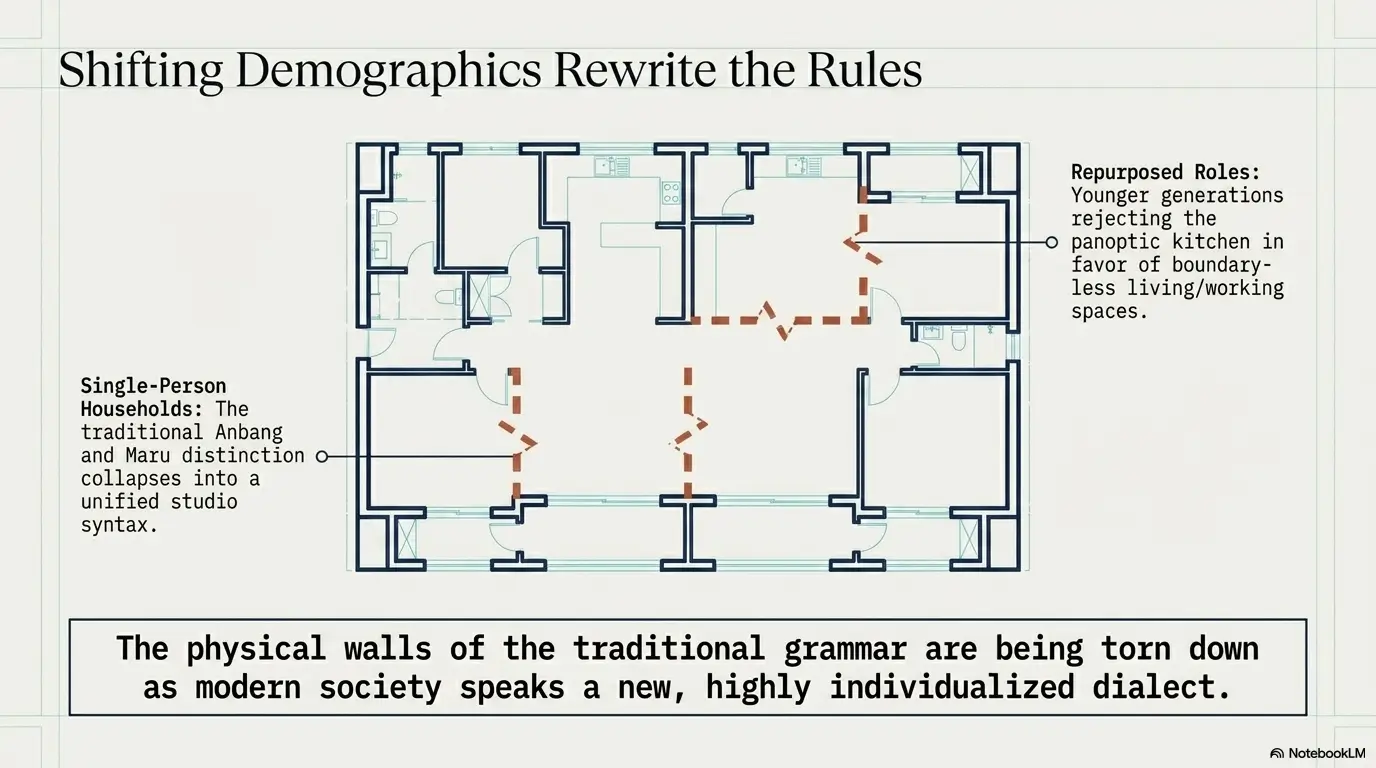
The most important correction is this: similar interiors do not create identical lives. Two apartments can share the same floor plan, same flooring, same kitchen style, and same pale walls while holding completely different emotional worlds.
One may be a quiet home for an elderly couple. Another may be a battlefield of school bags, piano practice, and rice cooker steam. Another may be a single professional’s carefully edited retreat. Another may be full of grandparents, children, pets, and drying laundry. The shell repeats. The rhythm changes.
This is where many foreign readings of Korean apartments go wrong. They stop at the photograph. But a home is not a photograph. It is a schedule, a set of compromises, a memory cabinet, a financial plan, and sometimes a small theater where family expectations rehearse themselves daily.
Two identical floor plans, two completely different family rhythms
Imagine two apartments in the same building. Both have three bedrooms, a living room, kitchen, two bathrooms, and a former balcony area. On paper, they match.
In the first home, the small bedroom near the entrance is a child’s study room with bookshelves, a desk, and a schedule taped to the wall. The living room has a large table because homework and meals often blur together. The balcony edge holds plants, a drying rack, and a small fan.
In the second home, the same small bedroom is a work-from-home office. The living room has no television because the owner prefers music and reading. The balcony edge has a coffee setup and a chair turned toward the city. The floor plan is identical, but the life inside has changed key.
Décor may be subtle because routines do the talking
In some homes, personality appears loudly through color and objects. In many Korean apartments, personality may appear more quietly through routines: where tea is placed, how slippers are arranged, which room gets the best desk, how the refrigerator is organized, where family photos appear, and what objects are hidden before guests arrive.
Subtle decor does not mean the home lacks meaning. It may mean that meaning is carried by use rather than display. This can be hard to see in photos, especially when online apartment tours favor clean angles and empty surfaces.
To read the room, look for signs of daily repetition. The charging cable near the sofa. The rice cooker’s position. The child’s workbook stack. The skincare tray. The recycling bags near the utility space. These small details say more than a dramatic accent wall ever could.
Sameness is easier to photograph than difference
Online images flatten homes. A camera loves clean lines and repeated features. It struggles with smells, sounds, habits, family tensions, bedtime routines, and the emotional temperature of a room after a long day.
This is why Korean apartment interiors can seem more uniform online than they feel in person. In real life, the difference may be the sound of soup boiling, a grandmother folding laundry, a teenager refusing to leave their room, a dog guarding the shoe cabinet, or a parent sorting delivery boxes at midnight.
When you see similarity, do not stop there. Ask what the photograph cannot show. That is where the home begins to breathe.
Illustrative Scenario: The same living room at 7 p.m.
Mina visited two friends in the same Seoul apartment complex on the same evening. The elevators smelled faintly of raincoats and fried chicken. Both front doors opened into pale floors, white walls, and living rooms that looked nearly identical at first glance.
In the first home, a child’s math workbook sat beside sliced apples. The television murmured while someone’s mother ladled soup. The sofa was less furniture than a family dock.
In the second home, the same sofa faced a low table with a laptop, a candle, and a half-built model kit. No children, no soup, no television. Just one person making quiet after work.
Mina realized the apartments had not hidden difference. They had made difference quieter. The lesson was simple: never judge a home only by its walls. Watch what the room helps people do.
What This Says About Korean Urban Life
Korean apartment interiors reveal a deep tension in modern urban life: the desire for private comfort inside collective density. Many people live close together, share elevators, hear traces of neighbors, follow building rules, and move through common infrastructure. Yet inside the unit, the home must feel private, orderly, and emotionally safe.
This tension creates the recognizable apartment formula. The interior must soothe without wasting space. It must be presentable without becoming stiff. It must serve family routines without looking chaotic. It must express enough status to feel secure but not so much individuality that resale becomes difficult.
That is a lot for a living room to carry. No wonder the palette often goes pale and quiet.
Private comfort inside collective density
Apartment living asks people to be private and collective at the same time. You live in your own unit, but your daily life depends on shared elevators, shared maintenance, shared walls, shared parking, and shared rules.
The interior responds by creating a calm private center. Soft colors, clear storage, warm floors, and predictable zones help residents feel they have control. In a city that moves quickly, the home becomes a small climate system for the nervous system.
This is also why noise, clutter, and inconvenience can feel especially stressful in an apartment. When the private refuge fails, there is not always a garden, garage, attic, or spare room to absorb the overflow. The home must work cleanly because there is less margin for mess.
The tension between individuality and social readability
Korean apartment interiors often balance individuality with social readability. A home should feel personal, but it should also make sense to others. Guests, relatives, potential buyers, and even online viewers bring expectations about what a “good” apartment looks like.
Social readability means the room communicates order, care, and taste without needing explanation. Neutral colors and familiar layouts help. So do clean surfaces, coordinated furniture, and visible signs that the household is managing life well.
This can feel restrictive, especially for people who crave bold self-expression. But it can also create a shared language. When everyone understands the basic form, small differences become meaningful: a tea shelf, a plant corner, a child’s art, a particular lamp, a dining table chosen for long conversations.
Why the apartment becomes both shelter and social signal
In Korea, apartments often carry strong social meaning. Location, complex reputation, school district, building age, brand, floor, view, and size can all become part of how a household is perceived. The apartment is shelter, but it is also a signal.
This affects interiors because the inside must support the outside story. A respected apartment complex with an interior that feels outdated, dark, or chaotic may seem out of step. A clean, neutral renovation helps align the private home with the social value of the address.
For more context on how place and identity connect in Korea, see this guide to Korean city identity. It helps explain why where you live can carry meanings beyond commute distance.
Key takeaway
Korean apartments are private homes inside highly collective systems. Their interiors often balance comfort, order, social readability, and real-estate value at the same time.
Infographic framework
The Korean Apartment Formula
1
Density
Limited land rewards repeatable, efficient layouts.
2
Resale
Neutral finishes keep future buyers comfortable.
3
Family rhythm
Living rooms, kitchens, and bedrooms support daily coordination.
4
Storage
Built-ins keep small-space life visually calm.
5
Convenience
Complex amenities shape what the private home must handle.
The K-Drama Apartment Effect Can Mislead You
K-dramas have done more than export stories. They have exported rooms. Many international viewers now carry a mental image of Korean apartments: spotless counters, glowing windows, tasteful sofas, perfectly staged bookshelves, and kitchens where nobody seems to own a stained dish towel.
Those images are useful, but they are not neutral. Screen homes are built to be filmed. They need clean sightlines, flattering lighting, wide movement paths for cameras, and visual clarity for viewers who must understand a character quickly.
Real apartments are more crowded, practical, and changeable. They contain recycling bags, medicine boxes, school notices, drying socks, half-open parcels, kitchen smells, and furniture chosen because it fit the elevator.
Screen homes exaggerate cleanliness, lighting, and space
Television apartments are often cleaner and more spacious than ordinary life because the camera needs room to breathe. Furniture is arranged for scenes, not always for daily convenience. Lighting is controlled. Clutter is curated. Even the mess is styled.
This can make real homes feel disappointing if you expect drama-level polish. But the real home is more interesting. It reveals how people actually manage density, family pressure, work schedules, and domestic care.
When watching K-drama interiors, enjoy the design but keep one eyebrow awake. A production designer’s apartment is a character portrait, not a housing survey.
Real apartments are more practical, crowded, and lived-in
Real homes have maintenance needs. A sofa may be chosen for washable fabric. A table may be selected because children can study there. A cabinet may exist because someone owns too many winter blankets. A balcony corner may hold tools, fans, or boxes that would never appear in a drama shot.
The lived-in apartment may still be elegant, but its elegance is negotiated with reality. That negotiation is part of the culture. A home must host, store, clean, recover, feed, impress, and protect.
Visitors who understand this become kinder observers. They stop asking why every home is not a design magazine spread and start noticing what the apartment helps residents survive.
Do not compare a family home to a production designer’s dream box
A real family home has a different job from a drama set. It does not need to reveal character in three seconds. It needs to keep breakfast moving, laundry drying, homework visible, and shoes contained.
If you are using K-dramas to understand Korean apartment culture, compare gently. Notice the repeated elements: central living room, entryway, kitchen visibility, pale finishes, built-in storage. Then remember that ordinary homes carry more friction.
The most useful question is not, “Do Koreans really live this perfectly?” It is, “Which parts of this staged interior reflect real housing habits, and which parts are polished for the screen?”
How to Read a Korean Apartment Tour Without Missing the Point
Whether you are watching a YouTube apartment tour, browsing listings, visiting a friend, or preparing to rent in Seoul, the same method helps: read the home by movement, storage, light, and social use. Do not start with style. Start with function.
This is especially useful for foreigners comparing apartments. A unit may look plain in photos but work beautifully. Another may look stylish but fail at storage, noise, light, or daily flow. Korean apartment design rewards careful observation.
If you are actively looking for housing, this guide to apartments for rent in Seoul can help connect cultural observation with practical search habits.
Start at the entryway because the city stops there
The entryway tells you how the home handles the outside world. Look at shoe storage, floor level, mirror placement, umbrella storage, parcel landing space, and the distance to the living area.
A strong entry system can make a compact apartment feel much more livable. A weak one means shoes, bags, and boxes invade the living room. In Korea, where shoe removal is normal and deliveries are frequent, the entryway is not a decorative foyer. It is a filter.
For renters, this is a practical check. Ask yourself: can two people enter at once without bumping into each other? Is there enough cabinet space for actual shoes, not showroom shoes? Where would a wet umbrella go? Where would a delivery box wait?
Watch the living room-kitchen relationship
The distance between kitchen and living room reveals the household’s likely rhythm. A semi-open kitchen supports conversation, supervision, and quick transitions between cooking, eating, and relaxing. A more separated kitchen may control smells and mess better, but it may feel less connected.
Look at whether a dining table fits naturally. Many Korean apartments show a dining zone that must negotiate with circulation paths. If the table is too large, daily movement becomes awkward. If it is too small, family meals and homework may compete for space.
Also look for appliance zones. Rice cookers, air fryers, water purifiers, coffee tools, and extra refrigerators need surfaces, plugs, and ventilation. A beautiful kitchen with nowhere to put real appliances will age badly by Tuesday.
Check where clutter is supposed to go
Every home has clutter. Better homes decide where it lands. In a Korean apartment, look for built-ins, balcony cabinets, utility storage, pantry space, and room for recycling. If you cannot identify the clutter paths, the living room will become the storage room.
This is one reason many renovated Korean apartments look so smooth. They are not pretending life has no objects. They are building hiding places for those objects.
For a practical test, imagine a normal Wednesday: backpacks, groceries, laundry, delivery packaging, wet coats, side dishes, a vacuum cleaner, and charging cables. If the apartment can absorb that Wednesday, it is better designed than it may first appear.
Show me the nerdy details
The repeated Korean apartment interior can be understood through four overlapping forces. First, production logic: large developers repeat floor plans, finishes, and building systems because standardization reduces uncertainty. Second, market logic: buyers and renters compare similar units, so neutral interiors make comparison easier and reduce perceived risk. Third, domestic logic: Korean households often need strong storage, shoe separation, efficient kitchens, and shared family zones. Fourth, symbolic logic: the apartment is not only a place to live but a visible marker of stability, school access, neighborhood status, and household competence. When all four forces point toward the same solution, similarity becomes durable.
Compare the apartment with the neighborhood, not with a Western house
A Korean apartment makes more sense when compared with its urban surroundings than with a detached suburban house in another country. Ask what the building provides outside the unit: transit access, schools, shops, elevators, security, parcel delivery, parking, and community facilities.
Then ask what the unit provides inside: privacy, order, warmth, family gathering, storage, and recovery. The two halves work together.
This is also why official urban and housing resources can be useful if you want context beyond interiors. The apartment is one piece of a much larger housing system.
FAQ: Korean Apartment Interiors and Urban Life
Why do Korean apartments often look so similar inside?
They often look similar because large apartment developments, repeated floor plans, resale expectations, neutral renovation trends, and strong storage needs have created a familiar interior formula. The similarity is practical as much as aesthetic.
Are Korean apartments really standardized?
Many are standardized in basic layout and building systems, especially in large complexes. However, residents still personalize through furniture, routines, storage habits, lighting, plants, children’s rooms, and daily use.
Why do many Korean apartments use neutral colors?
Neutral colors make spaces feel brighter, easier to sell, easier to rent, and easier to match with furniture. They also reduce visual clutter in homes where storage and flexibility matter.
What is unique about Korean apartment layouts?
Common features include a shoe-removal entry, a central living room, efficient kitchen access, strong built-in storage, flexible bedrooms, and balcony or utility zones that often support laundry, plants, storage, or extra living space.
Do Korean families prefer apartments over houses?
Many urban Korean families prefer apartments because they offer convenience, security, transit access, school access, maintenance systems, and resale clarity. Preference varies by age, budget, region, and family needs.
Why do Korean apartments have so much built-in storage?
Built-in storage helps compact homes stay orderly. It hides shoes, clothing, bedding, food supplies, cleaning tools, seasonal goods, and delivery clutter while keeping living areas visually calm.
Are Korean apartment interiors influenced by resale value?
Yes. Because apartments are often major financial assets, many owners avoid highly specific renovations that could reduce buyer appeal. Market-friendly interiors usually favor neutral colors, bright rooms, and broad usability.
What do Korean apartments reveal about city life?
They reveal how urban households balance density, privacy, convenience, family routines, status, and financial caution. The apartment is not just a home. It is a small operating system for modern Korean life.
Key takeaway
The best question is not “Why are Korean apartments all the same?” It is “Which pressures made this kind of similarity useful, acceptable, and valuable?”
Use a familiar floor plan as the start of an inspection
Two apartments with similar layouts can differ in orientation, maintenance, noise, storage and usable space. Check the exact unit rather than assuming a familiar arrangement guarantees the same experience. In a constructed comparison, mark where furniture, laundry, work and mobility needs would fit, then verify dimensions and fixed equipment. Ask about repairs and charges independently of the plan. A repeated design can help you compare rooms, but does not establish build quality or contract suitability.
| Focus | What to check |
|---|---|
| Layout | Map your actual activities and furniture. |
| Unit | Verify dimensions, light, noise and condition. |
| Terms | Check equipment, repairs and recurring costs. |
A reader question: Can a listing’s area figure tell me how my furniture will fit?
Ask what the figure measures and verify the actual room dimensions and access route. A total area label is not a furniture layout or a guarantee of usable space.
Next Step: Look at One Floor Plan Like a Cultural Map
The fastest way to understand Korean apartment interiors is not to memorize design terms. It is to study one floor plan or apartment tour for 15 minutes. Treat the home like a map of movement, pressure, and care.
Start at the door. Notice where shoes stop. Follow the route to the living room. Watch how the kitchen connects to family life. Look for the balcony edge, the hidden storage, the best light, and the room that seems to carry more than one job. Then ask what kind of life this layout makes easier.
That question closes the loop. Korean apartments feel similar because they are solving similar urban problems at scale. But inside that repeated frame, people still negotiate love, fatigue, status, study, food, aging, privacy, and hope. The walls may be pale. The lives are not.
15-minute observation plan
- Open one Korean apartment tour or floor plan.
- Trace the path from entryway to living room.
- Mark every visible and hidden storage zone.
- Identify the brightest area and what activity it supports.
- Ask what the layout makes easy: hosting, studying, cooking, cleaning, resting, or resale.
- Write one sentence: “This apartment is designed to protect…”
If your interest is practical rather than cultural, especially if deposits and contracts are involved, read about jeonse deposit protection before treating any apartment choice as only a design decision. In Korea, the beauty of a home and the safety of its housing arrangement are two different questions, and both deserve clear eyes.
Last reviewed: 2026-06
Practical example and reader question added October 20, 2026. Existing source dates are retained; this addition is not a fresh verification of every earlier claim.