
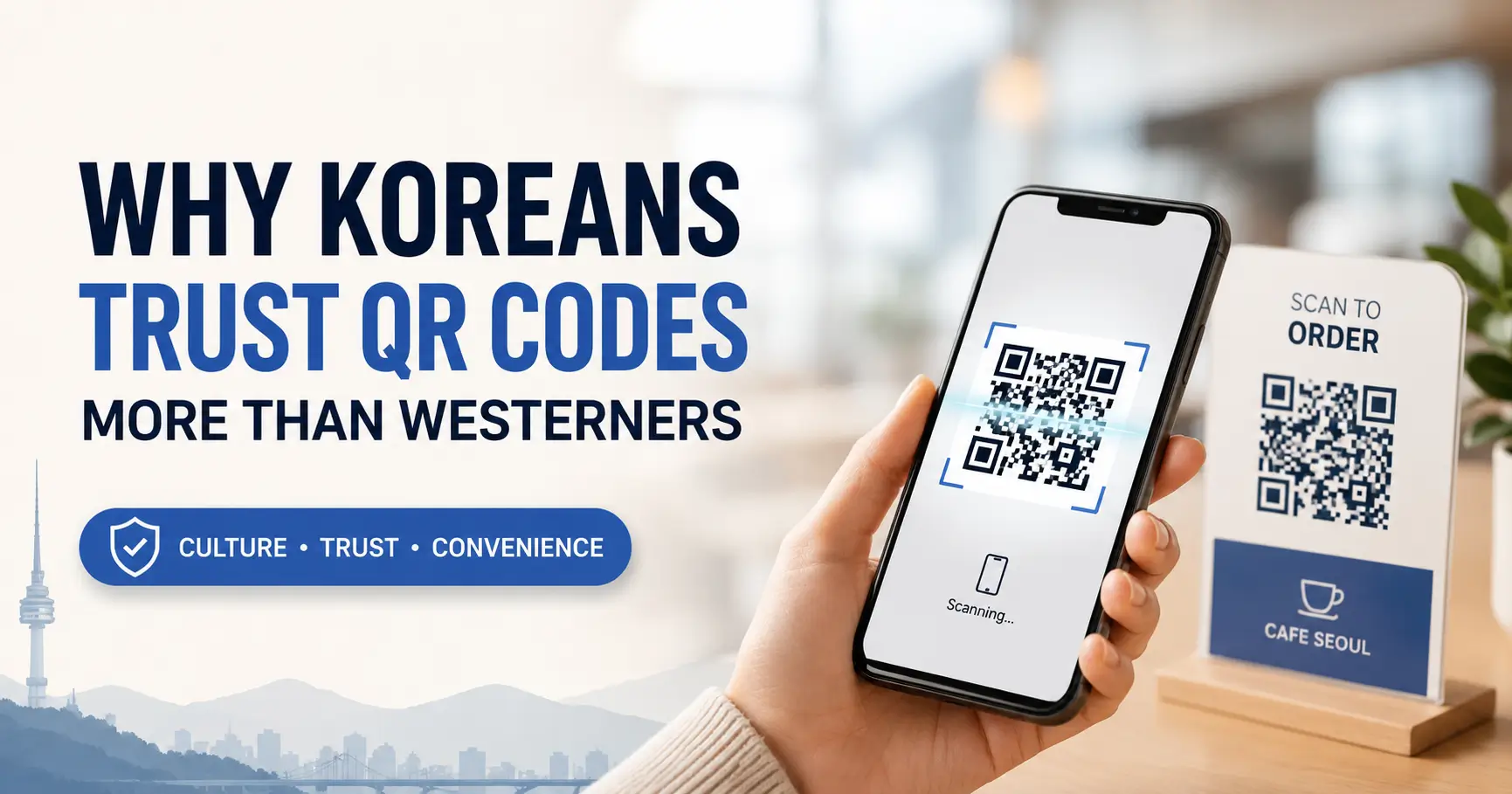
Culture, UX, and everyday trust
Why Koreans Are Comfortable With QR Codes
in More Situations Than Many Westerners
A QR code in Korea often feels less like a strange square on a wall and more like a small door that already knows why you are standing there. At a café, it may open a menu. At a clinic, it may check you in. At a pop-up store, it may connect you to a reservation, payment screen, event page, or loyalty benefit before the person behind you has finished clearing their throat.
That comfort did not appear from nowhere. It grew from fast mobile internet, dense cities, app-based errands, pandemic-era check-ins, cashless habits, and a general expectation that the phone is not just a device but a daily command center. For many Western readers, hesitation around QR codes is not backwardness. It is a different trust equation.
This guide explains the difference without flattening either side into a cartoon. You will see why QR codes feel ordinary in Korea, why many Americans and Europeans still pause, what businesses can learn, and how travelers can scan with local confidence while keeping a security editor’s eyebrow slightly raised.
For travelers
Understand when a QR code is normal in Korea and when a scan deserves caution.
For UX teams
Learn how context, design, and fallback options change the emotional cost of a scan.
For cautious scanners
Separate useful convenience from risky links, copied stickers, and app-download traps.
One small square can reveal a whole culture of speed, trust, privacy, and design. 📱
Snapshot
This article is for Korea-curious readers, travelers, product designers, marketers, and anyone wondering why QR codes feel more socially accepted in Korea than in many Western settings. You will learn the cultural and design reasons behind the difference, the safety checks worth using, and how businesses can use QR codes without making customers feel cornered.
Table of Contents
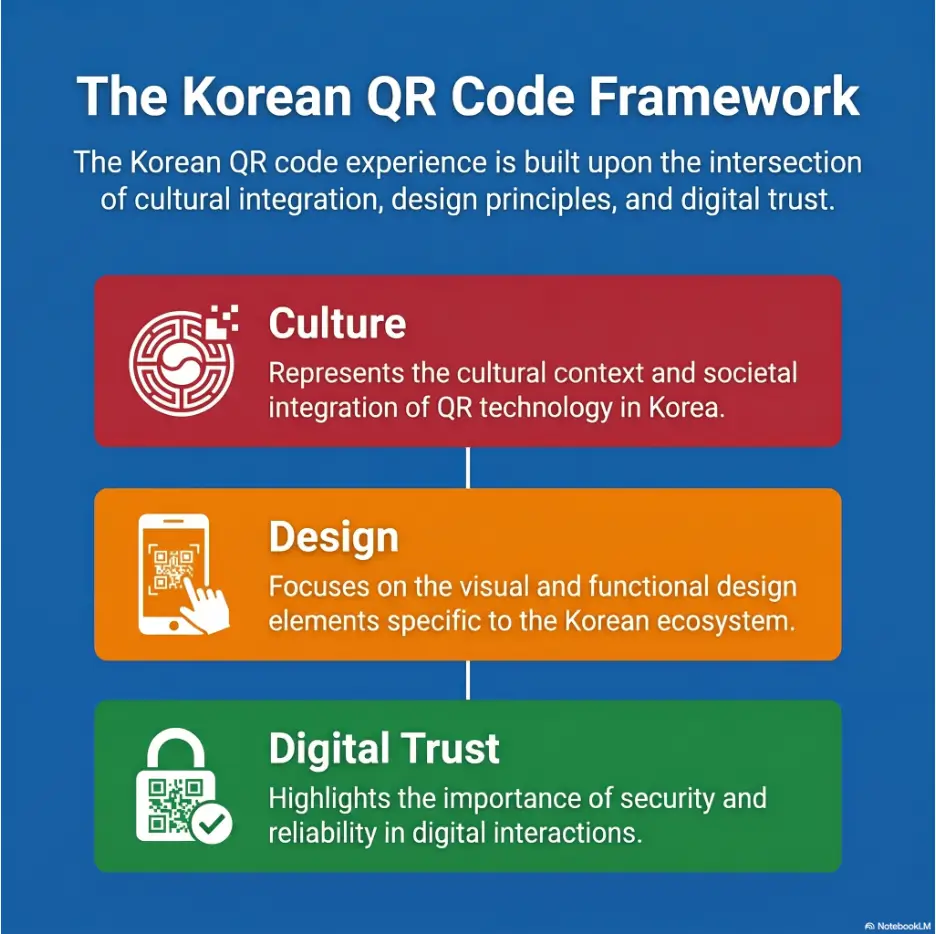
QR Codes Feel Normal in Korea, Not Novel
In many parts of Korea, a QR code is not treated as a novelty, decoration, or desperate restaurant workaround. It is treated as a standard action point, almost like tapping a transit card or pressing an elevator button.
That difference matters. A person who has scanned QR codes hundreds of times in familiar places has a lower emotional barrier than someone who sees one taped to a parking meter, wonders where it goes, and remembers reading about phishing scams over breakfast.
QR codes became part of everyday friction removal
Korean QR use makes more sense when you see it as part of a broader habit: remove small delays before they become social friction. Ordering food, joining a waitlist, entering an event, checking product details, using loyalty points, and paying at certain businesses can all become faster when the scan is placed at the right moment.
In a crowded café, the appeal is obvious. Nobody wants a long line of people squinting at a paper menu while the espresso machine hisses like an impatient cat. A good QR journey can move the decision-making away from the counter and onto the phone.
Dense cities reward fast, touchless micro-actions
Korean cities often compress many errands into a small physical area. A subway exit, convenience store, clinic, café, pharmacy, bank kiosk, and bus stop can live within a few minutes of one another. In that setting, tiny time savings accumulate.
QR codes fit that rhythm because they are small, cheap to display, and easy to update. A printed sign can become a live reservation page. A poster can become a ticketing screen. A table sticker can become a menu without reprinting twenty laminated pages every time the seasonal drink changes.
The phone is a daily control panel
For many Koreans, the smartphone is not only for messages and photos. It is tightly woven into payments, transport, food delivery, maps, bookings, social identity, customer service, coupons, authentication, and group coordination.
That does not mean every Korean loves every QR code. It means the scan often sits inside a familiar routine. The question is not “Why would I use my phone for this?” but “Is this scan the fastest way to finish the task?”
Key takeaway
Korean QR comfort is not just about technology. It is about where the code appears, how often people have used similar flows, and whether the scan clearly removes a small annoyance.
Korea Was Ready Before the QR Boom
QR codes did not land on a blank table in Korea. They landed on a table already crowded with mobile apps, fast networks, digital payments, public transport tools, and a population used to doing practical life admin through a screen.
That readiness made adoption feel less like a cultural leap and more like adding one more utensil to a place setting that was already digital.
Mobile-first habits came early and stayed sticky
Korean consumers have long been comfortable with mobile-first services. Messaging, delivery, maps, banking, reservations, shopping, authentication, and customer support often happen through apps or mobile web flows.
Once a phone becomes the default tool for small daily decisions, scanning a QR code is not a grand new behavior. It is simply one more route into a familiar phone-based task.
If you are preparing for a Korea trip, this is why guides to Korean phone plans for Americans can be more useful than they first appear. Connectivity is not just about posting photos. It affects how smoothly you order, navigate, reserve, translate, and sometimes even enter a venue.
Apps trained the same behavior before QR codes did
Think of the QR code as the visible tip of a deeper habit. Delivery apps taught people to choose quickly on a small screen. Transit tools taught them to trust live updates. Reservation systems taught them to expect confirmation messages. Mobile payment habits taught them that a phone could complete a transaction in public without drama.
By the time QR codes became more visible, the supporting gestures were already familiar: open, scan, confirm, tap, pay, receive message, move on.
One scan, many expectations
A Korean QR code may carry several expectations at once. The user may expect the page to load quickly, be mobile-friendly, show Korean interface patterns, connect to a known app, and complete a practical action without requiring a long explanation.
This is where many poor QR experiences fail in Western markets. The code works technically, but the landing page feels unfinished, slow, unbranded, or strangely demanding. Trust leaks out through tiny holes: a confusing domain, a surprise account requirement, a bad mobile layout, a request for too much data too soon.
What to notice as a traveler
In Korea, the QR code is often only the front door. The real experience is the mobile page, app connection, payment option, translation friction, and whether you can complete the task without help.
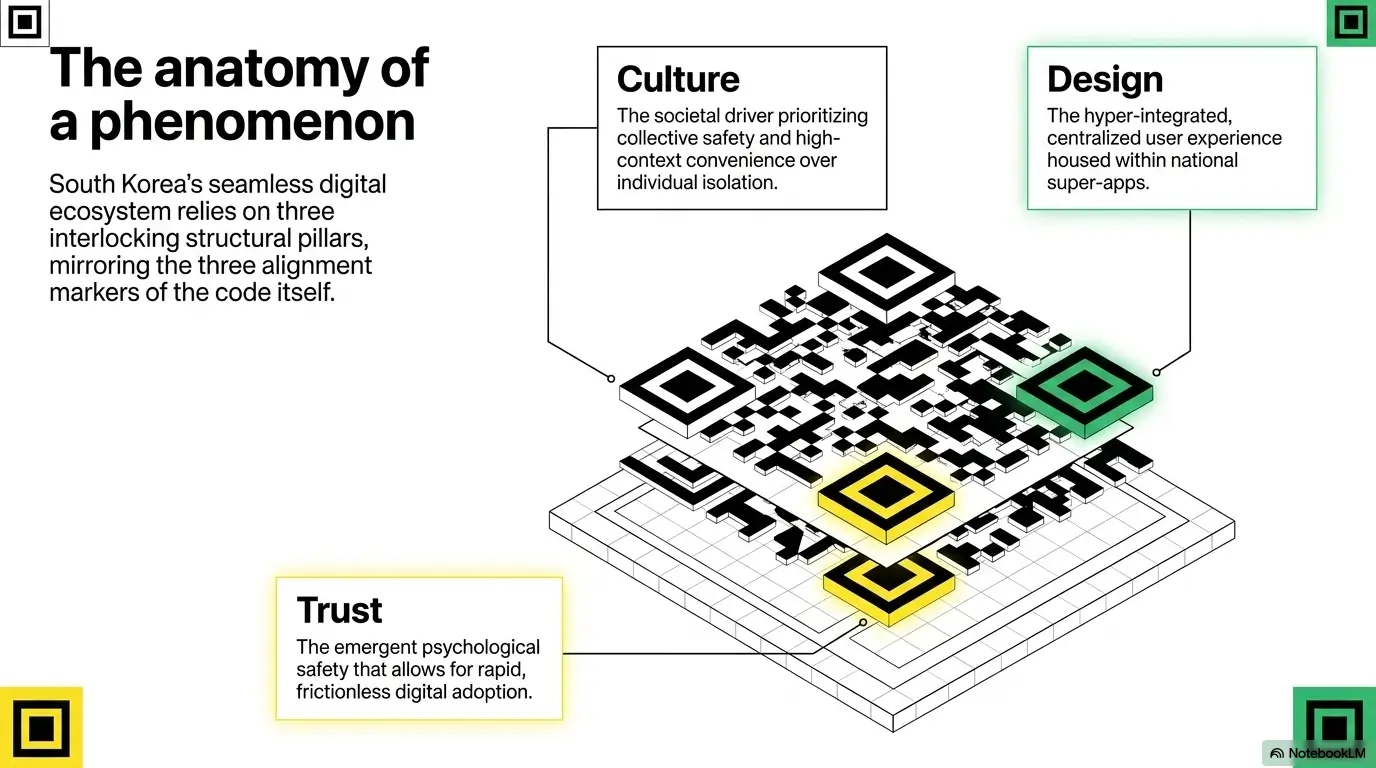
Trust Has a Shape
People do not trust QR codes in the abstract. They trust situations. A QR code on a polished café table, inside a bank branch, or on an official event banner feels different from a crooked sticker slapped over a parking sign at midnight.
In Korea, repeated exposure in trusted places gives the square a kind of borrowed credibility. The code itself is not trusted. The setting lends it a jacket and tells it to behave.
Familiar screens reduce emotional resistance
Trust increases when the scan leads to something visually and behaviorally familiar. A known payment interface, a recognizable brand page, or a common reservation flow reduces the user’s mental workload.
Western hesitation often rises when every QR code feels like a different little gamble. One leads to a PDF menu. One leads to a slow third-party ordering platform. One demands an app. One opens a suspicious shortened URL. The user starts to wonder whether the square is a door, a toll booth, or a trapdoor.
Brand context matters more than the square
A QR code on a government office notice, a hospital check-in desk, a branded restaurant menu, or an official event display benefits from its surroundings. The user can connect the scan to a physical place and a visible responsible party.
This is why design teams should stop treating QR placement as an afterthought. A code should not look like a stray sticker abandoned by a printer. It should appear with a clear label, destination preview, brand identity, and fallback option.
Trust is borrowed from the place
Here is what no one tells you: QR trust is often rented from the room. If the room feels official, maintained, and accountable, the scan feels safer. If the environment feels chaotic, temporary, or anonymous, the same code becomes suspicious.
That is why a tourist may scan a café menu in Seoul without much concern, then hesitate at an outdoor poster near a nightlife district. Same technology. Different trust scent.
Short rule
Before judging the QR code, judge the setting: who placed it, why it belongs there, whether it is branded, and whether the destination matches the task.
Western Hesitation Is Not Irrational
It is tempting to explain the gap by saying Korea is more tech-friendly and Western users are slower to adapt. That is too neat, and too smug. Western skepticism has real roots.
In the United States and parts of Europe, QR codes became highly visible during the pandemic, especially in restaurants. For some people, that first mass exposure was tied to inconvenience: tiny menus, poor Wi-Fi, forced downloads, awkward ordering flows, and privacy concerns. Not exactly a velvet entrance.
QR scams made people suspicious for good reason
QR codes can hide the destination until after the scan. That creates a natural security problem. A malicious code can send people to fake payment pages, phishing forms, malware prompts, or cloned login screens.
This does not mean QR codes are inherently unsafe. It means the user needs context and the business needs responsible design. A safe QR journey should not ask people to trust a mystery square with their payment details, login, or identity without clear signals.
Fragmented app ecosystems create tiny doubts
In Korea, many daily flows are concentrated around a familiar set of major platforms and mobile behaviors. In Western markets, QR experiences are often more fragmented. One restaurant uses one ordering system. The parking lot uses another. The event venue uses a separate ticketing app. A small shop uses a random form builder.
Each new platform asks the user to make another trust decision. Is this the right domain? Do I need an account? Will I get spammed? Why does the menu need my phone number? The doubts are small, but they multiply like crumbs in a laptop keyboard.
Privacy culture changes the emotional temperature
Western users may also carry different privacy expectations. Some are comfortable using contactless tools but object to unnecessary data collection. Others dislike being pushed into an app to perform what feels like a simple task.
That privacy reaction is not always about the QR code itself. It is about what happens after the scan: tracking, account creation, email capture, location requests, or unclear data use. A QR code can feel efficient until the landing page behaves like a clipboard with teeth.
Pandemic Check-Ins Left Muscle Memory
The pandemic did not invent Korean QR comfort, but it intensified it. Check-in systems made scanning socially ordinary in many public settings. The gesture became part of the choreography of entering restaurants, cafés, gyms, venues, and other shared spaces.
Some habits faded when rules changed. Others remained because people had already learned that QR codes could solve adjacent problems: ordering, waiting, paying, verifying, reserving, and finding information.
Mandatory check-ins made scanning socially ordinary
When a behavior becomes part of public routine, it loses some awkwardness. People learn where to stand, what screen to open, how long it takes, and what result to expect. The scan becomes a social gesture, not a technical puzzle.
That matters because much of technology adoption is not about whether people can use a tool. It is about whether they feel foolish using it in public. Repetition removes that sting.
Restaurants, cafés, gyms, and events normalized the gesture
Once QR codes appeared across many everyday venues, users stopped treating each scan as a special instruction. It became part of the expected entrance ritual, especially for younger and middle-aged smartphone users.
Travelers see the remaining effects today. A QR code in Korea may be used for a queue system, menu, ordering page, event registration, review prompt, membership benefit, or product page. The common thread is not the code. It is the assumption that a small phone action can move the whole interaction forward.
The habit survived because it solved other problems
Temporary habits rarely survive unless they become useful after the emergency. QR scanning remained common because it was not only a public health tool. It was also a low-cost interface between the physical world and a mobile service.
For businesses, this is the lesson worth taking seriously: emergency adoption can introduce a behavior, but everyday usefulness keeps it alive.
The Convenience Trap
Convenience is seductive. It wears clean shoes and says it will only take a second. But QR-first design can become rude when it forgets older users, tourists, low-battery phones, poor eyesight, dead zones, accessibility needs, or people who simply do not want to create another account to order soup.
Korea’s QR comfort does not mean every QR experience is good. A fast system can still exclude people quietly.
Faster does not always mean better
A QR code is helpful when it reduces effort. It becomes annoying when it moves work from the business to the customer without improving the result.
For example, a QR menu that loads instantly, displays prices clearly, supports translation, and lets customers order at their pace can feel elegant. A QR menu that opens a slow PDF, hides prices, forces sign-up, and breaks on smaller screens feels like a punishment with a square hat.
QR-first design can exclude real humans
Older users may have trouble focusing on small screens. Tourists may lack a local phone number. A visitor may have low battery. Someone may have limited data, accessibility needs, or a security policy that prevents scanning unknown codes on a work phone.
A humane QR system respects these realities. It offers a visible fallback, such as a printed menu, staff assistance, manual URL, kiosk, or simple payment option. The fallback should not feel like a walk of shame.
Nobody wants another app at the door
The fastest way to poison a QR experience is to make the scan lead to an app download before the user receives any value. Sometimes an app is necessary, but often it is not.
If the task is simple, keep it in the mobile browser. Let the user see the menu, schedule, ticket, payment page, or instructions first. Ask for deeper commitment only when the benefit is obvious.
| QR Experience | What the user feels | Better design choice |
|---|---|---|
| Scan opens a fast branded page | “Good, this belongs here.” | Use a clear domain, logo, and task label. |
| Scan opens an app download immediately | “Why are you making this my job?” | Offer mobile web first when possible. |
| Scan leads to a long form | “What are you collecting?” | Ask only for data needed for the task. |
| Scan has no fallback | “I am trapped if my phone fails.” | Provide staff help, printed info, or manual URL. |
Common Mistakes When Comparing QR Habits
Culture comparisons are useful until they turn into cardboard. Korea is not a single digital personality. The West is not one suspicious uncle glaring at a menu sticker. The interesting part is the pattern, not the stereotype.
Mistake: Calling it a simple East vs West gap
The difference is partly cultural, but it is also infrastructural, commercial, and design-driven. A Korean user who trusts a QR code at a major café may still avoid a suspicious link in a random message. An American user who dislikes QR menus may happily scan a boarding pass, event ticket, or payment code in a trusted app.
The better question is not “Which culture likes QR codes?” It is “Which settings make the scan feel useful, expected, and safe?”
Mistake: Ignoring infrastructure and blaming attitude
If mobile pages load quickly, payment systems are familiar, and users already solve errands by phone, QR codes feel natural. If Wi-Fi is weak, landing pages are poor, and payment options vary wildly, hesitation grows.
Adoption is rarely just a mindset. It is what happens when repeated success teaches the body that a gesture is worth making.
Mistake: Treating all QR codes as equally trustworthy
A QR code on a printed receipt, inside a known app, or on an official counter sign is not the same as one on a damaged sticker in a public place. The code may look identical, but the risk context is different.
Train yourself to read the surroundings before reading the square. A little suspicion is not rude. It is modern hygiene.
Mistake: Forgetting that design quality changes trust
Design can make a QR code feel safe or suspicious. Clear labels, visible branding, destination previews, staff awareness, accessible alternatives, and clean landing pages all make the scan easier to accept.
Bad design creates fear even when the code is legitimate. A confusing scan flow wastes the trust the physical business already earned.
Show me the nerdy details
QR adoption works through a chain of small trust events. The user notices the code, judges the physical context, scans, checks the destination, waits for the page, evaluates the interface, decides whether the requested action is reasonable, and only then completes the task.
Each step can either add trust or subtract it. Korea’s advantage is not merely that people scan more. It is that many scans occur inside repeated, socially familiar, mobile-ready flows where fewer steps feel surprising.
What Businesses Can Learn Without Copying Korea
Businesses outside Korea should not copy Korean QR habits blindly. A design pattern that works in Seoul may fail in Seattle, London, Manchester, Toronto, or Sydney if the audience, infrastructure, and privacy expectations are different.
The useful lesson is not “add more QR codes.” The useful lesson is “make the scan worth trusting.”
Put QR codes where intent already exists
A QR code works best when the user already wants the next step. At a restaurant table, they want the menu. At a museum label, they may want audio or translation. At a clinic desk, they may need check-in. At a product shelf, they may want specs, reviews, or warranty details.
Do not make people scan just to discover what the scan is for. Label the action clearly: “View menu,” “Join waitlist,” “Check in,” “See English guide,” “Pay parking,” or “Download receipt.”
Show the destination before asking for the scan
Trust rises when users can predict the destination. A short visible URL, brand name, or plain-language description reduces uncertainty. For high-risk actions such as payment or account login, this becomes even more important.
A good QR label answers four questions quickly: who owns this, what happens after I scan, what data is needed, and what can I do if scanning does not work?
Offer a non-QR fallback without shaming the user
A fallback is not a failure. It is a trust feature. Printed menus, staff help, a manual URL, a kiosk, or a simple phone number can make QR adoption more inclusive.
This is especially important for businesses serving older adults, tourists, families, people with disabilities, or customers who may be using foreign SIM cards. You can read more about everyday tourist friction in Korea in guides such as the Korean convenience store guide, where small systems often matter more than the big cultural headline.
Make the scan feel like a doorway, not a trapdoor
The user should feel in control after scanning. Avoid surprise app downloads, hidden fees, forced marketing opt-ins, unclear permissions, and confusing payment jumps.
A QR code should shorten the path. If it creates five new decisions, it is not convenience. It is bureaucracy in a tiny black-and-white costume.
| Setup level | Best for | What it includes | Watch out for |
|---|---|---|---|
| Good | Small cafés, pop-ups, basic event pages | Clear label, branded mobile page, simple fallback | Do not send users to a generic unbranded form. |
| Better | Restaurants, clinics, museums, service counters | Fast mobile page, language options, destination preview, staff training | Keep data requests minimal. |
| Best | High-volume businesses, travel hubs, ticketed venues | Accessible design, secure domains, analytics, support flow, non-QR alternatives | Test with cautious users, not only power users. |
QR Trust Framework
1. Context
Does the code clearly belong in this place?
2. Clarity
Does the label say what happens after scanning?
3. Control
Can the user review the URL and avoid unnecessary data sharing?
4. Fallback
Is there a respectful non-QR option?
Privacy, Scams, and the Line Between Helpful and Creepy
A QR code becomes uncomfortable when it asks for more trust than the moment deserves. That line can be thin. A scan for a menu feels ordinary. A scan for a menu that demands your full name, birth date, email, phone number, and location starts to feel like being interviewed by a vending machine.
Good QR design respects the task. It does not turn every customer interaction into a data harvest.
Explain what data is collected and why
If the QR journey collects data, explain the purpose in plain English. A restaurant reservation may reasonably need a name and phone number. A static menu usually does not.
The more sensitive the action, the clearer the explanation should be. Payments, medical intake, government services, school systems, and workplace tools all need stronger trust signals than a casual promotional landing page.
Avoid dark patterns after the scan
A scan should not trick users into subscriptions, marketing consent, hidden fees, or unnecessary app permissions. These tactics may increase short-term conversions, but they damage long-term trust.
Western QR hesitation often grows from exactly these experiences. People remember being forced into clunky flows and start treating future codes as guilty until proven useful.
Use trusted domains, visible branding, and clear landing pages
The landing page should confirm that the user arrived in the right place. Use a recognizable domain, consistent logo, clear title, readable text, and a task-focused layout.
If you use a third-party platform, make the connection visible. For example, say that ordering, payment, or booking is handled by a named provider. Mystery is expensive. It costs trust first, then conversions.
Do not make QR codes carry more trust than they deserve
A QR code can start a journey, but it should not be the only evidence that the journey is safe. Businesses should support it with signage, staff awareness, secure domains, clear privacy language, and practical alternatives.
For users, the same rule applies in reverse. A QR code is not automatically dangerous, but it is not automatically trustworthy either. Let the setting, destination, and requested action decide.
| Situation | Risk level | Safer behavior |
|---|---|---|
| QR code on a branded café table for a menu | Low to moderate | Check the URL preview, then continue if it matches the business. |
| QR code on an official museum sign | Low to moderate | Look for branding and use for guides, audio, or ticket info. |
| QR sticker placed over another sticker | Higher | Avoid scanning or ask staff for the correct link. |
| QR code in a random email or text asking for payment | Higher | Do not scan from the message. Go directly to the official site or app. |
| QR code asking for login details unexpectedly | Higher | Stop and verify the domain through another trusted route. |
Before you act
This article is cultural and practical guidance, not cybersecurity, legal, or privacy advice for a specific business system. If a QR flow handles payments, medical information, school data, government services, or customer records, compare options carefully and confirm security, privacy, and compliance expectations with qualified professionals.
FAQ
Why do Koreans use QR codes so often?
Koreans often use QR codes because they fit into a wider mobile-first routine. Fast connectivity, dense cities, digital payments, delivery apps, reservations, event systems, and pandemic-era check-ins all helped make scanning feel ordinary.
Are QR codes more trusted in Korea than in the US?
Often, yes, but not blindly. QR codes in Korea may feel more trusted because they frequently appear in familiar, branded, and task-specific settings. Trust still depends on context, destination, and whether the requested action makes sense.
Why do many Americans still hesitate to scan QR codes?
Many Americans hesitate because QR experiences have been inconsistent. Some lead to slow menus, forced app downloads, unclear domains, phishing risks, or unnecessary data requests. The hesitation is often a rational response to poor design and security uncertainty.
Are QR codes safe to use when traveling in Korea?
Many QR codes in Korea are routine and useful, especially in clearly branded places such as cafés, museums, clinics, and events. Still, check the physical context, avoid damaged or suspicious stickers, preview the URL, and be cautious if a scan asks for payment or login details unexpectedly.
Why did QR codes become common in Korean restaurants and cafés?
They help reduce small delays. A QR menu or ordering page can move customers away from the counter, update items quickly, support busy service, and connect to payment, waitlist, or promotion systems.
Do older Koreans use QR codes comfortably too?
Some older Koreans use QR codes comfortably, while others may struggle with small screens, app steps, eyesight, or unfamiliar interfaces. Good QR design should always include a respectful fallback, especially in hospitals, public offices, transit settings, and restaurants.
What should US businesses learn from Korea’s QR code adoption?
US businesses should learn that QR codes work best when they are placed where users already have intent, clearly labeled, branded, fast, mobile-friendly, and supported by non-QR alternatives. Copying the scan without copying the trust system is the expensive mistake.
How can I tell if a QR code is suspicious?
Be careful if the code is on a random sticker, covers another code, appears in an unexpected message, uses a strange URL, asks for sensitive data too soon, or pushes urgent payment. When in doubt, go directly to the official website or ask staff.
Scan Like a Local, Think Like a Security Editor
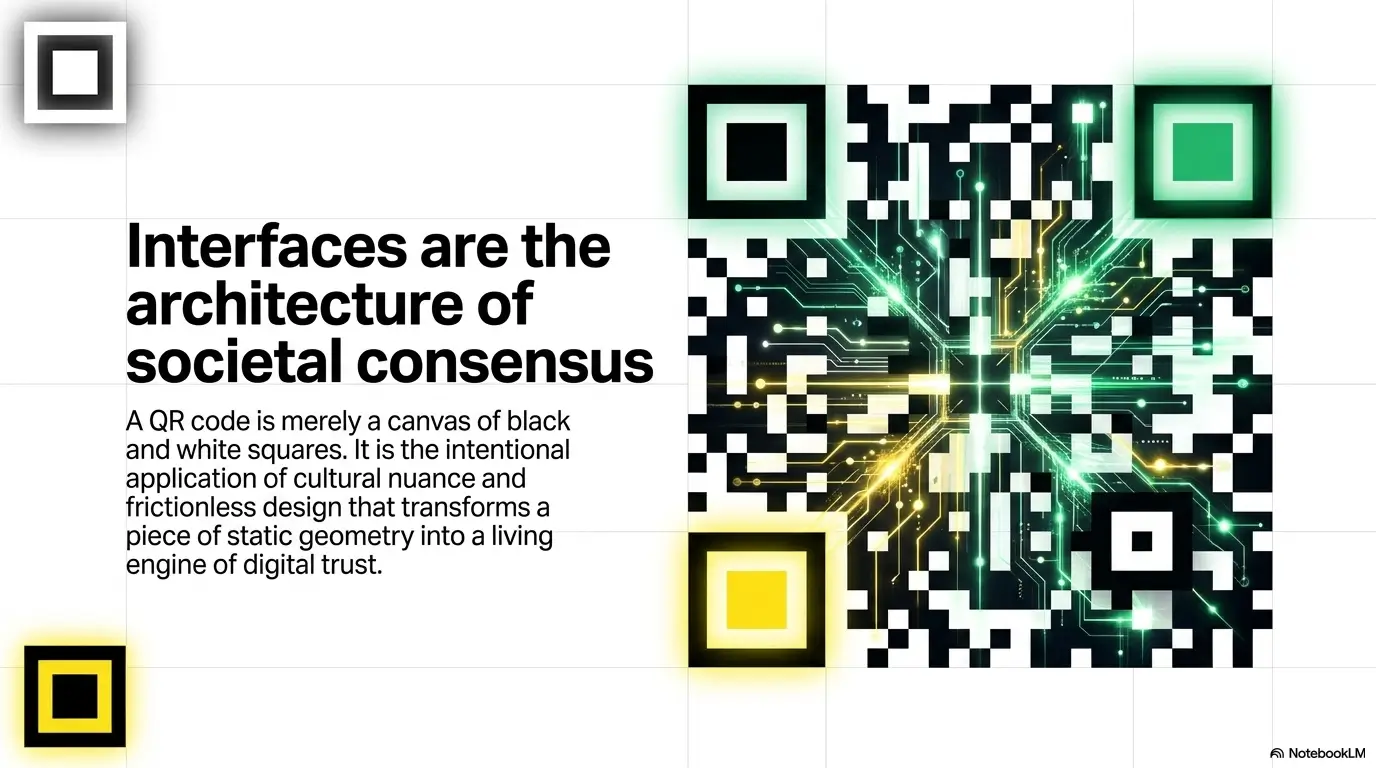
The quiet lesson of Korean QR comfort is not that everyone should scan everything. It is that trust is built through repetition, context, good design, and visible usefulness. Korea made the gesture feel normal because the surrounding systems often made it worth doing.
For travelers, the goal is not paranoia. It is graceful caution. Scan the café menu, join the waitlist, open the museum guide, and use the tools that make the day smoother. But keep one small habit: pause long enough to check whether the code belongs where it is.
Your 15-minute QR safety and design check
Within the next 15 minutes, pick one QR code near you or one used by your business, school, event, or website. Do not just scan it. Audit the whole journey.
- Check whether the physical placement makes sense.
- Look for a clear label that says what the scan does.
- Preview the URL before opening the page.
- Confirm the landing page is branded and mobile-friendly.
- Notice whether it asks for more data than the task requires.
- Find the fallback for someone without a working phone.
If it passes those checks, the QR code is probably doing what a good QR code should do: acting as a doorway, not a dare. And that, more than the little square itself, is what Korea’s QR habits can teach the rest of us.
Last reviewed: 2026-06