

Korean Society, Housing, Marriage, and the Future
Why So Many Korean Youth Conversations About the Future
Circle Back to Housing and Marriage
In South Korea, the future is rarely discussed as a clean calendar of personal dreams. It often arrives with a floor plan, a rent deposit, a job title, a wedding budget, and the quiet arithmetic of whether adulthood can be made to stand upright. Ask young Koreans about careers, dating, moving out, children, or staying in Seoul, and the conversation often returns to the same table: housing and marriage.
For US and UK readers, this can look puzzling at first. Isn’t marriage a personal choice? Isn’t housing a market issue? In Korea, those two questions braid together. A home is not only shelter. It can be a signal of stability, a negotiation with family expectations, a gatekeeper for starting a household, and sometimes the difference between “someday” and “not yet.”
This guide explains the social logic without reducing young Koreans to gloomy statistics. We will look at housing costs, work pressure, family formation, changing values, and the mistakes foreign observers often make when reading Korea’s demographic story from too far away.
Understand the Link
See why housing, marriage, work, and family planning often become one conversation.
Avoid Lazy Takes
Move beyond “young people just don’t want kids” or “it is only about money.”
Compare More Wisely
Use a practical framework for comparing Korea with Japan, the US, and other countries.
The real question is not only “Will young Koreans marry?” It is “What kind of future feels financially and emotionally survivable?” 🏙️
Snapshot
This article is for readers trying to understand Korean society beyond headlines about low birth rates. It explains why housing affordability and marriage are often discussed together, what foreign observers often miss, and how to compare Korea’s future-planning pressures with other advanced economies.
Table of Contents
Before You Read This as a Personal Finance Story
This article is an explanatory guide to Korean society, not personal financial, legal, immigration, or relationship advice. Housing systems, marriage norms, public benefits, taxes, visa rules, and family expectations can vary by city, income level, citizenship, job type, household structure, and year.
If you are making a real decision about renting, buying, marrying, moving to Korea, supporting a partner, or planning a family, confirm details with qualified professionals and official sources. Social patterns can explain pressure. They cannot replace a contract review, budget check, legal consultation, or honest conversation with the people involved.
Key takeaway
Use this article as a map of the social forces around Korean youth decisions. Do not use it as a calculator for anyone’s personal marriage, housing, or family plan.
Who This Is For
This is for readers who want context beyond “South Korea has a low birth rate.” It is especially useful for students, journalists, expats, cultural observers, policy-curious readers, and people trying to understand why ordinary conversations about Korean youth often return to apartments, deposits, jobs, weddings, and babies.
It is also for readers who have Korean friends, partners, colleagues, or family members and want to hear the music behind the words. Sometimes when a young person says, “Housing is too expensive,” they are not only talking about square footage. They may be talking about dignity, timing, parental expectation, risk, and the invisible cost of becoming an adult.
What This Article Will Not Do
This article will not argue that marriage is good or bad. It will not treat Korean young adults as one identical crowd marching under one slogan. It will not claim that every person wants the same future or that every delay is a tragedy.
Instead, it will show why housing and marriage remain powerful social reference points, even for people who are unsure whether they want a traditional path.
Two Topics, One Life Plan: Why Housing and Marriage Travel Together
In many countries, housing and marriage influence each other. In Korea, the connection can feel especially tight because household formation has long been tied to family approval, urban concentration, educational ambition, job security, and the social meaning of “settling down.”
A young adult may begin with a simple question: “Can I afford to live independently?” Very quickly, that question may become: “Can I live near work?” Then: “Can I save enough for a rental deposit?” Then: “Would I be considered ready to marry?” Then: “Could we raise a child in this area?” The staircase is steep, and each step is labeled with a cost.
Homeownership Became a Symbol of Adult Stability
For many Korean families, a home has not only been a place to sleep. It has also been a long-term asset, a protection against uncertainty, and a visible sign that a household has reached a certain level of stability.
This does not mean every Korean person worships homeownership. It means the housing question carries more than market logic. It can shape how parents evaluate a marriage plan, how couples discuss timing, and how young adults judge whether they are “ready enough” to start a household.
Marriage Is Often an Economic Decision Too
Marriage may begin in affection, but it usually continues into budgets. In Korea, wedding expenses, housing arrangements, family expectations, and future child-rearing costs can enter the conversation early. Romance may bring two people together, but spreadsheets quietly pull up a chair.
For some couples, the question is not “Do we love each other enough?” It is “Can we create a stable household without drowning in financial pressure?” That distinction matters. Delayed marriage does not always mean emotional disinterest. Sometimes it means caution.
Household Formation Is the Hidden Link
Housing and marriage meet at household formation. A household needs space, money, location, and some sense of durability. When all four become expensive or uncertain, marriage starts to feel less like a ceremony and more like a major project launch with family shareholders.
This is why a conversation about dating can become a conversation about apartments. It is not a random detour. It is the road underneath.
| Conversation Topic | What It Often Sounds Like | The Deeper Question |
|---|---|---|
| Dating | “Are you thinking seriously?” | Could this become a stable household? |
| Housing | “Can you get a decent place?” | Can you afford independence and family formation? |
| Career | “Is the job stable?” | Can income support long-term commitments? |
| Children | “When would you have one?” | Can you handle housing, care, education, and time? |
The Price Tag Problem: When Housing Costs Shape Life Timelines
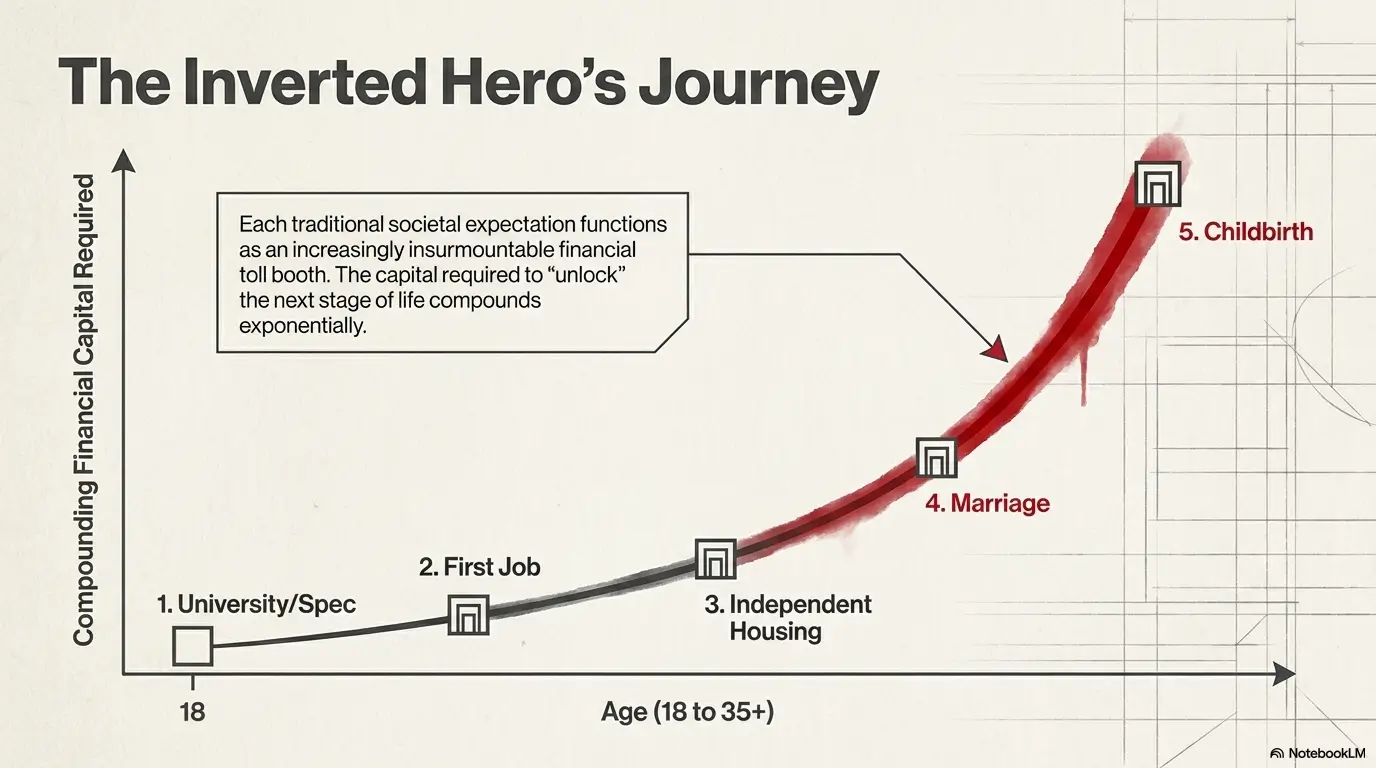
Housing affordability is not just a lifestyle issue. It changes the sequence of life. When rent, deposits, mortgage expectations, and desirable school districts become difficult to reach, people do not simply “spend less.” They often delay moving out, delay marriage, delay children, or change what kind of future feels realistic.
For a young professional in Seoul or the surrounding metro area, the housing question can be unusually heavy because opportunity is concentrated. The better job, the bigger network, the dating pool, the graduate program, the private academy, the hospital, the cultural life: many paths point toward the same crowded urban map.
Rising Costs Turn Milestones Into Negotiations
When housing is expensive, milestones stop being purely personal. Moving out can require family help. Marriage can require a deposit strategy. Childbirth can require a bigger home, childcare plan, and sometimes a move closer to grandparents or better schools.
The effect is psychological as well as financial. A person may technically be employed, dating, and hopeful, yet still feel suspended. The future exists, but the door has a keypad and the code keeps changing.
Deposits, Rent, and the Weight of Upfront Money
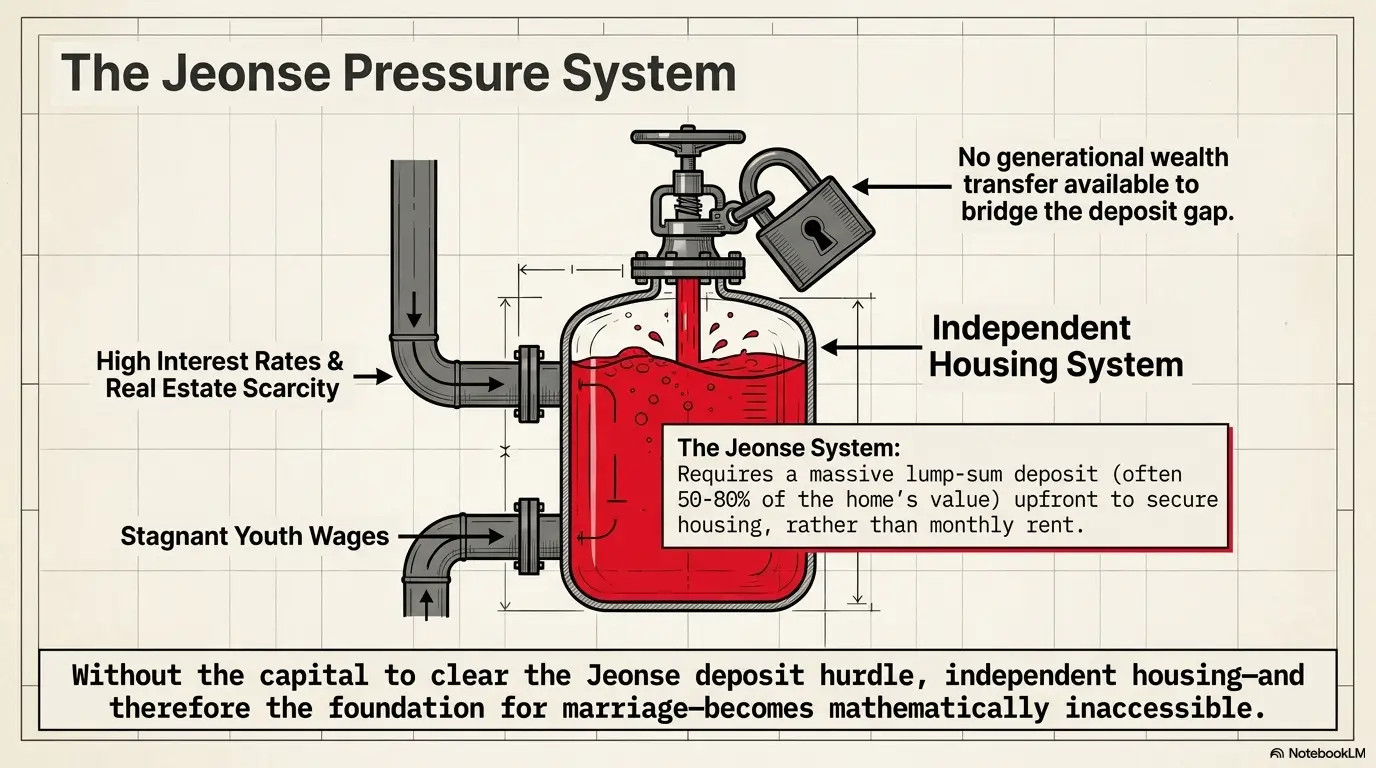
Korea’s rental system has features that may surprise foreign readers, including large deposits in many housing arrangements. Even when monthly rent is manageable, the upfront money can be a wall. For young adults without family support, that wall may delay independence.
This is one reason housing conversations can become so emotionally charged. A person may be working hard and still not have the lump sum needed to enter the next stage of life.
Practical comparison: free context vs paid help
| Need | Free DIY Approach | When Paid Help May Be Worth Considering |
|---|---|---|
| Understanding Korean housing terms | Read official guides, expat explainers, and rental vocabulary lists. | Use a licensed agent, translator, or legal reviewer before signing a contract. |
| Comparing neighborhoods | Check commute, transit, noise, schools, and daily costs. | Get local help if you cannot inspect in person or do not read Korean well. |
| Major life decisions | Build a household budget and discuss expectations early. | Consider professional advice for cross-border marriage, visas, property, or tax issues. |
Why Financial Readiness Becomes a Prerequisite
In a softer housing market, a couple might marry first and build gradually. In a high-pressure housing market, the order can reverse. People may feel they must secure the income, the deposit, the apartment, and the parental confidence before taking the next step.
That turns marriage into a threshold. Not everyone wants to cross it at the same time. Not everyone can.
The Question Beneath the Question Nobody Is Asking Out Loud
When Korean young adults talk about delaying marriage, the surface question is often about values. Do they still believe in marriage? Do they want children? Are they too individualistic? Are they tired of traditional gender roles?
Those questions matter. But beneath them is another one: are young adults delaying marriage itself, or delaying financial risk?
Delay Does Not Always Mean Rejection
Some people genuinely do not want marriage. Some are undecided. Some want partnership but not the traditional package attached to it. Others still want marriage and children but feel they cannot start under current conditions.
Foreign observers often miss this distinction. “Not now” can sound like “never” when viewed through a headline. In real life, the two are different rooms.
Security Versus Independence
Korean youth conversations often contain a tension between security and independence. Staying with parents may help someone save money, but it can limit privacy. Moving out may feel freeing, but it can slow savings. Marriage may provide partnership, but it can also add expectations from both families.
There is no clean answer. The choice is often between different kinds of pressure.
Decision lens: what is the real concern?
- Money: Can I afford rent, a deposit, wedding costs, or childcare?
- Time: Can I work, commute, care for a child, and still breathe?
- Family: Will parents support, pressure, or judge this decision?
- Location: Must I stay near Seoul, work, schools, or relatives?
- Identity: Does this path match the life I actually want?
Future Planning as Everyday Emotional Labor
Planning the future is not only technical. It is emotional labor. It means absorbing uncertainty, comparing yourself with peers, reading policy news, watching housing prices, listening to parents, and trying not to turn every dinner conversation into a referendum on your life.
That is why housing and marriage keep returning. They are not random topics. They are containers for anxiety, hope, and social measurement.
Career First, Family Later? The Trade-Off That Keeps Expanding
Korea’s education and employment systems have long rewarded preparation, credentials, and persistence. Many young adults spend years moving through exams, internships, job searches, probation periods, and career-building stages before they feel stable.
By the time someone reaches professional footing, marriage and family planning may already feel delayed. The clock is not only biological. It is institutional.
Education and Competition Stretch the Runway
Education can open doors, but it can also lengthen the runway before adult life feels financially secure. Graduate school, certification exams, language study, and job preparation can postpone stable income.
For students and early-career workers, this creates a painful rhythm: prepare longer, earn later, save under pressure, then wonder why marriage feels far away.
Stable Employment Still Carries Heavy Weight
Stable employment matters in most societies. In Korea, it can carry extra weight because family formation may be judged through the lens of job security. A stable job can influence rental options, parental approval, loan confidence, and social perception.
This is not only a conservative habit. It is also a rational response to expensive commitments. If the cost of failure is high, people look for stronger proof before they leap.
The Opportunity Cost of Early Family Formation
Starting a family early may mean less time for career advancement, fewer savings, more childcare pressure, and a harder path back into the labor market after caregiving. For women especially, traditional expectations can make the trade-off sharper.
This is why some young adults do not view marriage as the start of stability. They view stability as the prerequisite for marriage.
| Life Path | Short-Term Advantage | Possible Hidden Cost | Question to Ask |
|---|---|---|---|
| Focus on career first | More income growth and savings time | Delayed marriage or children | What stability target is enough? |
| Marry earlier | Earlier household formation | Higher pressure if housing is unstable | What support system exists? |
| Move out alone | Independence and privacy | Reduced savings speed | Is the rent worth the trade-off? |
| Live with parents longer | More saving potential | Less autonomy and dating privacy | What boundaries are needed? |
Common Mistakes Foreign Observers Make When Interpreting Korean Youth Attitudes
When English-language coverage discusses Korea’s demographic issues, it often jumps straight to dramatic phrases. Crisis. Collapse. World’s lowest fertility. Vanishing schools. These phrases may point to real concerns, but they can flatten the human story.
Good analysis needs a steadier hand. The goal is not to soften the problem. It is to see it clearly.
Mistake #1: Assuming Young People Simply Reject Marriage
Some young Koreans reject marriage. Others reject the old conditions attached to marriage. Others want marriage but not at the cost of permanent exhaustion. These are different positions.
A better question is not “Why don’t young people want marriage?” It is “What would make marriage feel fair, affordable, and compatible with a full life?”
Mistake #2: Treating Housing as a Separate Issue
Housing is not separate from marriage, fertility, work, gender roles, or regional decline. It is the stage on which those issues perform.
A couple that cannot find affordable housing near work may delay marriage. Parents worried about housing may pressure or subsidize their adult children. A city with high housing costs may see young families move out, while rural areas lose youth altogether.
Mistake #3: Ignoring Regional and Class Differences
Korea is not only Seoul, and Korean youth are not one economic category. A young person with parental housing support faces a different future from someone supporting family members or paying rent alone.
Regional differences matter too. A job seeker in Seoul, a civil servant in a smaller city, a freelancer, a factory worker, and a graduate student may all talk about housing and marriage, but their options are not the same.
Mistake #4: Reducing Youth to Pessimism
Public pessimism is real, but it is not the whole story. Many young adults keep planning, dating, saving, applying, negotiating, and adapting. They may joke darkly about the future while still trying to build one.
That complexity deserves attention. A shrug can hide a plan. A complaint can hide a calculation. A delay can hide a hope that has not yet found a safe place to land.
Key takeaway
The most expensive mistake in interpreting Korean youth culture is treating delay as laziness, rejection, or simple pessimism. Often, delay is a risk-management strategy.
Don’t Reduce Everything to Economics
Money matters. Housing matters. But the story becomes too thin if economics explains everything. Korean youth attitudes toward marriage are also shaped by gender expectations, work-life balance, personal freedom, mental health, dating culture, and changing ideas of a good life.
Housing may be the doorway, but values decide whether people still want to enter the same house.
Partnership Expectations Are Changing
Many young adults want partnership to feel emotionally fair, not only socially approved. They may expect shared housework, mutual respect, financial transparency, and room for both careers.
When marriage appears to demand unequal sacrifice, especially from women, postponement may reflect self-protection rather than indifference.
Individualism Is Not Always Selfishness
Wanting privacy, personal growth, travel, creative work, or rest is not automatically anti-family. It can be a response to a system that made adulthood feel crowded with obligation.
Some young Koreans are not rejecting care. They are questioning whether care must always follow one inherited script.
The Old Success Map No Longer Fits Everyone
The old map was clear: study hard, get a stable job, marry, buy or secure a home, have children, support the next generation. For some, that path still carries meaning. For others, it feels financially unrealistic or emotionally cramped.
A society can keep the old symbols while losing confidence in the old sequence. That is part of Korea’s present tension.
The Future-Planning Loop
1. Work
Is the job stable enough?
2. Housing
Can I afford a place that works?
3. Family
Will parents approve or need to help?
4. Marriage
Does partnership feel possible now?
5. Children
Can time, money, and care align?
When any stage becomes unstable, the entire loop slows down.
The Feedback Loop Few Policy Discussions Fully Address
Policy discussions often separate problems into neat boxes: housing policy, labor policy, childcare policy, gender equality, regional development, and fertility support. Real life does not keep those boxes tidy.
A housing subsidy may help, but not if stable jobs are scarce. Childcare support may help, but not if work hours remain brutal. Marriage incentives may help some couples, but not if women expect unequal domestic labor after childbirth. A single lever cannot move a piano.
Housing Costs and Family Formation Reinforce Each Other
High housing costs can delay marriage and children. Fewer young households can affect neighborhood life, school enrollment, local businesses, and regional planning. As schools shrink and services concentrate, more young adults may feel drawn toward already expensive urban centers.
This is the feedback loop: people move toward opportunity, opportunity raises costs, costs delay family formation, delayed family formation changes the future of communities.
Urban Concentration Changes the Meaning of Choice
When jobs, elite schools, hospitals, and cultural networks cluster around major cities, “just move somewhere cheaper” becomes less simple. A cheaper apartment in a place with fewer career options may not solve the long-term problem.
This is why Seoul-area housing carries symbolic power. It is not only about location. It is about access to the future people have been trained to chase.
Official data worth checking
For readers comparing Korea’s population, marriage, housing, and fertility trends, official statistical portals are better starting points than social media screenshots or recycled headlines.
Explore KOSIS Official Statistics Read OECD Korea Fertility Analysis
Single-Issue Solutions Often Fall Short
Cash benefits can be helpful. Public housing can be helpful. Workplace flexibility can be helpful. Childcare access can be helpful. But each works best when the others also move.
A young couple does not experience policy as separate departments. They experience it as a Tuesday evening conversation over money, time, parents, commute, and whether the spare room could ever become a child’s room.
Show me the nerdy details
A useful way to analyze Korea’s housing-marriage connection is to separate three layers: affordability, sequencing, and social meaning.
Affordability asks whether young adults can pay for housing, deposits, debt, childcare, commuting, and education. Sequencing asks which milestone must come first: job, home, marriage, or child. Social meaning asks how families and peers interpret those milestones.
When all three layers tighten at once, personal decisions become slower. A household may not form even when the desire exists, because the required proof of readiness keeps rising.
Compare Korea, Japan, and the United States Without Flattening the Story
Comparison is useful, but only if it avoids lazy ranking. Korea, Japan, and the United States all face housing and family pressures, but the social contracts around marriage, childcare, migration, employment, and adulthood differ.
A better comparison does not ask, “Which country has it worse?” It asks, “Which costs, expectations, and institutions shape the decision?” That question produces better analysis and better dinner conversations.
The Three-Country Checklist
If you want to compare Korea with Japan and the United States, use the same categories for each country. Otherwise, you may end up comparing Seoul apartment pressure with US suburban childcare costs and Japanese work culture without realizing you have changed variables midstream.
| Comparison Factor | South Korea | Japan | United States |
|---|---|---|---|
| Housing pressure | Often tied to Seoul-area opportunity, deposits, and family formation | Varies sharply by metro area, work location, and aging regions | Highly local, with major pressure in expensive coastal and job-rich cities |
| Marriage link to childbirth | Births remain strongly linked to marriage norms | Also strongly tied to marriage in many social contexts | More births occur outside marriage compared with Korea and Japan |
| Work-family tension | Career stability, long hours, and gender roles are central concerns | Work culture and caregiving expectations remain important | Childcare cost, paid leave gaps, and healthcare costs often dominate |
| Regional issue | Capital-area concentration shapes opportunity and housing demand | Aging towns and urban concentration both matter | State-by-state differences are large |
Cost Comparison Questions Before You Trust a Hot Take
Before trusting a viral explanation of Korea’s youth future, ask what costs are being included. Is the writer discussing rent, deposits, mortgage debt, childcare, private education, elder support, wedding expenses, commuting, or lost income after childbirth?
Different cost categories produce different conclusions. A narrow explanation may sound confident while quietly leaving out the expensive parts.
- Does the analysis separate Seoul from the rest of Korea?
- Does it distinguish marriage delay from marriage rejection?
- Does it discuss women’s work and domestic labor expectations?
- Does it include housing deposits, not only monthly rent?
- Does it compare Korea with countries that have different family norms?
- Does it use recent official statistics or recycled claims?
Real-world example
Imagine three 31-year-old friends comparing their futures. One lives in Seoul with parents while saving aggressively. One rents a small place near work and saves slowly. One moved to a smaller city for a stable public-sector job but has fewer dating and career options.
All three may say, “Housing makes marriage hard,” but they do not mean the same thing. The first means independence is delayed. The second means savings are fragile. The third means affordability improved, but opportunity narrowed.
This is why class and region matter. The same sentence can carry three different lives inside it.
Related reading on Korean society
For more context on family, housing, and social pressure, read about Korean adults living with parents, Korea’s low birth rate effects, generational conflict in Korea, and Korean family elder care planning.
FAQ
Why is housing such a major concern for young adults in South Korea?
Housing affects independence, commuting, savings, marriage timing, and family planning. In major urban areas, especially around Seoul, housing is also tied to access to jobs, schools, hospitals, and social networks. That makes housing feel like a gateway to adulthood, not just a monthly expense.
How do housing prices influence marriage decisions?
High housing costs can delay marriage because couples may feel they need a stable home, deposit, income, and family approval before starting a household. Even couples who want to marry may postpone if the financial foundation feels too fragile.
Are Korean young people choosing not to marry?
Some are choosing not to marry. Others are delaying marriage, questioning traditional expectations, or waiting for better financial conditions. It is more accurate to see a range of attitudes rather than one simple rejection of marriage.
What role does employment stability play in family planning?
Employment stability influences income, housing access, family approval, and confidence about raising children. In a high-cost environment, unstable work can make marriage and childbirth feel risky, even for people who want both.
Is this issue unique to South Korea?
No. Many advanced economies face delayed marriage, expensive housing, and lower fertility. What makes Korea distinctive is the tight connection among urban concentration, marriage-linked childbirth norms, education pressure, work culture, and family expectations.
How does urban concentration affect housing pressure?
When jobs, schools, hospitals, and cultural networks concentrate in a major metro area, more people compete for housing near opportunity. Moving somewhere cheaper may reduce rent but can also reduce access to work and social mobility.
Have attitudes toward marriage changed in recent decades?
Yes. More young adults question whether marriage is necessary, whether traditional gender roles are fair, and whether family life can coexist with career and personal well-being. But changing attitudes interact with financial pressure rather than replacing it.
What policies are often proposed to address these challenges?
Common proposals include housing support for young households, childcare expansion, parental leave reform, workplace flexibility, regional development, gender-equality measures, and financial support for marriage or childbirth. The strongest approaches usually address several pressures together.
Useful official comparison sources
For cross-country context, compare Korea with other countries using official data portals rather than relying only on commentary.
Your 15-Minute Next Step
The next time you read about Korean youth, housing, marriage, or fertility, do one small exercise before forming an opinion. Draw three columns: housing, work, and family expectations. Under each, write what pressure the article mentions and what pressure it leaves out.
Then add one more row: “Who is missing from this story?” Seoul renters? Regional youth? Women after childbirth? Men facing provider expectations? Couples without parental help? Foreign residents? People who do not want marriage at all?
That 15-minute habit will make your analysis sharper. It will also make it kinder. Behind every demographic trend is someone doing quiet math at a kitchen table, trying to see whether the future can fit inside the room they can afford.
Final practical takeaway
Do not ask only whether Korean young adults want marriage. Ask what level of housing, income, time, fairness, and support would make family formation feel possible rather than precarious.
Last reviewed: 2026-07