
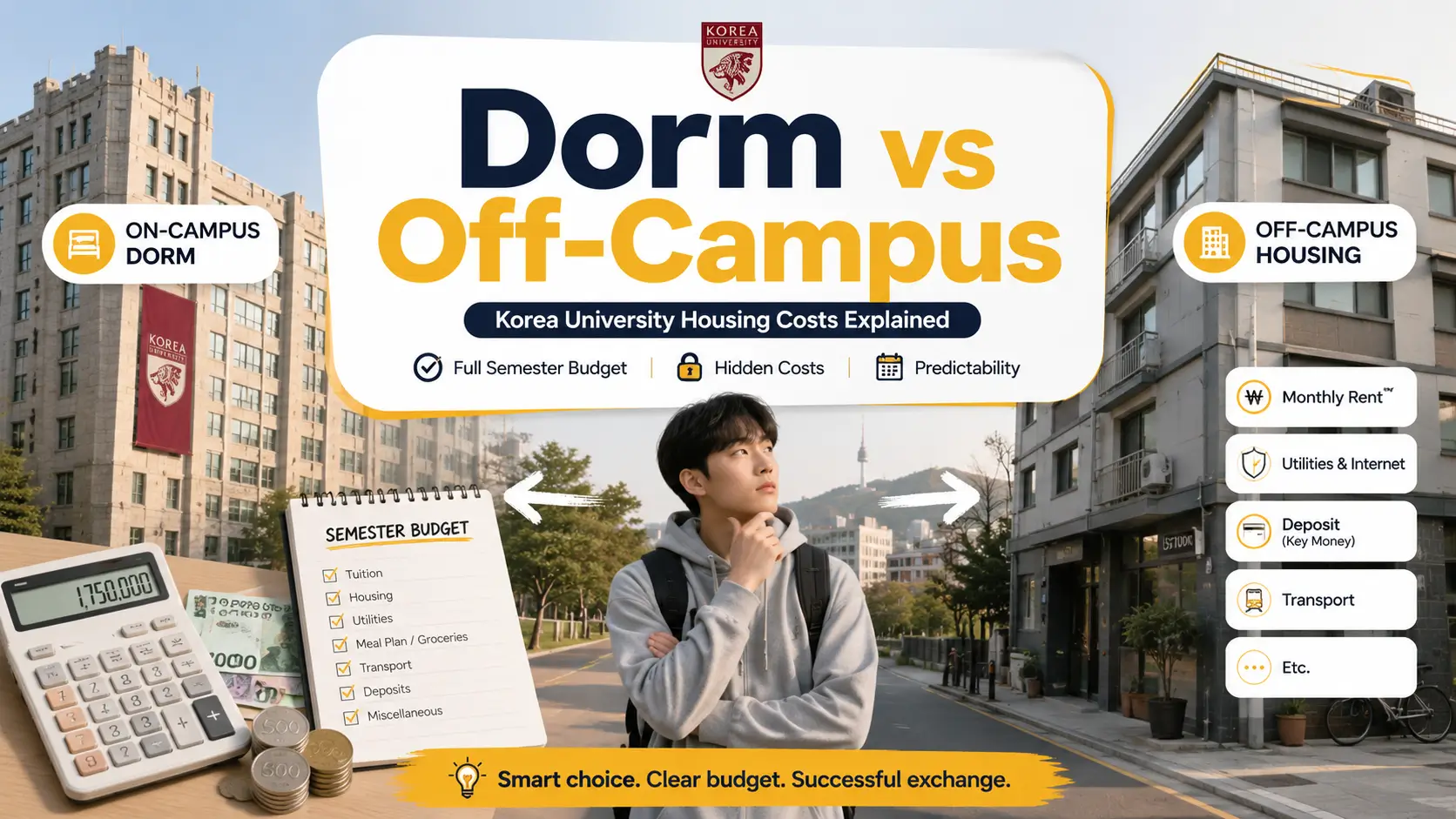
Seoul housing budget guide
Korea University Dorm vs Off-Campus Housing Cost:
The Real Seoul Budget Gap
Choosing housing near Korea University can feel simple until the math starts whispering in Korean won. A dorm fee looks like one clean number. A studio listing looks cheaper by the month. Then deposits, utilities, bedding, lease length, move-out timing, and late-night taxi rides stroll into the room carrying tiny invoices.
For US exchange students and parents, the real question is not just “Which is cheaper?” It is “Which option protects the semester from surprise costs?” A short stay in Seoul rewards predictability. A longer stay may reward independence, but only if you can handle the paperwork and the upfront cash.
This guide compares Korea University dorms, goshiwons, sharehouses, studios, and co-living options with semester-first budgeting. Think of it as a housing flashlight: not glamorous, but very useful when the hallway is unfamiliar and the lease is written in small print.
Compare the full semester
See why monthly rent alone can mislead short-stay students.
Catch hidden costs
Build room for deposits, utilities, bedding, transport, and move-out rules.
Choose with less drama
Use a clear dorm, goshiwon, sharehouse, studio, and co-living decision matrix.
Best rule: choose the option you can afford on your worst week, not your best mood. 🧭
Snapshot
This article is for US exchange students, visiting students, degree students, and parents comparing Korea University dorms with off-campus housing near Anam. You will learn how to compare dorm fees, goshiwon rent, sharehouse costs, studio deposits, utilities, commute trade-offs, and contract risks so you can build a one-page Seoul housing budget before applying or signing.
Table of Contents
Before You Act: Housing Prices Move, Contracts Matter
Housing near Korea University is a budget decision, but it is also a timing decision. Dorm beds can fill. Private listings can disappear. Lease terms can change by landlord, building, season, and your move-in date.
This guide can help you compare options, ask sharper questions, and avoid obvious traps. It cannot replace official Korea University housing notices, a lease review, immigration guidance, or professional real estate help if you are signing a large-deposit contract.
Before you pay anything:
Confirm current dorm rates, application windows, payment deadlines, refund rules, and move-in instructions directly with Korea University or the relevant housing provider. For private rentals, ask for the full written contract, deposit amount, maintenance fee, utility rules, move-out notice period, and refund timing before sending money.
For students on a D-2 visa, housing paperwork also matters because your residence address may need to be documented or reported. Dorms usually make this easier. Off-campus housing can still work, but you should keep contracts, receipts, and address documents organized from day one.
Use Korean won as your main budget currency. Dollars are useful for parents wiring money from the US, but your rent, deposit, laundry, bedding, and convenience-store survival snacks will live in won.
The Cost Gap Is Not Just Rent
Dorm sticker price: what looks expensive but includes simplicity
A Korea University dorm fee can look large because it arrives as a semester number. That makes it feel heavier than a monthly off-campus listing. But the dorm number often bundles the thing short-stay students need most: predictability.
On-campus dorms reduce the number of moving parts. You usually avoid hunting through Korean rental apps, negotiating with a landlord, setting up utilities, and worrying about whether your deposit will come back two days before your flight home.
Off-campus sticker price: what looks cheap until deposits appear
Off-campus housing near KU can look cheaper because the listing speaks in monthly rent. A goshiwon at ₩450,000 per month may seem like the obvious budget winner beside a dorm semester fee.
Sometimes it is. But only if the room is livable for you, the contract length fits your stay, utilities are clear, and you do not need to buy enough bedding, cookware, storage, and transport to erase the savings.
The “monthly illusion” that trips up US students
US students are used to monthly rent comparisons. Seoul student housing requires a different lens: total stay cost plus cash tied up in deposit.
A studio can have reasonable monthly rent and still be hard for a short-stay student because of key money. If ₩5,000,000 is locked in a deposit, your family may not consider it “spent,” but it still must be available upfront. That cash cannot pay for food, books, weekend trips, winter clothes, or emergency flights while it sits with a landlord.
Key takeaway: For a four-month exchange semester, compare “cash needed before move-in” and “total cost by move-out,” not just monthly rent. The cheapest-looking listing may be a cash-flow trap in a nice coat.
Here’s what no one tells you: semester math beats monthly math
For short stays, semester math is king. Put every option into one clean line:
- Rent or dorm fee for the full stay
- Deposit or key money
- Maintenance fee
- Utilities
- Laundry
- Bedding and basic supplies
- Transport changes
- Move-out cleaning, disposal, or penalty costs
Then separate “real cost” from “refundable but tied-up cash.” That one distinction calms the whole budget, like opening a window in a room full of numbers.
Korea University Dorm Costs: The Predictable Option
Korea University’s Global Services Center lists on-campus international housing options including CJ International House, Anam Global House, and Anam Dormitory II. The official accommodation page is the first place to check because rates, eligibility, and room availability can change.
CJ International House: higher comfort, limited beds
CJ International House is often the option students imagine when they picture a cleaner, simpler international dorm setup. KU describes rooms as furnished, with students sharing shower booths and toilets within the suite arrangement. Linen is not provided, which sounds small until you arrive tired and realize sheets are not a philosophical concept.
As listed by KU, CJ International House semester rates include single and double room pricing, with single rooms around ₩2,000,000 for a spring or fall session and double rooms around ₩1,600,000. Summer and winter session pricing is shorter and lower.
Anam Global House: the international-student middle lane
Anam Global House is another major international housing option. KU notes that it has singles, doubles, and triples, with shower booths in rooms and separate floors for female and male students.
The published semester rates for Anam Global House are similar to CJ International House for single and double rooms, around ₩2,000,000 and ₩1,600,000 respectively for spring or fall. The catch is not only price. It is availability. A room that fits your budget does not help if you miss the application window or the room type is not assigned to you.
Anam Dormitory II: the budget room with trade-offs
Anam Dormitory II is the budget outlier. KU lists a standard triple room at around ₩780,000 for a spring or fall session. That can be dramatically cheaper than many off-campus options for a semester.
But there are trade-offs. KU describes Anam Dormitory II as male-only, with triplets and shared bathrooms and shower stalls on each floor. For the right student, that is a smart low-cost solution. For a student who needs privacy, quiet, or a more self-contained setup, the savings may come with daily friction.
Meal plans, laundry, bedding, and the “bring your own linen” detail
Dorm housing does not mean every living cost disappears. KU notes that students can purchase meal plans for the central cafeteria. Dorm buildings also offer laundry access and shared facilities, but you still need to budget for bedding, toiletries, laundry, snacks, and the first-week setup run.
| KU dorm option | Published price signal | Best fit | Budget caution |
|---|---|---|---|
| CJ International House | Higher semester fee, furnished rooms | Students wanting comfort and simplicity | Limited beds and no linen provided |
| Anam Global House | Similar international dorm pricing | Students who want an international dorm setting | Room type and assignment may vary |
| Anam Dormitory II | Lower published triple-room semester fee | Budget-focused eligible students | Male-only, shared facilities, less privacy |
Off-Campus Housing Near KU: Cheap, Flexible, Not Always Simple
Off-campus housing near Korea University can be a win, especially for students staying longer than one semester or students who value privacy. It can also become a tiny administrative weather system: contracts, deposits, appliances, language barriers, utilities, garbage rules, and move-out terms all drifting across the sky.
Goshiwon/Gositel: lowest monthly cost, smallest personal space
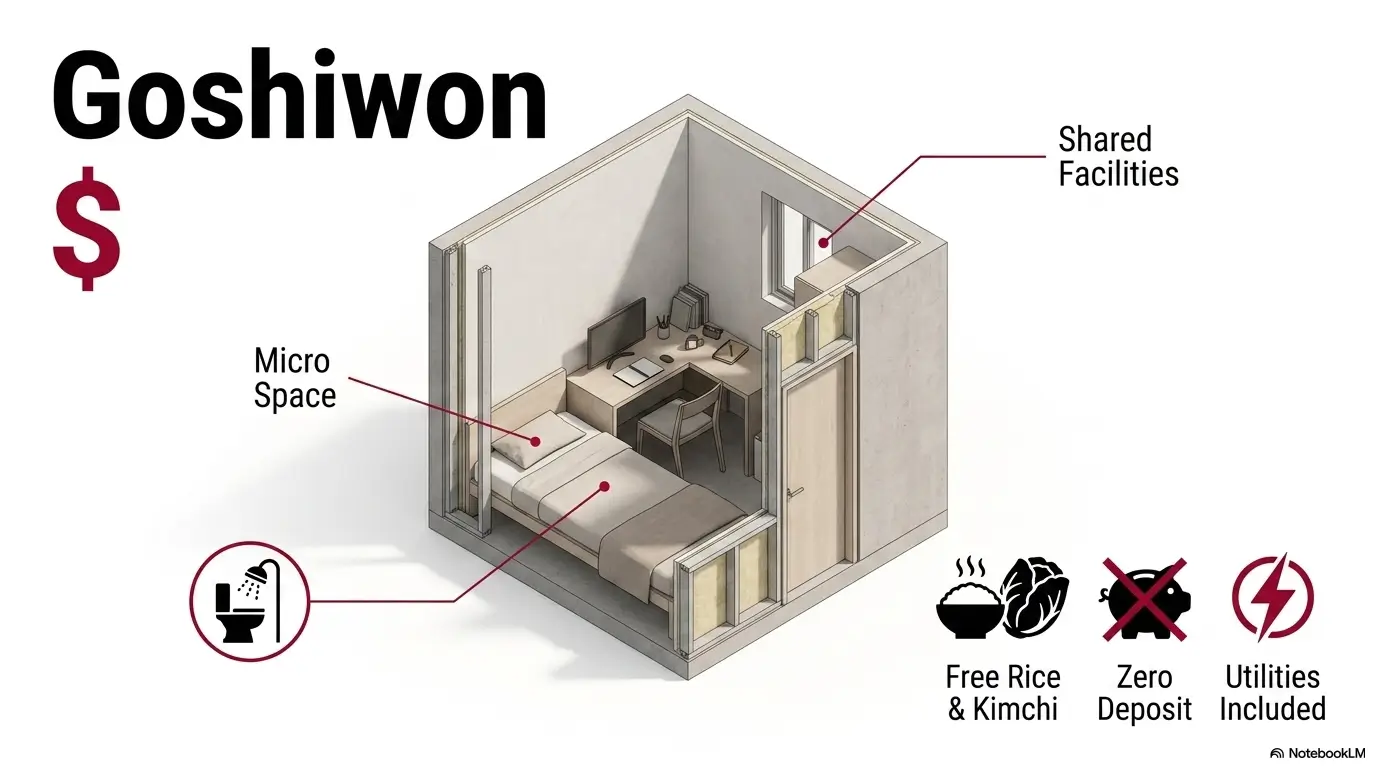
A goshiwon or gositel is usually the cheapest private option. KU describes gositels near campus as tiny furnished rooms with shared kitchens and laundry, with prices varying by size, meals, cleaning, and services. KU’s guidance places many gositels around ₩350,000 to ₩700,000 per month, with an average around ₩500,000.
This can be excellent for a student who spends most of the day on campus and wants the lowest monthly cost. It can be rough for someone who needs quiet, personal space, or a real desk setup for long study sessions.
Sharehouse: social living without a huge deposit
A sharehouse usually gives you a private bedroom and shared kitchen, living room, bathroom, or laundry areas. KU’s accommodation guidance describes sharehouses around campus as private student housing with variable services, with prices commonly around ₩400,000 to ₩800,000 per month and an average around ₩600,000.
This can be the middle lane for students who want more community than a studio and more breathing room than a goshiwon. Ask how many people share each bathroom, whether utilities are included, whether cleaning is provided, and whether guests are allowed.
Studio/one-room: privacy with key money attached
A studio, often called a one-room in Korea, gives you the clearest independence: your own bathroom, kitchenette, and door that closes on the world. For a year-long student, that privacy may be worth the cost.
For a four-month exchange student, the deposit can be the problem. KU’s accommodation page notes that private studios may require key money ranging from about ₩3,000,000 to ₩10,000,000 plus monthly rent around ₩500,000 depending on size and quality. More desirable locations or better rooms can cost more.
Co-living: higher rent, fewer setup headaches
Co-living spaces often charge more than goshiwons or basic sharehouses, but they may reduce setup stress. You may get furniture, Wi-Fi, cleaning of common areas, clearer English guidance, and shorter-term flexibility.
The paid convenience can make sense when time is scarce, parents want fewer unknowns, or the student arrives close to orientation. Still, compare the total stay cost. Convenience is useful. Overpaying because you panicked at midnight on a listing site is less poetic.
Key takeaway: Off-campus housing can be cheaper, but it asks you to manage more variables. Budget-conscious students should price both money and attention. A cheap room that consumes your first month with stress is not always cheap.
The Hidden Deposit Problem
Key money can make a “cheap” studio expensive upfront
Korean rental systems often use deposits much larger than many US students expect. Seoul’s official housing guidance explains that monthly rent contracts commonly involve a deposit plus monthly rent, and the deposit may be many times the monthly rent.
That means a studio with a reasonable monthly payment can still require a large wire transfer before move-in. Parents should decide early whether they are comfortable sending a multi-million-won deposit and waiting for it to be returned after move-out.
Low-deposit rentals often charge higher monthly rent
In Seoul, lower deposit does not always mean lower total cost. A landlord may accept less key money in exchange for higher monthly rent. That can help cash flow, but it may cost more over a full year.
For a short stay, lower deposit can be worth paying slightly more each month if it reduces refund anxiety. For a 12-month stay, the math may shift.
Refund timing matters when you leave Korea
A refundable deposit is not the same as instant cash. Ask when the deposit will be returned, what deductions are allowed, how utilities are finalized, and what happens if your flight leaves before the refund is processed.
This is especially important for students who will close a Korean bank account or return to the US soon after moving out. Keep written records. Screenshot messages. Save receipts. Future-you will send a thank-you note.
Show me the nerdy details
Use two numbers for every housing option: total cost and maximum cash required. Total cost includes rent, nonrefundable fees, utilities, laundry, bedding, transport changes, cleaning, and likely move-out costs. Maximum cash required includes refundable deposits because that money must exist before move-in. A dorm may have a higher visible semester fee but a lower cash-stress profile. A studio may have lower monthly rent but require several million won upfront. For short stays, cash timing can matter as much as price.
Don’t do this: compare dorm rent to off-campus rent only
The most expensive housing mistake is comparing one clean dorm fee against one monthly private rent number. That is not a comparison. That is a budget wearing one shoe.
Compare full-stay cost, upfront cash, exit rules, paperwork effort, and daily comfort. If the student will be happier, safer, and more focused in a dorm, the “premium” may be real value. If the student is staying a full academic year and can manage a contract, off-campus housing may start to shine.
The 4-Month Exchange Student Budget Test
Most exchange students should start with a four-month budget test. This makes the dorm vs off-campus question practical instead of emotional.
Dorm math for one semester
For one semester, a KU dorm can be simple. Use the published semester fee for your assigned room type, then add bedding, laundry, meals, personal items, and a small cushion.
Example: a double room in an international dorm at around ₩1,600,000 for the semester may look higher than a goshiwon at ₩400,000 per month. But over four months, that goshiwon is also ₩1,600,000 before any supplies, utilities, or service differences.
Goshiwon math for four months
A goshiwon at ₩450,000 per month becomes ₩1,800,000 over four months. If utilities and basic services are included, it may still be budget-friendly. If the room is too small, too noisy, or too far from campus, the hidden cost becomes daily exhaustion.
Ask for recent photos, window status, bathroom arrangement, kitchen rules, laundry costs, and whether the building has curfews or guest restrictions.
Studio math with deposit and utilities
A studio at ₩550,000 per month costs ₩2,200,000 over four months before utilities. Add maintenance fees, electricity, gas, internet, bedding, cookware, cleaning, possible brokerage, and the deposit.
If the deposit is ₩5,000,000, the family may need more than ₩7,000,000 in cash exposure before the semester is over. The deposit may return, but the cash has to cross the ocean first.
The break-even point most students miss
The break-even point is not just where monthly rent beats the dorm fee. It is where the savings are large enough to justify the extra work and risk.
| 4-month option | Simple cost example | Upfront cash pressure | Best for |
|---|---|---|---|
| Dorm double | About ₩1,600,000 plus living extras | Usually lower than private studio deposit | Exchange students wanting predictability |
| Goshiwon | ₩350,000 to ₩700,000 monthly range | Often lower, but varies | Students prioritizing lowest monthly cost |
| Sharehouse | ₩400,000 to ₩800,000 monthly range | Usually moderate, confirm deposit | Students wanting community and flexibility |
| Studio | Rent plus utilities and possible fees | Often high due to key money | Students who need privacy and can handle cash flow |
Key takeaway: For many four-month students, the dorm wins even when it is not the absolute cheapest. The value is fewer deadlines, fewer contracts, fewer setup errands, and less deposit risk.
The 12-Month Degree Student Budget Test
When off-campus housing starts to make more sense
For a 12-month degree student, off-campus housing can become more reasonable. You have more time to spread setup costs across the year, learn neighborhood rhythms, and negotiate a better fit.
A studio may also support a healthier routine if you cook often, need quiet, or have online meetings across time zones. Privacy becomes more valuable when Seoul is not a semester adventure but your actual Tuesday.
Why deposit recovery matters more than monthly rent
With a one-year lease, deposit recovery becomes a serious planning item. You need to understand when the lease ends, how much notice is required, whether early termination is allowed, and what deductions may apply.
If you are considering an officetel or private one-room, read a practical lease guide before you sign. A related next step is this guide to officetel leases in Korea, especially if you are comparing apartment-like private units.
Furnished vs unfurnished: the luggage-cost problem
A “cheaper” unit can become less cheap if you need to buy a mattress pad, desk chair, cookware, router, drying rack, trash bags, cleaning supplies, and storage boxes. Seoul apartments are efficient, but they do not magically furnish themselves at 11 p.m.
For long-stay students, lightly furnished is often the sweet spot. For short-stay students, fully furnished housing is usually worth more than it seems.
Let’s be honest: independence has an admin fee
Living off campus gives you freedom. It also gives you admin: garbage sorting, appliance issues, heating controls, internet problems, neighbor noise, move-out cleaning, and Korean messages from a landlord you may need to translate carefully.
That does not mean off-campus is bad. It means independence should be priced honestly. If the student wants a soft landing in Korea, the dorm is not childish. It is strategic.
Housing decision flow
1. Stay length
Under 5 months? Dorm, goshiwon, or co-living usually deserves first look.
2. Cash available
Can you carry deposit cash without harming food, travel, or emergency funds?
3. Privacy needs
Need quiet, cooking, guests, or online calls? Price those needs honestly.
4. Contract confidence
If you cannot read the lease, get help before paying or signing.
Location Costs Around Anam
Korea University Station: convenience premium
Housing close to Korea University Station and the main campus gates is convenient, especially during winter or late classes. Convenience has a price. Better location can mean higher rent, smaller rooms, or faster competition for listings.
For exchange students, proximity can be worth paying for because it reduces friction. Every 20-minute errand saved during the first month gives you more energy for classes, friends, and figuring out which convenience-store triangle kimbap is your emergency favorite.
Bomun and Hoegi: cheaper, but commute math changes
Nearby areas can offer better prices or more private options, but the commute changes the budget. Subway fares, bus transfers, walking time, weather, and late-night ride costs all matter.
Before choosing a cheaper room farther out, test the route at the time you will actually travel. Morning hill walks and late-night transfers have a different personality than a calm Saturday map search.
Hills, winter, and late-night safety as budget factors
Seoul is wonderfully walkable, but not flat. Around university neighborhoods, “close” can still mean stairs, slopes, narrow streets, and icy sidewalks in winter.
If a student expects late club meetings, part-time work, or evening language exchanges, consider lighting, route familiarity, taxi availability, and subway timing. This is where guides to Korea nightlife and last trains and T-money in Korea can help new arrivals plan daily movement.
Pattern interrupt: a 10-minute walk is not always a 10-minute walk
A 10-minute walk in September sunshine is not the same as a 10-minute walk with luggage, rain, hill grade, freezing wind, or a laptop bag after a long class.
When comparing housing, add a “bad weather tax.” If you will pay for taxis twice a week because the room is inconvenient, that cheaper rent may quietly leak money.
Common Mistakes That Make Housing More Expensive
Mistake 1: applying late and losing the dorm option
Late dorm applications can push students into private housing before they are ready. Even if you are not sure you want a dorm, track the application window and payment deadline. Optionality is a beautiful little luxury.
Mistake 2: ignoring utilities and maintenance fees
Private rent may exclude electricity, gas, water, internet, building maintenance, cleaning, or trash-related costs. Ask what is included, what is separate, and what a normal winter bill looks like.
Mistake 3: signing before checking move-out rules
Move-out rules can determine whether a housing choice is flexible or expensive. Ask about early termination, required notice, deposit return timing, cleaning fees, disposal rules, and whether subletting is allowed.
Mistake 4: assuming English listings mean English contracts
An English-friendly listing does not guarantee an English contract or English dispute support. If the written contract is in Korean, get help reviewing it before sending a deposit.
Renter checklist before paying:
- Confirm the exact address and room number.
- Ask whether the deposit is refundable and when.
- Get the total monthly payment in writing.
- Ask what utilities and maintenance fees are included.
- Check move-in and move-out dates against your flights.
- Save the landlord or provider’s legal name and contact details.
- Do not rely only on photos. Ask for a video or in-person viewing if possible.
Mistake 5: picking privacy before pricing the total semester
Privacy matters. Sleep matters. A door that closes matters. But privacy should be priced with the full semester in view.
If a studio costs more but keeps the student healthy and focused, that can be rational. If it drains the emergency fund and creates lease stress, the dorm may be the wiser choice.
Dorm vs Off-Campus Decision Matrix
Use this matrix as a first-pass filter. It is not a substitute for current prices, but it helps sort the decision by lifestyle, risk, and budget.
| Option | Choose it if | Avoid it if | Questions to ask before paying |
|---|---|---|---|
| Dorm | You want predictable cost, campus access, and simpler paperwork | You need strong privacy, guests, or a private kitchen | What is included, what is not, and what are refund rules? |
| Goshiwon | Your top priority is low monthly cost | You need space, quiet, or a larger bathroom | Is there a window, private bathroom, laundry fee, or curfew? |
| Sharehouse | You want community and moderate cost | You dislike shared kitchens or bathroom schedules | How many residents share each facility? |
| Studio | You need privacy and can handle deposit cash | You are staying only a short semester and cash is tight | What is the deposit, lease term, utility average, and exit rule? |
| Co-living | You want convenience, English support, and fewer setup headaches | You are focused on the absolute lowest cost | What services are included, and is the contract flexible? |
Good / Better / Best setup for different student budgets
| Budget style | Good | Better | Best |
|---|---|---|---|
| Lowest cash outlay | Goshiwon near campus | Budget dorm if eligible | Dorm plus emergency fund |
| Balanced comfort | Sharehouse | International dorm double | Co-living with clear included services |
| Maximum privacy | Small studio farther from campus | Studio near transit | Studio with reviewed contract and deposit plan |
| Parent peace of mind | Verified sharehouse | KU dorm | Dorm plus documented backup plan |
Students considering villas or apartment-style rentals should also read about Korean villa rentals and jeonse deposit protection before taking on a larger private housing commitment.
Key takeaway: The best housing choice is not the fanciest or cheapest. It is the one that fits your stay length, cash flow, privacy needs, commute tolerance, and ability to handle Korean housing paperwork.

FAQ
Is Korea University dorm cheaper than off-campus housing?
For many short-stay exchange students, a Korea University dorm can be cheaper or close enough once you compare the full semester. A goshiwon may beat the dorm on monthly cost, but dorms often reduce deposit risk, utility confusion, and setup costs.
How much does Korea University dorm cost for international students?
KU’s international accommodation page has listed spring and fall semester rates around ₩1,600,000 to ₩2,000,000 for CJ International House and Anam Global House room types, while Anam Dormitory II triple rooms have been listed around ₩780,000. Always confirm current prices directly with KU before budgeting.
Is off-campus housing near Korea University safe for US students?
Many students live safely off campus, but safety depends on the building, street, commute route, lighting, contract clarity, and support network. Visit or video-check the room, test the route, confirm the address, and avoid sending deposits without written terms.
Do Korea University dorms include meals?
Dorm housing does not automatically mean unlimited meals. KU notes that students can purchase meal plans for the central cafeteria. Budget separately for meals, snacks, convenience-store food, and occasional eating out.
How much deposit do students need for a studio near KU?
KU’s accommodation guidance notes that private studios may require key money from about ₩3,000,000 to ₩10,000,000 plus monthly rent around ₩500,000, depending on size and quality. Actual listings can vary, so confirm the exact deposit, rent, maintenance fee, and lease term.
Is a goshiwon a good option near Korea University?
A goshiwon can be good for a budget-focused student who can tolerate a small room and shared facilities. It may be a poor fit for students who need quiet, space, cooking comfort, or strong privacy.
Can exchange students rent apartments in Seoul?
Exchange students may be able to rent private housing, but short lease length, deposit size, language barriers, visa paperwork, and move-out timing can make it harder than it looks. For a short semester, dorms, goshiwons, sharehouses, or co-living may be simpler.
Should parents budget in dollars or Korean won?
Budget in Korean won first, then convert to dollars when you send money or compare family cash flow. This prevents exchange-rate movement from blurring the actual Seoul cost.
Build a One-Page Housing Budget Before You Apply
The next step is small, but it changes everything: make a one-page housing budget before you apply for a dorm or message a landlord.
Set a timer for 15 minutes. Create five rows: dorm, goshiwon, sharehouse, studio, and co-living. For each row, write the full-stay cost, maximum cash needed before move-in, commute time, privacy level, and biggest risk.
15-minute housing budget template
- Write your exact arrival and departure dates.
- Add KU dorm application and payment deadlines.
- List rent or dorm fee for the whole stay.
- Add deposit, utilities, maintenance fee, bedding, laundry, and transport.
- Mark refundable money separately from true cost.
- Add one emergency line item for housing surprises.
- Choose the option that still works if your week goes badly.
If the dorm is available and the student is staying one semester, it is often the calmer first choice. If the student is staying a year, wants independence, and can handle the deposit and lease review, off-campus housing may be worth the extra work.
Housing is not just where you sleep. It is where the semester recovers each night. Choose the room that leaves enough money, attention, and courage for the life you came to Seoul to live.
Last reviewed: 2026-08