
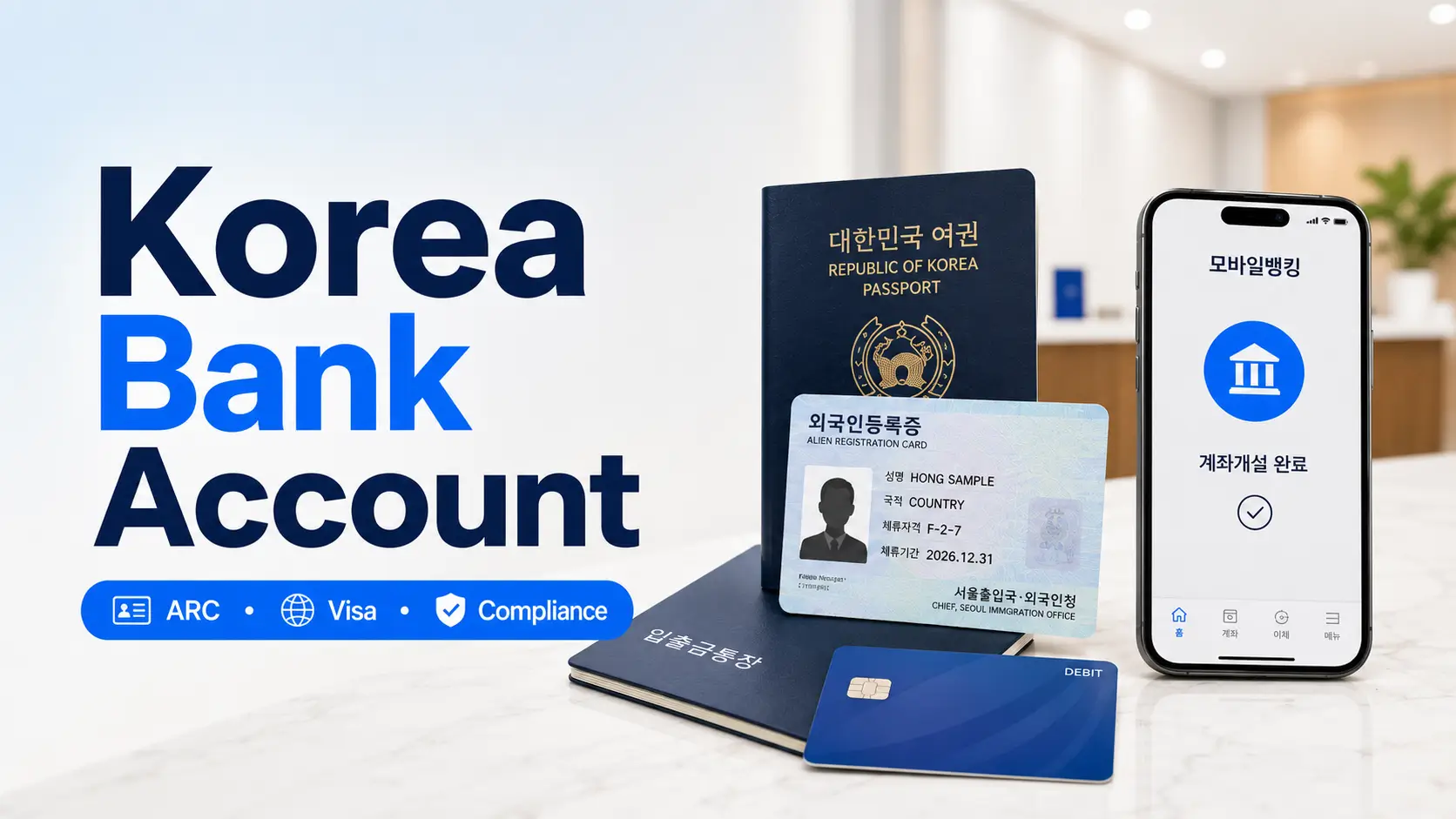
Banking in South Korea for Foreign Residents
Korea Bank Account for Foreigners:
ARC, Visa, and Compliance
Opening a bank account in Korea can feel strangely simple and unexpectedly difficult at the same time. One branch may ask for a passport and Residence Card, while another wants an employment contract, proof of address, a Korean phone number, and a clearer explanation of why the account is needed.
The difference is not always your visa. Korean banks must verify identity, transaction purpose, tax residency, and potential financial-crime risks. A valid Residence Card opens the conversation, but the complete document stack usually determines whether that conversation ends with a working debit card or another appointment.
This guide shows you how to prepare for the branch visit, handle limited-transfer accounts, set up mobile banking, answer FATCA and CRS questions, and leave with an account that actually works for salary, rent, online payments, and daily life.
Prepare once
Build a branch-ready document folder instead of gambling on a passport-only visit.
Avoid hidden limits
Check transfer, ATM, app, certificate, and overseas-access settings before leaving.
Answer compliance calmly
Explain your purpose, source of funds, occupation, and tax residency clearly.
The practical goal: do not merely open an account. Open one you can reliably use. 🏦
Snapshot
This guide is for foreign employees, students, spouses, overseas Koreans, expats, and digital nomads preparing to open a personal Korean bank account. You will learn which documents to bring, why branch decisions differ, how limited accounts work, and what to test before walking out the door.
Table of Contents
Before You Act: A Bank Account Is Not an Immigration Approval
Before You Act
This article provides general preparation guidance, not personalized banking, immigration, tax, or legal advice. Account eligibility, transfer limits, identification methods, and reporting duties can vary by bank, branch, visa history, residence status, transaction purpose, and tax profile. Confirm important requirements directly with the bank and consult a qualified tax or legal professional when your situation is complex.
A Korean visa permits particular activities and periods of stay. It does not require every bank to offer every deposit product, card, remittance service, or mobile-banking feature to the visa holder.
Likewise, opening an account does not prove that your employment, business activity, tax position, or source of funds is compliant. Banks verify financial customers for their own regulatory duties, while immigration and tax authorities apply separate rules.
What this guide can help you do
- Prepare identification and proof-of-purpose documents.
- Choose a branch that regularly serves foreign customers.
- Understand why an account may receive transfer restrictions.
- Set up cards, apps, certificates, and overseas authentication.
- Recognize when FATCA, CRS, or professional tax help may matter.
What you should confirm directly
- Whether your specific identification will be accepted at that branch.
- Which proof-of-purpose documents are required for your account type.
- The initial ATM, mobile-transfer, and online-banking limits.
- Whether a physical or Mobile Residence Card can be used for the requested service.
- Which tax-residency forms and taxpayer numbers you must provide.
Key takeaway: Treat the bank visit as a compliance appointment, not a casual errand. Ten minutes of preparation can save a second trip across town.
The ARC Reality: Why the Residence Card Changes Everything
“ARC” versus “Residence Card”
Foreign residents still commonly say “ARC,” short for Alien Registration Card. Current official English materials generally use terms such as Residence Card, Foreign Residence Card, Permanent Resident Card, or Overseas Korean Residence Card.
The older term remains useful when searching forums or speaking with long-term residents. At a bank, however, asking whether your specific Residence Card is acceptable is clearer than assuming every card category is handled identically.
What the card proves that a passport usually cannot
A passport establishes nationality and identity. A Korean Residence Card adds locally relevant information, including your registered status and identifying details used across Korean administrative, telecom, and financial systems.
Seoul Metropolitan Government’s banking guidance identifies a Residence Card and passport as core documents for resident foreigners opening a bank account. That remains a useful starting point, but individual banks can request further evidence before granting full account functions. :contentReference[oaicite:0]{index=0}
Foreign residents preparing for everyday digital services may also find it helpful to review how Korean identity verification works for foreigners. The same name, phone, and identification mismatches that disrupt shopping or app registration can also interfere with banking.
Can you open an account before the physical card arrives?
Possibly, but do not build your moving plan around a guaranteed passport-only account. A branch may offer a restricted or non-resident pathway, request alternative documents, or decline until residence registration is complete.
Students can ask their university whether a partner branch has an onboarding process. Employees can ask payroll or human resources whether the employer provides an account-opening request letter. Spouses may bring family-status and address documents when those records help explain the account’s purpose.
If you have not completed registration, review the broader Korea resident registration process before scheduling several bank visits. The missing card may be the first domino, not the only one.
Mobile Residence Card: valid identification, uneven service support
Korea’s Ministry of Justice began issuing the Mobile Residence Card on January 10, 2025. It is available to eligible registered foreign residents, but a legally valid digital credential does not mean every bank counter, app workflow, or third-party verification system supports it in the same way. :contentReference[oaicite:1]{index=1}
Carry the physical card for a first-time account-opening visit unless the branch has explicitly confirmed that the mobile version is sufficient. A digital wallet should make life lighter, but it should not turn your appointment into an identity-verification rehearsal.
Visa Status Is Only One Part of the Bank’s Decision
Work, student, spouse, permanent, and overseas-Korean statuses
Your status of stay helps the bank understand why you are in Korea and how long your relationship with the country may continue. The more clearly your documents support that story, the easier the review is likely to be.
- Employees: Bring an employment contract, certificate of employment, business card, payroll request, or employer letter.
- Students: Bring a certificate of enrollment, student ID, scholarship notice, tuition document, or dormitory confirmation.
- Spouses and family residents: Bring documents supporting residence, family connection, household expenses, or recurring transfers when relevant.
- Permanent residents and overseas Koreans: Bring the current residence credential and evidence explaining the account’s intended use.
- Freelancers and remote workers: Prepare contracts, invoices, payment records, or a brief explanation of how income enters Korea.
Short-term visitors face a different question
A tourist may possess valid identification without having the local registration, address stability, phone authentication, or ongoing financial purpose needed for a practical personal account.
Some official guidance acknowledges banking routes for both resident and non-resident foreigners, but that should not be read as a promise of identical access. A non-resident account may involve more documentation, fewer services, different tax treatment, or stricter transaction controls. :contentReference[oaicite:2]{index=2}
What the bank is really screening
- Can the applicant’s identity be verified?
- Is the intended account use specific and credible?
- Does the occupation or source of funds match the expected activity?
- Are foreign tax-residency declarations complete?
- Are there factors requiring enhanced review?
- Can the bank support the requested product and authentication method?
This is why two people with the same visa can receive different outcomes. One arrives with a Korean phone contract, employment letter, lease, and payroll request. The other says only, “I need it for personal use.” The visa label is identical, but the bank’s evidence file is not.
Key takeaway
Replace “personal use” with a concrete purpose: receiving salary, paying rent and utilities, receiving a scholarship, handling household expenses, or making documented local purchases.
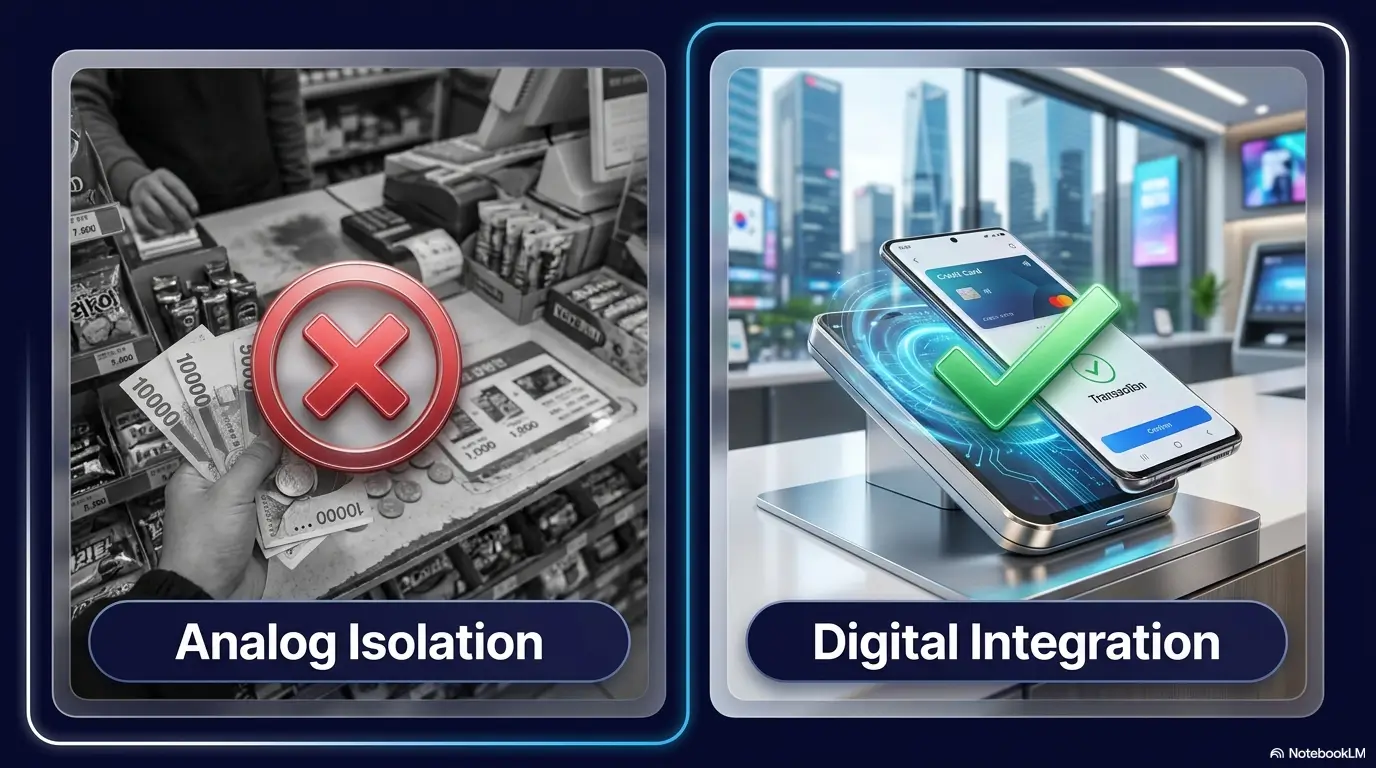
Build the Document Stack That Prevents a Second Visit
Core documents to place at the front
- Valid passport.
- Valid physical Residence Card or other accepted residence credential.
- Korean residential address written consistently.
- Korean mobile-phone number registered in your name when available.
- Taxpayer identification information for applicable countries.
- A small initial deposit if the bank requests one.
Check expiration dates before leaving home. A beautifully organized folder containing expired identification is still a beautifully organized problem.
Proof of purpose: the papers that explain why the account exists
Bring at least one strong document tied to the account’s intended use. Two complementary documents are better when your circumstances are unusual.
| Account purpose | Helpful supporting documents | Plain-English explanation |
|---|---|---|
| Salary | Employment contract, certificate of employment, payroll request | “My employer will deposit my monthly salary here.” |
| Study | Enrollment certificate, scholarship notice, student ID | “I need the account for scholarship payments and living expenses.” |
| Rent and bills | Lease, utility notice, housing confirmation | “I need local transfers for rent, utilities, and recurring expenses.” |
| Family support | Family documents, remittance records, household evidence | “I receive documented family support for living costs.” |
| Freelance income | Contracts, invoices, payment statements | “I receive contract income and need records for local expenses.” |
Address evidence: use documents the branch can understand quickly
- Residential lease agreement.
- Dormitory or university housing confirmation.
- Utility, telecom, insurance, or official notice showing the address.
- Residence-related certificate issued through an eligible government channel.
- Employer housing letter when company accommodation is provided.
Residents who need local administrative documents can review how local district offices in Korea work. Depending on the document, an immigration office, community service center, university office, landlord, or employer may be the correct source.
Name consistency: the tiny detail with enormous shoes
Compare the English name on your passport, Residence Card, phone account, employment documents, and lease. Look for missing middle names, reversed order, extra spaces, hyphens, shortened names, and different capitalization.
A human teller may recognize that two versions refer to the same person. An automated identity check may simply close the gate.
STEP 1
Identify
Passport, Residence Card, address, and phone.
STEP 2
Explain
State the real purpose and expected transactions.
STEP 3
Verify
Confirm tax residency, source of funds, and limits.
STEP 4
Test
Activate the card, app, transfer, and login.
Good, Better, Best preparation
| Preparation level | What you bring | Best for | Main risk |
|---|---|---|---|
| Good | Passport, Residence Card, address, phone | Existing customers or simple cases | The branch may request proof of purpose |
| Better | Core documents plus employment, school, lease, or family evidence | Most first-time applicants | Name or phone mismatches may remain |
| Best | Complete folder, photocopies, tax numbers, branch confirmation, translated explanation if useful | Complex income, short history, or time-sensitive setup | Requirements can still change after review |
Why Approval Can Change From One Branch to the Next
Bank policy versus branch practice
A bank may have institution-wide rules, but branches still differ in foreign-language support, staff experience, document familiarity, appointment traffic, and access to specialist teams.
A branch near a major university, business district, international neighborhood, military community, or large employer may process foreign-customer applications more often. That experience can make the visit smoother without changing the underlying compliance rules.
Five questions to ask before visiting
- Can this branch open a personal account for someone with my residence status?
- Which original documents and supporting documents should I bring?
- Will the first account have ATM or transfer restrictions?
- Can I register mobile banking, a debit card, and an authentication certificate during the same visit?
- Is foreign-language assistance available, and should I make an appointment?
Write down the branch name, call date, staff member’s name if offered, and the checklist you were given. This does not bind the bank, but it reduces confusion when you arrive.
DIY, foreign-customer desk, or paid administrative help?
| Support option | Likely cost | Useful when | What to verify |
|---|---|---|---|
| DIY branch visit | Usually lowest | Your documents are simple and you can communicate comfortably | Branch checklist, limits, and app support |
| Bank foreign-customer desk | Usually no separate advisory fee | You want language help or a branch familiar with foreign residents | Service hours and appointment availability |
| University or employer support | Often included | The account is for salary, scholarship, or institutional payments | Whether the support letter is current |
| Paid relocation or administrative service | Varies by provider and scope | Your case involves several appointments, translation, or business setup | Exact service, refund policy, privacy handling, and whether bank approval is promised |
Paid help may save time, but no legitimate service provider should guarantee approval. The bank must still conduct its own review.
Real-world example
Imagine a new teacher who visits a downtown branch with only a passport and Residence Card. She explains that she needs “a normal account,” but cannot show where she works or how the account will be used. The branch offers a limited account and asks her to return with employment evidence.
The next morning, she visits a branch recommended by her employer. She brings her contract, certificate of employment, lease, Korean phone information, and a payroll request. The second branch can understand the expected deposits and routine expenses within minutes.
The lesson is not that the second branch ignores rules. It has a clearer file, a familiar customer profile, and a specific transaction purpose. Preparation turns a foggy request into an ordinary banking relationship.
Limited Accounts: Opened Does Not Mean Fully Usable
What a limited account may restrict
A bank may open a deposit account while applying conservative transaction limits. Restrictions can affect daily transfers, mobile banking, ATM withdrawals, online payments, or particular remittance functions.
Do not assume that receiving an account number means every feature has been approved. Ask the teller to write down each limit or show it inside the app.
Questions to ask before accepting the setup
- What is the daily mobile-transfer limit?
- What is the daily ATM withdrawal limit?
- Can salary deposits be received immediately?
- Can utility and telecom autopayments be registered?
- Are domestic online purchases enabled?
- Can international transfers be sent or received?
- What documents or account history may support a later limit increase?
What may help remove restrictions later
The bank may ask for stronger evidence that the account is used for ordinary financial activity. Depending on the case, helpful records may include salary deposits, employment confirmation, recurring bills, lease payments, tuition records, tax documents, or a documented need for a higher limit.
Ask for the bank’s specific review path. “Use the account for a while” is not a useful instruction unless you also know what evidence, time period, or transaction pattern the bank expects.
Key takeaway: Ask about limits before you sign, not when rent is due in forty minutes.
Where banking costs actually appear
The account-opening appointment itself may not be the expensive part. Compare the ongoing costs and inconveniences attached to the account.
| Cost area | What to compare | Money-saving question |
|---|---|---|
| Domestic transfers | App, ATM, and counter fees | Are digital transfers free under this account? |
| ATM use | Own-bank, other-bank, and after-hours charges | Which ATM network avoids extra fees? |
| International remittance | Sending fee, intermediary fee, exchange-rate spread | What is the estimated total received by the beneficiary? |
| Debit card | Annual fee, replacement fee, overseas-use settings | Is a basic domestic card sufficient? |
| Administrative help | Translation or relocation-service fees | Can my employer, school, or bank desk provide this help free? |
Mobile Banking Setup: Finish the Job Before You Leave
Why the Korean phone number matters
A Korean phone number is often part of identity verification, login recovery, transaction authentication, card alerts, and online-service registration. The phone account may need to be registered in your own legal name.
Before opening a mobile plan, compare how prepaid, postpaid, short-term, and resident plans support identity verification. The guide to Korean phone plans for Americans explains why a number that can receive texts is not always equivalent to a number that passes full name-based verification.
The account, card, app, and certificate are separate services
Ask for each service you need. Do not assume the teller has bundled them automatically.
- Deposit account and bankbook, if issued.
- Debit or cash card.
- ATM withdrawal access.
- Mobile-banking registration.
- Internet-banking registration.
- Domestic transfer authority.
- Authentication certificate or other security method.
- International-use or overseas-login settings.
- Transaction notifications.
Run a five-minute test before leaving the branch
- Log in to the mobile app.
- Confirm that your account appears.
- Check the displayed transfer limit.
- Change temporary passwords or security settings.
- Confirm the debit card status.
- Ask how to recover access after changing phones.
- Ask what happens if you travel or move abroad.
If possible, make a small transfer to a trusted account or complete another permitted test transaction. A successful login is encouraging; a successful transaction is evidence.
Configure overseas access before leaving Korea
Foreign residents often discover authentication problems after changing SIM cards, replacing phones, allowing certificates to expire, or losing access to a Korean number.
- Confirm whether overseas logins are permitted.
- Ask whether a Korean phone number must remain active.
- Check certificate expiration and renewal procedures.
- Record international customer-service details securely.
- Update your address, phone, and residence status when required.
- Keep account statements needed for taxes or future compliance reviews.
Show me the nerdy details
Korean financial services may compare data across several systems: the bank’s customer record, your residence credential, the telecom subscriber record, and an app-based identity-verification service. Each system may store names differently.
A middle name omitted by the telecom provider, a hyphen inserted by the bank, or a recently renewed Residence Card can create an authentication failure even when every document belongs to the same person.
When a verification error appears, ask which data field failed. Repeatedly reinstalling the app rarely repairs a spelling mismatch living inside another company’s database.
Compliance Questions, FATCA, CRS, and Source of Funds
Why the teller asks personal questions
Know Your Customer and anti-money-laundering reviews require banks to understand who the customer is, why the account is being opened, and whether expected transactions make sense.
A current Korean bank account-opening form, for example, includes fields addressing transaction purpose, sources of financing, overseas tax status, and whether virtual-currency activity is involved. It also directs foreign or overseas-tax-connected customers to additional FATCA and CRS documentation. :contentReference[oaicite:3]{index=3}
Source of funds: prepare a clean explanation
Your answer should identify where money comes from, not merely what you intend to buy.
| Source | Useful evidence | Clear description |
|---|---|---|
| Salary | Contract, payslip, employer letter | Monthly salary from a Korean employer |
| Scholarship | Award notice, enrollment letter | University scholarship and living allowance |
| Personal savings | Foreign-bank statements, transfer records | Savings accumulated before moving to Korea |
| Family support | Remittance records, relationship evidence | Living support from an immediate family member |
| Freelance or business income | Contracts, invoices, tax records | Payments for documented professional services |
If you expect unusually large transfers, repeated cash deposits, crypto-related flows, or payments from several countries, ask in advance what supporting records the bank may require.
FATCA for Americans
US citizens, US permanent residents, and certain other US taxpayers should expect citizenship and taxpayer-identification questions when opening a foreign account. A Korean bank may request a US taxpayer identification number and certification documents as part of FATCA compliance.
The bank’s FATCA process is not the same as your personal US filing obligations. The IRS explains that some US taxpayers must report specified foreign financial assets on Form 8938, while the separate FBAR rules may also apply to foreign financial accounts. Thresholds, definitions, and filing methods differ. :contentReference[oaicite:4]{index=4}
Do not guess whether a Korean account is reportable based only on its year-end balance. Maximum values, joint ownership, signature authority, other foreign accounts, and whether you live abroad can affect the analysis.
CRS and multiple tax residences
Citizenship, visa status, physical residence, and tax residence are related concepts, but they are not interchangeable.
Under the Common Reporting Standard, a financial institution may require customers to disclose all jurisdictions in which they are tax residents. The OECD notes that a person can be tax resident in more than one jurisdiction and that merely holding a residence right or citizenship does not automatically settle the question. :contentReference[oaicite:5]{index=5}
Someone who recently moved, maintains a home in another country, works across borders, or receives income through a foreign company may need tailored advice. A bank employee can collect forms, but should not be expected to resolve your full international tax position.
Key takeaway: Bring taxpayer numbers and answer accurately. Saying “I pay tax in Korea now” does not automatically erase another country’s filing or reporting rules.
Common Mistakes That Create Banking Paperwork
Mistakes made before reaching the counter
| Common mistake | Why it causes trouble | Safer alternative |
|---|---|---|
| Assuming every branch uses one checklist | Experience and document review can differ | Call the exact branch before visiting |
| Bringing expired identification | The bank may be unable to complete identity verification | Check all expiration dates the night before |
| Using different English-name formats | Telecom and app checks may fail | Compare every record character by character |
| Saying only “personal use” | The transaction purpose remains unclear | Name the salary, study, rent, or household purpose |
| Forgetting taxpayer information | FATCA or CRS forms may remain incomplete | Bring relevant taxpayer identification numbers |
| Opening several accounts quickly | The pattern may trigger additional questions | Open the account you need and document its purpose |
Mistakes made during the appointment
- Becoming defensive when asked about occupation or source of funds.
- Agreeing to a restricted account without understanding the limits.
- Requesting an advanced remittance or card feature without explaining the need.
- Signing tax-residency forms without reading the questions.
- Assuming English-language app screens equal English-language support.
- Failing to ask what documents will be needed for future limit changes.
Mistakes made after the account opens
- Leaving the branch without testing the app.
- Not confirming the debit card’s domestic or overseas settings.
- Changing phone numbers without updating the bank.
- Ignoring requests to renew identification or tax-residency information.
- Lending the card, passbook, account, or authentication method to another person.
- Allowing unexplained third-party transactions to pass through the account.
- Closing a Korean phone plan before arranging another authentication method.
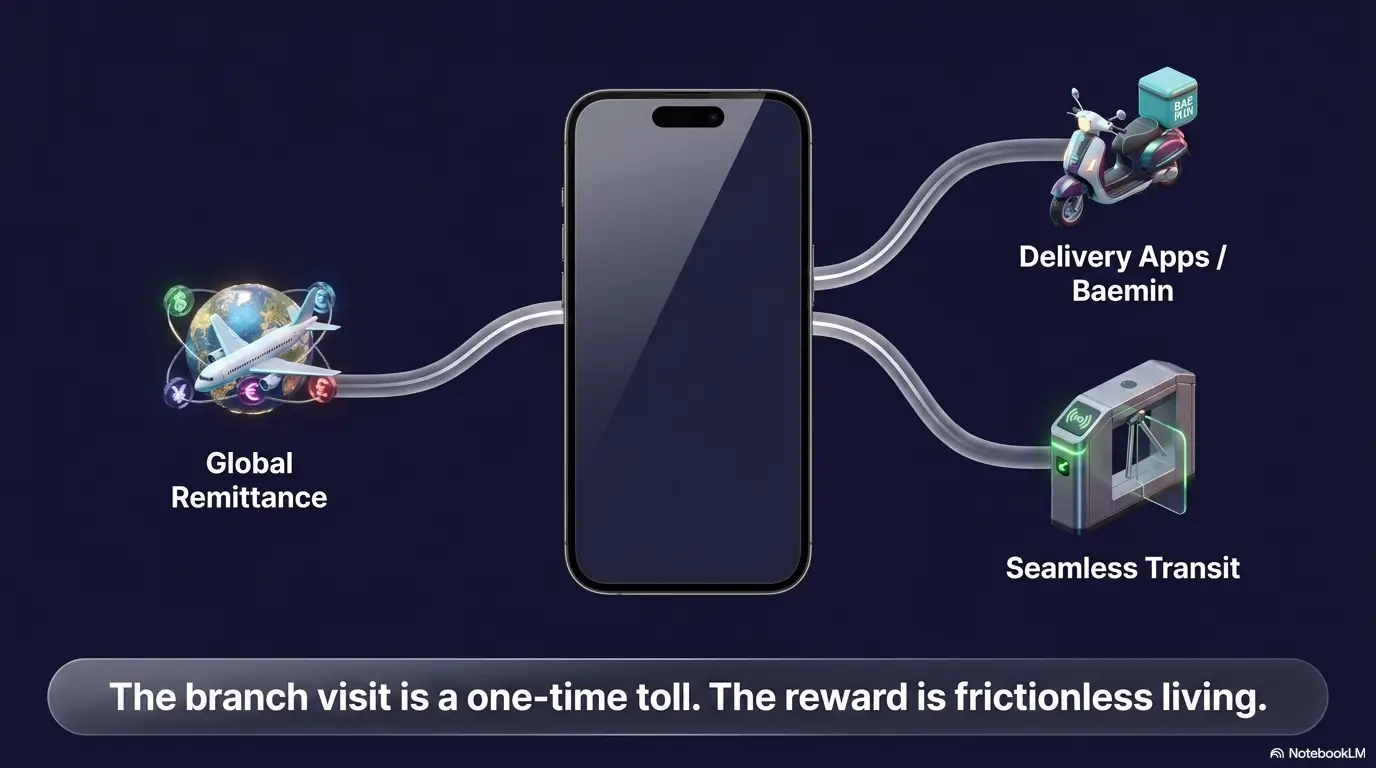
Once your account is working, it will often become the quiet plumbing behind Korean online shopping, subscriptions, delivery apps, and bill payment. The guide to online shopping in Korea can help you anticipate which payment and identity checks may come next.
Key takeaway: Never allow a friend, employer, customer, or online contact to “borrow” your account for unexplained payments. Convenience can turn into a compliance problem with alarming speed.
FAQ: Korea Bank Accounts for Foreigners
Can an American open a Korean bank account without an ARC?
A passport-only or non-resident pathway may be available in some circumstances, but approval, product choice, and transaction access are not guaranteed. Ask the exact branch what it accepts before visiting, particularly if your Residence Card is still being processed.
Can I open a Korean bank account using only my passport?
Some branches may process certain non-resident or restricted arrangements with a passport and additional evidence. Long-term residents should generally expect the Residence Card, local contact information, and proof of purpose to produce a more functional account.
Which Korean visa types can open a bank account?
There is no single practical list guaranteeing that every holder of a particular visa will receive every banking service. Banks consider identification, residence registration, account purpose, occupation, source of funds, tax residency, and their own product rules.
Do foreigners need a Korean phone number?
A branch may be able to open an account without every digital feature, but a Korean number registered in your legal name is often important for mobile banking, authentication, alerts, and recovery. Confirm whether your phone plan supports identity verification.
Why did the bank give me a limited-transfer account?
The bank may not yet have enough evidence to grant higher transaction authority, or it may apply conservative controls to a new account. Ask for the precise limits and the evidence required for a future review.
Can I use a Mobile Residence Card instead of the physical card?
Support varies by institution, branch, and transaction channel. Confirm acceptance before the appointment and carry the physical card for first-time onboarding when possible.
What FATCA information might a US citizen provide?
The bank may request confirmation of US status, a Social Security number or other applicable taxpayer identification number, an English address, and a signed tax self-certification. The exact forms depend on the bank and customer profile.
Can a tourist open a bank account in South Korea?
It may be possible in limited situations, but tourists should expect greater difficulty obtaining a fully functional everyday account. A short stay, lack of local registration, and limited account purpose can reduce available options.
Can a bank refuse me even when my documents are valid?
Yes. Valid identification does not automatically establish eligibility for every product or satisfy every compliance concern. Ask politely whether another document, product, branch, or review route is available.
Can I keep the account after my visa expires or I leave Korea?
An account may remain open, but the bank can require updated identification, address, tax residency, phone information, or residence status. Certain services may be restricted if records expire or authentication becomes unavailable. Discuss your departure plan with the bank before closing your Korean phone number.
Your 15-Minute Next Step: Make One Useful Branch Call
Choose one branch near your home, employer, university, or regular commute. A branch you can revisit easily is often more useful than one chosen solely because an old forum post called it “the best bank for foreigners.”
Use this simple call script
Branch call script
“Hello. I am a foreign resident with a valid passport and Residence Card. I need a personal account for salary, study, rent, or another specific purpose. Could you confirm which documents I should bring, whether the first account will have transfer limits, and whether mobile banking and a debit card can be activated during the visit?”
Then pack one calm, boring, excellent folder
- Passport.
- Residence Card.
- Proof of Korean address.
- Korean phone details.
- Proof of employment, enrollment, housing, or another account purpose.
- Relevant taxpayer identification numbers.
- Originals plus copies when practical.
- The branch name, appointment time, and confirmed checklist.
The best banking preparation is not dramatic. It is a folder in the right order, a purpose explained in one sentence, and five careful questions asked before you leave the counter.
That small act turns the account from a plastic card in your wallet into working infrastructure for life in Korea.
Last reviewed: 2026-08