
Korea Healthcare Guide for Foreign Residents
Health Insurance in Korea for Foreigners:
The 6-Month Rule, Costs, and Coverage Gaps
Moving to South Korea involves dozens of small administrative doors. Health insurance is one of the heavy ones. It can open through your employer, arrive automatically after a residence period, or remain stubbornly shut while a missing document travels between two countries.
The familiar phrase “foreigners join after six months” is useful, but incomplete. Employment, visa category, student status, family relationships, overseas travel, and prior enrollment can all change when coverage begins and how much you pay.
This guide separates the rules into practical paths. You will learn which enrollment route probably applies, how 2026 premiums are calculated, where private insurance fits, and which paperwork problems are worth solving before a medical bill lands with a dull thud.
Know your start date
Separate workplace enrollment from the six-month local-subscriber rule.
Budget the real premium
Understand payroll deductions, local assessments, and long-term care charges.
Avoid duplicate coverage
Use private insurance as a bridge or supplement, not an assumed exemption.
The most expensive insurance mistake is often not choosing the wrong policy. It is assuming you know your status without confirming it. 🩺
Snapshot
Who it is for: Employees, students, freelancers, digital nomads, spouses, and families planning a medium- or long-term stay in South Korea. What it solves: Confusion about NHIS enrollment dates, 2026 costs, dependents, travel interruptions, and private coverage. Your next move: Identify your enrollment category and confirm four facts with the National Health Insurance Service before buying, canceling, or ignoring any policy.
Table of Contents
Before You Act: What This Guide Can and Cannot Confirm
Safety and accuracy note
Korean health-insurance eligibility can depend on your visa, employment arrangement, residence history, family documents, school status, and time spent outside Korea. This article explains common rules and decision points, but it cannot determine your personal eligibility, premium, exemption, or immigration outcome. Confirm important dates and amounts directly with NHIS, your employer, school, insurer, or a qualified adviser.
The fast answer
Foreign employees working for an eligible Korean workplace are generally enrolled in National Health Insurance through that workplace, often from the beginning of eligible employment. They do not normally wait six months simply because they are foreigners.
Many other registered foreign residents become mandatory self-employed, also called local or regional, subscribers after residing in Korea for more than six months. Some visa categories and student situations follow different timing rules. In 2026, the published average monthly premium for applicable foreign local subscribers is KRW 158,630, including long-term care insurance.
Private travel or international medical insurance may protect you before NHIS begins or pay for gaps afterward. It usually does not erase mandatory public enrollment merely because the policy says “worldwide coverage.”
Who this guide serves best
- Americans and other foreign nationals moving to Korea for employment, study, family, or a residence-based stay
- Freelancers, job seekers, and nonworking spouses who may become local subscribers
- Employees checking whether payroll deductions and NHIS registration match
- Families preparing marriage, birth, income, and property documents for dependent applications
- Residents comparing NHIS with travel medical or international health insurance
Short-term tourists need a different plan. They will usually rely on travel insurance, reciprocal arrangements where available, or direct payment rather than resident NHIS enrollment.
The 6-Month Rule Is Not One Universal Countdown
Six months usually applies to eligible local subscribers
The six-month rule primarily matters to registered foreign residents who are not already covered as workplace subscribers or recognized dependents. For eligible visa holders, mandatory local enrollment generally begins after the required Korean residence period is completed.
This is why two people who arrive on the same flight may receive completely different answers. One starts a qualifying job and enters workplace coverage. The other remains self-employed and moves toward local enrollment based on residence and visa status.
Key takeaway
Do not ask only, “Have I been in Korea for six months?” Ask, “Am I a workplace subscriber, local subscriber, dependent, student, or an exception?” The category comes before the calendar.
Your employment date can outrank your arrival date
Foreigners working at an NHIS-covered workplace are generally subject to compulsory workplace enrollment. The employer reports the employee’s eligibility, and premiums are usually deducted from salary.
A worker who arrives in March and begins eligible employment in April may enter workplace coverage in April rather than waiting until September. Exact reporting and retroactive treatment should be checked when there is a delay, probation period, contractor label, or dispute over whether the workplace is covered.
Short trips may count, but longer or repeated trips complicate the clock
Under the detailed residence calculation, overseas absences totaling no more than 30 days during the relevant six-month period may still be treated as Korean residence. A single trip exceeding one month can cause the later re-entry date to become the new starting point for the calculation. Multiple shorter trips totaling more than 30 days can trigger a more technical recalculation.
This is not a friendly little stopwatch that simply pauses while you are abroad. It is closer to a station timetable written by a committee. Keep your entry and exit dates and ask NHIS to calculate the official date rather than counting backward from memory.
Enrollment Decision Flow
Four questions before you count six months
1. Eligible employee?
Workplace coverage may begin with employment.
2. Recognized dependent?
Apply through the employee’s plan and document the relationship.
3. Student or special visa?
Different start dates or reductions may apply.
4. None of the above?
Check the six-month local-subscriber calculation.
Your residence card date is not necessarily your NHIS start date
Your immigration registration proves a legal status and identity. It does not, by itself, prove that NHIS coverage is active on that exact date.
For related administrative hurdles, review the guide to Korean identity verification for foreigners. A mismatched address, name format, employer filing, or registration record can create problems across both healthcare and everyday digital services.
Who Enrolls Immediately, and Who Usually Waits?
| Resident situation | Likely route | Timing to check | Main action |
|---|---|---|---|
| Employee at an eligible Korean workplace | Workplace subscriber | Beginning of eligible employment or reported acquisition date | Confirm employer reporting and payroll deductions |
| Freelancer, job seeker, or independently residing adult | Local subscriber | Often after the qualifying six-month residence period | Verify visa eligibility and official residence calculation |
| D-2, D-4, or qualifying F-4 student | Student-related local coverage | Depends on study status and applicable rules | Check school guidance and NHIS reduction eligibility |
| Spouse or child supported by an employee | Dependent, if approved | Based on application timing and eligibility | Submit relationship and financial documents promptly |
| Permanent resident or marriage immigrant | May follow earlier enrollment rules | Visa-specific | Ask NHIS for the exact acquisition date |
Employees: coverage through an eligible workplace
An eligible foreign employee is generally treated much like a Korean employee for workplace insurance. The employer and employee share the health-insurance contribution, and the employee’s portion is withheld from pay.
Do not assume every person described as a “worker” is correctly enrolled. Contractor arrangements, very short working hours, unregistered workplaces, delayed reports, or an employer misunderstanding can complicate the result. When money is being deducted but coverage cannot be verified, request the acquisition date and subscriber category in writing.
Freelancers and job seekers: residence-based local coverage
Freelancers, independently residing foreigners, and some job seekers commonly fall into the local-subscriber route. Their premiums are not split with an employer, so the monthly bill may feel heavier even when their income resembles an employee’s take-home pay.
The calculation can consider information about income and property. For applicable foreign subscribers, a published average premium may operate as a minimum when the ordinary calculation produces a lower amount.
Students: a reduction is not the same as a universal start date
Students should not treat the word “discount” as a complete answer. D-2, D-4, and qualifying F-4 students may receive a 50% premium reduction when the required conditions are met, but the enrollment date, household status, and billed amount still need confirmation.
University instructions can help with routine cases, but NHIS remains the authority for the insurance record. Keep copies of enrollment certificates, residence documents, tuition or scholarship records if requested, and every notice received by mail.
Dependents and selected visa categories
A spouse or child may qualify as a dependent of an employee, but approval is not automatic. Income, property, relationship, residence, and documentation standards can apply.
Marriage immigrants, permanent residents, students, and certain employment visa holders may have timing rules that differ from the ordinary six-month route. That is another reason to lead with the visa code when speaking with NHIS.
Health Insurance Costs in Korea for Foreigners in 2026
Employee premiums start with a 7.19% health-insurance rate
For 2026, the employee health-insurance contribution is calculated using a 7.19% rate applied to the relevant monthly wage. In a standard workplace arrangement, the employee and employer each bear 50% of that health-insurance contribution. Long-term care insurance is calculated separately in addition to the health-insurance amount.
This means your paycheck does not normally lose the entire 7.19%. Your basic employee share is half of the calculated health-insurance contribution, plus your share of the related long-term care premium.
Real-world example: a KRW 4 million monthly salary
Suppose an employee’s applicable monthly wage is KRW 4,000,000. Using the 2026 rate, the total health-insurance contribution would be KRW 287,600. The employee’s 50% share would be KRW 143,800.
Using the published 2026 long-term care formula, the total long-term care contribution would be approximately KRW 37,792, with an employee share of approximately KRW 18,896. The combined employee deduction would therefore be about KRW 162,696 before rounding or payroll-specific adjustments.
Cost reality
A salary example is an illustration, not a quote. Payroll bases, bonuses, non-wage income, reporting corrections, rounding, and annual reconciliation can change the actual deduction.
The KRW 158,630 local-subscriber figure needs context
For 2026, NHIS published an average monthly contribution of KRW 158,630 for foreign local subscribers. The figure consists of KRW 140,210 for health insurance and KRW 18,420 for long-term care insurance. For applicable foreign subscribers, the average amount may be charged when the calculated contribution is lower.
It is therefore safer to describe KRW 158,630 as an important benchmark rather than a guaranteed bill for every foreign resident. Visa type, reductions, income, property, household treatment, and subscriber category may change the result.
| Cost question | Workplace subscriber | Local subscriber |
|---|---|---|
| Who pays? | Usually employee and employer share the health premium | Subscriber or household pays the billed amount |
| Main calculation basis | Reported monthly wage and contribution rate | Income, property, applicable scoring, and foreign-subscriber rules |
| 2026 benchmark | 7.19% total health-insurance rate before the 50/50 split | KRW 158,630 published foreign local-subscriber average, including long-term care |
| Can two similar residents pay differently? | Yes, because wage records and employment conditions differ | Yes, because household, visa, financial data, and reductions differ |
Show me the nerdy details
Employee health premium: monthly wage multiplied by 7.19% in 2026.
Typical employee share: 50% of that calculated health premium.
Long-term care premium: the health-insurance contribution multiplied by the 2026 long-term care rate of 0.9448%, then divided by the 7.19% health-insurance rate.
Local subscriber: the ordinary assessment may use income and property information. Applicable foreign subscribers can be subject to the foreign-subscriber average when the calculated amount falls below it.
Check Official NHIS Contribution Rates
What NHIS Covers, and Where Your Bill Can Still Leak
Foreign subscribers use the same NHIS benefit framework
Once properly enrolled, foreign subscribers generally receive the same NHIS benefit framework as Korean subscribers. Covered care may include eligible diagnosis, treatment, rehabilitation, childbirth-related care, preventive services, and health-promotion programs.
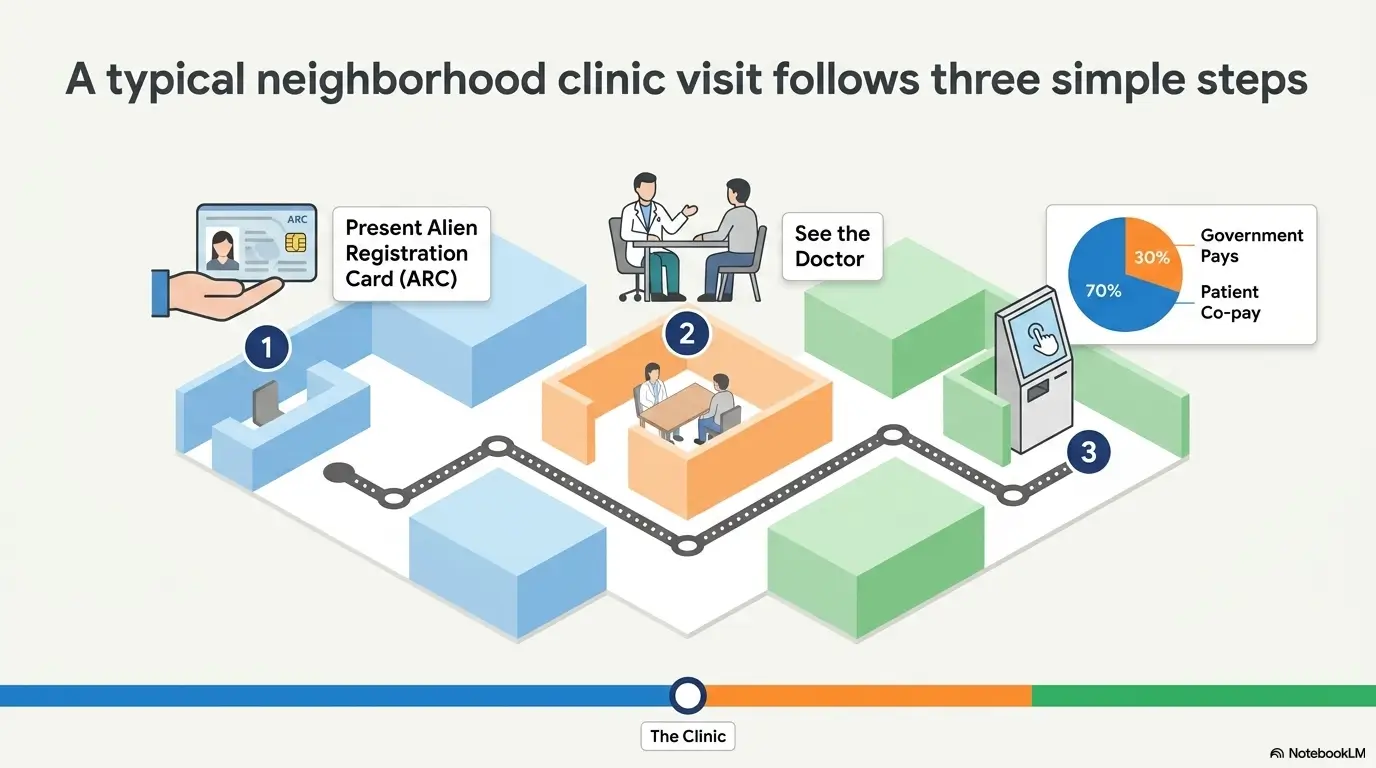
This does not mean every clinic visit costs nothing. NHIS usually reduces eligible charges, while patients still pay copayments and any noncovered expenses.
Covered does not mean free
Your out-of-pocket amount can vary by the type of provider, service, prescription, admission, and whether the item is classified as covered. A neighborhood clinic, a hospital outpatient department, and a large tertiary hospital may not produce the same patient bill for a similar concern.
For a closer look at inpatient procedures and deposits, see the guide to Korean hospital admission. Patients arranging scheduled treatment should ask for an estimate that separates covered and noncovered items.
The noncovered category surprises newcomers
Private rooms, upgraded materials, elective procedures, selected imaging, certain therapies, convenience services, and some newer treatments may sit partly or fully outside ordinary benefits. The exact classification matters more than the hospital’s glossy brochure.
- Ask whether each recommended service is covered, partially covered, or noncovered.
- Request the expected patient portion before planned treatment.
- Ask whether a clinically reasonable covered alternative exists.
- Confirm whether private insurance requires preauthorization.
- Keep itemized receipts, diagnosis documents, and medical records for reimbursement claims.
Prescriptions, dental care, and screenings need separate expectations
Not every medicine, dental procedure, eye-care expense, or preventive service is reimbursed in the same way. Brand choice, diagnosis, approved indication, and provider type can affect the bill.
Readers managing regular medication can use the guides to filling prescriptions in Korea and Korean pharmacies for foreigners to prepare for local procedures and language differences.
Eligible subscribers may also receive NHIS health checkups. General health checkups can be fully covered for eligible participants, while certain cancer-screening programs may involve a defined patient share. Confirm your invitation, age criteria, and screening schedule before booking.
Private Insurance: Bridge, Supplement, or Duplicate?
Before NHIS begins: build a bridge
A resident waiting for NHIS may consider travel medical insurance, international health insurance, a university plan, or employer-arranged interim coverage. The best fit depends on the length of the gap, planned care, medical history, travel outside Korea, and whether the insurer pays providers directly.
| Coverage option | Best for | Strength | Common weakness |
|---|---|---|---|
| Basic travel medical policy | Short interim stays and unexpected emergencies | Often lower cost | Limited routine care, renewability, or pre-existing-condition protection |
| International health insurance | Longer stays, frequent travel, or cross-border treatment preferences | Broader geographic and hospital options | Higher premiums, deductibles, and possible reimbursement paperwork |
| University-sponsored plan | Students during a defined academic period | Simple enrollment through the school | May have narrow networks or limited continuation |
| Employer interim arrangement | New hires waiting for registration or formal coverage | May be coordinated with work | Terms depend heavily on the contract |
| NHIS plus supplemental private coverage | Residents already enrolled in public insurance | Can target noncovered costs and additional benefits | Potential duplication and exclusions |
After NHIS begins: insure the gaps, not the logo
Once NHIS is active, private insurance should solve a specific remaining problem. That might include noncovered hospital costs, critical illness, evacuation, treatment abroad, private-room preferences, income protection, or access to a preferred international facility.
Private-insurance rule of thumb
Write down the financial risk you are trying to transfer. If the answer is merely “I want more insurance,” pause. Extra coverage can become an expensive echo when policies overlap.
Private coverage rarely cancels mandatory NHIS enrollment
Buying an international plan does not automatically exempt a resident from Korean public insurance. A narrow exclusion route may be available to certain workplace-insured foreigners who can prove equivalent medical protection through foreign law, foreign insurance, or an employer contract.
Approval is not automatic, documentary evidence is required, and timing rules apply. The NHIS English guidance states that an eligible employee seeking exclusion should submit the relevant application and proof through the employer.
What to inspect before paying for a private policy
- Pre-existing-condition definitions and look-back periods
- Maternity eligibility, waiting periods, and newborn coverage
- Outpatient, prescription, dental, and mental-health limits
- Annual maximums, per-condition caps, and deductibles
- Direct billing versus pay-first reimbursement
- Emergency evacuation and repatriation terms
- Coverage in the United States, Korea, and third countries
- Guaranteed renewal or the insurer’s right to reprice or decline renewal
- Whether NHIS participation changes reimbursement
- Documents and preauthorization required for planned care
For broader preparation before arrival, compare these questions with the guide to travel insurance for South Korea. Read the policy wording itself, not only the sales summary.
Open Official NHIS Guidance for Foreigners
Family Coverage and the Paperwork Behind It
A spouse is not automatically an NHIS dependent
Marriage establishes a family relationship, but it does not by itself establish dependent eligibility. NHIS also considers whether the person is mainly supported by the employee and whether income and property requirements are satisfied.
The official English guidance lists an annual total-income threshold of less than KRW 20 million for ordinary dependent assessment, with additional rules for business income, rental income, property, spouses, siblings, and cohabitation. These standards can change, and unusual cases deserve direct confirmation.
Foreign family documents may need authentication and translation
Foreign applicants may need a marriage certificate, birth certificate, divorce record, or another government-issued document proving the relationship. The document may require apostille or foreign-ministry authentication, sufficient identity details, recent issuance, and a Korean translation meeting NHIS requirements.
Family coverage document check
- Confirm the exact relationship NHIS needs to verify.
- Ask whether the document must have been issued within a specific period.
- Check whether apostille or consular authentication is required.
- Make sure names and birth dates match passports and residence records.
- Arrange an acceptable Korean translation and any required notarization.
- Ask which date coverage can begin if the application is filed now.
- Keep complete scans before surrendering or mailing originals.
NHIS guidance states that foreign relationship documents used for dependent applications generally need proper authentication and may need to be dated within nine months of issuance or confirmation. Documents not written in Korean generally require an acceptable notarized Korean translation.
Late paperwork can change the effective date
Dependent status may require an application within a specified period to receive an earlier effective date. Waiting until the next hospital appointment can produce a coverage gap or prevent the retroactive result you expected.
Submit family documents soon after the employee’s workplace coverage begins, after entry or registration, or after a change in family status. Ask NHIS to state both the application deadline and the proposed effective date.
One family bill may require a separate request
Eligible local-subscriber family members may be able to request household-based billing by submitting family-relationship documents. Do not assume that sharing an address, surname, or residence card automatically creates one insurance household.
Paperwork warning
Names that look “close enough” to a human may fail a database match. Check spacing, middle names, surname order, transliteration, and dates of birth before paying for authentication or translation.
Seven Costly Insurance Mistakes to Avoid
Mistakes 1 to 3: waiting, assuming, and budgeting from old numbers
- Waiting for NHIS to contact you. Mail may go to an old address, an employer report may be delayed, or the notice may arrive after premiums have already accrued.
- Assuming private insurance replaces NHIS. Equivalent private coverage and an approved statutory exclusion are not the same thing.
- Budgeting from last year’s rate. Contribution rates, average premiums, and long-term care charges can change annually.
Mistakes 4 and 5: ignoring automatic enrollment and travel history
- Ignoring a bill because you never applied. Mandatory enrollment can arise by law. A missing voluntary application does not necessarily erase the obligation.
- Treating every trip abroad as irrelevant. One long absence or several shorter departures can alter residence calculations or subscriber status.
Mistakes 6 and 7: late family documents and unpaid premiums
- Preparing family documents after the deadline. Apostilles, translations, and replacement certificates can consume weeks.
- Letting premiums become an immigration complication. Arrears can lead to collection action, restricted access to insurance benefits in some circumstances, and difficulties during certain immigration procedures.
NHIS states that unpaid contributions may be collected under legal authority. When a visa extension, change of status, re-entry, or expired stay is involved, check both NHIS and immigration requirements rather than relying on a forum post from three rule changes ago.
| Common mistake | Safer alternative |
|---|---|
| “My employer probably registered me.” | Ask for the workplace acquisition date and verify active coverage. |
| “I have international insurance, so NHIS cannot bill me.” | Confirm whether an exclusion is legally available and formally approved. |
| “My spouse will be added automatically.” | Submit the dependent application and relationship evidence promptly. |
| “A weekend trip never matters.” | Keep a complete travel record and request an official residence calculation. |
| “The hospital said it is covered.” | Ask which items are covered and request an estimate of your patient share. |
| “I can solve arrears when I renew my visa.” | Address bills early, before collection and immigration deadlines converge. |
When to Seek Help Before Changing Coverage
Contact NHIS when the enrollment date is unclear
Call before canceling private coverage, starting expensive treatment, leaving Korea for an extended period, or assuming that a new job solved an old local-subscriber bill.
- You changed employers or moved from employment to freelancing.
- Your visa category, school, address, or family status changed.
- You spent substantial time outside Korea.
- You received a bill for months when you believed you were exempt.
- Your payroll shows deductions but a hospital cannot verify coverage.
- A spouse or child has not appeared as a dependent.
Get immigration guidance when premiums and visa status collide
Immigration advice becomes valuable when unpaid premiums coincide with a visa extension, expired period of stay, re-entry issue, change of status, or pending residence application. NHIS determines insurance matters, while immigration authorities determine immigration status. One office may not resolve the other office’s question.
The official Hi Korea immigration portal provides immigration information and service access. For a disputed or high-value case, consider qualified immigration counsel or an experienced administrative professional.
Ask an insurance specialist about chronic or planned care
Generic policy comparisons are weak tools for pregnancy, surgery, cancer treatment, long-term prescriptions, mental-health care, or significant pre-existing conditions. Ask how the proposed policy treats your specific category of care without assuming that a condition will be accepted.
Readers planning counseling or psychiatric treatment may also find the guide to mental-health visits in Korea for foreigners useful when comparing language support, referrals, prescriptions, and payment expectations.
Escalate employer failures, but do not delay emergency care
If an employer refuses to report an apparently eligible employee, deducts money without verifiable enrollment, or provides inconsistent dates, preserve payslips, contracts, messages, work schedules, and deduction records. Contact NHIS promptly and consider employment advice when necessary.
In an emergency, seek medical care first. Insurance verification, reimbursement, and administrative corrections can be handled after immediate safety is addressed.
Review NHIS Foreign-Resident Rules
FAQ: Health Insurance in Korea for Foreigners
Do foreigners have to join Korean National Health Insurance?
Many foreign employees and qualifying registered residents are subject to mandatory NHIS enrollment. The route and timing depend on employment, visa status, residence history, student status, and dependent eligibility.
Does every foreign resident wait six months?
No. Eligible workplace employees may be enrolled through employment without waiting six months. Certain students, marriage immigrants, permanent residents, dependents, and other categories may follow different rules.
When does workplace insurance begin after starting a job?
It generally follows the employee’s workplace eligibility and employer reporting date. Ask the employer or NHIS for the exact acquisition date, particularly if reporting was delayed or deductions began before coverage appeared.
How much is Korean health insurance for foreigners in 2026?
Employee health-insurance contributions use a 7.19% total rate in 2026, usually split equally between employee and employer, with long-term care insurance added. The published 2026 average for applicable foreign local subscribers is KRW 158,630 per month, including long-term care insurance.
Can I use international health insurance instead of NHIS?
Usually not as an automatic replacement. Certain workplace-insured foreigners may apply for exclusion if they can prove equivalent protection through foreign law, foreign insurance, or an employer contract. NHIS approval and documentation are required.
Does leaving Korea reset the six-month waiting period?
A single absence exceeding one month can change the starting point. Several shorter trips totaling more than 30 days can also affect the calculation. Ask NHIS to calculate the official date from your complete travel history.
Can my spouse and children join as dependents?
Possibly. They must satisfy relationship, support, income, property, residence, and documentation requirements. Foreign certificates may need authentication and an acceptable Korean translation.
What happens if a foreign resident does not pay NHIS premiums?
Unpaid contributions can accumulate, become subject to collection, and create benefit or administrative problems. Serious arrears may also complicate certain immigration procedures. Contact NHIS early if the bill appears incorrect or unaffordable.
Does NHIS cover pre-existing conditions?
NHIS is a public social-insurance system rather than a medically underwritten private policy. Properly enrolled subscribers generally use covered benefits without a private-insurance-style exclusion based solely on having a prior condition. Individual services may still be noncovered or require patient cost sharing.
Should I keep private insurance after joining NHIS?
Keep it only when it protects a meaningful remaining risk, such as noncovered care, overseas treatment, evacuation, private-room costs, or income loss. Compare exclusions, deductibles, reimbursement rules, and duplication before renewing.
Your 15-Minute NHIS Check Before You Decide
Insurance decisions often become expensive when three different questions are tangled together: whether you must enroll, when enrollment begins, and what additional protection you still need. Untangle them in that order.
Make one confirmation call with four questions
- What is my exact NHIS eligibility or enrollment date?
- Am I classified as a workplace subscriber, local subscriber, or dependent?
- What is my estimated monthly premium, including long-term care insurance and any available reduction?
- Which documents and deadlines apply to family coverage, household billing, or an exemption request?
Have your residence card, visa code, Korean address, employment start date, school information, family status, and recent travel dates ready. Write down the representative’s answer, the date of the call, and any document names provided.
The NHIS lists 033-811-2000 for English consultation and 1577-1000 as its nationwide call center.
The calm next step
Do not cancel private coverage, ignore an NHIS bill, or book expensive planned care until your subscriber category and effective date are confirmed. Fifteen careful minutes now can prevent months of administrative archaeology later.
Last reviewed: 2026-08