

Foreign Patient Safety Guide
Seoul Plastic Surgery Complications: What Foreign Patients Should Know
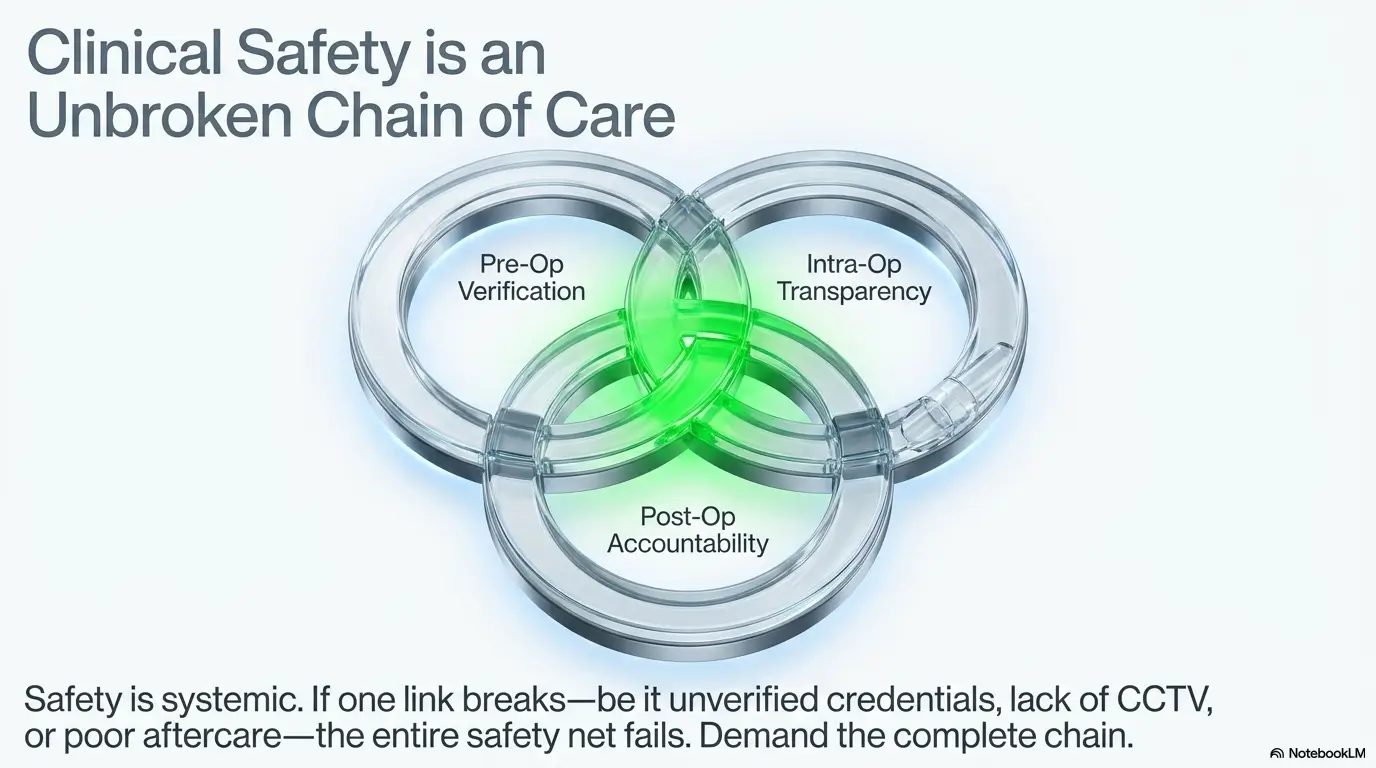
A Seoul clinic may look immaculate, communicate quickly, and show a gallery of polished results. None of those things answers the question that matters when healing takes an unexpected turn: who will examine you, where will you go, and who pays when a routine recovery becomes something else?
Complication planning belongs beside procedure choice, surgeon selection, anesthesia review, accommodation, and airfare. Possible problems range from bleeding and infection to poor wound healing, sensation changes, blood clots, anesthesia complications, functional changes, and the need for further treatment.
This guide helps foreign patients replace vague reassurance with a written plan. You will learn how to screen the medical team, recognise warning patterns without attempting a diagnosis, plan the flight home, preserve records, compare financial protections, and escalate care when a messaging-app reply is not enough.
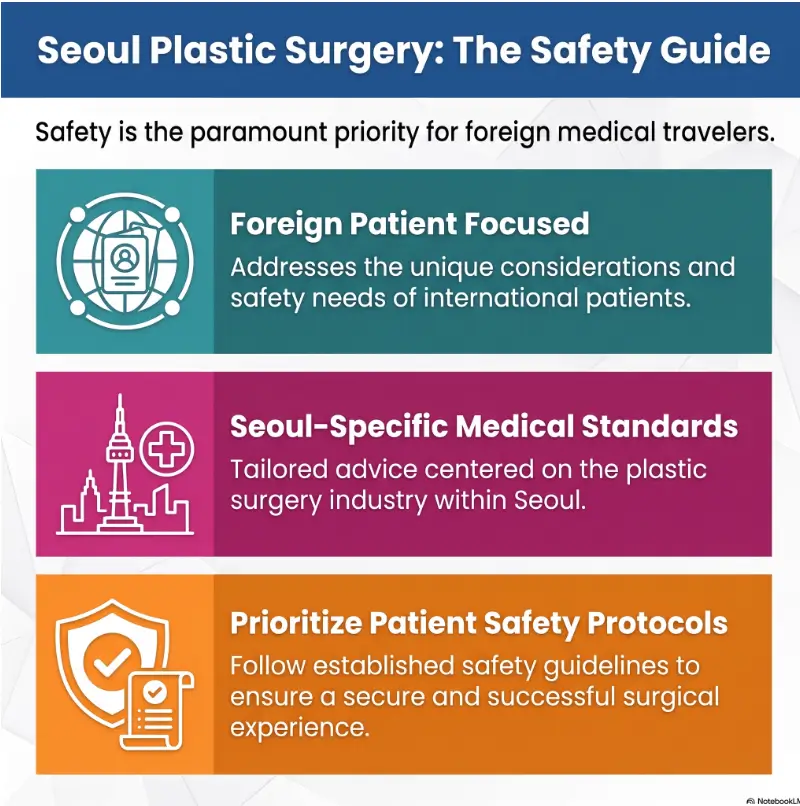
Spot the gaps
Check anesthesia, after-hours care, emergency transfer, consent, and record access.
Protect recovery time
Build follow-up appointments, mobility, lodging, and flight flexibility into the medical plan.
Know when to escalate
Separate routine clinic questions from symptoms requiring same-day or emergency assessment.
The safest bargain is not the lowest surgical quote. It is the plan that still works when recovery refuses to follow the brochure. 🩺
Snapshot
This article is for foreign patients considering elective cosmetic surgery in Seoul, planning postoperative care, or dealing with a concern after returning home. It will help you compare clinics more intelligently, prepare for complications and travel disruption, recognise when care should be escalated, and build a one-page safety plan before paying a deposit.
Table of Contents
Before You Act: What This Guide Can and Cannot Do
Medical safety note
This article provides general educational guidance. It cannot diagnose a postoperative complication, determine whether a result is negligent, or replace examination by a qualified clinician who knows your procedure and medical history.
In Korea, call 119 for fire, rescue, or ambulance assistance when life or health is in immediate danger. Foreign visitors who need language support can request English or an interpreter after the call connects. :contentReference[oaicite:0]{index=0}
Trouble breathing, chest pain, coughing blood, fainting, severe confusion, uncontrolled bleeding, or rapidly worsening symptoms require immediate medical attention. Do not wait for a clinic coordinator to wake up, translate a photograph, or ask a surgeon who may be operating.
Fever, increasing incision pain, spreading redness, unpleasant drainage, new weakness, vision changes, or a recovery pattern that is clearly worsening should be reported promptly to a healthcare professional. Infection can involve fever, redness, soreness, swelling, or new pain, but only an examination can establish what is happening.
Key takeaway
Use this guide to prepare questions and documents. Use a qualified clinician to interpret symptoms, examine wounds, review test results, and decide whether treatment or travel is safe.
Complication Types That Matter Beyond the Before-and-After Photo
A complication list becomes useful only when it helps you understand urgency, likely treatment needs, and the practical effect on travel. A tiny area of irritation, a rapidly expanding collection of blood, and shortness of breath do not belong in the same decision box.
Risks also vary by procedure. Facial bone surgery, eyelid surgery, rhinoplasty, breast procedures, liposuction, fat transfer, body contouring, hair transplantation, and combined operations have different recovery demands. The clinic should explain the risks of your exact procedure, not hand you a universal consent sheet with a signature line and a cheerful highlighter.
Bleeding, hematoma, fluid collection, and infection
Bleeding may remain minor, collect beneath the skin, or create pressure that requires urgent assessment. Increasing one-sided swelling, tightness, bruising, pain, dizziness, or bleeding that does not stop should not be dismissed simply because bruising was expected.
Infection and delayed healing can appear during the Seoul stay or after departure. Risk assessment should consider the wound, procedure, implants or devices, smoking or nicotine exposure, medications, immune health, hygiene instructions, and how quickly appropriate care can be reached.
Numbness, weakness, persistent pain, and functional change
Temporary altered sensation can occur after many procedures, but “temporary” should not become a blanket answer for every symptom. Ask what sensations are expected, which movements or functions should remain intact, what improvement usually looks like, and which changes require an examination.
Functional complications can affect breathing, eyelid closure, vision, chewing, speech, facial movement, arm movement, walking, sleep, or daily care. These concerns deserve more attention than whether a contour matches an edited reference photograph.
Asymmetry, scarring, dissatisfaction, and revision surgery
An unsatisfactory result is not automatically a medical emergency, and it is not automatically proof of improper care. Swelling may distort early appearance, tissues may settle unevenly, and scars can evolve over months.
Revision surgery is also not a magic eraser. It may introduce new anesthesia, infection, scarring, healing, financial, and travel risks. A clinic’s “free revision” language may cover only the surgeon’s fee, not facility charges, medication, testing, flights, accommodation, time away from work, or treatment by another institution.
| Complication category | Examples | Why it changes the plan |
|---|---|---|
| Immediate medical concern | Severe bleeding, breathing difficulty, chest pain, fainting, rapidly increasing swelling | May require emergency assessment rather than remote clinic advice |
| Prompt clinical review | Fever, worsening redness, drainage, increasing pain, wound separation | May require examination, tests, wound care, medication, or further treatment |
| Functional concern | New weakness, vision change, difficulty closing an eye, impaired breathing or movement | Can affect health and daily function even when appearance seems acceptable |
| Cosmetic outcome concern | Asymmetry, contour irregularity, visible scarring, unmet expectations | Usually requires time, photographs, examination, and a careful revision discussion |
Show me the nerdy details
Postoperative decisions are based on patterns, not a single photograph. Clinicians may consider the procedure performed, time since surgery, vital signs, pain pattern, symmetry, wound appearance, drainage, mobility, medications, medical history, and whether symptoms are improving or accelerating.
Aesthetic dissatisfaction and medical complications may overlap, but they are not interchangeable. A contour concern can wait for swelling to settle; breathing difficulty cannot. This is why the clinic’s written escalation instructions matter more than a general promise that “swelling is normal.”
The “Normal Swelling” Trap: When Recovery Stops Looking Routine
After surgery, patients often inspect the mirror as though it were a medical monitor. The mirror can show change, but it cannot measure oxygen, identify a blood clot, culture a wound, or distinguish expected inflammation from a developing collection beneath the skin.
The more useful question is not, “Is swelling normal?” It is, “Is my recovery moving in the direction described in my written aftercare plan?”
Recovery trends matter more than one mirror check
Expected recovery usually has a recognisable pattern, even when it is uncomfortable. Your clinician should explain when swelling commonly increases, when it should begin easing, which side-to-side differences may occur, how pain should respond to medication, and when the next examination is due.
A sudden reversal deserves attention. Pain that was improving and then sharply worsens, swelling that rapidly expands, or a wound that develops new redness or drainage should be discussed promptly with a clinician.
One-sided swelling deserves a closer look
Some asymmetry is common during healing, especially when procedures affect both sides. The concern rises when one side changes quickly, becomes unusually tense, painful, discoloured, hot, or associated with bleeding or reduced function.
Do not press, massage, drain, cool, heat, or medicate a new problem unless a qualified clinician has advised that action for your procedure. Advice copied from another patient’s recovery diary may be perfectly sincere and perfectly wrong for you.
Short Story: The symptom that appeared after checkout
A fictional patient named Maya booked a facial procedure in Seoul and stayed five nights. At her final clinic visit, the swelling appeared stable, so she moved from a recovery hotel to an airport hotel before her morning flight.
That evening, one side became noticeably tighter and more painful. Her coordinator replied that swelling was common and asked for another photograph under brighter light.
Maya compared the change with her discharge instructions. The instructions listed rapidly increasing one-sided swelling as a reason for urgent assessment. She contacted the clinic’s medical number, not the sales chat, and was examined that night.
The lesson is not that every uneven cheek is dangerous. It is that checkout does not end medical risk. A useful aftercare plan names the symptoms, the medical contact, the backup hospital, and the action to take when the clinic is closed.
Key takeaway
Ask for a written recovery timeline with symptom thresholds. “Message us if worried” is not a complete escalation plan.
Before You Book: Verify the Medical Team Behind the Marketing
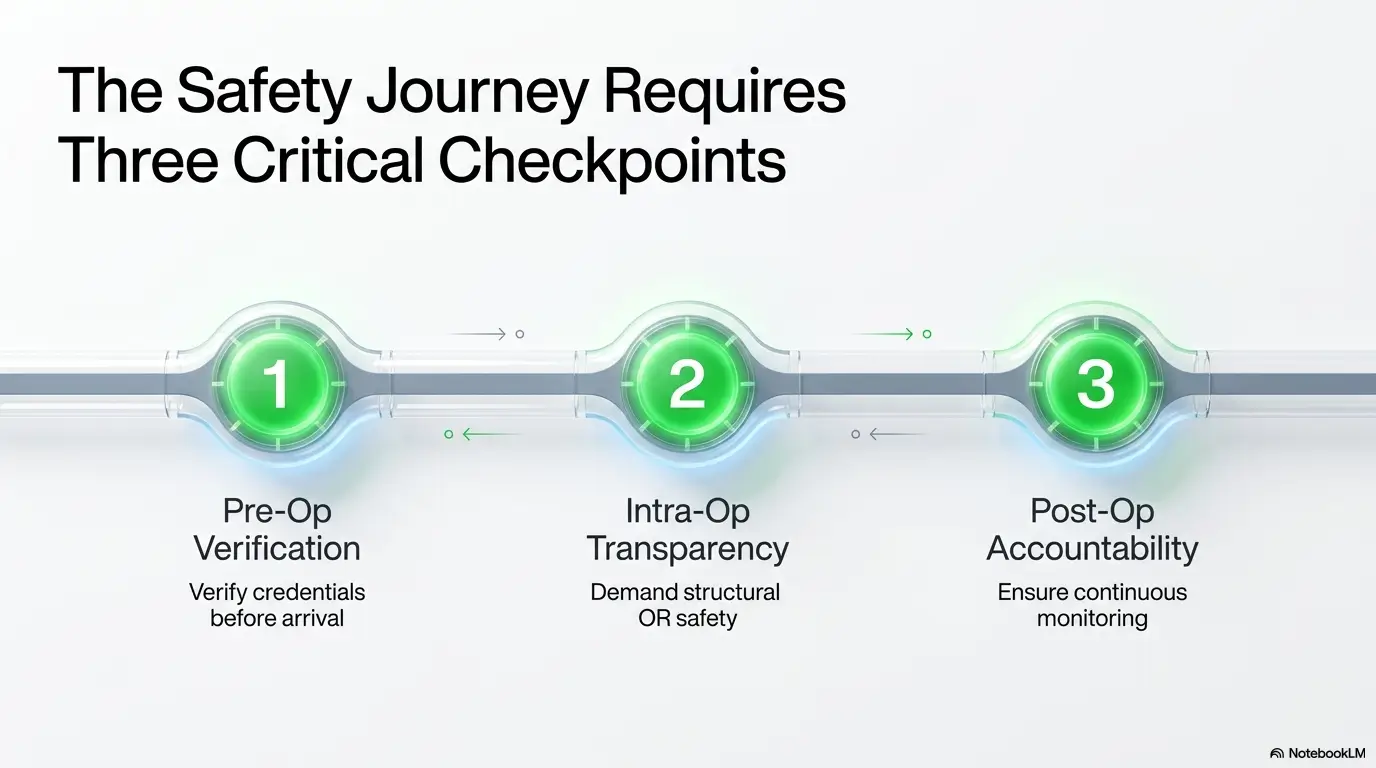
A polished coordinator can make an overseas procedure feel simple. Yet the coordinator may not be a physician, nurse, interpreter, or person authorised to make clinical decisions. Your due diligence should move past social-media responsiveness and identify the licensed people responsible for consultation, anesthesia, surgery, recovery, and emergencies.
For broader context on how Korean cosmetic providers communicate with international visitors, review this guide to Korean beauty clinics for foreign patients. Then return to the questions below and insist on procedure-specific answers.
Confirm the surgeon’s full name, role, and specialty
Ask for the surgeon’s full legal name in English and Korean, professional role, specialty, and responsibility for your operation. Confirm whether the person conducting the consultation will perform the procedure or whether another clinician may be substituted.
Do not rely on group photographs, initials, nicknames, or a clinic brand as proof of who will operate. The surgeon’s identity should appear on the surgical plan, consent documents, and medical record.
Identify who administers and monitors anesthesia
Ask what type of anesthesia or sedation is planned, who will administer it, who monitors you throughout the procedure, and what recovery monitoring is provided before discharge. Also ask what happens if the procedure lasts longer than expected or an airway, cardiac, allergic, or medication problem occurs.
Request the emergency-transfer and after-hours plan
The clinic should be able to explain where a patient is transferred when hospital-level care is needed, how transportation is arranged, what medical information accompanies the patient, and who communicates with the receiving team.
Ask for separate numbers for routine coordination and urgent medical concerns. A chat account staffed during sales hours is not the same as an after-hours clinical service.
Check registration, then ask about financial protection
Medical Korea maintains an official directory of registered hospitals serving foreign patients. A directory entry is a useful starting point, but it does not guarantee your desired result or eliminate surgical risk. Verify the exact institution name and address, then ask for written details about current liability or compensation coverage and the process for submitting a claim.
Clinic verification checklist before paying
- Record the clinic’s legal name, physical address, registration details, and main telephone number.
- Obtain the operating surgeon’s full name and confirm who performs each part of the procedure.
- Identify the anesthesia professional and planned monitoring.
- Ask which hospital receives emergency transfers and how transportation is arranged.
- Request after-hours medical contact details for nights, weekends, and public holidays.
- Ask who examines you if the primary surgeon is unavailable.
- Request written complication, refund, cancellation, and revision terms.
- Confirm when complete medical records can be issued and whether English copies are available.
| Planning level | What it includes | Likely limitation |
|---|---|---|
| Good | Named surgeon, written quote, basic consent, clinic-hours contact | Weak coverage for nights, emergencies, translation, and delayed travel |
| Better | Named surgical and anesthesia teams, after-hours number, emergency hospital, written aftercare, flexible lodging | May still leave gaps in insurance and US follow-up |
| Best prepared | Everything above plus independent translation, US follow-up contact, document plan, insurance review, emergency fund, flexible return ticket | Costs more upfront but reduces preventable confusion and rushed decisions |
The Consent Gap: What Can Disappear Between Translation and Surgery
Informed consent is more than a signature confirming that “risks were explained.” You need to understand the exact procedure, alternatives, expected recovery, material risks, likely limitations, and what happens if the plan changes during surgery.
Language support is central to that process. A coordinator may be kind and bilingual while still lacking medical translation training. For a closer look at the practical difference, read this guide to medical translation in Korea.
Interpreter, coordinator, or salesperson: know who is translating
Ask who employs the translator, whether the person has medical interpretation experience, and whether they will be present for the surgeon’s risk discussion rather than only the payment conversation.
When the procedure is complex or the financial stakes are high, paying for an independent qualified interpreter may be worth considering. Independence does not guarantee perfect consent, but it reduces pressure to compress, soften, or redirect difficult questions.
Get the exact procedure and materials in writing
Your file should identify the planned surgical sites, techniques, implants, devices, grafts, injected materials, donor sites, and any options that could be changed during surgery. Ask which changes require fresh consent and which decisions may be made intraoperatively for safety.
Separate revision policy from financial responsibility
“Revision available” and “all complication costs covered” are entirely different promises. Ask the clinic to state what is included, what is excluded, who decides eligibility, how long the policy lasts, and whether treatment can be performed by another provider.
| Cost or service | Question to ask in writing |
|---|---|
| Surgeon fee | Is the fee waived for an approved revision, and under what conditions? |
| Operating room and anesthesia | Are facility, anesthesia, nursing, and medication charges included? |
| Hospital treatment | Who pays if emergency admission or treatment at another institution is needed? |
| Travel and accommodation | Are additional flights, hotels, meals, and local transport excluded? |
| Lost income | Does the policy address missed work or caregiving costs? |
| US follow-up | Will the clinic coordinate records or speak with a treating physician at home? |
Key takeaway
Never sign a document you cannot fully understand. Ask for enough time to review it without a coordinator waiting beside the payment terminal.
The Flight-Home Problem Nobody Budgets For
The return date is a clinical decision wrapped inside a travel booking. It should reflect the operation, anesthesia, mobility, pain control, wound care, follow-up schedule, clot risk, and the availability of treatment if symptoms change.
A discounted nonrefundable flight can quietly become the most expensive item in the package if it pressures you to leave before an examination, travel while unwell, or abandon a needed treatment plan.
Recent surgery plus prolonged sitting changes clot-risk planning
Travel lasting more than four hours can contribute to blood-clot risk, and recent surgery is an additional risk factor. Individual risk varies, so discuss travel timing and prevention with the treating clinician rather than relying on a fixed waiting period copied from a clinic FAQ.
Do not start aspirin, anticoagulants, compression devices, massage, or other preventive measures on your own. The appropriate choice depends on bleeding risk, surgery type, medications, health history, and the clinician’s assessment.
Do not book the tightest possible recovery window
Build in time for the first meaningful follow-up, not merely a dressing change or quick photograph. Ask the surgeon what must be checked before departure, whether stitches or drains remain, how mobility should progress, and what would delay travel.
Budget-conscious travelers often concentrate on the surgical price while treating extra hotel nights as wasted money. In reality, flexible lodging can be a safety tool. It buys time for reassessment without forcing a choice between medical advice and a prepaid itinerary.
Carry medications and medical documents correctly
Keep prescribed medication, the prescription or medication list, discharge instructions, surgeon details, procedure date, allergy information, and emergency contacts in your carry-on bag. Check airline, airport, and destination rules for liquids, syringes, controlled medicines, or refrigerated products.
Foreign patients who need help filling or replacing medication locally may also benefit from this guide to Korean pharmacies for foreigners.
Arrange US follow-up before departure
Some US clinicians may be willing to evaluate complications but may not provide routine postoperative management for surgery performed elsewhere. Call ahead, explain the procedure honestly, and ask what records are required.
Review travel insurance and health insurance terms before paying the clinic. Cosmetic treatment, planned medical travel, complications of elective procedures, trip changes, and medical evacuation may be treated differently. This guide to travel insurance for South Korea can help you identify questions to take to an insurer.
Key takeaway
Do not ask only, “When can most patients fly?” Ask, “What must be true in my recovery before you approve my flight?”
Common Mistakes That Turn Small Problems Into Expensive Ones
Choosing a clinic from edited photographs alone
Before-and-after galleries can help you discuss preferences, but they cannot show emergency readiness, infection control, anesthesia staffing, record quality, consent accuracy, or how dissatisfied patients were managed.
Use photographs as one small piece of the comparison. Give greater weight to the named medical team, realistic risk discussion, aftercare access, documentation, and the clinic’s willingness to answer uncomfortable questions before receiving money.
Combining procedures mainly to save airfare
Combining procedures may sometimes be clinically reasonable, but airfare should not be the main medical argument. More operating time, more treatment areas, greater mobility limits, competing wound-care needs, and a harder recovery can change the risk discussion.
Ask the surgeon to explain the benefit of combining procedures, the alternatives, the added recovery burden, and whether separating them would materially improve safety or aftercare.
Hiding nicotine, medications, supplements, or medical conditions
Patients sometimes minimise information because they fear cancellation. That can interfere with anesthesia planning, bleeding assessment, wound healing, drug interactions, and postoperative care.
Tell the medical team about nicotine in every form, prescribed and nonprescribed medicines, supplements, allergies, previous anesthesia problems, clot history, sleep apnea, pregnancy possibility, chronic illness, and recent infections. Let the clinician decide what matters.
Assuming the coordinator is an emergency service
A coordinator may relay information, arrange transport, or translate messages. They may not be able to assess vital signs, examine tissue, order imaging, prescribe treatment, or manage an emergency.
- Use the coordinator for logistics and communication support.
- Use the clinic’s medical contact for clinical questions.
- Use same-day medical care when symptoms need examination.
- Use emergency services when symptoms are severe or rapidly worsening.
Waiting for the original clinic while symptoms worsen
The clinic that performed the procedure has valuable information, but it is not always the fastest or safest route to hands-on care. If you are back in the United States, contact the clinic while also seeking local assessment when symptoms are urgent.
Embarrassment, fear of a hospital bill, worry about voiding a revision policy, or loyalty to the original surgeon should never delay emergency treatment.
When to Seek Help: Clinic Message, Same-Day Care, or Emergency Room?
No online checklist can diagnose every postoperative problem. A practical escalation framework can still reduce hesitation by matching the level of response to the seriousness and speed of the change.
| Level | Examples | Practical action |
|---|---|---|
| Emergency now | Breathing difficulty, chest pain, coughing blood, fainting, severe confusion, severe uncontrolled bleeding, rapidly expanding swelling, sudden major neurological change | Call 119 in Korea or local emergency services in your current country |
| Urgent same-day assessment | Increasing one-sided swelling, worsening severe pain, wound separation, significant bleeding, new vision problem, new weakness, inability to keep medication or fluids down | Contact the clinic’s medical line and obtain in-person assessment without waiting for a routine appointment |
| Prompt clinician contact | Fever, spreading redness, new drainage, rising tenderness, medication reaction, recovery moving backward | Report symptoms promptly and follow the clinician’s examination or monitoring instructions |
| Routine follow-up question | Expected bruising, stable mild swelling, ordinary incision-care question, scheduled dressing issue | Use the clinic’s routine communication channel and written aftercare plan |
Document symptoms, but never delay treatment to gather evidence
Photographs, timestamps, medication lists, temperature readings, and message records can help a clinician understand progression. Take them only when doing so does not postpone urgent care.
If you are too unwell to organise files, hand your phone and documents to a trusted companion. The body comes first; the folder can be tidied later.
Prepare for hospital care in Korea
Bring identification, procedure information, medication and allergy lists, clinic details, insurance documents, and a payment method. This overview of Korean hospital admission for foreign patients can help you understand practical paperwork and communication needs.
The four-step complication response
1. ASSESS
Is the symptom severe, rapidly worsening, or affecting breathing, consciousness, vision, bleeding, or function?
2. CONTACT
Use emergency services, same-day clinical care, or the clinic’s medical line according to urgency.
3. EXAMINE
Do not let remote photographs replace an examination when symptoms require hands-on assessment.
4. RECORD
Preserve medical notes, images, prescriptions, receipts, messages, and the timeline after safety is addressed.
The hard line
Safety comes before protecting a package price, revision promise, deposit, flight, or relationship with the clinic.
If Something Goes Wrong: Build the Record Before the Story Blurs
Complication care comes first. Once the immediate medical issue is addressed, create a clear record that supports continuity of care, insurance questions, direct resolution with the clinic, and any formal dispute process.
Request your complete medical file
Ask for records before leaving Korea whenever possible. If the clinic cannot provide everything immediately, obtain written confirmation of what was requested, the expected delivery method, and the contact responsible for the request.
- Consultation notes and medical-history forms
- Consent forms and procedure plan
- Operative report
- Anesthesia record and recovery-room record
- Implant, device, graft, or material details
- Laboratory and imaging results
- Prescriptions and medication administration record
- Progress notes, wound-care notes, and discharge instructions
- Clinical photographs
- Itemised invoices, receipts, and payment records
- Referral, transfer, or emergency-treatment documents
Preserve advertisements, quotations, chats, and a dated timeline
Save the advertisement or webpage that influenced your decision, the original quote, deposit terms, procedure description, revision promises, coordinator messages, appointment changes, payment receipts, and postoperative communications.
Create a simple timeline with dates, times, symptoms, photographs, clinic replies, medical visits, diagnoses, treatments, costs, cancelled travel, and missed work. Write facts rather than accusations. A calm timeline is easier for physicians, insurers, mediators, and lawyers to review.
Seek an independent medical assessment when necessary
An independent clinician can assess current health needs, document findings, recommend treatment, and explain whether more information is required. They may not be able to determine the full cause or legal responsibility from limited records.
Ask the Seoul clinic to provide files in a format your US clinician can open. Reliable translation may be needed for operative, anesthesia, imaging, pathology, and discharge records.
Free, paid, and formal support options
| Option | What it can help with | When it may be enough |
|---|---|---|
| Direct clinic resolution | Records, explanation, follow-up, refund discussion, revision proposal | Communication remains constructive and the medical issue is being addressed safely |
| Independent translator | Consent review, medical records, meetings, written correspondence | Language accuracy is the main obstacle |
| Independent medical opinion | Current assessment, treatment needs, documentation, continuity of care | You need clinical guidance beyond the original clinic |
| Insurance assistance | Coverage review, claim documents, trip interruption, eligible medical expenses | A policy may apply and timely notification is required |
| Medical dispute mediation | Structured consultation, application guidance, review of records and positions | Direct resolution has stalled or a formal process is appropriate |
| Independent Korean legal advice | Deadlines, evidence, contractual issues, litigation options, representation | The loss is substantial, facts are disputed, or legal rights need individual review |
The Korea Medical Dispute Mediation and Arbitration Agency provides English-language guidance for foreign patients, including application routes for people living inside or outside Korea. Participation requirements, documentation, procedure, timing, and possible outcomes should be confirmed for the individual case.
FAQ About Seoul Plastic Surgery Complications
How much swelling is normal after plastic surgery in Seoul?
There is no universal amount or number of days that is safe for every procedure. Consider the operation, time since surgery, whether swelling is improving or accelerating, whether it is one-sided, and whether it comes with increasing pain, redness, drainage, bleeding, fever, visual symptoms, breathing problems, or reduced function.
Follow the written instructions for your procedure and contact a qualified clinician when the pattern differs from what was explained.
What symptoms mean I should go to an emergency room?
Breathing difficulty, chest pain, coughing blood, fainting, severe confusion, severe uncontrolled bleeding, rapidly worsening swelling, major neurological changes, or any symptom that feels immediately life-threatening should be treated as an emergency.
Call 119 in Korea or the emergency number in your current country. Do not wait for a routine clinic reply.
Can I fly home a few days after plastic surgery?
Possibly, but a few days is not a universal safe interval. The decision depends on the operation, anesthesia, mobility, clot risk, wound status, pain control, follow-up needs, and the treating clinician’s assessment.
Ask what examination must occur before departure and which findings would postpone travel.
What happens if a complication begins after I leave Korea?
Contact the Seoul clinic, but seek local US medical care according to urgency. Share the operative report, anesthesia record, implant or material information, medication list, discharge instructions, and symptom timeline.
Notify applicable insurers promptly, preserve receipts and records, and document additional travel, accommodation, treatment, and lost-income costs.
Who pays for hospital treatment or revision surgery?
Payment depends on written clinic terms, liability or compensation arrangements, insurance coverage, the facts of the complication, and any negotiated or formal dispute outcome. A verbal promise of “free revision” may not cover hospital treatment, anesthesia, flights, accommodation, US care, medication, or lost income.
How can I check a Seoul clinic before paying a deposit?
Verify the named surgeon, clinic identity, official registration listing, anesthesia arrangements, emergency-transfer plan, after-hours access, record policy, written complication terms, and revision exclusions. Compare independent patient accounts cautiously, looking for patterns rather than one dramatic review.
Which medical records should I collect before returning home?
Collect consultation notes, consent forms, operative and anesthesia records, implant or material information, prescriptions, laboratory and imaging results, progress notes, photographs, itemised bills, receipts, and discharge instructions. Request English versions or reliable translations when available.
Can a foreign patient pursue a medical dispute in Korea?
Foreign patients may explore direct resolution with the institution, Korea’s medical-dispute mediation process, insurer procedures, and independent Korean legal advice. Requirements and deadlines can depend on the facts and chosen route, so obtain current case-specific guidance rather than relying on a general online summary.
Build Your One-Page Complication Plan in 15 Minutes
Before paying a deposit, open a blank document and create four boxes. This small exercise exposes missing answers faster than another hour of scrolling through transformation videos.
Box 1: Emergency numbers and hospital
- 119 for emergencies in Korea
- Clinic’s urgent medical number
- Operating surgeon’s full name
- Nearest suitable hospital
- Hotel name, address, and room number
- Companion’s telephone number
Box 2: Named aftercare contacts
- Who answers during clinic hours?
- Who answers at night?
- Who answers on weekends and public holidays?
- Who makes medical decisions if the surgeon is unavailable?
- Which channel is for logistics, and which is for medical concerns?
Box 3: Recovery and flight checkpoints
- Scheduled follow-up dates
- Earliest clinician-approved travel date
- Mobility and wound-care instructions
- Symptoms that delay travel
- Flexible accommodation option
- Flight-change process and likely cost
Box 4: Records and financial protection
- Written procedure and surgical quote
- Consent and revision terms
- Medical-record request list
- Insurance confirmations and exclusions
- Payment receipts
- Emergency treatment fund
- US follow-up contact
Final checkpoint
No written plan, no deposit.
A clinic does not need to promise a risk-free result. It should be willing to identify the medical team, explain foreseeable risks, provide realistic aftercare, clarify financial terms, and show you exactly what happens when recovery does not proceed as planned.
Last reviewed: 2026-08