
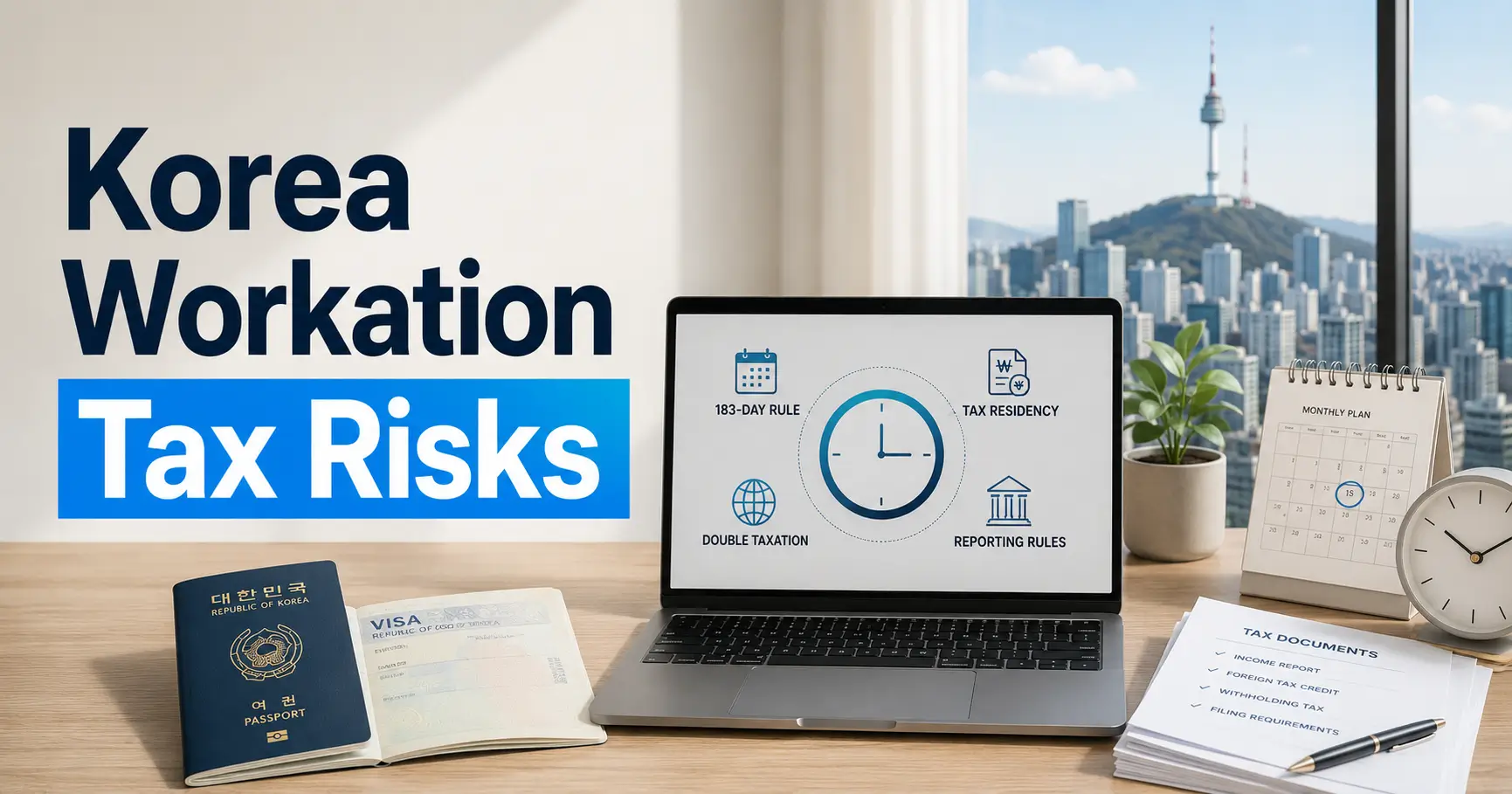
Remote work in Korea
South Korea Workation Visa Tax Risks Before Your Remote Stay Gets Expensive
A Seoul apartment, fast internet, and a foreign salary can look like a clean arrangement. Immigration law, individual tax rules, treaty provisions, U.S. reporting, employer payroll, and corporate-tax exposure may see several different arrangements hiding inside the same laptop.
The workation visa can support a qualifying stay for overseas business owners and foreign-company workers, but it does not issue a matching tax exemption. A legal immigration status answers whether you may stay and perform the permitted remote activity. It does not automatically answer where your salary is sourced, whether Korea treats you as resident, or whether your employer has acquired Korean obligations.
This guide turns those overlapping rules into a practical pre-move review. You will see why the famous 183-day rule is only one clock, how the U.S.–Korea treaty’s small dollar thresholds can surprise modern earners, and which facts should reach a cross-border adviser before your suitcase reaches the airport.
Separate the clocks
Track immigration, Korean residence, treaty days, and U.S. qualification periods independently.
Protect the employer
Identify payroll, permanent-establishment, contract, and data-security questions before approval.
Build one clean memo
Give Korean and U.S. advisers the same dates, compensation details, authority, and entity facts.
The safest workation plan is not the one with the fewest days. It is the one with the fewest unanswered questions. 🧭
Snapshot
This article is for U.S. employees, freelancers, consultants, founders, and one-person business owners planning an extended remote-work stay in South Korea. It helps you separate visa permission from tax exposure, spot employer-level risks, compare DIY preparation with professional review, and prepare a fact memo that can be checked before departure.
Table of Contents
Before You Book: What This Guide Can and Cannot Decide
Practical guidance, not a personalized tax position
This article explains the questions that commonly arise when a U.S.-connected remote worker lives and works from South Korea. It cannot determine your residency, treaty eligibility, payroll treatment, visa compliance, permanent-establishment status, or final tax bill.
Those results depend on exact dates, citizenship and residency, compensation type, employer structure, work location, authority, family ties, Korean business activity, state domicile, and how the relevant rules are administered when you file.
Before you act
Confirm current visa documents and income requirements with the Korean diplomatic mission or immigration office handling your case. For a stay involving substantial compensation, self-employment, equity, a Korean affiliate, contract authority, or more than a few months of work, consider coordinated advice from a Korean tax professional, a U.S. international tax preparer, and the employer’s payroll or corporate-tax adviser.
The facts that change the answer fastest
- Your arrival, departure, side-trip, and re-entry dates
- Whether you are an employee, contractor, partner, shareholder, or corporate officer
- Where the employing or invoicing entity is resident
- Whether a Korean affiliate bears or recharges your compensation
- Whether you negotiate or conclude contracts
- Whether you serve Korean customers or accept Korean side income
- Whether your family, permanent home, or strongest personal ties remain in a U.S. state
- Whether bonuses, commissions, options, or restricted stock relate to workdays in Korea
Key takeaway
Your job title is not enough. Dates, physical workdays, compensation flow, entity relationships, and decision-making authority usually tell the more useful story.
Visa Approval Is Not Tax Clearance
What the South Korea workation visa authorizes
South Korea’s published digital-nomad or workation framework covers qualifying overseas business owners and workers affiliated with international companies who can work remotely. The official guidance also refers to prior industry experience, income evidence, criminal-record documentation, private medical insurance, and accompanying family members.
The published framework grants a one-year period of stay from entry when the holder registers as a foreigner, with a possible additional one-year extension. It also states that employment and profit-making activities are restricted, which makes unapproved Korean client work, paid appearances, sponsorships, and local consulting especially sensitive.
What the visa does not decide
A visa decision does not automatically determine Korean individual income tax, treaty relief, Korean payroll withholding, U.S. federal filing, state residency, foreign tax credits, social-insurance treatment, or corporate permanent-establishment exposure.
Think of immigration and tax as two desks in the same government building. One desk can approve your stay without issuing an opinion for the other desk. The paperwork may share your name, but the legal questions are different.
The income number moves
The visa guidance describes the income requirement as more than twice the previous year’s per-capita gross national income announced by the Bank of Korea. The older example printed in the guidance is not a permanent threshold for future applications. Confirm the current amount, exchange-rate treatment, acceptable evidence, insurance wording, and document-validity periods with the mission processing your application.
Once you begin planning housing, remember that a long lease can become evidence of a settled living arrangement as well as a practical commitment. Review the mechanics of an officetel lease in Korea before paying a deposit or promising a full year to a landlord.
Real-world example: lawful stay, taxable work
Maya receives the workation visa, keeps her U.S. employer, receives dollars in a U.S. bank account, and performs her regular duties from a Seoul apartment for seven months.
Her immigration permission may be valid. That alone does not establish that her salary is outside Korean tax, that the treaty exempts it, or that her employer has no Korean payroll review. Each conclusion requires a separate test.
The 183-Day Trap: Four Clocks, Not One
Clock one: your permitted immigration stay
The immigration clock tells you how long your status permits you to remain. A potential one-year visa period does not promise one year of Korean tax nonresidence.
Clock two: Korean domestic tax residence
Korean income-tax law defines a resident as an individual with a domicile in Korea or a place of residence in Korea for at least 183 days. Domicile is a factual concept, so family, housing, occupation, property, and the expected pattern of living may matter alongside the day count.
This is why “I will leave on day 182” is not a universal plan. It may ignore an earlier residence conclusion, domestic-source income, treaty conditions, employer obligations, and rules that do not depend on personal tax residency.
Clock three: treaty days in the taxable year
The U.S.–Korea income-tax treaty contains separate provisions for independent personal services and dependent personal services. Its employee exemption refers to presence of less than 183 days in the taxable year, but that is only one of several required conditions.
Clock four: the U.S. foreign earned income period
The U.S. physical-presence test uses at least 330 full days in foreign countries during a qualifying 12-consecutive-month period. A full day generally runs from midnight to midnight, and travel over international waters can affect which days count. The bona fide residence route generally requires an uninterrupted period that includes an entire tax year and depends on more than simply renting abroad for twelve months.
| Clock | What it answers | Common counting error |
|---|---|---|
| Immigration | How long your status permits you to stay | Assuming permitted stay equals tax-free stay |
| Korean domestic residence | Whether Korea may treat you as a tax resident | Ignoring domicile facts and focusing only on a spreadsheet |
| U.S.–Korea treaty | Whether a specific treaty article may limit Korean taxation | Checking only the 183-day condition |
| U.S. FEIE qualification | Whether foreign residence or physical presence may support an exclusion | Counting travel days as full foreign days |
The Four-Clock Check
1. Permission
May you remain and perform the proposed activity?
2. Residence
Do Korean domicile or residence facts make you resident?
3. Treaty
Does the correct article satisfy every condition?
4. Relief
How will U.S. filing, FEIE, credits, and state rules interact?
The calendar rollover that scrambles casual day counting
Suppose you arrive on November 15 and leave the following June 30. Your total stay is longer than 183 days, but it crosses two calendar years. The treaty’s taxable-year day condition, Korean domestic residence analysis, and the U.S. 330-full-day test may each produce a different question.
A calendar rollover is not a loophole. It is a warning that each clock needs its own column, definition, and supporting records.
Key takeaway
Never write one number labeled “days abroad.” Maintain separate totals for Korean presence, treaty taxable years, full foreign days for U.S. purposes, and every entry or exit.
The $3,000 Treaty Clause Most Remote Workers Miss
Article 19 asks employees to satisfy four conditions
Under the treaty text, dependent-personal-services remuneration may be exempt from tax in the other country only when all listed requirements are met. For a U.S. resident employee working in Korea, the conditions include presence in Korea for less than 183 days in the taxable year, employment by a qualifying U.S. resident or permanent establishment, remuneration not borne by the employer’s Korean permanent establishment, and income not exceeding $3,000 or the won equivalent.
That final threshold is striking because it comes from an older treaty. A modern software engineer, consultant, executive, or designer may exceed $3,000 after a small number of Korean workdays.
Why a 90-day stay can still require Korean tax analysis
Consider a U.S. employee earning $180,000 annually who works from Seoul for 90 days. The stay is below 183 days, the employer is American, and the salary lands in an American account.
Those facts do not satisfy the treaty exemption by themselves. Compensation connected with the Korean work period is likely far above the treaty’s stated $3,000 ceiling, so the employee should not stop the analysis after checking the day count.
Article 18 gives contractors a different set of tripwires
For independent personal services, the treaty permits the other country to tax when any listed trigger applies. These include presence for at least 183 days in the taxable year, income exceeding $3,000 or the won equivalent, or maintaining a qualifying fixed base for at least 183 days, with the fixed-base rule applying to attributable income.
A freelancer therefore should not borrow an employee’s checklist. The labels, conditions, expenses, invoicing structure, customer location, and business-registration questions may all differ.
Show me the nerdy details
The treaty’s employee and contractor provisions are not interchangeable. They use different terminology, conditions, and fixed-base concepts. Treaty residence must also be established before relying on a personal-services article.
A treaty can restrict a country’s taxing rights, but it does not erase domestic procedures. A taxpayer may still need documentation, a treaty-exemption application, a return, withholding adjustment, or evidence supporting residence and compensation allocation.
Because the treaty is old and modern remote work arrangements were not its drafting focus, obtain advice on current interpretation rather than treating the dollar wording as a self-executing online coupon.
Key takeaway
“Under 183 days” is not the treaty answer. It is one line in a multi-condition test whose dollar threshold can be exceeded almost immediately.
Employee, Contractor, or Owner: The Laptop Is the Same, the Tax Map Is Not
W-2 employee: begin with employer and payroll facts
An employee should identify the legal employer, payroll entity, workdays in Korea, Korean affiliate involvement, compensation recharge, reporting line, client activity, and contract authority.
Ask whether the company has previously approved international remote work. A policy written for temporary travel may not address a seven-month stay, foreign payroll, corporate tax, regulated data, or local labor questions.
Independent contractor: follow the business activity
Contractors need a map of where clients are located, where contracts are negotiated and signed, where services are performed, how invoices describe the work, and whether a Korean location functions as a fixed base.
Also review deductible expenses, invoicing requirements, local registration, indirect-tax questions, self-employment tax, and whether the visa permits the proposed client activity. “My customer is abroad” is useful information, but it is not the whole file.
LLC, S corporation, or founder: the U.S. label does not travel untouched
A U.S. entity classification does not automatically control how Korea characterizes the entity, owner, salary, distributions, management activity, or business profits. A single-member LLC, S corporation shareholder, partner, and corporate officer can have very different issues even when each person casually says, “I work for myself.”
Founder risk rises when the person directs strategy, hires staff, negotiates material contracts, controls banking, solicits Korean customers, or repeatedly uses a Korean apartment as the company’s operational center.
| Worker type | First questions to answer | Common blind spot |
|---|---|---|
| Employee | Employer residence, payroll, Korean cost allocation, workdays, authority | Assuming employer approval resolves tax |
| Independent contractor | Client location, fixed base, invoices, registration, expenses | Using the employee treaty test |
| LLC or S corporation owner | Entity characterization, compensation, distributions, management | Assuming the U.S. tax label controls abroad |
| Founder or officer | Contract authority, strategic control, sales, hiring, local operations | Reviewing only the individual return |
Where You Work Can Matter More Than Where You Are Paid
A U.S. bank account does not decide the source of salary
Payment currency, bank location, employer headquarters, and contract wording are relevant facts, but compensation for services often follows where the services are physically performed. The treaty expressly addresses remuneration from labor or personal services performed in the other country.
Picture the full arrangement: a U.S. employer, U.S. payroll, dollars deposited in New York, a Seoul apartment, and six months of daily services performed in Korea. Offshore payroll is not an invisibility cloak. The laptop’s physical location can matter more than the bank statement’s letterhead.
The short-term foreign-resident rule needs careful sorting
Certain foreign residents who have lived in Korea for no more than five of the preceding ten years may receive limited Korean treatment for genuinely foreign-source income that is paid or remitted into Korea. That rule should not be casually applied to salary for labor physically performed in Korea.
Korea’s National Tax Service has specifically explained that salary received abroad for labor performed in Korea can constitute Korean domestic-source income even for a short-term foreign resident.
Bonuses, commissions, and equity leave a workday trail
Annual bonuses, sales commissions, restricted stock units, stock options, carried interests, and deferred compensation may relate to service periods spanning several countries. The payment date alone may not identify which country has a claim.
Save grant documents, vesting schedules, performance periods, payroll statements, travel calendars, and records of where you worked during each earning period. Reconstructing this two years later from flight confirmations and half-remembered cherry blossoms is unnecessarily expensive.
Insurance and local administration are separate tracks
The visa’s private-insurance requirement does not, by itself, settle whether Korean National Health Insurance or another social-insurance obligation may later apply. Review your status, registration, duration, employer arrangement, and exemptions separately.
For practical planning, compare the visa requirement with this guide to Korean National Health Insurance for foreigners. Local administration can also depend on registration and digital verification, so the guide to Korean identity verification is useful before assuming every app or account will work immediately.
Key takeaway
Separate payment from performance. Record where the work was done, when the compensation was earned, which entity bore the cost, and when the amount was paid.
Your U.S. Tax Return Follows You to South Korea
Worldwide-income reporting continues abroad
U.S. citizens and resident aliens generally remain subject to U.S. filing rules and taxation on worldwide income while abroad. Foreign earned income relief and foreign tax credits generally require a U.S. return rather than replacing it.
Opening Korean bank or investment accounts can also create separate U.S. information-reporting questions. Ask your preparer about foreign account, asset, entity, and signature-authority reporting rather than waiting for tax software to raise a cheerful little warning on April 14.
The foreign earned income exclusion is earned, not automatic
The foreign earned income exclusion generally requires foreign earned income, a qualifying foreign tax home, and either the bona fide residence test or the physical-presence test.
A typical one-year workation may fail to include an entire calendar tax year for bona fide residence. It may also fall short of 330 full foreign days after U.S. trips, international travel, arrival days, departure days, and time over international waters are counted correctly. Living abroad for twelve months is not automatically the same thing as meeting either test.
The foreign tax credit may fit the actual problem better
When Korea taxes income that the United States also includes, a foreign tax credit may help reduce double taxation, subject to qualification, sourcing, limitation categories, timing, treaty positions, and documentation.
Do not claim a credit for tax attached to income excluded under the foreign earned income exclusion. The IRS states that foreign tax credits are unavailable for taxes on income you exclude, and Form 1116 coordination can become complicated when income, taxes, bonuses, and payment dates cross years.
| Relief route | What it may do | What must be checked |
|---|---|---|
| Foreign earned income exclusion | Exclude qualifying foreign earned income up to the applicable limit | Foreign tax home, residence or 330-day test, qualifying income, timing |
| Foreign tax credit | Credit qualifying Korean income tax against U.S. tax on the same income | Source, category, limitation, accrual or payment timing, treaty rate |
| Combined planning | Use different relief for different portions where permitted | No double benefit, proper allocations, consistent forms and records |
| No relief claimed | File normally when qualification or benefit is absent | Estimated tax, withholding, state return, amended-return exposure |
Your former state may still follow you
State residency can survive an international move when domicile remains. States may examine retained housing, spouse and family location, driver’s license, voter registration, business interests, mailing address, financial accounts, vehicle registration, and intent to return.
Leaving for one defined year while keeping a home and returning to the same job can look different from abandoning a state domicile and establishing a new permanent home. Ask a state-tax professional to review the facts before assuming your airline ticket closed the file.
The Employer Risk Hiding Behind One Remote Worker
One apartment can raise a fixed-place question
The treaty defines a permanent establishment as a fixed place of business through which commercial activity is conducted. It also contains an agent rule involving authority to conclude contracts that is regularly exercised.
This does not mean every home office creates a permanent establishment. The company should review whether the location is available to it, required by the business, used for a meaningful duration, presented to customers, reimbursed, controlled, or used for core revenue activity.
Contract authority changes the temperature
Risk deserves closer review when the worker negotiates material terms, concludes contracts, repeatedly solicits Korean customers, manages local operations, hires personnel, or carries out the company’s central revenue-producing activity.
A back-office employee independently choosing to spend eight weeks in Busan presents a different fact pattern from a founder directing Asian sales from a Seoul apartment for eleven months. Both use Wi-Fi. The resemblance largely ends there.
Payroll can become more than an employee problem
Potential employer questions can include Korean withholding, employer registration, local tax, shadow payroll, compensation reporting, social insurance, labor rules, data security, export controls, immigration consistency, and intercompany recharges.
An individual adviser may explain your personal return without giving the company an opinion on corporate tax or payroll. Ask who owns each question and whether the company’s advisers have approved the actual arrangement, not a softened description of it.
Employer approval needs more than a chat reaction
- Manager approval for location, dates, hours, and duties
- Human-resources confirmation of policy and employment conditions
- Payroll review of withholding and reporting
- Corporate-tax review of fixed-place and agent exposure
- Legal review of contracts, labor, immigration, and local activity
- Information-security approval for devices, customer data, and access
- Confirmation that the Korean affiliate will not bear or supervise the arrangement unless reviewed
- A requirement to report extensions, role changes, side work, or new authority
| Approval level | What it includes | Best suited for |
|---|---|---|
| Good | Written manager and HR approval, exact dates, no Korean clients, day log | Short, low-authority stay with no Korean business connection |
| Better | Good level plus payroll, tax, legal, and security review | Several months, high compensation, regulated data, bonuses or equity |
| Best | Coordinated Korean and U.S. individual review plus employer-side corporate and payroll opinion | Founder, officer, contractor, Korean affiliate, contract authority, or long stay |
Common Mistakes That Turn a Workation Into a Tax Cleanup
| Common mistake | Why it fails | Safer alternative |
|---|---|---|
| Treating 182 days as a universal safe harbor | Residence, source, treaty, and employer rules use different tests | Maintain a four-clock calendar and review domicile facts |
| Assuming visa approval means tax exemption | Immigration permission and tax liability are separate | Obtain a separate Korean tax analysis |
| Relying on a U.S. bank account | Payment destination may not decide where services are sourced | Allocate compensation using physical workdays and earning periods |
| Counting days from memory | Entries, exits, partial days, and side trips are easily misremembered | Save flight, passport, lodging, calendar, and location records |
| Ignoring bonuses and equity | Compensation may relate to multinational service periods | Keep grant, vesting, performance, and workday documentation |
| Forgetting the Korean affiliate | Recharge, supervision, office use, or local customers can alter the analysis | Document who directs, benefits from, and bears the compensation |
| Claiming FEIE and FTC on the same excluded income | The same income generally cannot support both benefits | Coordinate Form 2555 and Form 1116 before filing |
| Quietly accepting Korean side work | Local profit-making activity may conflict with visa restrictions and tax assumptions | Clear the activity with immigration and tax advisers before accepting payment |
Build a day record that survives review
- Date, country, and city at midnight
- Arrival and departure time
- Reason for travel
- Whether work was performed
- Employer, project, or client served
- Location of meetings and contract activity
- Supporting flight, hotel, card, calendar, and access records
- Notes for days involving international waters or transit
A free spreadsheet is often enough when the trip is simple and records are entered weekly. A paid travel-tracking tool may be worthwhile for frequent travelers, but export the data regularly and retain independent documents. For a past year with missing records, professional calendar reconstruction may cost less than defending an improvised estimate.
Key takeaway
The expensive mistake is usually not one extra day. It is the unsupported assumption that every rule counts the day in the same way.
When Cross-Border Professional Help Is Worth the Cost
When DIY preparation may be enough
A personal spreadsheet and employer questionnaire may be a reasonable first step when the stay is brief, compensation is straightforward, no Korean customer or affiliate is involved, the worker has no signing authority, and the employer already has a reviewed remote-work policy.
DIY preparation does not mean issuing your own legal conclusion. It means organizing the facts well enough to determine whether a professional opinion is needed.
When individual cross-border advice is worth paying for
- The stay may reach or exceed 183 days
- The trip crosses calendar years
- Compensation includes bonuses, commissions, options, or restricted stock
- You are self-employed or own an LLC, S corporation, partnership interest, or foreign entity
- You plan to claim treaty relief, FEIE, a foreign tax credit, or a state-residency change
- You will open Korean financial accounts or receive crypto compensation
- You have already begun working and are unsure about filing or withholding
When employer-side advice becomes essential
Escalate the arrangement when the company has a Korean affiliate, Korean customers, office space, planned market entry, local sales, regulated data, intercompany cost allocation, or a worker with meaningful contract or management authority.
The employer’s adviser should receive the worker’s actual duties, not merely “remote administrative work” if the person is negotiating contracts and directing sales. A polished euphemism can make an opinion neat and useless at the same time.
What to ask before hiring a tax or immigration adviser
- Do you regularly advise U.S.-connected workers in South Korea?
- Will you review both domestic law and the applicable treaty article?
- Can you advise employees, contractors, owners, and equity compensation?
- Will your work cover filing and withholding procedures, not only general residence?
- Can you coordinate with the employer’s payroll and corporate-tax advisers?
- What facts and records do you need before quoting the work?
- Will the final advice identify assumptions, filing steps, deadlines, and unresolved issues?
- Who handles corrections if the stay is extended or the facts change?

FAQ: South Korea Workation Visa and U.S. Remote-Worker Taxes
Does the South Korea workation visa make remote income tax-free?
No automatic tax exemption comes with the visa. Immigration permission, Korean tax residence, income source, treaty relief, payroll, and U.S. filing are separate determinations.
Will I owe Korean tax if I stay fewer than 183 days?
Possibly. The day count is not the only issue. The treaty’s employee provision includes additional employer, permanent-establishment, cost-bearing, and compensation conditions, including the stated $3,000 ceiling.
Does being paid by a U.S. company prevent Korean taxation?
Not necessarily. Employer residence is relevant, but where the services are performed, who bears the compensation, how the treaty applies, and whether the employer has Korean connections must also be reviewed.
Does salary paid into my U.S. account count as foreign-source income?
The bank account alone does not decide the source. Salary connected with work physically performed in Korea can present Korean-source income questions even when payroll and payment remain offshore.
Can I use the foreign earned income exclusion during a one-year workation?
Only when the foreign tax-home requirement and either the bona fide residence or physical-presence test are satisfied. A twelve-month trip can still fail because it does not include an entire tax year or 330 full qualifying foreign days.
Can I claim a foreign tax credit for Korean income tax?
Potentially, when qualifying Korean tax is imposed on income also subject to U.S. tax. The amount may be limited, and the credit must be coordinated with sourcing, treaty positions, timing, and any foreign earned income exclusion.
Could my Seoul apartment create a permanent establishment for my employer?
Not automatically. Employer control, business necessity, duration, public presentation, reimbursement, contract authority, customer activity, and the role performed from the apartment should be reviewed.
Can I take Korean clients while holding the workation visa?
Local paid activity can conflict with the visa’s stated restrictions and can create additional tax, registration, payroll, and business issues. Clear the exact activity before accepting a client, sponsorship, speaking fee, or product sale.
Build Your One-Page Two-Country Risk Memo in 15 Minutes
Before booking a long lease or asking your employer for permission, open a blank document and record one agreed set of facts. This small memo prevents the Korean adviser, U.S. preparer, immigration professional, payroll team, and manager from answering five slightly different versions of your plan.
- Write your intended Korean arrival and departure dates.
- Add every expected trip outside Korea, including U.S. visits and regional travel.
- State whether you are an employee, contractor, owner, partner, director, or officer.
- Name the legal employer, payroll entity, contracting entity, and invoicing entity.
- List salary, bonus, commission, equity, distributions, and side income separately.
- Identify customers, team members, managers, and affiliates located in Korea.
- Describe your contract, hiring, banking, sales, and management authority.
- Record your current U.S. state ties and the home you intend to return to.
- Note the proposed treaty, FEIE, foreign tax credit, and state-filing approach as questions, not conclusions.
- Assign an owner to Korean individual tax, U.S. tax, immigration, employer payroll, and corporate-tax review.
One-Page Workation Risk Memo
Dates
Entries, exits, side trips, workdays, tax years
Role
Employee, contractor, owner, officer, authority
Money
Salary, bonus, equity, invoices, side income
Company
Employer, affiliate, cost bearer, clients, contracts
U.S. ties
State domicile, housing, family, accounts, return plan
Review owners
Korean tax, U.S. tax, visa, payroll, corporate tax
Once the tax and employer questions are cleared, the softer decisions become easier. You can compare Busan and Seoul for foreign residents, choose housing, arrange connectivity, and plan daily life without a quiet compliance question rattling beneath the floorboards.
Your 15-minute next step: create the memo now, mark every unknown in red, and send the same version to everyone reviewing the move. One clean page cannot guarantee a tax result, but it can prevent a suitcase full of contradictory assumptions.
Last reviewed: 2026-08