
Korea Residency and Insurance Guide
Korea Health Insurance Dependent Rules
for Foreign Spouses
A marriage certificate may open the door to dependent coverage, but it does not carry you through it. Korea’s National Health Insurance Service still needs to confirm the sponsoring spouse’s insurance category, the foreign spouse’s financial eligibility, the relationship evidence, and the correct effective date.
The most expensive mistakes are often quiet ones: waiting six months when the spouse exception applies, filing after the relevant 90-day window, submitting a marriage certificate that is too old, or assuming an F-6 visa automatically settles the insurance question.
This guide turns those rules into a practical filing sequence. You will learn what to check before contacting HR, how to build the document stack in the correct order, and what to ask NHIS when regional premiums or backdating are already in play.
Check eligibility
Separate marriage, sponsorship, income, property, and residence requirements.
Prepare documents
Organize authentication, translation, identity records, and filing dates.
Protect the start date
Understand when late filing may move coverage to the application date.
The goal is not a thicker folder. It is a document trail NHIS can verify without guesswork. 🧭
Snapshot
This guide is for foreign spouses and employee-insured sponsors in Korea. It explains how to check dependent eligibility, avoid document and timing errors, compare filing-help options, and prepare a focused question for NHIS before submitting an application.
Table of Contents
Before You File: What This Guide Can and Cannot Decide
Before You Act
This article provides general educational information, not individualized Korean legal, tax, immigration, employment, or insurance advice. NHIS can request different evidence based on nationality, visa status, foreign income, marriage registration, document-issuing country, previous coverage, and the facts surrounding a late filing. Confirm any disputed effective date, premium correction, or eligibility decision directly with NHIS.
What dependent status actually means
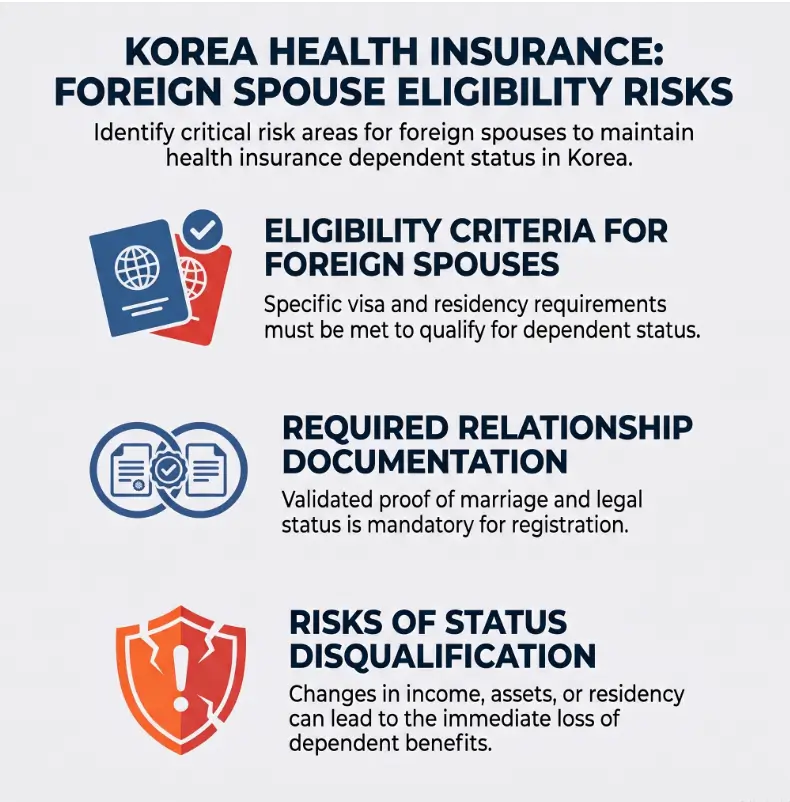
A dependent, often called a pibuyangja in Korean administrative settings, is not simply a spouse who lacks a job. The person must be supported mainly by an employee-insured member and satisfy the applicable relationship, income, property, and registration conditions.
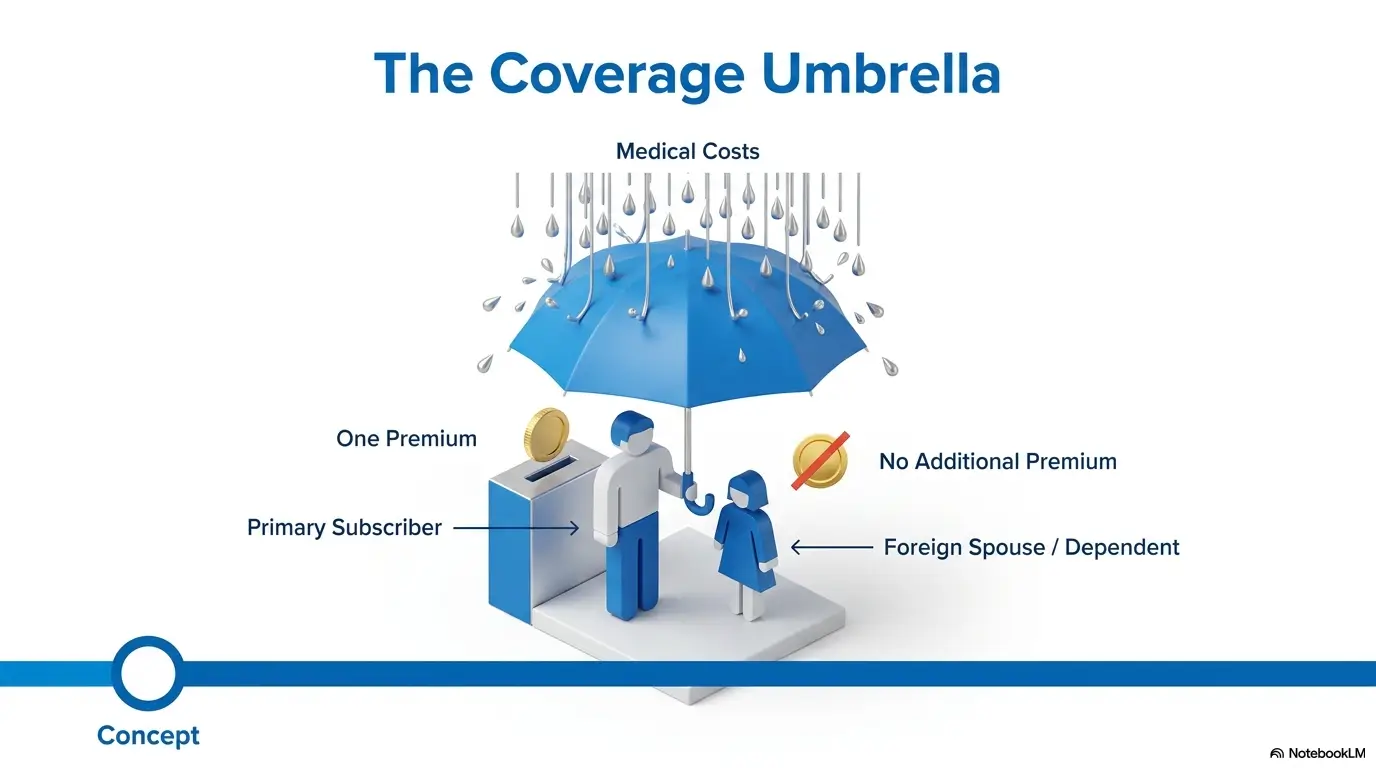
Dependent status belongs to the workplace-insurance system. If the sponsoring spouse is not an employee-insured member, the couple may need to examine regional coverage, independent workplace coverage, or another lawful insurance category instead.
Readers who need a broader explanation of workplace and regional categories can first review this guide to Korean National Health Insurance for foreigners.
Confirm these two facts before collecting paperwork
- Sponsor category: Is the sponsoring spouse currently registered as an employee-insured member?
- Relevant dates: When did the foreign spouse complete foreigner registration or domestic residence reporting, and when did the sponsor acquire workplace-insured status?
Those two answers shape nearly everything that follows. A beautiful Apostille is not much help if there is no eligible workplace sponsor, and a complete document set cannot recover every earlier effective date after a filing window has closed.
The Six-Month Rule Has a Spouse Exception
What changed for many foreign dependents
Since April 3, 2024, many foreign applicants seeking dependent status must generally satisfy a Korean-residence condition. This may involve six months of residence or a recognized reason showing that continued residence for the required period is expected.
The policy was introduced to limit immediate short-term enrollment by people entering Korea primarily to receive treatment. The Ministry of Health and Welfare explained the change while identifying an express exception for an employee-insured member’s spouse and children under age 19, including the spouse’s children.
What the spouse exception removes
A foreign spouse does not have to postpone a dependent application solely because six months have not passed since arrival. That can be enormously important for a newly relocated couple, particularly when the foreign spouse has already completed foreigner registration and the sponsor is actively enrolled through an employer.
What the exception does not remove
The exception does not create automatic enrollment. It does not waive the income test, property test, relationship evidence, lawful-registration requirements, or application process. It also does not guarantee that coverage begins on the marriage date, entry date, F-6 visa date, or first hospital visit.
Key Takeaway
No six-month wait does not mean no application. Treat the exception as permission to file sooner, not as proof that enrollment has already happened.
The Three-Gate Eligibility Test
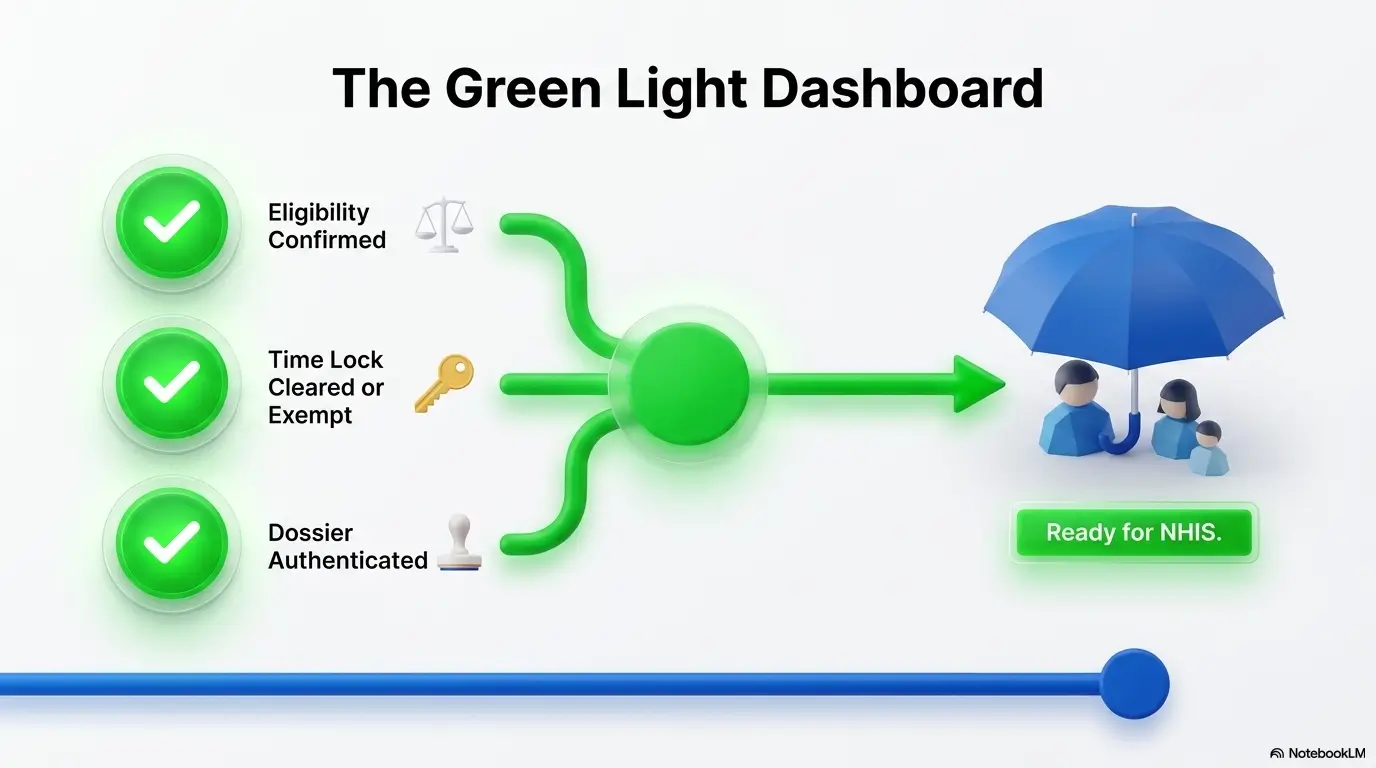
Dependent eligibility is easiest to understand as three gates. All three must open. Passing two out of three is not close enough for administrative purposes.
GATE 1
Employee-insured sponsor
The sponsoring spouse must hold an eligible workplace-insured status.
GATE 2
Verifiable relationship
NHIS must be able to connect the applicant to the sponsor through acceptable records.
GATE 3
Financial eligibility
Income and property must remain within the dependent-status criteria.
Gate 1: Is there an employee-insured sponsor?
A Korean citizen does not automatically possess the ability to register a spouse as a dependent. A permanent resident, sole proprietor, freelancer, unemployed person, or regional subscriber may also be unable to sponsor workplace-dependent status unless that person separately holds employee-insured membership.
Ask HR or NHIS for the sponsor’s workplace-insurance acquisition date. Do not rely only on the employment-contract start date, because payroll onboarding and insurance registration dates can differ.
Gate 2: Can NHIS verify the marriage?
A marriage may be perfectly valid under foreign law yet difficult for a Korean agency to verify. NHIS needs documents that identify both people, establish the relationship, and meet its authentication and translation standards.
Couples whose marriage is already reflected in Korean family records may face a simpler route. Couples relying on an overseas certificate should expect a longer chain: issuance, authentication, translation, notarization, and identity matching.
Gate 3: Does the applicant pass the financial criteria?
NHIS reviews more than a Korean monthly salary. Relevant business, financial, pension, employment, rental, and other income can matter, as can the property-tax base. A married applicant may also face a spouse-income condition. Do not turn that condition into a single household ceiling that simply adds the employee-insured sponsor’s salary to the applicant’s income. Ask NHIS which person’s income is being tested and under which provision.
Fast Eligibility Screen
- The sponsor is currently employee-insured.
- The foreign spouse has completed the required Korean registration.
- The marriage can be proved through Korean records or acceptable foreign documents.
- Income and property appear to fall within the dependent limits.
- The filing date has been compared with the relevant registration and sponsor dates.
Income and Property Rules That Quietly Sink Applications
The KRW 20 million combined-income ceiling
The Korean-language eligibility schedule states that the total of relevant business, financial, pension, employment, and other income must be KRW 20 million or less per year. It is a combined eligibility measure, not merely a limit on the applicant’s Korean wages.
This distinction matters for a foreign spouse who is not employed in Korea but receives overseas pension payments, investment income, consulting income, or rental income. “No Korean paycheck” and “no assessable income” are not interchangeable sentences.
Business and housing-rental income follow tighter rules
- A person with business registration generally must have no business income.
- Without business registration, annual business income must generally remain KRW 5 million or less.
- Housing-rental income can prevent dependent status when any such income exists, regardless of business registration.
- Different provisions may apply to certain registered disabled persons and eligible veterans.
A side business can therefore matter even when it feels small. The safest approach is to list each income category separately instead of giving NHIS one rounded estimate of “about KRW 10 million.”
Property-tax base is not the market price
The basic property test is generally met when the applicable property-tax base is KRW 540 million or less. If it exceeds KRW 540 million but is no more than KRW 900 million, annual income generally must be KRW 10 million or less. Relevant property categories include land, buildings, houses, ships, and aircraft.
Do not substitute an apartment’s purchase price, online estimate, or current listing price for the property-tax base. They are different measurements, and a casual conversion can make a safe case look risky or a risky case look safe.
| Issue | General rule to screen | What to verify |
|---|---|---|
| Total annual income | KRW 20 million or less | Which Korean and foreign income categories NHIS will count |
| Registered business | Generally no business income | Business registration and assessed business income |
| Unregistered business | Generally KRW 5 million or less | Tax treatment, records, and whether activity is considered business income |
| Housing-rental income | Any amount may cause exclusion | Property ownership, rental receipts, and tax reporting |
| Property-tax base KRW 540 million or less | Generally passes the basic property threshold | Official tax-base figure, not market value |
| Property-tax base from over KRW 540 million to no more than KRW 900 million | Income generally must be KRW 10 million or less | Exact tax-base and annual income records |
Key Takeaway
Build an income-category list, not a single income number. Separate employment, business, rental, pension, interest, dividends, and other potentially relevant income by person. Ask NHIS which records are required for the applicant and any spouse-income check.
Build the Foreign-Marriage Document Stack in the Right Order
The core filing materials
- Dependent qualification acquisition or loss report
- Alien Registration Card or domestic residence card
- Marriage or family-relationship document
- Apostille, foreign-ministry confirmation, consular authentication, or another accepted verification
- Notarized Korean translation when the original is not in Korean
- Additional income, property, visa, identity, or status records requested by NHIS
NHIS may waive records it can verify through government data. Foreign family relationships, however, often require direct evidence because an overseas marriage registry does not automatically update Korean insurance records.
The nine-month freshness rule
NHIS guidance generally calls for a foreign family or marriage document dated within nine months of issuance or the relevant foreign-ministry or Apostille confirmation. A certificate can remain legally valid in its home country while being considered too old for this application.
Check both dates when they differ: the certificate’s issue date and the authentication date. Ask NHIS which date controls for your issuing country before paying for a second translation.
Translation and identity matching deserve separate attention
A non-Korean document generally requires a notarized Korean translation. If translation and notarization occur in the issuing country, NHIS guidance indicates that additional foreign-ministry confirmation or an Apostille may also be required.
The supporting document should contain at least two identifying details, such as the person’s name and date of birth, so NHIS can connect the applicant to the sponsor. For practical help preparing bilingual records, see this guide to translation services in Korea.
| Mismatch | Why it matters | Useful supporting evidence |
|---|---|---|
| Maiden name versus married name | The certificate and passport may appear to identify different people | Name-change certificate, previous passport, marriage record |
| Middle name omitted | NHIS may hesitate to infer identity | Passport bio page and consistent birth-date record |
| Reversed name order | Family and given names may be transposed | Translator’s note or official identity record |
| Different Romanization | One Korean name may have several English spellings | Korean family record, passport, immigration record |
| Passport renewed | Document numbers no longer match | Old and new passport copies or renewal evidence |
| Birth-date discrepancy | This can prevent reliable identity matching | Corrected civil record and written explanation |
Key Takeaway
Treat authentication, translation, freshness, and identity matching as four separate checks. Completing one does not automatically satisfy the others.
The 90-Day Clock Can Change the Effective Date
For foreign applicants, the clock may begin with registration
The foreign-dependent timing rule is more specific than the ordinary “file within 90 days of workplace enrollment” summary. For a foreign spouse, the key starting point may be the date of foreigner registration, domestic residence reporting, or another qualifying Korean registration.
When the dependent application is filed within 90 days of that registration and all requirements are met, the effective date may be the registration date. If the sponsor became employee-insured later, the workplace-insurance acquisition date may become the starting point instead.
What happens after 90 days
If the application is filed more than 90 days after the relevant registration, dependent status may begin on the application date. One important exception can apply when the sponsor became employee-insured after the foreign spouse registered and the application is submitted within 90 days of that later workplace-insurance date.
This is why couples should put the dates on one page before asking whether coverage can be backdated. A vague statement such as “We moved here in March” is less useful than four exact dates.
| Date to record | Why it matters |
|---|---|
| Foreign spouse’s Korean entry date | Provides context but may not control the effective date |
| Foreigner registration or domestic residence reporting date | May start the foreign-dependent 90-day period |
| Sponsor’s employee-insurance acquisition date | May control when workplace-dependent status can begin |
| Dependent application submission date | Can become the effective date when filing is late |
| Regional-insurance acquisition or billing date | Helps NHIS review overlapping premiums or corrections |
Illustrative example: the marriage was not the missing date
Suppose an American spouse completed foreigner registration on May 10. The Korean spouse became employee-insured through a new job on June 1. The couple married years earlier, so they assume there is no urgency.
They finally submit the dependent application in October. The marriage certificate is valid, authenticated, and translated, but the application date falls well after both relevant 90-day periods.
NHIS may recognize dependent status only from the later application date, leaving earlier regional premiums to be reviewed separately. The lesson is plain: the decisive date was not the wedding anniversary. It was the administrative timeline created by registration, workplace eligibility, and filing.
Show me the nerdy details
Korean health-insurance rules contain both general dependent provisions and special provisions for foreign residents. The foreign-specific rule can alter the acquisition date by tying it to foreigner registration, domestic residence reporting, the sponsor’s later workplace-insurance date, and the date of the dependent application.
That means two couples with the same marriage date and the same documents can receive different effective dates because their immigration registration, sponsor enrollment, and application dates differ.
Key Takeaway
Ask NHIS to identify the controlling 90-day date in your case. Do not assume it is always the marriage date, entry date, or sponsor’s first day at work.
Filing Options, Help Costs, and When DIY Is Enough
Three practical filing routes
Some applications are simple enough for HR and the couple to handle. Others need professional translation, notarization, consular help, tax review, or direct case management with NHIS.
The best route depends less on the thickness of the file than on the number of unresolved questions inside it.
| Approach | Good | Better | Best for complex cases |
|---|---|---|---|
| Who handles it | Sponsor and employer HR | Couple plus professional translator or notary | Couple, NHIS, and a qualified Korean professional |
| Suitable case | Marriage appears in Korean records, no unusual income, dates are clear | Foreign certificate, Apostille, translation, or name mismatch | Late filing, foreign business income, disputed premiums, rejection, de facto marriage |
| Main cost | Time and document copies | Translation, notarization, authentication, courier fees | Professional review or representation fees |
| Main risk | HR may submit incomplete or overly generic information | Paying twice because the wrong document was translated | Hiring someone who promises approval without reviewing the facts |
| Best first step | Confirm sponsor status and required documents with NHIS | Get NHIS confirmation before ordering translation | Request the rejection reason, date history, and written document list |
When free help may be enough
- The sponsor is clearly employee-insured.
- The marriage is already recorded in Korea.
- The applicant has no business, rental, pension, or unusual foreign income requiring additional interpretation.
- The property threshold is not close.
- The filing is comfortably within the relevant 90-day period.
- There are no regional bills or previous rejections.
In that situation, HR submission plus a confirmation call to NHIS may be entirely reasonable. Keep a copy of the application, attachments, submission date, and any receipt or case number.
When paid help may be worth considering
- The certificate cannot receive a conventional Apostille.
- Names, dates of birth, or passport details do not match.
- The applicant or another person NHIS must assess has overseas business, pension, investment, or rental income.
- NHIS has already issued regional premiums.
- The couple is requesting an earlier effective date.
- The marriage is de facto rather than formally registered.
- NHIS has rejected the application without a clear written explanation.
Before paying, ask exactly what the service includes. Translation, notarization, Apostille assistance, tax analysis, immigration advice, and insurance-case representation are different services. A low quote may cover only one page of translation and none of the administrative follow-up.
Foreign spouses still working through immigration registration may also find this guide to the Korea F-6 marriage visa useful. Insurance and immigration are separate systems, but the documents often travel together like two passengers sharing one suitcase.
Common Mistakes That Create Coverage Gaps
Most failed applications are not cinematic disasters. They are small administrative mismatches: the wrong date, an old certificate, a missing authentication step, or an assumption that nobody stopped to test.
| Common mistake | Safer alternative |
|---|---|
| Assuming marriage triggers automatic coverage | Submit the dependent report and confirm the recognized acquisition date |
| Waiting six months because the applicant is foreign | Ask whether the employee-insured spouse exception applies |
| Submitting an ordinary scan of a foreign certificate | Confirm authentication, freshness, and translation requirements first |
| Using a certificate older than nine months | Check the issue and authentication dates before filing |
| Reviewing only Korean wages | List income categories separately for each person NHIS must assess |
| Using the home’s market price | Obtain the relevant property-tax-base figure |
| Ignoring a regional-insurance bill | Ask NHIS how the recognized dependent date affects overlapping premiums |
| Letting HR treat the matter as purely a visa question | Use HR for submission but obtain eligibility guidance from NHIS |
| Paying for translation before checking document acceptability | Confirm the exact issuing-country document with NHIS first |
| Failing to keep submission evidence | Save copies, receipts, dates, names, and case references |
A regional-insurance notice will not necessarily disappear by itself
If a regional premium notice arrives while a dependent application is pending, do not simply leave it unopened. Ask NHIS whether regional status is active, whether payment is due, and how the account will be corrected if dependent status is recognized from an earlier date.
Keep the bill even when you believe it is wrong. Administrative paperwork has an odd appetite for the one document people threw away.
Know the difference between HR and NHIS
Employer HR may collect and submit the application. NHIS decides whether the applicant qualifies and when the status begins. A helpful HR representative is valuable, but “the company accepted the papers” is not the same as “NHIS approved dependent status.”
Status Changes That Can End Dependent Coverage
Employment and income changes can alter the category
If the foreign spouse starts qualifying employment, that spouse may become independently employee-insured. New business income, housing-rental income, pension income, or other reportable income may also cause the person to fail the dependent criteria.
Do not wait for the next annual review if a major change occurs. Ask NHIS when the change must be reported and which date will control the loss of dependent status.
The sponsor’s workplace status is the anchor
Dependent coverage can end when the sponsor loses employee-insured status, changes insurance categories, or no longer satisfies the relationship and support rules. A job change can therefore affect both spouses even when the foreign spouse’s own circumstances remain unchanged.
When changing employers, record the old insurance-loss date and the new insurance-acquisition date. Ask whether a fresh dependent application is needed or whether the record will transfer.
Departure, visa expiration, and re-registration need attention
Current rules identify no longer residing in Korea, expiration of lawful stay, and other foreign-resident events as possible reasons for dependent status to end. Extended travel does not always produce the same result, so ask NHIS how departure reporting, visa expiration, and re-entry affect the record.
NHIS generally requests foreign relationship evidence again when eligibility changes because it cannot automatically verify overseas family updates. Additional evidence may sometimes be waived when the same person is re-registered under the same employee-insured sponsor within three months.
Report-or-Check Triggers
- The sponsor changes employers or loses workplace coverage.
- The foreign spouse begins a new job.
- Either spouse opens a business or begins receiving rental income.
- Foreign pension, investment, or employment income changes materially.
- The foreign spouse’s visa or registration expires.
- The foreign spouse leaves Korea for an extended period.
- A regional-insurance bill or eligibility-loss notice arrives.
For practical visits to government counters, this overview of local district offices in Korea can help clarify which services belong to local government and which belong directly to NHIS.
FAQ: Foreign-Spouse Dependent Registration
Can a foreign spouse join Korean health insurance immediately?
Potentially. A foreign spouse of an employee-insured member is exempt from the general six-month residence requirement, but the spouse must still satisfy the financial, relationship, registration, and filing conditions.
Does the sponsoring spouse need to be Korean?
Not necessarily. The central question is whether the sponsor is an eligible employee-insured member. Nationality alone does not create workplace-dependent sponsorship.
Does an F-6 visa guarantee dependent coverage?
No. An F-6 visa supports lawful residence as a marriage immigrant, but NHIS dependent status still requires an eligible sponsor, acceptable financial circumstances, verifiable marriage evidence, and timely application.
Can a foreign spouse with a job remain a dependent?
It depends on whether the employment creates independent workplace-insured status and whether the spouse continues to satisfy the dependent-income rules. Confirm the employment start date and insurance registration with the employer and NHIS.
Does overseas income count?
Do not assume overseas income is invisible or excluded. Ask how NHIS will treat foreign wages, pensions, investments, rental income, and business activity, and which tax or account records it requires.
Is an English marriage certificate enough?
Not always. The document may still need an Apostille or other authentication, a notarized Korean translation, acceptable identifying details, and an issue or authentication date within the required freshness period.
Can NHIS backdate dependent coverage?
An earlier effective date may be available when the application is filed within the relevant 90-day period. The correct starting point for a foreign spouse can depend on foreigner registration, the sponsor’s later workplace-insurance date, and the submission date.
What happens if dependent status is denied?
The applicant may remain or become a regional subscriber, qualify through employment, correct the documents, submit additional evidence, or challenge the decision through an available review process. Ask NHIS for the precise reason and the date used in the decision before choosing the next step.
Your 15-Minute Pre-Filing Check
Before contacting HR, a translator, or a professional adviser, make a one-page case summary. This small exercise turns a foggy question into something NHIS can answer.
- Write the sponsor’s employee-insurance acquisition date.
- Write the foreign spouse’s foreigner-registration or domestic-residence-reporting date.
- Write the intended dependent-application date.
- Record the marriage-certificate issue and authentication dates.
- List income categories separately for the applicant and any other person NHIS asks to assess.
- Record the relevant property-tax-base information.
- Note every current regional-insurance notice or premium bill.
- List any name, passport, or birth-date mismatch.
- Write the effective date you believe should apply.
Then ask one precise question:
Question to Ask NHIS
“Based on our foreigner-registration date, the sponsor’s workplace-insurance date, and today’s filing date, which documents are required for this issuing country, and what dependent effective date would apply?”
The NHIS English consultation number published on its foreigner guidance page is 033-811-2000. The general call center is 1577-1000. Have the dates and document country in front of you before calling; the conversation becomes shorter, sharper, and far less likely to drift into administrative fog.
The purpose of this checklist is not to predict approval. It is to protect the question that matters most: whether the application can be verified, filed on time, and connected to the correct effective date.
Last reviewed: 2026-09