
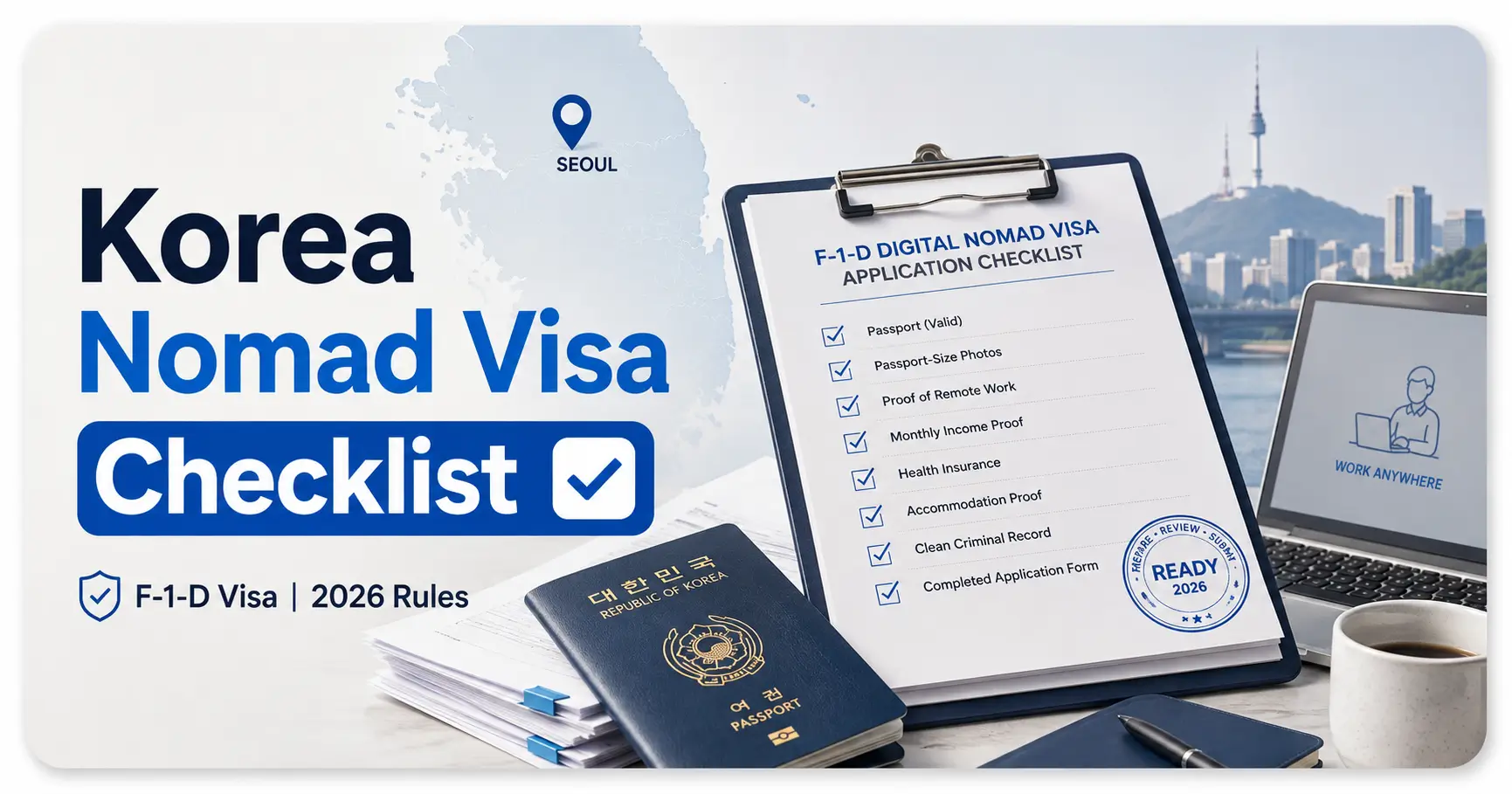
South Korea Immigration Guide • Updated for the June 2026 Rules
South Korea’s F-1-D workation visa changed substantially on June 30, 2026. The former pilot became a formal program, the maximum stay increased, and the income test began varying by age, intended residence area, and whether family members accompany the applicant.
That sounds friendlier, but the paperwork still behaves like a row of dominoes. Your overseas job, work history, income, bank deposits, tax records, Korean address plan, insurance certificate, criminal record, and family documents must support the same story. One unexplained number can make an otherwise strong application feel oddly hollow.
This guide turns the current rules into a practical preparation system for U.S.-based employees, founders, contractors, and families. It also flags a small but important discrepancy between the income figures in Korea’s 2026 immigration announcement and the Bank of Korea’s final 2025 GNI release.
Find Your Income Tier
Match your age, intended Korean residence, and family plan to the correct GNI multiplier.
Trace Every Dollar
Connect employment or business activity to payments, bank records, and tax documents.
Protect the Family File
Prepare separate applications, relationship records, insurance proof, and matching dates for each person.
The goal is not a fat folder. It is a clean chain of proof that an officer can follow without carrying a lantern. 🧭
Snapshot
For: U.S.-based remote employees, overseas founders, contractors, and families considering a move to South Korea. Solves: confusion about eligibility, 2026 income tiers, insurance wording, apostilles, family applications, and prohibited Korean work. Next: you will be able to build a one-page evidence matrix and identify the questions your Korean diplomatic mission must answer before filing.
Contents — choose a section
Table of Contents
Before You Act: The 2026 Rules Replaced the Old Pilot
Many English-language F-1-D guides still describe the original pilot: one universal income test, an initial year plus one extension, and a two-year maximum. That information became incomplete when the Ministry of Justice moved the visa into formal operation on June 30, 2026.
The current framework introduces age and residence-based income tiers, a special rule for applicants bringing family, and a maximum stay of up to three years through extensions. The official overview continues to require overseas employment, remote-work capability, at least one year in the same industry, qualifying private insurance, a criminal record certificate, and restrictions on employment or profit-making activity in Korea.
Before You Act
This article provides general educational information, not individualized immigration, tax, employment, nationality, or insurance advice. Requirements may be interpreted differently by the diplomatic mission serving your residence. Confirm the current won threshold, document validity periods, authentication method, application route, and family treatment before paying nonrefundable fees or booking a move.
The date on a visa guide now matters
A page updated in early 2026 may still be accurate about insurance or overseas work, yet wrong about income tiers and maximum stay. Treat every checklist as a snapshot, not a stone tablet.
Begin with the latest national rule, then check the website of the Korean embassy or consulate that has jurisdiction over your residence. That mission controls appointment procedures, mail-in options, fees, passport handling, translations, and requests for supplementary evidence.
What this checklist can and cannot decide
This guide can help you spot missing evidence, compare insurance documents, calculate planning thresholds, and prepare focused questions. It cannot determine whether irregular income counts, whether a particular consulting arrangement is Korean profit-making activity, or whether past Korean nationality affects your eligibility.
Key Takeaway
Use the new 2026 framework for planning, but obtain mission-specific confirmation before filing. A national announcement tells you the architecture; your consulate tells you which door to use.
Who Qualifies, and Who Needs a Closer Look
Strong fit: established overseas employees
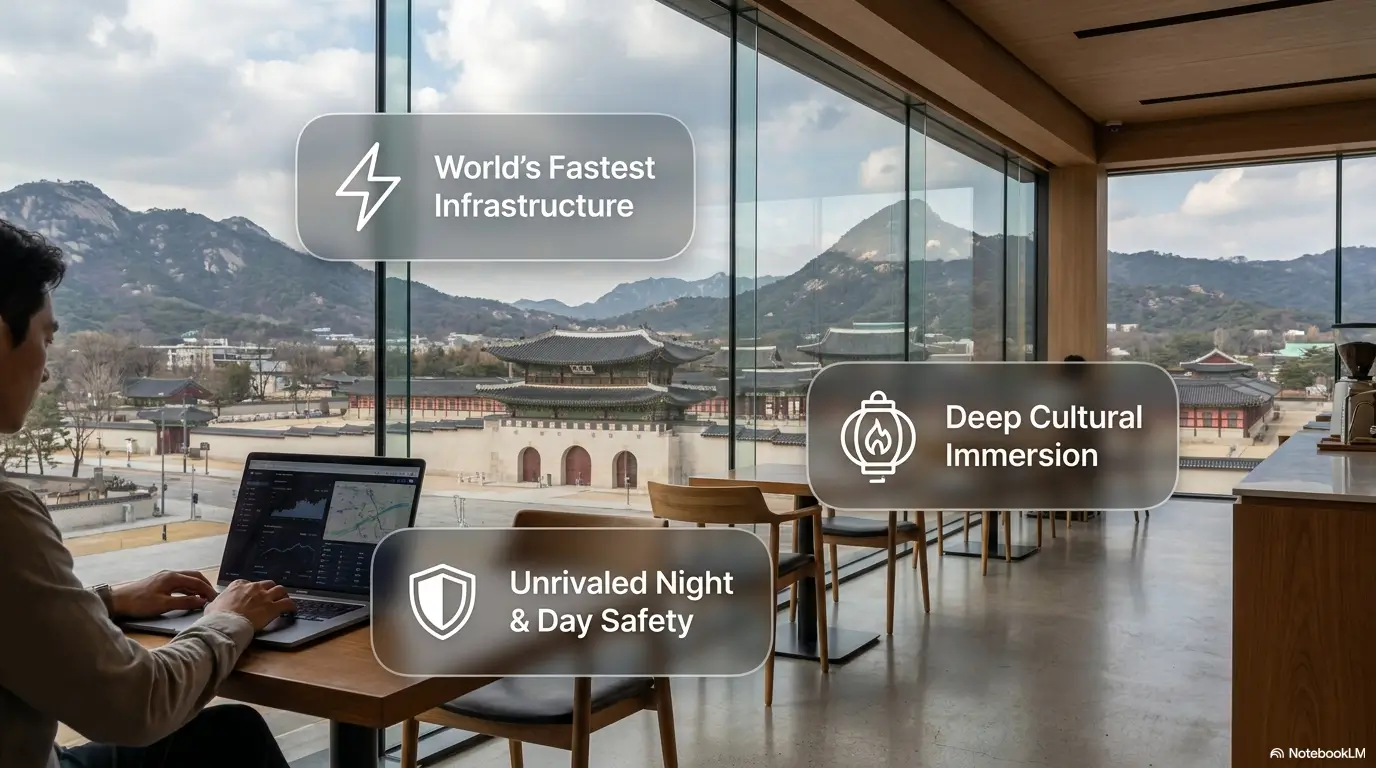
The cleanest applicant is an adult employed by a company outside Korea, able to perform the job remotely, and already working in the same industry for at least one year. The employment letter, contract, payroll history, tax return, and bank deposits should all point in the same direction.
The official 2026 overview describes eligible principal applicants as adults employed by an overseas company who can work remotely and have at least one year of experience in the same industry. It also lists a legal spouse and minor children as eligible accompanying family members.
Founders and contractors need a stronger bridge
The new official summary uses overseas-company employment language rather than offering a long explanation of freelancers, sole proprietors, or platform-based contractors. A founder may have a credible case when formally employed by an established overseas entity, but ownership alone does not answer every eligibility question.
Contractors and self-employed applicants should ask their mission whether their structure is accepted before assembling an expensive file. Helpful evidence may include overseas company registration, ownership records, employment agreements, client contracts, recurring invoices, tax filings, payroll records, and proof that management and revenue remain outside Korea.
Poor fit: Korean jobs disguised as remote work
The F-1-D is not a side entrance to a Korean employer. An applicant whose real plan is to seek local employment, invoice Korean clients, open a Korean shop, or earn recurring locally sourced compensation may need a different immigration route.
Where you sit is not the decisive fact. Officers and advisers may need to consider where the employer is located, who signs the contract, who receives the service, where payment originates, and whether the activity enters Korea’s labor or commercial system.
Quick Eligibility Screen
- You are at least 18 years old as the principal applicant.
- You are attached to an established company outside Korea.
- Your work can be performed remotely from Korea.
- You have at least one year of experience in the same industry.
- Your income meets the tier for your age, location, and family plan.
- Your insurance covers medical treatment and repatriation for the full stay.
- Your planned work does not depend on Korean employment or local profit-making activity.
Real-world example: the founder with two different stories
Consider a U.S. founder who owns a small software company and pays herself a regular salary. Her company registration, payroll records, personal bank deposits, tax return, and client contracts all identify the same business and role. The file explains both ownership and employment.
Now consider a second founder who submits only a business bank statement showing high turnover. Some deposits are client revenue, some are loans, and some are transfers from another account. Nothing shows what she personally earns or whether the company is operating consistently.
Both applicants may run real businesses. Only the first file answers the officer’s practical questions without requiring detective work. The lesson is simple: business revenue, personal income, and cash sitting in an account are three different creatures.
The New Income Tiers by Age, Region, and Family
The 2026 program no longer applies one income multiplier to everyone. The official immigration overview distinguishes applicants aged 18 to 34 from those aged 35 or older, and it distinguishes the capital region from non-capital and designated depopulation or depopulation-concern areas.
The published 2026 planning table
| Applicant situation | GNI multiplier | Amount shown in the 2026 immigration table |
|---|---|---|
| Age 18–34, capital region | 1.5 times | KRW 78.62 million annually |
| Age 18–34, non-capital or designated depopulation area | 1.0 time | KRW 52.41 million annually |
| Age 35 or older, capital region | 2.0 times | KRW 104.83 million annually |
| Age 35 or older, non-capital or designated depopulation area | 1.5 times | KRW 78.62 million annually |
| Any age bringing family to the capital region | 2.0 times | KRW 104.83 million annually |
| Any age bringing family to a qualifying non-capital area | 1.5 times | KRW 78.62 million annually |
These figures appear in the Ministry of Justice’s July 2026 program overview. The table also states that applicants using a regional reduction may need proof of an intended stay, such as a lease of at least one month or a reservation at accommodation or a designated workation facility.
Check the designated-area exception before choosing a tier. The official July 2026 overview labels its capital-region column as excluding designated depopulation and depopulation-concern areas; the reduced column includes those designated areas as well as the non-capital region. Do not classify an address solely by whether it is in Seoul, Gyeonggi or Incheon. Ask the mission to confirm the exact municipality’s current designation, accepted address evidence and applicable family rule before relying on a reduction.
The small GNI discrepancy you should not ignore
The immigration table uses 2025 per-capita GNI of approximately KRW 52.41 million. However, the Bank of Korea’s June 9, 2026 final national-accounts release reports 2025 per-capita GNI of KRW 52.57 million. Twice the final figure is about KRW 105.14 million, and 1.5 times is about KRW 78.86 million.
This difference is too small to redesign a move around, but large enough to matter if your income sits close to the line. Ask the diplomatic mission which won amount it is applying on the date you file. Build some breathing room rather than submitting a number that clears one publication by a whisker and misses another.
You can review the Bank of Korea’s final 2025 GNI announcement when updating your calculation.
Why a permanent U.S. dollar estimate is a trap
The legal test is based on Korean won and the prior year’s per-capita GNI, not a fixed dollar salary. Exchange rates move, GNI is revised, and a consular webpage may retain an older illustration after the underlying formula changes.
Convert your income using the method requested by your mission. Record the source, exchange-rate date, and arithmetic. A neat calculation page can prevent an officer from having to reconstruct twelve months of currency movement from scratch.
Show me the nerdy details
Published immigration table: KRW 52.41 million × 1.0, 1.5, or 2.0.
Final Bank of Korea figure: KRW 52.57 million × 1.0 = KRW 52.57 million; × 1.5 = approximately KRW 78.86 million; × 2.0 = KRW 105.14 million.
For an employee, compare qualifying annual compensation with the applicable threshold. For an owner or contractor, do not substitute gross company turnover for personal qualifying income unless the mission confirms that treatment.
Key Takeaway
Your threshold is no longer determined by income alone. Age, intended Korean residence, and accompanying family can change the multiplier, while the underlying GNI figure may be updated or clarified.
Build an Income File That Can Be Audited
A large bank balance does not prove qualifying remote-work income. The application should allow an officer to trace money from a legitimate overseas work arrangement into the applicant’s personal records.
Use a three-layer income trail
- Source: employment contract, employer letter, company registration, ownership record, client agreement, or another document explaining why you are paid.
- Payment: pay statements, payroll records, invoices, distribution records, and bank transactions showing money actually received.
- Tax: federal or national tax returns, wage statements, business filings, or accountant-prepared records showing how the income was reported.
The official overview lists employment verification, salary statements, and account-transaction records among the income evidence. A mission may ask for a longer or more specific set depending on the applicant’s structure.
For employees: make the employer letter do real work
A useful remote-work letter should identify the legal employer, your job title, start date, industry, compensation, employment status, and authorization to perform the role while physically located in South Korea.
Generic language such as “may work from anywhere” is weaker than a signed statement confirming that the company knows about the Korean stay and that the employment relationship, payroll, supervision, and business activity remain overseas.
For owners and contractors: separate turnover from income
Prepare a short explanation of how the business earns revenue and how money reaches you personally. If you receive salary, dividends, distributions, or owner draws, label each category clearly and avoid adding them together without explaining their tax and accounting treatment.
- Overseas entity registration and ownership records
- Client contracts and invoices showing recurring operations
- Business and personal bank records kept in separate lanes
- Business tax returns and personal tax returns
- Payroll or distribution records
- A concise chart reconciling the amount claimed on the visa application
Make names, dates, and numbers agree
Use the same spelling and ordering of your name across the application, passport, employer letter, bank records, insurance certificate, and translations. Explain legitimate variations rather than hoping they pass unnoticed.
| Potential mismatch | Why it raises a question | Safer preparation |
|---|---|---|
| Salary letter exceeds bank deposits | Bonuses, deductions, or unpaid amounts are unclear | Add pay statements and a reconciliation note |
| Deposits exceed reported wages | Transfers may not be employment income | Label reimbursements, transfers, and non-income deposits |
| Company name varies | Parent, subsidiary, or trade name relationship is uncertain | Add registration records or an employer explanation |
| Annual and monthly figures do not align | Currency conversion or variable pay may be wrong | Show the calculation and exchange-rate source |
| Contractor income is irregular | A strong month may not show sustained earnings | Provide a longer history and recurring client evidence |
The Remote-Work Red Line Inside Korea
Foreign employer, Korean location
The intended model is straightforward: you live temporarily in Korea while continuing work for an overseas company. The 2026 program overview expressly restricts employment and profit-making activity in Korea.
A laptop does not make every transaction foreign. A Korean client, Korean employment agreement, locally sourced consulting fee, paid Korean speaking engagement, or Korean brand sponsorship can change the analysis.
Creators, consultants, and agencies need bright boundaries
Remote professionals often receive opportunities after arriving. A foreign creator may be offered a campaign by a Seoul company. An overseas consultant may be asked to train a Korean team. A founder may want to sign a local customer.
Do not assume that small, occasional, or online payments are harmless. Ask immigration and, where appropriate, Korean employment or tax counsel before accepting compensation tied to a Korean entity or locally delivered service.
Real-world example: the Seoul workshop fee
A U.S. designer works remotely for her California employer while living in Busan. That is the core model the visa is built around.
During her stay, a Seoul agency offers KRW 3 million for a one-day workshop. The event is arranged in Korea, the client is Korean, and the fee is paid for a service delivered to that client. Calling it a “creative collaboration” does not settle whether it is restricted local activity.
The cautious response is not automatic rejection or automatic acceptance. It is to pause, document the proposal, and seek a written or professionally grounded answer before signing. Immigration files dislike surprises, especially profitable ones.
Visa permission and tax exposure are separate questions
F-1-D status does not create an automatic exemption from Korean tax. Time spent in Korea, residence patterns, family location, the source of services, remittances, and treaty rules may affect the result.
Use a separate tax workstream rather than hiding tax questions inside the visa checklist. These guides on Korea tax residency for digital nomads and U.S. expat tax in Korea can help you identify the next questions to take to a qualified adviser.
Key Takeaway
Keep three lanes separate: immigration permission, employment or commercial activity, and tax. A green light in one lane is not a green light in the other two.
The KRW 100 Million Insurance Requirement
The current rule requires individual private medical insurance with at least KRW 100 million in coverage for hospital treatment and repatriation to the applicant’s home country during the Korean stay. The number is only the first filter. The certificate must also show the right people, benefits, territory, and dates.
Repatriation wording matters more than the logo
Medical treatment, emergency evacuation, and repatriation are related but not identical. A policy may pay to move you to a suitable hospital without paying to return you to your home country. Another may cover repatriation only after death, which may not satisfy a broader requirement.
Ask the insurer for a certificate or benefit schedule that plainly identifies medical treatment and repatriation coverage. A glossy sales page is not a substitute for policy wording.
Compare policy types before buying
| Policy type | Possible strength | What to verify |
|---|---|---|
| Existing U.S. health plan | You may already pay for it | Overseas territorial coverage, direct payment, repatriation, duration, and written proof |
| Travel medical policy | Often designed for international emergencies | Long-stay eligibility, remote-work exclusions, one-way travel, renewal, and repatriation wording |
| International or expatriate health policy | May provide broader long-term treatment access | Cost, deductible, Korea coverage, evacuation limits, and whether repatriation is included |
| Family policy | One administration process for several people | Every applicant must be named clearly with adequate individual coverage |
Premiums can vary with age, destination, trip duration, deductible, benefit limits, medical history, family size, and cancellation terms. The cheapest policy can become expensive if the consulate rejects its wording or if it expires halfway through the intended stay.
For a broader buying framework, review this South Korea travel insurance guide, then compare the recommendations against the stricter F-1-D certificate requirements.
Your certificate should answer seven questions
- Who is insured?
- Is South Korea within the covered territory?
- Are the effective and expiration dates visible?
- Is the coverage amount at least KRW 100 million or a clearly adequate equivalent?
- Is hospital or medical treatment covered?
- Is repatriation to the home country covered?
- Are exclusions likely to affect a long stay or remote work?
Key Takeaway
Buy from the policy document backward, not the advertisement forward. Confirm medical treatment, repatriation, territory, dates, limits, exclusions, and every insured family member.
Family Applications, FBI Records, and Apostilles
Bringing family changes the income test
The 2026 overview describes accompanying family as a spouse and minor children. It also imposes a separate family-income rule: applicants bringing family to the capital region use the two-times-GNI standard regardless of age, while qualifying non-capital residence uses the 1.5-times standard.
Do not rely on an older page that describes unmarried children under a particular age without checking the current mission language. “Minor child,” custody, adoption, dependency, and approaching birthdays can create document-specific questions.
Treat each person as a separate mini-file
- Passport with sufficient validity
- Individual visa application and photograph
- Insurance certificate naming that applicant
- Marriage or birth record establishing the relationship
- Name-change, adoption, custody, or consent records where relevant
- Authentication or apostille required by the mission
- Certified translation if the document is not accepted in its original language
Cross-check passport spellings, middle names, dates of birth, parents’ names, marriage dates, and insurance dates. A minor spelling difference can be innocent and still consume a week at exactly the wrong moment.
For U.S. applicants, sequence the FBI record correctly
The official visa overview requires a criminal record certificate. A U.S. mission may instruct applicants to obtain an FBI Identity History Summary and have it federally apostilled. The FBI explains that its authenticated results may be sent to the U.S. Department of State for an apostille when necessary.
- Confirm the precise criminal-record document required by your Korean mission.
- Request the FBI Identity History Summary using the current FBI process.
- Check whether your mission requires a federal apostille.
- Submit the eligible federal document to the U.S. Department of State authentication office.
- Complete translation or copy requirements only after confirming the mission’s preferred format.
An FBI document is federal. Birth certificates, marriage certificates, and other vital records are commonly issued by states, so their apostille route is usually different. Notarization alone is not an apostille, and a state apostille is not a substitute for a federal apostille on a federal document.
Start early, but watch the validity clock
Criminal records, financial evidence, photographs, insurance certificates, and relationship documents may be subject to issuance or validity rules set by the mission. The national summary does not answer every timing question.
Before ordering documents, create a timeline that works backward from the intended submission date. Allow room for fingerprints, mailing, apostilles, translation corrections, appointment availability, and supplementary-document requests.
Key Takeaway
The family application is not an attachment to the principal applicant’s folder. It is a synchronized set of individual applications joined by authenticated relationship evidence.
Applying Abroad, Changing Status, and Registering
Route one: apply through a Korean diplomatic mission
The official framework directs overseas applications to Korean embassies and consulates. Begin by identifying the mission with jurisdiction over your legal residence, not the mission with the nicest appointment calendar.
- Confirm jurisdiction and current F-1-D instructions.
- Ask which income figure and regional tier apply.
- Confirm whether an appointment or mail-in filing is available.
- Prepare the principal and family files.
- Submit the passport, application, photographs, fees, and evidence.
- Respond promptly if supplementary documents are requested.
- Wait for issuance before making irreversible travel commitments.
Route two: request a change from eligible short-term status
The 2026 overview states that people holding B-1, B-2, or C-3 short-term visitor status may request a change to F-1-D inside Korea when they satisfy the requirements. Being physically present does not guarantee approval, excuse missing documents, or authorize local work while the request is pending.
In-country applicants should confirm appointment procedures, lawful-stay deadlines, original-document requirements, address evidence, processing consequences, and whether travel is advisable while the application is unresolved.
After arrival: address evidence and foreigner registration
Long-term residents generally need to complete foreigner registration within 90 days of arrival. The official F-1-D framework provides an initial one-year stay at registration, followed by possible one-year extensions up to a maximum of three years. Extensions require continuing eligibility rather than automatic renewal.
The initial year is measured from entry. The official overview says one year is granted from the entry date at foreigner registration. Do not assume that waiting for the residence card gives you a fresh year from the card’s issue date. Record your entry date, actual authorized stay expiry, registration step and extension deadline separately, and confirm the applicable calculation for an in-country status change.
Housing deserves early attention because address evidence can affect registration and any regional income reduction. Compare common Korean rental structures in this guide to wolse versus jeonse for foreigners.
A residence card also unlocks parts of daily life that can feel surprisingly circular, including mobile services and online verification. This guide to Korean identity verification for foreigners explains why the card often becomes the quiet hinge of settling in.
The F-1-D Preparation Flow
1. Fit
Confirm overseas employment, remote capability, and industry history.
2. Tier
Match age, residence area, and family plan to the GNI multiplier.
3. Proof
Reconcile employment, payment, banking, and tax records.
4. Protect
Secure compliant insurance, criminal records, and family documents.
5. File
Apply through the correct mission or eligible in-country route.
6. Maintain
Register, preserve records, avoid local work, and prepare for extensions.
Costly Mistakes and When Paid Help Is Worth It
The mistakes that weaken an otherwise credible case
- Using the old universal income threshold: the 2026 tiers now depend on age, region, and accompanying family.
- Submitting company revenue as personal income: turnover does not automatically establish what the applicant earns.
- Relying on unexplained bank deposits: transfers, loans, asset sales, and reimbursements need labels.
- Buying insurance from a headline: the certificate must show medical treatment, repatriation, territory, limits, dates, and insured names.
- Using a vague remote-work letter: it should identify the employer, role, compensation, work history, and Korean remote arrangement.
- Assuming a regional discount without address proof: qualifying residence may need a lease or reservation of at least one month.
- Treating dependents as one attachment: every family member needs a coordinated individual file.
- Booking a nonrefundable move around an estimate: appointments, apostilles, corrections, and supplementary requests can all move the calendar.
DIY, administrative support, or professional advice?
| Preparation level | Best suited to | What it may include | Main limitation |
|---|---|---|---|
| Good: organized DIY file | Salaried employee, simple family structure, clear income above the threshold | Spreadsheet, labeled PDFs, self-prepared reconciliation, direct consulate questions | You remain responsible for interpreting ambiguous rules |
| Better: administrative support | Busy applicant with several apostilles, translations, or family records | Document collection, certified translation, apostille logistics, file organization | Administrative providers may not be qualified to give legal advice |
| Best for complex cases: qualified professional review | Founder, irregular income, prior refusal, criminal history, nationality issue, custody issue, or possible Korean commercial activity | Eligibility analysis, risk review, legal positioning, response to document requests | Higher cost and no guarantee of approval |
Paid help is most valuable when it reduces a specific risk. Translation support can solve a language-format problem. Apostille support can solve a logistics problem. An immigration professional can analyze legal ambiguity. Paying one provider to “handle everything” is less useful when nobody can explain what they are actually qualified to decide.
Questions to ask before paying a provider
- Which part of the process are you legally and professionally qualified to handle?
- Have you worked with the post-June 2026 F-1-D rules?
- How do you treat the published GNI discrepancy?
- Will I receive copies of every document and submission?
- What happens if the consulate requests additional evidence?
- Which fees are government fees, third-party costs, and your service charges?
- Do you promise approval or use pressure-based deadlines? If so, step away.
Frequently Asked Questions
What is the current Korea F-1-D income requirement?
It depends on age, intended residence area, and whether family accompanies you. The official 2026 table ranges from one times GNI for an applicant aged 18 to 34 living in a qualifying non-capital area, to two times GNI for an applicant aged 35 or older in the capital region or an applicant bringing family to the capital region.
Should I use KRW 52.41 million or KRW 52.57 million as 2025 GNI?
The July 2026 immigration table uses approximately KRW 52.41 million, while the Bank of Korea’s final June release reports KRW 52.57 million. Ask the mission handling your application which figure it will apply and avoid filing at the bare minimum.
Can a business owner or freelancer apply?
The current national overview describes adults employed by an overseas company. Owners formally employed by an established overseas entity may be able to document that relationship, but sole proprietors, freelancers, and contractors should obtain mission-specific guidance before assuming eligibility.
Can I work for Korean clients on the F-1-D visa?
The official program restricts employment and profit-making activity in Korea. A Korean client, locally delivered service, sponsorship, or speaking fee may require individualized review. Do not rely on the fact that the work is performed online.
Which family members may accompany the principal applicant?
The 2026 overview lists a spouse and minor children. Each accompanying person needs a coordinated application and relationship evidence. Confirm how your mission treats unmarried status, birthdays near filing, adoption, custody, and consent documents.
Does every family member need insurance?
The national rule calls for individual medical insurance covering at least KRW 100 million for treatment and repatriation. A family policy may work only when each applicant is clearly named and the coverage satisfies the requirement for that person.
Can I change from tourist or visa-waiver status inside Korea?
The 2026 overview permits eligible holders of B-1, B-2, and C-3 status to request a change when they meet the requirements. Approval is not automatic, and applicants must remain attentive to their lawful-stay deadline and local immigration procedures.
How long can an F-1-D holder stay?
The current framework grants one year at foreigner registration and permits one-year extensions up to a maximum of three years. Continuing income, insurance, residence, overseas work, and compliance may need to be shown again.
Does the F-1-D automatically lead to permanent residence?
No automatic long-term residence path is stated in the program overview. The visa offers a temporary stay of up to three years, subject to continuing eligibility. A later change to another status would require its own legal basis and application.
Your 15-Minute Evidence Matrix
The fastest useful next step is not buying insurance or ordering an apostille. It is creating a one-page matrix that shows what you know, what you have, and what still needs an official answer.
Create these columns
- Requirement
- National rule
- Mission-specific instruction
- Principal applicant evidence
- Spouse evidence
- Child evidence
- Issue date
- Apostille status
- Translation status
- Expiration or policy end date
- Unresolved question
- Person responsible
What to do in the next 15 minutes
- Write your age on the intended filing date and your proposed Korean residence area.
- Record whether a spouse or minor child will accompany you.
- Calculate the applicable income tier using both the published immigration table and the final Bank of Korea figure.
- List the three documents that prove your overseas work and the three that trace your income.
- Draft one precise message to your mission asking about the income figure, applicant structure, regional proof, and document validity periods.
For unresolved questions, Korea’s Immigration Contact Center lists 1345 within Korea and international contact options including +82-2-1345. Keep a dated record of the guidance you receive, including the office, channel, and wording of your question.
A strong F-1-D application is less like packing a suitcase and more like tuning an instrument. Income, work, insurance, family records, and location evidence must sound the same note. Fifteen quiet minutes with the matrix can reveal the discord before a consular officer hears it.
Last reviewed: 2026-09
Targeted review: October 17, 2026. Clarified the designated-area exception in the income table and the entry-date basis of the initial stay. Individual classification and authorization remain official decisions.