

Foreign workers in South Korea can sometimes buy private critical illness or diagnosis-benefit insurance, but eligibility is not automatic. The insurer, exact product, sales channel, residence documentation, health history, occupation, age, and underwriting rules can all change the answer.
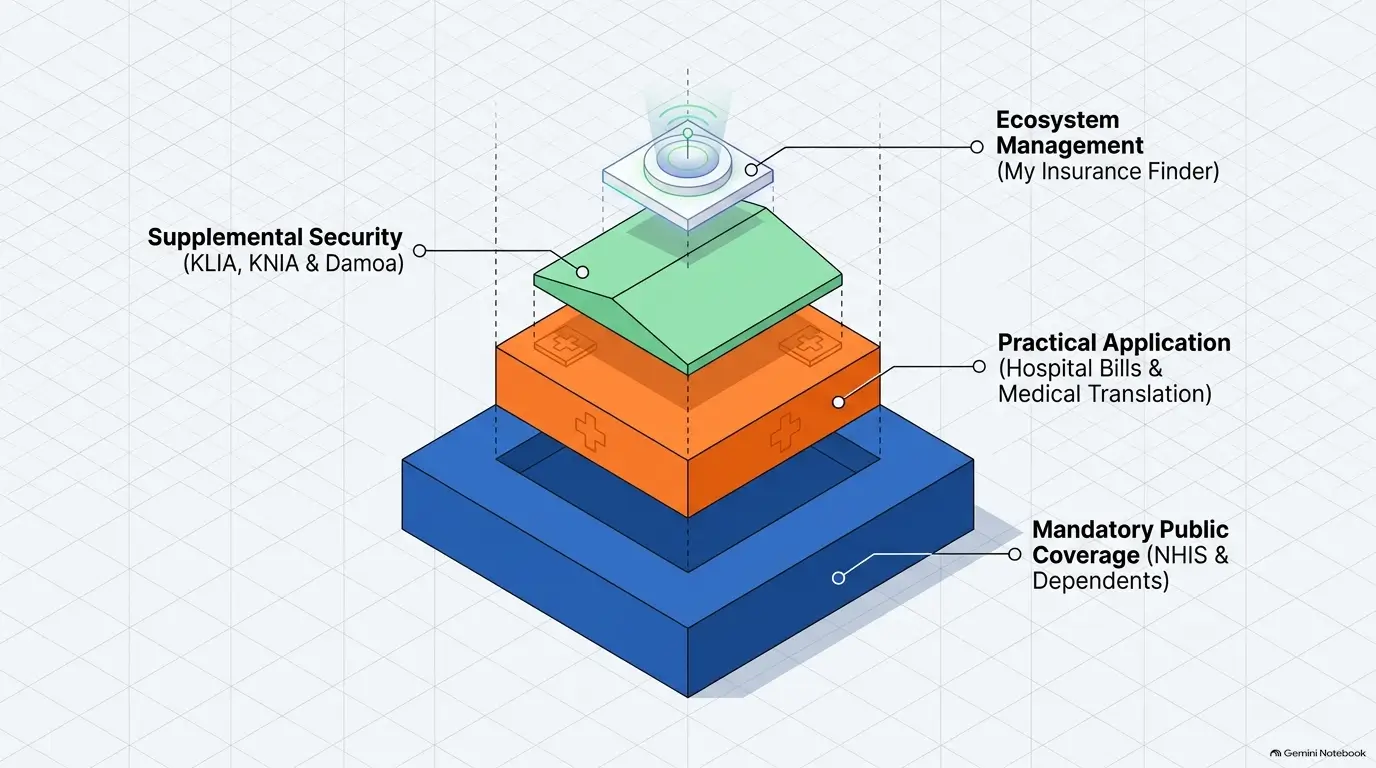
The first distinction matters more than the premium: Korea’s National Health Insurance Service (NHIS), private indemnity medical insurance, and critical illness or diagnosis-benefit insurance solve different financial problems. Being enrolled in NHIS does not mean you already have a lump-sum critical illness benefit.
There is another trap hiding in the English phrase “critical illness insurance.” In Korea, a policy described this way may involve traditional CI coverage with strict definitions of a “critical” condition, or it may be a disease policy paying specified diagnosis benefits for cancer, brain disease, heart disease, or other listed conditions. The Korean benefit wording, not the convenient English label, tells you what can actually trigger payment.
Table of Contents
Can Foreign Workers Buy Critical Illness Insurance in Korea?
Yes, some can. But Korea does not give every foreign worker a general right to purchase every private insurance product.
Private insurers set underwriting and product-access conditions within the applicable regulatory framework. A foreign applicant may be asked to prove lawful residence, provide a Korean-issued residence document, satisfy the insurer’s identification requirements, answer health and occupation questions, and demonstrate sufficient understanding of the contract.
The sales channel itself can change eligibility. For example, AIA Korea states that foreigners may enter certain insurance contracts when its eligibility conditions are satisfied, while one of its direct products specifically states that foreigners cannot enroll in that direct product. That is an insurer-specific example, not an industry-wide rule, but it exposes an important buying mistake: never ask only, “Does this insurance company accept foreigners?” Ask whether your exact product through your exact channel accepts foreign applicants.
The useful question: “Can a foreign national with my residence status buy this exact product through this exact sales channel?”
First Separate NHIS, Medical Expense Insurance, and Diagnosis Benefits
A foreign employee at a workplace subject to Korean National Health Insurance generally becomes a workplace subscriber when the employment relationship begins, subject to statutory exclusions and special circumstances. That public insurance status is separate from whether a private insurer will sell you critical illness coverage.
| Coverage | What it mainly does | What to verify |
|---|---|---|
| National Health Insurance, 국민건강보험 | Provides public health-insurance benefits under Korean rules for covered medical care | Your workplace enrollment and current eligibility |
| Indemnity medical insurance, 실손의료보험 | Privately reimburses eligible actual medical expenses under the policy | Deductibles, exclusions, covered expenses, and overlapping policies |
| Critical illness or diagnosis-benefit insurance, CI보험 / 진단비 보험 | May pay a contractually defined cash benefit when a specified diagnosis or severity trigger is met | The exact Korean benefit name and claim definition |
This distinction changes the buying decision. NHIS is principally about access to covered healthcare and sharing eligible medical costs. A fixed diagnosis benefit can instead provide cash that may help with rent, family support, debt payments, unpaid leave, or other expenses that continue while you are ill.
Do not assume that private insurance is therefore necessary. First identify the financial hole you are trying to fill. Buying three overlapping answers to one problem is an expensive way to remain confused.
The Word “Critical” Can Change Whether a Claim Is Paid
This is the most important contract-reading issue in the article.
Traditional Korean CI insurance can use terms such as 중대한, meaning that the covered event must satisfy the policy’s contractual definition of a critical or severe condition. A medical diagnosis that sounds serious in everyday English does not automatically prove that a traditional CI definition has been satisfied.
Other disease policies use diagnosis benefits, commonly called 진단비 or 진단보험금, for specifically defined illnesses. Korea’s official Insurance Damoa comparison system shows disease products using benefit categories such as cerebral hemorrhage, cerebrovascular disease, acute myocardial infarction, and ischemic heart disease. Those names are not interchangeable, and broader-sounding English translations should not be treated as substitutes for the actual policy definition.
| Wording to notice | Question to ask | Why it matters |
|---|---|---|
| 중대한 | What severity criteria must be satisfied? | A diagnosis alone may not satisfy a CI trigger |
| 진단비 / 진단보험금 | Which exact diagnoses and medical evidence qualify? | Similar English labels may hide different coverage |
| 갱신형 | When does the policy renew and can the premium change? | Today’s premium may not represent long-term cost |
| 면책 / 감액 | Is there a waiting or reduced-benefit period? | An early diagnosis may receive different treatment under the contract |
Some Korean cancer products, for example, can contain waiting periods or reduced benefits during an early policy period. The official comparison portal itself warns consumers that the timing and amount vary by product. Treat any sample period shown during comparison as an example, not as a universal Korean rule.
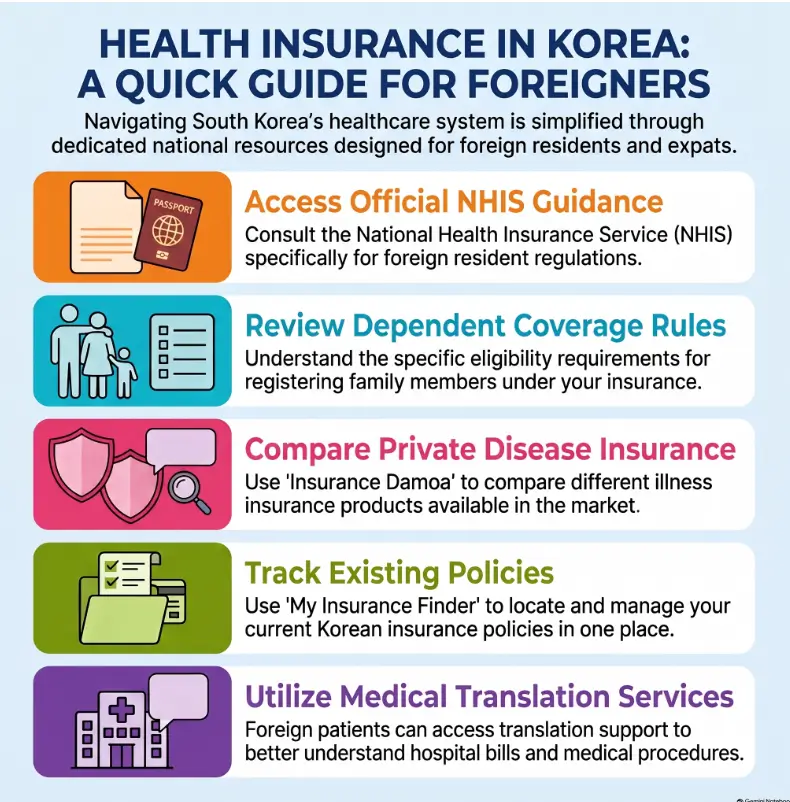
- Korea Health Insurance for Foreigners
- Korea Health Insurance Dependent Rules for Foreigners
- Korean Hospital Bills for Foreigners
- Korea Health Insurance for Expats
- Medical Translation in Korea for Foreign Patients
What Actually Changes Eligibility for a Foreign Worker?
Your nationality is only one piece of the application. In practice, several separate gates can matter.
- Residence and identification: the insurer may require an eligible Korean residence status and acceptable residence documentation.
- Product and sales channel: a branch, adviser-assisted product, and online-direct product from the same insurer may not have identical foreigner rules.
- Health underwriting: past diagnoses, treatment, medication, examinations, and other health information requested on the application can affect acceptance or conditions.
- Occupation: the work you actually perform can matter to underwriting. A job title alone may not describe the risk accurately.
- Age and insurance term: entry ages and available policy periods depend on the specific product.
- Contract comprehension: an insurer may apply procedures intended to ensure that a foreign applicant understands the contract and disclosures.
AIA Korea, for example, states that its foreign applicants must meet conditions including acceptable residence status, residence documentation, and the ability to understand the contract in Korean. Other insurers may use different criteria, so this should be treated as a provider example rather than a national eligibility checklist.
Immigration status and insurance underwriting are separate decisions. Holding an E-series work visa, residence card, or Korean job does not by itself guarantee acceptance into a private policy.
Do Not Compare Korean Critical Illness Policies by Premium Alone
There is no responsible single “average premium” for foreign workers. A useful quote must be tied to an actual applicant and an actual contract.
Depending on the product, pricing and availability may be affected by age, insured amount, health information, occupation, policy term, riders, renewal structure, and other underwriting factors. Insurance Damoa also cautions that comparison examples may differ from the premium and eligibility that apply to an individual applicant.
When two policies have different prices, compare these seven items before deciding that one is “cheaper”:
- The exact Korean name of each diagnosis benefit.
- The benefit amount payable for each covered event.
- The diagnostic or severity definition required for payment.
- Any waiting period or reduced-benefit period.
- Whether the contract is renewable and how renewal can affect premiums.
- Material exclusions, termination provisions, and surrender-value features.
- What happens if you later live, work, receive treatment, or make a claim outside Korea.
A lower monthly premium can represent genuinely leaner coverage, a narrower disease definition, a different benefit amount, a renewable structure, or simply a different underwriting result. The number without the contract architecture is only half a price.
Your 10-Minute Pre-Application Check
Before paying the first premium, build a one-page comparison note. This catches more costly mistakes than collecting another stack of brochures.
- Confirm your NHIS status. Check whether you are enrolled through your workplace and what public coverage you already have.
- Check insurance you already own. Korea’s insurance associations operate the My Insurance Finder service, 내보험찾아줌, which can help eligible users identify existing contracts and unclaimed benefits. Access depends on the service’s authentication process.
- Name the financial risk. Are you trying to cover hospital expenses, several months without wages, family remittances, rent, debt, or a combination? Do not select a benefit amount merely because an agent presents a round number.
- Write down the Korean benefit names. “Cancer cover” or “heart cover” is too vague for a serious comparison.
- Ask about waiting, reduction, renewal, and overseas-claim rules. Get the answers before the contract begins.
- Keep the documents. Save the product summary, policy terms, application answers, and any written explanation of a provision that influenced your decision.
If you cannot explain what event unlocks the largest benefit in your own words, the policy is not yet ready to buy.
Disclosure Is the Claim-Protection Step
Insurance applications in Korea can require disclosure of health history, accidents, occupation, and other information that is material to underwriting. Incomplete or inaccurate answers can later become a coverage problem, depending on the facts, the question asked, the policy, and applicable insurance rules.
For a foreign worker, occupation deserves particular care. “Factory employee,” “engineer,” “driver,” or “construction worker” may conceal very different actual duties. Answer the insurer’s questions according to the work you really perform.
Do not rely solely on saying something verbally to a salesperson if the application asks for it in writing or electronically. Read the completed disclosure before signing or confirming it, and keep a copy.
If a Korean question is unclear, ask the insurer to explain it before answering. Guessing your way through a medical-history question to finish an application faster is a tiny shortcut with potentially expensive edges.
Prepare for a Claim Before Serious Illness Makes Paperwork Harder
A critical illness claim can arrive at precisely the moment when managing documents becomes difficult. Set up the boring pieces while life is still boring.
- Keep your policy number and current policy terms accessible.
- Confirm who is listed as policyholder, insured person, and beneficiary where applicable.
- Ask the insurer what medical evidence is required for the major diagnosis benefits you purchased.
- If you may receive treatment outside Korea, confirm in advance whether overseas medical records are accepted and whether translation or additional certification may be required.
- Ask how a future change of residence or Korean bank access could affect premium payment and claim payment.
For qualifying contracts, also ask about the designated proxy claimant system, 지정대리청구인. Korean financial authorities have specifically highlighted this mechanism for situations where serious illness can leave the insured person unable to make a claim personally. Eligibility, permissible relationships, and required documents must be checked with the insurer and the specific contract.
This can be especially worth discussing when your closest family members live overseas. The useful question is not merely “Can my spouse claim?” but “Who may be registered, when must registration occur, and what documents will that person need?”

When Paying for Professional Help Becomes Rational
Most uncomplicated insurance shopping should not begin with a lawyer. There are several free checks to exhaust first.
DIY may be enough
You may be able to compare and apply directly when the product wording is clear, your disclosures are straightforward, the insurer confirms foreigner eligibility, and there is no claim dispute.
One professional consultation may be enough
A focused consultation can become useful when an older CI contract contains difficult severity definitions, substantial medical history complicates underwriting, an overseas diagnosis raises evidence questions, or the explanation you received does not match the written policy terms.
More substantial help may be justified
Consider specialist claims or legal help when a financially significant claim has been denied, the insurer alleges a serious disclosure problem, the contract has been rescinded or terminated, or a procedural deadline could affect your position.
Before paying anyone, ask the insurer for the denial or restriction in writing, the policy provision relied upon, and the additional evidence that could change the decision. A dispute is much easier to evaluate when the disagreement has a paragraph number instead of a cloud of telephone conversations.
Frequently Asked Questions
Does an E-7 or E-9 work visa automatically qualify me for private critical illness insurance?
No. A Korean work status may be relevant to residence and identification, but private-policy acceptance still depends on the insurer, product, channel, underwriting, and other eligibility conditions. Your NHIS position is a separate question.
Does having Korean National Health Insurance make critical illness insurance unnecessary?
Not automatically. NHIS and a private diagnosis benefit perform different jobs. The useful decision is whether serious illness would leave you with a meaningful cash-flow gap after considering medical coverage, employer benefits, savings, paid leave, and other insurance.
Can I keep a Korean critical illness policy if I leave Korea?
Do not assume either yes or no. Before leaving, ask the insurer about continued policy eligibility, premium payment from abroad, changes of address or residence, overseas medical evidence, translation requirements, claim submission, and benefit-payment arrangements. The answer is contract and insurer specific.
Is an English explanation of the policy enough?
Use English assistance to understand the product, but do not make a high-value decision from a translated headline alone. Ask which policy document governs the contract and match every important English term to the corresponding Korean benefit name and definition before signing.
Your Next 15 Minutes
Open a note on your phone and put the exact product name at the top. Then ask the insurer these questions before paying:
- Can a foreign national with my residence status buy this exact product through this channel?
- What is the exact Korean name of each major diagnosis benefit?
- What diagnosis or severity criteria must be met for payment?
- Is there any waiting period or reduced-benefit period?
- Is the policy renewable, and how can renewal affect my premium?
- What changes if I later live or receive treatment outside Korea?
- What claim documents are required, and can I register a designated proxy claimant?
Write the answers beside the policy wording rather than beside the salesperson’s promises. That single page gives you something far more valuable than a vague sense of being “covered”: a map of what the contract is actually supposed to do.
Last reviewed: 2026-10