
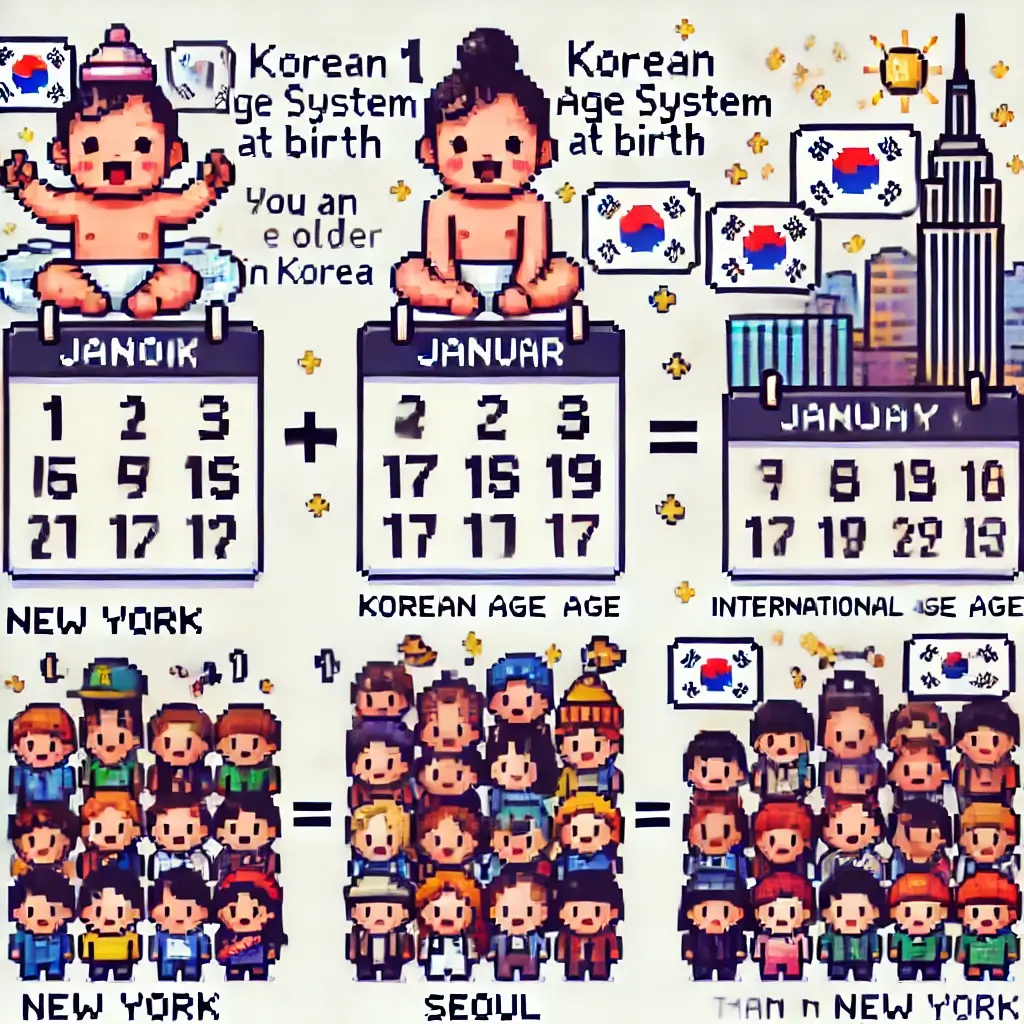
You do not become biologically older when you arrive in Korea. Different counting conventions can produce different numbers for the same birthday. The useful question is which convention a conversation, form or rule requires.
This guide explains the arithmetic and the 2023 standardization background. It does not decide eligibility for a particular school, benefit, purchase, employment rule or military obligation.
Distinguish three counting methods
International age, or 만 나이, counts completed years since birth: age increases on the birthday. Year age, or 연 나이, subtracts the birth year from the reference year without considering whether the birthday has occurred.
Traditional counting age, often called 세는나이, starts at one at birth and adds a year at the start of each calendar year. It is a social convention, not an extra year of lived experience. Ask which system someone means rather than assuming every Korean speaker uses it.
Understand the 2023 change
The Ministry of Government Legislation’s June 2023 explanation describes international age as the default in administrative and civil matters from June 28, 2023, unless a specific provision uses a different method.
The same dated explanation identifies exceptions and rules that already used international age. It does not mean every legal age threshold changed or that all informal conversation changed overnight. For a current decision, check the actual applicable rule and responsible authority.
Work through a dated example
| Method | Born November 20, 1997; reference October 18, 2026 |
|---|---|
| International age | 28: the 29th birthday has not occurred |
| Year age | 29: 2026 minus 1997 |
| Traditional counting age | 30: 2026 minus 1997 plus one |
On November 20, 2026, the international age becomes 29. The other two figures remain the same until the calendar year changes. This constructed example illustrates arithmetic and is not an eligibility ruling.
Use the complete date for international age
Subtract birth year from reference year, then subtract one if the reference month and day come before the birthday. Use the birthday and reference date recorded for the actual purpose.
Do not automatically subtract one or two from an age someone mentions: first establish how that number was calculated. For leap-day birthdays, calendar conversions or disputed records, follow the relevant official guidance instead of inventing a universal exception.
Clarify the question politely
A useful question is 만 나이로 말하면 돼요?, meaning “Should I give my international age?” You can also state a birth year when that is what the conversation needs. These are constructed language examples.
Age can be relevant to introductions, but it does not by itself settle every title, speech level or relationship. Avoid pressing someone to disclose a full birth date when it is unnecessary, especially in a public form or group chat.
Calculate completed age before discussing a special rule
For a constructed example, a person born on November 5, 2000 is 25 on October 20, 2026, and becomes 26 on November 5, 2026. The birthday and reference date matter; subtracting birth years alone would miss that distinction.
Keep that arithmetic separate from eligibility. If an application uses a particular age definition or reference date, copy the rule and ask the responsible institution how it applies. An explanation of traditional counting cannot override the wording of a current requirement.
| Focus | What to check |
|---|---|
| Birth date | The complete year, month and day. |
| Reference date | The date for which age is being calculated. |
| Eligibility | The rule, institution and any additional conditions. |
A reader question: Does an age label establish eligibility for insurance, a test or a benefit?
Not by itself. Completed age is one calculation; eligibility is a separate rule-based question. Use the current conditions of the particular scheme and ask its responsible institution when the definition or reference date is unclear.
Check the rule before acting
For a real application, record the institution, purpose, reference date, required age method and official source. If the wording is unclear, ask the organization how it calculates age and retain its response.
A general calculator cannot determine all exceptions or guarantee acceptance. Keep the arithmetic result separate from any legal or administrative condition attached to the service.
Editorial revision: October 20, 2026. Verify current provider terms and official requirements where relevant. Examples marked as constructed are not quotes or research findings.