Unlock 1 Critical Secret: Master Korean Age and NEVER Misstep Socially Again!
So, you’ve decided to dive into the vibrant, dynamic, and sometimes bewildering world of South Korea. Maybe you’re planning a trip, considering teaching English, or just fascinated by K-Pop and K-Dramas. Whatever your reason, there’s one fundamental aspect of Korean culture that will constantly pop up, subtly shaping every interaction you have: **Korean Age** and its iron grip on social hierarchy. Trust me, understanding this isn’t just a fun fact; it’s your social survival guide.
I remember my first few weeks in Seoul. I was at a company dinner, feeling pretty confident about my newly acquired Korean phrases. Then someone asked my age. I confidently gave my Western age, only to see a mix of confusion and polite smiles. Turns out, I was either suddenly younger or older than everyone thought, completely messing up the pecking order at the table. It was a hilarious, yet humbling, lesson.
This isn’t just about counting candles on a cake. In Korea, age is a social compass, dictating everything from how you speak, what titles you use, and even who pours whose drink. Get it wrong, and you might accidentally disrespect someone, come across as rude, or simply miss out on genuine connection. But don’t worry, by the end of this deep dive, you’ll be navigating Korean age like a pro, avoiding those awkward moments and earning serious street cred. —
Table of Contents
- Korean Age Decoded: Why You’re One (or Two!) Years Older in Korea
- The Unbreakable Link: Social Hierarchy, Age, and Honorifics
- Real-Life Scenarios: Navigating Age in Everyday Korean Life
- The Age Reveal: When and How to Share Your Age Gracefully
- Your Survival Kit: Practical Tips for Foreigners
- Beyond the Basics: Exceptions and Modern Shifts in Age Norms
- Korean Age in Pop Culture: What Your Favorite K-Drama Isn’t Telling You
- Embracing the Difference: Why Korean Age Makes Sense
—
Korean Age Decoded: Why You’re One (or Two!) Years Older in Korea
Let’s get straight to the heart of the matter: **Korean age**. It’s often the first hurdle for many Westerners, and frankly, it can feel like a mathematical riddle wrapped in a cultural enigma. But once you break it down, it’s actually quite simple, if a little quirky.
Here’s the deal: In Korea, everyone is considered one year old at birth. Yes, you read that right. Your grand entrance into the world immediately grants you a year of life. Think of it as a head start, or maybe just a different way of measuring existence. It’s like the moment you’re born, the clock starts ticking not from zero, but from one. This alone can add a year to your perceived age.
Now, here’s the kicker that often trips people up: everyone in Korea gains another year on January 1st, regardless of their actual birthday. So, if you were born in December, you might be just a few days old but already considered two years old in Korean age by January 1st! Imagine being born on December 30th. On December 31st, you’re one year old. On January 1st, you’re two! Your Western age might still be 0, but in Korea, you’re already a toddler in terms of age count.
So, to calculate your Korean age, it’s generally one of two simple formulas:
- (Your current Western age) + 1 = Your Korean Age (if your birthday hasn’t passed this year)
- (Your current Western age) + 2 = Your Korean Age (if your birthday hasn’t passed this year and you were born in the previous calendar year)
Let’s use an example. Say you were born on July 15, 1990. In July 2025, you are 35 in Western age. In Korea, you were 1 year old in 1990. On Jan 1, 1991, you became 2. On Jan 1, 1992, you became 3, and so on. So, in 2025, your Korean age would be 2025 – 1990 + 1 = 36. If your birthday was in December, your Korean age would still be calculated the same way, but it would often feel like you gained two years more than your Western age for a significant portion of the year.
This system, while seemingly arbitrary to us, is deeply rooted in Korean tradition and cosmology. It’s often linked to the time spent in the womb, where the nine months of gestation are rounded up to a full year at birth. It’s a holistic approach to life counting, one that emphasizes collective milestones rather than individual ones.
For more details on this fascinating concept, you can check out this resource:
The Unbreakable Link: Social Hierarchy, Age, and Honorifics
Now that we’ve cracked the code of Korean age, let’s explore its immense power. In Korea, age isn’t just a number; it’s a social determinant, a cornerstone of the intricate web of **social hierarchy** that permeates every facet of life. This hierarchy dictates how people interact, speak, and even perceive each other.
Imagine a staircase where each step represents a different age group. The older you are, the higher up the staircase you stand, and the more deference and respect you are generally shown. This isn’t about arrogance or superiority; it’s a deeply ingrained cultural value rooted in Confucianism, which emphasizes respect for elders and those in positions of authority.
This respect manifests most clearly in the use of **honorifics** in the Korean language. Unlike English, where “you” is pretty much a one-size-fits-all pronoun, Korean has an entire spectrum of speech levels, verb endings, and titles that shift based on the speaker’s and listener’s relative age, social status, and relationship. It’s like trying to navigate a forest with a map that keeps changing based on who you’re talking to!
For instance, if someone is older than you (even by a year!), you’ll use more formal language and specific titles. If they’re significantly older, the formality increases. Conversely, if someone is younger, you can use more casual speech. This isn’t a suggestion; it’s a fundamental rule of engagement. Using informal language to someone older is akin to calling your boss by their first name when you’ve just met them – except amplified by a thousand.
Common honorifics you’ll quickly encounter include:
- Hyung (형): Used by a male to address an older male.
- Oppa (오빠): Used by a female to address an older male (often a brother, boyfriend, or close older friend).
- Noona (누나): Used by a male to address an older female.
- Unnie (언니): Used by a female to address an older female.
- Dongsaeng (동생): A gender-neutral term for a younger sibling or friend.
- Sunbae (선배): Used to address someone who is your senior in school, work, or a specific field.
- Hoobae (후배): Used to address someone who is your junior.
Beyond these, there are countless other nuances, including verb conjugations that change based on the level of respect required. For instance, “to eat” can be 먹다 (meok-da – informal), 먹어요 (meog-eoyo – polite), or 잡수시다 (japsusida – highly formal/honorific). Imagine having to pick the right “eat” every time you talk to someone! It can be a minefield for beginners.
This system, while complex, fosters a deep sense of respect and order within society. It’s a mechanism for showing deference to experience and wisdom. Understanding this hierarchical framework is paramount to building meaningful relationships and avoiding social gaffes in Korea. It’s like learning the secret handshake that unlocks better connections.
To dive deeper into the world of Korean honorifics and speech levels, this site is a fantastic resource:
Real-Life Scenarios: Navigating Age in Everyday Korean Life
Alright, so you understand the theory. But how does this play out in the messy, wonderful chaos of everyday life in Korea? Let me tell you, it’s everywhere. Like invisible threads, age and hierarchy weave through almost every social interaction.
Dining and Drinking Etiquette: A Toast to Age!
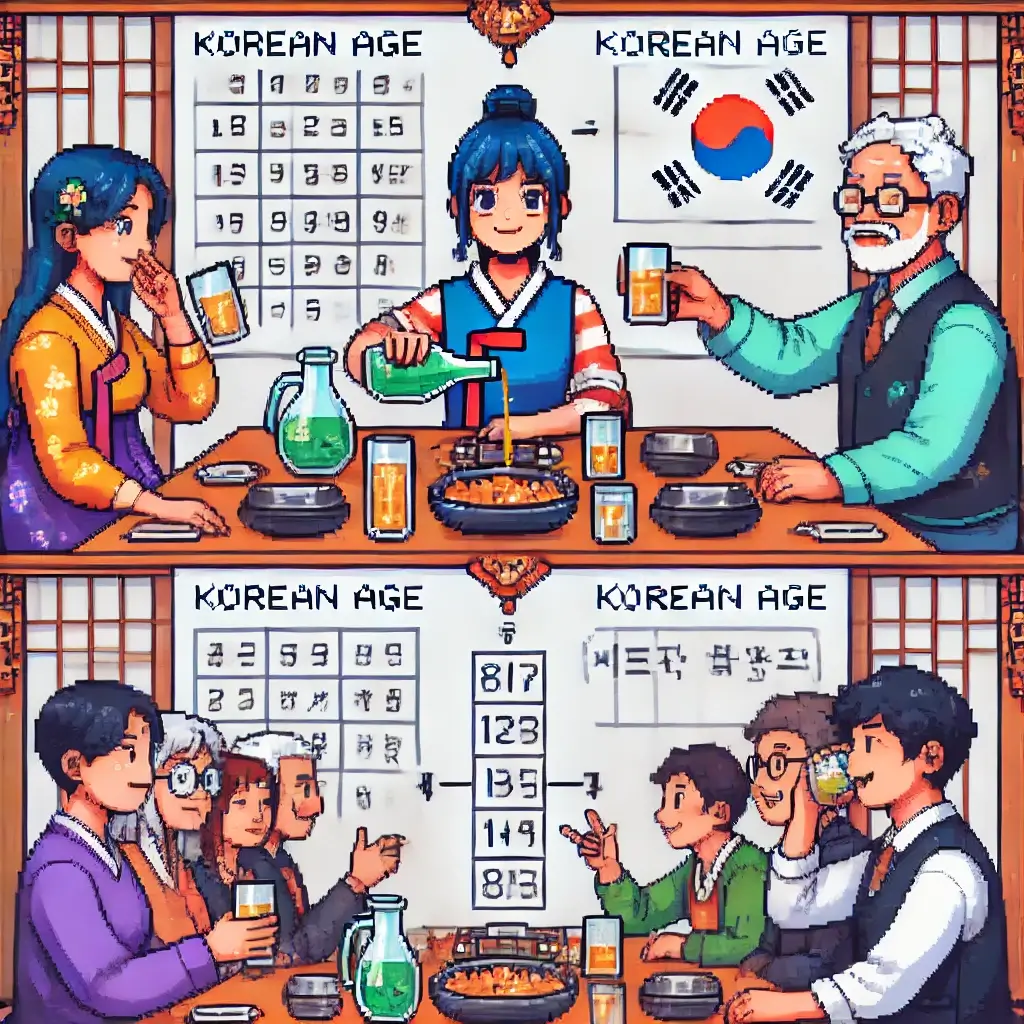
This is where things often get interesting, especially for newcomers. At a casual dinner, if you’re the youngest, you’ll be expected to pour drinks for your elders first. You’ll use two hands to pass and receive items, especially drinks, as a sign of respect. When drinking, especially alcohol, it’s common to turn your head slightly away from your elders when taking a sip. It’s a subtle gesture, but it speaks volumes.
I once saw a fresh-faced exchange student chug his beer straight-on while looking his professor square in the eye. The professor, bless his heart, just smiled kindly, but I could feel the collective cringe from everyone else. It’s not about being rude, it’s about not knowing the unspoken rules.
Workplace Dynamics: More Than Just Titles
In the office, the age hierarchy is as solid as concrete. Even if someone is your peer in terms of job title, if they are older, they hold a higher social standing. You’ll likely use honorifics and more formal language with them. Decisions, even seemingly minor ones, often flow down from older or more senior colleagues. Don’t be surprised if a younger colleague automatically defers to an older one, even if they have more experience in a specific task.
This also extends to social gatherings after work. If your boss or a senior colleague offers you a ride, it’s generally expected that you accept, even if it’s slightly out of your way. These aren’t just polite gestures; they’re part of the glue that holds professional relationships together.
Meeting New People: The Age-Checking Game
When you meet new people, especially those around your age, one of the first questions you might hear is “What year were you born?” (몇 년생이세요? – Myeot nyeonsaeng-iseyo?). This isn’t idle curiosity; it’s essential information. They’re trying to figure out your Korean age to establish the proper social footing. It’s their way of downloading your “social operating system.”
Once you’ve exchanged birth years, there’s a quick mental calculation. If you’re the same age, congratulations! You’re *donggap* (동갑), and you can switch to more comfortable, informal speech relatively quickly. If there’s an age difference, the honorifics and speech levels come into play. It’s like a social algorithm running in real-time.
My advice? Don’t be offended by the directness. They’re not being nosy; they’re just trying to be polite and interact with you correctly according to their cultural norms.
Public Transportation and Everyday Courtesy
You’ll notice it on subways and buses. Younger people often give up their seats for older individuals without a second thought. Holding doors open for elders, assisting them with luggage, or offering a helping hand is simply part of the fabric of daily life. These aren’t just random acts of kindness; they are reflections of the ingrained respect for age.
Think of it this way: in many Western cultures, we might prioritize individual freedom. In Korea, there’s a strong emphasis on group harmony and respecting the social order, and age plays a massive role in maintaining that harmony.
Understanding these scenarios will not only help you avoid awkward situations but also allow you to observe and appreciate the subtle beauty of Korean social interactions. —
The Age Reveal: When and How to Share Your Age Gracefully
So, you’re inevitably going to be asked your age. It’s a fundamental part of a new introduction in Korea. Knowing when and how to respond can make all the difference between a smooth interaction and a slightly bumpy one.
The Inevitable Question: “How Old Are You?” (나이가 어떻게 되세요? – Naiga eotteoke doeseyo?)
This question, or more commonly, “What year were you born?” (몇 년생이세요? – Myeot nyeonsaeng-iseyo?), isn’t considered rude or intrusive in Korea. It’s simply a necessary piece of information to establish the correct social dynamic. In fact, if someone *doesn’t* ask, it might mean they don’t plan on having a close relationship with you, or they’ve already deduced your general age from context.
When asked, the best approach is to be upfront and honest, stating your birth year first, then perhaps your Western age, and finally, your calculated Korean age. This shows you understand the cultural context.
For example, if you were born in 1990:
“저는 1990년생이에요. (Jeoneun cheongubaekgusip-nyeonsaeng-ieyo.)” – “I was born in 1990.”
Then, you might add:
“서양 나이로 35살인데, 한국 나이로 36살이에요. (Seoyang nairo seoreun-dasossal-inde, Hanguk nairo seoreun-yeoseossal-ieyo.)” – “In Western age, I’m 35, but in Korean age, I’m 36.”
This shows awareness and respect for their system. You’ll often see a visible shift in their demeanor once they know your age – a quick mental adjustment as they slot you into the correct hierarchical position.
When to Volunteer the Information
While you’ll usually be asked, there are times when volunteering your age can be helpful, especially in group settings. If you’re introduced to a group of new Korean friends, offering your birth year early on can help everyone establish comfortable speech levels. It’s like an efficient way to break the ice and avoid any initial awkwardness.
However, avoid leading with your age. Let the conversation flow naturally for a bit, and if it feels appropriate, or if a similar question comes up, then you can offer the information.
Dealing with Age Gaps: Donggap and Beyond
The moment you discover you’re *donggap* (동갑 – same age, born in the same calendar year), a magical thing happens. The formality can often melt away, and you can switch to casual speech with a shared sense of camaraderie. This is a big deal! It means you’re on truly equal footing, at least in terms of age.
If you find yourself older than someone, remember to be gracious. They will likely be more deferential, and it’s important not to abuse that. If you are significantly younger, embrace the opportunity to learn from your elders and show respect. It’s a reciprocal relationship.
One time, I was at a gathering, and I realized I was one year older than someone I’d been speaking informally to. As soon as I found out, I immediately switched to honorifics. They laughed, but appreciated the gesture. It shows you’re trying, and that effort goes a long way.
Being transparent about your age, and understanding its significance, is one of the quickest ways to build trust and rapport in Korea. It shows you respect their customs, and that’s a universal language. —
Your Survival Kit: Practical Tips for Foreigners
Navigating the nuances of Korean age and hierarchy can feel like walking a tightrope, but with a few practical tips, you can transform from a clumsy tourist into a culturally savvy explorer. Here’s your essential survival kit:
1. Always Know Your Korean Age (and Birth Year!):
This is non-negotiable. Before you even land, calculate your Korean age and commit your birth year to memory. You’ll be asked it constantly. Being able to quickly respond demonstrates your understanding and effort.
Example: “저는 1988년생이에요. 서양 나이로는 37살인데, 한국 나이로는 38살이에요.” (Jeoneun cheongu-baekpalpal-nyeonsaeng-ieyo. Seoyang nairo-neun seoreun-ilgopsal-inde, Hanguk nairo-neun seoreun-yeodeolsal-ieyo.)
2. Err on the Side of Formality (Initially):
When in doubt, always use formal speech (해요체 – haeyo-che or 하십시오체 – hashipsio-che) and honorifics. It’s far better to be overly polite than to accidentally offend someone. Koreans will often tell you to speak comfortably (편하게 말씀하세요 – pyeonhage malsseumhaseyo) if they are older or if they want to establish a closer relationship. Take their lead.
My first Korean language teacher drilled this into us. “If you don’t know, use the most respectful form. No one ever gets mad at too much respect!” She was right.
3. Observe and Mimic:
Pay close attention to how Koreans interact with each other, especially those of varying ages. Notice the body language, the titles they use, and the verb endings. This isn’t copying; it’s learning through immersion. Watch how friends who are *donggap* interact versus those with an age gap.
4. Don’t Be Afraid to Ask (Politely):
If you’re unsure about someone’s age or the appropriate way to address them, it’s okay to ask. A polite, “죄송하지만, 혹시 저보다 나이가 많으세요?” (Joesonghajiman, hoksi jeoboda naiga man-euseyo? – “Excuse me, but are you perhaps older than me?”) or simply asking their birth year (몇 년생이세요?) is perfectly acceptable and shows you care about respecting their culture.
5. Embrace the Two-Handed Rule:
Whenever you’re giving or receiving something from someone older or in a position of authority (e.g., pouring drinks, exchanging business cards, passing money), use two hands. It’s a small gesture that carries significant weight and demonstrates respect.
6. Be Patient with Yourself (and Others):
You’re not Korean, and you won’t get everything right immediately. Koreans are generally very understanding of foreigners who are making an effort to learn and adapt. Don’t let a mistake discourage you. A sincere apology (죄송합니다 – joesonghamnida) and a willingness to learn will smooth over most blunders.
7. Focus on Relationships, Not Just Rules:
While understanding the rules is crucial, remember that at its heart, this system is about fostering harmonious relationships. By showing respect for age and hierarchy, you’re building bridges, not just following protocols. It’s about connecting with people on their terms.
By keeping these tips in mind, you’ll find that navigating Korean social dynamics becomes less daunting and more rewarding. You’ll gain the respect of your Korean friends and colleagues, and truly begin to understand the fabric of their society.
For more insights into Korean etiquette, check out this comprehensive guide:
Beyond the Basics: Exceptions and Modern Shifts in Age Norms
While the traditional Korean age system and its impact on hierarchy are incredibly strong, like any living culture, things are subtly changing. It’s not a rigid, unchanging monolith. There are nuances, exceptions, and even a gradual shift, especially among younger generations and in certain contexts.
The Donggap Phenomenon: Your Yearmates Are Gold!
We touched on *donggap* (동갑) earlier, but it deserves more emphasis. If you find someone born in the same year as you, regardless of their actual birth month, you are officially “same age.” This creates an immediate bond and allows for informal speech. It’s like finding a long-lost sibling! This shared birth year often trumps even a few months’ difference in actual age and creates a powerful sense of camaraderie. Many Koreans form their closest social circles based on *donggap* relationships from school, military service, or college.
Professional Settings vs. Social Settings: A Slight Difference
While age is always a factor, professional settings sometimes prioritize professional hierarchy over strict age hierarchy. For example, a younger CEO might be addressed with more deference than an older entry-level employee, even if the age gap is significant. However, even in these cases, age will still influence informal interactions outside of official duties.
International Contexts: When Western Age Might Be Used
In highly international environments, like multinational companies or universities with many foreign students, there’s often a pragmatic shift. Koreans might sometimes use Western age to simplify interactions with non-Koreans who aren’t familiar with the Korean system. Don’t assume this is always the case, but be aware that some might adapt for your convenience. It’s their way of extending a hand.
Younger Generations and Casual Spaces: Loosening Up?
Among very close friends, especially younger Koreans in relaxed, informal settings, the rigidness of honorifics might loosen a bit. They might still acknowledge the age difference, but the practical application of formal language might be slightly less strict. However, this is usually only after a significant period of building trust and rapport. Don’t expect this as a default when you first meet someone!
There’s also been a growing public discussion, particularly in recent years, about the complexities of the Korean age system, especially regarding things like official documents and international standards. This led to a significant change on June 28, 2023, when South Korea officially adopted the international age system for all administrative and judicial purposes. This means that for legal and official matters, your age will now be calculated from your birth date, just like in the West.
However, and this is a big “however,” this **does not mean** the social use of Korean age has disappeared. It’s still deeply ingrained in cultural norms and everyday interactions. Think of it like this: legally, your age is now Western, but socially, the Korean age system largely persists. It’s a bit of a dual system for now, which can be confusing but is important to understand.
For official purposes, you can now rest easy knowing your age aligns with international standards, but for social interactions, continue to factor in the traditional Korean age system. It’s a good example of how culture and law can exist side-by-side, even if they sometimes feel contradictory.
This recent legal change has been a hot topic, and you can read more about it here:
South Korea Dumps Traditional Age System —
Korean Age in Pop Culture: What Your Favorite K-Drama Isn’t Telling You
If you’re anything like me, you’ve probably spent countless hours binging K-Dramas and listening to K-Pop. You might think you’re getting a full picture of Korean society, but even in these seemingly globalized forms of entertainment, the subtle (and sometimes not-so-subtle) influence of Korean age and hierarchy is constantly at play, even if it’s not explicitly explained to a Western audience.
The “Oppa” and “Unnie” Dynamic: More Than Just a Cute Nickname
You hear it all the time in K-Dramas: “Oppa!” or “Unnie!” To a casual viewer, it might just sound like an affectionate nickname. But now you know the truth: these aren’t just terms of endearment; they are explicit acknowledgments of an age difference and the social hierarchy that comes with it. A younger female calling an older male “Oppa” is showing respect, even if they’re also expressing affection.
When a character suddenly switches from formal speech to “Oppa,” it signifies a deepening of their relationship and a shift towards a more intimate, yet still hierarchical, bond. It’s a huge moment!
School Life Dramas: The Ultimate Age-Based Battleground
Watch any high school K-Drama, and you’ll see the age dynamic in full force. Seniors (선배 – sunbae) hold significant sway over juniors (후배 – hoobae). There are unwritten rules about who can address whom informally, who pays for food, and who leads group activities. These dramas aren’t just exaggerating for effect; they’re reflecting a very real social structure that begins early in life.
You’ll often see juniors bowing deeply to seniors, or senior students taking care of their hoobaes. It’s all part of the established order.
Idol Groups: The “Maknae” and “Hyung/Unnie Line”
In K-Pop groups, the age dynamic is central to their structure and fan appeal. The youngest member is called the “maknae” (막내), and they often have a special, sometimes mischievous, role. The older members are the “hyung line” (for male groups) or “unnie line” (for female groups), and they are expected to guide and look after the younger ones.
Even within the group, you’ll notice how members speak to each other. Younger members will use honorifics with their older bandmates, at least initially, and often even after years of close friendship. It’s a professional and personal respect that permeates their interactions both on and off stage.
The “Age Reveal” Moment in Dramas: Why It Matters
Have you ever noticed in a K-Drama when two characters who have been speaking informally suddenly discover one is older? There’s often a moment of awkwardness, sometimes followed by an immediate switch to honorifics, or a playful insistence from the older character that the younger one can continue speaking comfortably.
This is not just for dramatic tension; it’s a reflection of how crucial age is in real-life Korean interactions. That moment of discovery redefines their social standing and requires an immediate adjustment in their communication style.
So, the next time you’re enjoying your favorite K-Drama, look for these subtle cues. You’ll gain a deeper appreciation for the layers of meaning behind seemingly simple interactions, and you’ll see how deeply ingrained the concept of Korean age is in their cultural narrative. —
Embracing the Difference: Why Korean Age Makes Sense
At first glance, the Korean age system and its accompanying social hierarchy can seem baffling, even antiquated, to a Westerner steeped in individualistic values. We often cringe at overt displays of hierarchy or strict adherence to age-based rules. But if you take a moment to look beyond the surface, you’ll start to see the profound beauty and logic behind it.
Fostering Respect and Harmony:
This system is fundamentally about fostering respect. Respect for elders, for experience, for those who have walked the path before you. It’s a way of acknowledging that wisdom often comes with age, and that maintaining social harmony is paramount. Imagine a society where everyone knows their place, not in a rigid, oppressive way, but in a way that minimizes friction and promotes smooth interaction.
Clear Social Cues:
While it might seem complex initially, once you understand it, the system provides incredibly clear social cues. You know exactly how to address someone, how to behave, and what is expected of you. This reduces ambiguity and allows for more fluid social interactions. It’s like having a universal instruction manual for every new person you meet.
A Sense of Community and Belonging:
The collective nature of Korean age, where everyone gets a year older on the same day, also fosters a sense of shared experience and community. It emphasizes belonging to a collective rather than just existing as an individual. The *donggap* bond, in particular, creates powerful, lifelong connections rooted in shared formative years.
More Than Just a Number:
In Korea, age isn’t just a number on your birth certificate. It’s a living, breathing aspect of your identity that influences your relationships, your language, and your place in the social fabric. It’s a system designed to create order, show deference, and weave a stronger communal tapestry.
As foreigners, we have the unique opportunity to step outside our own cultural norms and truly experience another way of life. By embracing the Korean age system, you’re not just memorizing rules; you’re opening yourself up to a deeper understanding of Korean values, fostering genuine connections, and enriching your entire experience in this fascinating country. It’s a challenge, sure, but a wonderfully rewarding one.
So, go forth, calculate your Korean age, and embark on your journey with newfound confidence. The more you understand, the more you’ll connect.
Korean Age, Social Hierarchy, Honorifics, Korean Culture, Etiquette