
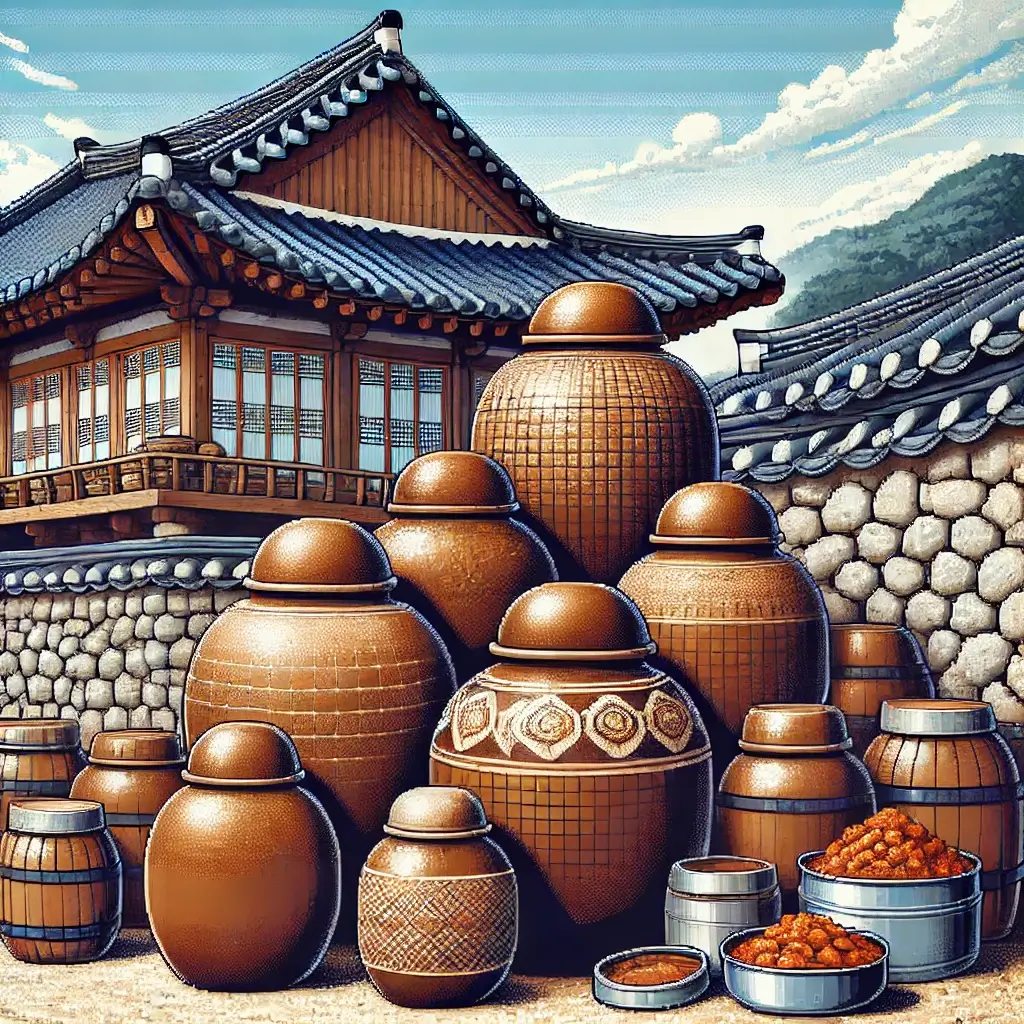
The Soulful Clay: 7 Millennia of Korean Onggi Pottery
Ever looked at a piece of pottery and felt… a connection?
Not just admiration for the craftsmanship, but a sense of history, of purpose, of something truly alive?
If you haven’t, then you haven’t met Onggi.
Oh, Onggi, you magnificent, humble, breathing vessels!
Seriously, these aren’t just pots; they’re like the ancient, wise grandmothers of the fermentation world, holding stories, flavors, and centuries of Korean culinary tradition within their sturdy, earthen embrace.
For me, delving into the world of Onggi is like stepping into a time machine, backward into the very essence of Korean life and sustenance.
It’s a journey filled with the scent of fermenting kimchi, the echoes of potters’ wheels, and the quiet dignity of a craft passed down through generations.
And trust me, after reading this, you’ll never look at a simple clay pot the same way again.
Let’s get our hands a little dirty, shall we?
—
Table of Contents
—
What Exactly is Onggi? Beyond Just a Pot
Alright, let’s start with the basics, though “basic” hardly does justice to something so profound.
When I say “Onggi,” I’m not talking about just any old earthenware.
This is a specific type of traditional Korean earthenware, instantly recognizable by its distinctive dark, earthy tones and often monumental size.
Think of those vast, beautifully imperfect jars you see lined up in Korean drama scenes, brimming with mysterious, bubbling contents – that’s Onggi.
But what truly sets Onggi apart isn’t just its appearance; it’s its very nature.
Unlike glazed ceramics that are impermeable, Onggi is designed to breathe.
Yes, you read that right: breathe.
It’s porous, allowing for a subtle exchange of air, which is absolutely critical for the fermentation processes that define so much of Korean cuisine.
We’re talking about the magic that transforms humble ingredients into culinary powerhouses like kimchi, gochujang (chili paste), doenjang (soybean paste), and ganjang (soy sauce).
Without Onggi, Korean food as we know it simply wouldn’t exist.
It’s like trying to make bread without yeast – it just won’t rise to its full, glorious potential.
And believe me, when it comes to flavor, Onggi helps things rise to epic proportions.
—
A Journey Through Time: 7000 Years of Onggi’s Enduring Legacy
Imagine a craft that has survived over 7,000 years.
Seven millennia!
That’s older than the pyramids, older than written language in many parts of the world.
Korean pottery, and specifically Onggi, has roots stretching back to the Neolithic age.
Archaeological digs across the Korean Peninsula have unearthed pottery shards dating back to 5000 BC, showcasing early forms of utilitarian earthenware.
These weren’t just decorative items; they were essential tools for survival, used for storing food, water, and eventually, for fermentation.
During the Three Kingdoms period (1st century BCE – 7th century CE), pottery techniques became more refined, with distinct regional styles emerging.
The Goryeo Dynasty (918–1392) is famous for its exquisite celadon, but alongside these aristocratic wares, the humble Onggi continued its indispensable role in daily life.
It was during the Joseon Dynasty (1392–1910), however, that Onggi truly reached its zenith, becoming ubiquitous in every Korean household.
This was a period of great culinary innovation, especially concerning fermented foods, and Onggi was the silent, indispensable partner in this gastronomic revolution.
It wasn’t just about utility; it was about tradition, about community, about the very fabric of Korean identity.
My great-grandmother, bless her industrious soul, had a jangdokdae (an outdoor terrace specifically for Onggi jars) that seemed to stretch on forever, each jar holding a different secret: potent soy sauce, tangy kimchi, rich soybean paste.
It was the heart of her kitchen, the pantry that never emptied, and a testament to Onggi’s enduring power.
It reminds me of how some of our oldest, most reliable tools are often the ones we take for granted, but they’re the very ones that allow civilization to flourish.
Onggi is exactly that – a silent, powerful workhorse of history.
—
The Breathing Magic: Why Onggi is No Ordinary Pottery
Okay, let’s talk about the “breathing” part again because it’s not just a poetic metaphor; it’s a scientific marvel.
The secret lies in the unique firing process and the clay itself.
Traditional Onggi is made from a coarse, iron-rich clay, often mixed with small particles of sand or rock.
When fired at relatively lower temperatures (compared to porcelain or stoneware, for example), these impurities burn out, leaving behind microscopic pores in the clay body.
Now, here’s where the genius comes in: Onggi is typically glazed only on the inside or partially on the outside with a natural, ash-based glaze.
This glaze, when fired, doesn’t seal the pores completely.
Instead, it creates a semi-permeable surface.
Think of it like human skin: it allows for respiration while still protecting what’s inside.
This controlled porosity allows air to circulate, which is absolutely vital for aerobic fermentation, preventing spoilage and encouraging the growth of beneficial microorganisms.
It’s a perfectly calibrated environment for the complex biochemical reactions that give fermented foods their depth of flavor and incredible health benefits.
Without this “breathing” capability, the ferments would likely go rancid, or at best, not develop that signature Korean funk (and I mean that in the best possible way!).
I once tried fermenting kimchi in a regular, fully glazed ceramic pot, thinking “close enough.”
Big mistake.
It tasted… flat.
Lifeless.
Like a song played without rhythm.
It just didn’t have that vibrant, nuanced complexity that comes from Onggi’s subtle respiration.
It’s a stark reminder that sometimes, the oldest methods are the best, precisely because they’ve been perfected over millennia of trial and error, harnessing nature’s own principles.
It’s not just a vessel; it’s an active participant in the alchemical process of fermentation.
—
Crafting a Masterpiece: The Intricate Art of Onggi Making
Creating Onggi isn’t just a craft; it’s an art form, a dance between human hands, natural elements, and centuries of inherited knowledge.
It’s demanding, physically intensive, and requires an intimate understanding of clay, fire, and tradition.
Let me walk you through the fascinating process, because honestly, it makes you appreciate every single Onggi jar even more.
1. The Clay: The Soul of Onggi
It all starts with the right clay.
Onggi potters use a special coarse clay, often reddish-brown due to its high iron content, sourced locally from specific areas.
This isn’t your average smooth pottery clay; it’s intentionally rough, sometimes mixed with sand, which helps create those crucial pores during firing.
The clay is meticulously prepared, often trampled by foot (yes, really!) to achieve the perfect consistency and remove air bubbles.
2. The Coil Method: Building from the Ground Up
Unlike smaller pottery often thrown entirely on a wheel, large Onggi jars are typically built using the coil method.
This is where the potter adds successive coils of clay, meticulously smoothing and shaping each layer by hand as the pot slowly grows upwards on a large, hand-operated wheel.
It’s a mesmerizing process, requiring immense strength, precision, and an intuitive feel for the clay.
I’ve watched master potters do this, and it’s like witnessing a living sculpture emerge from raw earth.
They use wooden paddles to gently beat the outside of the pot while supporting the inside, shaping the distinctive curves and strengthening the walls.
3. Drying: Patience is a Virtue
Once shaped, the Onggi must dry slowly and evenly to prevent cracking.
This can take weeks, depending on the size of the jar and the weather conditions.
It’s a waiting game, a testament to the patience required in traditional crafts.
4. Glazing: The Natural Protective Layer
The characteristic deep brown or black glaze on Onggi is often made from a mixture of ash, clay, and sometimes pine resin, providing a natural, food-safe coating.
As mentioned, it’s applied strategically to allow for breathability, often leaving parts of the exterior unglazed or lightly glazed.
5. Firing: The Fiery Transformation
This is perhaps the most dramatic stage.
Onggi is traditionally fired in an updraft kiln called a “dungjae-gama” or “kiln climbing a mountain” – a long, tunnel-like kiln built on a slope, allowing heat to rise efficiently.
The firing process can last several days, with temperatures reaching around 1,100-1,200°C (2,000-2,200°F).
The potters must carefully monitor the temperature, adjusting the airflow and adding wood to ensure an even, complete firing.
It’s a delicate balance, as too high a temperature would vitrify the clay too much, destroying its porosity.
The smoke and ash from the wood firing contribute to Onggi’s unique color and texture, giving each piece a distinct, artisanal character.
Each Onggi piece, therefore, isn’t just manufactured; it’s born from a painstaking process that respects the materials and the ancient techniques.
It’s a testament to human ingenuity and perseverance.
—
Onggi’s Cultural Heartbeat: More Than Just Fermentation
While its role in fermentation is undoubtedly Onggi’s most famous contribution, its significance in Korean culture runs far deeper.
It’s interwoven with daily life, spirituality, and the very concept of home.
The Jangdokdae: An Altar of Sustenance
The jangdokdae, that outdoor terrace where Onggi jars reside, is more than just a storage area.
It’s historically been considered one of the most important spaces in a Korean home, almost a sacred space.
Families would often offer prayers for good harvests and healthy ferments at the jangdokdae, recognizing the vital role these jars played in their survival and well-being.
It was a place of abundance and gratitude.
A Symbol of Simplicity and Self-Sufficiency
In a world increasingly dominated by mass-produced goods, Onggi stands as a powerful symbol of simplicity, sustainability, and self-sufficiency.
It represents a lifestyle in harmony with nature, where food is preserved and enhanced through traditional, natural processes.
It’s about making the most of what you have, and doing it beautifully.
Artistic Expression and Regional Identity
While Onggi is primarily utilitarian, it’s not devoid of artistic merit.
Each Onggi jar, with its unique imperfections and hand-formed character, is a work of art.
Regional variations in clay, firing techniques, and forms also contribute to a rich tapestry of Onggi styles, reflecting the diverse landscapes and traditions across Korea.
Just like accents in different parts of a country, Onggi from Jeolla-do might have a slightly different “feel” than Onggi from Gyeongsang-do, a subtle nod to their origins.
It’s a wonderful example of how practical objects can also embody deep cultural meaning and aesthetic beauty.
—
Onggi in the 21st Century: Preserving a Living Heritage
In our fast-paced, modern world, one might wonder if a traditional craft like Onggi still holds relevance.
The answer is a resounding YES!
In fact, its importance is arguably growing.
The Fermentation Renaissance
Globally, there’s been a massive resurgence of interest in fermented foods, driven by a growing awareness of gut health and the desire for natural, wholesome food.
This renewed interest has shone a spotlight on Onggi, recognizing its unparalleled ability to create truly exceptional ferments.
Chefs, health enthusiasts, and home cooks worldwide are now seeking out authentic Onggi to elevate their fermentation game.
Sustainability and Craft Revival
Onggi is inherently sustainable, made from natural materials and crafted to last for generations.
It stands in stark contrast to disposable plastic containers or energy-intensive modern production methods.
There’s also a powerful movement to preserve traditional crafts and the knowledge embedded within them.
Master Onggi potters are recognized as “Living National Treasures” in Korea, and efforts are underway to ensure their skills are passed on to new generations.
It’s like nurturing a rare, vital species – if we lose the knowledge, we lose a piece of our collective human heritage.
Beyond the Kitchen: Artistic and Decorative Uses
While its primary function remains practical, Onggi’s rustic beauty and imposing presence make it a striking decorative element.
You can find smaller Onggi pieces used as unique planters, artistic displays, or even water features in gardens.
They bring an earthy, natural elegance to any space, a quiet reminder of tradition in a modern setting.
I have a small Onggi vase on my desk, and just looking at it brings a sense of calm, a connection to something ancient and authentic.
It’s a simple reminder of the beauty that can arise from humble materials and dedicated hands.
—
Finding Your Own Onggi: Tips for the Enthusiast
Feeling inspired to get your own Onggi?
Excellent!
Here are a few tips to help you find an authentic piece and care for it.
1. Where to Look:
The best place to find authentic Onggi is, of course, in Korea, directly from potters or specialized stores.
However, with the global rise in popularity of Korean culture, you can now find reputable online retailers specializing in Korean crafts and kitchenware.
Look for terms like “traditional Korean earthenware” or “Onggi fermentation crock.”
Make sure the seller specifies it’s traditionally made and unglazed/partially glazed for breathability.
2. What to Look For:
Authentic Onggi will have a rustic, earthy feel.
Don’t expect perfect symmetry or a uniformly smooth surface; imperfections are part of its charm and a sign of handcraftsmanship.
Check for the “breathing” quality – if it feels completely sealed and vitreous like regular stoneware, it might not be true Onggi.
A good sign is often a slightly coarse texture on the unglazed parts and a subtle, earthy smell.
3. Caring for Your Onggi:
Onggi is remarkably durable, but it does require some care.
Avoid sudden temperature changes, which can cause cracking.
Clean with mild soap and water, avoiding harsh chemicals.
For fermentation, ensure it’s thoroughly clean and dry before adding ingredients.
And remember, because it breathes, it’s best kept in a well-ventilated, relatively stable environment, ideally outdoors on a patio or a cool, airy spot, just like a traditional jangdokdae!
—
So there you have it: the incredible world of Onggi.
It’s more than just pottery; it’s a living artifact, a testament to human ingenuity, cultural resilience, and the timeless art of transforming humble ingredients into extraordinary flavors.
Next time you enjoy a spoonful of delicious kimchi or a dash of aged soy sauce, take a moment to appreciate the unsung hero behind it: the magnificent, breathing Onggi.
It’s a piece of history you can actually eat!
—
Further Exploration of Korean Pottery
Want to dive even deeper into the world of Korean ceramics?
These resources offer fascinating insights into the history, artistry, and cultural impact of Onggi and other Korean pottery traditions.
Discover Korean Ceramics at Smithsonian’s Freer|Sackler
Learn More About Korean Crafts from Korea.net
Onggi, Korean pottery, Fermentation, Korean culture, Traditional craft