
South Korea Airports Overview: Incheon, Gimpo, Gimhae, Jeju, and Regional Hubs – 11 Essential Lessons I Learned After My First Seoul–Busan Trip
What I Wish I Knew Before My First Seoul–Busan Trip: 11 Hard-Learned Lessons (and a Few Facepalms)
On my very first trip from Seoul to Busan, I landed at the “wrong” airport—yes, Seoul has two—and almost missed my connection. I ended up learning more about Korean airports in one frantic, sweaty day than I had in a decade of flying. Spoiler: Google Maps doesn’t save you when you’re dragging luggage across a city you don’t understand.
So, if you’re staring at your itinerary wondering whether to fly or take the KTX, or whether Jeju magically fits into the same week (it doesn’t—unless you’re time-rich or secretly teleporting), this guide is for you.
In the next few minutes, I’ll walk you through the 11 things I wish someone had told me—from airport transfers and baggage surprises to whether travel insurance actually matters (hint: yes, when your suitcase decides to go on its own vacation).
You’re probably planning this in between meetings or on your third coffee of the day, so we’ll keep it simple, honest, and actually usable. There’s even a 60-second Seoul–Busan travel calculator, plus a few “decision cards” to help you avoid my mistakes and make smarter moves with your time, money, and patience.
Let’s get into it—and maybe save you a missed flight or two.
Table of Contents
How South Korea’s Airports Actually Fit Your Trip
South Korea looks compact on the map, but its airport network behaves more like a cluster of mini-strategies than “one big hub.” You’ve got:
- Incheon (ICN): the giant international gateway, long-haul flights, and serious duty-free energy.
- Gimpo (GMP): Seoul’s domestic workhorse with frequent Seoul–Busan and Seoul–Jeju flights.
- Gimhae (PUS): Busan’s main airport, mixing domestic and regional international routes.
- Jeju (CJU): a domestic superstar, one of the busiest air routes in the world with constant Seoul–Jeju shuttles.
- Regional hubs like Daegu, Cheongju, Muan, and Yangyang, which matter if you chase niche routes or cheaper fares.
On my first Seoul–Busan run, I treated all of these as interchangeable dots. Big mistake. Every airport has its own transport links, typical delays, and sweet-spot routes. Once you see how they fit together, planning airports in Korea becomes less “mystery puzzle” and more “mix-and-match LEGO set.”
“Eligibility first, route second—you can save 30–40 minutes per segment just by picking the right airport pair.”
- Incheon for long-haul and big rewards redemptions.
- Gimpo, Gimhae, and Jeju for fast domestic hops.
- Regional hubs only when they clearly save time or money.
Apply in 60 seconds: Write down your arrival city, final city, and side-trip (if any)—we’ll plug those into the decision cards below.
Lesson 1: Don’t Fly Into the “Wrong” Seoul Airport
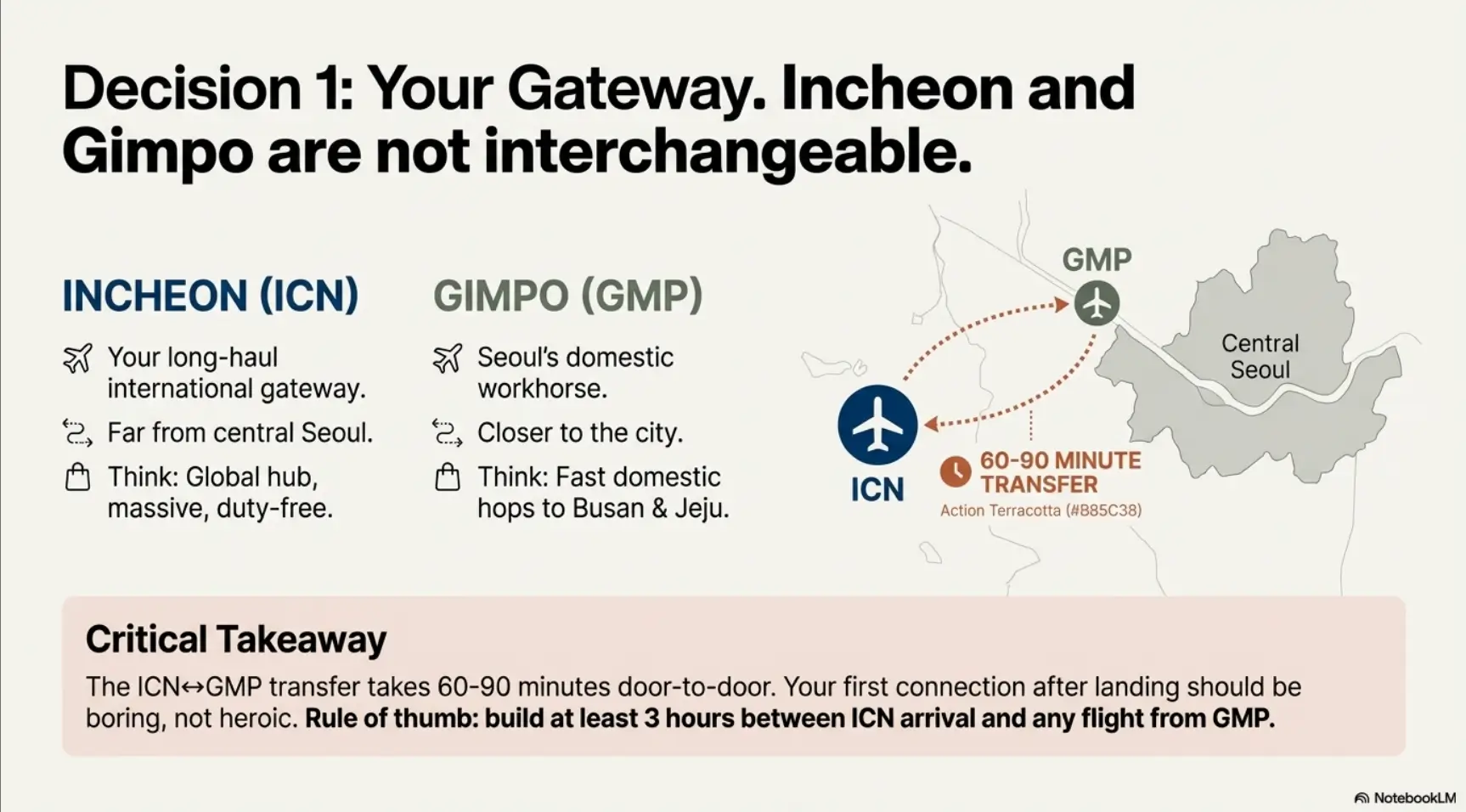
The first lesson I learned the hard way: Incheon and Gimpo are not interchangeable, even though both serve “Seoul.”
My itinerary looked clever on paper: arrive at Incheon, quick hop over to Gimpo, fly to Busan, then KTX back. In reality? I arrived bleary-eyed after a 13-hour flight, dragged my suitcase onto the airport railroad, misread the transfer sign, and watched my original Gimpo–Busan departure time tick by while I was still on the subway.
Here’s what I wish I had tattooed on my boarding pass:
- Incheon (ICN) is almost always your arrival point if you’re coming from outside Asia.
- Gimpo (GMP) is across town, closer to central Seoul, and handles a huge slice of domestic traffic to Busan and Jeju.
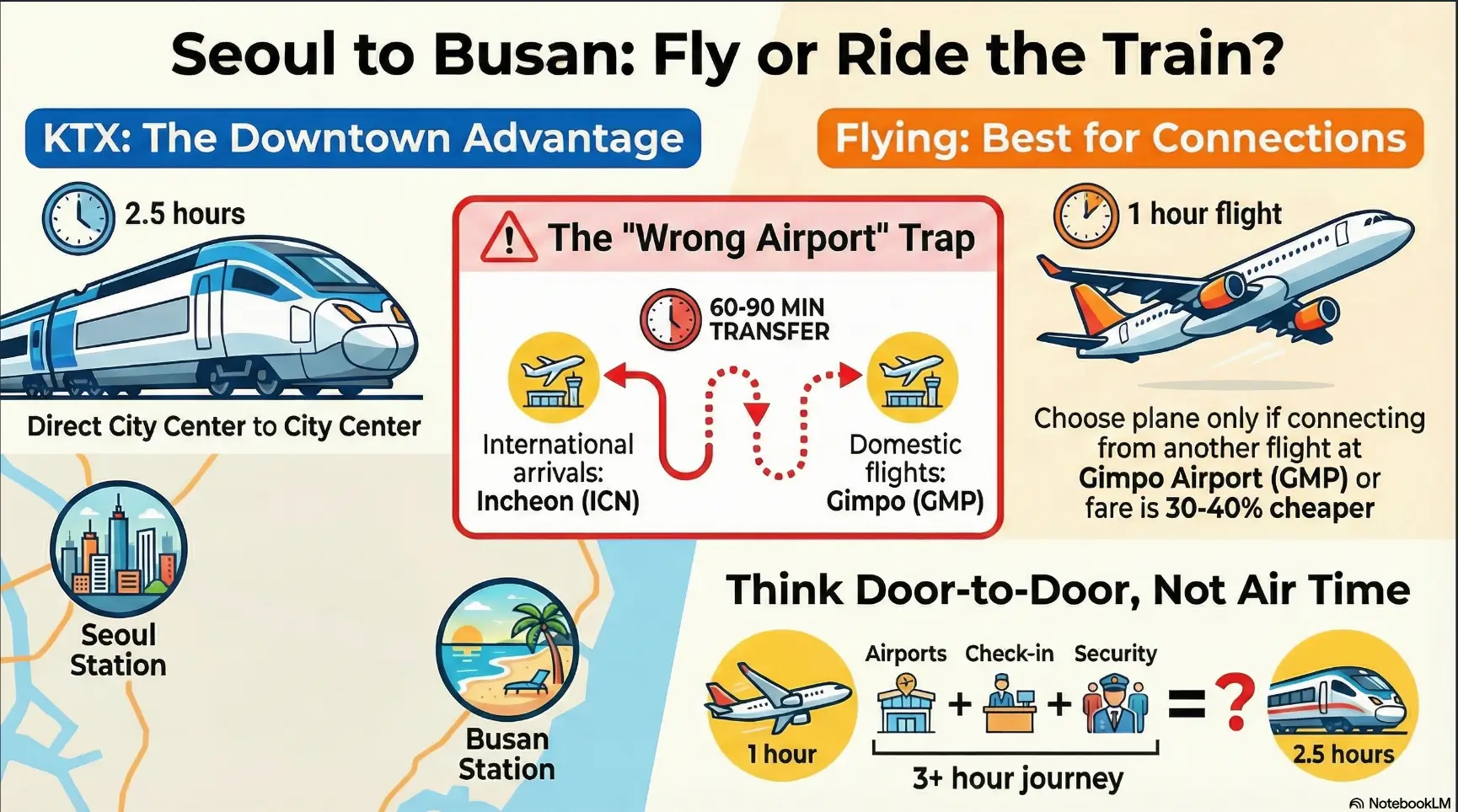
- The ICN↔GMP transfer can take 60–90 minutes door to door once you include immigration, baggage, train, and security again.
Is it doable? Yes. Is it pleasant after an overnight flight? Not always. Many time-poor travelers underestimate just how much mental bandwidth that first transfer eats up.
- Same-airport connections beat cross-town transfers.
- Build at least 3 hours between ICN arrival and any flight from GMP.
- If you’re exhausted, consider one night in Seoul before heading to Busan.
Apply in 60 seconds: Open your itinerary and highlight any ICN→GMP transfer with less than 3 hours. If you see one, mark it “at risk” and plan a plan B.
Lesson 2: Seoul–Busan Is an Air vs Rail Money Question
For the Seoul–Busan leg, you’re basically picking between two machines:
- Plane from Gimpo to Gimhae (roughly 1 hour in the air; around 200 miles of distance).
- KTX high-speed train between Seoul Station and Busan Station, usually 2 hours 15 minutes to just under 3 hours with fares that often land around the low-to-mid USD 40s in 2025.
On my first trip, I chose the plane because “shorter flight” sounded automatically smarter. Door-to-door, with transfers and check-in, the time difference shrank to maybe 30–40 minutes, and the energy cost was higher. The train would have meant one station, one boarding, no extra security, and easier refunds.
Money Block #1 — Decision Card: Fly or Take KTX?
When a flight makes sense (Gimpo ⇄ Gimhae)
- You’re already near Gimpo (western Seoul) or Gimhae (Busan airport area).
- You have a same-day connection from another flight.
- You find a promo fare that undercuts KTX by at least 30–40%.
When the KTX is usually better
- You’re staying near Seoul Station or central Busan (Seomyeon, Nampo, Haeundae with subway links).
- You prefer fewer security checks and more legroom.
- You want easy same-day changes at the station without airline rules.
Save this card and confirm current fares on the official rail and airline sites before booking.
Short Story: On my return leg, I switched to KTX. I bought a ticket online over hotel Wi-Fi, showed up 30 minutes early, and grabbed a convenience-store lunch box for the ride. No weighing cabin bags, no gate changes, just a window seat watching rice fields blur past. When we slid into Busan Station almost exactly on schedule, I realized I’d traded one security line and two boarding passes for a single, predictable train—and I slept better for it.
- Calculate from hotel to hotel, not runway to runway.
- Factor in check-in and security time for flights.
- Consider flexibility: trains are often kinder to last-minute changes.
Apply in 60 seconds: Sketch your Seoul address and Busan address, then note which is closer to airport or station—your winner will start to appear.
Lesson 3: Domestic vs International Terminals in 2025
South Korea’s main airports are tidy, but they still split traffic in ways that can confuse tired travelers.
- Incheon has multiple passenger terminals and concourses, mainly for international flights with a few limited domestic services.
- Gimpo separates international and domestic, with domestic being the workhorse for Seoul–Busan and Seoul–Jeju flights.
- Gimhae and Jeju mix domestic and international, but signage and gates are clearly marked English/Korean.
On my first day, I followed the wrong arrow at Gimhae and ended up wandering near international check-in, wondering why “my” airline didn’t appear on the screens. A security guard gently redirected me to the domestic side with a look that said, “We see this a lot.”
To stay sane, treat each airport as two experiences:
- International mode: longer check-in lines, more stringent document checks, more duty-free.
- Domestic mode: faster bag drop, shorter security, fewer shops but quicker boarding.
Show me the nerdy details
In 2024–2025, Korea’s aviation planners have been pushing more regional international routes through secondary airports such as Daegu, Cheongju, and Muan. That means schedule shifts and seasonal charters that may alter which terminal opens when, especially in shoulder seasons. Checking your terminal the day before—inside your airline app or booking email—can save you a surprise walk and one unnecessary security line.
- Screenshot your terminal info the night before.
- Follow “Domestic” vs “International” signs first, airline logos second.
- Expect domestic security to be faster—but still arrive 60–90 minutes early.
Apply in 60 seconds: Open your confirmation email and note “I” or “D” next to each airport segment—instant clarity.
Lesson 4: Transfer Times and Ground Links You Can Actually Trust
On maps, everything in South Korea looks close. In real life, you have to respect immigration, baggage, and ground transport.
As of late 2025, the main options from Incheon to central Seoul include the AREX airport train, airport buses, and taxis/rideshare. Express trains run non-stop to Seoul Station in a little over 40 minutes; the all-stop version is slower but cheaper and more frequent. Typical fares between Incheon Airport and Seoul Station sit in the ballpark of a few thousand won for the all-stop and roughly double for the express, with modern, air-conditioned carriages and luggage racks.
The hitch is everything that happens before and after those 40 minutes: walking to the platform, buying a ticket, waiting for the next train, and then transferring at Seoul Station if you’re heading to a different neighborhood or onward KTX.
Money Block #2 — Airport Transfer Fee & Time Table (2025, Korea)
| Mode | Typical Fare (KRW) | Typical Time | Best For |
|---|---|---|---|
| AREX All-Stop Train | Around 4,500–5,000 | ~60 minutes to Seoul Station | Budget-friendly solo travelers |
| AREX Express Train | Around 9,000–10,000 | ~43 minutes non-stop | Time-sensitive connections |
| Airport Limousine Bus | ~10,000–17,000 | 60–90 minutes (traffic-dependent) | Direct to major hotels/districts |
| Taxi / Ride-hail | ~55,000–75,000+ | 45–70 minutes | Families, heavy luggage, late-night arrivals |
Save this table and confirm the current fee on the official provider’s page before you travel.
My own “aha” moment came when I realized I’d planned a 2-hour transfer that silently assumed a 10-minute walk, a zero-minute queue, and a train waiting just for me. Reality shaved at least 20–30 minutes off that fantasy.
- Add 20–30 minutes of “friction” to whatever Google Maps says.
- Late at night or with kids, premium modes are often worth it.
- Build extra time if you’re catching a KTX or domestic flight afterward.
Apply in 60 seconds: Take your tightest transfer and add 30 minutes. If it breaks your plan, adjust now—before you’re jet-lagged.
Lesson 5: Baggage Rules, Weight Surprises, and Airport Storage
Another rookie mistake: assuming domestic baggage rules in Korea match your long-haul ticket. They often don’t.
On my Seoul–Busan flight, I learned my international fare’s generous allowance didn’t automatically apply to the separate domestic ticket I’d booked later. The agent was kind, but the scale was not. A few kilos over and the fee per kilo can climb surprisingly fast compared with just traveling lighter or choosing the train.
Three things to keep in mind:
- Domestic low-cost carriers (LCCs) tend to have stricter cabin baggage rules and lower checked baggage allowances.
- Premium credit cards or frequent flyer status might soften this—but only for specific airlines, not all carriers in Korea.
- Airports like Incheon and Gimpo offer baggage storage and delivery services, which can be cheaper than lugging everything to every city.
Money Block #3 — Eligibility Checklist: Are You Likely to Pay a Baggage Fee?
- Is your Seoul–Busan leg booked with a different airline than your long-haul ticket? Yes/No
- Is your checked bag over 15–20 kg on the scale at home? Yes/No
- Are you flying a low-cost carrier (Jeju Air, T’way, Air Busan, etc.) without a bundle that includes bags? Yes/No
- Do you have airline status with this specific carrier or a card benefit that clearly mentions baggage? Yes/No
If you answered “Yes” to 2 or more, assume a fee is likely and plan for it.
Save this checklist and confirm the current baggage rules on your airline’s official site before packing.
- Weigh your luggage at home; aim 1–2 kg below the limit.
- Consider using station lockers or airport storage for side-trips.
- On tight itineraries, keep one small carry-on for Seoul and Busan only.
Apply in 60 seconds: List what you truly need in Busan and Jeju. Everything else can stay in storage in Seoul for a few dollars a day.
Lesson 6: Airport to City Without Burning Your Budget
Even if you fly the cheapest ticket you can find, you can quietly erase those savings with one or two expensive transfers. This shows up strongly in and around airports in Korea.
Seoul example:
- Land at Incheon, take a premium taxi into central Seoul, then another taxi to Gimpo the next day.
- Or: take the AREX train into Seoul Station, buy a T-money card, ride the subway cheaply, and do one taxi only when your legs give up.
Busan example:
- From Gimhae, the light rail connects you straight into the metro system, with low fares and predictable times.
- Taxis are still reasonable but can add up if you bounce between beach and port districts.
A quick regional note: in South Korea, transport systems are tightly integrated. Your reloadable transit card works on buses, subways, and many regional systems. That means you can often swap a 30,000-won taxi ride for a 5,000-won mix of train + subway without sacrificing too much comfort—especially outside rush hour.
- Buy one transit card early and keep it loaded.
- Use premium options only when late, exhausted, or carrying heavy bags.
- For couples or groups of 3–4, compare taxi vs rail; the math flips quickly.
Apply in 60 seconds: Decide your “default mode” now: train or taxi. Use the other only as your backup, not your default.
Lesson 7: How Jeju and Gimhae Reshape Your Whole Itinerary
Jeju is the island that keeps hijacking people’s itineraries. “Maybe we’ll just add a quick Jeju weekend,” they say. Then suddenly all their airport choices rearrange themselves.
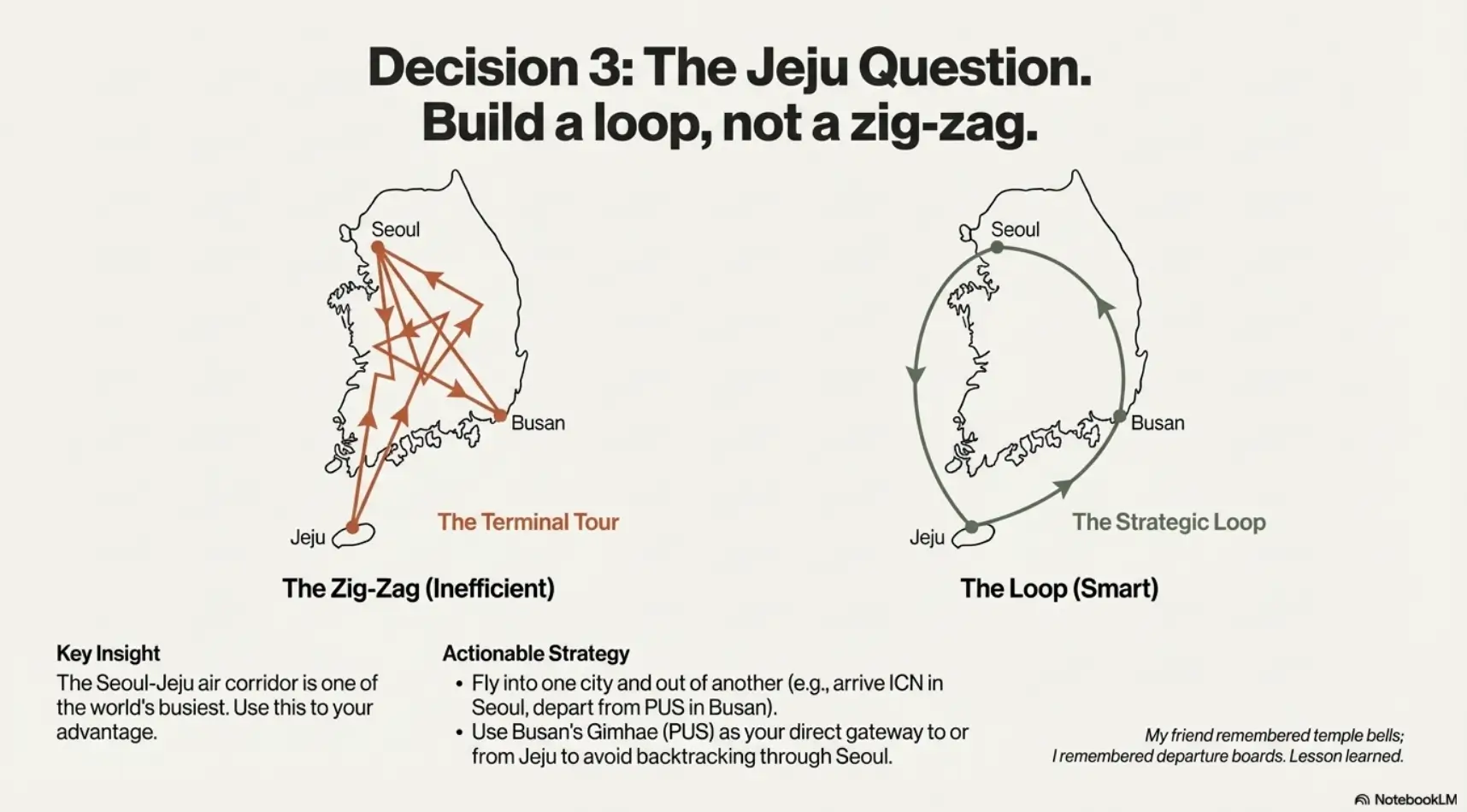
In 2025, the Seoul–Jeju air corridor remains one of the world’s busiest domestic routes, with constant shuttles from both Gimpo and, to a lesser extent, Incheon. Busan’s Gimhae also connects to Jeju with frequent services. That creates a triangle: Seoul ⇄ Busan ⇄ Jeju ⇄ Seoul.
On my first trip, I tried to cram all three vertices into seven days. By day five I could identify every chain café in three different terminals, but I remembered fewer details of the beaches than the boarding gates.
The smarter way:
- If Jeju is a must, consider flying Seoul → Jeju → Busan (or the reverse) to avoid backtracking.
- Use Gimhae as a gateway if you want to pivot from Jeju straight into Busan’s coastal neighborhoods.
- Keep one flight open-jaw: arrive in Seoul, depart from Busan, or vice versa.
Short Story: A friend of mine did the opposite: Seoul → Busan by KTX, Busan → Jeju by plane, Jeju → Seoul by plane, then back out of Incheon. Same seven days, but he minimized extra train rides and never had to cross Seoul twice before or after a long-haul flight. When we compared notes, he remembered temple bells and market smells; I remembered escalators and departure boards. Lesson learned.
- Build a loop, not a zig-zag.
- Open-jaw tickets (arrive one city, leave another) are your friend.
- Let Jeju be a real break, not a rushed layover.
Apply in 60 seconds: Circle Jeju on your imagined map. Is it truly essential this trip? Answering honestly will simplify everything else.
Lesson 8: Smaller Airports and Regional Hubs (Should You Use Them?)
Beyond the big four, South Korea has several regional airports: Daegu, Cheongju, Muan, Yangyang, and others. They often serve specific international routes or seasonal charter flights and can sometimes offer lower fares or less crowded terminals.
Here’s the catch: these airports usually make sense only if at least one of these is true:
- You’re visiting the nearby region anyway (Daegu for Gyeongju sights, Yangyang for the east-coast beaches).
- You find a direct route that saves a full connection compared with using Incheon.
- Your time and stress budget can handle more limited schedule options.
After Korea’s recent focus on aviation safety and infrastructure reviews—even more so after high-profile incidents—regional airports have been under closer scrutiny. For a first-time, time-poor traveler, I usually suggest sticking with Incheon, Gimpo, Gimhae, and Jeju unless there’s a very specific reason not to.
- Great if you know exactly why you’re using them.
- Risky if you’re rushing, new to Korea, or on tight timelines.
- Schedules can be thinner and more seasonal.
Apply in 60 seconds: Look at your search results. If a regional airport appears, ask, “Does this meaningfully reduce transfers?” If not, skip it.
Lesson 9: Insurance, Credit Cards, and When Things Go Wrong
We need to talk about the unglamorous side of airport planning: delays, cancellations, and coverage.
South Korea’s major airports and carriers generally run a tight operation, but weather, air traffic, and operational issues still happen—especially on busy domestic corridors like Seoul–Busan and Seoul–Jeju. Recent years have also reminded travelers that regional airports and low-cost carriers are not immune to serious disruptions and safety reviews.
Instead of obsessing over “perfect” punctuality stats, I treat airport planning as an insurance exercise:
- Can you survive a 2–3 hour delay without missing your international connection?
- Do your tickets sit on one booking (protected connection) or multiple separate tickets (you’re on your own)?
- Do you have travel insurance or a card benefit that actually covers missed connections and delays—not just lost luggage?
Money Block #4 — Travel Insurance & Card Coverage Quick Check
- Did you pay for your flights with a card that includes trip delay or interruption coverage? Yes/No
- Does your travel insurance clearly mention missed connections and trip interruption, not just medical? Yes/No
- Is your Seoul–Busan leg on the same ticket as your long-haul flight? Yes/No
- Do you have at least one backup way to reach your destination (KTX, earlier flight, overnight hotel budget)? Yes/No
If you answered “No” to most of these, assume you are self-insured and build bigger buffers into every airport transfer.
Save this checklist and confirm actual coverage terms on your insurer or card issuer’s official page before you fly.
From a Korean perspective, this matters even more if you’re connecting across systems—say, arriving at Incheon on an overseas airline, then separately flying a domestic low-cost carrier. In that case, you are your own safety net. A single foggy morning at Gimpo can rearrange your whole day.
- Keep at least 3 hours between domestic and international flights on separate tickets.
- Know your insurance and card benefits before departure day.
- Always have a fallback, like a KTX seat or overnight hotel budget.
Apply in 60 seconds: Answer one question: “If my Seoul–Busan flight disappears, what’s my plan B?” Write it down.
Lesson 10: Airport Etiquette and Local Culture Clues
Airports are the first place many travelers meet Korean culture in motion. A few small habits will make everything smoother:
- Lines are taken seriously. Whether it’s check-in, boarding, or security, people queue in orderly fashion. Jumping the line will earn you polite but firm disapproval.
- Quiet efficiency rules. People speak more softly than at many Western hubs. Keep phone calls short and earbuds handy.
- Security is thorough but calm. Remove laptops and follow instructions; staff will guide you even if you don’t speak Korean.
- Food and coffee culture is strong. Convenience stores, bakeries, and cafés are everywhere—great for refueling between flights or before the KTX.
On my first trip, I watched a family ahead of me at Gimhae security unpack an entire picnic’s worth of liquids and snacks in slow motion. The staff stayed patient, the line adjusted, and no one yelled. That calm—plus excellent signage in English and Korean—does a lot to reduce stress if you let it.
- Follow the line, not the crowd.
- Keep your voice and luggage compact.
- Use convenience stores as your backup meal plan.
Apply in 60 seconds: Pack one small clear pouch with your liquids and chargers so you can glide through security without repacking everything.
Lesson 11: Building a Sane, Airport-Smart Korea Itinerary
Now that you’ve seen how the big airports behave, let’s turn this into a simple, airport-first itinerary logic you can reuse.
60-Second Seoul–Busan Time Estimator
Use this tiny calculator to get a feel for total travel time between Seoul and Busan, including transfers.
This is intentionally conservative. It assumes check-in and security overhead for flights and a modest buffer for the KTX. You’ll often beat it—but if your itinerary only works when everything runs perfectly, that’s a warning sign.
Infographic — Which Airport Should You Use?
Incheon (ICN)
Use when: Long-haul flights, international arrivals/departures.
Think: Big hub, best lounges, longest transfers.
Gimpo (GMP)
Use when: Domestic Seoul–Busan/Jeju, short hops.
Think: Close to city, quick in/out.
Gimhae (PUS)
Use when: Busan base, Jeju side-trips, some regional international.
Think: Perfect for coastal itineraries.
Jeju (CJU)
Use when: Island escape is a priority.
Think: Super-busy domestic route, plan buffers.
- Pick entry/exit airports based on your whole route.
- Use KTX as your “reset button” when flights feel too tight.
- Let Jeju and Busan anchor your side-trip decisions.
Apply in 60 seconds: Draw a quick loop—Incheon → Seoul → Busan → back, with Jeju if needed—then align airports to that loop.
FAQ
Is it better to fly or take the KTX between Seoul and Busan for a first-timer?
If you’re new to Korea and staying near central districts, the KTX is usually simpler. You avoid extra check-in and security, and you go straight from city center to city center in under three hours. Flying can be faster in the air, but once you add transfers between airports and downtown, the time gap often shrinks. 60-second action: Check how far your hotel is from Seoul Station and Busan Station—if both are convenient, start your plan with KTX.
How much time should I leave between an Incheon arrival and a Gimpo domestic flight?
A safe general buffer is about 3 hours or more between scheduled landing at Incheon and departure from Gimpo, especially on separate tickets. That accounts for immigration, baggage, the train or bus transfer, and domestic check-in and security. 60-second action: Look at your current gap; if it’s under 3 hours, consider moving to a later domestic flight or switching to KTX.
Which Seoul airport should I choose if I’m only visiting Seoul, not Busan?
If your airline offers both, Incheon is the primary international gateway, while Gimpo sits closer to many central districts and is excellent for domestic connections. For a Seoul-only trip, it often comes down to which airport your airline serves and which side of the city your accommodation is on. 60-second action: Type your hotel address into a map app and compare travel time from both ICN and GMP—pick the one with the smoother route.
How do I manage costs around airports without sacrificing comfort?
Use premium transport only where it genuinely matters: late at night, with kids, or when you’re hauling heavy luggage. Otherwise, Korea’s integrated rail and subway system is fast and affordable. Swapping even one or two taxi rides for trains can save the equivalent of an upgraded meal or nicer hotel room each day. 60-second action: Decide in advance on a taxi “budget limit” per day and route everything else by train or bus.
Do I need special travel insurance just for domestic flights in Korea?
You don’t need a separate policy, but it’s smart to make sure your existing travel insurance or credit card benefits cover trip delays, missed connections, and medical care in South Korea. Domestic legs often sit on separate tickets, which can leave you exposed if a delay causes you to miss a long-haul flight. 60-second action: Open your policy or card benefits page and search for “trip delay” and “missed connection”—if you don’t see them, build bigger buffers into your itinerary.
Can I appeal or get help if a delay causes me to miss my next leg?
If your flights are on a single ticket, the airline usually has clearer obligations to reroute you. On separate tickets, help is often discretionary, and you may need to rely on insurance or your own backup plan. In all cases, staying polite, asking for written documentation of delays, and keeping receipts for hotels and meals will help if you later file a claim. 60-second action: For each connection in your trip, write “single ticket” or “separate tickets” so you know in advance how much support to expect.
Conclusion & 15-Minute Next Steps
When I stepped off my first Seoul–Busan trip, I realized the journey had quietly taught me how South Korea’s airports, trains, and cities lock together. The near-missed connections, extra taxi fares, and terminal wanderings all pointed to one simple truth: once you treat airports as strategic tools instead of generic “arrival points,” the whole country opens up with less friction.
Here’s your 15-minute action plan:
- Mark your must-see cities: Seoul, Busan, Jeju, or others.
- Choose entry and exit airports that form a loop, not a zig-zag.
- Run the 60-second estimator to sanity-check each Seoul–Busan segment.
- Check your insurance and ticket structure so you know where buffers matter.
- Lock in one or two big decisions today—KTX vs flight, Jeju or no Jeju—and let the rest fall into place.
You don’t need the “perfect” plan; you just need a resilient one that respects time, energy, and money. Do that, and your own first Seoul–Busan trip will be less about racing between gates and more about that quiet moment when the train slides along the coast or the plane turns over Busan’s harbor—and you realize you’ve arrived with enough bandwidth left to enjoy it.
Last reviewed: 2025-11; based on current Korean airport, rail, and insurance practices. Always confirm live schedules and fees before you book.
airports in Korea, South Korea airports overview, Incheon vs Gimpo, Seoul to Busan KTX, Jeju flights