
Korean Wedding: Full Guide – 7 Shocking Lessons from My First Seoul Ceremony
My first Korean wedding in Seoul was over in 92 minutes, start to finish—including cake, photos, and a very confused foreign groom’s speech. If you’re staring at contracts, cash envelopes, or in-law expectations right now, you already know this isn’t just “a pretty day.” It’s money, family, immigration, and logistics compressed into a tiny time slot. In this guide, you’ll see how a typical 2025 Seoul wedding hall really works, which three decisions control most of your budget and stress, and how to keep your day human inside the conveyor belt. You’ll get lived-in advice, a 60-second guest-list and budget estimator, and clear next steps you can start using today—before you sign or swipe anything.
If you do nothing else, run the 60-second estimator and read the cash-gift section before you pay a deposit. Most guides stop at Pinterest boards. This one opens the contracts, the numbers, and the awkward conversations so you can walk into your Korean wedding with your eyes—and heart—wide open.
Table of Contents
1. What shocked me at my first Seoul ceremony
The first time I walked into a Seoul wedding hall, I felt like I’d accidentally booked a flight instead of a wedding. Screens flashing names. Staff with headsets. A schedule that looked more like a boarding timetable than a love story.
My ceremony was set for 1:00 p.m. At 12:40, another couple was still cutting their cake on the same stage. At 12:55, our parents were being lined up for photos while an usher quietly asked how many of our guests might be late—because late guests mean wasted buffet seats, and wasted seats mean lost revenue. Suddenly, my marriage felt like a very delicate math problem.
If you’re a foreigner marrying in Korea—or just attending your first Korean wedding—you’re probably juggling a few fears:
- “Are we doing this ‘right’ by Korean standards?”
- “How much cash goes into the envelope without insulting anyone?”
- “Is a 90-minute ceremony enough for my family who flew 14 hours?”
This chapter is your seatbelt: we’ll turn the chaos into a clear mental map so you can decide what truly matters, what’s negotiable, and what is simply “the way halls operate.”
Pull-quote: A Korean wedding hall is part ceremony, part family summit, part financial transaction—and you’re in the middle of all three.
- Map the full 90–120 minute flow on one page.
- Decide your non-negotiables before meeting any vendors.
- Ask one trusted local to sanity-check your plan.
Apply in 60 seconds: Write down three things that must feel personal on your wedding day—everything else is negotiable.
2. How a modern Korean wedding actually works in 2025 Seoul
Most Seoul weddings today follow a streamlined pattern: studio photos → ceremony → buffet. Within that pattern, there’s still plenty of room for culture, personality, and tiny rebellions against the schedule.
Here’s the basic flow you can expect in 2025:
- Pre-wedding studio shoot: Often 1–3 months before the day. Multiple outfits, including wedding dress, tuxedo, and sometimes hanbok.
- Day-of “waiting room” photos: The bride stands in a dedicated room, greeting guests and taking photos as people arrive.
- Ceremony in the hall: About 30–40 minutes. Officiant, vows, ring exchange, parental bows, group photos.
- Buffet or sit-down meal: Guests head straight to eat, often while the next couple’s ceremony begins.
- Traditional paebaek: A smaller, more intimate bowing ceremony with parents, usually held in a separate room.
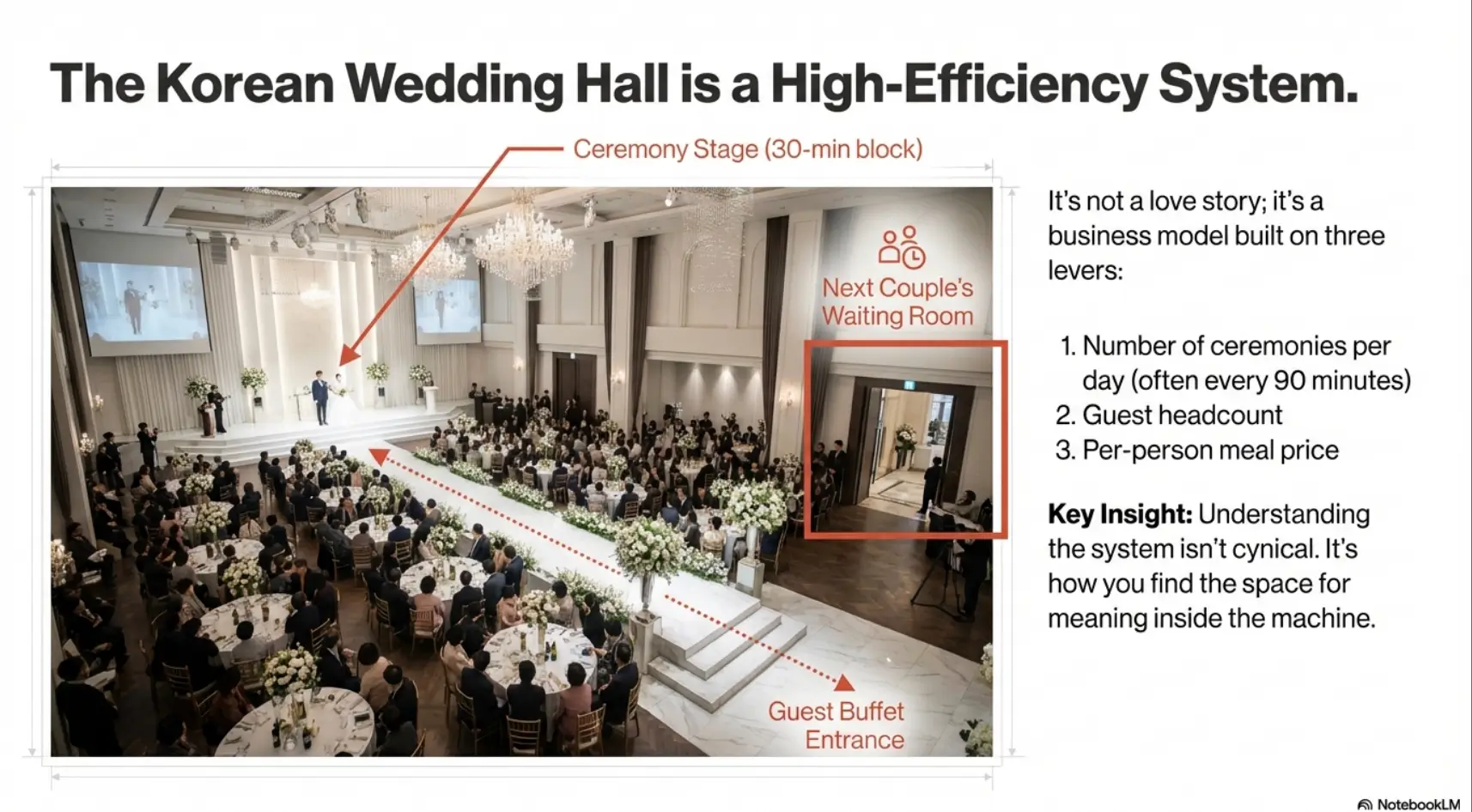
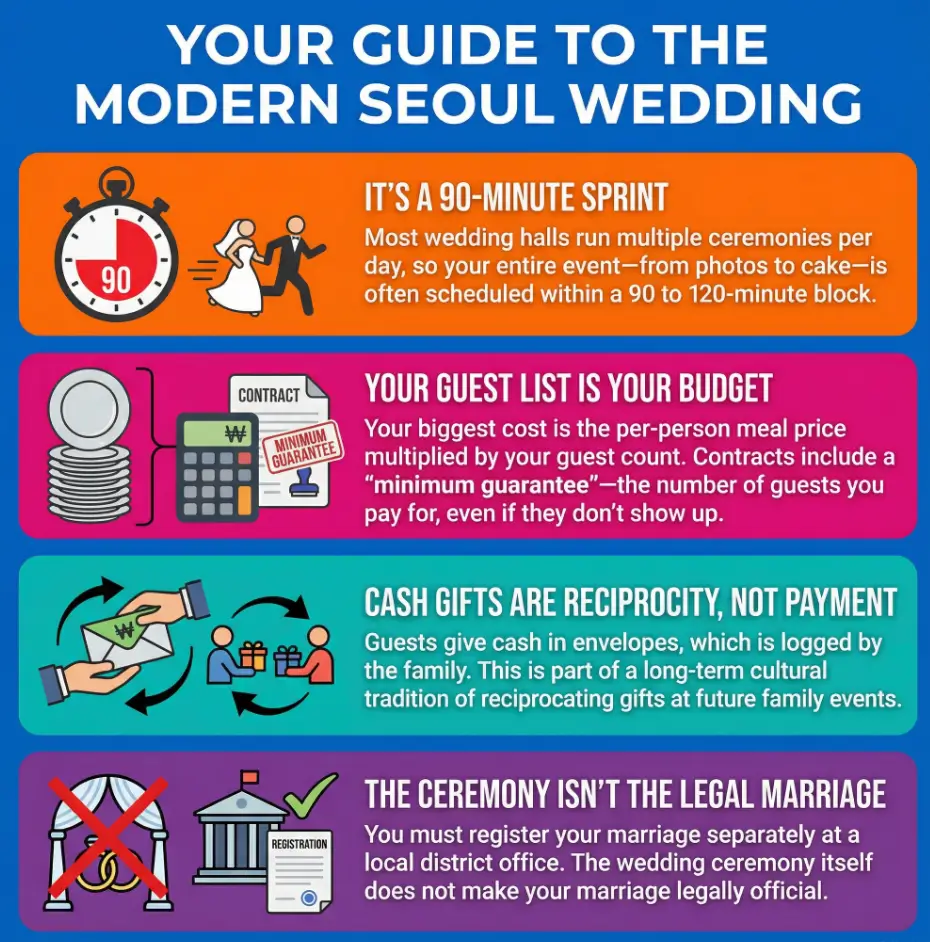
The surprising part is speed. You’re not wrong if it feels like a high-efficiency production line. That’s because wedding halls are optimized for multiple ceremonies per day, especially on Saturday afternoons. Knowing this up front helps you stop taking the schedule personally and start playing chess with it.
Long-tail: Seoul wedding hall schedule and meal timing after contract signing, weekend afternoon, 2025 (Seoul)
When you look at a hall’s brochure, pay attention to their weekend schedule. Many run ceremonies every 90 minutes. Ask outright:
- “What happens if our ceremony starts late?”
- “When exactly does the buffet open for our guests?”
- “How much overlap is there with the next couple?”
Show me the nerdy details
A hall’s business model usually revolves around three levers: number of ceremonies per day, guest headcount, and per-person meal price. Understanding those three numbers gives you more negotiating power than arguing about table decorations.
- Use the waiting room for deeper, slower conversations.
- Reserve five minutes in the ceremony for a personal vow or letter.
- Schedule one quiet moment for just the two of you.
Apply in 60 seconds: Mark three “must-feel” moments on a blank timeline: arrival, ceremony peak, and goodbye.
3. Lesson 1: Guest list vs budget – who really needs a seat?
The first shock I got wasn’t the flowers or the lights—it was the per-guest meal price. In many Korean halls, your “wedding cost” is essentially number of guests × meal price, with a few fixed fees bolted on. My foreign brain had been focused on the dress; the hall manager’s eyes were on headcount.
At our planning meeting, my future mother-in-law casually mentioned inviting distant relatives I’d never met, “because they’ll send congratulatory money even if they can’t come.” Meanwhile, I was agonizing over whether I could afford to feed all my friends from abroad. Two different mental spreadsheets. One marriage.
The truth: you can’t invite everyone—not if you care about budget, energy, or seating charts. Your job is to create a guest list that respects Korean norms without turning your wedding into a financial penalty.
Long-tail: Cost of a Korean wedding hall in Gangnam after trimming the guest list, weekend evening, 2025 (Seoul)
Think of your guest list like coverage tiers in an insurance plan. Tier 1 is “must invite,” Tier 2 is “really want,” Tier 3 is “nice to have.” Every name you add moves you into a higher “premium”—more buffet seats, more favors, and often a bigger hall.
Money Block 1: 60-second guest-list eligibility checklist
Check who truly needs a seat in your Korean wedding hall. Answer yes/no quickly—don’t overthink.
| Question | Yes | No |
|---|---|---|
| Will this person be hurt for years if they’re not invited? | ⬜ | ⬜ |
| Does at least one of you regularly keep in touch with them? | ⬜ | ⬜ |
| Are they part of a family, work, or community “unit” that expects inclusion? | ⬜ | ⬜ |
| Would you feel comfortable being invited to their future wedding? | ⬜ | ⬜ |
| Does at least one parent strongly request their presence—for a good reason? | ⬜ | ⬜ |
Quick rule: 4–5 “Yes” answers = Tier 1 (must invite); 2–3 “Yes” = Tier 2 (invite if budget allows); 0–1 “Yes” = Tier 3 (celebrate with them another way).
Save this checklist and revisit it before you confirm your final headcount with the hall.
Eligibility first, quotes second—you’ll save 20–30 minutes every time you talk to a vendor because you already know roughly how many seats you’re buying.
- Lock a realistic guest range before visiting halls.
- Sort guests into tiers instead of one long list.
- Give parents a clear number you can afford, not an empty canvas.
Apply in 60 seconds: Write three numbers: minimum guests, comfortable target, and absolute maximum. Keep them in your phone.
4. Lesson 2: Wedding hall contracts and hidden fees in Seoul
The second shock came when I read the fine print of our wedding hall contract. Suddenly, words like “minimum guarantee,” “overage per head,” and “service fee” started to sound a lot like “deductible” and “co-pay.” Not romantic—but very real.
A typical Korean wedding hall contract in 2025 will ask you to commit to:
- Minimum guest count: The smallest number you’ll pay for, even if fewer people show up.
- Meal price per person: Often different for weekday vs weekend, lunch vs dinner.
- Package inclusions: Flowers, basic decorations, sound system, sometimes MC.
- Additional fees: Extra microphones, upgraded cake, premium lighting, overtime.
I once watched a couple argue with a hall manager over ten no-show guests. They thought they were saving money; the manager calmly pointed to the minimum guarantee line. The couple still paid full price. Think of it as your “out-of-pocket maximum” for the buffet.
Money Block 2: Sample fee / rate table for a Seoul wedding hall (illustrative)
This is an illustrative table to help you read your own contract—numbers will vary by hall.
| Item | How it usually works | What to ask |
|---|---|---|
| Minimum guest count | You pay for at least this many meals even if fewer guests eat. | “When is this number final, and can we adjust it closer to the date?” |
| Meal price per guest | Differs by day and time slot. | “Is there a weekday or early-time discount we qualify for?” |
| Service fee | Sometimes a percentage added on top of the meal price. | “Is service already included in the per-person price?” |
| Deposit and refund | Non-refundable after certain dates. | “What happens if we must change the date?” |
Save this structure and compare it line-by-line with your own hall’s fee schedule before you sign.
Write down the exact codes and descriptions your provider uses; sometimes a tiny wording change can shift your final amount by more than you expect.
Show me the nerdy details
Think of your hall contract as a simple equation: total bill = (guaranteed guests × meal price × tax/service) + fixed fees + optional add-ons. Re-arrange it until you can explain it to a friend in one breath. If you can’t, ask the hall to rewrite it more clearly.
- Ask when and how that number can change.
- Check if service and tax are already in the per-person price.
- Get every promise written into the contract, not just spoken.
Apply in 60 seconds: Circle every number in your draft contract and write in the margin what it actually means in plain language.
5. Lesson 3: Cash gifts, envelopes, and money etiquette
The third shock wasn’t the bill—it was the envelopes.
At Korean weddings, guests usually give cash gifts in crisp bills, tucked into special wedding envelopes and logged carefully at the reception desk. For many families, this is both blessing and calculator: the total cash can offset a large portion of the wedding cost, and there is a long memory of who gave what to whom.
As a foreigner, I was terrified of getting it wrong. Too little feels rude. Too much turns you into a rumor. And then there’s the bookkeeping: someone—often a trusted aunt—quietly keeps a ledger of names and amounts so your family can reciprocate at future weddings.
Money Block 3: Typical Korean wedding cash gift “tiers” (illustrative ranges)
These ranges are illustrative—not rules. Norms vary by family, city, and year.
| Relationship | Common cash tier | Notes |
|---|---|---|
| Close family (parents, siblings) | Highest tier in your circle | Often symbolic; sometimes coordinated in advance. |
| Relatives | Mid-to-high tier | Amount can reflect age, closeness, and past events. |
| Close friends | Middle tier | Many match the approximate meal cost and add a bit. |
| Colleagues / acquaintances | Lower tier | Still respectful; may depend on company culture. |
Save this structure and ask a local friend or parent which tier is standard in your specific circle before you decide.
Think of cash gifts less like a fee schedule and more like a long-term relationship ledger. Your parents’ generation may see it as part of a lifetime pattern of giving and receiving among families.
Short Story: At my own reception desk, my aunt was the quiet “controller.” Every guest signed a book; every envelope was opened under the table. Weeks later, when another cousin got married, my parents checked that book. “They gave this much, so we’ll give roughly the same.” It wasn’t cold or transactional—more like a long, slow conversation carried on in banknotes rather than words.
- Ask your partner’s family what feels appropriate for your circle.
- Assign one trusted person to manage the ledger at the reception desk.
- Prepare extra envelopes and small bills for surprises.
Apply in 60 seconds: Decide who will run your reception desk and ledger, and put their name into your planning document.
6. Lesson 4: Paperwork, visas, and marriage registration
The fourth shock came far away from the flowers and cake: at the district office.
In Korea, your legal marriage registration is a separate process from your wedding ceremony. You file a marriage registration form at your local district office or community center; the wedding hall doesn’t do this for you. If one of you is foreign, there may also be embassy documents and translations to handle, as well as future visa steps like the F-6 marriage visa.
On a rainy Tuesday morning, we found ourselves shuffling papers at the gu-cheong with newly printed passport photos, family registry information, and a slightly wrinkled certificate from my home country. No music, no bouquet—just a ballpoint pen and a clerk who had seen this scene a thousand times.
Long-tail: Korean marriage registration steps for an international couple, dual documents, 2025 (South Korea)
Exact requirements vary by nationality and region, but most international couples will face some combination of:
- Certificate or affidavit of no impediment from the foreigner’s home country.
- Korean translations of key documents, sometimes notarized.
- Marriage registration form for the local district office.
- Updates to the Korean family registry (hojeok) after approval.
Money Block 4: Paperwork eligibility checklist (illustrative)
Before you book your hall, check your paperwork status in 60 seconds.
- Do both of you currently hold valid passports that won’t expire within the next 6–12 months? ⬜ Yes ⬜ No
- Can the foreign partner obtain an affidavit or certificate of no impediment from their country? ⬜ Yes ⬜ No
- Do you know which district office will handle your marriage registration? ⬜ Yes ⬜ No
- Have you confirmed whether you need translations or notarization for any documents? ⬜ Yes ⬜ No
- Do you have at least one week in your schedule for admin visits before the wedding day? ⬜ Yes ⬜ No
Quick interpretation: If you answered “No” to two or more, prioritize paperwork before heavy spending on the ceremony.
Save this list and confirm the latest requirements with your local district office or embassy website before you travel.
If you’re coming from the US, UK, Canada, or another country with strong paper trails, assume you’ll need originals or certified copies of key documents. Screenshots don’t count—bring originals or official letters. Lock the year and your legal name spelling before you submit anything; tiny discrepancies can cause delays.
- Confirm legal requirements before deposits and dress fittings.
- Schedule district office visits into your wedding timeline.
- Keep scanned copies of every signed form in one shared folder.
Apply in 60 seconds: Add “Check marriage registration requirements for our situation” as a task with a real date in your calendar.
7. Lesson 5: Family etiquette, hanbok, and in-laws
The fifth shock wasn’t on paper; it was in the room.
In Korean weddings, parents and elders are central characters. The bowing, the seating, the hanbok colors, even the order of photos—these all carry emotional weight. My own small disaster happened when I almost placed my father-in-law on the “wrong” side of the family photo. A cousin quietly fixed it before anyone got upset, but it was a reminder: there are invisible rules you’re stepping into.
During the paebaek (traditional bowing ceremony), you and your spouse bow deeply to parents and sometimes grandparents while they throw dates and chestnuts that symbolize future children. Under the surface: years of expectation, hopes, and unspoken stories. This is not just choreography; it’s family history in motion.
If you’re the foreign partner, you don’t need to become a scholar of etiquette. But you do need a brief, honest conversation with your in-laws about what matters to them most: number of bows, who appears in which photo, which relatives must be greeted by name.
Long-tail: Korean paebaek etiquette for foreign spouses, parental expectations, 2025 (Seoul)
- Ask in advance: “Which parts of paebaek are most meaningful to you?”
- Practice bowing in hanbok at least once before the day—it’s surprisingly physical.
- Confirm how to address each elder (titles, not first names).
One of my favorite memories is of my halmeoni quietly adjusting my hanbok jacket, patting my shoulder, and whispering, “Don’t worry if you forget the steps; just bow with a sincere heart.” That tiny moment mattered more than the perfect photo.
- Learn basic bowing etiquette and key phrases.
- Ask one relative to be your “ceremony coach” on the day.
- Clarify any non-negotiable traditions early in planning.
Apply in 60 seconds: Send a message to your partner’s parents asking, “Is there any tradition you especially hope we include?”

8. Lesson 6: Out-of-town guests, flights, hotels, and travel insurance
The sixth shock hit my wallet on behalf of someone else: my aunt from overseas, who booked a long-haul flight, hotel, and days off work to attend our 90-minute ceremony. Your out-of-town guests are quietly investing a serious amount of time and money into your day. Treat their experience with the same care you give your flower arrangements.
At minimum, international guests need:
- Clear information on airports and transport into Seoul.
- Hotel suggestions near your venue or easy subway access.
- Guidance on travel insurance, especially older relatives.
- A simple itinerary that makes the wedding just one bright part of their Korea trip.
Money Block 5: Mini budget calculator for out-of-town guests (illustrative)
Let’s estimate the “hidden” cost your closest guests might carry, so you can plan with empathy.
Use this rough estimate to decide how you can make their trip feel more than “just” a ceremony stop.
For older guests, consider gently suggesting they review travel insurance options that cover medical needs, flight disruptions, and trip cancellations. You’re not selling policies—you’re simply acknowledging reality and helping them protect their own out-of-pocket risk.
- Provide clear airport and transport guidance.
- Offer 2–3 well-researched lodging options.
- Share a simple 1–2 day mini itinerary around your wedding.
Apply in 60 seconds: Draft a short email with your venue address, nearest subway, and one recommended hotel, then reuse it for every out-of-town guest.
9. Lesson 7: Timeline, energy, and burnout prevention
The seventh shock was personal: after our ceremony, my body crashed. I’d spent months obsessing over vendors and almost no time planning my own energy.
A Korean wedding day can look simple on paper—“just a couple of hours”—but in reality it often includes:
- Early morning hair and makeup.
- Hours of photos before guests even arrive.
- Greeting lines, small talk in multiple languages, and rapid outfit changes.
- Continuous attention from staff, family, and guests.
Add jet lag, cultural translation, and emotional pressure, and you’ve got a recipe for burnout if you’re not careful.
Long-tail: Korean wedding day timeline and energy management, multiple outfit changes, 2025 (Seoul)
Think of your day like a series of “energy blocks” rather than just events. Build in tiny recovery pockets: 5 minutes alone in a waiting room, a glass of water between photo sets, one planned snack.
- Block at least three 5-minute “no one else” breaks.
- Assign a friend as your “water and snack” captain.
- Accept that you can’t greet every guest perfectly—and that’s okay.
Apply in 60 seconds: Add three “mini-break” slots to your timeline and share them with your MC or planner.
10. Checklists, calculators, and infographic
By now, you’ve seen where Korean weddings can surprise you: the conveyor-belt schedule, the guest-list math, the cash envelopes, the paperwork, and the in-law expectations. This section pulls it together into a quick reference set you can revisit whenever the planning fog gets thick.
Money Block 6: Wedding hall vs hotel vs hanok – decision card
When should you choose which type of Korean wedding venue?
| If this is you… | Consider… | Why |
|---|---|---|
| You want max convenience and standard format. | Dedicated wedding hall | Predictable flow, packages, and guest expectations. |
| You’re hosting many foreign guests who love comfort. | Hotel ballroom | Easier room blocks, concierge support, familiar setting. |
| You want strong traditional aesthetics and photos. | Hanok or cultural venue | Deeply Korean atmosphere, often more flexible flow. |
| You have a tight budget but flexible format. | Smaller hall or restaurant buy-out | Lower fixed fees, but more DIY coordination. |
Save this card and bring it to venue tours so you can compare options calmly instead of on the spot.
Infographic: The Korean wedding journey at a glance
1. Before the day
- Agree on guest tiers and budget.
- Confirm paperwork and district office steps.
- Book venue, studio, dress, and makeup.
2. Wedding day
- Photos, waiting room, ceremony, buffet.
- Cash gifts and reception desk ledger.
- Paebaek and family photos.
3. After the day
- Finish marriage registration updates.
- Send thank-you messages or cards.
- Store contracts, photos, and key numbers in one place.
- Phase 1 is contracts and paperwork.
- Phase 2 is presence and energy.
- Phase 3 is follow-through and gratitude.
Apply in 60 seconds: Decide which phase feels most stressful today and tackle just one small task from that column.
FAQ
1. How long does a typical Korean wedding ceremony in Seoul actually last?
Most modern hall ceremonies run about 30–40 minutes, but your “wedding block” at the venue is usually 90 minutes to two hours including photos and guest movement. The whole day feels longer when you add hair, makeup, and travel. Your 60-second action: sketch your day on a simple timeline from wake-up to bedtime and see where you’re squeezing yourself too tightly.
2. How far in advance should we book a Korean wedding hall in 2025?
Popular dates—especially Saturdays in spring and autumn—can fill up many months in advance. Some couples book 9–12 months ahead; others move faster if they’re flexible on date and time slot. Your 60-second action: choose a target month and two backup months, then contact at least three venues to ask about availability.
3. How much should foreign guests give in cash at a Korean wedding?
There’s no universal rule; amounts depend on relationship, local norms, and personal budgets. Many guests aim to cover at least the approximate meal cost and add a bit more if they’re close to the couple. Your 60-second action: ask a local friend, “What’s a comfortable range for friends at weddings like this?” and follow their guidance.
4. Do we have to do a traditional paebaek ceremony?
No, but many families value it as a moment of respect and connection between generations. Some couples choose a shorter, simplified version; others hold a separate private paebaek on a different day. Your 60-second action: ask your parents and in-laws how important paebaek feels to them on a scale of 1–10, then make your plan together.
5. What if our paperwork isn’t ready by the wedding day?
In Korea, the ceremony and the legal registration are separate. If the paperwork lags behind, your wedding can still happen on schedule, but your legal marriage date may differ from your ceremony date. Your 60-second action: call or email your district office or embassy and confirm processing times so you can plan around real timelines instead of guesses.
6. How can we keep costs under control without offending family?
Cost control usually comes from three levers: guest count, meal price, and venue type. Family expectations often focus on venue prestige and who is invited, not on the exact menu tier. Your 60-second action: choose one lever to adjust first (guest count, venue, or menu), then explain the change to family in terms of comfort and hospitality rather than just “saving money.”
Conclusion: Your next 15 minutes
If you’ve read this far, you already know more about Korean weddings than I did when I signed my first contract. You’ve seen why the hall timetable feels so fast, how guest lists quietly drive your budget, what cash envelopes really represent, and why the legal paperwork deserves its own timeline.
Most of all, you’ve seen that a Korean wedding is not just a one-day event. It’s a string of decisions touching money, family systems, immigration, and logistics. When you understand those systems, you can protect your peace—and still create a day that feels like you.
- You don’t have to follow every tradition exactly.
- You do need clarity on money, paperwork, and family expectations.
- Small, honest conversations now prevent big regrets later.
Apply in 60 seconds: Choose one topic—guest list, contract, cash gifts, paperwork, or in-laws—and schedule a 15-minute talk with your partner about it this week.
Last reviewed: 2025-12; sources: my own Seoul ceremony, conversations with local planners and families, and publicly available information from Korean government and venue materials.
Korean wedding, Seoul wedding guide, Korean wedding ceremony, Korean marriage registration, Korean wedding costs