
These Korean alteration shop phrases cover the moment a tailor asks how much to take off. Choose the line that matches what you can show at the counter.
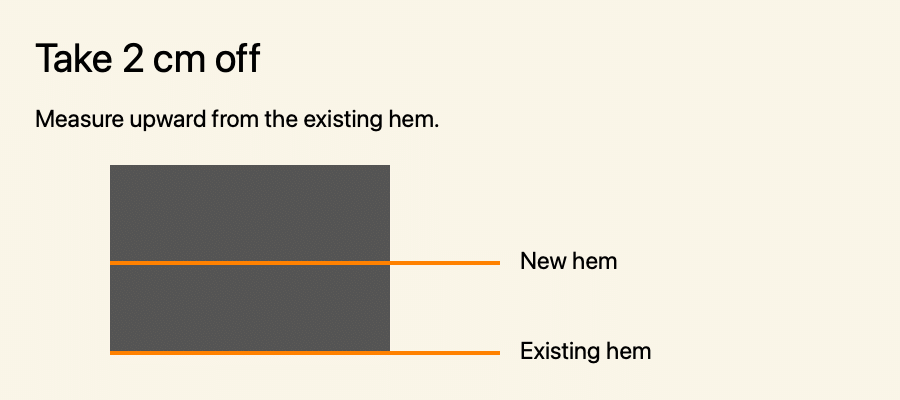
지금보다 2센티만 줄여 주세요.
“Please take just two centimeters off the current length.” Use this when the pants are still unfolded.
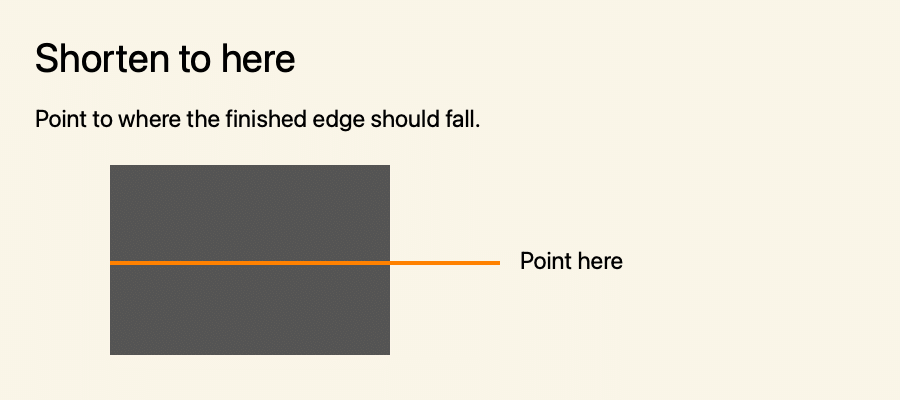
여기까지 줄여 주세요.
“Please shorten them to here.” Point to the fold where you want the finished edge to sit.
Table of Contents
1. Ask the alteration shop to shorten your pants
Looking for an alteration shop? Check the sign for the word 수선 (alterations or repairs). At the counter, say 이 바지 기장 좀 줄여 주세요. “Could you shorten these pants?” 기장 means the length of a garment. Naming the part matters here. 허리 means the waist, and 통 refers to the width. If the trousers fit everywhere except at the ankle, 기장 is the word you want.
If you need to find the shop first, look for 옷수선 on a sign. 옷 means clothing. To ask for directions to an alteration shop, try 이 근처에 옷 수선하는 곳이 있어요? (“Is there a place nearby that alters clothes?”). At the alteration shop door, showing the trousers and asking 바지 수선도 하세요? (“Do you alter pants, too?”) gives the person a chance to check the garment before quoting a price.
If you are holding the trousers and only want to know whether the shop can do the work, ask 이 바지 기장 줄일 수 있어요? “Can you shorten these pants?” That leaves room to ask about cost and timing before asking the tailor to start.
Two jobs can sound similar when you are pointing at a pair of jeans. 바지 기장을 줄이고 싶어요 means you want shorter legs. 바지통을 좀 줄이고 싶어요 means you want narrower legs. If the tailor looks at the width and asks 통도 줄일까요? (“Shall I narrow the legs, too?”), answer 아니요, 기장만요 (“Just the length, please”) to keep the request clear.
2. Specify the amount or show the endpoint
2센티만 줄여 주세요. “Please take off just two centimeters.” Say the number as 이 센티. The two centimeters are the amount to remove. The small word 만 means “just” and helps when you are worried about losing too much length.
여기까지 줄여 주세요. “Please shorten them to here.” Touch the point where you want the finished hem to fall. 까지 marks the endpoint. This is especially handy when you like what you see in the mirror but have no idea how many centimeters you folded up.
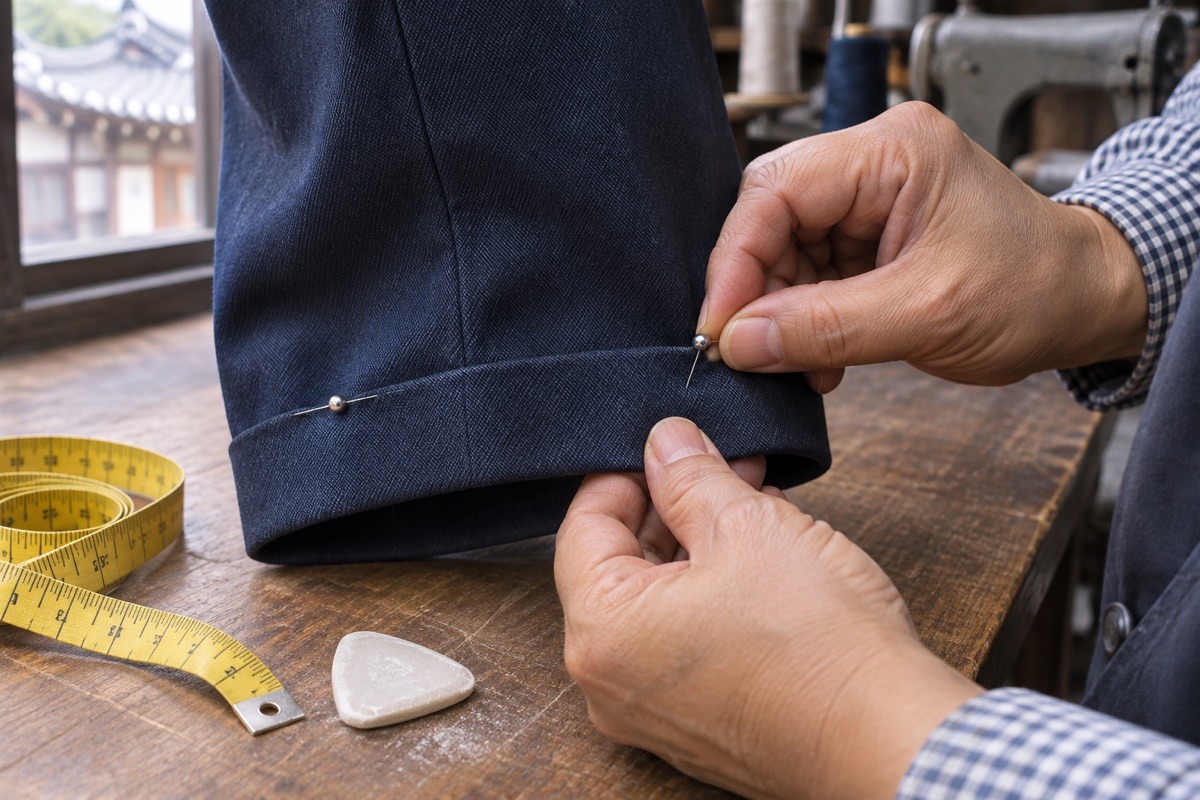
Suppose the tailor has already pinned the hem and you want it a little longer. 조금만 더 길게 해 주세요. means “Please leave them a little longer.” Keep pointing at the pinned leg as you speak. Once the pin is in the right place, 네, 이 길이가 좋아요. means “Yes, I like this length.”
What if you brought the alteration shop a second pair that fits well? Lay the pairs side by side and ask 이 바지랑 같은 길이로 해 주실 수 있어요? (“Could you make them the same length as these?”). Point first to the pair you want altered and then to the pair you want to use as a reference. Try the pinned trousers on if the two pairs sit at different heights on your waist.
3. Try the pants on with your shoes
입어 보고 길이를 정해도 될까요? “Could I try them on and decide on the length?” If you brought your usual shoes to the alteration shop, add 이 신발에 맞추고 싶어요. “I’d like the length to work with these shoes.” This gives the tailor a concrete reference, especially if the hem looks right barefoot but bunches up over your shoes.
If only one leg has been pinned and the other still brushes the floor, you can check what will happen to the second leg. 양쪽 다 이 길이로 해 주시는 거죠? means “Both legs will be this length, right?” If you prefer to check the second leg separately, try 반대쪽도 입은 채로 봐 주실 수 있어요? (“Could you check the other side while I’m wearing them, too?”).
4. Ask to keep the original hem
At an alteration shop, two pairs of jeans may need different finishes. If you like the faded stitching at the bottom of your jeans, point it out before agreeing on a price. Ask 원래 밑단을 살릴 수 있어요? “Can you keep the original hem?” Here 밑단 means the bottom edge. The tailor can tell you what is possible with that pair.
You can make a decision after hearing the options. Suppose the tailor says 원래 밑단을 살리면 비용이 더 들어요 (“Keeping the original hem costs extra”). Ask 얼마나 더 들어요? (“How much extra?”). If you prefer a plain finish after hearing the amount, say 그럼 원래 밑단은 안 살려도 돼요 (“In that case, it’s fine to leave off the original hem”).
5. Ask the price at the alteration shop
You 이 바지 기장 좀 줄여 주세요.
Could you shorten these pants?
Tailor 어느 정도 줄여 드릴까요?
How much would you like me to take off?
You 여기까지요. 이렇게 하면 얼마예요?
To here, please. How much would it be to do that?
Tailor 팔천 원이에요. 내일 오후에 찾으러 오세요.
That’ll be 8,000 won. Come pick them up tomorrow afternoon.
You 그럼 내일 세 시쯤 와도 될까요?
In that case, could I come around three tomorrow?
6. Confirm when to return to the alteration shop
To ask for the pickup time, say 언제 찾으러 오면 될까요? Compare 세 시쯤 (around three) with 세 시 이후 (at or after three). If the tailor says 오후 세 시 이후에 오세요, plan to arrive at 3 p.m. or later. When you return, 어제 맡긴 바지 찾으러 왔어요 means “I’m here for the pants I dropped off yesterday.”
When picking up several items from an alteration shop, describe the color as well as the garment. 검은색 바지 두 벌 맡겼어요 means “I left two pairs of black pants.” Notice the different numbers you have used in the shop. Two centimeters is 이 센티, two pairs of trousers is 두 벌, and two o’clock is 두 시. Saying each with its unit makes it much easier for the listener to follow.
7. Correct the pin: a one-minute alteration shop rehearsal
The tailor pins the hem and asks 이 정도면 될까요? (“Would this length work?”). Look in the mirror. You want the finished hem one centimeter lower than the pin. How would you ask for that change? Once the tailor moves the pin, confirm the length and ask when to come back.
One last listening test: compare 조금 더 줄여 주세요 and 조금 덜 줄여 주세요. 더 asks the tailor to take off a little more. 덜 asks the tailor to take off a little less. Try saying each while moving your hand up or down a trouser leg. If those two words come out alike when you are nervous, point to the desired line and use 여기까지 instead.
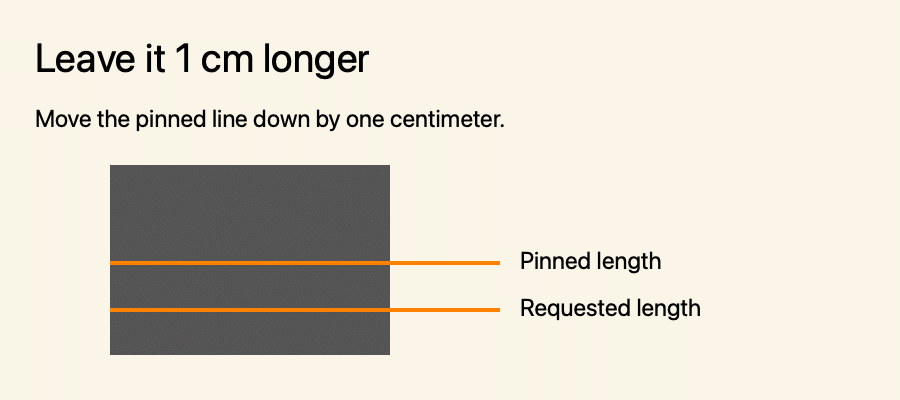
Point to the pin and say 핀 꽂은 데보다 1센티만 더 길게 해 주세요. (“Please leave them just one centimeter longer than where you pinned them.”) Once the fold looks right, say 네, 이 길이가 좋아요. (“Yes, I like this length.”) Finish with 언제 찾으러 오면 될까요? If you miss the answer, ask 날짜랑 시간을 적어 주실 수 있어요? (“Could you write down the date and time?”)
Practice with a partner. One person runs the alteration shop and asks 어느 정도 줄여 드릴까요? The other has a pair of trousers, a mirror, and no ruler. Give the answer once using a gesture. Then switch roles, put the trousers on the counter, and imagine you have already measured the change at home. Which part of the answer changes? In the first round, 여기까지 carries the meaning because both people can see the line. In the second round, the number does that work.
Two pairs, two instructions. Imagine you have a black pair for work and a blue pair for weekends. Say 검은 바지는 2센티만 줄여 주시고, 청바지는 그대로 두세요. (“Please take just two centimeters off the black trousers and leave the jeans as they are.”) The jeans might be on the counter only as a reference. Naming each pair before giving the instruction makes it clear which garment the tailor should alter.
When the instructions come back too fast. If you understood the measurement but missed the day, repeat the part you know: 기장은 2센티 줄이고, 찾는 날은 언제라고 하셨어요? (“We’re taking two centimeters off the length. What day did you say I should collect them?”). This gives the tailor a specific question to answer and lets you check the arrangement before you leave the alteration shop.
For listening practice, open the National Institute of Korean Language’s Korean–English Learners’ Dictionary and search for 줄이다 (to shorten) or 맡기다 (to leave something in someone’s care). If you are still trying on trousers before buying, browse the magazine’s Korean fitting-room guide for questions about fit and size.