Unleash Your Inner Zen: 5 Reasons Why Korean Calligraphy Will Transform Your Life!
Table of Contents
- The Whispering Brush: Unveiling Seoye’s Soul
- A Journey Through Time: The Ancient Roots of Korean Calligraphy
- Why Seoye? More Than Just Beautiful Writing
- Your Starter Pack: The Four Treasures of the Study
- From Beginner to Brush Master: Essential Techniques to Get You Started
- Decoding the Strokes: Exploring the Diverse Styles of Korean Calligraphy
- Beyond the Ink: The Deep Philosophical Heart of Seoye
- The Art of Mindful Movement: Seoye as a Healing Practice
- Bridging Worlds: Seoye in the Modern Age
- Ready to Write? How to Begin Your Seoye Journey
- The Last Stroke: Embracing a Lifetime of Learning
The Whispering Brush: Unveiling Seoye‘s Soul
Ever felt that gnawing sense of restlessness, the constant digital hum that just won’t quiet down?
I know the feeling.
For years, I chased fleeting distractions, always on the lookout for that elusive “thing” that would truly ground me.
Then, I stumbled upon something that didn’t just calm the noise; it transformed my entire perspective: Korean calligraphy, or Seoye (서예).
Trust me, it’s not just about pretty writing.
It’s a profound journey into mindfulness, history, and a discipline that can genuinely rewire your brain for peace and focus.
Forget those fleeting digital detoxes; this is a true immersion into an ancient art form that still holds immense power today.
And I’m here to tell you why you absolutely, unequivocally need to explore it.
—A Journey Through Time: The Ancient Roots of Korean Calligraphy
To truly appreciate Seoye, you’ve got to understand where it comes from.
It’s not some recent fad, but an art form with a lineage stretching back millennia, deeply intertwined with Korea’s rich cultural tapestry.
Imagine a time when the written word wasn’t just a means of communication, but a sacred act, a direct connection to wisdom and beauty.
That’s the world where Korean calligraphy blossomed.
From China to the Korean Peninsula: A Shared Heritage
While uniquely Korean in its development and spirit, Korean calligraphy fundamentally originated from Chinese calligraphy.
Chinese characters, or *Hanja*, were introduced to Korea around the 1st century BCE.
Initially, they were used for official documents and scholarly pursuits, primarily by the upper classes.
As these characters became integrated into Korean society, so did the art of writing them beautifully.
It wasn’t long before Korean scholars and artists began to adapt the techniques, imbuing them with a distinct Korean sensibility.
The Three Kingdoms Period (57 BCE – 668 CE): Early Flourishing
During the Three Kingdoms period (Goguryeo, Baekje, and Silla), calligraphy started to gain significant prominence.
Buddhist monks played a pivotal role in its spread, using calligraphy to transcribe sutras.
Think about the sheer dedication required to meticulously hand-copy entire religious texts, each stroke a meditation in itself.
This era saw early masters emerge, though much of their individual work hasn’t survived the ravages of time.
Still, the foundations were firmly laid.
Goryeo Dynasty (918 – 1392): A Golden Age of Elegance
The Goryeo Dynasty is often considered a golden age for Korean calligraphy, especially with the flourishing of Buddhism.
The emphasis shifted towards more refined and elegant styles, often seen in the beautifully crafted Buddhist texts and royal decrees.
This was a time when the aesthetic principles of balance, harmony, and rhythm were deeply explored and perfected.
It’s like the Renaissance for Seoye, where masters were revered and their works highly prized.
Joseon Dynasty (1392 – 1897): The Rise of Distinct Korean Styles and Hangul
The Joseon Dynasty marked a significant turning point.
While *Hanja* calligraphy continued to be highly respected, the invention of Hangul (한글), the Korean alphabet, in 1443 by King Sejong the Great, revolutionized the written word.
This wasn’t just about literacy; it was about national identity.
Suddenly, a new canvas emerged for calligraphers.
They began to develop unique styles specifically for Hangul, blending the elegance of *Hanja* calligraphy with the distinct structural characteristics of the new alphabet.
This period saw the emergence of truly unique Korean calligraphic styles, differentiating it more strongly from its Chinese origins.
Imagine the excitement of artists discovering a whole new set of possibilities!
Modern Era: Preservation, Innovation, and Global Recognition
The 20th century brought immense changes to Korea, but Seoye persisted.
Despite the rapid modernization and the shift to Western writing tools, masters continued to pass down their knowledge.
Today, Korean calligraphy isn’t just a relic of the past; it’s a vibrant, living art form.
There’s a strong emphasis on preserving traditional styles, but also a fascinating movement towards contemporary interpretations, blending traditional brushwork with modern artistic expressions.
It’s like watching a majestic river, flowing from ancient mountains into the vast ocean, constantly evolving yet retaining its essence.
—Why Seoye? More Than Just Beautiful Writing
So, you might be thinking, “Why should I spend my precious time learning to write with a brush when I can just type?”
Fair question.
But Seoye offers something keyboards and screens never will.
It’s a holistic practice that nurtures your mind, body, and spirit in ways you wouldn’t expect.
Here are 5 compelling reasons why delving into Korean calligraphy can profoundly change your life.
1. The Ultimate Mindfulness Practice: Find Your Calm in a Chaotic World
In our hyper-connected world, true focus is a superpower.
Seoye demands it.
Each stroke requires complete attention, from the way you hold the brush to the pressure you apply, the amount of ink, and the flow of your breath.
There’s no room for distractions, no space for your mind to wander to your to-do list or that email you forgot to send.
It’s an active meditation, a form of moving Zen.
You’re literally forced to be present, and that presence translates into a profound sense of calm and clarity.
It’s like hitting a reset button for your brain.
2. Develop Unshakeable Patience and Discipline: A Life Skill, Not Just an Art Skill
Let’s be honest: instant gratification is our modern addiction.
Seoye, however, teaches patience.
You won’t master it overnight.
You’ll make mistakes.
Lots of them.
The ink will bleed, the lines will waver, and some characters will look like a child’s scribble.
But it’s in this process of repeated practice, of gently correcting yourself, and of embracing imperfections, that true growth happens.
This discipline isn’t confined to the paper; it spills over into other areas of your life, making you more resilient, persistent, and grounded.
It’s like learning to ride a bike – you fall, you get up, and eventually, you glide.
3. Enhance Your Aesthetic Appreciation: See Beauty in Every Line
Once you start practicing Seoye, your eyes will open to a whole new world of aesthetic beauty.
You’ll begin to notice the subtle nuances in strokes, the balance of negative space, the tension and flow within a composition.
It’s not just about legibility; it’s about the visual dance of ink on paper, the expression of character and emotion through abstract forms.
This heightened aesthetic awareness isn’t limited to calligraphy; it deepens your appreciation for all forms of art, design, and even nature itself.
Suddenly, a single tree branch or a cloud formation takes on a new artistic significance.
4. Connect with a Rich Cultural Heritage: A Link to Korea’s Soul
Learning Korean calligraphy is an act of cultural immersion.
Each stroke carries centuries of history, philosophy, and artistic evolution.
You’re not just learning a skill; you’re stepping into a dialogue with generations of scholars, monks, and artists who poured their hearts into this art form.It’s a direct link to the soul of Korea, offering insights into its values, its reverence for nature, and its pursuit of harmony.
It’s like holding a piece of history in your hand, feeling the echoes of the past resonate with your present.
5. Boost Creativity and Self-Expression: Unleash Your Inner Artist
While Seoye involves strict rules and traditional forms, it’s also a powerful avenue for personal expression.
Your individual energy, mood, and spirit are subtly (and sometimes not so subtly) reflected in your strokes.
No two calligraphers will produce identical works, even when writing the same character.
This freedom within structure allows for immense creativity.
As you grow in skill, you’ll find your own voice, your own “hand,” emerging on the paper.
It’s a beautiful way to express yourself without words, a tangible manifestation of your inner world.
So, are you ready to pick up the brush?
Good.
Because the journey is truly captivating.
—Your Starter Pack: The Four Treasures of the Study (Munbangsau)
Before you even think about putting brush to paper, you need the right tools.
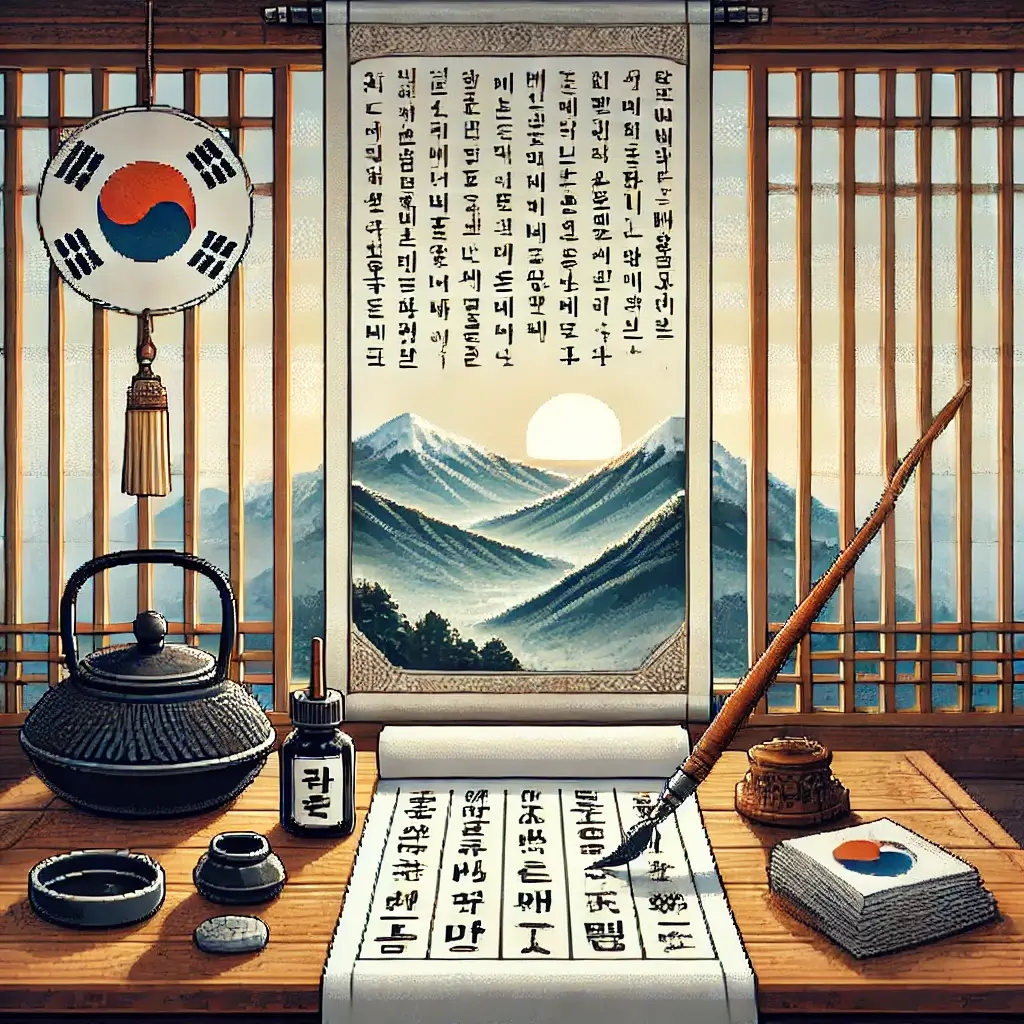
In Korean calligraphy, these aren’t just mere instruments; they’re revered as the “Four Treasures of the Study” (Munbangsau, 문방사우), symbolizing the essential elements for any scholar or calligrapher.
Treat them with respect, and they will serve you well.
1. The Brush (붓, But): The Extension of Your Soul
The brush is the heart of Seoye.
It’s not just a tool; it’s an extension of your hand, your arm, and ultimately, your intention.
Calligraphy brushes are typically made from animal hair (wolf, goat, rabbit, or a blend) attached to a bamboo or wooden handle.
They vary in size, hair type, and stiffness, each suited for different styles and stroke types.
A good brush holds ink well, has a responsive tip, and retains its shape.
Learning to control the brush is probably the most challenging, yet rewarding, aspect of Seoye.
It’s like learning to dance with a new partner – you need to understand its movements and nuances.
2. The Inkstick (먹, Meok): The Essence of Blackness
The ink isn’t just black liquid from a bottle.
Traditional Korean calligraphy uses an inkstick, typically made from pine soot or oil soot mixed with animal glue.You grind this stick on an inkstone with a little water to produce the ink.
This process is integral to the practice – it’s a meditative ritual that prepares your mind and body for the act of writing.
The quality of the ink, its depth of color, and its consistency are crucial.
Freshly ground ink provides a vibrancy and depth that pre-made bottled ink often lacks, though bottled ink is perfectly fine for beginners!
3. The Inkstone (벼루, Byeoru): The Grinding Ground of Creativity
The inkstone is where the magic happens – where the solid inkstick transforms into liquid ink.
These stones are often beautifully carved and polished, made from slate, granite, or other fine stones.
A good inkstone has a smooth, slightly abrasive surface for grinding and a well or reservoir to hold the prepared ink.
It’s not just a tool; it’s a stable, grounding presence on your desk, a symbol of patience and meticulous preparation.
4. The Paper (종이, Jong-i): The Canvas for Expression
While any paper can technically be used, traditional Korean calligraphy uses *hanji* (한지), a traditional handmade paper made from the bark of the mulberry tree.
*Hanji* is incredibly durable, resistant to tearing, and has a unique texture that absorbs ink beautifully, allowing for nuanced strokes and subtle ink tones.
It also ages gracefully, preserving your practice for decades.
For beginners, practice paper specifically designed for calligraphy (often called “rice paper” or “xuan paper”) is more accessible and forgiving.
But once you get serious, *hanji* is a must-try.
It truly elevates the experience.
Additional Tools (Not Treasures, But Still Useful!):
- Paperweight (문진, Munjin): Keeps your paper flat and steady.
- Felt Mat (깔개, Kkalgae): Placed under the paper to provide a softer surface for the brush and absorb excess ink.
- Water Dropper (연적, Yeonjeok): For adding controlled amounts of water to the inkstone.
Investing in good quality tools is like investing in your journey.
It makes the process more enjoyable and your results more satisfying.
—From Beginner to Brush Master: Essential Techniques to Get You Started
Alright, you’ve got your tools.
Now comes the fun part: learning how to actually use them!
Korean calligraphy isn’t just about drawing pretty shapes; it’s about mastering a series of fundamental techniques that bring characters to life.
It’s like learning the basic steps in a dance before you can choreograph your own masterpiece.
1. Posture and Holding the Brush: The Foundation of Control
Before your brush even touches the paper, your posture is paramount.
Sit upright, with your back straight and feet flat on the floor.
The table should be at a comfortable height.
This isn’t just about ergonomics; it’s about allowing your entire arm, not just your wrist, to guide the brush.
Hold the brush vertically, using all five fingers, gripping it firmly but not tightly.
The grip is often described as holding an egg – firm enough not to drop it, but gentle enough not to crush it.
This allows for maximum flexibility and control.
2. Preparing the Ink: A Mindful Ritual
This step is often overlooked by beginners, but it’s crucial.
Place a few drops of water on your inkstone.
Then, take your inkstick and grind it in a circular motion, applying gentle, even pressure.
Don’t rush it.
This isn’t just about producing ink; it’s a meditative practice that helps you clear your mind and focus on the task ahead.
The ink should be smooth, consistent, and neither too thick (which will dry too fast) nor too thin (which will look watery and bleed).
You’ll learn to judge the right consistency by eye and feel.
3. Loading the Brush: The Perfect Amount
Dip the tip of your brush into the ink, ensuring the hair is fully saturated but not overloaded.
Gently tap the brush on the edge of the inkstone or wipe off excess on a scrap piece of paper.
Too much ink, and your strokes will blob; too little, and they’ll be dry and faded.
It’s a delicate balance that comes with practice.
4. Basic Strokes: The Building Blocks of Beauty
Every character, whether *Hanja* or *Hangul*, is composed of fundamental strokes.
You’ll start by practicing these individually:
- Horizontal strokes: Begin with a slight pause, press down, move horizontally, and end with a deliberate “stop” motion.
- Vertical strokes: Similar to horizontal, but moving downwards, ensuring a consistent line.
- Diagonal strokes: Mastering the angle and pressure for precise, dynamic lines.
- Dots and hooks: Small but impactful elements that require precise control.
The key is consistency in pressure, speed, and direction.
Each stroke has a “head,” a “body,” and a “tail,” and mastering these subtle beginnings and endings is crucial.
It’s like learning scales before you play a symphony.
5. Pressure and Speed: Adding Life to Your Lines
This is where Seoye truly becomes an art form.
Varying the pressure on your brush allows you to create thick and thin lines, adding depth and dynamism to your characters.
A light touch creates delicate lines, while more pressure yields bold, powerful strokes.
Similarly, the speed of your stroke affects the “life” of the line.
A slow, deliberate stroke might convey stability, while a quicker, more fluid stroke can express energy and movement.
It’s a dance between control and spontaneity, a careful balance that makes each character unique.
6. Composition and Space: The Unwritten Elements
Korean calligraphy isn’t just about individual characters; it’s about the entire composition.
The empty space around and within characters – known as “white space” or “negative space” – is just as important as the inked lines themselves.
It provides balance, rhythm, and breath to the work.
Learning to arrange characters harmoniously on the paper, considering their size, spacing, and overall flow, is an advanced but essential skill.
It’s like arranging furniture in a room – every piece has its place to create a sense of balance and flow.
Remember, practice is key.
Don’t get discouraged by early attempts.
Every master was once a beginner who just kept going.
—Decoding the Strokes: Exploring the Diverse Styles of Korean Calligraphy
Just like there are different fonts on your computer, Korean calligraphy boasts a rich array of styles, each with its own history, aesthetic principles, and emotional resonance.
Understanding these styles is like learning the different dialects of a language – they all convey meaning, but with distinct flavors and nuances.
While many styles originated in China, Korean calligraphers have imbued them with their unique spirit and developed distinct *Hangul* styles.
1. Seal Script (전서, Jeonseo): The Ancient and Majestic
This is the oldest major style, characterized by its thick, even lines and often symmetrical, formal appearance.
It evolved from ancient pictographs and was primarily used for official seals and inscriptions.
Reading *Jeonseo* today can be challenging even for native Korean speakers due to its archaic forms, but its monumental presence is undeniable.
Think of it as the dignified, ancient grandparent of calligraphy – full of history and gravitas.
2. Clerical Script (예서, Yeso): The Serene and Expansive
Emerging from the Qin Dynasty in China (hence its original use by clerks), *Yeso* is known for its wide, flattened characters and distinctive “silkworm head and wild goose tail” strokes – where horizontal strokes start with a slight swelling and end with a graceful, flared tail.
It’s less rigid than Seal Script but still possesses a formal, serene elegance.
It’s like a peaceful landscape painting, with broad, sweeping horizons.
3. Regular Script (해서, Haeseo): The Foundation of Clarity and Precision
This is often the first style taught to beginners and is the most widely recognized and legible.
*Haeseo* is characterized by its clear, distinct strokes, well-defined structure, and balanced composition.
Every stroke is carefully placed, making it ideal for official documents, educational materials, and daily writing.
Mastering *Haeseo* is essential because it builds the fundamental brush control and understanding of character structure that underpins all other styles.
Consider it the classical ballet of calligraphy – precise, graceful, and the bedrock of all other forms.
4. Semi-Cursive Script (행서, Haengseo): The Flowing and Expressive
As the name suggests, *Haengseo* sits between the formality of Regular Script and the wild freedom of Cursive Script.
Characters are often connected, strokes flow into one another, and there’s a greater sense of movement and spontaneity.
It allows for more personal expression while still maintaining readability.
This is often the preferred style for personal letters, poems, and artistic expressions where a sense of vitality and continuous flow is desired.
It’s like a lively conversation, full of natural pauses and expressive gestures.
5. Cursive Script (초서, Choseo): The Spirited and Abstract
This is the most abstract and free-flowing of the traditional styles, sometimes called “grass script” because its rapid, connected strokes resemble blades of grass swaying in the wind.
Characters are highly abbreviated and interconnected, often requiring considerable expertise to read.
*Choseo* emphasizes the dynamic movement of the brush, the rhythm, and the emotional energy of the calligrapher.
It’s less about legibility and more about the raw power and artistic expression.
This is the jazz improvisation of calligraphy – wild, energetic, and deeply personal.
6. Korean Script (한글 서예, Hangul Seoye): The National Treasure
While the above styles primarily apply to *Hanja* (Chinese characters), the development of *Hangul* brought about its own distinct calligraphic styles.
*Hangul Seoye* explores the unique geometric and linear qualities of the Korean alphabet.
There are classical *Hangul* styles (like *Gungche*, which resembles royal court handwriting) and more modern, expressive interpretations.
It’s a vibrant field where calligraphers can truly express a unique Korean identity through their brushwork.
Exploring these styles is a lifelong journey.
Each one offers a different path to understanding the profound beauty and expressive power of Korean calligraphy.
—Beyond the Ink: The Deep Philosophical Heart of Seoye
If you think Korean calligraphy is just about making pretty shapes on paper, you’re missing the entire ocean for a single drop of ink.
At its core, Seoye is deeply infused with philosophical principles, primarily from Confucianism, Daoism, and Buddhism.
These ancient wisdom traditions aren’t just background noise; they’re the very air the calligrapher breathes, shaping every stroke and every pause.
It’s where the mundane act of writing transcends into a spiritual practice.
1. Harmony (조화, Johwa): The Dance of Opposites
Harmony is perhaps the most central tenet in Seoye.
It’s the balance between opposing forces: thick and thin strokes, wet and dry ink, light and heavy pressure, movement and stillness.
It’s also about the balance between the characters themselves and the surrounding empty space.
Think of the Yin and Yang symbol – perfect balance, where one cannot exist without the other.
A truly harmonious calligraphic piece feels complete, settled, and aesthetically pleasing, even if it’s just a single character.
This pursuit of harmony on paper naturally encourages a more harmonious approach to life itself.
2. Spirit (기, Gi): The Breath of Life
In Korean culture, *Gi* (or *Qi* in Chinese) refers to vital life force or energy.
In calligraphy, *Gi* is the invisible force that flows through the brush and into the ink, giving the strokes their vibrancy and dynamism.
A skilled calligrapher imbues their work with *Gi*, making the characters feel alive, not just static forms.
This energy comes from the calligrapher’s own inner state, their concentration, and their connection to the moment.
It’s the reason why some pieces feel dull and others pulsate with energy.
It’s the invisible pulse within the visible lines.
3. Emptiness (공, Gong): The Power of the Unwritten
Influenced heavily by Daoism and Buddhism, the concept of emptiness or “negative space” is paramount.
The un-inked areas of the paper are not just blank; they are active components of the composition, providing balance, rhythm, and a place for the eye to rest.
In fact, many masters believe that the empty space is more important than the written characters themselves, as it allows the spirit of the work to breathe.
This reflects a philosophical understanding that true beauty and meaning often lie in what is unsaid or unseen.
It’s like the silence between musical notes – without it, the melody loses its impact.
4. Simplicity (간결, Gangyeol): The Elegance of Less
While characters can be complex, the ultimate goal in Seoye is often a profound simplicity.
This isn’t about laziness; it’s about achieving maximum impact with minimal effort, reducing extraneous elements to reveal the essence.
Each stroke is deliberate, purposeful, and necessary.
This pursuit of simplicity is mirrored in many East Asian philosophies, advocating for a life unburdened by excess, finding beauty in modesty and clarity.
It’s about getting to the core of things, stripping away the unnecessary until only the truth remains.
5. Impermanence (무상, Musang): Embracing the Fleeting Moment
Every calligraphic stroke is unique and cannot be replicated exactly.
Once the ink touches the paper, it’s there.
There’s no erasing, no undo button.
This teaches us to embrace the moment, to fully commit to each action, and to accept imperfections.
It’s a powerful lesson in impermanence, a core Buddhist concept that everything is constantly changing and nothing lasts forever.
This acceptance of the fleeting nature of each stroke can lead to a greater appreciation for the present moment in all aspects of life.
It’s like catching a snowflake – beautiful, unique, and gone in an instant.
Understanding these philosophical underpinnings elevates Seoye from a mere craft to a profound spiritual and intellectual pursuit.
It makes every brushstroke a meditation, every character a contemplation.
—The Art of Mindful Movement: Seoye as a Healing Practice
Beyond its artistic and philosophical depths, Korean calligraphy offers something incredibly tangible for our modern, stressed-out lives: healing.
Yes, you read that right.
It’s not just a hobby; it can be a genuine path to mental well-being and emotional balance.
I’ve personally witnessed how friends, initially drawn by curiosity, have found immense solace and stress relief through this practice.
It’s like a quiet revolution happening right on your desk.
1. Stress Reduction: The Antidote to Overwhelm
The repetitive, focused nature of grinding ink and practicing strokes is inherently calming.
It pulls you out of your head, away from worrying thoughts, and into the tactile, sensory experience of the present moment.
When you’re concentrating on the flow of the ink and the movement of the brush, there’s simply no mental space left for anxiety or distractions.
It acts as a natural “flow state” inducer, where time seems to disappear, and your mind finds a much-needed respite from constant stimulation.
Think of it as a mini-vacation for your brain, without leaving your chair.
2. Enhanced Concentration and Focus: Sharpening Your Mind
In a world of constant notifications and fragmented attention, Seoye trains your brain to focus deeply.
Each stroke demands unwavering concentration – from the initial dip of the brush to the final lift.
This sustained attention strengthens neural pathways related to focus and executive function.
Over time, you’ll find this improved concentration spilling over into other areas of your life, making you more efficient and less prone to distraction.
It’s like a workout for your attention span, making it stronger and more resilient.
3. Emotional Regulation: Expressing Without Words
Seoye can be a powerful tool for processing emotions.
Your state of mind often influences your brushwork – anger might lead to harsh, jagged lines, while peace might result in fluid, gentle strokes.
Conversely, the act of disciplined practice can help regulate those emotions.
By channeling your energy into the precise movements, you can find a constructive outlet for pent-up feelings, promoting a sense of release and calm.
It’s a non-verbal form of therapy, allowing your subconscious to speak through the brush.
4. Cultivating Patience and Perseverance: A Long-Term Investment
The path to mastering Seoye is long and filled with repetition.
There are no shortcuts.
This continuous practice, accepting mistakes, and striving for incremental improvement, inherently builds patience and perseverance.
These are invaluable life skills that extend far beyond the calligraphy desk.
Learning to stick with a challenging task, to remain calm in the face of imperfection, and to celebrate small victories are profound lessons that Seoye teaches effortlessly.
It’s a marathon, not a sprint, and the joy is in the journey itself.
5. Boosting Self-Esteem and Accomplishment: Tangible Progress
As you progress in Seoye, even small improvements become incredibly rewarding.
Seeing your strokes become smoother, your characters more balanced, and your compositions more harmonious provides a tangible sense of accomplishment.
This feeling of mastery, of creating something beautiful with your own hands, significantly boosts self-esteem and confidence.
It’s a reminder that you are capable of learning, growing, and creating, no matter how daunting a task may seem at first.
Each successful stroke is a little cheer for your soul.
If you’re looking for a profound way to de-stress, focus, and find a deeper sense of inner peace, Korean calligraphy might just be the unexpected balm your soul needs.
Give it a try – your mind will thank you.
—Bridging Worlds: Seoye in the Modern Age
You might be wondering, “Is Korean calligraphy still relevant in an age of emojis and AI-generated content?”
Absolutely!
Far from being a dusty relic, Seoye is finding exciting new expressions and applications in the 21st century, proving its timeless appeal and adaptability.
It’s fascinating to see how an ancient art form can seamlessly blend with contemporary life, much like a seasoned sage offering wisdom in a bustling city.
1. Contemporary Art and Design: From Canvas to Concept
Many modern artists are incorporating calligraphic elements into their paintings, sculptures, and mixed-media works.
The dynamic strokes, the interplay of black and white, and the inherent philosophical depth of Seoye offer a powerful visual language for contemporary expression.
You’ll see calligraphic principles influencing graphic design, fashion, and even architecture.
It’s not just about writing characters anymore; it’s about using the *essence* of the brushstroke as an artistic motif.
Think of it as street art meets ancient wisdom – bold, impactful, and thought-provoking.
2. Brand Identity and Logos: The Personal Touch
In an increasingly digital world, there’s a growing appreciation for the handmade and authentic.
Businesses, especially those emphasizing tradition, quality, or a unique Korean identity, often commission calligraphers to create their logos, brand names, and packaging.
A calligraphic logo conveys a sense of craftsmanship, heritage, and artistic flair that a standard font simply cannot replicate.
It’s not just a design; it’s a signature, carrying the spirit of the brand.
3. Educational and Therapeutic Programs: Holistic Well-being
Beyond traditional art academies, Seoye is increasingly being integrated into educational curricula and therapeutic settings.
Schools recognize its benefits in improving concentration, fine motor skills, and cultural appreciation.
Therapists use it as a form of art therapy for stress reduction, emotional expression, and cognitive rehabilitation, much like I discussed earlier.
It’s a testament to its profound positive impact on mental and emotional health.
It’s a prescription for peace, written in ink.
4. Cultural Diplomacy and Global Interest: Soft Power
As Korean culture (Hallyu) gains global prominence, so too does interest in its traditional arts.
Seoye is frequently featured in cultural exchange programs, exhibitions, and international art festivals, serving as a powerful tool for cultural diplomacy.
People worldwide are captivated by its beauty and the meditative practice it offers, bridging cultural divides through the universal language of art.
It’s like an ambassador of tranquility, speaking volumes without uttering a single word.
5. Personal Enrichment and Digital Detox: A Return to the Tangible
For individuals, Seoye offers a much-needed escape from the digital noise.
In a world saturated with screens, the tactile experience of brush, ink, and paper is incredibly grounding.
It’s a hobby that requires focus, patience, and manual dexterity – skills that are often neglected in our fast-paced lives.
It offers a pathway to personal growth, mindfulness, and a deeper connection with oneself and with traditional aesthetics.
It’s not just about what you create; it’s about who you become in the process.
So, yes, Korean calligraphy is not only relevant, but it’s thriving, adapting, and enriching lives in countless ways, proving that some traditions are simply too powerful to fade away.
—Ready to Write? How to Begin Your Seoye Journey
Feeling inspired?
Fantastic!
The best way to learn Korean calligraphy is to dive right in.
It can seem intimidating at first, but with the right approach and a little patience, you’ll be surprised at how quickly you can start making beautiful strokes.
Here’s a practical guide to kickstart your journey.
1. Get the Right Tools (and Don’t Break the Bank!)
While professional tools can be pricey, you can start with an affordable beginner’s set.
Look for a basic calligraphy brush (medium size is usually good for beginners), a simple inkstone, an inkstick (or a bottle of liquid sumi ink for convenience), and some practice paper.
You can often find these online or at Asian art supply stores.
Don’t worry about perfection; focus on getting comfortable with the basics first.
2. Find a Teacher or a Good Resource
While self-study is possible, a good teacher can make an enormous difference.
They can provide immediate feedback on your posture, brush hold, and stroke technique, correcting habits before they become ingrained.
Look for local cultural centers, universities, or art schools that offer Korean calligraphy classes.
If in-person classes aren’t an option, there are many excellent online courses and instructional books.
Smithsonian: Korean Art Resources
3. Start with Basic Strokes and Characters
Don’t jump straight to writing complex poems.
Begin by practicing fundamental strokes – horizontal, vertical, diagonal, dots.
Focus on consistency in pressure, speed, and direction.
Once you’re comfortable with individual strokes, move on to simple *Hanja* characters or basic *Hangul* letters.
Repetition is your best friend here.
Think of it as doing your scales before playing a concerto.
4. Practice Regularly (Even if It’s Just 15 Minutes!)
Consistency trumps intensity.
Even 15-20 minutes of daily practice is far more effective than one long session once a week.
It keeps your muscles trained, your mind focused, and the learning process continuous.
Find a time that works for you, make it a ritual, and stick with it.
Your hands and your mind will thank you.
5. Embrace Imperfection and Enjoy the Process
You will make “bad” strokes.
You will make “ugly” characters.
That’s not just okay; it’s part of the learning process.
Don’t strive for immediate perfection.
Instead, focus on understanding *why* a stroke didn’t work and what you can do differently next time.
The true beauty of Seoye lies in the journey itself, the meditative act of creation, and the profound personal growth it offers.
Celebrate your progress, no matter how small, and allow yourself to enjoy the peaceful solitude of the brush and ink.
Learn More at Korean Culture Center
Remember, every master calligrapher started exactly where you are now – with a brush, a blank piece of paper, and a desire to create.
Your journey begins with that first stroke.
—The Last Stroke: Embracing a Lifetime of Learning
If there’s one thing I hope you take away from this, it’s that Korean calligraphy isn’t just an art form to admire from afar.
It’s a vibrant, living practice that offers a profound pathway to mindfulness, discipline, and a deeper connection with yourself and a rich cultural heritage.
In a world that often feels like it’s spinning too fast, Seoye offers an anchor, a quiet space where you can slow down, breathe, and create something truly beautiful with your own hands.
It’s more than just ink on paper; it’s a mirror reflecting your inner state, a teacher guiding you towards patience, and a friend offering solace.
So, why not give it a try?
Pick up a brush, feel the subtle resistance of the paper, and let the ink flow.
You might just find that the most beautiful strokes aren’t just on the paper, but in the transformation that happens within you.
The journey of Korean calligraphy is a lifelong one, full of endless discovery, quiet joy, and the constant revelation that beauty can be found in the simplest of movements.
It’s a priceless treasure waiting to be unearthed, one stroke at a time.
Korean Calligraphy, Seoye, Mindfulness, Brushwork, Hanji