
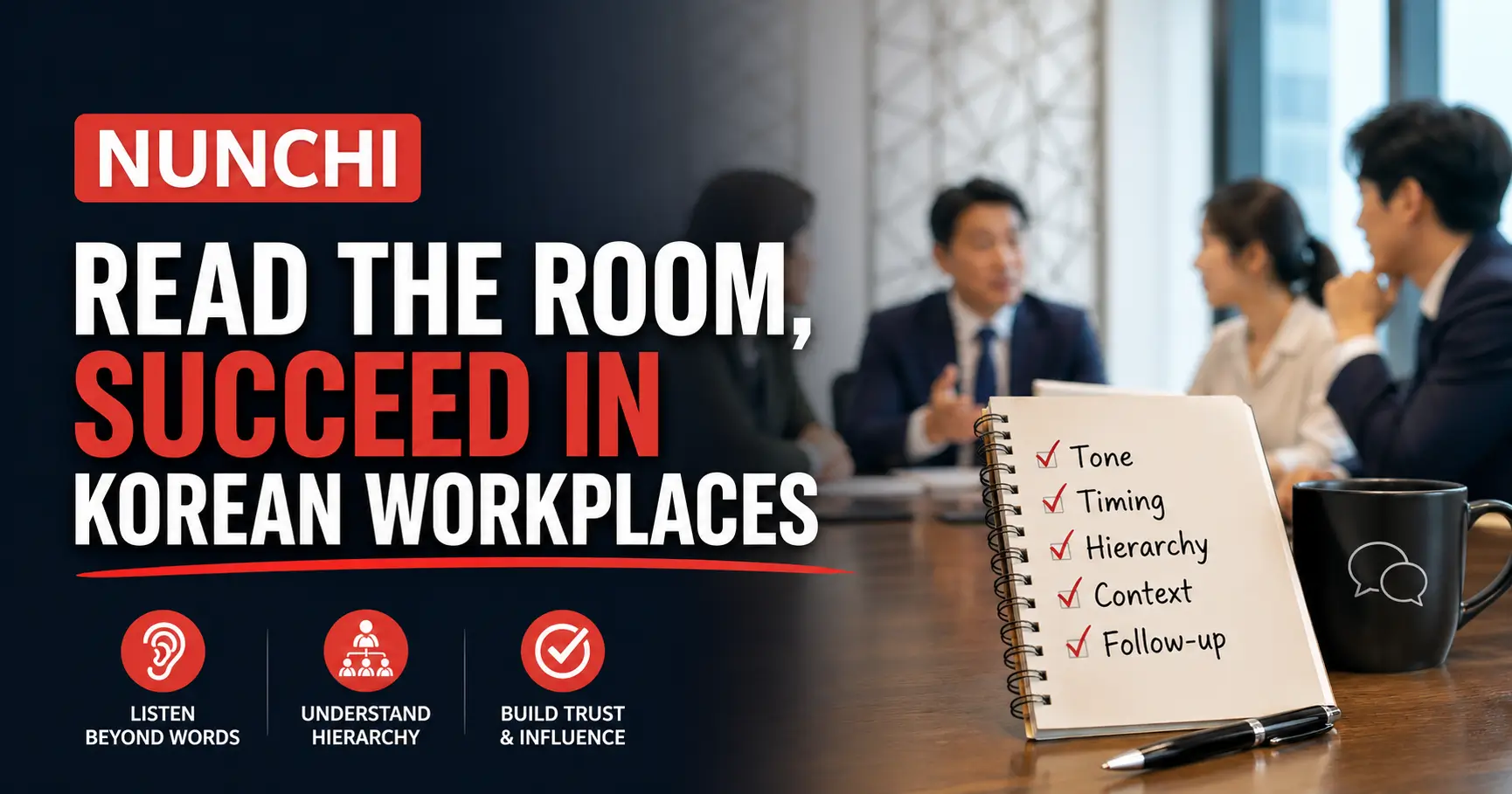
Beyond the Words:
Mastering the Art of Nunchi
In a Korean meeting, everyone might nod and speak politely, yet the real answer often hides in the pause after “we’ll review it.”
The challenge isn’t open conflict—it’s the missed timing, indirect disagreement, and the invisible hierarchy that everyone sees except the newcomer reading only the transcript.
“Nunchi is not mind reading; it is context reading. It’s noticing what people protect, what they avoid, and knowing when a polite answer isn’t a commitment.”
This guide helps you decode workplace patterns—who speaks, who waits, and what changes once the room empties. Because while the words matter, the room matters more.
The real meeting often begins after the meeting ends.
Table of Contents
Fast Answer: Nunchi matters at work in Korea because many workplace signals are communicated through timing, tone, silence, hierarchy, group mood, and indirect feedback rather than blunt verbal instruction. Foreign employees who only listen for explicit words may miss what is actually being decided, delayed, softened, or refused. Learning nunchi helps you participate with more tact, trust, and cultural fluency.
Start Here: Nunchi Is Not Mind Reading, It Is Workplace Context Reading
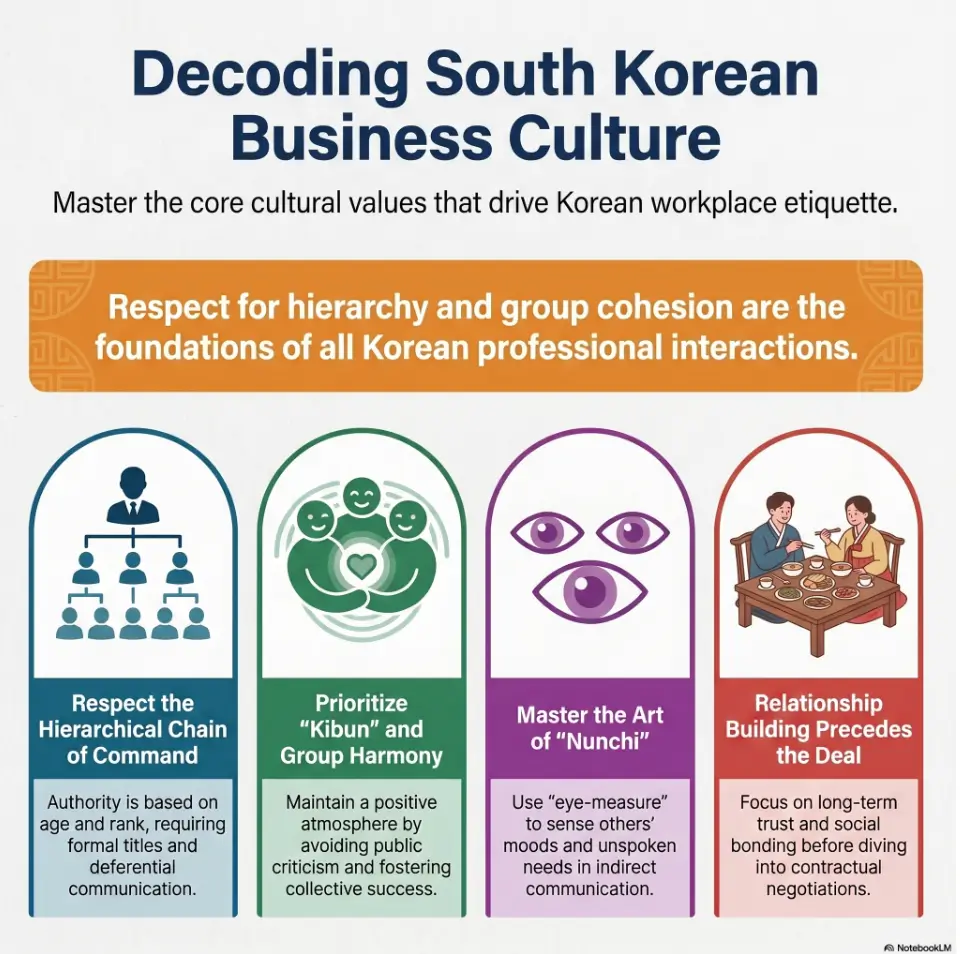
Nunchi is often translated as “reading the room,” but that phrase can sound too casual, as if you are merely noticing whether people are bored at a dinner party. In a Korean workplace, nunchi can be much more practical. It helps you notice who is hesitant, who has authority, who is uncomfortable, and when a public answer is not the whole answer.
I once watched a foreign colleague give a beautifully logical presentation in Seoul. The slides were clean, the numbers were tidy, and the conclusion had the confidence of a freshly ironed shirt. Then the senior manager said, “We can think about it.” My colleague heard possibility. The Korean team heard a soft brake pedal. That small gap is one reason Korean indirect communication can feel so subtle to newcomers.
Why “reading the room” becomes a professional skill in Korea
Korean workplace communication often carries more information in the edges of the conversation than many foreign employees expect. A pause can matter. Seating can matter. The order in which people speak can matter. The person who says the least may be the person everyone is quietly watching.
This does not mean Korean offices are secret theaters where every eyebrow is a coded telegram. It means the workplace often rewards sensitivity to context. The spoken sentence is important, but the situation around the sentence may tell you how seriously to take it.
How nunchi differs from ordinary emotional intelligence
Emotional intelligence often focuses on recognizing feelings and managing relationships. Nunchi includes that, but it also asks a sharper question: What does this room require right now?
- Does the senior person want open debate, or careful alignment first?
- Is the team excited, nervous, tired, or protecting someone’s face?
- Is the decision really being made here, or only being prepared?
- Is silence a green light, a red light, or a yellow light wearing a cardigan?
The hidden workplace question: what is being protected right now?
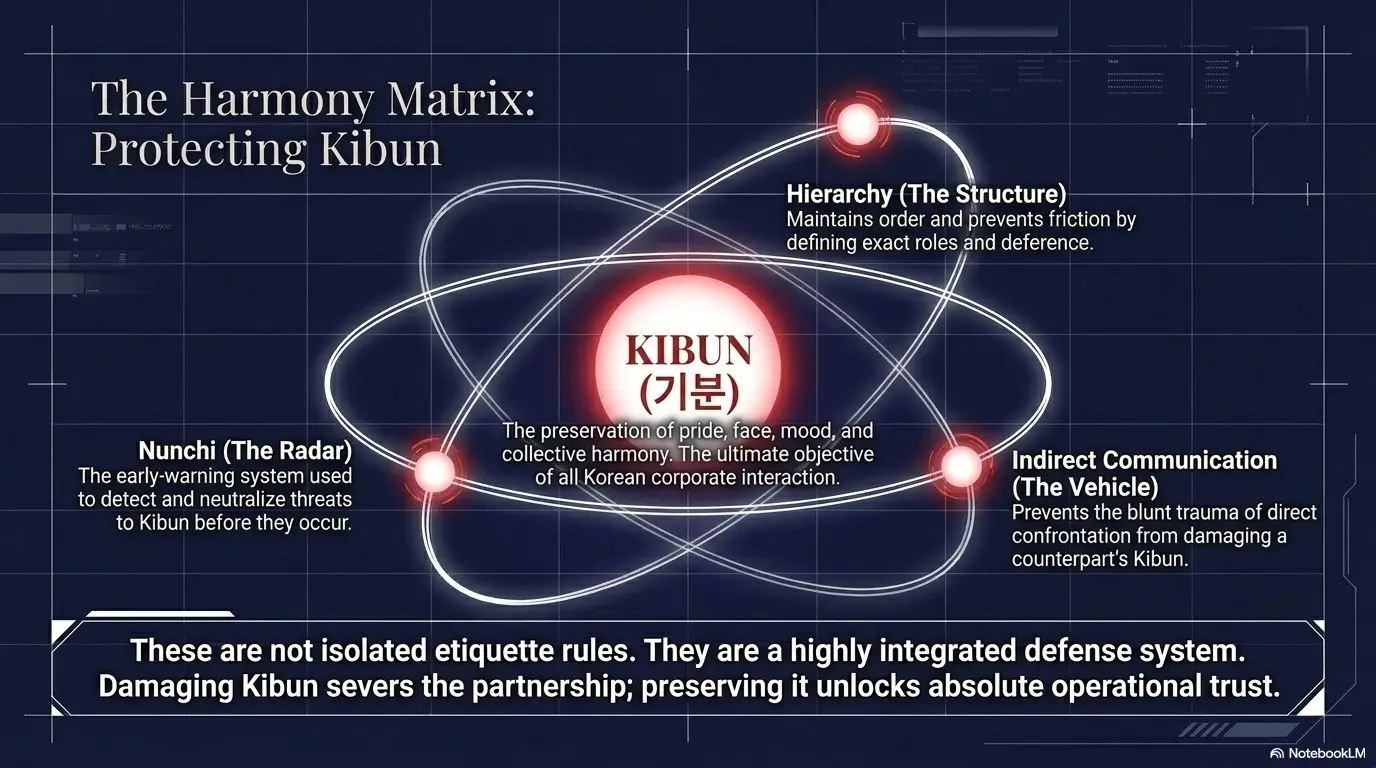
Many misunderstandings begin when foreign employees assume the main thing being protected is speed. In some Korean workplace moments, the thing being protected may be harmony, seniority, reputation, group stability, or the ability to revise a decision without public embarrassment.
Once you ask, “What is being protected?” the room becomes easier to read. Not perfectly. You are not installing cultural radar in your forehead. But you begin to notice why a direct question gets a soft answer, why a decision waits until after a meeting, or why a junior colleague gives you useful information only in a hallway.
- Listen to tone, pauses, and order of speech.
- Watch who influences the room without speaking much.
- Separate public agreement from final commitment.
Apply in 60 seconds: Before your next meeting, write down one question: “Who has authority, and who has influence?”
The First Surprise: Korean Meetings Often Say Less Than They Mean
Foreign employees often expect meetings to be the place where disagreement becomes visible. In many Korean offices, the meeting may be only one layer of the process. The real decision may be shaped before the meeting, softened during the meeting, and clarified after the meeting.
This can be frustrating if you come from a workplace culture where a good meeting is supposed to produce clear debate, next steps, owners, and deadlines. You may feel as if the room is wrapped in cotton. But often, the cotton is doing a job: reducing public friction while people test whether a proposal can survive socially and operationally.
Why agreement in the room may not mean final approval
A nod in a Korean meeting may mean “I hear you,” not “I approve this.” A polite phrase like “That sounds possible” may mean “We are not rejecting it in public.” A request to “review again” may mean there is a serious concern, even if nobody has used the word “problem.” If you have ever wondered why “maybe” in Korean communication can carry more weight than it seems to, this is the workplace version of that puzzle.
One useful rule: treat the meeting as a weather report, not a signed treaty. The clouds matter. The wind direction matters. But you may still need to check the forecast after everyone leaves.
How silence can signal caution, disagreement, or hierarchy
Silence is one of the easiest signals to misread. In some American or European workplaces, silence may be taken as consent. In a Korean workplace, silence can mean several things:
- The person disagrees but does not want to embarrass someone.
- The most senior person has not signaled a position yet.
- The team needs time to align internally before answering.
- The idea is not dead, but it is not safe enough to support publicly.
In other words, silence is not empty. It may be crowded with caution. For a broader everyday lens, Korean silence in conversation often works less like absence and more like a room with its lights dimmed.
What foreign employees miss when they only track spoken words
If you only write down what people said, your notes may look tidy and still be wrong. Better meeting notes include mood and movement: who hesitated, who redirected, who looked uncomfortable, who avoided confirming ownership, and what was postponed.
Mini Infographic: The Korean Meeting Signal Stack
What was said directly.
How carefully it was said.
Who avoided confirming.
Who others waited for.
What changed after the room.
Who This Is For, and Who This Is Not For
This guide is for people who want to work more respectfully and effectively with Korean colleagues, clients, managers, schools, vendors, or headquarters. It is not a cheat sheet for decoding every Korean person. Humans are not vending machines. You cannot press “hierarchy plus silence” and receive one guaranteed meaning.
For foreign employees joining Korean offices or Korean-led teams
If you are entering a Korean office for the first time, nunchi can save you from avoidable bruises. Not dramatic disasters, usually. More often, small frictions: pushing for an answer too early, assuming a soft reply means approval, or publicly cornering someone who was trying to help you privately.
The first 30 days matter. During that time, observe more than you perform. Notice how people enter meetings, how decisions are summarized, how disagreement is phrased, and who junior employees consult before answering.
For managers working with Korean clients, vendors, or headquarters
Managers need nunchi because they shape the emotional weather. If you demand instant clarity in every public setting, Korean partners may become more cautious, not more transparent. If you leave too much ambiguity, your own team may drift into confusion. The sweet spot is respectful clarity.
A good manager learns to ask questions that leave dignity intact: “Would it be better to review this internally first?” or “Is there any concern we should handle before confirming the timeline?” These questions lower the temperature without dimming the lights.
Not for people looking for shortcuts, stereotypes, or “how to manipulate Koreans”
Nunchi should not become a cultural crowbar. The goal is not to manipulate people, flatter seniority, or become artificially quiet. The goal is to work with more precision. You are learning to reduce accidental pressure, not to become a fog machine in business casual.
Eligibility Checklist: Should You Actively Build Nunchi for Work?
- Yes if you work with Korean managers, vendors, clients, schools, or headquarters.
- Yes if you often hear “maybe,” “we will review,” or “it may be difficult” and feel unsure what happened.
- Yes if your role includes meetings, negotiation, teaching, project management, HR, sales, or cross-border collaboration.
- No if you want a stereotype-based script that treats every Korean workplace the same.
Neutral next step: Choose one recurring meeting and track the same 3 signals for 2 weeks: silence, decision owner, and follow-up wording.
The Hierarchy Layer: Nunchi Helps You Hear Rank Without Being Told
Korean workplaces vary widely. A gaming startup in Pangyo will not feel identical to a family-owned manufacturer in Daegu or a large Seoul conglomerate team. Still, hierarchy often has more social weight than many foreign employees expect.
Hierarchy does not always announce itself with a trumpet. Sometimes it sits quietly at the conference table and everyone angles their sentences around it.
Why job title, age, tenure, and group role can shape the room
In Korea, professional rank may be shaped by title, seniority, age, tenure, department, company history, and relationship networks. You may not know the whole map at first. That is normal. The mistake is assuming there is no map because nobody handed you one. Even outside the office, Korean titles versus first names can reveal how much relationship and rank shape everyday speech.
Watch practical signals. Who opens the conversation? Who gets interrupted least? Who receives the most eye contact when a risky point is raised? Who gives the final “we will proceed” sentence?
How junior employees may communicate disagreement indirectly
A junior employee may not say, “This plan is flawed.” They may say, “We may need to check the schedule,” or “There could be some difficulty.” That can sound vague to foreign ears. But in context, it may be a careful warning.
I once ignored a soft “maybe difficult” because I thought we were still brainstorming. Two days later, the project timeline folded like a cheap umbrella. The warning had been there. It was just wearing indoor shoes.
The danger of treating every conversation as flat and casual
Flat communication can feel refreshingly honest in some workplaces. But in a Korean setting, acting as if everyone has equal permission to challenge, decide, joke, or disagree may put others in an awkward position.
This does not mean you must become stiff. It means you should calibrate. A friendly tone is welcome. Public pressure is risky. Casual jokes may work beautifully after trust is built and wobble badly before then.
Show me the nerdy details
One useful way to analyze Korean workplace communication is to separate formal authority from informal influence. Formal authority is visible through title, reporting line, and meeting role. Informal influence appears through who people consult, who can slow a decision, and whose hesitation changes the room. Nunchi improves when you track both layers instead of assuming the official org chart explains everything.
Don’t Do This: Mistaking Directness for Honesty Every Time
Many foreign employees arrive with a sincere belief: direct communication is honest communication. There is truth in that. Clear words can prevent confusion, protect timelines, and stop the office rumor-ferret from chewing through everyone’s afternoon.
But directness is not automatically virtuous in every setting. Sometimes blunt clarity helps. Sometimes it forces someone into public discomfort and makes the next answer less honest, not more honest.
Why “just say what you mean” can sound less efficient than you think
“Just say what you mean” sounds practical. It can also sound culturally impatient. In a Korean workplace, meaning may need to move through relationship, timing, status, and group alignment before it becomes safe to say plainly.
When a foreign employee pushes too hard for a direct answer, the Korean colleague may offer a polite placeholder instead of the real concern. The result is the opposite of clarity. Everyone smiles, the issue survives, and the calendar quietly grows teeth.
How blunt questions can force people into public discomfort
Questions like “Do you disagree with the director?” or “Is this plan bad?” may be normal in some teams. In many Korean settings, they can create a face-risk problem. The person may need to choose between honesty and social damage. This is where understanding Korean politeness helps you see tact as a form of precision, not decorative softness.
Try replacing blunt public questions with safer process questions:
- “Would it help to review possible risks separately?”
- “Is there anything we should check before confirming?”
- “Would a smaller follow-up be better for the details?”
- “Are there concerns around timing, approval, or resources?”
Let’s be honest: being clear is not the same as being culturally loud
You can be clear without being loud. You can be honest without making someone defend themselves in front of 8 people. The best cross-cultural communicators do not abandon clarity. They package it so the room can receive it.
- Ask risk questions before accusation-shaped questions.
- Move sensitive disagreement into smaller settings when appropriate.
- Use direct summaries after people have room to respond safely.
Apply in 60 seconds: Rewrite one blunt meeting question into a process question before you ask it.
The Feedback Puzzle: When “It’s Fine” May Not Be Fine
Few workplace phrases have caused more trouble than “It’s fine.” It can mean fine. It can mean not fine. It can mean “I do not want to discuss this here.” It can mean “Please notice I am saying fine in the voice of a man carrying a piano up wet stairs.”
In Korean workplace settings, negative feedback may arrive softly at first. That softness is not always weakness. It may be the first polite chance to adjust before the issue becomes formal.
Why small corrections may arrive softly before they arrive seriously
A Korean manager may not begin with a dramatic critique. They may say, “Maybe we can improve this part,” or “Please check once more.” To foreign employees, this can sound minor. But if the same point repeats, it may be serious.
Track repetition. One soft comment may be a suggestion. Three soft comments on the same issue may be a warning wearing slippers.
How to notice repeated hesitation, delayed replies, and careful wording
Feedback is not only what appears in a performance review. It may show up in delays, rewritten instructions, extra approval steps, sudden CCs, or a colleague carefully saying, “Maybe next time, it would be better to…”
Create a simple signal log. Not a paranoid diary with red string on the wall. Just a practical record:
- What phrase keeps repeating?
- Who is slowing down?
- Which topic gets postponed?
- Where do people become careful?
Here’s what no one tells you: the warning often comes before the warning
By the time feedback becomes explicit, you may have missed several earlier opportunities to adjust. Nunchi helps you catch the soft warning while it is still cheap to fix.
Mini Calculator: Is This Feedback Actually Soft Warning?
Use this quick 3-input check after a confusing exchange.
- Repeated? Same concern mentioned 2 or more times.
- Delayed? Replies slowed or approvals became harder.
- Careful? Wording became more indirect, formal, or cautious.
Output: If 2 or 3 are true, treat it as a signal to clarify privately within 24 hours.
Neutral next step: Ask, “Would you like me to revise the direction, timing, or level of detail?”
Common Mistakes Foreign Employees Make With Nunchi at Work
The biggest nunchi mistakes are usually not rude on purpose. They come from using the wrong workplace operating system. You think you are being efficient. The room experiences you as rushed, careless, or socially heavy.
Assuming no comment means no problem
No comment may mean no problem. It may also mean no one wants to be first. If the room is quiet after your proposal, do not celebrate too early. Ask a soft-check question: “Would it be useful to review possible concerns before we confirm?”
Asking for final decisions too early in front of too many people
Public finality can be uncomfortable when people have not aligned behind the scenes. Instead of demanding a final yes in a crowded room, ask what process would help confirm the decision. That single shift can save days of strange silence.
Treating after-meeting conversations as less important than the meeting itself
In some Korean workplaces, the hallway conversation, KakaoTalk follow-up, team dinner comment, or quiet desk-side explanation may carry the missing piece. Do not dismiss informal follow-ups as side quests. Sometimes they are the main quest wearing sneakers. The same pattern shows up in Korean group chat culture, where timing, audience, and wording can matter as much as the message itself.
Overcorrecting into silence and becoming invisible
Some foreign employees learn that nunchi matters and then vanish into politeness. That is not the goal. You still need to contribute, ask, summarize, and lead when needed. Nunchi is not self-erasure. It is calibrated participation.
Decision Card: Speak Now vs. Follow Up Privately
- The issue affects safety, legality, budget, or deadline.
- The room has invited open discussion.
- You can phrase it as a risk check, not a public challenge.
- The concern may embarrass one person or team.
- The senior person has not shown their view yet.
- You need cultural or political context before pushing.
Neutral next step: If unsure, ask for a small follow-up meeting instead of forcing the full answer in public.
The Timing Skill: Knowing When to Speak May Matter as Much as What You Say
Nunchi is partly a timing skill. The same idea can be wise at 2:10 p.m., awkward at 2:16 p.m., and brilliant again at 3:05 p.m. after the right person has spoken. Workplace timing is not decoration. It changes how your message lands.
Why the same idea can land differently before, during, or after a meeting
Before a meeting, your idea may help people prepare. During a meeting, it may sound like a challenge. After a meeting, it may become a practical next step. The idea did not change. The room did.
One Korean colleague once told me, “Your point was good. The moment was bad.” Brutal? A little. Useful? Extremely. I wrote it down and mentally underlined it with a very expensive pen.
How to use private follow-ups without seeming evasive
Private follow-up is not cowardice. It can be respectful preparation. The trick is to keep it transparent and work-focused.
- “I had one concern about timing. Could I ask you briefly before we confirm?”
- “I want to make sure I understood the direction correctly.”
- “Would it be better to raise this in the group, or handle it first with the project lead?”
The three-second pause that can save a conversation
A small pause before answering gives you time to read the room. Who looked at whom? Did someone inhale as if about to object? Did the senior person lean forward or back? Three seconds can prevent 30 minutes of repair work.
- Prepare sensitive points before the meeting when possible.
- Use private follow-up to clarify without cornering people.
- Pause before answering when the room feels delicate.
Apply in 60 seconds: Add one phrase to your meeting notes: “Best place to raise this: before, during, or after?”
The Group Mood: Nunchi Protects Harmony Without Killing Initiative
Harmony can be misunderstood. Foreign employees sometimes hear “harmony” and imagine a workplace where nobody disagrees and everyone silently suffers under fluorescent lights. That can happen anywhere, frankly. But harmony at its best is not the enemy of initiative. It is the social container that lets work continue without unnecessary damage.
Why Korean workplace culture often values smooth coordination
Many Korean teams move fast once alignment exists. The slower, quieter stage before visible action may be the cost of coordinated speed later. If you mistake that alignment stage for indecision, you may push at exactly the wrong moment.
Think of it like tuning an orchestra. The audience hears noise before music. The musicians hear preparation.
How to disagree without making the room choose sides
Disagreement lands better when it protects the project rather than attacks a person. Try these frames:
- “From the customer side, one risk might be…”
- “To protect the launch date, should we check…”
- “I may be missing context, but could we review…”
- “Would it be safer to test this with a smaller group first?”
These phrases are not magic. But they reduce the chance that your disagreement sounds like a public duel with office chairs.
When harmony becomes confusion, and how to clarify gently
Harmony can become a problem when nobody knows who owns the next step. That is where polite clarity matters. Summarize without accusing: “To make sure I understood, the current plan is A, pending review from B, by Friday. Is that correct?”
This kind of recap is a gift. It lets people correct the plan without admitting the meeting was fuzzy. A small dignity-preserving door opens. Use it.
Quote-Prep List: What to Gather Before Comparing Options With a Korean Team
- The decision owner and the practical influencer may not be the same person.
- The deadline that is public and the deadline that is truly safe may differ.
- The budget limit may need private confirmation before group discussion.
- The risk category matters: timeline, cost, client reaction, quality, or internal approval.
- The preferred format may be a short memo before a meeting, not surprise debate during it.
Neutral next step: Send a 5-line pre-read before asking for a final decision.
The Practical Script: How to Show Nunchi Without Pretending to Be Korean
You do not need to become Korean to work well in Korea. Please do not put on a cultural costume. It squeaks. Good nunchi for foreign employees means staying yourself while making your communication easier for the room to receive.
Use soft-check questions before pushing a point
Soft-check questions help you test the room without forcing a public yes or no. They are especially useful when the topic involves deadlines, quality concerns, budget, approval, or disagreement with a senior person.
- “Would this be difficult from the team’s side?”
- “Is there any context I should understand before we decide?”
- “Would it be better to discuss risks separately?”
- “Do you see any issue with timing or internal approval?”
Summarize decisions privately when the meeting felt ambiguous
After an unclear meeting, send a short, respectful summary. Do not write a legal scroll. Keep it calm. If the follow-up happens by message, Korean texting formality can help you choose wording that feels clear without sounding abrupt.
Example: “Thank you for today’s discussion. My understanding is that we will revise the proposal, check the timeline with the design team, and confirm by Thursday. Please let me know if I misunderstood any point.”
Ask about process, not just preference
Instead of asking, “What do you want?” try asking, “What is the best process for confirming this?” Process questions work well because they respect hierarchy and coordination.
Notice who speaks first, who waits, and who everyone watches
In your first few weeks, observe the choreography. Who starts? Who summarizes? Who reframes conflict? Who gets the last word? This is not gossip. It is workplace literacy.
Short Story: The “Yes” That Was Really a Waiting Room
I once helped a foreign employee prepare for a Korean client call. The client had said “yes, yes, we understand” several times, so the team assumed the proposal was accepted. But the call had two odd signals: the senior client stayed mostly quiet, and the project manager kept saying they would “review internally.”
We wrote a gentle follow-up instead of sending the contract immediately. The reply came back with three concerns that had never been stated in the meeting. Nothing exploded. No one lost face. The foreign team adjusted the timeline, the Korean client felt heard, and the deal moved forward. The lesson was not “yes means no.” That would be too simple. The lesson was smaller and more useful: when the room gives you warmth but not commitment, confirm the process before you celebrate.
FAQ
What does nunchi mean in a Korean workplace?
In a Korean workplace, nunchi means noticing the atmosphere around communication: timing, hierarchy, tone, silence, mood, and indirect signals. It helps you understand whether a comment is casual, serious, cautious, final, or politely delaying a decision.
Is nunchi the same as reading body language?
No. Body language can be part of nunchi, but nunchi is broader. It includes social context, relationship dynamics, rank, meeting timing, group mood, and what people avoid saying directly.
Why do Korean coworkers sometimes avoid saying no directly?
A direct no can create public discomfort, especially when hierarchy, client relationships, or team harmony are involved. Instead, disagreement may appear through softer phrases such as “that may be difficult,” “we should review,” or “let’s think about it more.”
Can foreign employees learn nunchi, or is it only cultural instinct?
Foreign employees can learn practical nunchi. You may not catch every nuance, but you can improve by observing meeting order, tracking repeated soft signals, asking process questions, and confirming decisions respectfully after unclear conversations.
How can I ask for clearer feedback without sounding rude?
Ask in a way that protects the other person’s comfort. Try: “Could you help me understand which part should be revised first?” or “Would you prefer a different direction, more detail, or a shorter version?” This invites clarity without demanding public criticism.
Does nunchi matter in Korean startups too, or only traditional companies?
Yes, it can matter in startups too, though the style may be more casual. Younger teams may use English, Slack, Notion, or flat titles, but hierarchy, timing, indirect feedback, and group mood can still influence decisions.
What should I do if I misunderstood a workplace signal?
Repair quickly and calmly. Say, “I may have misunderstood the direction. Could I confirm the expected next step?” Avoid dramatic apologies unless the issue was serious. A practical correction is usually more useful than emotional overexplaining. When the misunderstanding is personal rather than procedural, Korean apology phrases can help you repair the moment without overdoing it.
How do I balance nunchi with my own communication style?
Keep your clarity, but adjust delivery. Use softer entry points, private follow-ups, and respectful summaries. You do not need to become silent or vague. The goal is clear communication that fits the room.
Next Step: Build a “Room Reading” Habit Before Your Next Meeting
The hook of this article began with a familiar cross-cultural trap: you heard polite agreement, saw the nods, and walked out with the wrong map. Nunchi is how you redraw the map before the project wanders into a swamp wearing nice shoes.
You do not need to become perfect. You need a repeatable habit. Before your next Korean workplace meeting, take 5 minutes to prepare for the room, not only the agenda.
Write down who decides, who influences, and who stays quiet
Make three columns. Decision owner. Influencer. Quiet signal. Fill them in over time. The first version may be wrong. That is fine. A rough map is better than walking through a cultural forest with a desk lamp.
Track one moment where the mood changed
After the meeting, write one sentence: “The mood changed when…” Maybe it changed after a deadline was mentioned. Maybe after a senior person paused. Maybe after a junior colleague said, “It might be difficult.” This habit trains your eye.
Ask one clarifying question after the meeting instead of forcing certainty during it
When the room feels delicate, do not always force a final answer. Use a respectful follow-up: “To make sure I understood correctly, should we revise the proposal first and confirm after internal review?” That sentence can prevent a week of polite fog.
- Track decision authority.
- Notice repeated soft warnings.
- Confirm ambiguous next steps privately.
Apply in 60 seconds: Open your calendar and choose one Korean workplace meeting where you will practice this habit.
Last reviewed: 2026-04.
For your next step, do not try to master nunchi as a grand life philosophy by lunchtime. Choose one practical pilot: before your next meeting, write down who decides, who influences, and what kind of answer would be safest to ask for publicly. Then spend 15 minutes afterward comparing what was said with what changed. That tiny habit is where cultural fluency begins: not in guessing minds, but in respecting rooms.