
Korea errands, decoded
How Digital Waiting Lists, Number Tickets, and Queue Apps
Shape Korean Errands
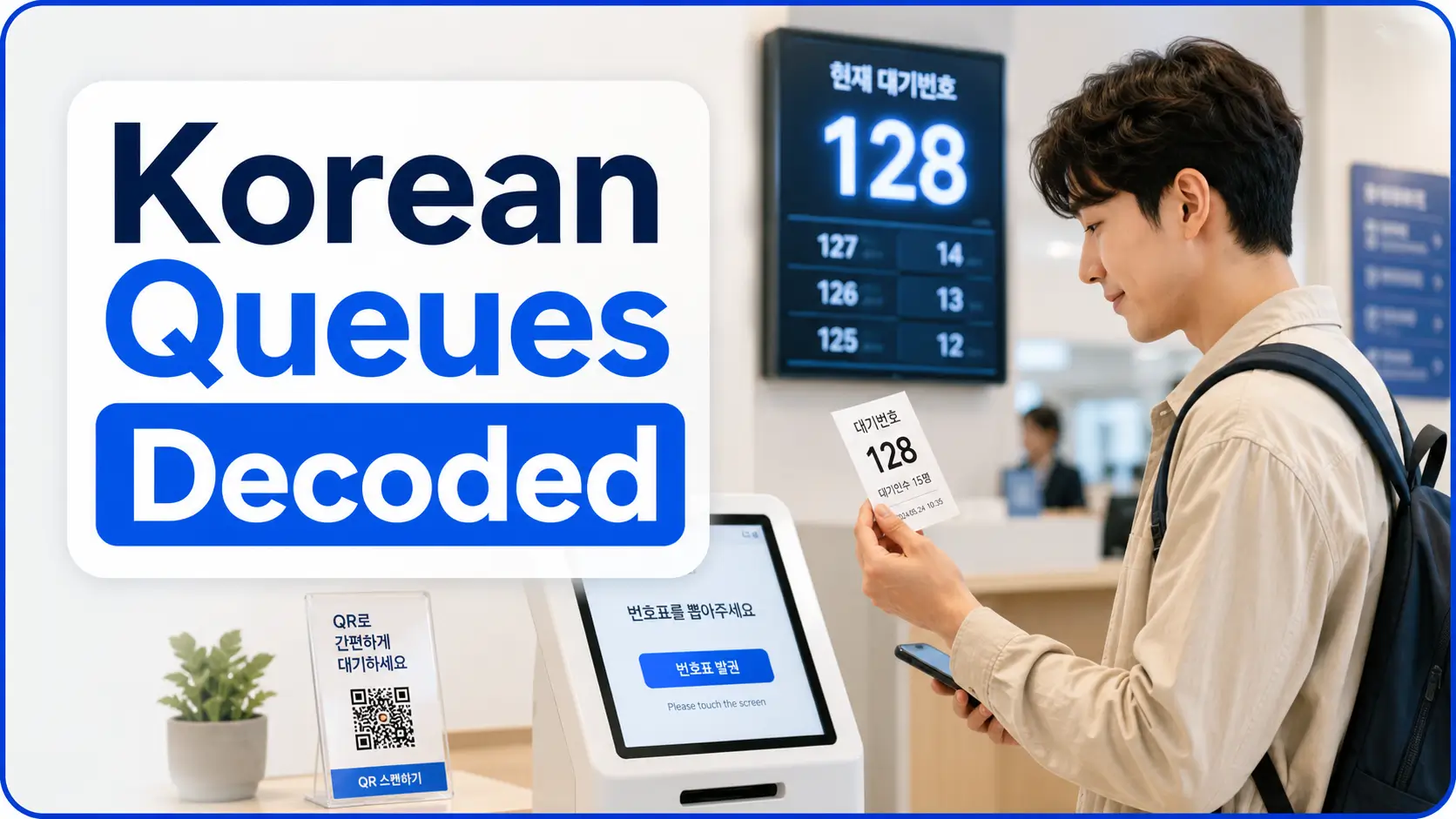
In Korea, waiting often begins before anyone speaks to you. A small ticket machine near the entrance, a tablet by the host stand, a QR code taped to the wall, or a glowing number board can decide whether you are truly in line or merely standing in the room with hopeful eyebrows.
For US and UK travelers, expats, remote workers, and Korea-curious readers, this can feel wonderfully efficient one minute and oddly strict the next. The lobby may look empty, the counter may look open, and yet the invisible queue has already formed in software.
This guide explains the everyday choreography behind Korean number tickets, digital waiting lists, clinic check-ins, restaurant queue apps, bank counters, and public office systems, so you can save time, avoid awkward mistakes, and move through errands with less static in the air.
Read the room faster
Spot the kiosk, ticket machine, QR code, or screen before you lose your place.
Avoid the silent reset
Choose the right category and avoid waiting politely in the wrong digital lane.
Use smarter errand habits
Learn when DIY translation is enough and when asking staff early saves money and time.
The practical promise: before you wait, learn where the waiting officially begins. 🎟️
Snapshot
This article is for travelers, expats, students, remote workers, and foreign residents who want Korean errands to feel less confusing. You will learn how digital waiting lists, number tickets, queue apps, and screen-based turn systems work, where mistakes happen, and what to do in your first 10 seconds at a bank, clinic, restaurant, telecom shop, or local district office.
Table of Contents
Before You Wait: Know What This Guide Can and Cannot Do
Korean queue systems are everyday tools, not secret codes. Still, they can feel mysterious when the instructions are in Korean, the screen is flashing numbers, and everyone around you seems to know the ritual already.
This guide explains the common patterns behind digital waiting lists, number tickets, queue apps, and kiosk-based check-ins. It is not a live app manual, legal guide, medical guide, or promise that every location works the same way.
Systems vary by city, business, branch, hospital, chain, and day. When the errand involves immigration status, medical treatment, banking, contracts, government paperwork, travel deadlines, or payment disputes, confirm the details with staff or a qualified professional before acting.
Key takeaway
Use this article as a practical orientation map. For high-stakes errands, let it help you ask better questions, not replace official instructions.
Who This Guide Helps Most
It helps a first-time traveler who walks into a Seoul bank and wonders why nobody is forming a visible line. It helps an expat at a clinic who hears a number called but cannot connect it to the screen. It helps a remote worker trying to squeeze lunch, pharmacy pickup, and a phone plan errand into one efficient afternoon.
It is especially useful if you come from a service culture where the line is physical, staff-directed, and verbally managed. In many Korean spaces, the queue may be digital, self-started, and screen-directed.
What You Should Not Assume
Do not assume every Korean restaurant uses an app. Do not assume every clinic has English instructions. Do not assume a quiet room means quick service. And please, for your own peace, do not assume that standing near the counter has entered you into the queue.
The safest mental model is simple: a Korean errand often has an entry step before the service step. Your job is to find that entry step first.
The Hidden Rule: The Line May Be Invisible
In the US or UK, waiting often has a visible shape. People stand behind one another. A staff member says “next.” Someone gestures you forward. The room itself tells you where you belong.
In Korea, the queue may live inside a kiosk, tablet, phone notification, ticket machine, or wall screen. The room may look calm because the order has already been outsourced to a number system. The line is not gone. It has simply become quieter.
The Queue Starts at the Machine, Not the Desk
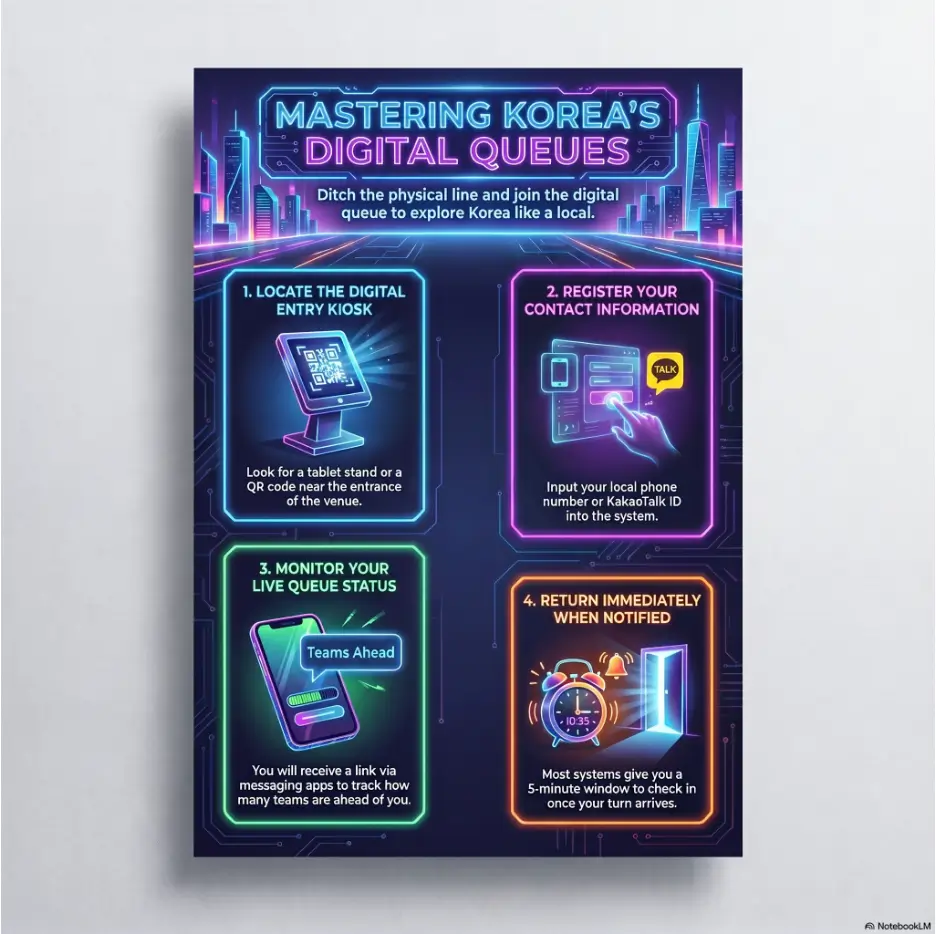
At many banks, clinics, public offices, telecom stores, repair counters, and popular restaurants, the first thing to find is not a person. It is the device that recognizes your arrival.
That device might print a paper number, ask for a phone number, scan a reservation code, separate errands by category, or direct you to a specific counter. Until that happens, you may be physically present but digitally invisible.
Why Visitors Often Miss Their Turn
Visitors often look for a human cue first. They wait for eye contact, a wave, or a spoken invitation. But in many Korean service spaces, the cue is visual: a number appears on a screen, a counter light changes, or your phone receives a notification.
This can be tricky if the announcement is Korean-only, the screen changes quickly, or your ticket has several numbers and letters printed on it. A small delay can send the system to the next person, especially in busy locations.
The Ten-Second Scan That Saves the Errand
When you enter, pause near the doorway and scan left to right. Look for a ticket dispenser, kiosk, tablet stand, QR sign, reception desk, number screen, or waiting area sign. Then watch what the next local customer does.
Those 10 seconds can save 20 minutes. They can also save you from the special flavor of embarrassment that comes from waiting beautifully, patiently, and incorrectly.
Errand entry checklist
- Look for a kiosk, ticket machine, tablet, QR code, or sign near the entrance.
- Check whether the ticket machine has categories.
- Keep your ticket visible and take a photo if you are worried about losing it.
- Watch the main screen, not only the counter.
- If confused, show your ticket or phone screen to staff and ask simply.
Number Tickets: The Tiny Paper That Controls the Room
The Korean number ticket is humble: a small slip of paper, often thin enough to flutter like a receipt. Yet in many rooms, it has more authority than the loudest customer.
It tells staff who arrived first, which counter should handle your request, and sometimes what type of service you need. It lowers the emotional temperature of a busy room by making order visible.
The Ticket Is Your Place in the Social Contract
At a bank, clinic, pharmacy, district office, or service center, a ticket quietly prevents arguments. No one needs to debate who came first. The number becomes the room’s neutral referee.
This can feel refreshing if you dislike crowding and counter-hovering. It can also feel strict if you accidentally skip the ticket machine and wait near the wrong place.
Look for Categories Before You Tap
Many ticket machines separate services by task. A bank may sort deposits, card issues, foreign exchange, loans, account opening, or consultation. A clinic may separate registration, payment, testing, prescription pickup, or follow-up.
If you tap the first button just to be safe, you may get a number for the wrong queue. That mistake rarely feels dramatic. It simply makes time disappear, one fluorescent minute at a time.
What to Check on Your Ticket
Your ticket may include a waiting number, service category, estimated wait, counter range, branch name, or time stamp. Some systems use letters and numbers together, so do not track only the digits.
For example, A105 and B105 may be different queues. If you only watch for “105,” you may stand up at the wrong moment, perform a tiny public dance of uncertainty, then sit back down with your soul slightly untucked.
| Ticket detail | What it may mean | What to do |
|---|---|---|
| Letter plus number | Different service lanes may use different letters | Match both the letter and number on the screen |
| Counter number | Your turn may be tied to a specific desk | Move to that counter when called |
| Service category | You selected a task type | Confirm it fits your errand before waiting too long |
| Estimated wait | A rough time, not a guarantee | Stay nearby if the queue is moving fast |
| QR code | May connect to mobile status or check-in | Scan only if needed and safe to do so |
Queue Apps: When the Waiting Room Moves to Your Pocket
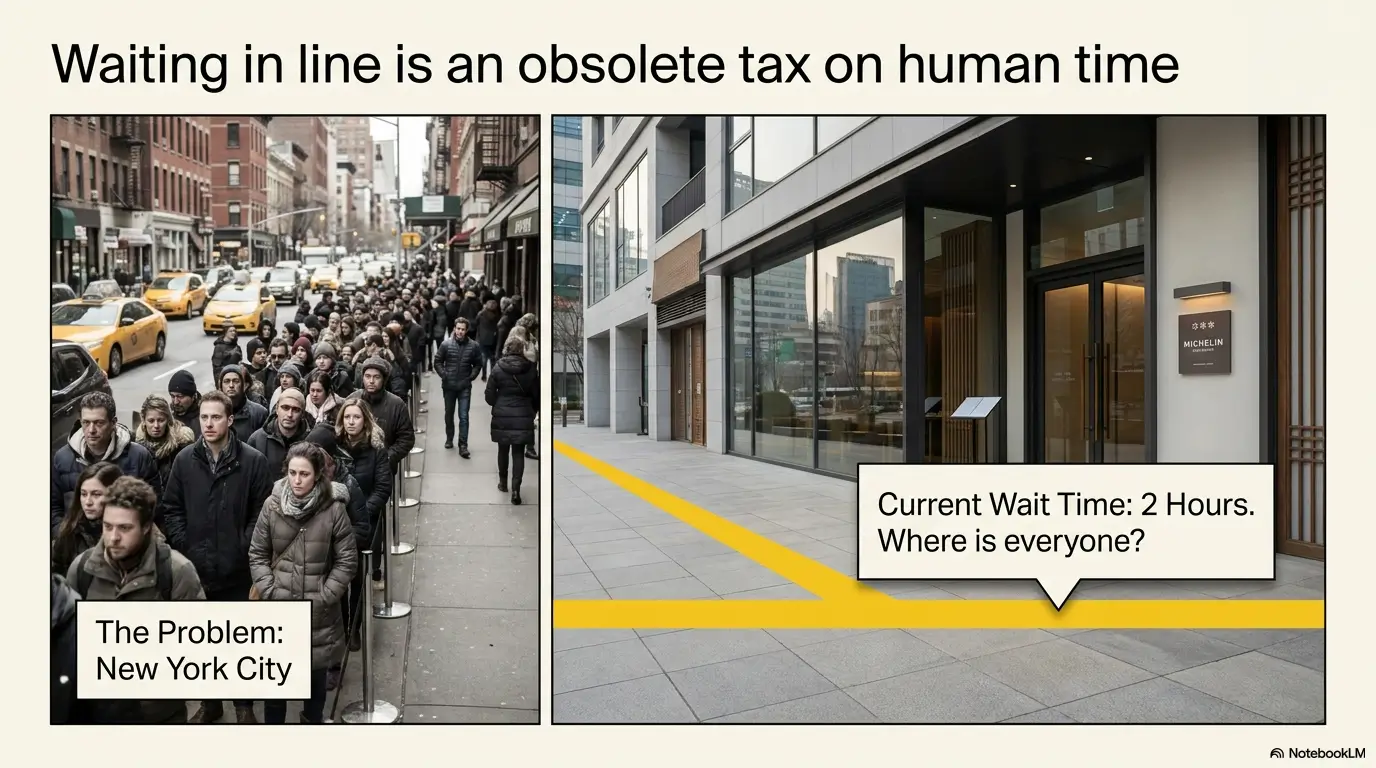
Restaurant waiting in Korea can feel unusually mobile. Instead of standing outside for an hour, customers may enter a digital waiting list, receive a countdown, and return when notified.
This sounds like pure convenience, and often it is. But it also changes the emotional texture of waiting. You are free to wander, yet your phone becomes a leash made of notifications.
Restaurants Turn Waiting into a Mobile Countdown
Popular restaurants, cafes, brunch spots, and dessert shops may use tablet-based waiting lists or app-linked systems. Some ask for a phone number. Others print a ticket. Some display your place in line on a nearby screen.
For visitors, the hardest part is often not the wait itself. It is knowing whether the system accepts foreign phone numbers, whether you must remain nearby, and how quickly your turn can vanish if you are late.
Errands Become Less Linear
Digital queues allow people to stack errands. You can join a restaurant waitlist, grab coffee, visit a pharmacy, pick up a package, and return when your phone says the table is near.
This is one reason Korean city errands can feel fast from the outside. The waiting is still happening, but it is woven between other tasks. Time gets braided.
The Phone Number Problem for Visitors
Some queue systems work better with a Korean mobile number. A traveler using a foreign SIM, travel eSIM, or data-only plan may have trouble receiving local SMS alerts or app notifications.
This does not mean you are stuck. Ask staff whether you can wait nearby, use a printed ticket, register with a companion’s number, or check the screen manually. The best phrase is simple: “No Korean phone number. Can I wait here?”
Key takeaway
Queue apps give you freedom, but not permission to disappear. Stay close enough to return quickly, especially at restaurants with fast table turnover.
Short Story: The Table That Arrived Before the Tourist
A traveler in Hongdae joined a digital waitlist at a noodle shop, watched the screen show “12 teams ahead,” and decided that was enough time for a relaxed walk. The street was bright, music leaked from second-floor cafes, and the evening felt generous.
Twenty minutes later, the queue had moved like rainwater down a steep alley. Her number had already flashed, paused, and vanished.
When she returned, staff were kind but firm. She had not done anything rude. She had simply treated a Korean queue like a long American wait, when the system was closer to a boarding call.
The lesson was small and useful: when your phone holds your place, your body still needs to stay within reach.
Clinics, Banks, and Public Offices: Where Digital Order Gets Serious
Some Korean queues are casual. A cafe waitlist may only affect lunch. But in clinics, banks, hospitals, telecom stores, and government offices, missing the system can cost far more than a table.
You may lose time, miss a document window, delay a prescription, or choose the wrong counter for a service that already has its own channel.
Medical Clinics Often Use Layered Check-In
A Korean clinic visit may involve several steps: registration, identity confirmation, waiting number, consultation, payment, prescription issuance, and pharmacy pickup. Some clinics move quickly, which is wonderful when you understand the rhythm and startling when you do not.
If you are a foreign visitor or resident, bring your ID, insurance information if relevant, appointment details, medication names, and a translation-ready summary of your symptoms. For a deeper related guide, see what to expect during Korean hospital admission and how prescription filling in Korea usually works.
Banks Use Tickets to Sort Complexity
Bank queues often separate quick services from longer consultations. A simple deposit is not the same queue as opening an account, dealing with a card issue, foreign exchange, loan paperwork, or business banking.
Before taking a number, scan the categories. If the machine is Korean-only, use camera translation or ask staff near the entrance. It is better to ask early than to wait 25 minutes in the wrong financial hallway of fate.
Government Offices Reward Prepared Visitors
Local district offices and public service centers often use number systems to manage certificates, address registration, family documents, taxes, welfare services, and administrative requests.
The queue may be efficient, but it cannot fix missing paperwork. Before you go, check office hours, ID requirements, document names, fees, and whether your errand can be handled online. You may also find this guide to local district offices in Korea useful if your errand involves resident paperwork or neighborhood administration.
| Errand type | What usually matters most | Money or time risk | Safer move |
|---|---|---|---|
| Clinic visit | Registration, ID, symptoms, payment, prescription flow | Medium if you miss instructions or pharmacy steps | Prepare a short translated symptom note |
| Bank service | Correct service category and required ID | Medium to high for account or transfer issues | Ask staff before taking a ticket if unsure |
| Government office | Documents, forms, certificates, exact counter | High if you must return another day | Confirm documents online or by phone first |
| Telecom store | Phone number, ID, plan type, device issue | Medium if you choose the wrong queue or plan help | Bring contract details and screenshots |
| Restaurant queue | Phone notifications and return timing | Low to medium, mostly time and inconvenience | Stay close after check-in |
US and UK Line Habits That Backfire in Korea
Many visitors are not doing anything wrong on purpose. They are using the waiting etiquette they already know. The problem is that Korean service spaces often ask for a different kind of attention.
If your instinct is to find the end of a line, smile at staff, and wait for a verbal invitation, you may need to add one more step: locate the system that controls the room.
Do Not Hover at the Counter
Hovering near the counter can look impatient, especially if staff are following number order. It may also block other customers whose numbers have already been called.
Instead, take a number, sit or stand where you can see the screen, and approach only when your number or name appears. The counter is not the queue. It is the finish line.
Do Not Ignore the Screen
Your number may appear visually before you clearly understand the audio. If Korean announcements are hard to follow, the screen becomes your best friend.
Sit where you can see it. Match the full number and letter. Watch for counter numbers, color changes, or flashing indicators. The screen is often the room’s conductor.
Do Not Assume “No Line” Means “No Wait”
A room can be quiet because everyone is already in a digital queue. Ten people may be ahead of you even if nobody is standing in a neat row.
The most dangerous Korean errand sentence is: “It looks empty, so this should be quick.” Sometimes it is quick. Sometimes the queue is simply hiding in plain sight, wearing a little LED crown.
Common mistake checklist
- Waiting without registering in the ticket or app system.
- Choosing the wrong service category because the machine looked confusing.
- Leaving too far after joining a restaurant waitlist.
- Watching staff instead of the screen.
- Assuming a foreign phone number will always receive notifications.
- Expecting staff to notice you before the system does.
Why Korean Queue Systems Feel Fast but Strict
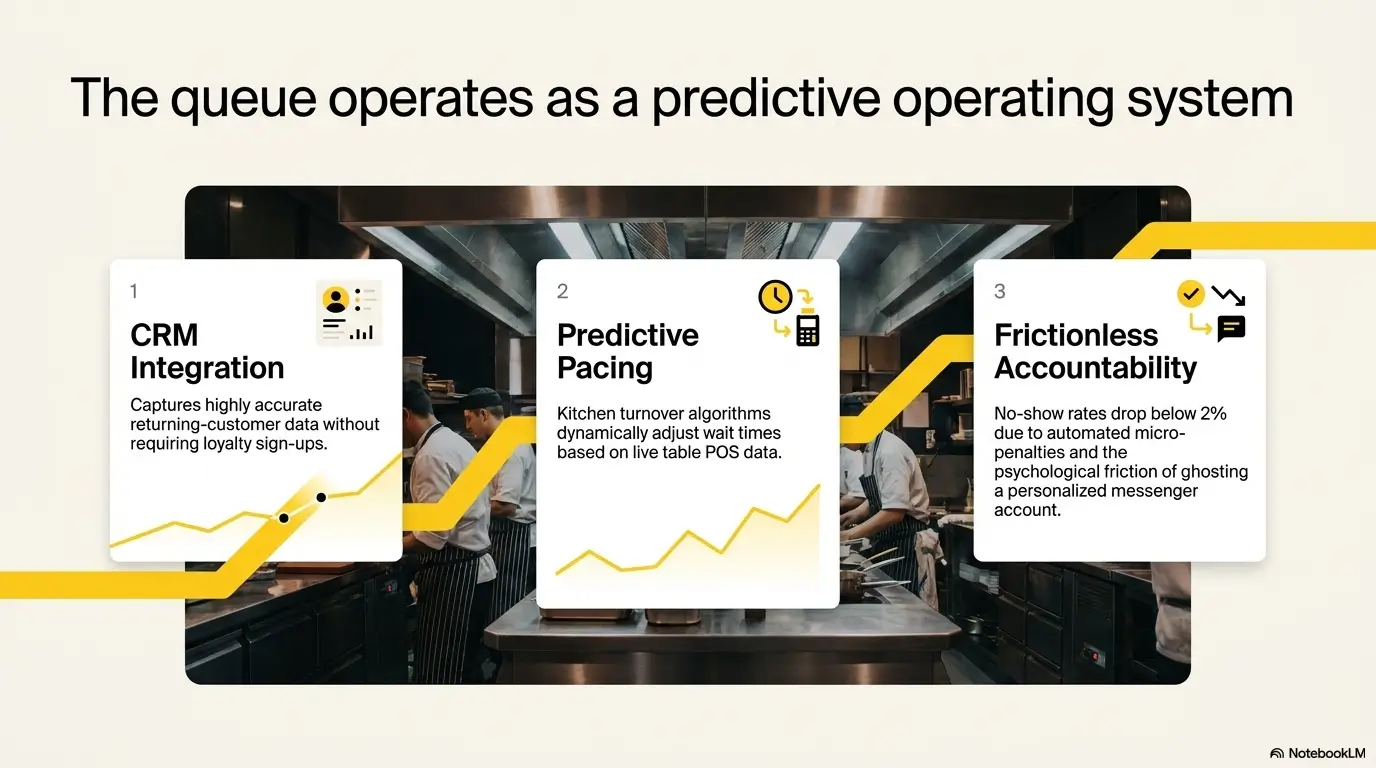
Korean queue systems often feel fast because they reduce negotiation. The order is not created by charm, confidence, height, volume, or who makes eye contact first. The machine says who is next.
That can make busy places feel calmer. It can also make them feel unforgiving when you miss a step. The system is efficient partly because it expects the customer to participate correctly.
Efficiency Comes from Removing Negotiation
In a crowded service space, small disputes take energy. Who arrived first? Which counter handles which task? Is this person waiting or just standing nearby? A number system answers those questions before they become social friction.
This is why the tiny paper ticket matters. It turns waiting into shared evidence.
Speed Depends on User Compliance
The system works best when everyone understands the ritual: enter, register, wait, watch, respond, finish. If one step breaks, the smoothness fades.
For tourists and new residents, the challenge is not intelligence. It is unfamiliar choreography. You are learning the dance after the music has already started.
Visible Time Feels Better, and Sometimes Worse
Seeing your number on a screen can reduce uncertainty. A wait with shape is easier to tolerate than a wait that feels endless.
But digital visibility can also create low-grade anxiety. Every buzz might be your turn. Every screen change might matter. A better wait can still feel more watchful.
Show me the nerdy details
Korean queue systems work because they separate three things that are often tangled together in traditional lines: arrival order, service category, and customer movement. A physical line usually handles arrival order well, but it struggles when customers need different services. A digital system can route simple tasks to one counter, complex tasks to another, and app-based waits to a flexible waiting area.
The trade-off is cognitive load. Customers must identify the correct entry point, select the right task, monitor the correct signal, and respond at the correct time. In plain English: the system saves time when you understand it and quietly taxes you when you do not.
Free vs Paid Help for Navigating Korean Errands
Most Korean queue systems do not require paid help. A translation app, patience, screenshots, and a little observation can solve plenty. But some errands are worth more preparation, especially when money, health, contracts, visas, or deadlines are involved.
The practical question is not “Should I pay someone?” It is “What is the cost of getting this wrong?”
When Free DIY Is Enough
For restaurants, cafes, casual shopping, simple pickup counters, museums, and many pharmacies, free tools are usually enough. Use camera translation, keep your ticket, watch the screen, and ask short questions.
For example, if you are joining a restaurant waitlist, the key risks are missing your turn or entering a phone number incorrectly. Annoying, yes. Life-altering, no.
When Paid Translation or Professional Help May Be Worth It
Paid help may be worth considering for hospital admissions, major medical consultations, lease paperwork, banking problems, immigration documents, business registration, legal notices, or telecom contracts you do not understand.
You are not paying because Korean queues are impossible. You are paying because the errand behind the queue has consequences. For medical language support, this related guide on medical translation in Korea may help you decide what level of support fits your situation.
Questions to Ask Before Paying for Help
If you hire a translator, relocation helper, clinic coordinator, admin assistant, or local service provider, ask specific questions before you pay. Vague help can become expensive fog.
| Option | Best for | Approximate cost mindset | What to verify |
|---|---|---|---|
| Free DIY tools | Restaurants, cafes, simple kiosks, basic errands | Low cost, more patience required | Translation accuracy, ticket category, return timing |
| Ask staff early | Confusing machines, wrong category risk, quick clarification | Free, but may require simple phrasing | Whether staff can help in English or with your screen |
| Paid translator | Clinic visits, official paperwork, complex appointments | Worth comparing by hour, task, or appointment | Language pair, confidentiality, medical or admin experience |
| Relocation or concierge service | New residents handling multiple errands | Higher cost, may save time across many tasks | Scope, cancellation terms, what is included |
| Qualified professional | Legal, tax, immigration, banking, medical decisions | Higher cost, used for higher-risk decisions | Credentials, official role, written guidance |
Provider question checklist
- Can you help with the queue or only translate once I reach the counter?
- Do you have experience with this exact type of errand?
- Is the fee hourly, per appointment, or per task?
- Will you explain documents before I sign or submit anything?
- Can you provide a written summary of what happened?
- What happens if the appointment runs long or must be rescheduled?
How to Read the Room Before You Ask for Help
The fastest way to understand a Korean queue is often not the sign. It is the person ahead of you. Watch the entrance choreography for a few seconds and you will usually see the system reveal itself.
This is not about pretending to know everything. It is about gathering enough clues to ask a better question.
Scan for the Machine First
Look near the entrance, reception area, host stand, or wall beside the waiting seats. Many ticket machines are positioned where locals naturally expect them, not necessarily where a foreign visitor would look first.
If you see a machine with several buttons, do not rush. Translate the options or ask staff which one fits your errand. One correct tap is better than a brave wrong tap.
Watch Locals for Ten Seconds
If every person enters and immediately touches a tablet, that is the beginning. If they pull a ticket and sit down, do the same. If they scan a QR code outside the door, the queue may begin before the door.
Observation is not awkward. In a new country, it is the quietest form of competence.
Show the Screen, Not a Long Speech
When you need help, staff can often respond faster if you show the problem: your ticket, the app screen, the kiosk page, your reservation, or a translated sentence.
Keep the question short. “Which button?” “Is this my number?” “Do I wait here?” “No Korean phone number. Is this okay?” Simple sentences cut through noise.
| Situation | Simple English phrase | What to show |
|---|---|---|
| You cannot read the ticket machine | Which button should I press? | Your errand name or translated note |
| You are unsure if your number was called | Is this my turn? | Your ticket and the screen |
| You have no Korean phone number | No Korean phone number. Can I wait here? | Your waitlist screen or ticket |
| You chose the wrong category | I think I chose the wrong service. | Your current ticket |
| You missed your turn | I missed my number. What should I do? | Your ticket and time stamp |
Key takeaway
In Korea, showing the exact screen or ticket often works better than explaining the whole story. Let the evidence speak first.
The Korean Errand Flow: A Simple Visual Map
Once you understand the basic rhythm, Korean queue systems become far less intimidating. The details change, but the pattern often stays recognizable.
Think of it as a five-step loop: enter, register, wait, watch, respond. The magic is not in any one app or machine. It is in the sequence.
Korean errand flow
Before the counter, find the system.
1. Scan
Look for kiosk, ticket, QR, tablet, or screen.
2. Register
Take a number or join the digital list.
3. Confirm
Check category, counter, and full number.
4. Watch
Track the screen, app, or announcement.
5. Respond
Move quickly when your turn appears.
The Practical Rule for Any New Place
Before asking, buying, ordering, registering, or waiting, ask yourself: “Where does the waiting officially begin?” That one question works in restaurants, banks, clinics, repair shops, district offices, and telecom stores.
It also makes you calmer. Instead of feeling ignored, you start looking for the system. The room becomes legible.
What This Says About Korean Daily Life
Korean errands often turn public space into choreography. Enter, register, wait, watch, move. The result can feel clean and quick, especially in dense neighborhoods where too many people need service at the same time.
But order has a personality. It asks you to notice signs, numbers, screens, and timing. It rewards preparedness and punishes dreamy wandering. It makes everyday life feel less like a line and more like a sequence.
Key takeaway
Korean queues are not only about speed. They reflect a wider habit of making public order visible through small systems, repeated steps, and shared attention.
FAQ
Do Korean restaurants use digital waiting lists?
Yes, many popular restaurants, cafes, and chains use tablet-based or app-based waiting systems, especially in busy neighborhoods. Smaller local restaurants may still use handwritten lists, staff-managed waiting, or simple first-come seating.
Do I always need a Korean phone number for queue apps?
No, not always. Some systems can work with manual checking, printed tickets, or staff help. However, some app-based queues and SMS notifications work best with a Korean mobile number, so visitors should confirm before wandering away.
What should I do if I cannot read the kiosk?
First, look for an English option. If there is none, use camera translation or ask staff while showing the screen. Keep the request short, such as “Which button?” or “I need this service.”
Is taking a number required at Korean banks?
In many bank branches, yes. Customers usually take a number based on the type of service they need. Choosing the correct category matters because different counters may handle different tasks.
What happens if I miss my number?
It depends on the location. Some places call the next number immediately. Others may allow you to approach soon after. If you miss your turn, show your ticket and ask staff what to do next.
Are digital queues common in Korean hospitals and clinics?
Yes. Many clinics and hospitals use registration desks, ticket systems, screens, payment counters, and sometimes mobile alerts. Larger hospitals may have more complex flows than small neighborhood clinics.
Why does Korea use so many queue systems?
They help manage dense demand, reduce disputes, sort service types, and keep busy places moving. They also fit well with Korea’s strong everyday use of mobile tools, kiosks, and screen-based public information.
Can tourists use Korean queue systems easily?
Usually, yes, with patience. The main challenges are Korean-only screens, local phone number requirements, service categories, and knowing that the queue may start at a machine rather than the counter.
Your 15-Minute Next Step: Build the Errand Entry Habit
The next time you enter a Korean bank, clinic, cafe, restaurant, telecom shop, district office, pharmacy, or service center, do not begin by asking, ordering, or waiting. Begin by finding the place where the queue begins.
Give yourself 15 minutes today to build a tiny “errand kit” on your phone. Save a translation app, prepare three simple phrases, keep a note with your phone number and address in Korean if relevant, and practice taking a photo of your ticket or screen. This is not glamorous preparation. It is pocket-sized calm.
Then use the 10-second rule: scan the entrance, find the machine or screen, watch what locals do, register before waiting, and keep your number visible. Korean errands become easier once you stop looking only for a line and start looking for the system.
Your 15-minute setup
- Save a camera translation tool on your home screen.
- Create a note that says: “No Korean phone number. Can I wait here?”
- Create another note that says: “Which button should I press?”
- Practice checking both the letter and number on a sample ticket or receipt.
- Bookmark one official Korea travel or government resource for later errands.
Last reviewed: 2026-07