
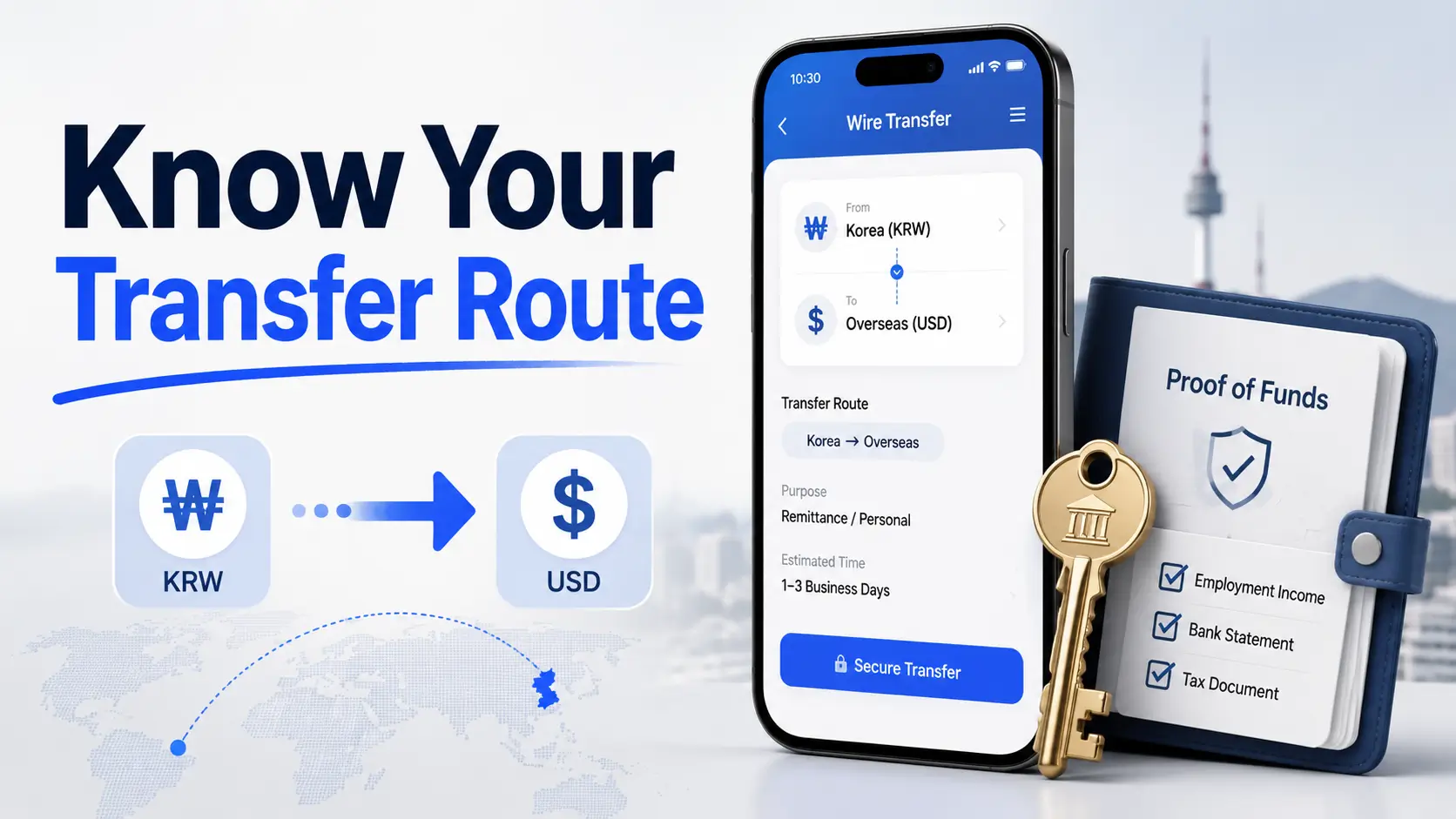
Cross-Border Banking Guide
Korea Wire Transfer Limits for Foreign Residents:
What You Can Actually Send
You have earned the money, paid Korean taxes, and watched it collect quietly in a won account. Then the transfer screen asks for a purpose code, your app shows a smaller limit than expected, and a search result confidently announces that everyone can send USD 100,000. Suddenly, moving your own savings feels like applying for permission to leave the country with your socks.
The useful answer is not one universal ceiling. Foreign residents can encounter different rules depending on nationality, foreign-exchange residence, the source of the money, the transfer purpose, previous remittances, and whether supporting records are available. The familiar USD 50,000 figure usually describes a no-document route for foreigners, not an absolute cap on documented Korean earnings.
This guide separates legal allowances from app limits, reporting thresholds, tax questions, and bank compliance reviews. You will leave with a practical document checklist, a way to compare transfer costs, and a script for obtaining approval before an important payment date starts breathing down your neck.
Know your route
Separate no-document remittances from documented income and capital transactions.
Prepare the proof
Build a clean trail from income records to the money now sitting in your account.
Compare true cost
Judge providers by the dollars received, not a shiny zero-fee label.
The number on a transfer screen is only the front door. Your source-of-funds record is the key. 🔑
Snapshot
For: Foreign employees, teachers, freelancers, retirees, and long-term residents sending money from South Korea. Problem solved: Identifying which transfer route applies and what evidence a bank may request. Next step: Ask an FX desk to classify the transfer before converting or committing the funds.
Table of Contents
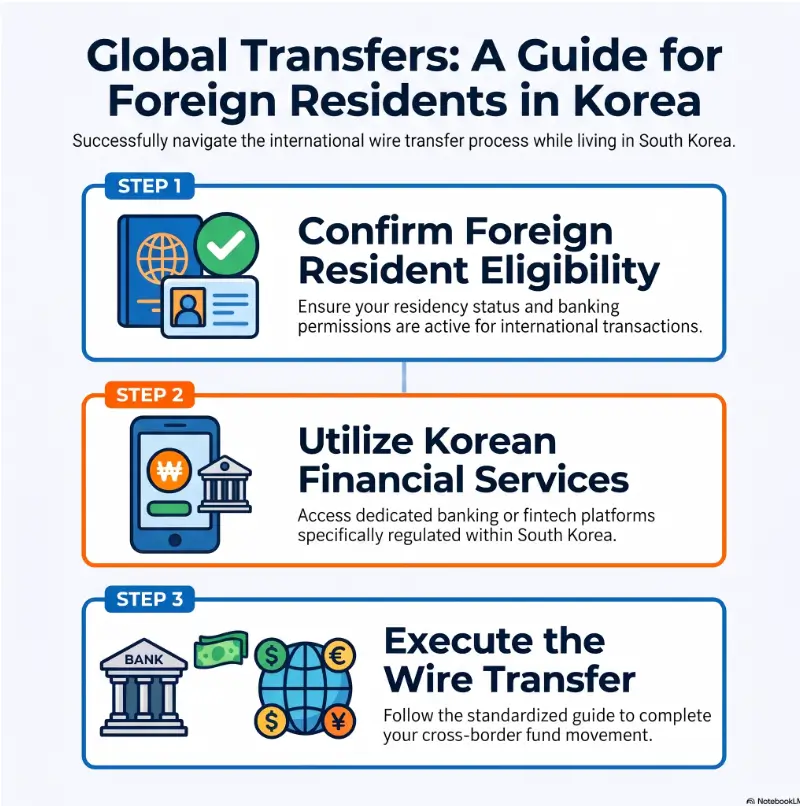
Before You Transfer: The Rule Is Not One Number
Before You Act
This article provides general planning information, not personalized Korean foreign-exchange, tax, or legal advice. Procedures can depend on your nationality, residence classification, income history, payment purpose, bank designation, and destination country. Confirm a large or unusual transfer with a Korean foreign-exchange bank before converting funds, signing a contract, or promising a settlement date.
Start with three separate questions
A wire transfer can pass one test and still pause at another. To avoid confusion, treat the process as three separate questions:
- Is the underlying transaction permitted? Salary, family support, tuition, a loan, a property purchase, and an investment are not interchangeable purposes.
- What foreign-exchange procedure applies? You may need a designated bank, supporting records, a bank report, or a filing with an authority.
- Can your chosen channel process it? A mobile app may have a lower operational cap even when a branch can lawfully handle the transfer.
Korean foreign-exchange rules generally allow ordinary payments when the reason and amount are supported, while some capital transactions and unusual payment methods require additional procedures. Third-party payments and payments that bypass authorized foreign-exchange banks receive particular scrutiny.
Reporting is not the same as prohibition
A bank report to the National Tax Service or Financial Supervisory Service does not automatically mean the transfer is forbidden or that tax is immediately due. Reporting, transaction monitoring, source-of-funds review, and an actual tax assessment are different processes.
The receiving bank can also conduct its own review. A U.S. bank may ask who sent the money, why it was sent, whether the sender and beneficiary are the same person, and how the funds were acquired. Save the Korean documents even after the transfer lands.
Key Takeaway
USD 50,000 is usually a procedural lane, not a universal wall. Documented Korean-earned income may follow a different route from money sent without proof of acquisition.
Which Korea Wire Transfer Limit Applies to You?
The USD 100,000 headline has a nationality footnote
Korean bank guidance describes a general annual no-document remittance allowance of USD 100,000 for residents, but expressly excludes foreign nationals from that category. The same guidance explains that the annual period runs through December 31 of the designated year rather than for 12 months from your first transfer.
That exclusion is why a foreign employee can read a perfectly real USD 100,000 rule online and still be told that a different procedure applies at the branch. The search result is not necessarily false. It may simply be answering a question about Korean nationals rather than foreign residents.
The three practical transfer lanes
| Transfer lane | Typical use | Practical ceiling | Likely preparation |
|---|---|---|---|
| No-document foreigner remittance | Personal funds when acquisition records are not submitted | Commonly described by banks as up to USD 50,000 per calendar year | Passport, bank designation, purpose declaration, prior-transfer check |
| Documented Korean income | Salary, professional income, pension, severance, or eligible benefits earned in Korea | Amount supported by acceptable evidence and bank review | Income, tax, employment, pension, and account records |
| Separately regulated transaction | Overseas investment, real estate, loans, deposits, business payments, or third-party structures | Depends on the transaction and required report or approval | Contracts, filings, professional review, and bank instructions |
Woori Bank’s current English guidance states that a foreigner may remit up to USD 50,000 per year when no acquisition evidence is available after designating the foreign-exchange transaction bank. When evidential documents are available, the bank describes remittance within the supported amount.
Calendar year means January 1 through December 31
The annual counter generally does not follow a rolling 12-month window. A transfer made in November and another made the following February may fall into different calendar years, although the bank will still review the pattern, purpose, and supporting facts.
Key Takeaway
Do not calculate your remaining allowance from the date of your first wire. Ask the bank for your accumulated total for the current calendar year.
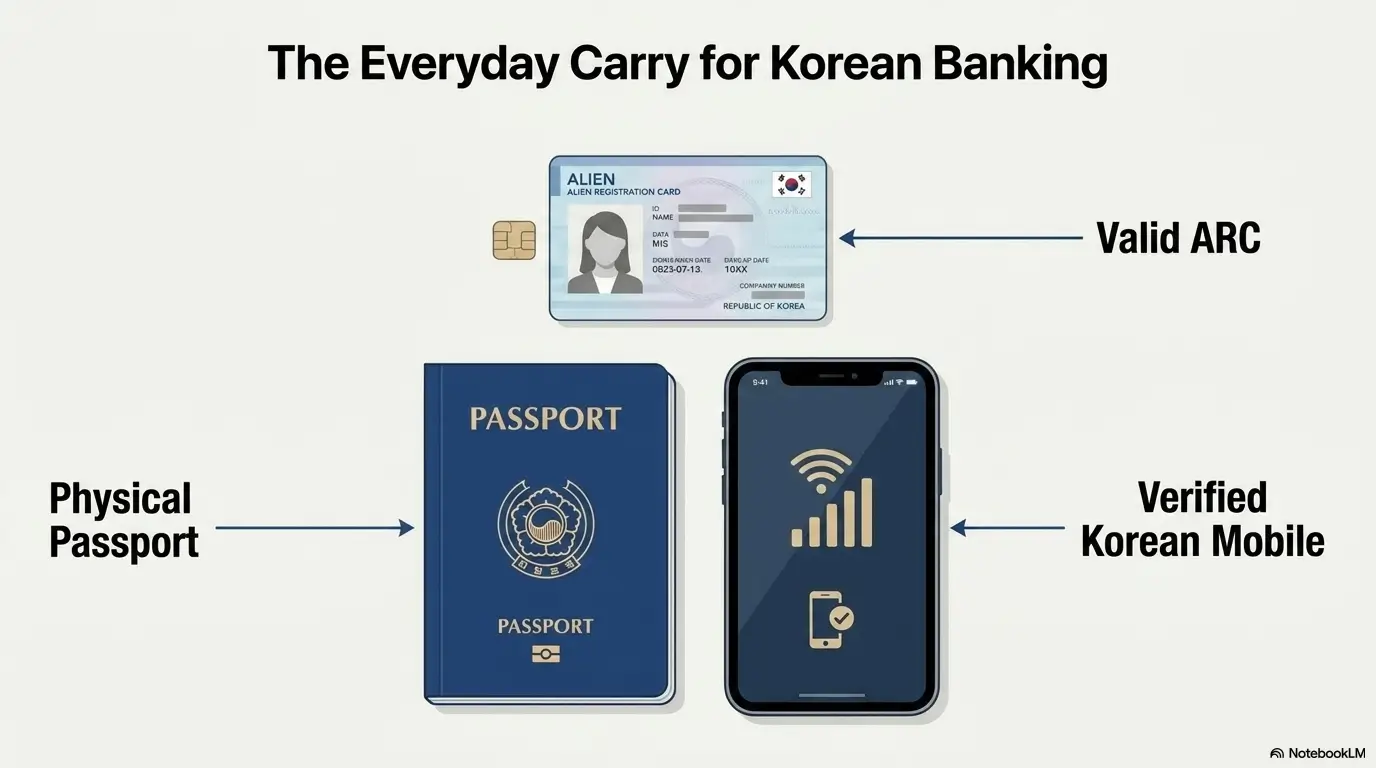
Residency Comes First, but Your Visa Is Not the Whole Answer
Foreign-exchange residency is its own classification
Your immigration status matters, but it is not always the final answer. Korean foreign-exchange residency can consider how long you have stayed, whether you conduct business or earn income in Korea, and whether an exception applies.
A six-month stay is often used as an important starting point for foreign nationals, but categories such as certain diplomats, foreign government personnel, and international-organization staff may receive different treatment. A residence card helps establish identity and lawful stay. It does not, by itself, prove the correct foreign-exchange classification for every transaction.
Your residence card solves identity, not source of funds
A bank can accept that you are the account holder while still asking where the balance came from. This distinction explains many frustrating branch visits: the customer brings a passport and residence card, while the bank is waiting for salary, tax, pension, or sale records.
Name consistency also matters. Before wiring a significant amount, compare your passport, Korean bank profile, residence card, and overseas beneficiary record. The guide to Korean identity verification for foreigners explains why spacing, middle names, and romanization can cause otherwise puzzling account problems.
Ask the bank to state your classification
Do not settle for “you are a foreigner” as the complete explanation. Ask the FX desk to confirm, preferably in writing:
- Whether you are being handled as a resident or nonresident for this transfer
- Which remittance-purpose code applies
- Whether a designated foreign-exchange bank is required
- Whether the transfer is treated as undocumented personal funds, documented income, or a capital transaction
- Which previous remittances are included in the annual total
Show me the nerdy details
A cross-border payment can be reviewed through several legal lenses at once. The bank may check the underlying transaction type, the payment or receipt itself, and the method used to settle it.
That is why a lawful gift may still create a problem if paid through an unrelated third party, and why an ordinary salary transfer may pause if the declared purpose does not match the evidence.
The label on the app is not cosmetic. It connects the transfer to the bank’s reporting and follow-up obligations.
How Documented Salary Can Move Beyond USD 50,000
Evidence, not the app screen, sets the practical ceiling
The Bank of Korea explains that foreigners and nonresidents use a designated bank when remitting qualifying Korean-earned income. Bank guidance also distinguishes unsupported funds from transfers backed by acceptable acquisition or payment evidence.
For a salaried employee, that may allow transfers beyond the familiar USD 50,000 no-document amount. The bank is not simply asking whether you currently possess the money. It is asking whether the records support the amount and the declared reason for moving it abroad.
Documents commonly worth preparing
- Passport and valid Korean residence card
- Employment contract or employer verification letter
- Monthly pay statements or employer-certified payroll summary
- Korean withholding receipt or income certificate
- Tax-payment certificate when requested
- Bank statements showing salary deposits
- Pension, social-insurance, bonus, or severance statements
- Records of previous overseas remittances
- A short explanation of the amount and destination account
A freelancer may need a wider file: service contracts, invoices, client payments, business-registration records where applicable, tax filings, and proof that the deposited money corresponds to declared income. Undeclared cash income is not transformed into documented income merely because it has been sitting in a bank account for several years.
Make the numbers reconcile before the bank tries
Net pay alone may not explain the balance. The bank may need to understand gross income, Korean taxes, bonuses, severance, living expenses, cash withdrawals, investment gains, earlier transfers, and deposits from other people.
| Ledger item | What to record | Why it matters |
|---|---|---|
| Gross Korean income | Salary, bonus, pension, severance, freelance revenue | Establishes the top of the evidence chain |
| Taxes and deductions | Withholding, social insurance, pension contributions | Explains the difference between gross and deposited income |
| Net bank deposits | Salary credits and other verified deposits | Connects records to your account |
| Prior remittances | Bank wires, app transfers, remittance companies | Prevents double counting of the same earnings |
| Current available balance | Amount now held in the sending account | Shows what remains available to transfer |
Real-world example: The teacher with seven years of savings
An American teacher has USD 82,000 equivalent in a Korean account after seven years of work. The mobile app shows a lower annual remittance limit, so she assumes the money cannot be transferred legally.
At the branch, the FX specialist explains that the app is offering a simplified transfer route. Her accumulated salary may be handled differently if she can show employment records, annual income certificates, bank statements, and previous remittances.
The first document package still leaves a gap because two old employers paid bonuses through separate accounts. She adds those statements and a one-page ledger reconciling gross income, taxes, earlier transfers, and the present balance.
The lesson is not that every USD 82,000 transfer will be approved. It is that the correct question is “What evidence supports this amount?” rather than “Which number appeared on the first app screen?”
Why Your Designated FX Bank Becomes the Gatekeeper
Designation creates one compliance home
A designated foreign-exchange bank is the institution registered to manage a particular category of your foreign-exchange transactions. It keeps the relevant records, checks supporting documents, tracks applicable totals, and performs follow-up management.
Bank guidance lists separate designation items for purposes such as a foreigner’s domestic wage or pension payments, overseas living expenses, relocation expenses, investments, deposits, and other capital transactions. If another bank already holds the relevant designation, you may need to change or transfer it before the new bank can process the same category.
A mobile rejection is not always a legal rejection
Automated systems work best when the amount, customer profile, purpose, and evidence fit a standard lane. Large, accumulated, unusual, or mixed-source transfers often need human review.
When an app refuses the transfer, capture the error message and contact the bank’s foreign-exchange desk. Ask whether the issue is:
- A daily authentication or security limit
- A per-transfer online cap
- An unregistered beneficiary
- A missing bank designation
- A regulatory allowance issue
- A source-of-funds or purpose-document problem
- A transaction that must be handled at a branch
Send one precise message before visiting
Copy-and-Send Bank Request
I am a foreign national residing in Korea and want to remit approximately [amount and currency] from my Korean account to [my own account / family member / other recipient] in [country]. The funds come from [salary / pension / severance / savings / gift / sale proceeds]. Please confirm my foreign-exchange residency classification, the correct remittance-purpose code, whether I must designate your bank, my remaining annual no-document allowance, the supporting records required, the online or branch limit, and the expected fees.
The Clean Transfer Path
1. Classify
Confirm resident status, nationality treatment, and payment purpose.
2. Document
Connect income, taxes, deposits, prior wires, and the current balance.
3. Pre-clear
Let the designated FX bank review the route before conversion.
4. Compare
Choose the channel using the final amount received and delivery terms.
Transfer Purpose Changes the Rulebook
Salary, gifts, and family support are not interchangeable
Sending your Korean salary to your own U.S. account is different from gifting money to a parent, lending money to a sibling, or paying another person’s debt. The recipient may be the same bank customer, but the legal and tax character changes.
Choose the purpose that describes what actually happened. Labeling salary as a gift because the app menu looks easier can create a mismatch between the transfer message and your records. A truthful purpose with additional documentation is usually safer than a convenient label that collapses under one follow-up question.
Tuition and overseas living expenses may use dedicated routes
Transfers for an overseas student or dependent can require proof of enrollment, relationship, overseas stay, tuition invoices, or living-expense needs. Do not assume they consume the same allowance as an ordinary personal remittance.
Investments, property, loans, and deposits need an earlier conversation
Overseas securities purchases, foreign real estate, loans to a nonresident, guarantees, overseas deposits, and business payments may be treated as capital transactions or separately classified payments. Some require prior reporting or confirmation before the bank can release the money.
The Bank of Korea notes that capital transactions can require advance procedures and that a payment may not proceed when a required report was not made. It also identifies third-party payments and payments bypassing foreign-exchange banks as methods that can require separate reporting.
Leaving Korea permanently can change the route
A person closing a Korean household, receiving a large severance payment, selling domestic assets, or becoming a nonresident should ask about relocation or asset-removal procedures. Residence-card expiration does not cause your money to evaporate, but it can change the documents and classification the bank uses.
Key Takeaway
The payment purpose should match the real economic event. A cheaper-looking category can become costly when the documents tell a different story.
App Limits, Bank Limits, and the Real Cost of Sending
A provider cap is not your legal allowance
Banks and remittance companies can set their own daily, monthly, per-transfer, and customer-tier limits. Those limits may reflect security settings, identity verification, operational risk, settlement partners, or product design.
Using two apps does not automatically create two legal allowances. Previous transfers can still matter when the bank or provider reviews your annual activity and source of funds.
Key Takeaway
Do not split transfers among banks, apps, coworkers, or family accounts to make the activity less visible. Repeated small wires can still form one reviewable pattern.
Compare channels by fit, not advertising
| Option | Best suited to | Strength | Watch for |
|---|---|---|---|
| Digital remittance service | Routine smaller personal transfers | Convenient pricing display and fast setup | Lower caps, limited document handling, destination restrictions |
| Bank mobile transfer | Standard transfers within an approved profile | Direct access to your bank account | Security caps, beneficiary rules, simplified purpose menus |
| Bank FX branch | Large, documented, accumulated, or unusual transfers | Human document review and classification support | Appointment time, paperwork, variable processing speed |
| Professional-assisted route | Mixed-source wealth, tax issues, property, loans, or business funds | Coordinated bank, tax, and legal preparation | Professional fees and the need to choose qualified advisers |
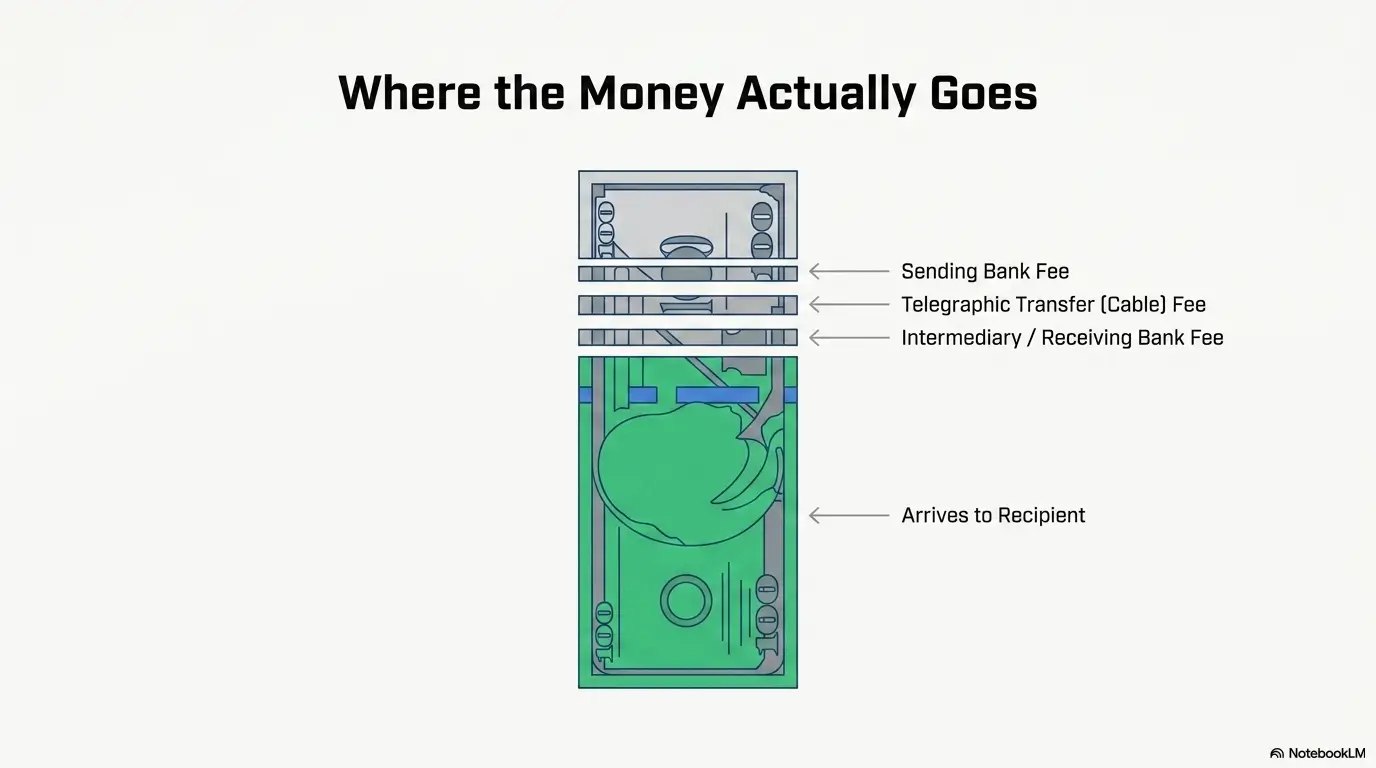
The fee usually hides in at least three places
- Sending charge: The visible bank or provider fee in Korea.
- Exchange-rate spread: The difference between the market reference rate and the customer rate.
- Intermediary or receiving deductions: Charges removed before or after the money reaches the destination account.
A zero-fee transfer can be more expensive than a paid wire when the exchange rate is weaker. Compare the final USD amount expected in the recipient account for the same KRW cost.
Questions to ask before choosing a service
- What exact amount should the recipient receive after all known charges?
- Is the exchange rate locked, estimated, or calculated later?
- Can the provider review salary and tax documents?
- Does it count previous transfers made through other channels?
- What happens if the receiving bank rejects or returns the wire?
- Who absorbs intermediary-bank deductions?
- Can I obtain a formal remittance receipt and SWIFT details?
Mistakes That Delay an Otherwise Lawful Transfer
Small inconsistencies create large pauses
| Common mistake | Why it causes trouble | Safer alternative |
|---|---|---|
| Quoting the USD 100,000 rule without checking nationality | The cited resident category may exclude foreign nationals | Ask which foreigner-specific procedure applies |
| Bringing only a residence card | Identity does not establish how funds were acquired | Bring income, tax, and account records |
| Choosing “gift” for salary | The purpose conflicts with payroll documents | Use the truthful purpose and submit evidence |
| Ignoring previous app transfers | Annual totals may include activity outside the current bank screen | Create a complete transfer ledger |
| Using a friend’s or coworker’s account | The payment can become a third-party transaction | Send through an authorized channel in your own name |
| Converting before approval | You may hold foreign currency while the transfer remains blocked | Obtain the document list and route first |
| Mismatched beneficiary names | The receiving bank may pause or return the wire | Match passport spelling and account ownership records |
Do not break transfers apart to avoid review
Sending repeated smaller amounts “under the radar” can look worse than presenting one well-documented transaction. The same caution applies to rotating among providers, borrowing another person’s account, informal currency swaps, and unregistered intermediaries.
Bank-bypassing methods can interfere with source verification and official monitoring. Korean rules specifically identify payments bypassing foreign-exchange banks and certain third-party payments as methods that may require reporting.
Run a name and SWIFT check before pressing send
- Confirm the beneficiary’s legal name and account number
- Verify the receiving bank’s SWIFT or BIC code
- Check whether an intermediary bank is required
- Use a destination address that matches the receiving account records
- Confirm who pays transfer charges
- Save a screenshot of the purpose and beneficiary information
When Bank, Tax, or Legal Help Is Worth the Cost
Start with a bank FX specialist
A branch FX specialist is often enough for straightforward salary or pension remittances. Contact one early when the transfer involves several years of savings, severance, an approaching departure date, or a destination bank that requires detailed payment instructions.
Use a Korean tax professional when the source is messy
Professional review becomes more valuable when funds include mixed personal and business income, undeclared freelance earnings, gifts, crypto proceeds, old cash deposits, inheritance, business-sale proceeds, or property transactions.
The goal is not to purchase a magical approval stamp. It is to identify missing filings, reconstruct records, and prevent you from making a declaration that conflicts with your tax history.
U.S. citizens should separate the wire from U.S. reporting
Transferring money to the United States is not itself the same as determining U.S. tax liability. U.S. persons may have separate reporting duties for Korean financial accounts, foreign assets, gifts, business ownership, or income.
FinCEN states that a U.S. person generally must file an FBAR when the aggregate value of reportable foreign financial accounts exceeds USD 10,000 at any time during the calendar year. The FBAR obligation is separate from the Korean bank’s transfer review.
DIY, bank review, or professional support?
| Preparation level | Suitable situation | What to do |
|---|---|---|
| Good: DIY file | Recent salary, modest amount, own overseas account, clean records | Prepare identity, payroll, tax, and bank statements |
| Better: Bank pre-review | Large amount, several years of savings, severance, prior providers | Send a ledger and documents to an FX specialist before transfer day |
| Best: Coordinated advice | Property, inheritance, gifts, loans, business funds, crypto, unclear tax history | Coordinate the bank with qualified Korean and destination-country advisers |
FAQ: Korea Wire Transfer Limits for Foreign Residents
What annual period is used for a Korea remittance allowance?
Bank guidance generally calculates the annual amount through December 31 of the relevant calendar year. It is not normally a rolling 12-month period beginning with your first transfer.
Can a foreign resident transfer more than USD 50,000 of Korean salary?
Potentially, yes. The USD 50,000 figure commonly describes a route used when acquisition evidence is not submitted. Documented Korean income may be remitted within the amount supported by acceptable records and the designated bank’s review. Approval is fact-specific.
Can I use two Korean banks to double the limit?
No. Using another bank or provider does not automatically create a separate legal allowance. Designation requirements, previous remittances, and aggregated activity can still affect the review.
Is it easier to send money to my own U.S. account?
Matching ownership can make the purpose easier to explain, but it does not remove Korean source-of-funds requirements, provider limits, or U.S. account-reporting obligations. Make sure the name on both accounts matches your passport record.
What if I am sending money to a spouse or parent?
The bank may request a relationship document and a truthful purpose declaration. A family-support transfer can also create separate Korean or destination-country gift-tax questions depending on the amount and circumstances.
Are limits shown by a remittance app the legal Korean limit?
Not necessarily. An app can impose a lower per-transfer, daily, monthly, or annual product cap. Ask whether a branch or a different documented route is available rather than assuming the app screen states the law.
How do I prove savings accumulated over several years?
Reconstruct a chain using annual income certificates, tax-payment records, employer statements, bank deposits, pension or severance documents, previous overseas wires, and a one-page reconciliation. Explain gaps before the bank has to discover them.
Can I transfer money after my residence card expires?
The funds do not become inaccessible merely because a residence card expires, but departure and residency changes can alter the procedure. Contact the bank before expiration when possible and ask about nonresident, relocation, or domestic-asset-removal requirements.
Your 15-Minute Pre-Transfer Plan
You do not need to solve the entire Korean foreign-exchange system this afternoon. You need to make your transfer easy for an FX specialist to classify.
Do these five things now
- Write down the exact amount, destination country, recipient, and real payment purpose.
- List every overseas transfer made during the current calendar year, including apps and other banks.
- Gather your passport, residence card, latest income certificate, pay records, and relevant bank statements.
- Create a one-page funds ledger showing income, taxes, deposits, previous wires, and the amount remaining.
- Send the pre-transfer message in this guide to your bank’s foreign-exchange desk and request a written document list.
Do this before chasing the best exchange rate. A favorable rate is useful only when the transfer route is ready. The calm order is classification first, documentation second, cost comparison third, and conversion last.
Once the bank confirms the route, compare providers using the dollars expected to arrive, the document support available, delivery timing, return policy, and total fees. That is how a vague “How much can I send?” becomes a transfer plan that survives contact with the teller window.
Last reviewed: 2026-08