
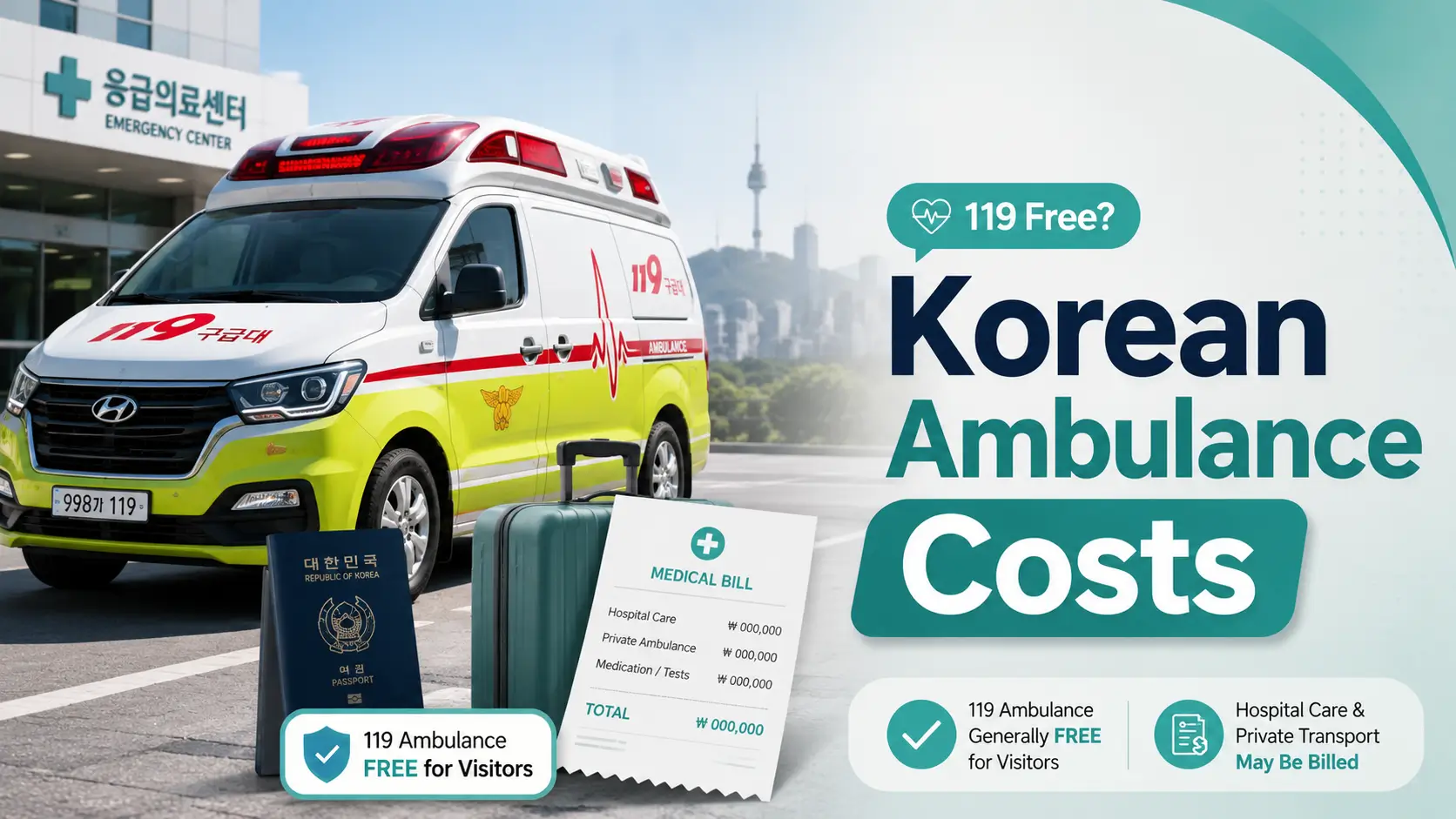
Emergency costs in South Korea
Korean Ambulance Costs for Visitors:
What Is Free, What Is Billed
A medical emergency abroad has two clocks running at once. One measures the patient’s condition. The other quietly counts unfamiliar charges, insurance requirements, translation problems, and documents that may matter weeks later.
In South Korea, the public 119 ambulance system is generally free to use, including for foreign visitors. That reassuring fact comes with an important boundary: the emergency-room examination, tests, treatment, medication, admission, and any private ambulance service are separate financial matters.
This guide separates those moving parts, explains the private-ambulance rate change scheduled for August 2026, and gives you a practical receipt trail for travel-insurance claims. The aim is not to turn an emergency into a spreadsheet. It is to keep the spreadsheet from ambushing you afterward.
Know what is free
Separate a government 119 response from hospital and private-transfer charges.
Use the right fee date
Avoid applying the revised August 2026 schedule to an earlier journey.
Protect your claim
Leave with itemized transport, medical, and payment records.
In a serious emergency, call 119 first. Costs and paperwork belong on the far side of safety. 🚑
Snapshot
This guide is for tourists, business travelers, exchange students, and accompanying family members who need to understand Korean ambulance costs. You will learn when 119 transport is free, when regulated private charges apply, how the August 2026 rate transition works, and which documents to request before leaving the hospital.
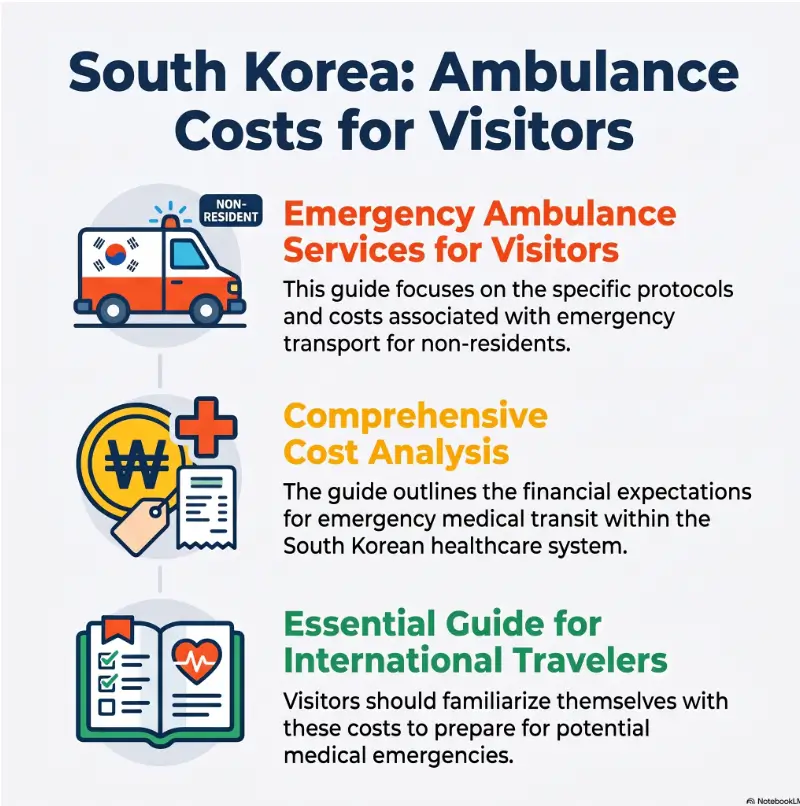
Before You Act: Safety Comes Before the Price List
This article explains general transport charges and visitor logistics. It cannot determine whether an ambulance is medically necessary, which hospital is appropriate, whether a particular insurance policy will pay, or what care an individual patient needs.
Call 119 immediately for unconsciousness, severe breathing difficulty, suspected stroke, chest pain, major trauma, uncontrolled bleeding, seizures, a rapidly worsening allergic reaction, or any condition that appears life-threatening. Do not delay the call while comparing hospitals, checking exchange rates, or seeking insurance authorization.
Before You Act
Use the fee tables for planned transfers, receipt review, and insurance paperwork. During a genuine emergency, describe the symptoms first and let trained responders assess the situation. Confirm important billing and coverage questions with the ambulance operator, hospital, and insurer when the patient is safe.
A taxi is not a bargain ambulance
A taxi may be reasonable for a stable person attending a routine appointment. It is not suitable for someone who may lose consciousness, stop breathing, deteriorate suddenly, require oxygen, or need monitoring during the journey.
The financial difference can feel important in the moment. The medical difference may be far more important. Saving a transport fee is not a win if the patient arrives in worse condition.
Who should confirm costs before booking?
Price confirmation is appropriate when the patient is stable and the transfer is planned. Examples include movement between hospitals, transport to a rehabilitation facility, discharge transport for a person who cannot safely sit in a normal vehicle, or medically supervised travel to another city.
- Ask the treating clinician what level of transport is medically appropriate.
- Ask whether the vehicle is an ordinary or special ambulance.
- Confirm whether the operator is a medical institution, another licensed organization, or a nonprofit entity.
- Request the estimated route, distance rate, surcharge rules, and waiting policy.
- Check whether the insurer requires an assistance-company referral or preauthorization for a planned transfer.
The Free Ride That Can Still Produce a Bill
Public 119 ambulance transport is generally free
Seoul’s official guide for foreign residents states that the 119 ambulance service is free and that foreign callers can be connected to third-party interpretation assistance. The guidance also distinguishes 119 transport from hospital or medical-institution ambulances that charge according to distance. :contentReference[oaicite:0]{index=0}
You do not need Korean National Health Insurance to place an emergency call. From a working mobile phone in Korea, dial 119 without an area code.
The hospital bill begins after the free transport
The word “free” describes the government-operated ambulance service, not the medical episode. An uninsured visitor may still receive charges for emergency registration, physician assessment, laboratory work, imaging, medication, procedures, specialist consultations, observation, surgery, and admission.
That distinction is the hinge of the whole subject: free 119 ambulance transport does not mean free emergency care in Korea.
When paid ambulance transport enters the picture
Hospital ambulances and licensed paid ambulances are commonly used for interfacility transport. Korea’s National Emergency Medical Center describes 119 as responsible for pre-hospital transport, while hospital and paid ambulances are mainly used to move patients between facilities. :contentReference[oaicite:1]{index=1}
A traveler might encounter paid transport after initial stabilization, when a smaller hospital transfers the patient to a center with specialist services, or when the patient needs supervised transportation following discharge.
| Transport situation | Likely service | Typical billing approach |
|---|---|---|
| Medical emergency at a hotel, airport, restaurant, or street | Public 119 ambulance | Generally no ambulance transport charge |
| Urgent transfer ordered between hospitals | Hospital or licensed paid ambulance | Regulated transport charges may apply |
| Stable patient needs stretcher transport after discharge | Licensed paid transport | Confirm vehicle category, route, waiting, and surcharges |
| Routine appointment for a mobile, stable traveler | Taxi or accessible transport may be considered | Discuss medical suitability before choosing |
Key takeaway
Identify the operator before interpreting the price. A vehicle marked as an ambulance may belong to the fire service, a hospital, a nonprofit entity, or a licensed private transport business.
The Date Trap: Which Fee Schedule Applies?
Korea announced a revised ambulance transport-fee structure in July 2026. The broader regulation was promulgated on July 13, 2026, but the Ministry of Health and Welfare stated that the revised transport fees would begin one month later to allow time for operational preparation. :contentReference[oaicite:2]{index=2}
Transport through August 12, 2026: use the previous rates
For a paid ambulance journey beginning on or before August 12, 2026, the earlier schedule remains the relevant starting point. That schedule had been in place since 2014 and included lower base and per-kilometer charges, a limited midnight surcharge period, and an additional professional-crew fee for ordinary ambulances.
Transport from August 13, 2026: use the revised rates
For transport beginning from August 13, 2026, the revised schedule is expected to apply. It raises base and distance rates, removes the old separate professional-crew charge for ordinary ambulances, expands surcharge periods, and introduces a waiting charge after a hospital handoff delay.
Which fee table should you use?
1. Check the service
Was it public 119 transport or a paid hospital/private ambulance?
2. Check the start date
Through August 12, use the previous schedule. From August 13, use the revised schedule.
3. Check the category
Match ordinary or special ambulance and the operator type shown on the receipt.
4. Reconcile the extras
Review distance, time surcharge, holiday status, and any billable waiting period.
Why two believable websites may show different prices
An older page may accurately show the pre-August schedule. A February 2026 article may accurately describe the proposed schedule but give an anticipated implementation date that later changed. A newly published page may quote the revised numbers without explaining that they were not effective on July 13 itself.
The useful question is not merely, “What are Korean ambulance prices?” It is, “What fee schedule applied on the date this paid transport began?”
Korean Private Ambulance Rates at a Glance
Previous schedule through August 12, 2026
The following figures apply to regulated paid transport rather than public 119 ambulance service. “Medical institutions and similar operators” and “nonprofit operators” use different rate columns.
| Ambulance type | Operator | First 10 km | Each km over 10 | Old ordinary-ambulance crew fee |
|---|---|---|---|---|
| Ordinary | Medical institution or similar operator | ₩30,000 | ₩1,000 | ₩15,000 when an eligible medical professional rode with the patient |
| Ordinary | Nonprofit operator | ₩20,000 | ₩800 | ₩10,000 when an eligible medical professional rode with the patient |
| Special | Medical institution or similar operator | ₩75,000 | ₩1,300 | Not listed as a separate ordinary-ambulance crew fee |
| Special | Nonprofit operator | ₩50,000 | ₩1,000 | Not listed as a separate ordinary-ambulance crew fee |
Under the earlier schedule, a 20% nighttime surcharge applied to the base and distance components for use between midnight and 4:00 a.m. A separate waiting fee was not part of this older schedule.
Revised schedule from August 13, 2026
| Ambulance type | Operator | First 10 km | Each km over 10 |
|---|---|---|---|
| Ordinary | Medical institution or similar operator | ₩40,000 | ₩1,500 |
| Ordinary | Nonprofit operator | ₩26,600 | ₩1,000 |
| Special | Medical institution or similar operator | ₩95,500 | ₩2,300 |
| Special | Nonprofit operator | ₩63,600 | ₩1,500 |
The revised figures and fee components were detailed during the rulemaking process, including the ₩6,000 waiting charge for each qualifying 10-minute period after the first 30 minutes at the receiving institution. :contentReference[oaicite:3]{index=3}
Night, weekend, holiday, and waiting charges
- Weekday nighttime: A 20% surcharge applies to the base and additional-distance charges for qualifying transport between 6:00 p.m. and 9:00 a.m.
- Saturday and public-holiday transport: A 20% surcharge applies to the base and additional-distance charges under the revised structure.
- Waiting: After the vehicle has been at the receiving institution for more than 30 minutes, a charge of ₩6,000 may be calculated in 10-minute units.
- Old ordinary-ambulance crew add-on: The separate professional-crew charge used under the previous schedule is removed from the revised structure.
For a journey that falls into more than one timing category, ask the operator to show exactly how the applicable surcharge was calculated. Do not assume that percentages stack, or that the waiting charge itself receives the same percentage adjustment.
Key takeaway
The quoted “base price” is not necessarily the final private-ambulance cost. Distance over 10 km, timing, holiday status, and a delayed hospital handoff may change the total.
How to Calculate a Private Ambulance Bill
Ordinary ambulance example: an 18 km daytime transfer
Suppose a stable patient is transferred 18 km in an ordinary ambulance operated by a medical institution after the revised schedule begins.
- Base charge covering the first 10 km: ₩40,000
- Distance beyond 10 km: 8 km
- Additional distance: 8 × ₩1,500 = ₩12,000
- Daytime weekday total with no waiting charge: ₩52,000
If the same transport qualifies for one 20% surcharge, the surcharge on ₩52,000 would be ₩10,400, producing a transport subtotal of ₩62,400.
Special ambulance example: monitoring changes the category
Now suppose the treating team determines that the patient needs the equipment or monitoring associated with a special ambulance. For an 18 km journey operated by a medical institution:
- Base charge: ₩95,500
- Eight additional kilometers: 8 × ₩2,300 = ₩18,400
- Daytime weekday subtotal: ₩113,900
The difference is not simply an upgrade chosen for comfort. Ambulance classification should reflect the patient’s condition, required equipment, and clinical transport needs. Ask the hospital or operator to document why that category was used, particularly when an insurer will review medical necessity.
Waiting example: when the hospital handoff runs long
Imagine the ordinary-ambulance example above arrives at the hospital, but the vehicle cannot complete the patient handoff for 50 minutes. The first 30 minutes are not billed as waiting under the revised rule. The remaining 20 minutes may create two 10-minute units:
2 × ₩6,000 = ₩12,000 waiting charge.
If the transport subtotal was ₩62,400 after one timing surcharge, adding ₩12,000 would produce a worked-example total of ₩74,400.
Show me the nerdy details
Basic revised formula: base charge + kilometers beyond 10 × category rate + applicable percentage surcharge + qualifying waiting units.
The receipt should allow you to trace the calculation backward. Confirm the ambulance category, operator category, transport distance, pickup time, day classification, arrival time, handoff time, and final paid amount.
A quotation can differ from the final charge if the destination changes, the route becomes longer, a timing surcharge begins, or hospital handoff takes longer than expected. Ask whether an estimate is fixed or provisional before a planned transfer.
The four-number receipt check
- Ambulance type: ordinary or special
- Transport distance: total distance used for the calculation and kilometers beyond 10
- Timing: pickup date and time supporting any night or holiday surcharge
- Waiting duration: arrival, handoff, and billable 10-minute units
The Hospital Bill Is a Separate Financial Animal
Emergency transport and emergency treatment are different bills
The ambulance transports the patient. The hospital evaluates and treats the patient. Even when the ride was a free 119 response, an uninsured visitor may be billed directly for the hospital services that follow.
The final amount can vary widely because a brief assessment for a minor injury is financially different from CT imaging, specialist consultation, emergency surgery, intensive monitoring, or several days of admission. A single average price is rarely useful without knowing what care occurred.
What to ask when the hospital requests payment
- Is the requested amount a deposit, estimated charge, or final bill?
- Will unused deposit funds be refunded automatically?
- Can the hospital contact the travel insurer or assistance company?
- Is an international patient coordinator or interpreter available?
- Can you receive an English itemized statement and medical report?
- Which payment methods are accepted, and will a final paid receipt be issued?
For a broader explanation of registration, deposits, ward logistics, and discharge documents, see this guide to hospital admission in Korea. Travelers concerned about communication can also review medical translation options in Korea.
International clinic versus emergency department
An international clinic or international patient center can be extremely helpful for translation, appointments, payment coordination, and document requests. It does not replace the emergency department when symptoms require immediate assessment.
During normal business hours, the international center may smooth the administrative edges. At night or during a serious emergency, the clinical pathway usually begins in the emergency department, with language and billing help added around it.
Documents worth requesting before discharge
| Document | Why it matters |
|---|---|
| Itemized hospital statement | Shows tests, procedures, medication, and facility charges |
| Medical report or physician summary | Explains symptoms, diagnosis, treatment, and medical necessity |
| Final paid receipt | Proves that payment was completed rather than merely requested |
| Prescription and medication record | Supports continuity of care and reimbursement |
| Ambulance receipt | Separates transport charges from hospital treatment |
| Imaging or test records when relevant | Helps a home-country physician continue care |
Key takeaway
Ask for documents while you are physically at the hospital. Reconstructing an itemized file across time zones is possible, but it has the charm of assembling furniture after losing half the screws.
Calling 119 in English When Seconds Matter
Begin with “English please” or “Interpreter please”
Korea Tourism Organization guidance advises non-Korean speakers to say “English please” or “Interpreter please” after the emergency call connects. The operator can connect the caller with professional interpretation support. :contentReference[oaicite:4]{index=4}
Do not spend the first minute apologizing for your Korean or narrating the entire day. Start with the location and the immediate medical problem.
A simple 119 call structure
Emergency call script
“English please. Ambulance. We are at [hotel, building, subway exit, street address, floor, or room]. The patient is [age] and has [main symptom]. They are conscious or unconscious and breathing or not breathing. My callback number is [number].”
When possible, give the Korean name of the hotel or building from a booking confirmation or map app. A subway station name alone may be too broad, so add the exit number, nearby shop, floor, or entrance.
Can you request a particular hospital?
You can tell the crew about a relevant hospital relationship, specialist, or previous treatment. However, 119 generally selects an appropriate receiving facility based on the patient’s condition, proximity, treatment capability, and practical availability.
A preferred hospital may not be the safest or available destination. In a time-sensitive emergency, medical suitability outranks brand familiarity.
Prepare while help is coming
Korea’s National Fire Agency recommends preparing identification, a passport or insurance card, payment means, regularly used medication, and basic necessities when doing so does not interfere with first aid. It also advises telling responders about the patient’s condition, changes, medical history, treatment already given, and current medication. :contentReference[oaicite:5]{index=5}
- Send someone to guide the crew from the entrance if the location is difficult to find.
- Unlock doors and secure pets where practical.
- Collect the patient’s passport or identification.
- Bring medication containers or a clear medication list.
- Note allergies, chronic conditions, and recent procedures.
- Take the phone and charger, but do not delay departure to pack luggage.
The Paper Trail That Protects an Insurance Claim
Contact the assistance line when it is safely possible
Many travel-insurance policies distinguish between emergency care and planned transport. Emergency treatment should not be delayed while a traveler waits on hold. Once the patient is stable, contact the insurer or assistance company and record the claim number, representative’s name, time of call, and instructions received.
For a scheduled hospital transfer, the insurer may want prior approval, a physician’s recommendation, or use of an approved transport provider. Review the policy’s emergency medical transportation and evacuation language rather than relying on the word “ambulance” in a benefits summary.
A broader overview of policy limits, exclusions, and medical-expense protection is available in this guide to travel insurance for South Korea.
What an itemized ambulance receipt should show
- Patient’s full name
- Date and time of transport
- Provider or operator name and contact information
- Ordinary or special ambulance category
- Pickup and destination details
- Distance used for billing
- Base, distance, surcharge, and waiting components
- Total amount and payment status
Match the medical record to the reason for transport
An invoice proves that a service was charged. It does not always prove why that service was medically necessary. Insurers may also look for a physician’s note, transfer order, emergency record, diagnosis, or symptom description supporting ambulance use.
For example, “transport to another hospital” is less informative than documentation explaining that the patient required monitoring, oxygen, a stretcher, specialist treatment, or movement to a facility capable of providing a necessary procedure.
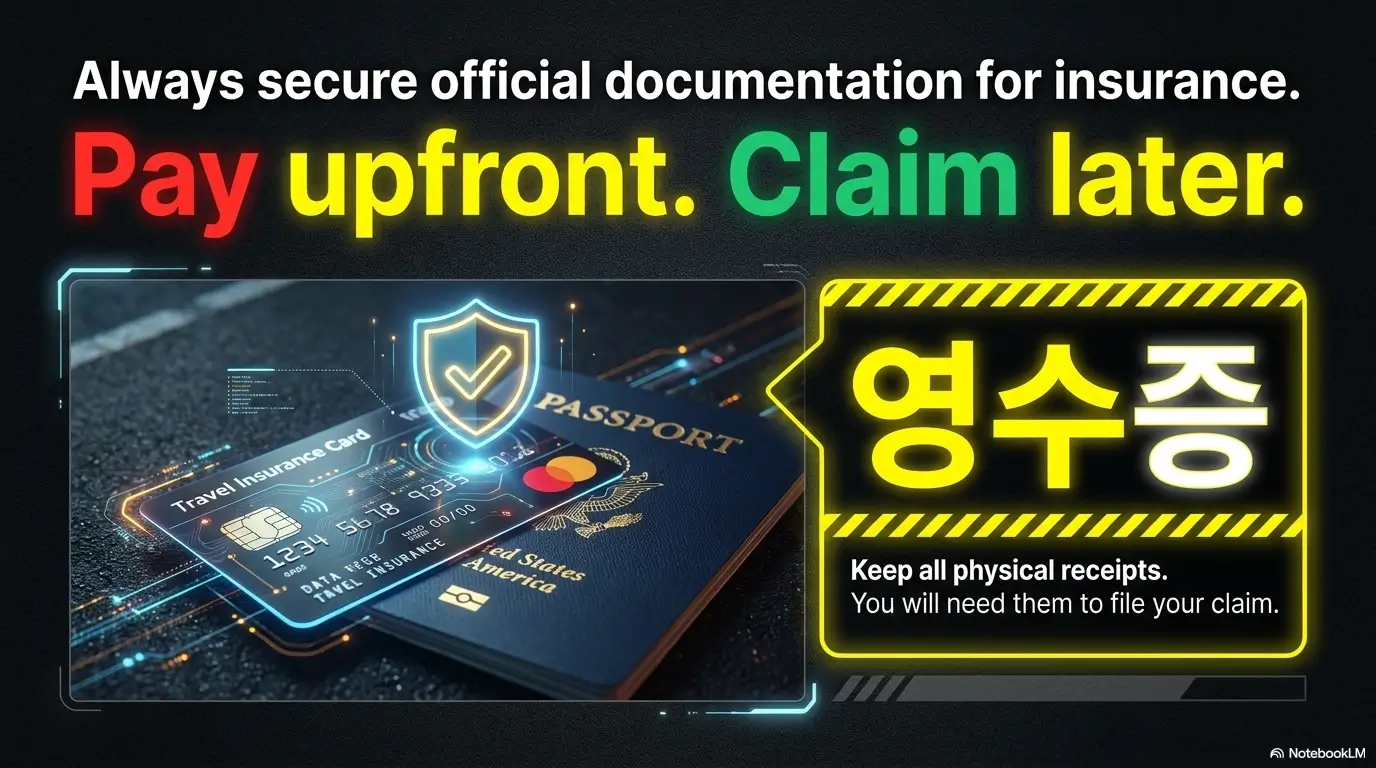
Keep proof of payment, not merely proof of price
An invoice, estimate, card authorization, and final paid receipt are not interchangeable. Ask for a document showing that the charge was settled and retain the card statement or cash receipt as secondary evidence.
Five-minute claim folder
- Photograph every page before handing documents to another person.
- Save the ambulance and hospital bills as separate files.
- Add a photo of the passport identification page.
- Save the policy certificate and assistance-company messages.
- Name files by date, patient, and document type.
Mistakes That Inflate Costs or Weaken Claims
| Common mistake | Safer alternative |
|---|---|
| Assuming every Korean ambulance is the free 119 service | Identify the fire service, hospital, nonprofit, or paid operator |
| Asking about price before describing dangerous symptoms | Give the location and symptoms first during an emergency |
| Accepting a verbal lump-sum quote for planned transport | Request category, distance, surcharge, waiting, and receipt details |
| Using the revised rate table for a journey before August 13, 2026 | Match the schedule to the transport start date |
| Treating the ambulance receipt as the full medical bill | Track transport and hospital treatment separately |
| Leaving with only a credit-card slip | Request itemized invoices plus final paid receipts |
| Assuming travel insurance automatically covers every ambulance | Check medical necessity, exclusions, deductibles, and authorization rules |
Do not price-shop during a true emergency
Calling several hospitals or private operators while a patient has stroke symptoms, serious trauma, breathing difficulty, or altered consciousness burns the one resource nobody can refund: time.
Use cost comparison for planned, stable transport. Use 119 for an unfolding emergency.
What to ask before paying for planned transport
- Which ambulance category has the clinician requested?
- Who operates the vehicle, and which rate category applies?
- How many kilometers are included in the estimate?
- Could a night, Saturday, Sunday, or public-holiday surcharge apply?
- When does waiting time begin, and how is it measured?
- Is the quotation fixed or subject to route and handoff changes?
- Will the provider issue an itemized receipt in the patient’s name?
- Can the provider supply records required by the insurer?
Good, better, best preparation for visitors
| Preparation level | What it includes | Best suited to |
|---|---|---|
| Good | Save 119, hotel address in Korean, passport photo, and insurer number | Healthy short-term tourists |
| Better | Add medication list, allergies, policy certificate, and a translated emergency note | Families, students, and travelers taking regular medication |
| Best | Confirm assistance procedures, nearby emergency facilities, specialist needs, and medical-transport limits before travel | Travelers with complex conditions or recent treatment |
Key takeaway
The best way to avoid wasting money is not to choose the cheapest ambulance. It is to use the medically appropriate service, confirm the regulated calculation, and collect documents that explain both the charge and the need.
Frequently Asked Questions
Is the Korean 119 ambulance free for American and British tourists?
The government-operated 119 ambulance service is generally free, including for foreign visitors. Emergency-room treatment, tests, medication, admission, and later private or hospital ambulance transfers are billed separately.
Can I call 119 without a Korean phone number?
You can dial 119 from a working mobile phone in Korea without entering an area code. Give your precise location, a callback number, and the patient’s main symptom as early as possible.
Will the 119 operator speak English?
Interpretation assistance is available. Say “English please” or “Interpreter please” when the call connects, then give the location and medical problem in short, plain sentences.
Can I choose which Seoul hospital the ambulance takes me to?
You may mention a relevant hospital or specialist relationship, but the destination is generally selected according to the patient’s condition, treatment needs, proximity, and facility availability. The nearest building with the word “hospital” on it is not necessarily the right destination.
How much does a private ambulance cost in Korea?
The amount depends on the service date, ambulance category, operator category, distance beyond 10 km, timing surcharge, and qualifying waiting. From August 13, 2026, revised base charges range from ₩26,600 for a nonprofit ordinary ambulance to ₩95,500 for a special ambulance operated by a medical institution, before added distance or surcharges.
Does travel insurance automatically cover Korean ambulance transport?
No. Coverage can depend on medical necessity, emergency status, policy exclusions, deductible or excess rules, benefit limits, preauthorization requirements for planned transfers, and the quality of the documentation submitted.
Can a hotel arrange an ambulance?
Hotel staff can call 119 during an emergency and help communicate the address. For a stable guest needing planned medical transport, the hotel may help contact a hospital or licensed transport provider, but the patient or companion should still confirm the vehicle category and fee structure.
What should I do if a private ambulance charge looks incorrect?
Request the itemized calculation and compare the ambulance type, operator category, transport date, distance, surcharge, and waiting duration with the applicable schedule. Keep the invoice and payment evidence, contact the operator for clarification, and ask the insurer or an appropriate Korean authority for help if the discrepancy remains unresolved.
Save a 60-Second Korea Emergency Card
You do not need a thick emergency binder or a color-coded command center. A single offline phone note can remove several sharp edges from a difficult moment.
Put these five essentials in one note
- Emergency number: 119
- Accommodation address: English and Korean versions, including room or unit
- Patient basics: full name, date of birth, nationality, and passport number
- Medical details: allergies, medication, chronic conditions, and recent procedures
- Insurance contact: policy number and 24-hour assistance number
Add the call script and save it offline
Copy this sentence beneath the details: “English please. Ambulance. We are at [location]. The patient is [age] and has [main symptom]. They are conscious or unconscious and breathing or not breathing.”
Take a screenshot so the card remains available without mobile data, hotel Wi-Fi, or a functioning map app. Share it with a travel companion. This takes less than 15 minutes and may be the most useful document you never planned to open.
Last reviewed: 2026-08