

A pre-deposit guide for US medical travelers
Korean Plastic Surgery Insurance Risks: What US Travelers Miss
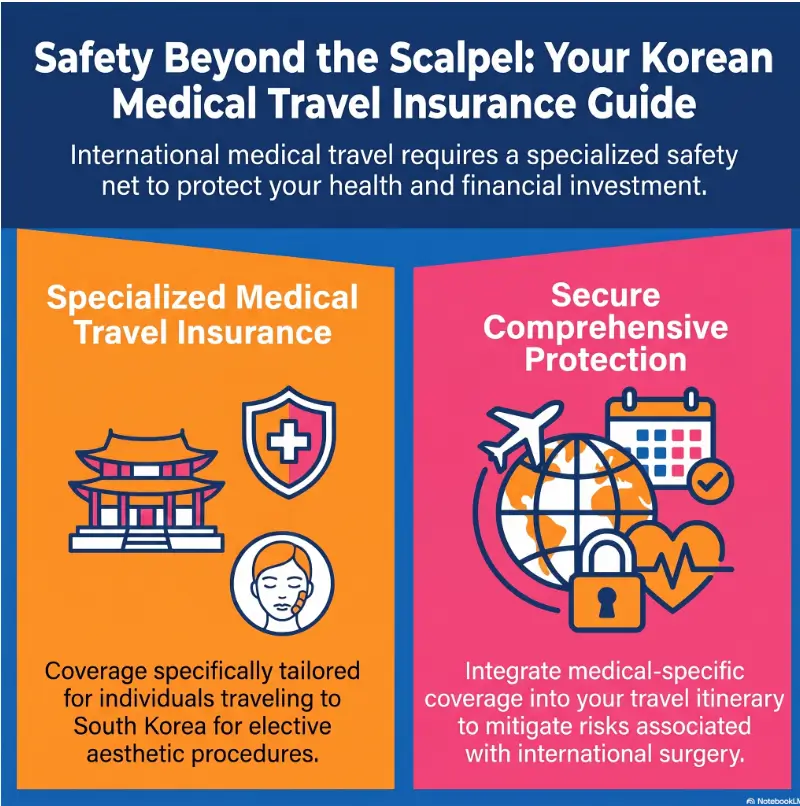
A Korean cosmetic-surgery quote can look wonderfully tidy: procedure, hotel, airport transfer, perhaps a recovery coordinator with excellent English and a soothing KakaoTalk profile photo. Insurance is rarely as tidy. The moment a complication crosses from the clinic into another hospital, an airline rebooking desk, or a US emergency room, several different contracts may begin pointing at one another.
Ordinary US health insurance, travel medical insurance, evacuation coverage, clinic liability insurance, and special complication coverage solve different problems. A policy that covers an unexpected illness in Seoul may still exclude treatment connected to the cosmetic operation you planned before departure. A clinic that says it is insured may be describing protection for the business, not a personal benefit payable to you.
This guide helps you separate those layers before money changes hands. You will learn what to ask an insurer, how to read a clinic guarantee, which recovery costs commonly sit outside the package, and how to preserve evidence if something goes wrong after you return home.
Spot exclusions
Find the words that can separate a covered emergency from an excluded surgical complication.
Compare real protection
Distinguish insurance from warranties, revision promises, concierge assistance, and marketing language.
Protect your return home
Plan for delayed flights, extended lodging, US follow-up care, records, and cross-border claims.
The safest question is not “Am I covered in Korea?” It is “What pays when my planned surgery causes the bill?” 🧾
Snapshot
Who this is for: US adults comparing elective cosmetic surgery in South Korea, particularly travelers combining surgery with hotels, flights, financing, or tourism. What it solves: confusion about which insurance layer might pay for complications, evacuation, revisions, and US aftercare. What you can do next: send one precise written coverage request before paying a clinic deposit.
Before You Act
This article offers general medical-travel, insurance, and documentation guidance. It cannot interpret your personal policy, determine whether a treatment is medically appropriate, or predict the result of a claim or dispute. Confirm procedure risks with qualified clinicians, obtain coverage answers from the insurer in writing, and seek legal advice when contract language, consent, injury, or jurisdiction is disputed.
Table of Contents
Who This Guide Protects, and Who Should Pause the Trip
Medical tourism is not automatically reckless, and South Korea is not automatically unsafe. The useful question is whether your medical plan, insurance plan, recovery plan, and financial backup plan still work when events stop following the glossy itinerary.
The CDC advises medical travelers to consider infection risk, quality and accreditation differences, communication problems, continuity of care, and the challenges of receiving follow-up treatment after returning home. Cosmetic surgery is among the common reasons US residents travel internationally for medical care.
Best for patients comparing clinics, packages, and financing
This guide is particularly useful while you are still comparing quotations. That is the moment when you have bargaining power, time to request documents, and the freedom to walk away from vague answers.
Read it before paying a nonrefundable deposit, arranging medical financing, or booking flights that cannot be changed. Once the calendar is crowded with surgery dates and hotel reservations, optimism begins doing unpaid administrative work.
Especially relevant when surgery and tourism share one itinerary
A vacation policy may be designed for an unexpected stomach illness, a broken ankle, lost luggage, or trip cancellation. Your trip has a planned medical event at its center. That distinction can affect medical, cancellation, interruption, and evacuation benefits.
Be candid when requesting quotations. Describing the trip as an ordinary vacation while intending to undergo surgery can create a coverage dispute and, in serious cases, an allegation that material information was withheld.
Pause when your safety plan depends on assumptions
- You are relying on a verbal assurance from a coordinator, broker, or customer-service agent.
- You cannot identify who pays for an unexpected hospital admission.
- You need specialist care for a health condition that has not been coordinated with the Korean surgeon.
- You could not afford several extra hotel nights, a changed flight, or an uncovered medical deposit.
- You have not arranged a realistic follow-up option in the United States.
- You do not know the full name of the surgeon, anesthesia provider, and operating facility.
Pausing does not necessarily mean canceling. It means replacing a soft promise with a document, a named person, a phone number, or a funded contingency.
For a broader view of clinic research, language support, and practical appointments, read this guide to choosing Korean beauty clinics as a foreign visitor.
Key takeaway
A bargain procedure is not financially low-risk unless you can also absorb the cost of a complication, delayed departure, and follow-up care that no policy accepts.
Four Insurance Layers That Look Similar Until a Claim Arrives
The word “insurance” creates a comforting blur. Clear the fog by asking which contract pays which bill, under which trigger, and for whose benefit.
| Coverage layer | What it may be designed to cover | The question that exposes the gap |
|---|---|---|
| US health insurance | Domestic care and, in some plans, limited overseas emergencies or reimbursement | Does it cover care caused by a procedure deliberately performed outside the United States? |
| Travel medical insurance | Unexpected illness or injury occurring during a covered trip | Are complications of elective, planned, or cosmetic treatment excluded? |
| Medical evacuation coverage | Transport to an appropriate medical facility when policy conditions are met | Who decides evacuation is medically necessary, and is a surgery-related event eligible? |
| Clinic liability or complication arrangement | Provider liability, certain defined complications, or a clinic-funded revision promise | Is the patient a beneficiary, claimant, or merely the recipient of a limited clinic warranty? |
US health insurance: overseas emergency care is not the same as elective-procedure coverage
Some US health plans provide no routine overseas coverage. Others may reimburse limited emergency treatment outside the country, frequently subject to deductibles, network rules, documentation requirements, or a requirement to pay first and claim later.
Even when overseas emergency treatment is generally eligible, the plan may exclude cosmetic surgery and services resulting from excluded treatment. Your question must therefore connect the complication to the planned operation rather than asking only whether “emergencies abroad” are covered.
Travel medical insurance: the trip may be covered while the reason for treatment is not
Travel insurance policies vary widely. Industry consumer guidance recommends examining both included benefits and exclusions, including policy-specific conditions that can limit medical claims. Travel disruption, travel health, and medical evacuation coverage are separate benefits even when sold together.
A traveler who develops appendicitis may present a different coverage question from a traveler hospitalized for bleeding after a planned facelift. Both are medical emergencies. Only one is directly connected to a deliberately scheduled procedure.
Medical evacuation: transportation is separate from treatment
Evacuation coverage is often misunderstood as a private aircraft waiting beside the runway. In practice, the insurer or assistance company may require medical necessity, approval, coordination, and transport to a facility it considers appropriate.
The benefit may not give you the right to choose immediate transport to your preferred US hospital. It may also exclude a condition connected to an excluded procedure even when the transportation itself is medically sensible.
Clinic insurance and complication coverage: similar labels, different beneficiaries
A malpractice or professional-liability policy generally protects an insured provider against covered legal liability. It is not necessarily a first-party health policy that pays your hospital bill as soon as a complication occurs.
A separate complication plan may offer defined benefits, but the definitions matter. Confirm eligible procedures, waiting periods, benefit limits, treatment locations, claim deadlines, excluded conditions, and whether the plan pays the hospital directly or reimburses you later.
The Planned-Surgery Exclusion Hiding in Plain Sight
Insurance disagreements frequently turn on ordinary-looking words. “Elective,” “planned,” “foreseeable,” “cosmetic,” “medical tourism,” and “treatment-related” can carry more financial weight than the front-page benefit limit.
Why “elective,” “planned,” and “foreseeable” can decide the claim
An elective procedure is scheduled rather than performed as an immediate emergency. That does not mean it is medically trivial, but it can place the procedure outside the purpose of ordinary travel coverage.
A complication may also be treated as arising from the excluded procedure. The insurer may examine causation rather than the dramatic appearance of the event. A severe infection can be an emergency and still be denied if the policy excludes emergencies resulting from planned cosmetic treatment.
An unrelated emergency and a surgical complication may follow different rules
Suppose you undergo rhinoplasty and later fracture your wrist in a traffic accident. The wrist injury may be evaluated as an unexpected travel injury. Now suppose you develop postoperative bleeding and require admission. The second claim is more likely to be examined through cosmetic-treatment and planned-procedure exclusions.
Do not try to simplify the claim by omitting the operation. Accurate medical history is essential for treatment and insurance review. Incomplete information can delay care, complicate reimbursement, and damage credibility.
Written preauthorization helps, but only within its stated boundaries
A written response can establish what you asked and how the insurer answered. It does not rewrite the entire policy unless the response has legal effect under the contract and applicable law.
Request policy-page references and ask the representative to address the named procedure. “Your plan includes international emergencies” is weaker than “Page 42 does not exclude hospitalization medically necessary because of complications from the planned blepharoplasty described in the attached treatment plan.”
Show me the nerdy details
A useful coverage analysis separates five issues: insuring clause, definitions, exclusions, conditions, and benefit limits.
The insuring clause states the broad promise. Definitions decide what words such as “emergency,” “medically necessary,” or “covered trip” mean. Exclusions remove categories of loss. Conditions describe duties such as preauthorization, timely notice, and document submission. Benefit limits cap what remains.
A large medical limit is therefore not the first number to inspect. A $500,000 headline benefit can be irrelevant when the event sits inside an elective-surgery exclusion.

The Clinic Says It Is Insured. Insured for What?
“Our clinic is fully insured” sounds reassuring because it is short. Insurance contracts are long because the short version leaves out the machinery.
Identify the insured party, insurer, policy period, and limit
Ask the clinic or facilitator to provide a current certificate or written coverage summary that identifies the legal clinic entity, named surgeon, operating facility, insurer, policy period, and applicable limit.
A certificate can be useful evidence that a policy exists, but it normally does not contain every exclusion, condition, or claims rule. Treat it as the front label, not the full ingredient list.
Confirm that the surgeon and operating facility are both covered
The clinic brand, legal business, surgeon, anesthesiologist, and hospital or operating center may not be the same entity. A beautifully branded consultation office does not tell you who performs the surgery or who bears responsibility for anesthesia and postoperative monitoring.
- What is the surgeon’s full legal name and professional role?
- At which licensed facility will the operation occur?
- Who employs or contracts with the anesthesia provider?
- Which entity receives your payment?
- Which entity signs the treatment agreement?
- Which policy applies to each of those parties?
Ask whether an international patient can make a direct claim
A liability policy may respond only after negligence is alleged, investigated, negotiated, or established. It may not pay an immediate medical deposit. Ask whether you have direct rights, whether the clinic must submit the claim, and whether treatment costs are advanced or reimbursed.
Also request the claims contact, required language, notice deadline, and governing jurisdiction. A promise to “take care of everything” is not a claims procedure.
Separate the revision warranty from actual insurance
A “free revision” policy may cover only the surgeon’s fee. It may exclude anesthesia, operating-room charges, implants, medicines, testing, travel, accommodation, lost wages, and treatment by another surgeon.
It may also apply only to a defined technical issue, not dissatisfaction with appearance, ordinary asymmetry, scarring, healing differences, or a result the surgeon considers medically acceptable.
Key takeaway
Provider liability insurance, a clinic-funded guarantee, and personal complication coverage are three different financial instruments. Ask for each one by name.
The Package-Deal Gap Between Surgery, Hotel, and Recovery
Medical-tourism packages are convenient because they join several moving parts. The risk is that the package looks like one purchase while the legal and financial obligations remain scattered among several companies.
Which company holds your deposit?
Your payment may go to the clinic, a facilitator, a travel agency, a foreign-patient coordinator, or a payment processor. Identify the recipient on the invoice and confirm who owes a refund if surgery is canceled.
Ask what happens if the surgeon becomes unavailable, the medical assessment changes after arrival, the facility changes, or you decide not to proceed because the proposed operation differs from the quotation.
What happens when recovery takes ten days longer than planned?
Extra hotel nights, nursing visits, meals, transportation, companion expenses, changed flights, and missed work may not qualify as medical expenses. Even trip-interruption coverage may exclude losses caused by the planned operation.
Build a recovery budget in two columns: expected costs and disruption costs. The second column is where plans tend to become bashful.
| Preparation level | What it includes | Best suited to | Remaining weakness |
|---|---|---|---|
| Good | Standard travel policy, refundable lodging, emergency cash reserve | Healthy travelers undergoing a limited procedure with local follow-up | The travel policy may still exclude surgery-related treatment |
| Better | Written insurer response, flexible flights, named US follow-up clinician, larger contingency fund | Travelers undergoing surgery requiring several recovery days | US follow-up and revisions may remain self-funded |
| Best prepared | Procedure-specific coverage review, complication-benefit analysis, translated contracts, coordinated medical records, legal review for major procedures | Multiple procedures, implants, significant health history, or high financial exposure | No arrangement can remove medical risk or guarantee payment |
The coordinator disappears. Which contract survives?
A coordinator can be enormously helpful, especially with translation and logistics. Still, save direct contact information for the clinic, surgeon, insurer, hotel, and receiving hospital. Do not let one messaging account become the only bridge between you and care.
For help anticipating admission procedures, deposits, and communication issues, see this practical guide to Korean hospital admission for foreign patients.
Real-world example: one package, five separate bills
A traveler books eyelid surgery through a facilitator. The quoted package includes the surgeon, two hotel nights, medication, and airport pickup. On the third evening, increasing pain and swelling lead to evaluation at a different hospital.
The hospital requests an upfront payment. The travel insurer asks whether the admission resulted from elective cosmetic treatment. The clinic offers to review the patient the following morning but does not promise to pay the outside hospital. The airline charges a fare difference for the delayed flight, and the hotel applies its standard nightly rate.
Nothing in this scenario necessarily proves poor care or wrongdoing. The lesson is contractual: a package can stop at the clinic door. Before travel, the patient needed separate answers for outside hospitalization, trip changes, extended lodging, and treatment after returning home.
The Return-Flight Trap: When Trouble Begins Over the Pacific
Discharge is not a certificate that your body is ready for a long flight. Your surgeon should advise when travel is medically appropriate based on the procedure, healing, mobility, and individual risk factors.
Ask for clinical clearance, not calendar reassurance
Do not build the return date around the minimum number of nights in a promotional package. Ask the surgeon what findings would delay travel and what type of reassessment will occur before departure.
- Who makes the final fitness-to-fly decision?
- Will the clinic provide written documentation if travel must be delayed?
- What symptoms require emergency evaluation rather than a clinic message?
- Which hospital should you use after clinic hours?
- What movement, hydration, compression, or medication instructions apply to the flight?
US follow-up can become a second uninsured episode
A US clinician may evaluate and treat an urgent complication, but do not assume a local plastic surgeon will accept routine postoperative care or revision responsibility for surgery performed abroad.
Even medically necessary US treatment may face claim scrutiny if the underlying condition resulted from an excluded cosmetic procedure. Ask your US insurer separately about emergency stabilization, specialist follow-up, diagnostic tests, wound care, prescriptions, and revision surgery.
Leave Korea with records a US clinician can actually use
Request the operative report, anesthesia record, implant details, medication list, allergies, laboratory results, imaging, discharge instructions, complication notes, and contact details for the surgeon.
Ask for Korean originals and usable English translations. A polished one-page aftercare sheet is helpful, but it is not a substitute for the clinical record when another physician must reconstruct what happened.
This guide to medical translation in Korea explains how to prepare documents and interpretation support without relying on improvised translation during a stressful appointment.
Key takeaway
Your risk does not end at discharge. It changes address, moving from the clinic to the hotel, aircraft, US emergency department, and claims office.
Eight Mistakes That Turn a Lower Price Into a Larger Loss
Most expensive insurance mistakes are not dramatic. They are small assumptions allowed to harden into plans.
| Common mistake | Why it creates risk | Safer alternative |
|---|---|---|
| Buying ordinary trip insurance after booking surgery | The policy may exclude known events or planned treatment, and timing rules may affect cancellation benefits | Disclose the medical purpose before purchase and save the written response |
| Asking whether Korea is covered | Territorial coverage does not answer procedure-related exclusions | Name the operation and ask about complications caused by it |
| Treating a clinic guarantee as insurance | A guarantee may cover only the surgeon’s fee for a narrow revision | Request the full written revision terms and separate insurance details |
| Assuming dissatisfaction is a complication | Cosmetic preference, healing variation, and medical injury may be treated differently | Ask how each category is defined and documented |
| Assuming evacuation means transport home | The insurer may select the destination and require prior coordination | Review medical-necessity, destination, and authorization clauses |
| Paying a nonrefundable deposit too early | You lose bargaining power before reviewing contracts and medical eligibility | Condition payment on receipt of named documents and cancellation terms |
| Leaving without complete records | US clinicians and insurers may lack the evidence needed for treatment or claims | Use a records checklist before checkout |
| Waiting because the original surgeon is overseas | Delay can worsen a medical problem | Use urgent or emergency care when symptoms are serious, then address coverage |
The most common wording mistake
“Will I be covered?” invites a broad answer. “Will this policy pay for hospitalization caused by complications of my specifically planned cosmetic procedure in South Korea?” requires the representative to confront the real issue.
The most common comparison mistake
Comparing surgical prices without comparing complication exposure is like comparing airfares while ignoring whether one ticket has a return flight.
Include the following in your true cost comparison: clinic price, anesthesia, implants, medication, laboratory testing, hotel extensions, changed flights, companion expenses, outside-hospital deposits, translation, US aftercare, and a possible return trip for revision.
Do not let insurance uncertainty delay urgent care
Seek immediate medical assessment for symptoms such as breathing difficulty, chest pain, fainting, confusion, heavy bleeding, rapidly worsening swelling, high fever, or severe uncontrolled pain. The appropriate emergency response depends on the situation, but a coverage question should not become a reason to ignore a potentially dangerous change.
CDC medical-tourism guidance emphasizes planning for complications and continuity of care, including the possibility of seeking treatment after returning home.
Before Paying the Deposit, Put These Answers in Writing
Your goal is not to collect a suitcase full of PDFs. It is to create a short evidence trail showing what procedure was proposed, who agreed to do it, which costs were included, and how the insurance questions were answered.
Pre-deposit decision flow
Five documents between you and an expensive assumption
1. Name it
Exact procedure, surgeon, facility, anesthesia, implant, and date.
2. Price it
Included services, exclusions, deposits, refunds, and revision charges.
3. Insure it
Written answers on complications, hospitalization, evacuation, and US care.
4. Recover
Emergency contacts, extra lodging, flight flexibility, and follow-up plan.
5. Preserve
Contracts, messages, receipts, records, translations, and claim deadlines.
Procedure and provider details
- Exact operation and any proposed add-on procedures
- Surgeon’s full name and role
- Operating facility and recovery location
- Anesthesia method and responsible provider
- Implant manufacturer, model, and size when relevant
- Expected length of stay and criteria for discharge
Policy and claim details
- Elective, cosmetic, medical-tourism, and planned-treatment exclusions
- Coverage for infection, bleeding, wound problems, and hospitalization linked to the procedure
- Coverage for treatment at a hospital other than the original clinic
- Medical-evacuation eligibility, authorization, and destination rules
- Coverage after returning to the United States
- Deductibles, coinsurance, sublimits, and maximum benefits
- Direct payment versus reimbursement
- Notice periods, forms, translations, and original-receipt requirements
Recovery and contract details
- Number of hotel nights and nursing visits included
- Emergency-transfer arrangements and likely payment method
- Revision eligibility, decision-maker, time limit, and excluded costs
- Cancellation rules before and after arrival
- Governing law, jurisdiction, mediation, and translation obligations
- Consent for photographs, marketing use, and transfer of medical information
- Method and deadline for receiving complete medical records
The one-sentence test your insurer should answer clearly
“Will this policy pay for medically necessary treatment, hospitalization, or evacuation caused by complications of my specifically planned cosmetic procedure in South Korea?”
Attach the clinic’s written treatment plan. Ask the insurer to answer treatment, evacuation, trip interruption, and US follow-up separately, with policy-page references.
Keep this answer with the contract
Save the message as a PDF, record the date, representative’s name, reference number, attached treatment plan, and policy edition. A screenshot without context is better than nothing, but a complete thread is stronger.
If Something Goes Wrong in Korea, Build the Evidence Early
Medical care comes first. Documentation follows as soon as it can be done safely. A calm evidence file can help clinicians understand the timeline, insurers evaluate the claim, and legal advisers assess the available remedies.
Create a date-stamped timeline
- Record the consultation date, proposed procedure, and promises made.
- Note the procedure time, surgeon, facility, and anesthesia details.
- Describe when each symptom began and how it changed.
- Record every call, message, visit, instruction, prescription, and transfer.
- List payments, receipts, flight changes, hotel extensions, and lost deposits.
Use neutral language. “Swelling increased from the left cheek to the lower eyelid between 3 p.m. and 8 p.m.” is more useful than “Everything became terrible.” Precision carries farther than volume.
Preserve advertisements, consent forms, messages, and invoices
Save the clinic webpage, quotation, surgeon profile, before-and-after promises, consent documents, revision policy, payment receipt, and coordinator messages. Webpages and social posts can change, so preserve the version you relied upon.
Request itemized invoices instead of a single package total. An itemized bill helps show what service was provided by which entity and can make reimbursement review less murky.
Ask whether Korean medical-dispute mediation is available
The Korea Medical Dispute Mediation and Arbitration Agency provides guidance for foreign patients, including applicants living outside Korea. Its English guidance indicates that applications may be submitted by email or fax, while required documents may need to be prepared in Korean or accompanied by Korean translations.
Mediation availability does not guarantee compensation, prove malpractice, or suspend every insurance and legal deadline. Treat insurer notice periods, clinic complaints, mediation procedures, and court filing deadlines as separate tracks.
Do not sign a refund or settlement document you do not understand
A refund offer may include a release of claims, confidentiality terms, a statement about the medical outcome, or a requirement to remove online posts. Obtain a reliable translation and legal advice before signing when the injury, amount, or waiver is significant.
Likewise, avoid making public accusations before understanding Korean defamation rules and preserving the evidence privately. This overview of defamation law in Korea explains why factual documentation and careful wording matter.
Evidence checklist
Keep clinical records and financial records in separate folders, then create one timeline connecting them. That simple structure can save hours when an insurer, physician, translator, or lawyer asks what happened.

Korean Plastic Surgery Insurance FAQ
Does US health insurance cover plastic surgery performed in South Korea?
Ordinary US health insurance commonly limits or excludes elective cosmetic surgery, and overseas coverage varies by plan. Even a plan covering foreign emergencies may apply exclusions to treatment arising from a planned cosmetic procedure. Review the actual policy and request a written procedure-specific answer.
Will travel insurance cover an infection after elective cosmetic surgery?
Possibly, but many policies distinguish unexpected illness from a condition caused by planned or elective treatment. The infection may be medically urgent while still falling under a procedure-related exclusion. Ask about postoperative infection by name before purchasing the policy.
Can I buy insurance specifically for plastic-surgery complications abroad?
Specialized arrangements may exist, but availability and terms vary. Compare the covered procedures, qualifying complications, territory, treatment facilities, limits, deductibles, waiting periods, exclusions, reimbursement method, and claim deadline. Do not assume the clinic’s revision promise is equivalent coverage.
Does medical evacuation insurance cover a postoperative emergency?
Coverage depends on the policy’s exclusions, medical-necessity definition, authorization rules, and approved destination. Ask whether an event caused by the named elective procedure is eligible and who controls the transport decision.
What does a Korean clinic’s malpractice insurance cover?
It may protect the insured clinic or clinician against covered legal liability. It does not automatically operate as your personal health or complication policy. Ask who is insured, which professionals and facility are included, whether foreign patients can make claims, and whether immediate treatment costs are advanced.
Who pays for revision surgery after I return to the United States?
The answer depends on the clinic’s written revision policy, any complication coverage, your US health plan, medical necessity, and the reason for revision. Cosmetic dissatisfaction is often treated differently from treatment needed for infection, functional impairment, or another medical complication.
Can an insurer deny a claim because surgery was the main purpose of the trip?
The trip’s purpose can matter when the policy excludes travel undertaken for treatment, planned medical care, or foreseeable events. Disclose the purpose accurately and request written confirmation rather than relying on a destination-only answer.
What records should I bring home after surgery in Korea?
Bring the operative report, anesthesia record, implant information, prescriptions, medication administration record, test results, imaging, discharge instructions, itemized invoices, payment receipts, complication notes, and direct surgeon contact details. Request Korean originals and appropriate English translations.
Can a US patient pursue a medical dispute after leaving South Korea?
Foreign patients living outside Korea may be able to apply for assistance through the Korean medical-dispute framework, subject to procedural and translation requirements. Legal options and deadlines vary, so obtain advice based on the actual documents and alleged injury.
Are hotel extensions and changed flights covered when recovery is delayed?
Not automatically. Medical, trip-interruption, and accommodation benefits can have different triggers, limits, and exclusions. A policy may deny travel costs linked to an excluded surgery even when a doctor advises delaying the flight.
Your 15-Minute Next Step: Send One Coverage Request
Open a new email and attach the clinic’s treatment plan. Include the exact procedure, surgeon, facility, anesthesia type, surgery date, and travel dates.
Ask the insurer to answer four questions separately:
- Will medically necessary treatment for a complication of this procedure be covered in South Korea?
- Will hospitalization at a different Korean facility be covered?
- Will medically necessary evacuation or repatriation be covered if the complication results from this procedure?
- Will emergency and follow-up treatment be covered after I return to the United States?
Request the policy pages supporting each answer. Save the response beside the clinic contract, quotation, cancellation terms, and payment receipt. Do not let a pleasant phone call become the only record of a six-figure risk question.
For a broader comparison of travel-policy features before visiting Korea, review this guide to travel insurance for South Korea. The National Association of Insurance Commissioners also recommends checking policy exclusions, medical benefits, and evacuation terms rather than judging a plan by its headline price alone.
The quiet rule worth remembering
Do not pay for certainty you have not actually received. One careful email today can expose the difference between a benefit, a warranty, a courtesy, and a hope wearing a name badge.
Last reviewed: 2026-08