
Foreign Resident Money Guide
Korea Credit Cards for Foreigners:
Approval, Scores, and a Smarter First Application
Getting a Korean credit card can feel oddly personal. You may have a residence card, a stable job, regular salary deposits, and years of responsible card use overseas, yet the application screen still delivers a brisk refusal with almost no explanation.
The missing piece is usually not one magical document or a secret minimum score. Korean card issuers combine identity verification, domestic income evidence, residence status, existing obligations, credit-bureau information, and their own internal risk rules. A strong file is less about appearing wealthy and more about being easy to verify.
This guide shows you how to prepare that file, choose a sensible application channel, read your Korean credit information, avoid expensive borrowing features, and respond calmly if the first application is declined.
Your best first application is not the flashiest card. It is the application that an issuer can understand, verify, and responsibly approve. 💳
Snapshot
This article is for registered foreign residents, employees, students, entrepreneurs, spouses, and long-term residents trying to obtain a Korean credit card or strengthen a thin Korean credit file. By the end, you will know what issuers may examine, which documents to prepare, how to choose an application channel, and what to check before submitting one carefully prepared application.
Table of Contents
Before You Apply: What This Guide Can and Cannot Promise
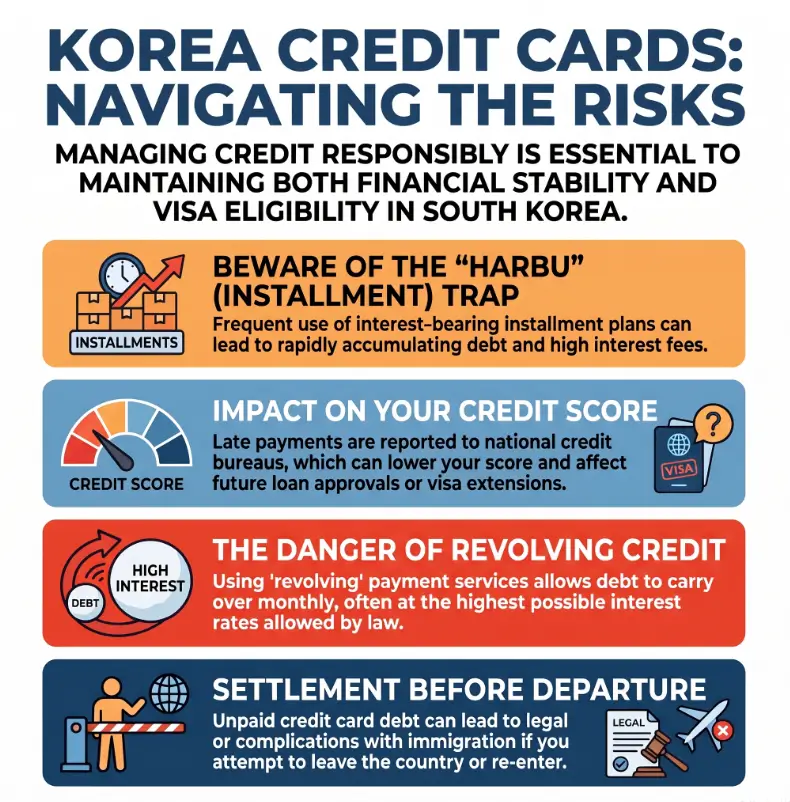
Korean credit-card approval is issuer-specific. A document accepted by one bank may be insufficient at another, and two issuers can evaluate the same salary, visa status, and credit score differently.
This guide can help you prepare a cleaner application, understand common risk factors, compare application routes, and ask better questions. It cannot predict approval, calculate a personal borrowing limit, interpret immigration consequences, or replace advice from a bank, card issuer, credit bureau, lawyer, immigration professional, or financial counselor.
Before You Act
Confirm current eligibility, required documents, annual fees, interest rates, repayment methods, and foreign-resident policies directly with the issuer. Never borrow simply to create activity, and do not assume that a credit limit is additional income.
The safest goal is not “get approved at any cost.” It is “obtain an appropriate card with terms I understand and payments I can reliably manage.” That small change in wording keeps the application from becoming a financial scavenger hunt with interest charges hiding behind the curtains.
Who Can Realistically Qualify for a Korean Credit Card?
Registered Foreign Residents With a Korean Financial Footprint
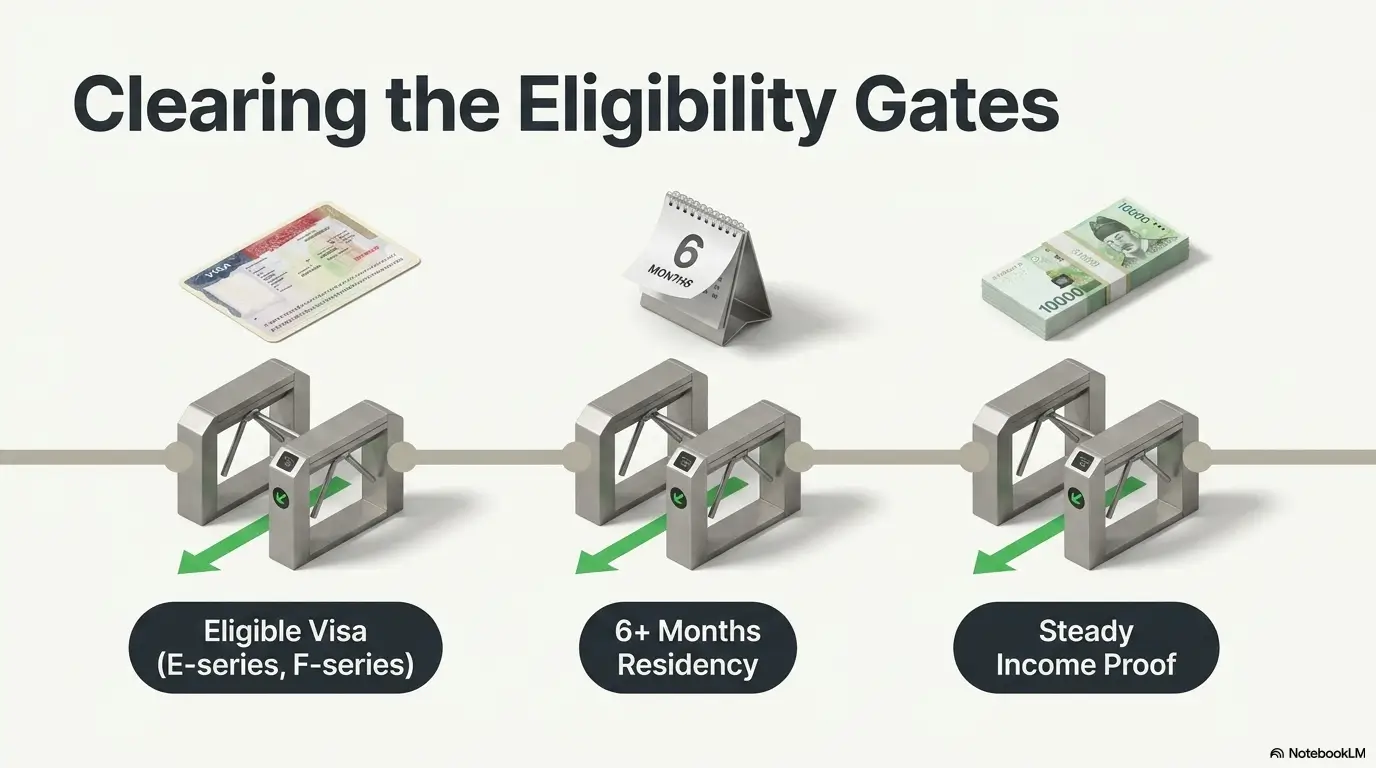
The strongest starting group usually includes foreign employees, professors, researchers, permanent residents, entrepreneurs, spouses of Korean citizens, overseas Koreans, and other long-term residents who have recognized residence documentation, a Korean mobile number, a local bank account, and verifiable income or assets.
International students may also be able to apply, but a residence card alone does not establish repayment capacity. An issuer may want evidence of scholarship income, employment, savings, family support, a deposit relationship, or another acceptable source of funds. Policies differ, so students should ask about entry-level products and manual review before completing an app-only application.
Tourists and Short-Term Visitors Usually Need a Different Starting Point
Tourists and short-stay visitors generally lack the domestic identity, address, income, and repayment records that issuers use for underwriting. An internationally issued card, Korean debit or check card, prepaid option, or cash reserve may be more realistic.
A debit card can still solve many practical problems, including local purchases, transportation payments, and online transactions when Korean identity verification works. Readers struggling with phone or website authentication may also benefit from this guide to Korean identity verification for foreigners.
Eligibility to Apply Is Not the Same as Approval
Residence status opens the door to the application process. Underwriting decides whether the door stays open.
An issuer may legally accept applications from foreign residents while still declining an individual because income cannot be verified, the remaining residence period is short, identity records do not match, the domestic credit file is thin, or the internal risk model does not support approval.
Key Takeaway
A residence card proves that you can be identified as a resident. It does not, by itself, prove stable income, repayment history, or acceptable credit risk.
Approval Anatomy: What Korean Card Issuers May Examine
Identity and Residence Verification
Issuers commonly need to connect your passport identity, residence record, Korean address, mobile-phone registration, bank account, and application name. A single spelling difference can interrupt automated verification.
Registered foreign residents have been able to use mobile residence cards for certain banking services at participating institutions since March 21, 2025. Acceptance still depends on the bank, transaction, branch procedure, and current verification rules, so carry the physical card when a branch recommends it.
Income and Employment Stability
Regular salary deposits are easy for a bank to observe. Freelance income, overseas income, business revenue, pension income, stipends, and spouse-supported finances may require more explanation and supporting evidence.
An issuer may consider how long you have been employed, whether income arrives consistently, whether the documents match the deposits, and whether existing debts leave enough capacity for additional credit. A high annual income on paper is less useful when the issuer cannot connect it to your Korean financial records.
Debt, Delinquencies, Card Loans, and Recent Applications
Late payments, outstanding loans, card loans, cash advances, guarantees, and a large amount of available credit may affect the decision. Recent applications may also be relevant, particularly when several issuers receive applications in a short period.
The point is not that one inquiry automatically ruins a score. The practical problem is that scattershot applications create more variables. You may receive several rejections without learning whether the original obstacle was documentation, identity matching, residence duration, income verification, or internal policy.
The Hidden Variable: Each Issuer’s Internal Score
Credit-bureau scores are only one layer. Issuers combine outside credit information with their own data, risk appetite, customer history, product rules, fraud controls, and underwriting standards.
That is why one company may decline an applicant while another asks for additional documents or approves a modest limit. Different outcomes do not necessarily mean that one institution found an error. They may simply be using different decision rules.
The Five-Part Approval File
Documents That Turn You Into a Verifiable Applicant
Core Identity Documents
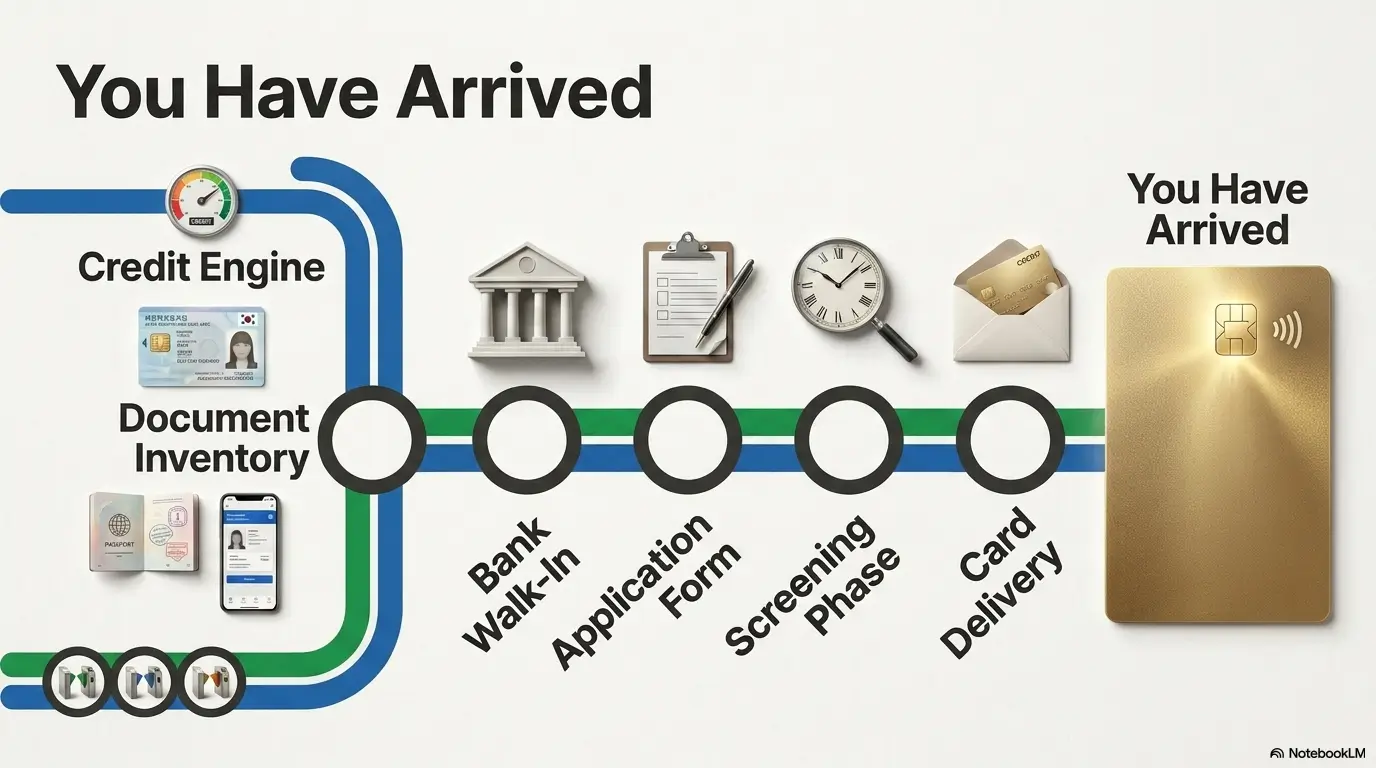
Ask the issuer for its exact document list before visiting. A practical preparation folder may include the following:
- Valid passport
- Valid residence card or accepted mobile residence credential
- Registered Korean address
- Korean mobile number registered under the correct identity
- Korean bank-account information
- Employment, income, tax, scholarship, pension, savings, or business documents requested by the issuer
- Additional proof of residence or relationship when specifically required
Income Evidence by Applicant Type
| Applicant type | Documents an issuer may request | Common verification issue |
|---|---|---|
| Salaried employee | Employment certificate, salary statements, tax or withholding records, salary-account history | Very recent employment or deposits that do not match the stated salary |
| Freelancer | Contracts, invoices, tax filings, bank statements, business registration when applicable | Irregular income or overseas payments that are difficult to verify |
| Business owner | Business registration, tax records, revenue evidence, account history | Mixing personal and business cash flow without clear records |
| International student | Enrollment, scholarship evidence, permitted employment income, savings or other accepted support | No independently verifiable repayment source |
| Retiree | Pension statements, savings evidence, regular account deposits | Foreign pension or asset documents not accepted by the issuer |
| Spouse-supported applicant | Relationship documents and financial evidence requested by the issuer | Assuming a spouse’s income is automatically considered |
The Name-Matching Problem That Quietly Stops Applications
Foreign names can appear in different orders, with spaces removed, middle names shortened, or long names truncated. The passport, residence card, bank account, phone registration, employer record, and tax documents may therefore look similar to a person but different to a machine.
Before applying, compare every record character by character. Ask the relevant institution how it stores your legal name, and correct outdated information where possible. Consistent passport-based naming can also reduce friction when using the card overseas.
Bring More Than the Minimum, but Keep It Organized
A bulging folder is not automatically persuasive. The goal is a tidy chain of evidence: this is my identity, this is my lawful residence, this is where I live, this is how I earn or receive money, and this is the account from which the bill will be paid.
Application Folder Checklist
Place identity documents first, residence documents second, income evidence third, and bank records fourth. Add a one-page note listing your visa type, employer or income source, Korean phone number, intended settlement account, and the documents enclosed.
Korean Credit Scores: Why the Number Is Only Part of the File
Korea’s 1-to-1,000-Point System
Korea replaced the former 1-to-10 credit-grade framework with a 1-to-1,000-point system across the financial sector beginning January 1, 2021. A higher score generally indicates lower assessed credit risk, but there is no single score that guarantees approval for every card and applicant.
Think of the score as one instrument in an orchestra. It may be playing clearly, but the issuer is still listening to income stability, debt, residence information, product rules, and its own customer data.
NICE and KCB Scores May Not Match
Korea has more than one credit bureau, and scores can differ because the models, data timing, weighting, and available information are not identical. A difference between scores does not necessarily indicate an error.
What matters most is whether the information behind the scores is accurate. Review registered loans, late payments, guarantees, opened accounts, and other reported records. A tidy score number sitting on top of incorrect data is still a problem wearing polished shoes.
A Thin File Is Not the Same as Bad Credit
A newcomer may have no late payments and still be difficult to assess because there is little Korean repayment history. Overseas credit history usually does not slide neatly into domestic underwriting systems.
This is why regular account activity, stable salary deposits, responsible debit-card use, automatic payments, and time can matter. They create a domestic record that is easier to interpret than a verbal promise that you have always paid on time elsewhere.
Show Me the Nerdy Details
Why a “good score” can still produce a decline
A bureau score estimates general credit risk from reported information. A card issuer must also decide whether you qualify for a specific product, whether your identity can be verified, whether your income is acceptable, whether your residence period fits its policy, and whether its current portfolio rules allow the account.
The score answers one question. The issuer is answering several questions at once.
Read the Financial Services Commission Credit-Score Guidance
The Salary-Bank Strategy and Your First-Card Options
Start Where Your Financial Footprints Already Exist
A bank receiving your salary may already see recurring deposits, account age, automatic transfers, savings, and ordinary spending. That history does not guarantee approval, but it may make verification easier than applying to an institution that knows only your name and the information entered five minutes ago.
Ask whether the bank offers branch-assisted card applications for foreign residents and whether your salary history can be used as supporting evidence. A well-prepared manual review can be more suitable than an app-only route that rejects any record requiring extra interpretation.
Bank-Affiliated Card or Standalone Card Company?
A bank-affiliated application may offer branch help, existing account history, and an obvious settlement account. A standalone card company may offer different rewards, eligibility rules, language support, or review procedures.
For a first card, the practical application route often matters more than a glittering welcome offer. Rewards are useful only after approval, and only when the annual fee, spending requirements, and repayment terms fit your real life.
Good, Better, Best: A First-Card Setup
| Approach | What it looks like | Best for | Watch for |
|---|---|---|---|
| Good | Use a Korean debit card, build regular account activity, and prepare documents | New arrivals and applicants with thin local records | Assuming debit history guarantees later approval |
| Better | Apply for one simple card through the salary bank with full-payment autopay | Employees with stable deposits and matched identity records | Annual fees, spending conditions, and insufficient account balance |
| Best | Choose a modest card after reviewing credit data, fees, repayment method, and actual monthly spending | Applicants ready to manage credit without carrying balances | Overvaluing rewards or accepting revolving credit by default |
Illustrative Example: The Bonus Card That Wasn’t the Best First Card
In this fictional example, Maya had worked at a Seoul technology company for eight months. Her salary arrived at the same bank every month, but she applied online for a premium travel card from a different issuer because the airport benefits looked generous.
The application was declined. She then visited her salary bank, where a staff member noticed that her mobile-phone name omitted part of her passport name. After correcting the mismatch and confirming the required income documents, she applied for a simpler card with a modest limit.
The lesson was not that premium cards are “bad.” It was that her first task was verification, not optimization. Once her records were consistent and she had built a clean payment history, comparing richer rewards became a more sensible project.
For related practical friction, see this guide to Korean phone plans and local mobile setup, since phone registration is often tied to financial authentication.
Key Takeaway
For a first application, optimize for clear eligibility, manageable fees, full-payment autopay, and a realistic limit. Optimize rewards later.
Rejected Despite a Good Salary? Check These Quiet Failure Points
Too Little Korean Credit History
A good salary does not erase a thin domestic file. The issuer may see income but little evidence of how you manage Korean financial obligations over time.
Rather than applying everywhere, allow clean account activity to accumulate. Use your bank account normally, keep recurring payments funded, maintain accurate contact information, and avoid unnecessary borrowing.
Too Little Time Left on the Current Residence Period
Some issuers may consider the remaining validity of your residence status when assessing account duration and collection risk. This is not a universal legal cutoff, and policies can differ by product and institution.
Ask a precise question before applying: “Does my current residence status and remaining validity meet the requirements for this card?” A clear answer is more useful than forum folklore preserved in amber from someone else’s application three years ago.
Income Exists, but the Issuer Cannot Verify It
Overseas consulting income, cash compensation, recently started employment, irregular freelance payments, and income documents in another language may require additional review. The issuer may decline when the evidence does not fit its accepted process, even when the money is genuine.
Ask which document format is accepted, whether Korean translation or certification is required, which period of statements is needed, and whether overseas income can be considered at all.
The Application Channel Was the Problem
Automated applications work best for records that fit neatly into standard fields. A foreign applicant with a long name, mixed income, recent residence renewal, or additional documentation may need a branch, foreign-resident center, or telephone-assisted process.
| Possible problem | What to check | Safer next move |
|---|---|---|
| Name mismatch | Passport, residence card, bank, phone, employer, and tax records | Correct records before reapplying |
| Thin Korean file | Account age, payment history, registered credit information | Build clean history and apply selectively |
| Unclear income | Accepted income types and document formats | Request a manual document list |
| Short residence validity | Issuer-specific status and validity rules | Confirm eligibility before submitting |
| App-only decline | Whether extra documents can be reviewed | Use a branch or assisted channel |
Credit-Building Habits and Mistakes That Cost More Than Points
Pay the Statement in Full and on Time
Payment reliability is the center of the credit story. Set up automatic payment for the full statement balance when available, then confirm that the settlement account contains enough money before the withdrawal date.
Travel, job changes, salary-account changes, and residence renewals are common moments for payment arrangements to break. Put the due date in your calendar and check the account several business days beforehand.
Keep Spending Comfortable, Not Dramatic
A credit limit is the most you are allowed to borrow, not a spending target. Repeatedly approaching the limit can strain cash flow even when payments remain technically current.
Use the card for ordinary spending that already fits your budget. If the limit is small, make an additional payment only when the issuer permits it and you understand how it will be applied. Do not manufacture purchases merely to create “credit activity.”
Cash Advances and Revolving Credit Are Not Credit-Building Tools
Cash advances and card loans can carry high costs and may signal financial stress. Partial-payment revolving arrangements allow you to pay less than the full balance, but the unpaid amount continues with interest and can become stubbornly expensive.
Before activating any repayment feature, ask whether the card is set to full monthly payment, what percentage would be paid under revolving, what interest applies, and how to return to full payment. Never accept a feature merely because the enrollment screen presents it as convenient.
Five Common Mistakes and Safer Alternatives
| Common mistake | Why it creates risk | Safer alternative |
|---|---|---|
| Applying to several issuers at once | Creates multiple inquiries and hides the original cause of rejection | Prepare one strong application and diagnose any decline |
| Treating the limit as extra income | Encourages spending that future income must repay | Charge only budgeted purchases |
| Using cash advances to build credit | Adds cost and may indicate financial pressure | Build history through ordinary purchases and full payment |
| Leaving revolving payment active | Allows balances and interest to continue | Confirm full-statement repayment settings |
| Forgetting the settlement account | A funded card account still fails if the linked bank account is empty | Check the withdrawal account before every due date |
Key Takeaway
Do not borrow money to prove that you can manage borrowed money. Normal spending, accurate records, and full on-time payment are the cleaner path.
Review annual fees and benefit conditions before keeping an unused card. Cancellation can also require thought, particularly when installments, pending charges, points, or automatic payments remain. Ask the issuer what will happen before closing the account.
Foreign residents who shop through Korean apps should also check how card ownership, mobile verification, and local payment systems connect. This guide to online shopping in Korea explains several of those practical hurdles.
When to Seek Help Instead of Filing Another Application
An Unknown Delinquency or Account Appears
Check whether a loan, overdue payment, telecom obligation, guarantee, insurance record, or opened credit account has been registered under your identity. Do not assume that an unfamiliar entry will disappear on its own.
Contact the institution that supplied the information and ask what the entry represents, when it was reported, and how to dispute or correct it if inaccurate. Keep copies of statements, correspondence, identity documents, and reference numbers.
Your Credit File Contains Incorrect Information
Request correction through the reporting institution and the relevant credit-information process. Be precise. Identify the disputed record, explain why it is wrong, and attach documents supporting the correction.
Credit4U, operated by Korea Credit Information Services, allows individuals to review registered credit information such as loans, delinquencies, guarantees, insurance information, and opened credit accounts.
Review Your Registered Credit Information at Credit4U
The Rejection Cannot Be Explained
Ask whether the issuer can provide an explanation of the personal credit-evaluation result or identify the general category that affected the decision. The answer may be limited, but even a broad explanation can help distinguish a document problem from a credit-information problem.
Do not ask only, “Why was I rejected?” Try a structured version: “Was the decision related to identity verification, residence eligibility, income evidence, credit information, product criteria, or another internal requirement?”
The Debt Is Already Difficult to Repay
Contact the issuer promptly. Waiting until several payments are missed usually reduces your options. Ask about available repayment arrangements, fees, interest, and the consequences of any modification before agreeing.
For significant debt, legal uncertainty, identity theft, or disputed reporting, consider qualified financial counseling or legal help. Free self-checking is useful when the problem is missing paperwork. Professional help may be worth the cost when the file contains disputed debt, fraud, collection action, or obligations you cannot manage.
| Situation | DIY step may be enough | Professional or institutional help may be worth considering |
|---|---|---|
| Missing application document | Request the issuer’s document checklist | Usually unnecessary unless immigration or legal status is unclear |
| Name mismatch | Correct bank, phone, employer, or residence records | Helpful when official records conflict or cannot be amended easily |
| Incorrect credit entry | File a documented correction request | Consider help if the institution refuses, fraud is suspected, or debt collection begins |
| Unmanageable balances | Contact the issuer immediately and stop new borrowing | Financial counseling or legal advice may be appropriate |
Key Takeaway
A second application is useful only after you understand what changed. Otherwise, it is the same question sent to a different machine.
Frequently Asked Questions About Korea Credit Cards for Foreigners
Can a foreigner get a credit card in South Korea?
Yes, registered foreign residents may be able to obtain Korean credit cards. Approval depends on the issuer’s rules, identity verification, residence status, income or financial resources, Korean credit information, existing obligations, and internal underwriting.
Do I need a Korean credit score before applying?
You do not necessarily need a long credit history before applying, but a thin file can make assessment harder. An issuer may rely more heavily on salary deposits, employment, banking history, residence information, and other verifiable evidence.
Does my visa type affect credit-card approval?
It may. Issuers can set product-specific policies related to residence status, permitted activity, stability, and remaining validity. Ask the issuer whether your exact status is eligible before applying.
How long must my residence card remain valid?
There is no universal period that guarantees approval across all issuers. Some institutions may consider the remaining residence period, so confirm the current requirement for the specific card and application channel.
Can an international student get a Korean credit card?
Possibly, but students may face stricter repayment-capacity review. Ask whether scholarships, permitted employment income, savings, deposits, or other support can be considered. A Korean debit card may be the more practical starting option.
Can a freelancer use overseas income as proof?
Some issuers may consider it, while others may not accept it or may require additional documentation. Ask which contracts, invoices, tax records, translations, and bank statements are acceptable before submitting an application.
Will a Korean debit card build my credit history?
Responsible check-card usage has historically been recognized as potentially useful positive information in Korean personal credit assessment. It should not be treated as a guaranteed route to a higher score or card approval.
Why was I rejected even though I have a full-time job?
Possible reasons include a thin Korean file, recent employment, identity mismatches, short remaining residence validity, existing debt, insufficient accepted documentation, product-specific restrictions, or the issuer’s internal score.
Does checking my own credit information lower my score?
Reviewing your own registered information is generally different from applying for new credit. Use an official credit-information service and check its current terms if you are unsure how a particular inquiry is classified.
Can I apply again after a rejection?
Yes, but first identify what changed. Correct mismatched records, gather missing evidence, review your credit information, confirm product eligibility, and select a suitable application channel. Reapplying immediately with the same unresolved file is unlikely to teach you much.
Your 15-Minute One-Application Readiness Check
Before browsing rewards pages or filling out another application, set a timer for 15 minutes and check the five items below. This is the small hinge on which the larger door often turns.
- Residence: Confirm your residence card is valid and ask whether the remaining period meets the issuer’s current policy.
- Identity: Compare your passport, residence card, mobile-phone registration, bank account, employer records, and tax documents for name differences.
- Income: Gather the exact income evidence accepted for your applicant type.
- Repayment: Choose the Korean bank account that will pay the bill and confirm it can support full-statement autopay.
- Credit information: Review registered accounts, debts, delinquencies, and guarantees for errors or surprises.
Then call the issuer with one precise question:
Use This Script
“As a registered foreign resident with my residence status and employment or income type, which documents must I submit for a manual credit-card review, and does my remaining residence period meet the current requirement?”
Apply once through the institution that can most clearly verify your income and financial activity. Choose a manageable card, confirm full monthly repayment, and keep the settlement account funded. That approach is slower than chasing five welcome bonuses before lunch, but it is far more likely to build the kind of Korean financial record you actually want.
Review the Credit Finance Association Cardholder Guide
Last reviewed: 2026-09