
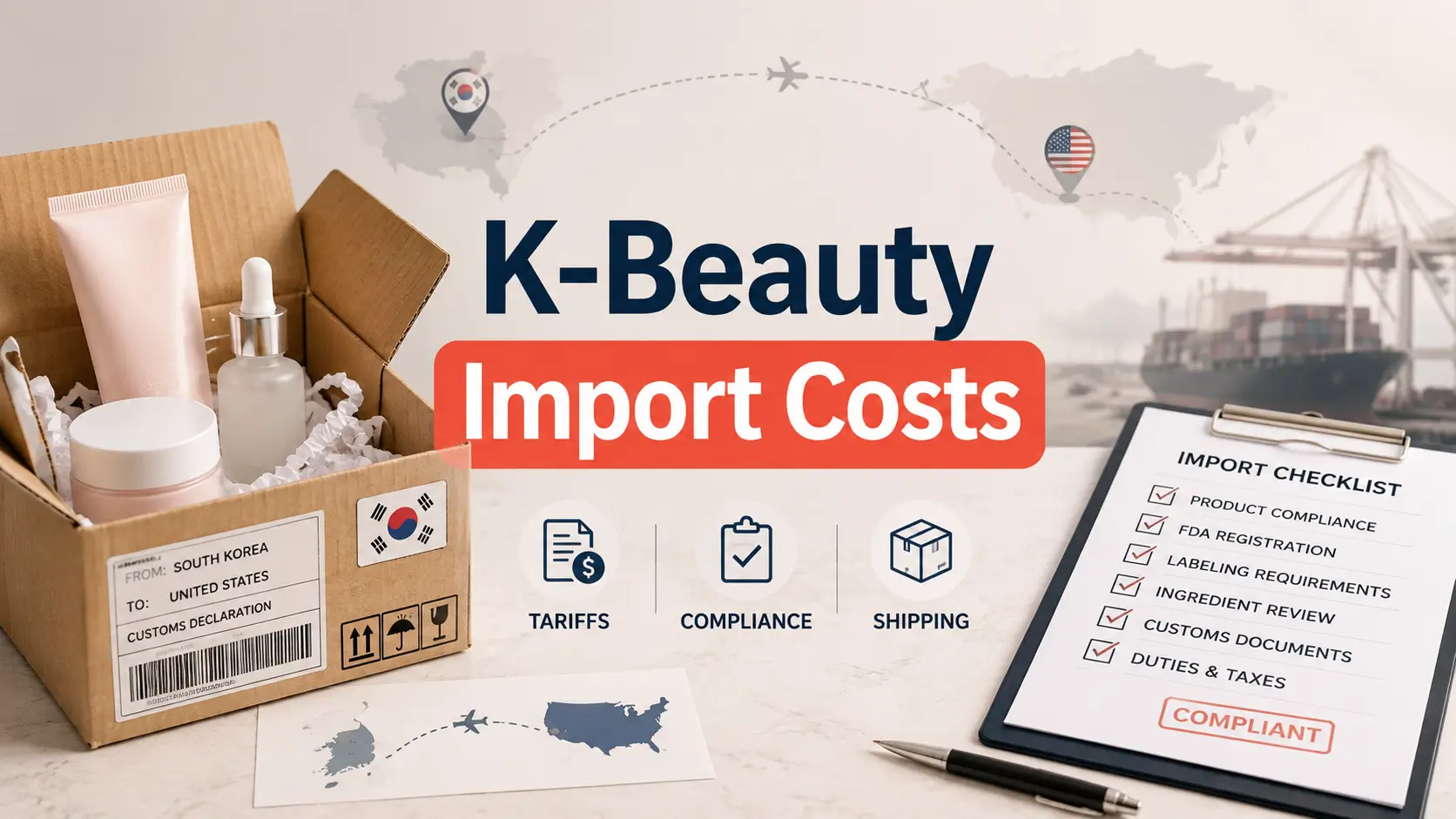
Importing Korean cosmetics into the United States is no longer a matter of buying compliant K-beauty products in Seoul, adding an English sticker, and paying ordinary freight. The expensive question is not simply, “Is this cosmetic legal in Korea?” It is: What is this product under U.S. law, who is responsible for it, and what tariff applies on the day it enters the country?
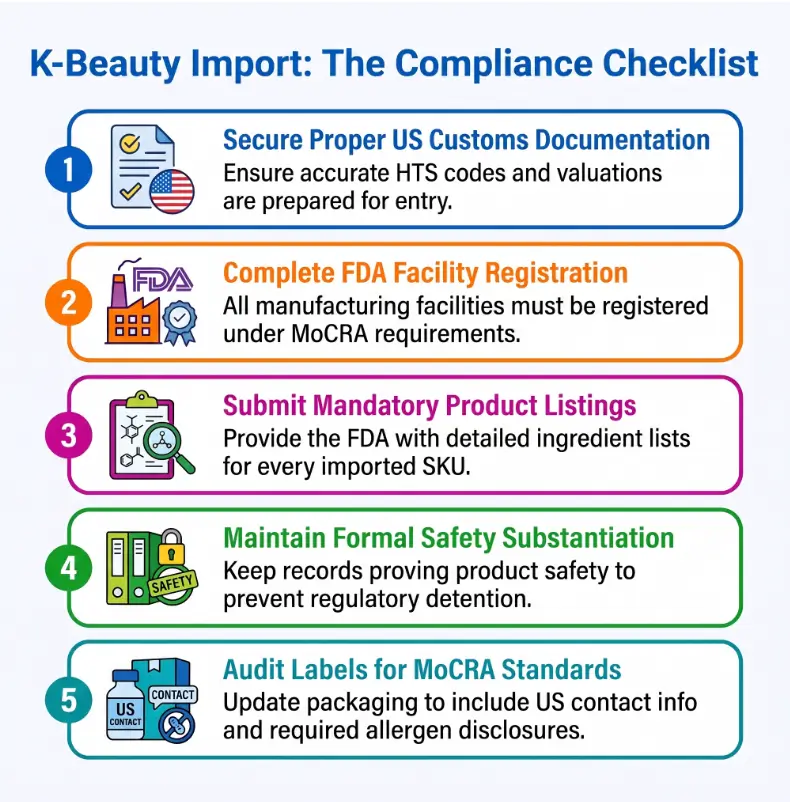
For an ordinary cosmetic, FDA generally does not require premarket approval, although color additives are an important exception. MoCRA now requires facility registration, product listing, safety substantiation, adverse-event procedures, and other compliance steps for businesses that fall within its requirements. FDA charges no fee for MoCRA cosmetic facility registration or product listing.
The border bill can be much larger. As of August 2026, the current U.S. tariff framework for many products of South Korea can produce a combined 15% tariff rate when the otherwise applicable Column 1 tariff rate is below 15%, subject to exclusions and product-specific rules. Ocean shipments may also incur the 0.125% Harbor Maintenance Fee, while customs-broker fees, bonds, testing, relabeling, insurance, storage, and examination costs are separate.
The first task, therefore, is not finding the cheapest freight forwarder. It is determining whether the Korean SKU in your spreadsheet is really a U.S. cosmetic at all. FDA’s cosmetics import guidance makes clear that imported cosmetics must satisfy the same U.S. requirements as domestically produced cosmetics.
Table of Contents
First Ask Whether the Korean Product Is Actually a Cosmetic in the US
This distinction can change the entire project. A moisturizer sold as a cosmetic in Korea may remain a cosmetic in the United States. A product sold with sunscreen, acne-treatment, dandruff-treatment, or certain structure-or-function claims may instead be regulated as a drug, or as both a drug and a cosmetic.
That means the same bottle can move from a relatively manageable MoCRA compliance project into a substantially different FDA drug-regulatory system because of its intended use and claims.
| Product or claim | Likely U.S. issue | What to do before importing |
|---|---|---|
| Basic cleanser or moisturizer | Usually cosmetic if claims remain cosmetic | Check ingredients, labeling, MoCRA status, safety records and customs classification |
| SPF moisturizer or sunscreen | Drug or drug/cosmetic regulation | Stop the cosmetic-only analysis and verify OTC drug requirements |
| Acne treatment | Drug claim | Review active ingredients, monograph status, establishment and labeling requirements |
| Anti-dandruff shampoo | Drug and cosmetic | Check both regulatory systems |
| “Regenerates cells,” treats eczema, restores hair | Claims may establish drug intended use | Review U.S. packaging, website, marketplace copy and advertising before launch |
| Ordinary makeup with approved cosmetic claims | Generally cosmetic | Pay particular attention to color-additive requirements |
FDA explains this distinction in its cosmetic-versus-drug guidance. Sunscreens are a particularly important trap for Korean importers because products treated as cosmetics in some foreign markets can be drugs under U.S. law.
Do not review only the Korean package. U.S. intended use may also be established through website copy, marketplace listings, advertisements, social-media claims, and other promotional material. Removing a therapeutic sentence from the carton while leaving it on the Amazon listing does not necessarily solve the classification problem.
What Does It Actually Cost to Import Korean Cosmetics?
The useful way to budget is to separate government charges from private compliance and risk costs. Only a few items have fixed statutory or percentage-based amounts. The rest depend on the product, shipment, supplier, importer, and insurer.
| Cost component | Current structure | Main variable |
|---|---|---|
| FDA cosmetic facility registration | $0 FDA filing fee | Whether the facility is subject to MoCRA registration |
| FDA cosmetic product listing | $0 FDA filing fee | Whether the product/responsible person is subject to listing |
| Base customs duty | Depends on HTS classification | Exact product and tariff classification |
| Current Korea reciprocal tariff | For many Korean goods, Column 1 plus reciprocal tariff is brought to 15% when the applicable Column 1 rate is below 15% | Origin, HTS code, exclusions and current Chapter 99 rules |
| Merchandise Processing Fee | Formal entry: 0.3464%, subject to FY2026 minimum and maximum when applicable | Entry type and eligibility for an FTA exemption |
| Harbor Maintenance Fee | 0.125% for qualifying commercial ocean cargo | Transportation mode and port |
| Customs bond | Provider-set premium | Shipment frequency, bond type and customs exposure |
| Customs broker | Provider-set | Number of lines, agencies, complexity and services |
| Safety testing and substantiation | Provider-set | Formula, risk profile, existing Korean data and testing gaps |
| U.S. label review or redesign | Provider-set | Number of SKUs, claims and artwork changes |
| Product liability insurance | Insurer-set | Sales, product type, limits, claims history, distribution channels and exclusions |
For fiscal year 2026, CBP states that the formal-entry Merchandise Processing Fee is 0.3464% of merchandise value, excluding duty, freight and insurance, with a minimum of $33.58 and maximum of $651.50 when the fee applies. Current figures can be checked through CBP’s Merchandise Processing Fee guidance.
Qualifying KORUS-originating merchandise can receive an MPF exemption. That should not be confused with exemption from every current tariff measure. Free-trade-agreement treatment and later trade-remedy or reciprocal-tariff measures are separate layers of the customs calculation.
The 15% Korea Tariff Can Matter More Than the FDA Filing Cost
This is the cost change most likely to surprise an importer using an old KORUS spreadsheet.
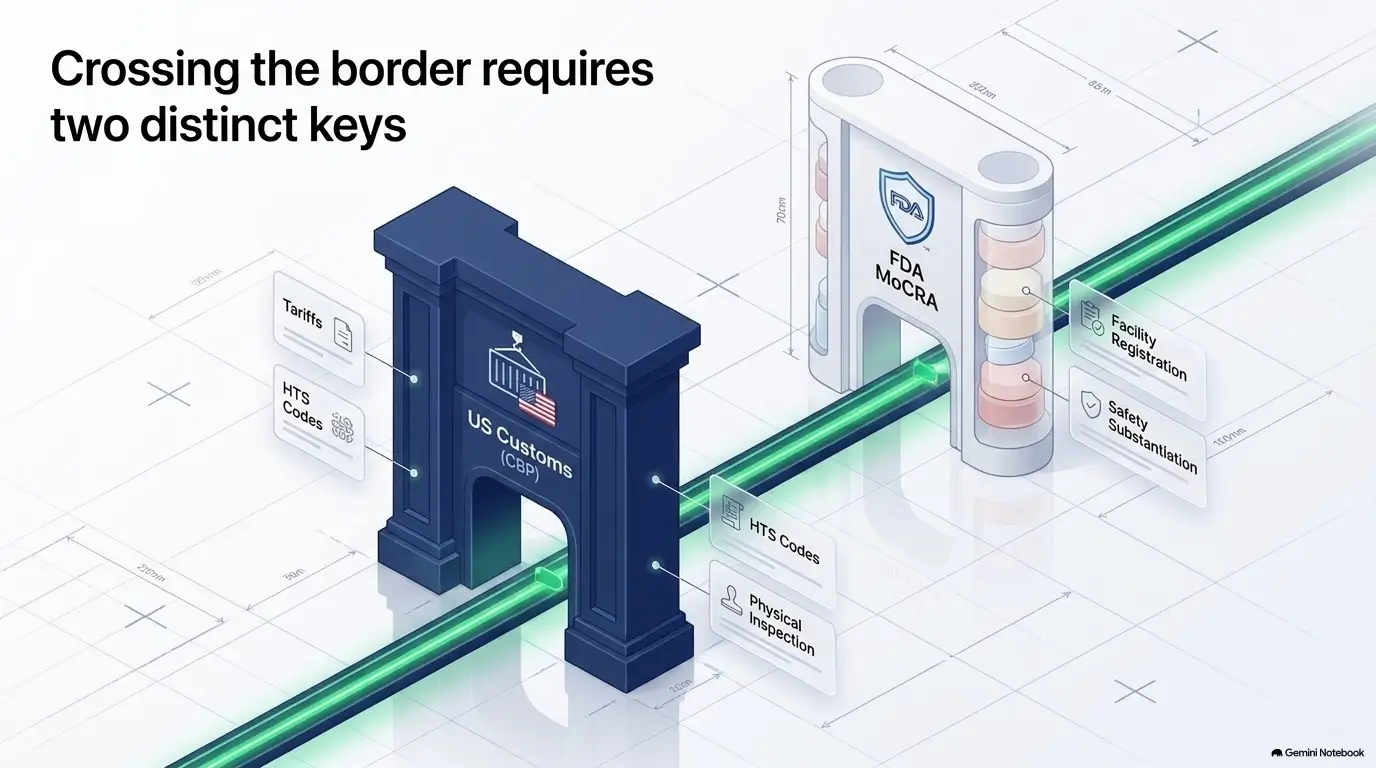
Effective November 14, 2025, the U.S. implementation for products of South Korea generally operates so that when the applicable Column 1 tariff rate is below 15%, the combined Column 1 and reciprocal tariff rate is 15%. When the applicable Column 1 rate is already 15% or more, the additional reciprocal tariff is generally zero. Exclusions and other tariff measures can change the result.
This matters because common skin-care preparations can have an ordinary tariff classification whose base general rate is free. “Base duty-free” therefore does not necessarily mean “15%-tariff-free” under the current Korea trade framework.
Always check the current Harmonized Tariff Schedule of the United States for the entry date. Tariff actions have changed rapidly since 2025, so a landed-cost calculation should be refreshed before a purchase order is locked, not merely when the business plan is written.
Illustrative Example: A $20,000 Korean Skin-Care Shipment
Illustrative example: suppose a U.S. importer buys $20,000 of an ordinary Korean skin-care preparation. Assume the product falls under a classification with a 0% applicable Column 1 rate, qualifies as a product of South Korea, has no applicable reciprocal-tariff exclusion, arrives by ocean, and qualifies for the KORUS MPF exemption.
- Customs value: $20,000
- Applicable Column 1 duty: $0 under the assumptions
- Current combined Korea tariff at 15%: $3,000
- Merchandise Processing Fee: $0 if the KORUS MPF exemption is properly available and claimed
- Harbor Maintenance Fee at 0.125%: $25
- FDA MoCRA registration/listing filing fees: $0
Under those assumptions, the identified federal border charges would be approximately $3,025 before freight, broker charges, customs-bond premium, cargo insurance, testing, labeling, examination charges, storage, domestic delivery, and product-liability insurance.
If MPF were applicable instead, 0.3464% of $20,000 would be $69.28, which falls between the FY2026 minimum and maximum. The example would then change accordingly.
This is why a $20,000 factory invoice is not a $20,000 inventory cost. The tariff layer alone can move the economics enough to change retail price, wholesale margin, or whether the SKU should be imported at all.
What MoCRA Requires Before a Korean Cosmetic Reaches the US Market
For ordinary cosmetics subject to MoCRA, the compliance chain has several different owners. The Korean factory, the brand owner, and the U.S. importer should not casually assume that another party has completed each task.
The Korean manufacturing facility may need FDA registration
Manufacturers and processors subject to MoCRA facility-registration requirements must register with FDA and renew registration every two years. Changes to required registration information generally must be updated within the applicable statutory timeframe.
A foreign cosmetic facility that is required to register must provide a U.S. agent. The U.S. agent serves as a communications contact with FDA. It is not the same thing as FDA approval of the Korean manufacturer.
FDA’s current MoCRA registration and listing page also emphasizes a point worth putting into every import contract: registration and product listing are not an FDA certification program. A supplier should not market an FDA facility registration number as proof that FDA has approved the product.
Each marketed cosmetic may require a product listing
The “responsible person” must list each cosmetic product subject to the requirement, including its ingredients, and provide required updates. The responsible person is the manufacturer, packer, or distributor whose name appears on the label within the statutory definition.
A Korean company can be the responsible person if it fits that definition. A U.S. private-label importer may instead become the responsible person when its name appears on the product as the relevant manufacturer, packer, or distributor. Do not choose the label entity for branding convenience without understanding the regulatory work attached to that decision.
Safety substantiation is not optional paperwork
MoCRA requires the responsible person to ensure and maintain records supporting adequate substantiation of safety. FDA does not prescribe one universal test package for every cosmetic, which is why the correct budget cannot be reduced to “one FDA laboratory test.”
The evidence appropriate for a water-based facial serum may differ from that for an eye product, hair dye, aerosol, talc-containing powder, or product using unusual botanical extracts. Existing Korean stability, microbiology, challenge-test, toxicological, raw-material and quality records may reduce duplicated work, but only if they actually support the U.S. product and formulation being sold.
- Korean Beauty Clinics: What Foreigners Should Know Before Booking
- Korean Skin Clinics for Foreigners
- Korean Skin Clinic Packages and Pricing
- How Korean Live Commerce Works
- Online Shopping in Korea for Foreigners
Do Not Approve the US Label by Translating the Korean Box
A literal Korean-to-English translation is not a U.S. regulatory review.
Cosmetic labeling distributed in the United States generally needs the required information in English, including the product identity, accurate net quantity, required business information and ingredient declaration. Ingredients ordinarily need to use names acceptable under U.S. labeling rules rather than whatever English transliteration happens to appear on the Korean export artwork.
MoCRA also requires cosmetic labeling to provide a domestic address, domestic telephone number, or electronic contact information through which the responsible person can receive adverse-event reports.
Then there is a separate customs question: country-of-origin marking. For goods properly determined to be Korean origin, wording such as “Made in Korea” or “Product of Korea” may be acceptable. But origin is a customs determination, not a marketing preference. A product made in Korea and packaged, filled, blended, or otherwise processed elsewhere may require a more careful substantial-transformation analysis.
The costly mistake is printing 50,000 cartons before the U.S. ingredient names, claims, responsible-person information, net contents, country-of-origin marking, and product classification have all been checked.
The Importer of Record Still Has a Customs Problem Even With a Broker
A customs broker can file the entry, calculate duties, arrange a bond, communicate with CBP, and coordinate FDA entry data. That does not turn a questionable classification or unsupported origin claim into a safe one.
Before the first commercial shipment, establish four facts for every SKU:
- Tariff classification: the correct HTSUS classification for the finished product.
- Customs value: the legally correct transaction value or other applicable valuation basis.
- Country of origin: where the finished product legally originates for customs purposes.
- Current Chapter 99 treatment: whether the Korea reciprocal tariff, an exclusion, or another trade measure applies on the entry date.
Commercial imports worth more than $2,500 generally require formal entry, and a customs bond is generally required for commercial imports over that threshold or merchandise subject to another federal agency’s requirements. The premium for a single-entry or continuous bond is not a government-fixed cosmetic fee; it is obtained through a surety or broker.
Examination is another wild card. FDA and CBP do not examine every cosmetic shipment, but a held or examined container can generate drayage, handling, examination, demurrage or storage costs that were never present in the supplier’s quotation. The cheapest prevention is accurate entry data and a clean compliance file before the cargo leaves Korea.
Product Liability Cost Starts After Customs Releases the Goods
FDA compliance and civil product liability are related, but they are not the same system. Clearing FDA and CBP does not immunize an importer from a consumer claim.
Product-liability rules are largely shaped by state law and the facts of the claim. Depending on the jurisdiction and distribution arrangement, manufacturers, importers, distributors, brand owners, and sellers may face allegations involving defects, contamination, inadequate warnings, misleading instructions, allergic reactions, or other injuries.
There is therefore no meaningful universal answer such as “Korean cosmetic product liability costs $800 per year.” Insurance pricing is commercial, not a statutory FDA tariff. Quoting a made-up premium would be less useful than understanding what drives the quote.
Ask an insurer about these items before comparing premiums
- Are imported cosmetics expressly covered?
- Which SKUs and product categories are covered?
- Are skin irritation, allergic reaction and contamination claims within scope?
- Are sunscreens, OTC drugs, medicated products or therapeutic claims excluded?
- What are the per-occurrence and aggregate limits?
- How is the deductible or self-insured retention applied?
- Are defense costs inside or outside the policy limits?
- Is product recall expense covered, excluded, or available only through separate coverage?
- Can retailers or distributors be added as additional insureds when required?
- What happens when annual U.S. sales exceed the amount declared on the application?
A lower premium with a broad cosmetic, contamination, or recall exclusion may transfer less risk than a more expensive policy. Compare the coverage language, not merely the first number in the proposal.
Your Korean Supplier File Should Be Built Before the Purchase Order
The best negotiating moment is before money crosses the Pacific. Once inventory is manufactured with noncompliant labels or unsupported claims, every correction acquires freight, warehouse and repackaging costs.
For each SKU, obtain and organize:
- Exact finished-product name and SKU
- Manufacturing facility’s legal name and physical address
- FEI and MoCRA facility-registration information where applicable
- Foreign facility’s U.S. agent information where registration is required
- Complete ingredient information needed for U.S. listing and labeling
- Current formula and version-control date
- Safety-substantiation records relevant to the formula
- Stability, microbiological, quality and batch documentation appropriate to the product
- Color-additive information where relevant
- Final U.S. label artwork
- Approved U.S. claims and marketing language
- Lot-coding and traceability procedure
- Country-of-origin evidence and manufacturing-process description
- KORUS origin support if preferential treatment will be claimed
- Recall-cooperation and complaint-handling terms in the supply agreement
- Supplier insurance certificate where contractually required
One especially useful contractual question is: Who pays if the U.S. label, formula, claims, or regulatory status supplied by the Korean manufacturer turns out to be wrong?
The answer should not first be discovered after an FDA hold or consumer claim.
The 15-Business-Day Rule Makes Complaint Handling a Compliance Function
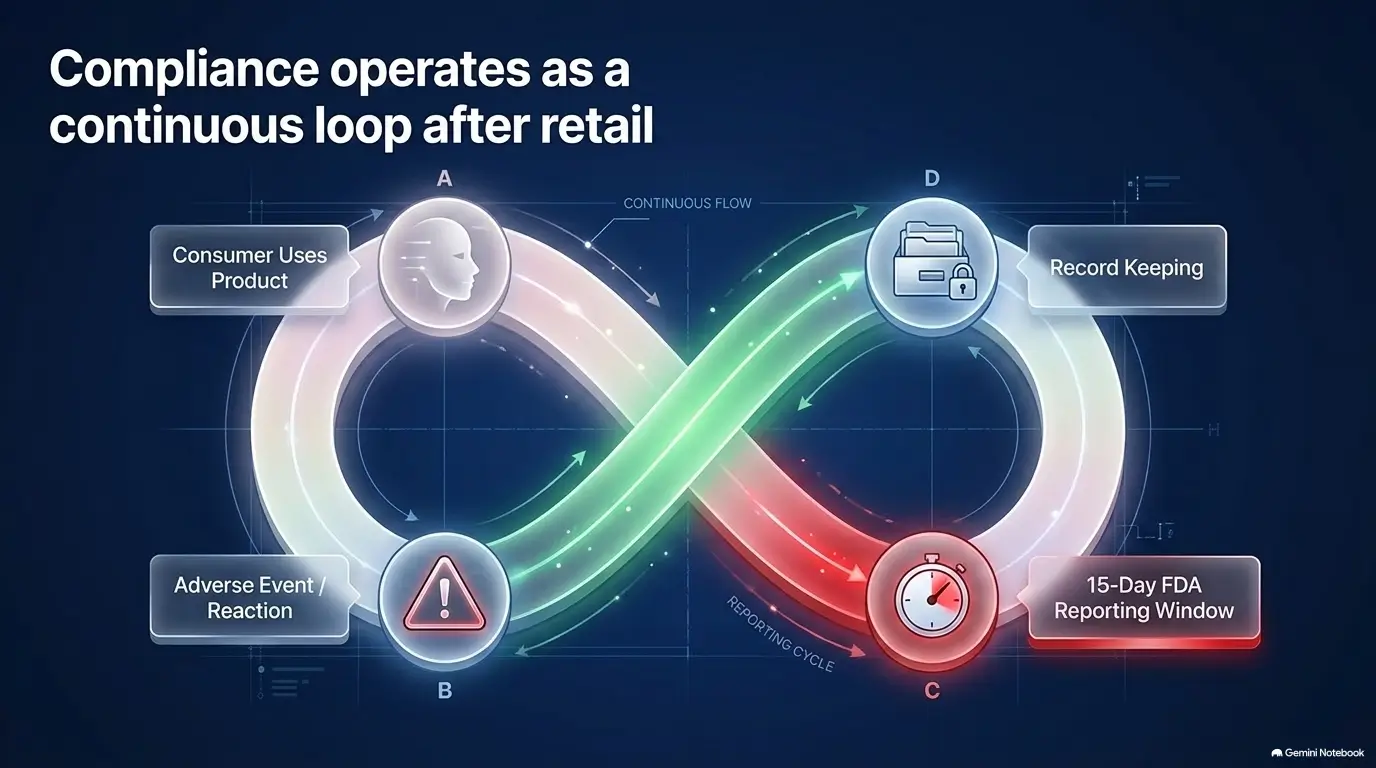
Under MoCRA, a responsible person must report a serious adverse event associated with use of a cosmetic in the United States to FDA within 15 business days after receiving the report. Certain follow-up information received within one year must also be submitted within the required timeframe.
This means a Korean brand selling through a U.S. distributor needs more than a customer-service inbox. Someone must recognize which complaints may meet the statutory definition, preserve the product label and case information, escalate promptly, and determine who is responsible for the FDA submission.
A contract that says only “manufacturer handles quality issues” is too vague for a 15-business-day clock.
When DIY Is Enough and When Paying for Help Makes Sense
DIY may be enough
A small importer may be able to handle much of the preparation internally when the product is clearly an ordinary cosmetic, the Korean manufacturer already maintains strong documentation, the label is straightforward, the HTS classification is established, and there are no therapeutic claims or unusual ingredients.
FDA’s filing portals themselves are not the expensive part. Paying someone hundreds or thousands of dollars merely to “get FDA approval” for a normal cosmetic should immediately trigger questions about what service is actually being sold.
One professional review may be enough
A targeted U.S. regulatory or customs review can be rational when one issue is uncertain: whether a claim creates drug status, whether an eye product qualifies for a MoCRA exemption, whether an ingredient or color additive is permitted, whether the English label works, or whether the proposed origin and tariff classification are defensible.
The goal is to buy an answer to the unresolved question, not outsource every administrative task indefinitely.
More extensive professional help may be justified
- The product is sunscreen, anti-acne, anti-dandruff, medicated, or otherwise potentially a drug.
- The formulation contains ingredients or color additives whose U.S. status is unclear.
- The product has already been detained or placed under heightened FDA scrutiny.
- Several countries participate in manufacturing, filling or packaging and origin is uncertain.
- You are private-labeling many SKUs under your own U.S. company.
- The supplier will not disclose enough formula or safety information to substantiate compliance.
- A retailer requires significant insurance, indemnification or regulatory warranties.
- A consumer injury, recall, FDA warning, or active dispute already exists.
Questions to Send a Customs Broker Before Requesting a Quote
A broker’s “entry fee” is only meaningful when the scope is the same. Send the same questions to every provider:
- Does your quote include FDA entry data for cosmetics?
- Will you review or only accept the HTS classification supplied by us?
- Will you evaluate KORUS eligibility and the current Korea Chapter 99 tariff treatment?
- Is customs-bond pricing included or separate?
- What additional fee applies if FDA or CBP examines or holds the shipment?
- Are disbursement, advancement, courier or document fees separate?
- Who monitors release status and communicates a hold?
- What documents must be received before the shipment departs Korea?
A $75 entry quote and a $175 entry quote are not comparable if one includes FDA filing, bond administration and tariff review while the other charges them separately.
FAQ About Importing Korean Cosmetics to the US
Do Korean cosmetics need FDA approval before they can be imported?
Ordinary cosmetics and cosmetic ingredients generally do not require FDA premarket approval, although color additives are an important exception. That does not mean cosmetics are unregulated. They must comply with U.S. safety, labeling and other requirements, and applicable businesses must satisfy MoCRA obligations such as facility registration and product listing. Products that are drugs or drug/cosmetic combinations face a different regulatory system.
Does KORUS mean Korean cosmetics enter the US duty-free?
Not necessarily. KORUS may affect ordinary tariff treatment and can provide an MPF exemption for qualifying originating goods, but subsequent U.S. tariff measures must also be applied. Under the Korea tariff framework in force in August 2026, many Korean-origin goods with an applicable Column 1 rate below 15% are brought to a combined 15% rate unless an exclusion or different treatment applies. Verify the current HTSUS immediately before entry.
Can the Korean cosmetics company be the MoCRA responsible person?
Yes, a company outside the United States can fit the responsible-person definition if it is the manufacturer, packer, or distributor whose name appears on the label as required. The cosmetic label must still contain the required adverse-event contact information. Separately, a foreign manufacturing or processing facility that must register needs a U.S. agent for its facility registration.
Does FDA require product liability insurance for imported cosmetics?
FDA’s MoCRA cosmetic registration and listing system does not establish a product-liability insurance premium as a condition of filing. Insurance is a separate risk-management and contractual issue. Retailers, distributors, marketplaces, lenders, landlords, or commercial agreements may impose their own insurance requirements, and the appropriate coverage depends on the products and business.
Before You Send the Purchase Order
Take one Korean SKU and create a single-page import sheet before approving production. You need only eight fields to expose most expensive surprises:
- U.S. product classification: cosmetic, drug, or both
- Manufacturing facility and MoCRA registration status
- Responsible person
- Final U.S. ingredient list and claims
- HTSUS classification
- Country of origin and KORUS support
- Current tariff, MPF and HMF calculation
- Insurance, testing, broker, bond and relabeling costs not included in the factory price
If any of those boxes contains “supplier says it should be fine,” leave it open. That sentence is not a tariff classification, safety record, insurance endorsement, or FDA compliance determination.
For a Korean cosmetics importer, the most valuable number is often not the Seoul factory price. It is the fully compliant landed cost of one sellable U.S. unit. Calculate that number before the inventory exists, and the Pacific becomes a shipping lane rather than a very expensive correction process.
Last reviewed: 2026-10