You Think You Know Korean? 6 Regional Dialects That Will Blow Your Mind!

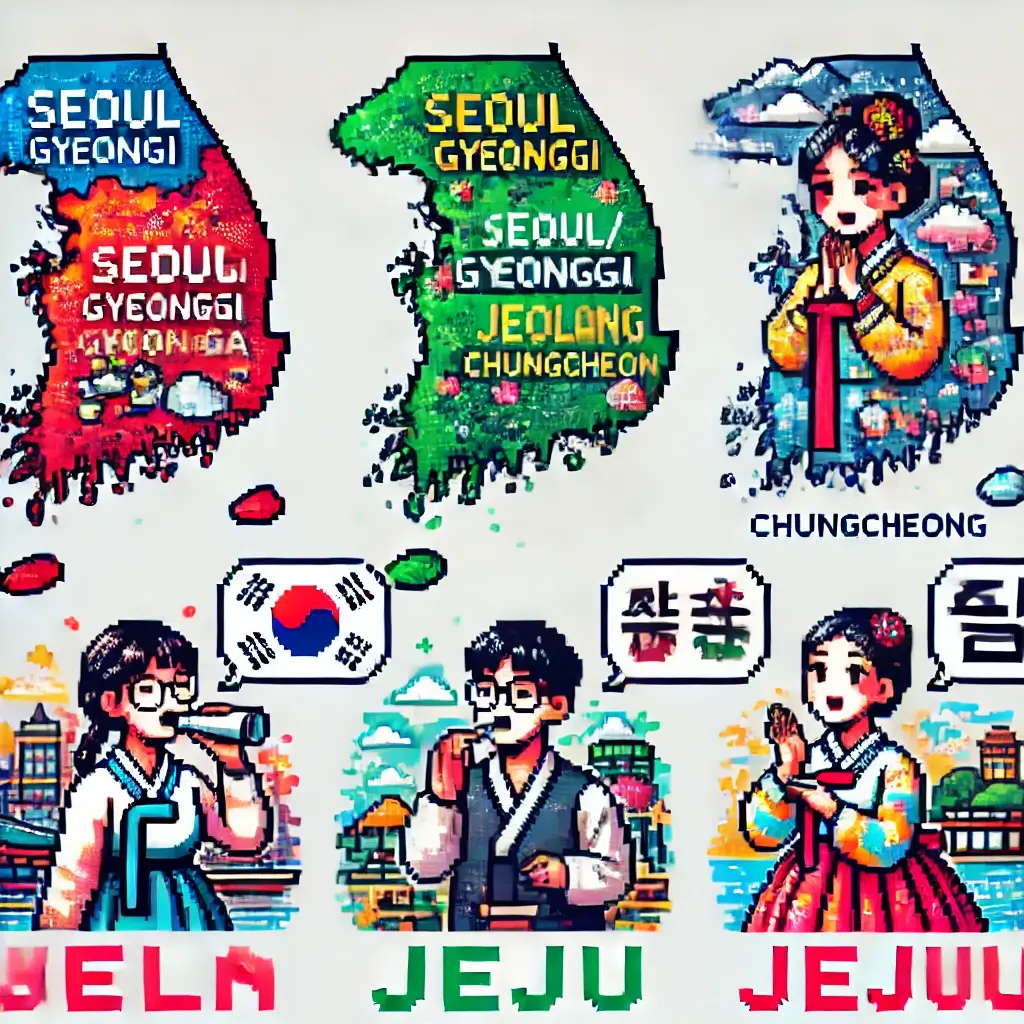
Pixel art map of South Korea with distinct colored regions for Seoul/Gyeonggi, Gyeongsang, Jeolla, Chungcheong, Jeju, and Gangwon, each marked with cultural icons. Regional Dialects
You Think You Know Korean? 6 Regional Dialects That Will Blow Your Mind! 3

You Think You Know Korean? 6 Regional Dialects That Will Blow Your Mind!

1. So, You’ve Mastered “Annyeonghaseyo”? Think Again!

You’ve done it.

You’ve binged countless hours of K-dramas, you can sing along to BTS without looking at the lyrics (mostly), and you can confidently order a kimchi jjigae at your local Korean restaurant.

You’ve learned the crisp, clear Korean that you hear from news anchors and in your textbooks.

But then you take a trip to Busan, or you watch a movie set in a sleepy seaside village in Mokpo, and suddenly… you can’t understand a word.

It’s like the language has been flipped on its head.

The intonation is all wrong, the endings are different, and they’re using words you’ve never heard of.

Welcome, my friend, to the wonderful, wild, and incredibly rich world of Korean dialects, or **Satoori (사투리)**.

It’s the secret sauce of the Korean language, the hidden layer that separates the tourists from the travelers, the learners from the locals.

Forget everything you thought you knew.

Learning about Satoori isn’t just about learning new words; it’s about unlocking the very soul of Korea.

It’s about understanding that Korea isn’t a monolith.

It’s a vibrant tapestry woven from centuries of distinct regional histories, cultures, and yes, languages.

And trust me, it’s a journey that will make you fall in love with Korea all over again, in a much deeper and more authentic way.

2. What Exactly is “Satoori” and Why Should You Care?

In the simplest terms, **Satoori** is the Korean word for regional dialects.

But that’s like saying a kimchi jjigae is just “spicy soup.”

It misses the whole point!

Satoori is history, identity, and personality all rolled into one linguistic package.

Think about the difference between someone from Brooklyn, a Texan, a Londoner, and a Scotsman.

They all speak English, but the accents, slang, and rhythm of their speech tell a story about where they’re from, right?

Satoori is exactly that, but amplified.

For centuries, the Korean peninsula was a collection of different kingdoms and regions, separated by mountains and rivers.

This isolation allowed unique ways of speaking to flourish.

These aren’t just minor accent differences; we’re talking about different vocabulary, unique grammar patterns, and completely distinct intonation that can make some dialects almost mutually unintelligible to the untrained ear.

Why should you, an English speaker learning Korean, care?

Because if you only learn the “Seoul standard,” you’re only getting a fraction of the picture.

You’re missing out on the fiery passion of the Busan *ajumma*, the poetic soulfulness of a Gwangju native, and the gentle, slow-burn humor of someone from Chungcheong province.

Understanding Satoori gives you a backstage pass to Korean culture.

It allows you to connect with people on a deeper level, to understand the jokes in movies without needing subtitles, and to appreciate the incredible diversity of this amazing country.

It shows you’ve gone beyond the surface and are making a genuine effort to understand the real Korea.

3. The “Standard” Seoul/Gyeonggi Dialect: The Face of Modern Korea

Before we dive into the regional flavors, we have to talk about the main dish: the **Seoul dialect (서울말)**, also known as the Gyeonggi dialect.

This is the official, standard language of South Korea, called *pyojun-eo* (표준어).

It’s what you hear on the news, what’s taught in schools, and what pretty much every Korean language textbook is based on.

It’s considered the clearest, most “neutral” form of Korean.

Its intonation is relatively flat, and the rhythm is steady.

There are no dramatic ups and downs like you’ll find in other regions.

Think of it as the “Received Pronunciation” (or “Queen’s English”) of Korean.

Because it’s the language of media, business, and government, almost everyone in Korea can speak and understand it, even if they grew up speaking a different Satoori.

In fact, many people who move to Seoul from other provinces consciously try to “correct” their accent to fit in, a phenomenon that has its own complex social implications.

While mastering the Seoul dialect is absolutely essential for any learner, it’s important to recognize it as just one color in the Korean rainbow, not the entire spectrum.

It’s our baseline, our control group.

Now, let’s get messy and explore the fun stuff.

4. The Gyeongsang Dialect (경상도 사투리): Fast, Furious, and Full of Passion

If the Seoul dialect is a calm, composed news anchor, the **Gyeongsang dialect** is a fiery auctioneer on their fifth cup of coffee.

Spoken in the southeastern region of Korea, which includes major cities like Busan and Daegu, this is probably the most famous (or infamous) Satoori of them all.

The Sound of Gyeongsang

The first thing you’ll notice is the **aggressive, dynamic intonation**.

It has a strong, song-like pitch accent, with dramatic ups and downs that can make a simple question sound like an urgent declaration.

This is why people from Gyeongsang are often stereotyped as being tough, aggressive, or impatient.

It’s not that they’re angry; it’s just that their language is built on a different musical scale!

For example, in Standard Korean, you’d ask “Did you eat?” as “Bap meogeosseoyo?” (밥 먹었어요?).

In Busan, it becomes a rapid-fire “Bap meogeonna?” (밥 먹었나?).

The “na?” ending is a classic Gyeongsang question marker, often delivered with a sharp rising tone.

They also have a tendency to shorten words and sentences, making the speech feel even faster.

Key Gyeongsang Phrases and Words

One of the most iconic Gyeongsang-do words is **”Maaa!” (마!)**.

It’s a multipurpose word that can mean anything from “Hey!”, “Dude!”, “Stop it!”, to “What did you say?”.

Context is everything.

Another classic is using **”~예” (ye)** instead of the standard “~요” (yo) for politeness, although this is becoming less common among younger generations.

You’ll also hear different vocabulary. For instance, “Why are you like this?” in standard Korean is “Wae geuraeyo?” (왜 그래요?).

In Gyeongsang-do, it becomes the much more forceful-sounding **”Wae irano?” (왜 이라노?)**.

The Cultural Vibe

The Gyeongsang stereotype is the *ssangnamja* (상남자), or “real man” – tough, direct, a bit gruff on the outside, but fiercely loyal and warm-hearted once you get to know them.

Think of the gruff but loving father figure in so many Korean dramas.

Chances are, he’s channeling that Gyeongsang energy.

It’s a dialect that’s full of life and passion, and while it might sound intimidating at first, it’s one of the most expressive and characterful ways of speaking in all of Korea.

5. The Jeolla Dialect (전라도 사투리): The Soulful, Poetic Heartbeat of Korea

If Gyeongsang Satoori is rock and roll, **Jeolla Satoori** is a soulful ballad.

Hailing from the southwestern region of Korea, known for its incredible food and rich artistic history, the Jeolla dialect is melodic, expressive, and incredibly charming.

The Sound of Jeolla

The most defining characteristic of the Jeolla dialect is its **long, drawn-out vowel sounds** and the distinctive sentence ender **”~잉” (ing)** or **”~부러” (beureo)**.

Where a Seoul speaker would say “Geureotguna” (그렇구나 – “Oh, I see”), a Jeolla native might say “Geureotguma-ing” (그렇구만잉), stretching out the sounds in a way that feels warm and friendly.

The intonation is much less aggressive than Gyeongsang’s.

It has a gentle, lilting quality, almost like the speaker is singing their sentences.

This melodic nature lends itself to the stereotype of Jeolla people being artistic, emotional, and expressive.

Key Jeolla Phrases and Words

One of the most famous (and endearing) expressions from Jeolla-do is **”A따” (Atta)** or **”오메” (Ome)**.

These are exclamations of surprise or amazement, similar to “Oh my gosh!” or “Wow!”.

They are used with incredible frequency and feeling.

A word that perfectly encapsulates the flavor of Jeolla is **”거시기” (geosigi)**.

This is the ultimate placeholder word. It can mean… well, almost anything.

It can be a person, a place, a thing, or an adjective.

“Hey, bring me that *geosigi* over there.” or “You know, that actor, the *geosigi* one.”

It relies entirely on shared context, and using it well is a true art form.

The ending “~부러” (beureo) is also a key feature, added to verbs to emphasize the completion of an action, often with a touch of emotion. For example, “Haebureotda!” (해부렀다!) is a much more emotive way of saying “I did it!” than the standard “Haesseoyo” (했어요).

The Cultural Vibe

Jeolla-do is often called the breadbasket and the artistic heartland of Korea.

The dialect reflects this.

It’s seen as being more emotional, friendly, and human.

While the Gyeongsang speaker might bluntly state a fact, the Jeolla speaker will wrap it in a story, full of feeling and nuance.

Listening to Jeolla Satoori feels like getting a warm hug.

It’s a dialect that reminds you that language is not just for communication, but for connection.

6. The Chungcheong Dialect (충청도 사투리): Slow, Gentle, and Deceptively Witty

Now we move to the central region of Korea, Chungcheong-do.

If Gyeongsang is fast and Jeolla is melodic, **Chungcheong Satoori** is… slow.

Painfully slow, some might joke.

But don’t mistake that slowness for a lack of intelligence.

The Chungcheong dialect is famous for being one of the most polite, indirect, and subtly witty forms of Korean.

The Sound of Chungcheong

The defining feature of this dialect is its **slow pace and stretched-out vowels**, especially at the end of sentences.

The polite ending “~요” (yo) often becomes a long, drawn-out **”~유” (yuu)** or **”~여” (yeoo)**.

For example, “Annyeonghaseyo?” (안녕하세요?) might become “Annyeonghaseyuu?” (안녕하세유?).

The intonation is generally flat, even more so than the Seoul dialect, which can make speakers seem very calm and even-tempered.

There’s a famous joke that perfectly illustrates this:

A son from Chungcheong calls his father in Seoul. The father asks, “What’s wrong? Is something on fire?” The son slowly replies, “Father… your house… was on fire… yesterdayyy…”.

It’s an exaggeration, of course, but it captures the stereotype perfectly.

The Art of Indirectness

What’s truly fascinating about Chungcheong Satoori is its indirectness.

Speakers often avoid making strong, direct statements.

They might not give you a clear “yes” or “no.”

Instead, you’ll get a thoughtful “Hmm, well, I suppose that could be okay…”

This isn’t because they are indecisive, but because the culture values politeness and avoiding potential conflict.

You have to listen not just to what is said, but how it’s said, and what *isn’t* said.

A classic example is the phrase **”됐슈” (dwaessyu)**. In standard Korean, “dwaesseo” (됐어) can be a curt “it’s done” or “forget it.” But in Chungcheong, “dwaessyu” is a much softer “It’s alright” or “That’s fine,” delivered with a gentle calmness.

The Cultural Vibe

People from Chungcheong are often seen as being extremely patient, calm, and hard to read.

They are the *yangban* (양반), the old aristocrats of Korea – composed, thoughtful, and never in a rush.

But beneath that slow exterior often lies a very sharp, dry wit.

They might not be the loudest person in the room, but they are often the most observant.

Understanding Chungcheong Satoori is a lesson in patience and reading between the lines.

7. The Jeju Dialect (제주도 방언): A Language Within a Language

Hold onto your hats, because we’re about to go off the linguistic deep end.

The language spoken on the beautiful island of Jeju is so different from mainland Korean that many linguists consider it a separate language altogether, not just a dialect.

It’s called **Jeju-eo (제주어)** or the Jeju dialect.

An Echo of the Past

Because Jeju is an island, its language was preserved in a way that mainland dialects weren’t.

It retains a huge number of words and grammatical structures from Middle Korean (the language spoken centuries ago) that have long since vanished from the rest of the peninsula.

For a mainland Korean speaker, listening to a conversation between two elderly Jeju natives can be like an English speaker trying to understand Chaucer’s *Canterbury Tales*.

It’s borderline incomprehensible.

For instance, the standard greeting “Eoseo oseyo” (어서 오세요 – “Welcome”) is **”Honjeo opseo” (혼저 옵서)** in Jeju.

Completely different!

Unique Sounds and Vocabulary

Jeju-eo has its own unique set of vowels, including the famous **arae-a (ㆍ)**, a vowel sound that has disappeared from standard Korean but is preserved here.

The vocabulary is a fascinating mix of ancient Korean words and loanwords from languages like Mongolian (due to a period of Mongol rule) and even Japanese.

Words for everyday things are different. “Father” is *abaji* (아버지) in standard, but **”abang” (아방)** in Jeju. “Grandmother” is *halmeoni* (할머니) in standard, but **”halmang” (할망)** in Jeju.

A Threatened Treasure

Sadly, this unique language is critically endangered.

For decades, its use was suppressed by the government in favor of the standard Seoul dialect.

Today, while there are passionate efforts to preserve and revitalize it, most young people on Jeju Island do not speak it fluently.

Learning even a few phrases of Jeju-eo when you visit the island is a huge sign of respect for its unique culture and history.

It’s a living museum of the Korean language, and a treasure that deserves to be protected.

8. Gangwon, Hamgyong, and Beyond: Other Flavors of Korean

While the four we’ve covered are the heavy hitters, they are by no means the only dialects.

The **Gangwon dialect**, spoken in the mountainous region east of Seoul (where the Pyeongchang Olympics were held), is often described as a sort of mix between the Gyeonggi and Gyeongsang dialects, but with its own slow, distinct rhythm, especially ending sentences with **”~래요” (raeyo)**.

Then there are the dialects of North Korea, which have evolved differently over the past 70+ years of separation.

The **Hamgyong** and **Pyongan** dialects have their own unique characteristics, retaining different words and having a very different intonation from what South Koreans are used to hearing.

The differences are so pronounced that they can sometimes cause communication issues for defectors who arrive in the South.

It’s a poignant reminder that language is always evolving and is deeply tied to political and social history.

9. Beyond Words: Embracing the True Korea Through Its Dialects

Learning about Korea’s regional dialects is about so much more than memorizing new vocabulary.

It’s about peeling back the polished, modern surface of Seoul and discovering the incredible diversity that lies beneath.

It’s recognizing that the tough-sounding man from Busan has a heart of gold, that the slow-talking woman from Daejeon has a wicked sense of humor, and that the friendly local from Gwangju is speaking a language steeped in art and soul.

You don’t need to become fluent in every Satoori.

But by simply being aware of them, by learning to recognize their unique sounds, and by appreciating the cultural context they come from, you will fundamentally change your relationship with Korea.

The next time you watch a K-drama, listen closely.

Is that character’s accent telling you something about their personality? When you travel, make an effort to listen to the people around you.

You’ll start to hear the music in their speech.

Embrace the “wrong” intonation, the “strange” words, and the “fast” or “slow” pace.

Because in that beautiful, chaotic, and wonderful mess of sounds, you’ll find the authentic, beating heart of Korea.

And that’s a language lesson you’ll never find in a textbook.

Satoori, Korean dialects, Gyeongsang, Jeolla, Chungcheong

🔗 Soul of Korea: 13 Traditional Tal Masks Posted 2025-08-09 03:26 UTC 🔗 Hanji: Korea’s Ancient Paper Posted 2025-08-10 04:44 UTC 🔗 Korean Digital Nomads Phrasebook Posted 2025-08-10 10:13 UTC 🔗 Korean Ritual Costumes Posted 2025-08-11 07:31 UTC 🔗 Korean Pottery Kilns Forged Posted N/A 🔗 Unbelievable 1000-Year Journey: Korean History Posted N/A