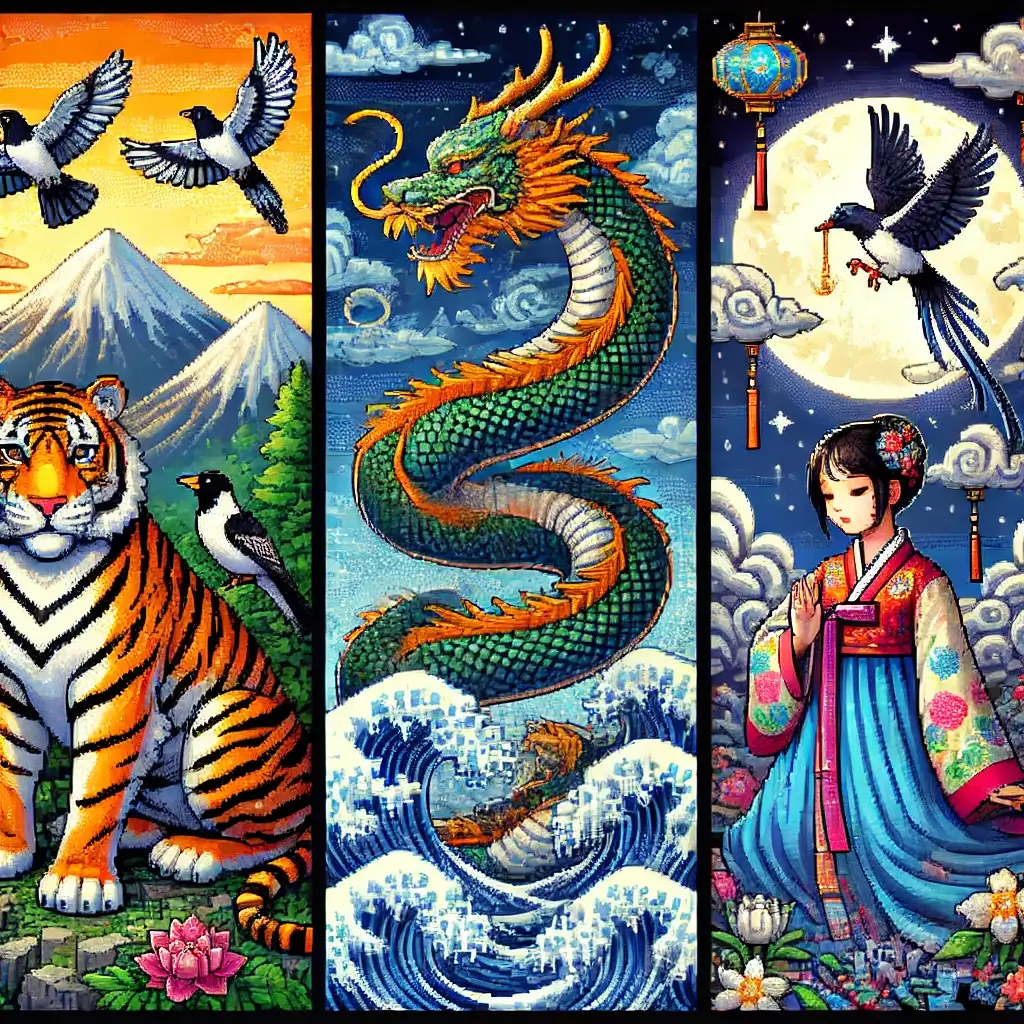
Animals in Korean stories can appear as protectors, rivals, ancestors or ambiguous figures. Their role depends on the particular tale or artwork. A symbol does not have one fixed meaning across every region and period.
Distinguish a tiger from its symbolic role
A tiger is a real animal that also appears in folklore and art. Depending on the work, it may be imposing, protective, comic or vulnerable. Describe the actual image and narrative rather than calling every tiger a mountain guardian.
Read dragons and bonghwang in context
Dragons are often associated with water and authority, while the bonghwang appears in auspicious and royal imagery. Those associations need an object-specific source. Avoid a simple claim that all Korean dragons are benevolent while another culture’s dragons are evil.
Keep foundation narrative and evidence separate
The bear is important in the Dangun foundation narrative. Present that account as a story with a textual history, rather than biological evidence of ancestry or a literal explanation of the origins of all Korean people.
Compare versions of the gumiho
The nine-tailed fox appears differently in older narratives and modern screen adaptations. Record which version you mean before drawing conclusions about gender, morality or romance. A contemporary drama may intentionally reverse familiar expectations.
A practical next step
Separate an animal motif, a narrative figure and a modern adaptation
A tiger in a painting, a bear in a narrative and a gumiho in a television adaptation belong to different kinds of evidence. Start by identifying the source and what sort of claim you want to make. A motif’s visual role is not the same question as a character’s action in a story.
For a comparison, choose two specific examples and describe one difference you can support. Attribute symbolism to the museum or literary source that explains it. Do not turn one version of a story into a statement about the beliefs of every Korean person.
| Compare | What to record |
|---|---|
| Evidence type | Artwork, text, oral account or modern adaptation. |
| Role | What does the animal or figure do in this example? |
| Interpretation | Which source supports the proposed meaning or comparison? |
A reader question: Does an animal’s symbolic association stay identical in every work?
No. It can vary with genre, period, setting and the surrounding narrative or composition. Name the work you mean and explain the association supported there. Similar animal imagery is a reason to compare examples, not to erase their differences.
Further reading: National Folk Museum of Korea: Encyclopedia of Korean Folk Culture. Check the specific entry, object, edition or current provider notice relevant to your question.
Editorial revision: October 20, 2026. Practice examples are editorial constructions. The discussion distinguishes documented information, interpretation and personal choice.