
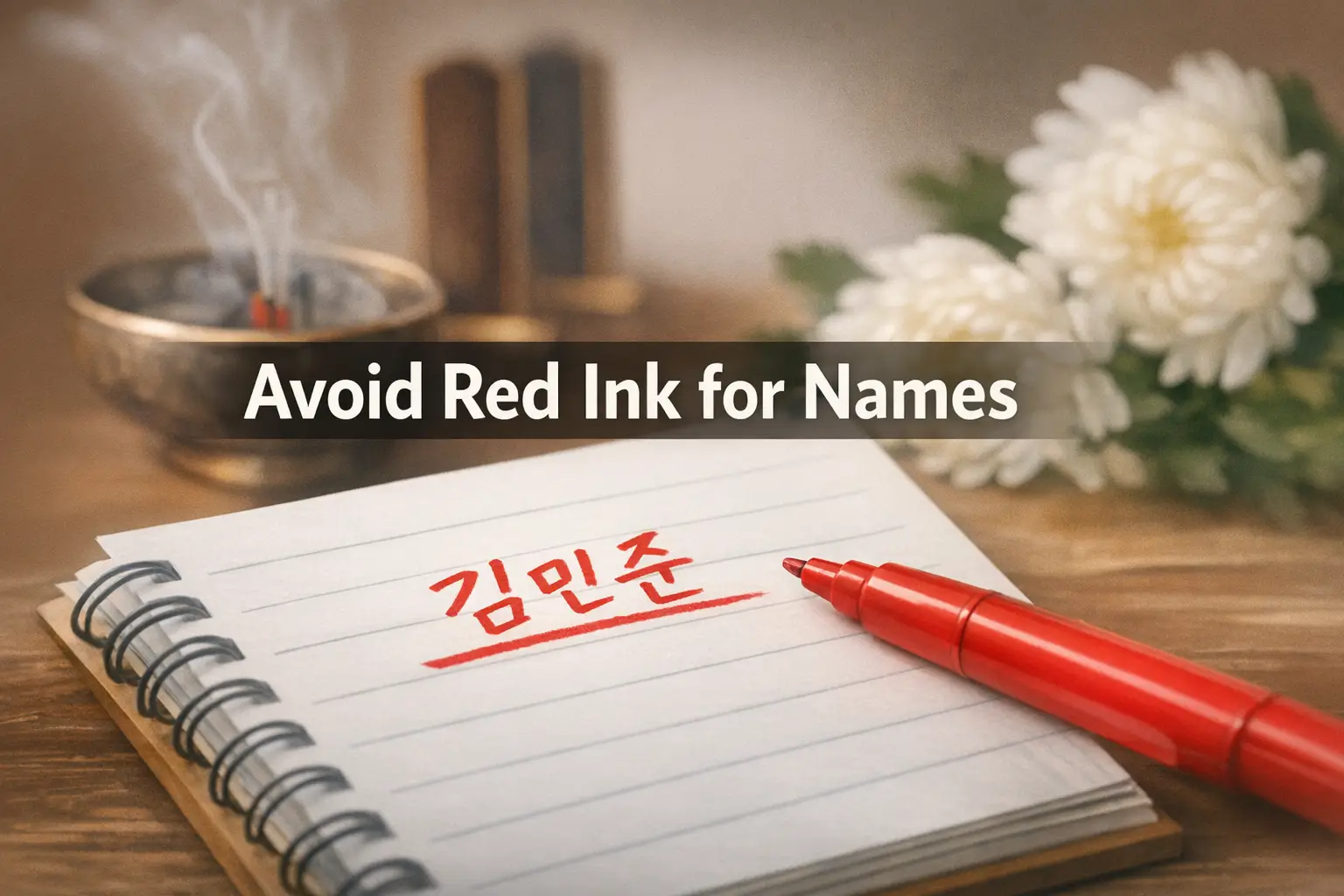
A red pen can cause more trouble in Korea than most foreigners expect.
Writing someone’s name in red still carries a quiet association with death, memorial notation, and bad luck in everyday social life. This isn’t about forbidden ink, but about unintended chills in festive moments like birthday cards, weddings, or office gifts.
In Korea, writing a living person’s name in red is widely seen as an inappropriate choice. This guide helps you navigate these social nuances, from classrooms to business settings, so you can avoid the “quiet correction” and keep your interactions warm.
Etiquette rarely announces itself with a siren; it shows up as a pause or a glance. Let’s get into the part that actually helps.
Contents — choose a section
Table of Contents
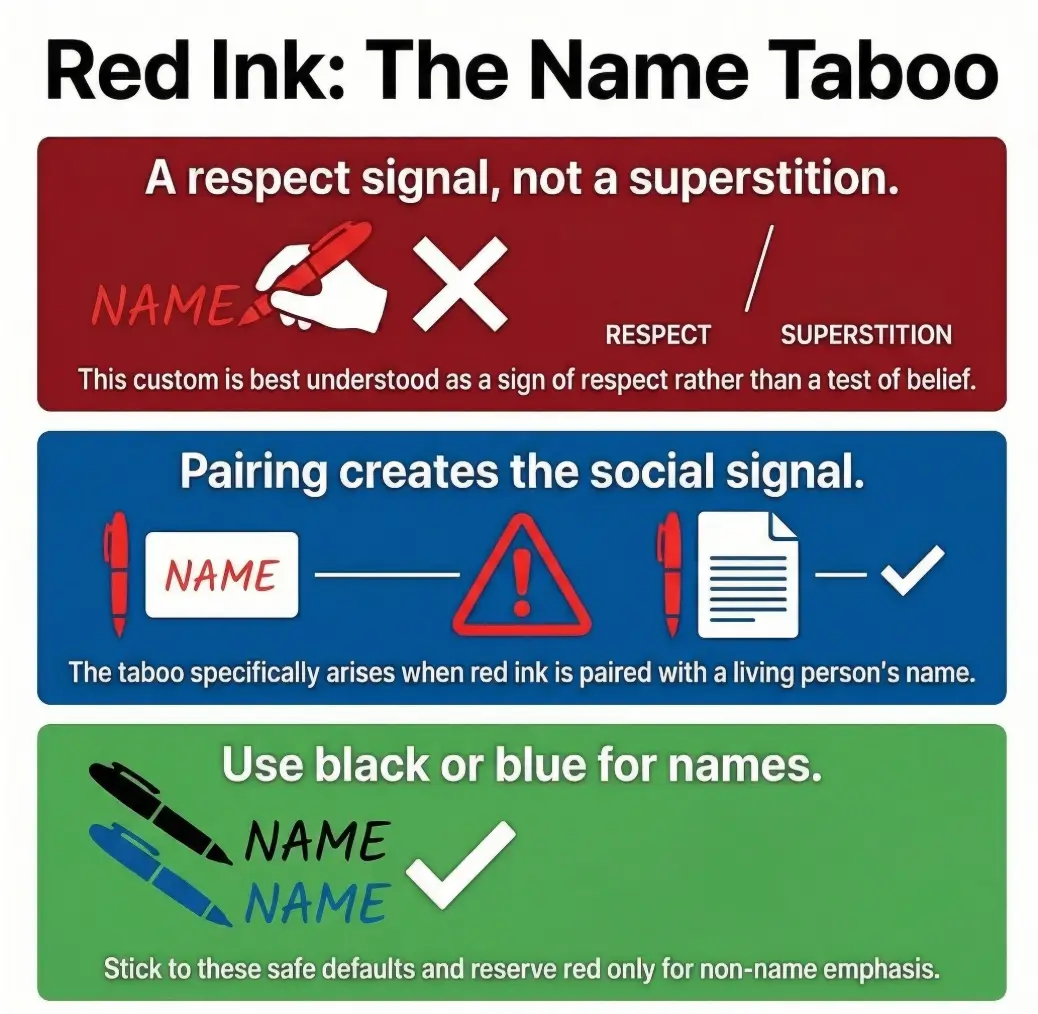
Fast Answer: In Korea, writing a living person’s name in red can feel unsettling because red ink has long been associated with death, memorial notation, and bad luck in certain contexts. Not everyone reacts the same way today, but the custom still carries emotional weight. For US readers, the safest rule is simple: avoid red ink for someone’s name unless you are absolutely sure the context makes it acceptable.
Start here first: who this is for / not for
This is for US travelers, expats, students, teachers, and anyone writing cards, notes, labels, or invitations in Korea
If you are the kind of person who likes getting the little things right, this topic is for you. Maybe you are bringing flowers to a Korean host family. Maybe you are a teacher labeling student folders. Maybe you are writing a farewell card at the office and grabbing the nearest pen without thinking. This custom tends to appear in moments that feel almost too ordinary to prepare for, which is exactly why people get caught by it.
This is for people trying to avoid small etiquette mistakes that create awkward moments bigger than the ink itself
That is the heart of it. The issue is rarely the pen. It is the message the pen accidentally sends. Etiquette is often like stage lighting. The audience may not notice it directly, but it changes the emotional tone of the entire scene. One red name can turn a warm note into something oddly cold.
This is not for legal name rules, official government paperwork, or handwriting analysis
We are talking about social meaning, not law. There is no dramatic police raid for using a red marker on a memo. This is cultural literacy, not compliance paperwork.
This is not for proving that every Korean person interprets red names the exact same way today
No culture is a machine with one button and one reaction. People differ by age, family habits, region, personality, and context. The practical goal is not to win an argument about universality. The goal is to avoid an easy, unnecessary misstep.
- It shows up in everyday writing, not just ceremonial moments.
- You do not need perfect cultural mastery to avoid it.
- A safer pen color solves the problem before it starts.
Apply in 60 seconds: Put one black or blue pen in your bag and make it your “Korea names” pen.
Etiquette checklist: Before writing a Korean person’s name, ask yourself three yes-or-no questions.
- Is this a living person’s name? If yes, move away from red.
- Is this a social item like a card, tag, list, or envelope? If yes, use black or blue.
- Is the red ink only for headings or warnings, not the name itself? If yes, context may be fine.
Neutral next step: if you answered yes to the first two, switch pen colors and keep moving.
Red ink first, discomfort second: why the reaction feels immediate
Why a simple pen color can trigger a cultural “something is off” feeling
Most etiquette reactions happen before logic arrives. A person sees the red name, pauses, and feels that faint internal tilt: something about this is not right. That pause matters. Humans do not experience symbols as spreadsheets. We experience them as atmosphere. A wedding ring, a black armband, a white flower, a stamp on an official form, a crossed-out name on a seating chart. Meaning reaches the body before the explanation catches up.
Constructed example: A coworker uses several pen colors on gift labels, including red for a personal name. Someone asks for a different color. Rewriting that label respects the stated preference without requiring a theory about everyone’s beliefs.
How symbolism travels faster than explanation in everyday etiquette
This is why foreigners often feel blindsided. In the US, pen color often reads as personality or organization. Red can mean grading, urgency, or decoration. In Korea, the color can carry older associations that are still legible even when nobody around the table gives you a history lecture. The signal arrives whole, like a melody people recognize even if they cannot name the key.
Why the issue is not grammar, but emotional association
There is no grammar mistake here. No sentence becomes incorrect because of scarlet ink. The problem is symbolic context. Think less “spelling error” and more “wearing funeral black to a beach proposal.” The clothing is not illegal. It just sends the wrong weather.
Useful rule of thumb: when a custom survives for a long time, it often survives as feeling first and explanation second. That is especially true with names, because names are not just labels. They carry personhood, status, memory, and relationship.
Show me the nerdy details
Taboos like this often persist because names sit at the intersection of language and ritual. Even when the original practice becomes less visible in daily life, the emotional residue remains. That is why younger people may describe the red-name issue as “kind of weird” or “better not” rather than giving a formal historical lecture. The custom has moved from documented practice into social instinct.
The old shadow behind it: where the red-name taboo comes from
How red names became linked with death records, memorial practices, and the deceased
A commonly repeated explanation associates red personal names with death or bad luck. This guide has not established a single primary historical origin for that association and does not present a specific record-keeping practice as proven. A practical color choice can respect a recipient’s preference without overstating the history.
What matters for a foreign reader is not the fantasy of a single origin story carved in stone. Customs often gather several roots over time. Ritual practice, written notation, folk belief, and family teaching blend together. Then the explanation compresses into one household sentence: “Don’t write a person’s name in red.” That sentence travels farther than the archive.
Why historical customs still linger long after people stop explaining them out loud
Because habit is sticky. Because grandparents teach grandchildren with three words instead of three pages. Because many of us inherit social reflexes long before we inherit the footnotes. Koreans are hardly unique in this. Americans also carry symbolic habits they cannot always unpack on command. People still hesitate over unlucky numbers, wedding colors, condolence language, and funeral flowers without needing a doctoral defense first.
Here’s what no one tells you: many etiquette rules survive as feeling before they survive as fact
This is the piece foreigners miss when they demand a courtroom standard of proof for every custom. Social meaning does not need to behave like a chemistry formula to matter. If enough people feel a symbol as unsettling, that feeling shapes real interactions. Etiquette lives in the soft tissue of daily life, not just in official records.
And there is another reason the custom lingers: names are intimate. A red title on a poster is one thing. A red personal name touches identity directly. In many cultures, names are where respect becomes visible. That is why the same red ink can feel harmless in one place and loaded in another.
Decision card: History certainty vs social caution
When A: You are unsure exactly how the taboo developed. Do this: still avoid writing living names in red.
When B: You know some younger people do not care much. Do this: still choose the safer default in mixed-age or formal settings.
Time/cost trade-off: It takes about 3 seconds to switch pens and can save a noticeably awkward moment.
Neutral next step: choose the option that reduces social friction, not the one that wins a debate.
Not every red word is forbidden: the nuance foreigners usually miss
Why red itself is not always negative in Korean culture
This is where simplistic explanations fall apart. Red is not a universally “evil” color in Korea. That claim is clumsy and wrong. Red can signal energy, intensity, visibility, celebration, passion, warning, or importance depending on the setting. It appears in design, branding, correction marks, notices, and seasonal imagery. The color itself is not the villain of this story.
When red can symbolize luck, energy, warning, celebration, or strong emphasis
Think of how colors work in your own culture. White can feel bridal, clinical, sacred, blank, expensive, or cold depending on where you place it. Red behaves the same way. In one context, it can brighten a holiday display. In another, it can scream hazard. In another, it becomes emotionally charged because it sits next to a person’s name. Context is the whole orchestra. The color is just one instrument.
A personal card can be thoughtful while containing a detail the recipient dislikes. Ask about the actual concern, change it if practical and avoid claiming that one reaction represents all Koreans.
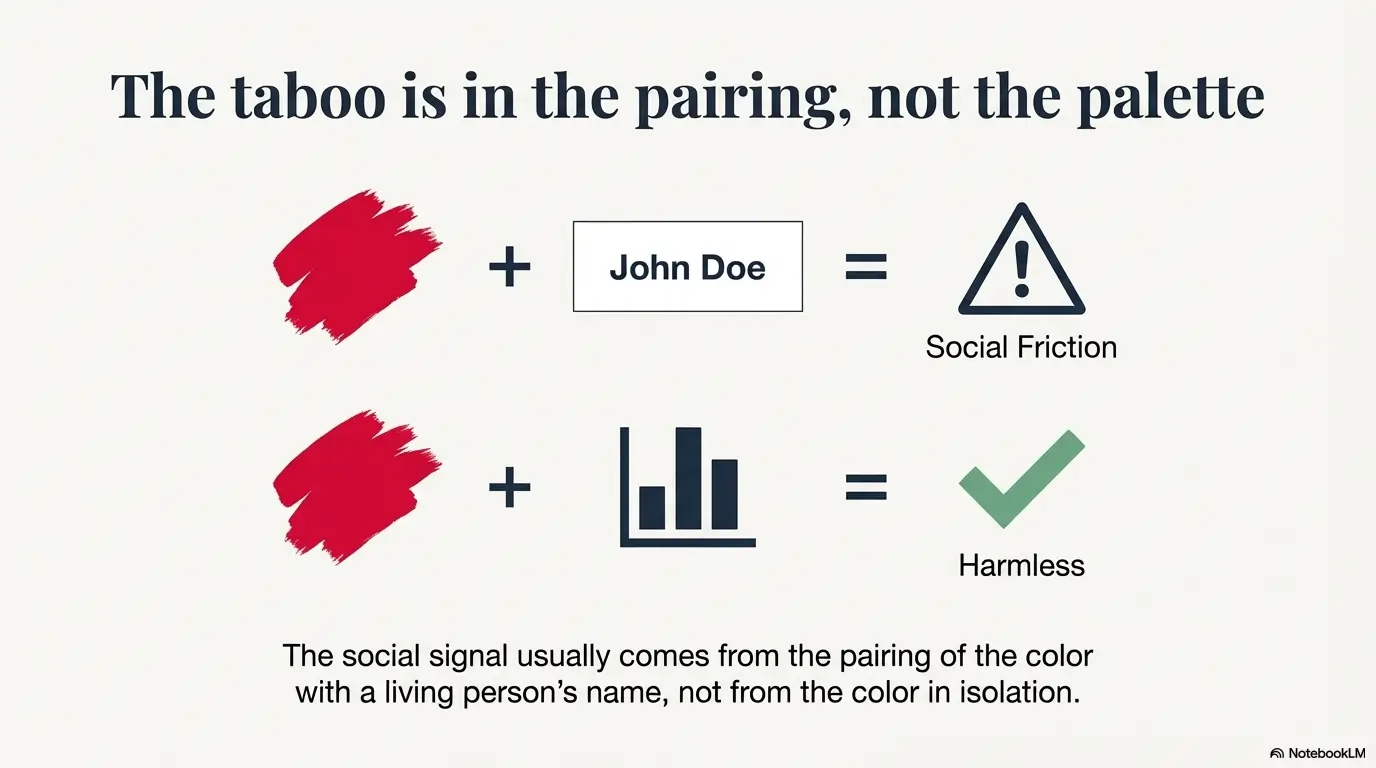
Why the problem is often the combination of red + a living person’s name, not the color alone
Exactly. Foreigners sometimes overcorrect and decide red is dangerous everywhere. It is not. The sharper rule is narrower and more useful: be careful with red when writing the name of a living person. That framing keeps you from making two mistakes at once: offending someone on one side, then becoming absurdly superstitious on the other.
Put differently: red on a warning label may be helpful. Red in a teacher’s markup may be ordinary. Red in a birthday card where someone’s name is highlighted like a memorial inscription is where the floor gets slippery.
- Do not turn the rule into “red is banned.”
- Do turn it into “red names are a bad default.”
- Context decides whether red feels festive, practical, or unsettling.
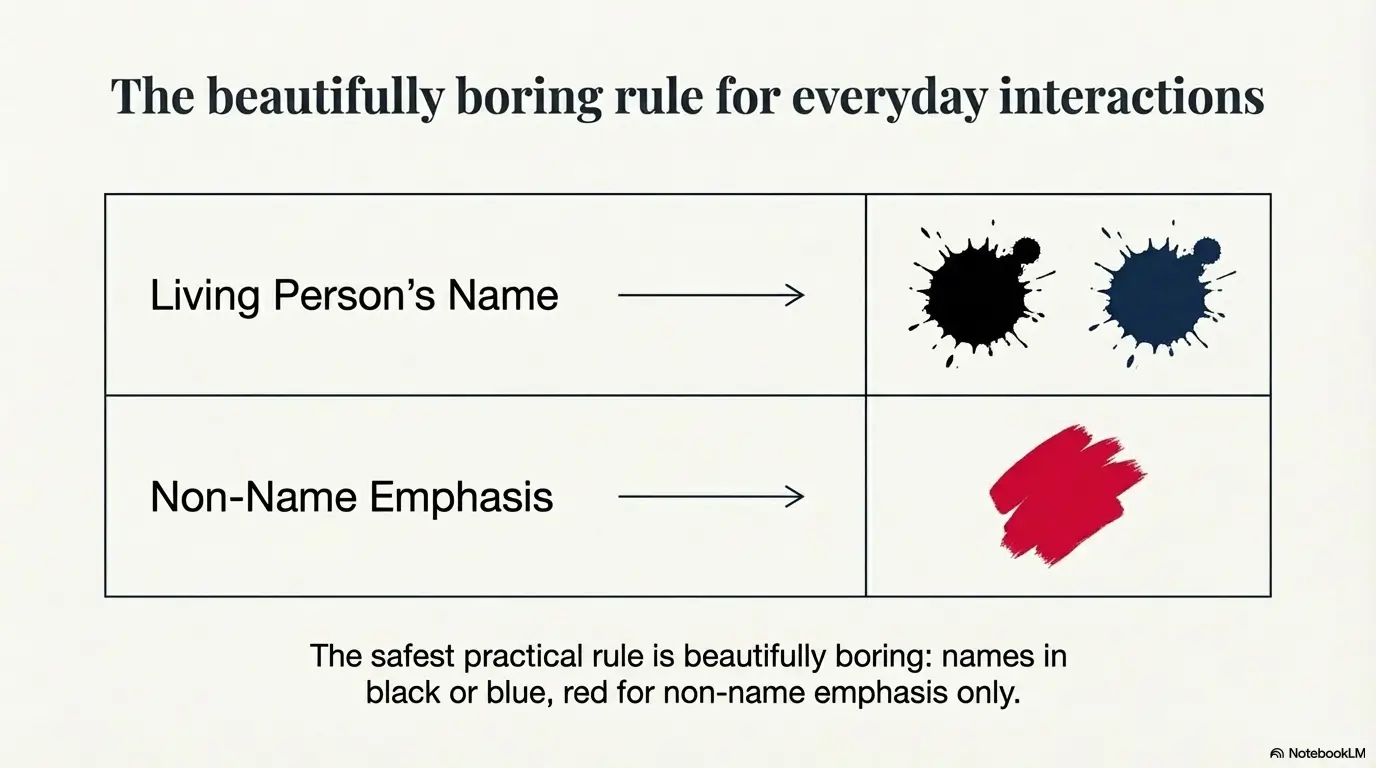
Apply in 60 seconds: Keep red for headers and highlights, and keep names in black or blue.
The real mistake zone: where foreigners accidentally cross the line
Writing names in red on greeting cards, class lists, seating charts, and office notes
These are the danger zones because they feel harmless. Cards and lists are exactly the kinds of items people personalize quickly. A red pen is often within reach. A teacher or manager may think color-coding improves readability. A designer-minded person may think the red name “pops.” And then the pop lands like a tiny curse. Not dramatic. Just wrong enough.
Using red marker for “design flair” without knowing the social signal
This happens constantly in cross-cultural settings. Someone reaches for aesthetics before they reach for context. I understand the temptation. Red can look lively. It photographs well. It adds visual hierarchy. But etiquette often punishes beautiful ignorance with the politest possible silence. That silence can be more confusing than open criticism because the writer assumes the choice worked.
Assuming “it’s just a color” in a culture where context quietly does the heavy lifting
The phrase “it’s just a color” is one of those sentences that sounds rational and behaves badly. Social life is made of things that are “just” something until they are not. Just a seat. Just a title. Just a bow. Just a form of address. Just a gift wrapping color. Then suddenly the whole mood changes. The price of learning etiquette is accepting that symbols do not need your permission to matter.
One practical way to think about it is risk asymmetry. There is very little upside to using red for someone’s name. There is some downside. That is enough to decide. Smart travelers do this all the time. They do not test every custom to destruction. They choose the low-drama path and save their energy for the train schedule.
Before you write any public list with names, gather this first:
- The purpose of the list: celebration, admin, classroom, workplace, event
- The age mix of the audience: peers only, mixed generations, elders present
- The safest available pen colors: black, blue, dark neutral
- Whether red is needed only for headings, not names
Neutral next step: set up your formatting before you start writing names.
Let’s be honest… most awkward moments happen in ordinary places
Birthday cards, farewell notes, and school messages
These are classic trapdoors because they invite warmth and decoration. When people are trying to be sweet, they often get more colorful, not less. A foreign teacher may write student names in red stars. A coworker may sign a farewell board with a bright marker set. A friend may letter a birthday card beautifully, only to discover the one color that felt festive reads oddly funereal. Culture enjoys this kind of irony a little too much.
Workplace sign-in sheets, church rosters, and community lists
Office lists may be read by people with different preferences. A neutral color is an easy default for personal names, while status or instructions should be stated explicitly rather than encoded by a guessed cultural color rule.
Gift tags, wedding envelopes, and handwritten labels
If there is one place to be extra conservative, it is anywhere gifts, family, or ceremony are involved. Weddings, milestone birthdays, formal thank-you notes, and gift labels can magnify symbolic choices. Nobody wants their careful gesture to arrive with a strange aftertaste. The whole point of these objects is relational goodwill. Why add static to the signal? This is especially true if you are already learning adjacent customs around Korean wedding cash gift etiquette or broader Korean wedding expectations.
Illustrative scenario, not a reported event: A graduate student learns that a recipient dislikes a name written in red. The student rewrites it in blue and checks the remaining labels. The correction is small and does not need an exaggerated apology.
When she showed the finished set to a Korean classmate, the classmate paused, smiled in that brave, helpful way people do when they are deciding how much honesty the moment can bear, and said, “These are beautiful. But maybe not the red names.” The student was mortified for about thirty seconds, then grateful for years. They reprinted the tags together at a campus printer, laughed about how culture hides in stationery, and the dinner went beautifully. The part she remembered most was not the embarrassment. It was the rescue.
Generational gap or living custom: does everyone in Korea still care?
Why older Koreans may react more strongly than younger people
Older people often carry stronger, more explicit memories of etiquette rules transmitted through family and school. For them, the red-name issue can feel less like a vague preference and more like a plain social fact. What may strike a 24-year-old as “better to avoid” may strike a 70-year-old as jarringly inappropriate. That difference is not irrational. It reflects the era and environment in which social meaning was learned.
Why younger Koreans may know the custom and still prefer you avoid it
This is the subtle point many foreigners miss. Even when younger Koreans are not personally superstitious, many still understand the association and would rather not see their name written in red. Why? Because modernity does not erase emotional residue on command. Also because people know customs do not exist in isolation. Even if they themselves do not mind, someone else around them might.
Why “some people don’t mind” is not the same as “the rule is gone”
This is the sentence I wish more travelers memorized. Social rules do not vanish because exceptions exist. In fact, exceptions are exactly why caution remains wise. If a custom is disappearing, it often disappears unevenly. Family by family, office by office, generation by generation. That makes the safe default more useful, not less.
I have heard people say, with great confidence, “Young Koreans don’t care about that anymore.” Maybe some do not. But confidence is cheap, and replacement cards are annoying. The better question is not “Can I find someone who won’t mind?” It is “What choice is considerate across the broadest range of people?”
- Older Koreans may react more strongly.
- Younger Koreans may still prefer you avoid it.
- “Some don’t mind” is not a reliable etiquette strategy.
Apply in 60 seconds: In any mixed-age or unfamiliar setting, write names in black or blue and remove the guesswork.
Don’t test this casually: common mistakes that make a small issue bigger
Treating the custom like a joke to prove you are modern or rational
This almost never lands well. Mocking a custom you barely understand is a fast way to make yourself the real subject of the conversation. Cross-cultural grace is not about performing intellectual superiority over local habits. It is about deciding that respect is cheaper than ego. The joke may get a laugh from one person and close a door with another. That is a bad exchange rate.
Doubling down after someone looks uncomfortable
Once a Korean friend or colleague hints that the red name is awkward, the best move is easy: thank them, switch the pen, move on. Do not deliver a TED Talk about color theory. Do not explain how in your country red means love. Do not become the defense attorney for a marker. The moment is too small for a courtroom and too human for a debate. A quiet recovery matters here in much the same way it matters when learning Korean indirect communication or choosing the right Korean apology phrases.
Confusing lack of confrontation with lack of offense
This might be the most important practical point in the whole article. Many people will not openly correct you, especially in professional or polite settings. They may simply absorb the discomfort, edit around it, or mention it later to someone else. Foreigners often mistake this restraint for approval. It is not. It is restraint.
Politeness can be a fog machine. It makes the room look calm while the furniture is still there. When in doubt, do not read silence as a green light. Read it as a reason to prefer lower-risk behavior next time.
One tiny color, one big signal: why this matters in relationships
How small etiquette choices communicate care, respect, and cultural effort
People rarely expect foreigners to know everything. What they notice is effort. Small adjustments, especially unglamorous ones, often communicate more respect than loud declarations of admiration for the culture. Choosing a different pen color is not a grand gesture. That is exactly why it works. It says: I paid attention. I did not need to be corrected twice. I understand that your comfort matters even when the issue looks minor from the outside.
Why people often remember the intention behind the correction more than the mistake itself
The good news is that most red-name mistakes are recoverable. In fact, how you respond can leave a better impression than if you had never slipped at all. A simple “Thanks for telling me, I’ll change it” can do more for trust than a defensive explanation ever could. Relationships are not built from flawless performances. They are built from decent recoveries.
Let’s be honest… cross-cultural trust is often built through details that seem trivial at first
The grand narrative of travel loves big moments. New cities. Big meals. Monumental views. But trust usually grows through details so small they almost look ridiculous on paper. Which form of address you use. Whether you remove your shoes. How you hand over a business card. What color ink you choose for a name. A relationship is often a thousand little stitches, not one cinematic speech. The same principle shows up in seemingly unrelated customs, such as handing over money gifts and business cards politely or learning basic Korean honorifics for foreigners.
Years ago, a friend in Korea told me something I still think about: “People remember whether you made them relax.” That line is more useful than many etiquette books. Choosing a safe pen color is not about obeying folklore. It is about helping the other person stay relaxed in your presence.
Practical check: Use the specific questions below. A quick score or a visual impression cannot establish the right choice for every person or setting.
What to do instead: safer writing choices that work almost everywhere
Use black, blue, or dark neutral ink for names
This is the simplest answer because it works. Black is formal, clean, and widely safe. Blue is also common and generally comfortable. Dark gray can work in design-heavy contexts where you want a softer look without wandering into symbolic trouble. If your only goal is to avoid awkwardness, black wins by a mile.
Reserve red for highlighting titles, warnings, or visual emphasis, not personal names
You do not need to ban red from your life. Just move it away from living names. Use it for headings, arrows, reminders, priority marks, holiday accents, or section dividers. Let the color do useful work where it does not risk misfiring socially.
When in doubt, choose legibility and restraint over decoration
One of the quiet truths of etiquette is that restraint ages well. Decorative instincts are wonderful until they collide with a symbol you did not know carried baggage. When working across cultures, clean and readable usually beats clever. I say this as someone who has definitely overdesigned a card before. Sometimes the most elegant choice is the one that does not ask to be admired.
- Black is the least risky default.
- Blue usually works well too.
- Restraint often reads as respect.
Apply in 60 seconds: Separate your pens by function: one for names, one for highlights.
But what about teachers, editors, and pens in daily life?
Why red correction marks do not automatically carry the same meaning as writing a person’s name in red
Because context changes the job the color is doing. In schools and offices, red is often used to correct, highlight, or organize information. A red circle around an error or a red comment on a draft does not usually send the same signal as writing a person’s name itself in red. The taboo is not “red exists on paper.” The taboo is more specific.
How context changes the message in schools, offices, and documents
If a teacher writes a note in red on an assignment, most people read that as instructional. If a designer uses red for headings in a slide deck, people read that as visual hierarchy. If someone writes a living person’s name in red on a congratulatory message, the symbolic needle swings in a different direction. Same pigment. Different meaning. The social charge lives in context.
Why the same color can feel neutral in one place and loaded in another
This is true beyond Korea, of course. A flower can be romantic or funerary depending on where it appears. Silence can be respectful or hostile depending on the room. Colors behave the same way. This is why reductionist advice fails. You do not need one giant rule for red. You need one precise rule for names, then a broader awareness that context still matters.
For teachers and office workers, the practical compromise is simple. Keep red for markup, reminders, and category labels. Keep personal names in black or blue, especially in messages meant to honor, greet, welcome, or thank someone. That keeps your system functional without stepping on a cultural landmine the size of a paperclip.
Common mistakes: what people get wrong when explaining this custom
Saying “Koreans think red is evil,” which is too simplistic
This statement flattens a living culture into a cartoon. Red is not simply “evil.” It can be vivid, useful, celebratory, or cautionary. The issue is contextual and relational. A broad statement like this may sound tidy, but it teaches the wrong lesson and makes learners more confused later.
Saying “nobody cares anymore,” which is often too confident
This is the opposite error and it is just as unhelpful. Plenty of people still care, and many more still prefer you avoid it even if they would not stage a protest in the break room. Cultural habits do not vanish because a few urban twenty-somethings roll their eyes at them. Social meaning can be weaker than before and still very present.
Explaining the custom without separating history, modern practice, and personal sensitivity
A better explanation uses three layers. First, there is the historical association with death, memorial practice, or bad luck. Second, there is modern practice, where reactions vary but awareness remains common. Third, there is personal sensitivity, which changes by individual and situation. Put those together and you get a helpful answer. Ignore any one of them and you get one of those internet explanations that sounds neat and leaves readers worse off.
That is why the most truthful summary is also the least theatrical: not everyone reacts the same way, but enough people do that avoiding red names is still the considerate choice. It is not dramatic. It is not mystical. It is simply useful. The same caution helps when navigating emotionally loaded settings like Korean funeral etiquette for foreigners or understanding related customs around Korean condolence money.
FAQ
Is writing someone’s name in red always offensive in Korea?
Not always. Reactions vary by person, age, and context. But it can still feel unsettling or inappropriate enough that avoiding it is the safer, more respectful choice. If your goal is smooth social interaction, “not always offensive” is not a strong enough reason to use it.
Do younger Koreans still believe writing a name in red is bad luck?
Some do, some do not, and many sit in the middle. They may not personally frame it as bad luck, but they still recognize the custom and prefer that people avoid it, especially in formal or mixed-generation settings.
Why is red associated with death in this context?
Many accounts explain the discomfort through an association with death or bad luck. The precise historical pathway is not established here. Reactions vary, so use a neutral color for someone’s name when their preference is unknown, rather than presenting one origin story as settled fact.
Can I use red ink for holidays, decorations, or emphasis?
Yes, often. Red can be perfectly normal for headings, warnings, decorative accents, or festive design. The main caution point is using red for a living person’s name, especially on personal or formal items. That broader pattern also appears in seasonal situations where etiquette matters more than tourists expect, such as Seollal etiquette for foreigners or Chuseok etiquette for foreigners.
What should I do if I already wrote someone’s name in red?
Do not panic. If possible, rewrite it in black or blue. If someone points it out, thank them and fix it without making a speech. Most people respond well to simple, respectful correction.
Is this taboo unique to Korea or found elsewhere in Asia too?
Similar red-name associations appear in other cultural contexts too, although the meaning and strength can differ. That is another reason not to assume your own color logic travels cleanly across borders.
Does it matter in business settings more than casual settings?
It can matter in both, but business settings often make the issue more visible because names, titles, lists, and first impressions matter so much. Formality tends to reward safer defaults.
Are there exceptions for art, design, or classroom corrections?
Yes. Red in visual design or correction marks does not automatically carry the same message. Context matters. The safest distinction is between using red as a general visual tool and using red specifically for the name of a living person.
Correct a red-ink name without turning it into a confrontation
If you write someone’s name in red and they seem uncomfortable, switch to black or blue and say briefly that you did not realize their preference. You do not need to debate the belief’s origin to respond considerately. For a group activity, providing neutral-colored pens can avoid the issue without singling anyone out. Distinguish writing a person’s name from using red for a correction mark, graphic design or an unrelated label; context matters.
A reader question: Does every Korean object to red ink?
No. Preferences and interpretations vary. Avoid presenting one reaction as universal, and choose an ordinary neutral color when you do not know the recipient’s preference.
Next step: the easiest etiquette win to keep
Before writing a Korean name on a card, envelope, label, or note, switch to black or blue ink and remove the decision entirely
That is the whole move. Tiny, unglamorous, effective. If the hook of this article was the mystery of how a pen can change a room, this is the answer: because names are emotional objects, and colors can lean on those emotions harder than foreigners expect. The best way to handle that truth is not with anxiety, but with a system. Black or blue for names. Red for emphasis elsewhere. No drama required.
There is a quiet pleasure in learning customs like this. They remind us that respect is often material. It lives in paper, tone, spacing, shoes at the door, how we pass a bowl, where we place a business card, which pen we reach for before the words begin. Travel gets marketed as a parade of spectacular moments, but friendship usually enters through the side door, carrying stationery.
So here is your honest fifteen-minute next step. Open your pencil case, desk drawer, or work bag. Put one black pen and one blue pen somewhere easy to grab. Move your red pen into the “headings only” category. Then forget about the issue until you need it. The point of etiquette is not to make you nervous. It is to make other people more at ease around you. That is a beautiful return on a very small investment.
Last reviewed: 2026-03.
Practical example and reader question added October 20, 2026. Existing source dates are retained; this addition is not a fresh verification of every earlier claim.