

Bridging the Silent Gap: Decoding Korean-U.S. Cross-Border Workflows
At 10:07, everyone nods; by 4:00, one team is building a launch timeline and the other believes the decision is still parked. That gap is where cross-border projects quietly burn budget. In Korean indirect communication in the workplace, phrases like “Let’s think about it” often carry social precision, not indecision.
The pain isn’t grammar—it’s governance. U.S. teams read speed cues; Korean teams often protect alignment, hierarchy, and face before committing publicly.
“Yes-like” language can mask unresolved approval paths, and polite silence can mean active internal review. Keep guessing, and you pay in rework and strained trust.
This guide helps you decode indirect signals, separate acknowledgment from commitment, and turn ambiguous meetings into clear next steps—without forcing confrontation. You’ll get practical response scripts, low-pressure follow-up phrasing, and a simple decision frame built around owner, date, scope, and approval path.
The Method:
Read context first, clarify with options, confirm in writing, then repair cadence if needed.
Politeness is not the opposite of clarity.
Ambiguity is not failure—it’s a process signal.
Once you see the pattern, you can translate it into action fast.
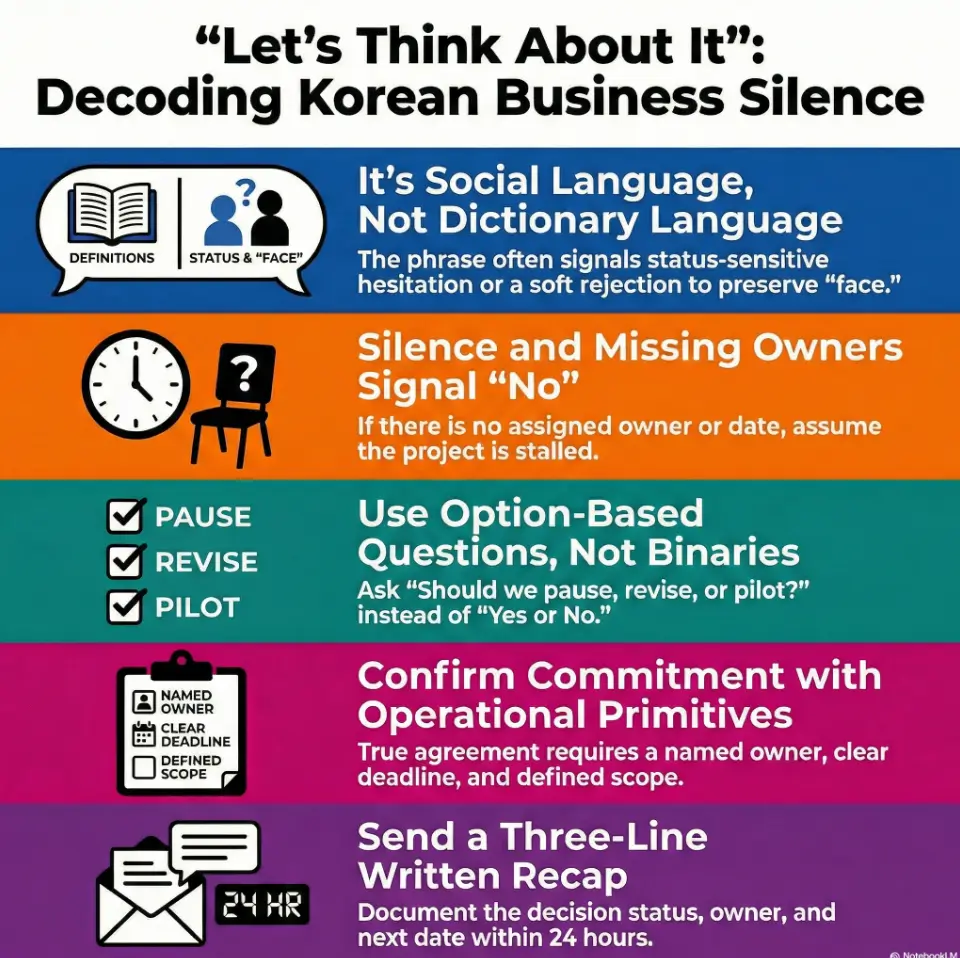
In many Korean workplaces, “Let’s think about it” often signals polite hesitation, status-sensitive delay, or a soft “no” rather than neutral brainstorming. Meaning depends on hierarchy, timing, and tone. The safest move: confirm intent with low-pressure follow-ups, offer options, and document next steps. Don’t force direct confrontation—read context, preserve face, and translate ambiguity into clear action items.
Table of Contents
What This Phrase Signals: “Let’s Think About It” Is Often a Decision, Not a Delay
Literal meaning vs workplace meaning in Korean corporate culture
Literal English invites open-ended analysis: gather data, compare options, decide later. In many Korean workplace contexts, the same phrase can carry a different job: reducing friction while signaling reluctance. It’s less “we’re undecided” and more “we are not ready to commit under current conditions.” This protects relationships when direct refusal might embarrass someone, especially in mixed seniority settings.
A small memory: years ago, I watched a cross-border launch call where a U.S. PM heard “we’ll think about it” as a green light with caveats. The Korean side heard it as a polite boundary. Nobody lied. Both sides were coherent inside their own communication logic. The gap appeared because the phrase was treated as dictionary language, not social language.
Why indirect language protects relationships, hierarchy, and team harmony
In high-context environments, preserving team stability often outranks verbal bluntness. A direct “no” can create public loss of face, signal disrespect, or lock people into defensive positions. Indirect phrasing buys time, lowers emotional temperature, and leaves room for future collaboration. It also protects juniors who cannot openly contradict seniors in group settings, even when operational concerns are real.
Let’s be honest… sometimes this is the final answer, politely packaged
Sometimes “later” means “no.” Not always. But often enough that treating it as neutral delay creates costly rework. If there is no owner, no date, and no decision path attached to the phrase, assume hesitation until proven otherwise. In busy organizations, ambiguity defaults to inaction. That is not failure—it is a risk signal.
- Interpret phrase + hierarchy + timing together.
- Look for ownership and due date before calling it progress.
- Treat ambiguity as a cue to clarify gently, not push harder.
Apply in 60 seconds: Ask, “Would you prefer we pause, revise, or prepare a smaller pilot?”
Context First, Words Second: How Power Distance Changes the Meaning
Same phrase, different meaning from a manager vs a peer vs a client
If a senior manager says “let’s think about it,” it may function as a soft stop. If a peer says it, it may indicate uncertainty or dependency on another approver. If a client says it, it can be diplomatic risk management: “not now, but keep trust warm.” Same words. Different authority paths.
A practical trick: ask yourself who can actually authorize next steps. If the speaker cannot approve budget, legal scope, or staffing, the phrase likely means “needs internal escalation.” That is not rejection. It is workflow reality.
How meeting format (group vs 1:1) shifts the real intent
Group meetings reward social harmony. One-on-one channels reward precision. In group calls, indirect language can protect multiple stakeholders at once. In private follow-up, clarity often increases by 30–50% because face risk is lower. If a decision is sensitive, move from public thread to private alignment before final recap.
Timing clues: immediate response, delayed response, or no response
Timing is data. Immediate “let’s think about it” can mean instant discomfort with scope. A delayed version after internal review often means priorities changed. No response after a recap may indicate unresolved ownership. Calendar behavior matters too: if follow-up slots keep slipping, treat it as a signal to shrink scope or reframe value.
Show me the nerdy details
In cross-cultural project operations, ambiguity has compounding cost. A single unclear decision can trigger duplicate work streams, conflicting assumptions, and delayed dependencies. Teams reduce this by converting linguistic ambiguity into operational primitives: owner, deadline, dependency, and escalation path. The phrase itself is less predictive than whether these four primitives appear within 24–48 hours after discussion.
Hidden “No” Patterns: 7 Signals You’re Getting Soft Rejection
“Let’s revisit later,” “It may be difficult,” “We’ll review internally”
These are classic buffer phrases. Individually, any one might be neutral. Together, they often point to a low-probability path under current framing. Instead of debating the phrase, diagnose the blocker category: resources, risk, hierarchy, timing, or misalignment with internal goals.
Agreement sounds that are not agreement (“Yes, yes” without commitment)
Verbal assent can signal listening, not commitment. In multilingual environments, backchanneling gets mistaken for approval all the time. If there is no confirmation of owner/date/deliverable, you do not have operational agreement yet. You have conversational smoothness—which is valuable, but different.
Silence after meetings: when follow-up becomes the real conversation
Silence is not empty. It can mean internal debate, political caution, or concern about feasibility. I once watched a team send three escalating reminders in two days. Result: less trust, slower response. Another team sent one respectful summary with options and a clear “no-pressure” path. They got a concrete answer in 36 hours. Pressure is not the same thing as progress.
- Watch for repeated defer-language across channels.
- Separate politeness cues from commitment cues.
- Use follow-up to reveal blockers, not to force speed.
Apply in 60 seconds: Send one recap asking for the “main blocker category” with three options.
A: Keep current proposal if stakeholder concern is mainly timing and you can shift launch date by 1–2 weeks.
B: Reframe to pilot if concern is risk, visibility, or senior approval; pilots lower exposure and speed decisions.
Neutral action: Choose A or B in your next recap and request one sentence of rationale.
Don’t Push for “Yes” Too Fast: The Mistake That Closes Doors
Why direct pressure can be read as disrespect, not efficiency
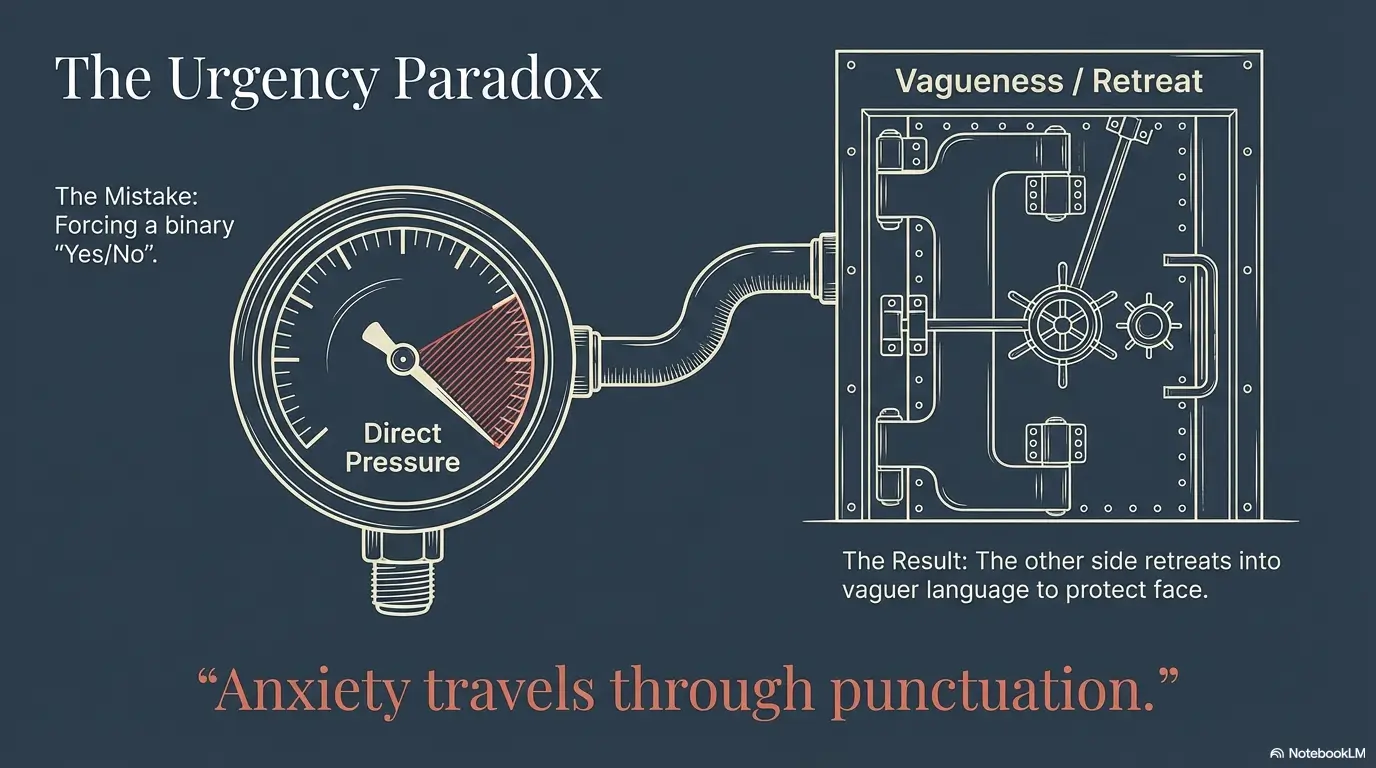
In some U.S. teams, urgency equals competence. In many Korean settings, urgency without relational framing can look careless or status-insensitive. The paradox: the more aggressively you chase clarity, the less clarity you may receive. People protect themselves with vaguer language when they feel cornered.
How to ask for clarity without causing face loss
Use option-based questions, not binary traps. “Can we do this, yes or no?” invites defensive responses. “Which path is easier for your team this month: pause, revise, or pilot?” invites collaboration. Face is preserved because the other side can choose without public contradiction.
Safer phrasing: option-based questions that keep trust intact
- “Would it help if we reduce scope to one function first?”
- “Should we route this through senior review before finalizing?”
- “Would next Thursday be better for a decision checkpoint?”
- “Which concern should we solve first: timeline, budget, or risk?”
A little humor helps too. One PM I coached said, “I’m allergic to ambiguous timelines, but we can treat it with a tiny pilot.” Everyone laughed. Tension dropped. Decision quality improved. You don’t need a perfect phrase. You need a phrase that lowers defensiveness by 10%.
Email vs Meeting Language: Where Meaning Gets Lost for US Teams
Why English translations flatten Korean intent
Business English often compresses social nuance. Phrases that carry caution, hierarchy, and relationship management in Korean can sound merely vague in English. This flattening creates false confidence. Teams think, “We heard yes-ish language,” while the original intent was “not yet under current constraints.” If your team is already documenting broader Korean culture context for global colleagues, this section should sit next to that playbook.
“Noted” vs “Approved”: commitment language you should confirm
“Noted,” “understood,” and “we’ll review” are not commitment words. Treat them as acknowledgment states. Commitment language includes explicit owner, due date, deliverable, and approval scope. If one of these is missing, your project risk rises quietly.
Documentation habits that reduce ambiguity across time zones
Use a recap format with three lines only: decision status, owner, next date. Keep it short enough to read on mobile in under 40 seconds. In distributed teams, clarity loses if the recap is long, emotional, or overloaded with side points.
- Owner named? Yes/No
- Decision date named? Yes/No
- Scope clearly stated? Yes/No
- Approval path identified? Yes/No
- Written recap acknowledged? Yes/No
Neutral action: If you have fewer than 3 “Yes,” classify as “in discussion,” not “approved.”
Micro-Translation Toolkit: What to Say Back in the Moment
Response scripts for “soft no,” “not now,” and “needs senior approval”
When someone says “let’s think about it,” your next sentence should reduce risk, not increase pressure. Here are field-tested scripts:
- Soft no suspected: “Thanks, that helps. To make this easier, would a smaller pilot be more practical?”
- Not now: “Understood. Is there a better timing window this quarter we should target?”
- Senior approval needed: “Would it be useful if we prepare a one-page brief for leadership review?”
Clarifying questions that sound collaborative, not confrontational
Use “what would make this easier?” instead of “why can’t we do this?” One asks for partnership. The other asks for defense. In cross-cultural work, that tiny shift can save two weeks of friction.
Here’s what no one tells you… your tone matters more than your words
Same sentence, different tone, opposite outcome. If your message feels like a compliance check, people retreat. If it feels like joint problem-solving, people share real constraints. A manager once told me, “Your wording was fine; your tempo was the issue.” That was painfully true. I was writing fast because I was anxious. Anxiety travels through punctuation.
Show me the nerdy details
Tone calibration can be operationalized with three variables: sentence length, hedge level, and action framing. Short sentences plus hard verbs (“need,” “must,” “confirm now”) increase perceived pressure. Moderate hedging (“would it help,” “if useful”) plus option framing tends to preserve agency. Use one clear ask per message; multiple asks create cognitive load and reduce reply quality.
Who This Is For / Not For
For: US managers, PMs, recruiters, founders, and client-facing teams
If your calendar has cross-border calls, vendor approvals, hiring loops, or client updates, this guide is for you. Especially if your team ships fast and assumes silence means green light. It doesn’t always.
For: Korean professionals working with direct-communication cultures
If you often think, “I already implied this clearly,” and your global counterpart still misses it, this framework helps translate intent into operational language without losing courtesy. Teams onboarding foreign hires often pair this with practical etiquette explainers such as Korean bowing (jeol) basics and Korean honorifics in business communication.
Not for: legal disputes, HR investigations, or formal conflict mediation
This is practical communication guidance, not legal advice, HR case handling, or investigative protocol. For those contexts, use formal company policies and qualified professionals.
| Tier | Use case | Recommended action |
|---|---|---|
| 1 | Routine updates | Simple recap with owner/date |
| 2 | Light ambiguity | Option-based question |
| 3 | Cross-team dependency | 1:1 clarification + recap |
| 4 | Senior approval needed | Brief for leadership path |
| 5 | High-stakes external impact | Formal governance cadence |
Neutral action: Label your current situation Tier 1–5 before choosing wording.
Common Mistakes (And What To Do Instead)
Mistake #1: Treating politeness as uncertainty
Politeness is sometimes clarity in a different format. If you mistake it for indecision, you’ll over-forecast delivery and under-manage risk.
Mistake #2: Assuming silence means agreement
Silence can mean “still reviewing,” “not comfortable,” or “waiting for senior input.” It rarely means “fully approved, proceed.”
Mistake #3: Escalating too early in public channels
Public escalation can trigger defensiveness and freeze honest feedback. Private clarification first, then structured escalation if needed.
Mistake #4: Asking binary yes/no questions in high-context moments
Binary framing creates social risk. Option framing creates collaborative room.
Mistake #5: Skipping written recap after verbal alignment
If it isn’t recapped, it drifts. Written recap is not bureaucracy; it is memory externalization across time zones and languages. Teams building global onboarding docs can also cross-reference high-context Korean words that carry cultural meaning and polite vs casual Korean register choices.
- Move from phrase interpretation to decision design.
- Ask one collaborative clarification, not three forceful reminders.
- Recap every ambiguous conversation in writing.
Apply in 60 seconds: Create a reusable recap template with status + owner + date.
Cross-Cultural Repair Moves: When You Already Misread the Signal
How to recover after over-pushing or misframing urgency
Good news: trust is repairable. Bad news: not with one heroic sentence. If you over-pushed, acknowledge impact briefly, then switch to option-based planning. Keep your tone calm and specific. Avoid dramatic apologies that force emotional labor on the other side.
One client team I supported made this exact mistake during a product rollout. They sent four urgent nudges in one day. Response quality collapsed. We reset with a single message: “Thank you for the candid feedback. We’ll pause and propose two lower-risk paths.” Replies resumed within 24 hours. Repair is cadence, not charisma.
A face-saving reset message template for Slack/Email
Template:
“Thanks for your patience on this. We may have pushed too quickly on timing. To support your process, we can either (A) pause and revisit on [date], or (B) run a limited pilot with reduced scope. Please choose whichever is easier for your team, and we’ll align accordingly.”
Rebuilding trust with cadence, not one perfect sentence
Use predictable, low-pressure check-ins (for example, once every 5 business days) instead of reactive bursts. Reliability beats intensity. Over time, consistent tone plus clear recaps rebuilds credibility faster than persuasive language.
Short Story: The Tuesday Reset (120–180 words)
On a gray Tuesday, a U.S. product lead called me after a rough partner meeting. “They keep saying maybe. We keep hearing yes. I’m exhausted.” We opened the transcript and circled every “we’ll review,” “let’s think,” and “might be difficult.” Not one line had an owner or date. No wonder both sides felt frustrated. We drafted a 7-line reset note with two options and one decision checkpoint.
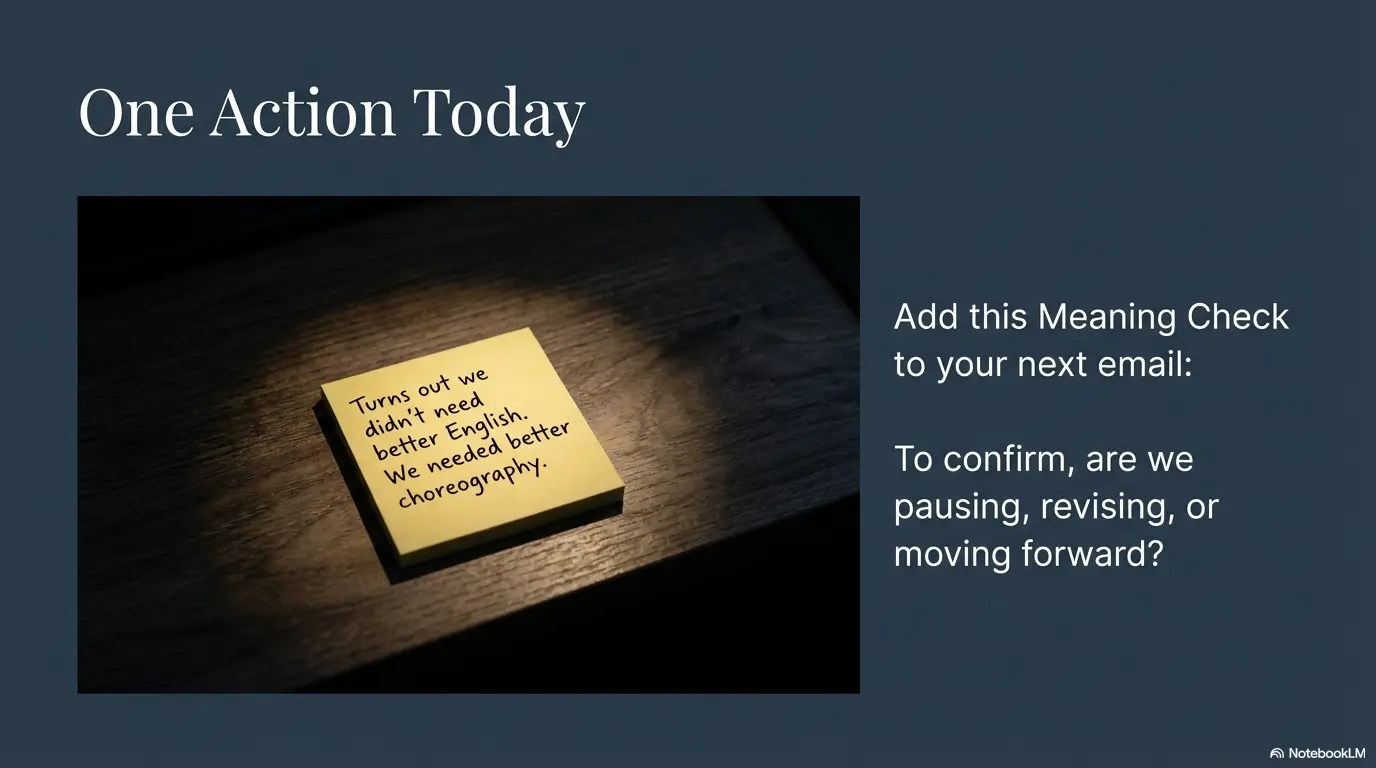
No blame. No pressure. Just structure. By Thursday, the Korean partner replied with a clear preference: pilot first, then broader rollout after internal review. The project took longer than the original fantasy timeline, but it shipped with less conflict and better adoption. The lead told me later, half-joking, “Turns out we didn’t need better English. We needed better choreography.” That sentence still sits on a sticky note near my desk.
Input 3 values (0–2 each):
- Owner missing? (0 no / 2 yes)
- Date missing? (0 no / 2 yes)
- Approval path unclear? (0 no / 2 yes)
Output: 0–2 low risk, 3–4 moderate risk, 5–6 high risk.
Neutral action: If score ≥3, send one clarification recap before proceeding.
FAQ
Is “Let’s think about it” always a no in Korean workplaces?
No. It can mean “not now,” “needs approval,” or “we need a safer format.” Treat it as ambiguous until you confirm owner, scope, and timing.
How can I confirm next steps without sounding aggressive?
Use options: “Would you prefer pause, revise, or pilot?” Option framing preserves dignity and still creates movement.
What’s the best follow-up timeline after an ambiguous meeting?
Send a recap within 24 hours, then one gentle follow-up in 3–5 business days if no response. Avoid same-day escalation bursts unless risk is critical.
Why do Korean colleagues say yes in meetings but delay afterward?
Meeting “yes” can indicate acknowledgment, courtesy, or provisional alignment—not final commitment. Post-meeting governance often determines real execution.
How should US teams write recap emails after Korean partner calls?
Keep it concise: current status, owner, decision date, and 2–3 options. Remove emotional language and avoid binary “approve/deny” framing. If your audience is foreign professionals new to Korean settings, you can also link companion etiquette pieces like practical Korean business-meal phrases for smoother in-person rapport.
Does hierarchy matter more than personality in indirect communication?
In many workplace decisions, hierarchy often has stronger influence than personal communication style. Personality still matters, but approval paths matter more.
What phrases are polite alternatives to a direct no in Korean business English?
Common forms include “it may be difficult,” “let’s revisit,” and “we need internal review.” Don’t decode them in isolation; read timing and channel too.
How do I coach US staff to avoid cultural misreads with Korean teams?
Train them to separate acknowledgment from commitment, use option-based follow-ups, and require recap primitives: owner, date, and approval path. It helps to pair this with a short primer on Korean sentence endings and nuance when teams communicate bilingually.
When should I move from chat to 1:1 call for clarity?
If two written exchanges remain ambiguous or tension rises, move to a short 1:1 call. Private space often unlocks practical honesty.
Can indirect communication still work in fast startup environments?
Yes, if you pair it with disciplined documentation. Speed and courtesy can coexist when decisions are translated into concrete action fields.
Next Step: One Concrete Action You Can Do Today
Build a “meaning check” line into every recap:
“To confirm, are we (A) pausing, (B) revising, or (C) moving forward by [date]?”
Use this on your next ambiguous “Let’s think about it” moment
That one line does what long debates cannot: it protects face, reveals intent, and creates action. This closes the loop from our opening scene. The phrase wasn’t the problem. The missing decision frame was. In the next 15 minutes, copy this line into your team’s meeting template and run it in your next cross-border recap. You’ll feel the difference almost immediately: less guessing, fewer awkward chases, and more honest momentum.
Phrase + hierarchy + timing. Don’t interpret words alone.
Ask option-based questions, not binary pressure questions.
Write recap with owner, date, and approval path.
If misread happens, reset calmly with cadence and options.
- One-line objective and non-negotiables
- Two reduced-scope alternatives
- Approval map (who decides what)
- Decision date candidates (2 options)
- Recap template ready to send in 24 hours
Neutral action: Prepare this list before the meeting, not after confusion starts.
If this article sits inside a broader expat onboarding hub, internal references to Korean social protocol basics, formal condolence etiquette for foreigners, and family registry and documentation context can help teams interpret language through the right cultural lens before negotiations begin.
Last reviewed: 2026-02.