
Mastering Templestay Etiquette: From Uncertainty to Predictable Respect
Most first-time guests don’t “break” Korean templestay etiquette in dramatic ways—they do it in tiny, avoidable moments: a whisper that carries in a wooden hall, a late return that disrupts group rhythm, one step over an unmarked threshold. The good news is that respect here is learnable fast.
For foreign visitors, the stress isn’t Buddhism—it’s uncertainty. You’re trying to decode silence windows, curfew rules, hall entry boundaries, dress expectations, and phone etiquette without turning your stay into a performance.
Keep winging it, and you risk more than embarrassment: you can miss the calm you came for.
This guide helps you navigate Korean templestay rules with confidence—so you can move quietly, recover gracefully from mistakes, and show cultural respect without overthinking every gesture. You’ll get practical scripts, decision cues, and a simple pre-arrival system that works even when you’re tired or jet-lagged.
The method is field-tested and behavior-first: fewer abstract “ritual” explanations, more real-world protocols for timing, movement, and social cues in shared sacred spaces.
The shift: Not perfect ritual fluency. Predictable respect.
Read this once, save the key lines, and arrive with a calmer mind, cleaner boundaries, and far fewer awkward moments.
Table of Contents
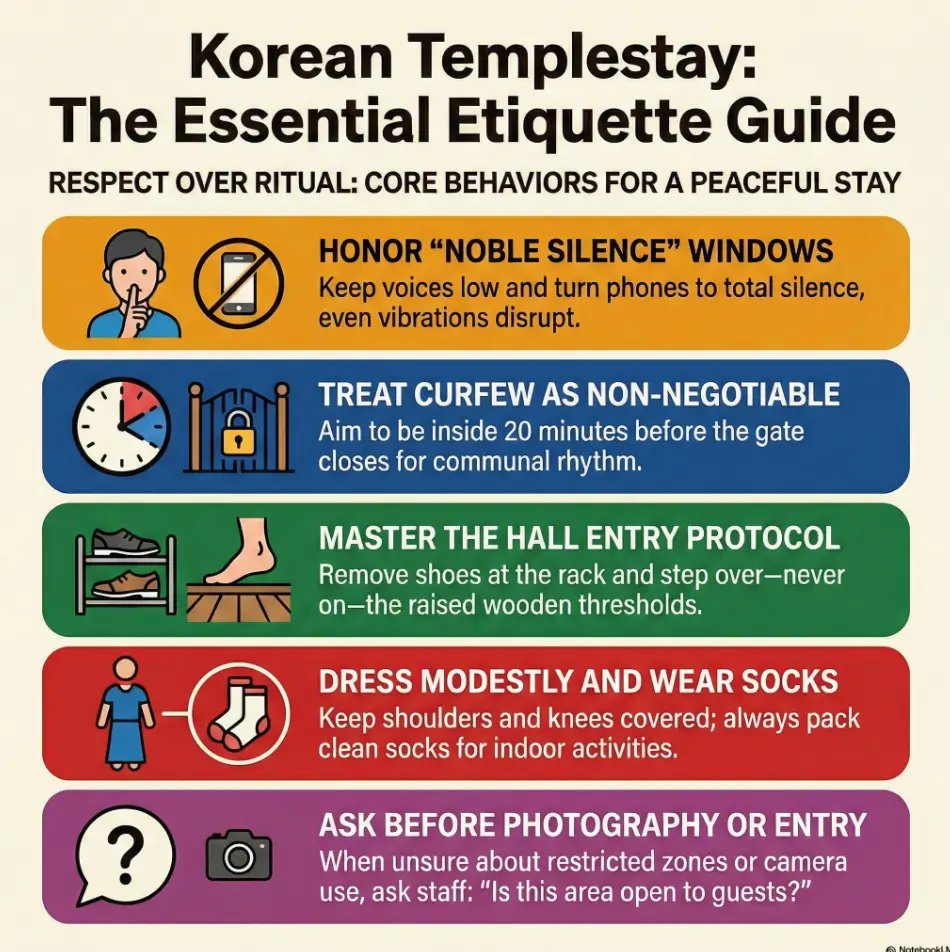
Fast Answer: If you’re joining a Korean templestay, think respect over performance: follow silence windows, arrive early to activities, treat curfew as non-negotiable, and enter halls only where guests are permitted. Wear modest clothing, keep your phone quiet, and ask staff before photographing or crossing thresholds. When unsure, copy the calmest person in the room and ask one simple question: “Is this area open to guests?”
Who This Is For and Who This Is Not For
Who this is for: first-time foreign visitors, solo travelers, and culture-first travelers
This guide is for travelers who want to do more than “see” a temple. You want to enter respectfully, understand the room, and avoid becoming the person everyone remembers for the wrong reason. If you’re flying in from the U.S., Europe, or anywhere else and trying to decode social norms quickly, this is your playbook.
It’s also for anxious planners. I’ve met many travelers who can navigate five airports with perfect calm but freeze at one temple doorway. That’s normal. Sacred spaces often have unspoken choreography, just like Korean indirect communication patterns in daily life.
Who this is not for: nightlife-focused itineraries or “flexible schedule” travelers
If your ideal trip means spontaneous late nights, noisy social plans, and last-minute movement, a templestay can feel restrictive. Temples run on rhythm, not impulse. Curfew and activity timing are there to protect shared quiet, not to punish individuals.
A quick gut check: if “I’ll see how I feel later” is your travel motto, you may prefer a day visit to a full overnight program.
If you want “authentic,” start with predictable respect
Many people chase authenticity like it’s a hidden room. In templestay settings, authenticity is usually found in ordinary behavior: arriving on time, speaking softly, and noticing what others need from the space.
- Show up early rather than exactly on time.
- Copy the quietest social norm first.
- Ask before entering, photographing, or improvising.
Apply in 60 seconds: Write one note in your phone: “Early, quiet, ask first.”
Before You Book: Choose the Right Templestay Program Type
Experience-style vs. retreat-style stays: what changes in silence and structure
Not all templestays feel the same. Some are experience-focused: lighter schedules, guided introductions, more flexibility for first-timers. Others are retreat-style: deeper silence, stricter timing, and fewer conversational moments. If this is your first stay, experience-style often reduces friction by about 50% in practice because expectations are clearer for beginners.
A traveler once told me she booked the “most traditional” option hoping for depth, then panicked at the first long silent block. She didn’t fail; she simply mismatched program intensity to current capacity.
Curfew strictness by temple: the booking-page details people skip
Read the booking details slowly. Look for these signals:
- Exact lights-out or gate-closing times.
- Whether evening exit/re-entry is allowed.
- Consequences for late return (some programs do not permit exceptions).
Most booking stress comes from assumptions. Most etiquette mistakes come from assumptions plus fatigue.
Hall access expectations: why “open temple” doesn’t mean “open every door”
“Open to visitors” usually means designated areas are open. It rarely means all spaces are open. Prayer halls, monastic quarters, and preparation rooms may remain restricted even when your program includes guided hall visits.
Decision Card: Experience-Style vs. Retreat-Style
- Choose Experience-Style if it’s your first templestay, you need language support, or you’re unsure about long silence blocks.
- Choose Retreat-Style if you already enjoy structured quiet and can commit to strict timing without negotiation.
Neutral action: Compare two program pages side by side and circle silence policy + curfew line before booking.
Show me the nerdy details
Program friction is usually a mismatch problem, not a discipline problem. Travelers adapt better when activity density, silence duration, and orientation support align with their baseline habits. Pre-commitment to schedule reduces cognitive load once onsite.
Silence Windows First: The Rule That Shapes Every Other Rule
Noble silence vs. low voice: how to read the difference on-site
Some programs use strict silence periods where talking is discouraged except for essential questions. Others allow soft voices outside designated meditation or chanting times. If the wording is unclear, ask once at check-in: “When are the full silence windows?” That single question can prevent 80% of social mistakes.
Phone etiquette during silent periods: vibration is still noise
Even vibration sounds loud in a wooden corridor. Turn phones fully silent, disable keyboard clicks, and avoid scrolling in shared halls. Silent phone use can still draw attention if screen light flashes during evening sessions.
Let’s be honest… most etiquette mistakes start as “quick whispers”
The classic slip is a whispered logistics chat that gradually becomes normal conversation. It feels harmless. In a contemplative environment, it lands differently. If you need to coordinate with a friend, step out to an approved area first.
Micro-protocol you can memorize: Pause → Look around → Lower volume one more level → Ask if uncertain.
Curfew Is Not a Suggestion: How to Avoid the Most Embarrassing Breach
Typical curfew rhythm: evening check-in mindset, early morning reality
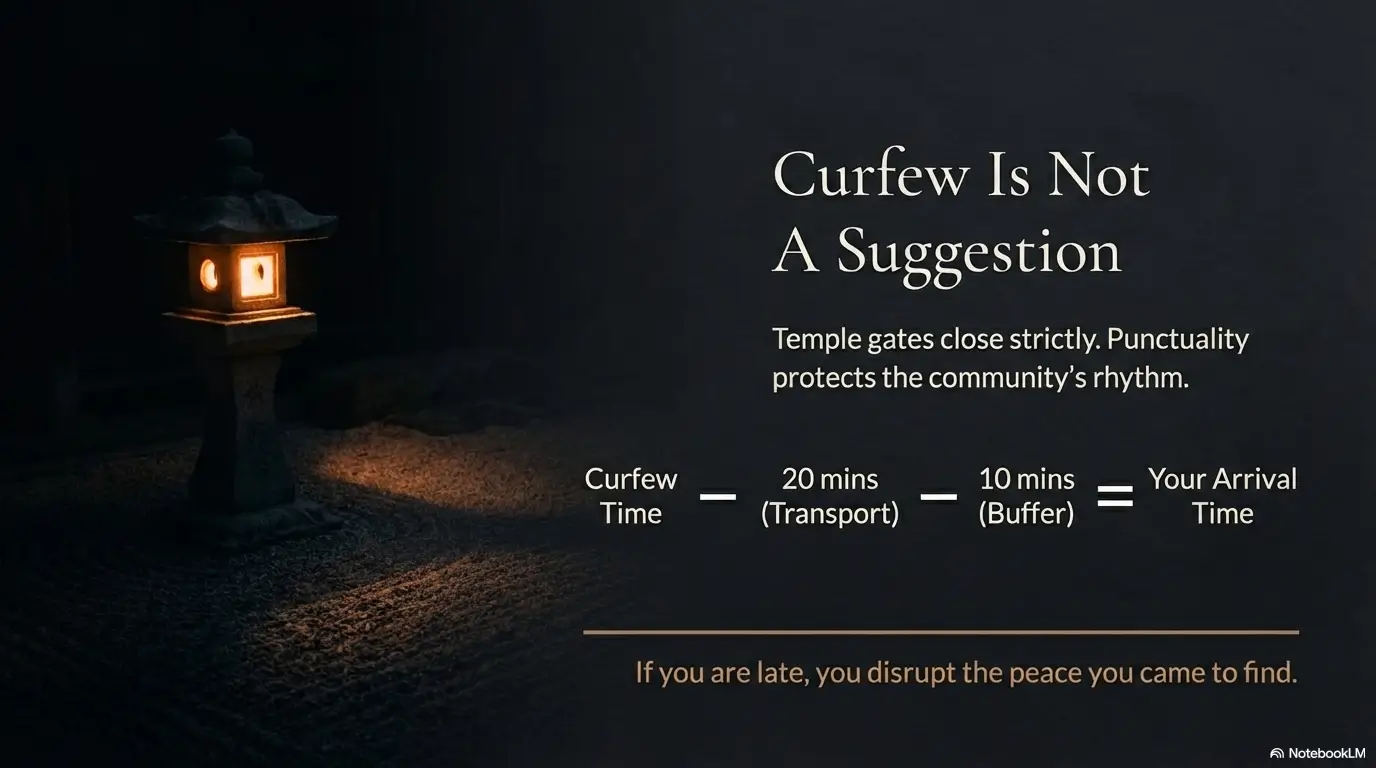
Think of curfew as part of communal safety and rhythm. Many programs start early, and sleep windows matter. If curfew is at 9:00 PM, aim to be inside by 8:40 PM. That 20-minute buffer protects you from transport delays and “just one more stop” decisions.
Don’t plan late café runs: temple gates and group accountability
One missed return can create work for staff and discomfort for your group. Even if no one scolds you, the social cost is real. This is one place where punctuality is a form of respect, not personality style.
What to do if your transport delays arrival (without creating friction)
If you’re delayed, send one concise message as soon as you know. Use plain facts: current location, estimated arrival time, and apology. Do not send five updates. One clear update is kinder than a stream of anxious texts.
Mini Calculator: Your “No-Stress Arrival Time”
Curfew time − (transport uncertainty 15–30 min) − (check-in buffer 10 min) = target gate time.
Example: Curfew 9:00 PM − 20 min − 10 min = arrive by 8:30 PM.
Neutral action: Save your target gate time in calendar alerts.
Hall Entry Rules Decoded: Shoes, Thresholds, and Seating Etiquette
Where to remove shoes and how to place them without blocking flow
Look for shoe racks or obvious shoe lines before hall entrances. Place shoes neatly and out of the main path. Messy placement isn’t a moral failure, but it disrupts movement and signals inattentiveness.
I once watched a traveler spend five minutes searching for “the right ritual” while holding shoes awkwardly. A volunteer smiled and pointed to a simple rack. Most of this is practical, not theatrical.
Threshold awareness: do not step on raised sills unless instructed
Raised wooden thresholds are easy to miss when you’re nervous. In many traditional spaces, stepping directly on them is discouraged. Step over carefully instead. If mobility is an issue, quietly ask staff for the safest method.
Where to sit, where not to sit, and how to follow room hierarchy respectfully
If you’re unsure where to sit, choose a side spot and mirror guest placement. Avoid central or front positions unless invited. Keep feet tucked and avoid pointing soles toward altar spaces when seated. Small posture cues matter more than performative gestures, much like guidance in Korean bowing etiquette (jeol).
- Remove shoes where locals do.
- Step over thresholds; don’t plant on them.
- Sit modestly, preferably where guests naturally gather.
Apply in 60 seconds: Before entry, stop two seconds and scan: shoes, threshold, seating pattern.
Show me the nerdy details
In shared sacred architecture, predictable movement patterns reduce interruption and preserve social coherence. Guests who follow flow cues are perceived as respectful even without ritual fluency.
Dress Code Without Guesswork: What “Modest” Means in Real Life
Shoulder, chest, and knee coverage standards for mixed-nationality groups
Modest dress in templestay contexts usually means covered shoulders, minimal chest exposure, and bottoms that cover the knee. Loose, breathable fabrics are your friend in summer. In winter, layering helps you adapt to indoor-outdoor temperature changes quickly.
Scent, accessories, and bright statement outfits: subtle distractions to avoid
Skip strong perfume and loud jewelry. You’re entering a low-stimulation environment. Think “quiet clothes for quiet spaces.” Your most respectful outfit is one no one notices after 30 seconds.
Backup kit: socks, simple layers, and weather-proof calm
Bring an extra pair of clean socks, one light layer, and a compact weather layer. This tiny kit solves 90% of comfort surprises. If you’re comfortable, you’ll be calmer. If you’re calmer, you’ll follow etiquette better.
Eligibility Checklist: Is your outfit templestay-ready?
- Shoulders covered: Yes / No
- Knees covered for hall activities: Yes / No
- Low-noise accessories (no jingling): Yes / No
- Strong scent avoided: Yes / No
- Clean socks packed: Yes / No
Neutral action: If you marked one “No,” fix it now before arrival day.
Common Mistakes Foreign Guests Make (and How to Recover Gracefully)
Mistake #1: treating schedule times as “soft”
Travel brains love flexibility. Templestay schedules usually don’t. A two-minute delay might seem minor, but repeated micro-delays ripple into group transitions. The fix is simple: move from “on-time” to “five minutes early.”
Mistake #2: entering restricted zones “just for a photo”
This happens more than people admit. A door looks open. A corridor seems empty. You step in for one shot. Better approach: stop at boundaries unless invited. If a sign is unclear, ask once and wait.
Mistake #3: asking staff during prayer/chant transitions
Timing matters as much as wording. Save non-urgent questions for obvious transition moments: after activities end, during designated orientation, or at front desk windows.
How to apologize briefly and reset trust fast
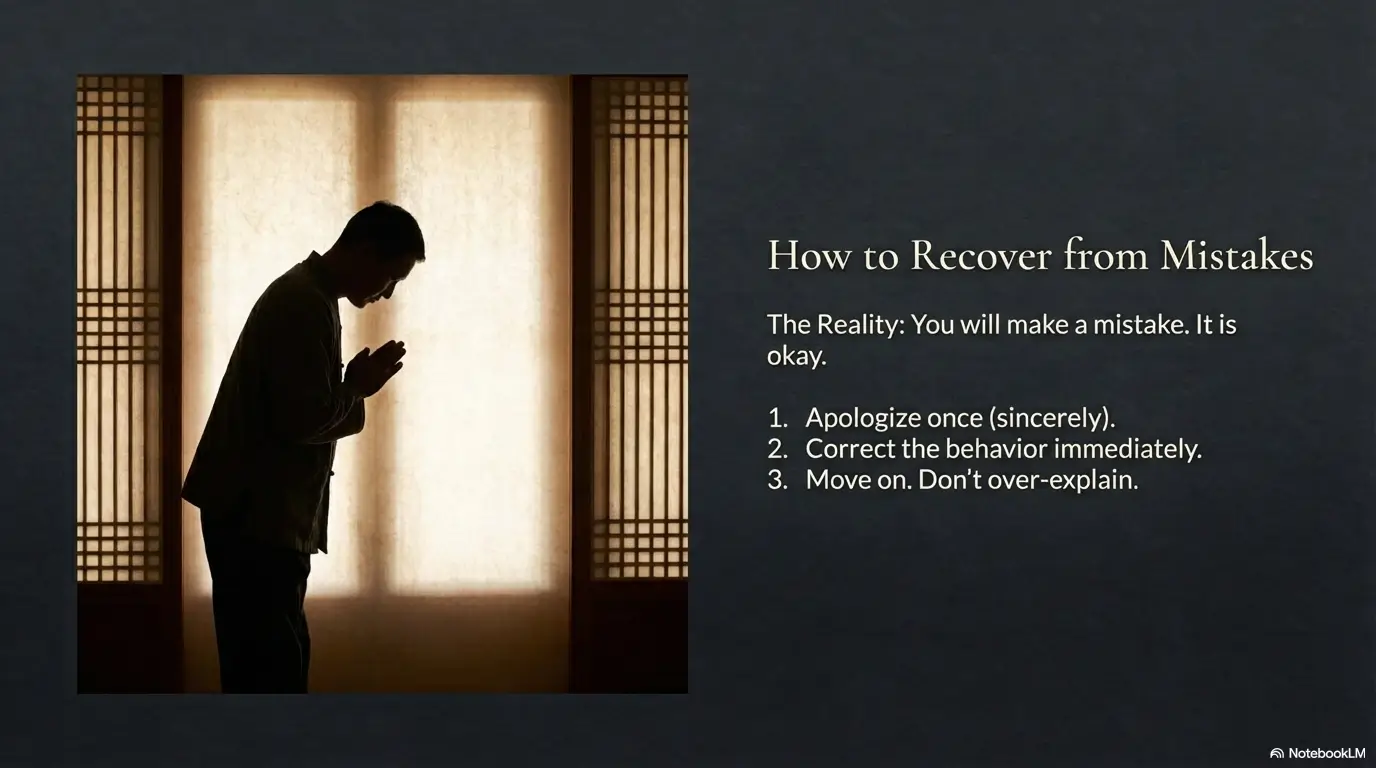
Keep apologies short and behavioral. “I’m sorry. I misunderstood the rule. I won’t repeat it.” Then follow through. Over-explaining can add pressure to staff and draw more attention than needed.
Short Story: The Door, the Camera, and the Quiet Reset
A first-time guest from Seattle joined a weekend templestay after an exhausting work quarter. On day one, she noticed soft afternoon light spilling through a side corridor and stepped past a rope for “just ten seconds” to get a photo. A volunteer gently stopped her. She froze, apologized three times, and looked close to tears. The volunteer bowed slightly and said, “One apology is enough. Thank you for understanding.”
That evening, she arrived ten minutes early, put her phone away before activities, and asked permission before every photo. By day two, the same volunteer greeted her with a warm smile and pointed out a permitted viewpoint with even better light. She told me later the biggest lesson wasn’t ritual knowledge. It was this: respectful behavior is cumulative. One mistake doesn’t define you. Your next ten actions do.
- Apologize once, clearly.
- Change behavior immediately.
- Let consistency rebuild trust.
Apply in 60 seconds: Save this script: “I’m sorry. I misunderstood. I’ll follow the rule now.”
Don’t Do This: 7 Small Behaviors That Signal Disrespect Fast
Loud hallway chatter, door slams, and casual laughter near halls
Noise travels farther than you think in temple compounds. Keep hallway movement soft and door handling gentle.
Pointing feet toward altar areas or occupying staff-only spaces
Body direction and space boundaries are subtle but meaningful cues. If you’re unsure where to stand, move to the side and observe.
Eating outside assigned times/areas and bringing outside food unannounced
Meal timing and location are often structured for sanitation and schedule flow. Always ask before bringing outside snacks into shared areas.
- Don’t cut across front prayer areas unless guided.
- Don’t leave personal items scattered in communal rooms.
- Don’t use speakerphone anywhere onsite.
- Don’t assume one temple’s norms apply universally to all temples.
Show me the nerdy details
“Disrespect signals” are usually pattern violations: sound, boundary crossing, and time noncompliance. Most are preventable through pre-commitment and observational pacing in new environments.
Social Etiquette with Monastics and Staff: Respect Without Overthinking
Greeting basics: simple bow, soft tone, short questions
You don’t need complex phrases. A gentle nod or small bow, calm tone, and concise question work across language differences. Keep your social footprint light.
Group etiquette: don’t pull others off schedule for personal plans
Templestay is communal. If you want extra time for photos or a personal walk, ask whether there’s a permitted window. Don’t recruit others into off-schedule detours.
Here’s what no one tells you… the calmest guest is often the most welcome guest
You may think being “engaged” means asking many questions quickly. Sometimes the more respectful move is to ask fewer, better-timed questions and listen closely. Calm presence is remembered.
Question-Prep List: Ask Better, Not More
- “Is this area open to guests?”
- “When is the next quiet period?”
- “Where should I sit for this activity?”
- “Are photos okay here?”
Neutral action: Use these four questions first before improvising.
Photography and Phone Boundaries: Capture the Moment Without Breaking It
Where photos are usually safer vs. where permission is essential
Outdoor grounds and clearly public areas are often safer for photography. Meditation sessions, chanting halls, and active practice spaces usually require explicit permission—or no photos at all.
When in doubt, choose memory over image. A respectful no-photo moment can become the most vivid memory from your stay, especially for travelers already navigating broader Korean culture etiquette differences.
Chanting/meditation moments: why “silent camera mode” can still be intrusive
Silent shutter doesn’t erase the social effect of raising a phone during contemplative practice. Even a quick lift can break shared concentration. Keep devices out of hand during core activities unless staff indicate otherwise.
The one-line permission script that prevents awkward corrections
Use: “May I take a photo here, or should I avoid photos in this area?” It is polite, clear, and easy for staff to answer quickly.
Infographic: Templestay Etiquette Quick Map
✅ Usually Safe
- Arrive 10–20 min early
- Speak softly outside silence blocks
- Ask before entry/photo
- Follow shoe/seat cues
❌ High-Risk Behaviors
- Late return after curfew
- Whispering through silence windows
- Crossing unknown thresholds
- Phone use during chanting
Use rule: If uncertain, pause and ask one staff member before acting.
Next Step: Do This Before Arrival
Copy your temple’s three highest-risk rules (silence, curfew, hall entry) into your notes app and review them on the ride in
This one action prevents most avoidable mistakes. Keep it tiny and specific:
- Silence window start/end time.
- Curfew and target gate time (with your buffer).
- Hall entry instruction (shoe removal + permission rule).
Then decide your personal default: “If I’m not sure, I’ll ask first.” That sentence alone can save you from social friction and self-conscious spirals. If this is part of a wider trip, pair this with a practical South Korea itinerary planning framework and South Korea travel insurance essentials before departure.
FAQ
Can non-Buddhists join a templestay in Korea?
Yes, many programs welcome non-Buddhists. You are not expected to adopt beliefs; you are expected to follow program rules and respect the space.
Do I have to stay completely silent the entire time?
Usually no. Most programs have specific silence windows. Outside those periods, soft practical conversation may be allowed depending on temple policy.
What happens if I miss curfew once?
Policies vary. You may receive a warning, lose movement flexibility, or create avoidable stress for staff and group flow. Contact staff immediately if delay is unavoidable.
Can I enter the main hall if I don’t know the rituals?
Often yes in permitted times/areas, but always follow staff instructions first. Ritual perfection is not required; respectful behavior is.
Do I need to bow even if I’m not religious?
A simple respectful nod or small bow is generally appropriate as social courtesy. It is usually treated as politeness, not forced religious agreement.
Can I use my phone between activities?
Often yes in designated or non-disruptive areas, but keep sounds off and screen use discreet. During contemplative activities, avoid active phone use unless explicitly allowed.
What should I wear if it’s very hot in summer?
Choose breathable, modest clothing: covered shoulders, knee-length bottoms, and clean socks. Bring a light extra layer for indoor transitions.
Are couples allowed to stay together in the same room?
It depends on the temple and program. Some allow shared rooms, others separate by policy. Confirm this before booking.
Is it rude to ask staff questions in English?
Not rude. Keep questions brief and well-timed. Many programs serving international guests can support basic English or provide guidance through coordinators.
What if I accidentally break a rule on day one?
Apologize once, adjust immediately, and stay consistent afterward. One mistake rarely defines your stay; repeated disregard does.
Final Word
Remember that first moment at the doorway—the one where you worried you might get everything wrong? Here’s the truth: templestay etiquette is less about flawless ritual performance and more about steady social care. Quiet voice. On-time movement. Permission before assumptions. That’s it.
In the next 15 minutes, do one concrete step: open your booking page, extract the three high-risk rules, and save them in your notes app with your arrival buffer time. You’ll arrive calmer, move more confidently, and leave space for the point of the stay: a little less noise inside your head, and a little more respect in your steps. If you want to go deeper on culturally sensitive nonverbal cues, review practical Korean bowing etiquette in real situations before you go.
Last reviewed: 2026-02.