
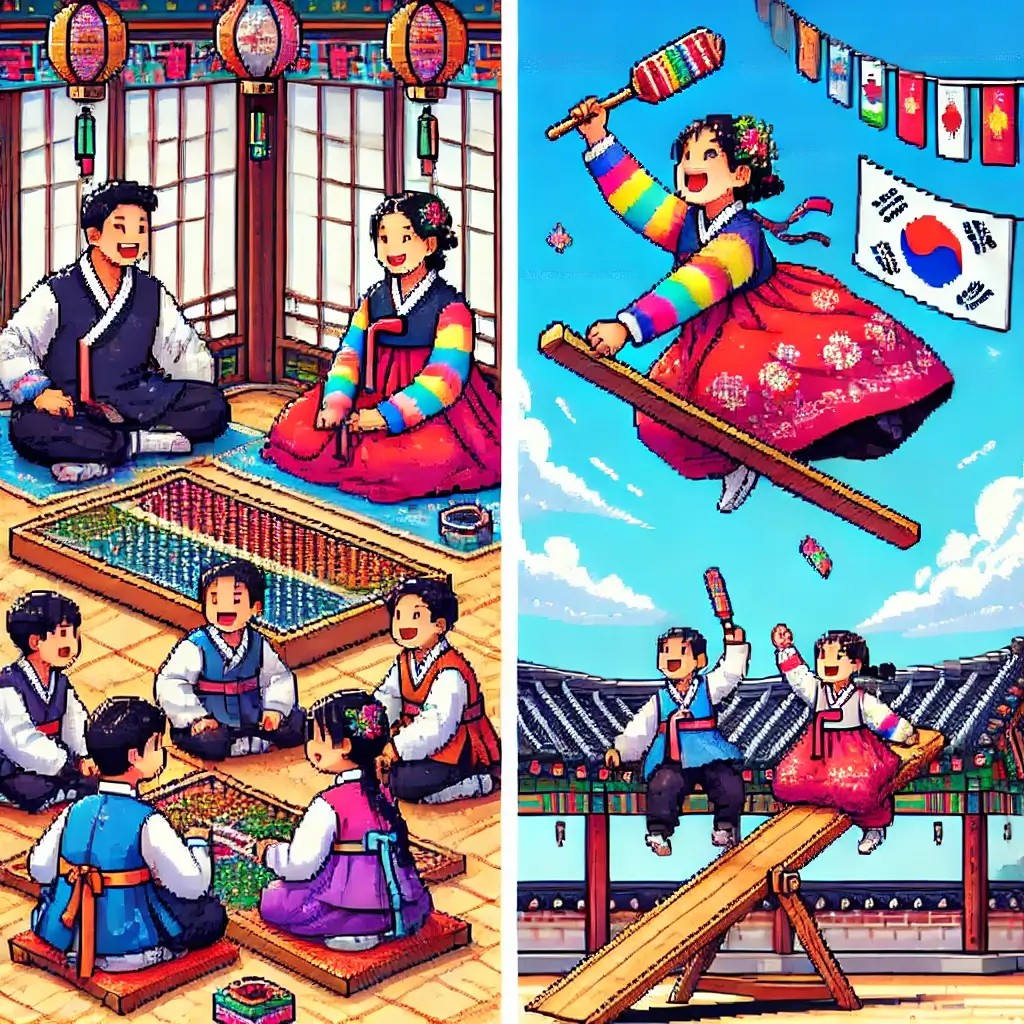
Yutnori, gonggi, jegichagi, ssireum and neolttwigi require different spaces, equipment and supervision. They are not interchangeable activities for every age group. Choose a manageable game and explain the actual rules before play.
Begin with a tabletop or small-space option
Yutnori uses four sticks and tokens on a board, with house rules that should be demonstrated. Gonggi uses small pieces in staged tossing and pickup tasks. Select equipment appropriate for participants, especially where small objects could be swallowed.
Make space for a kicking game
Jegichagi asks players to keep a jegi in the air with the foot. Give each player a clear area and use a personal practice target rather than contact or crowding. Adapt the movement and waiting time to the group.
Treat wrestling and board jumping differently
Ssireum is a wrestling tradition; neolttwigi involves coordinated jumping on a board. These need suitable instruction, equipment and conditions. A historical description or an improvised plank is not a safe substitute for a supervised program.
Run a clear session
Demonstrate a turn, agree on scoring and allow an observing or alternative role. Pause if equipment, space or participation is unsuitable. End with cleanup and a discussion of the actual game rather than claiming that one session guarantees fitness, teamwork or cultural mastery.
Run a short game session with a clear finish
Start by choosing a game that fits the actual group and space. Demonstrate one turn before discussing variations. For a first session, an easy-to-understand practice target is often more useful than a long competition, especially if players are learning the vocabulary as well as the movement.
- Before play: Identify equipment, clear space and any age or supervision needs.
- Demonstration: Show one turn, a scoring example and when the next player begins.
- Practice round: Let players try the action without assuming everyone wants to compete.
- Finish: Agree on a short stopping point, collect equipment and compare what worked.
Allow an observing or alternative role, and change the activity when the space or equipment is unsuitable. Keep descriptions of ssireum and neolttwigi separate from instructions for unsupervised play. For a family or classroom session, use the linked children’s-games guide to compare adaptations and materials before choosing your next activity.
Compare a tabletop session with a movement-based game
For a first group session, compare yutnori at a table with individual jegichagi practice in a clear area. The first needs a shared explanation of turns and board rules; the second needs room for movement and waiting. Choose from the actual space and participants rather than calling every traditional game a classroom activity.
Agree on house rules before starting. For a beginner exercise, demonstrating one turn and letting someone explain it back is more useful than adding several variants. Contact or board-jumping activities belong in properly instructed settings, not in an improvised substitute for a tabletop game.
| Compare | What to record |
|---|---|
| Space | Seated shared play or a clear individual movement area? |
| Demonstration | One turn, how it ends and who acts next. |
| Participation | Playing, observing or another role agreed with the group. |
A reader question: Must a cultural game session become a competition?
No. A demonstration, cooperative explanation or practice round can be a useful learning activity. State how your version differs from a competitive game, and do not claim that a short activity represents every regional or family rule.
Further reading: National Folk Museum of Korea: Encyclopedia of Korean Folk Culture. Check the specific entry, object, edition or current provider notice relevant to your question.
Editorial revision: October 20, 2026. Practice examples are editorial constructions. The discussion distinguishes documented information, interpretation and personal choice.