
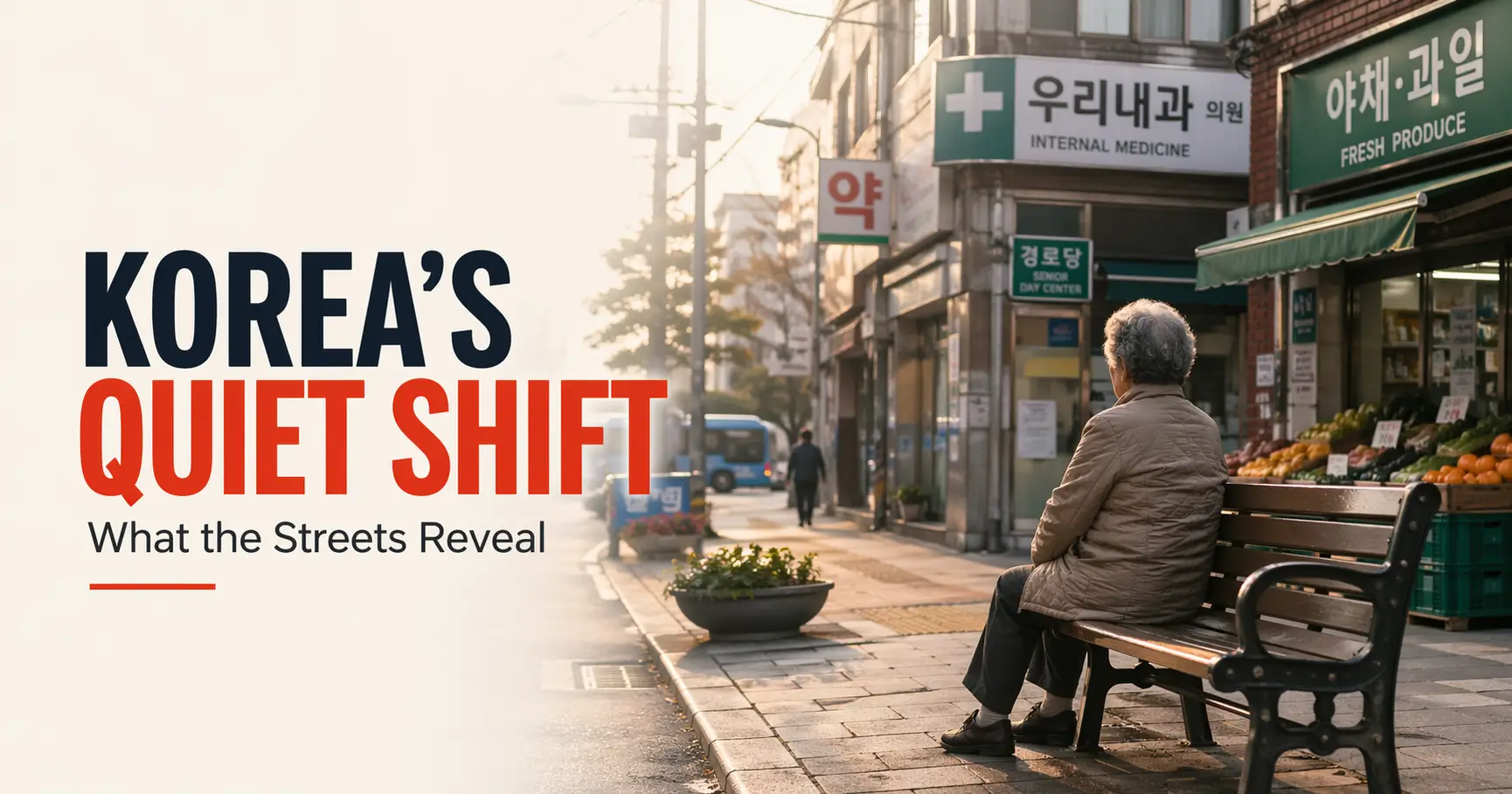
The Quiet Transformation: Reading the Sidewalks of a Super-Aged Korea
South Korea became a super-aged society in 2025, but Korea’s rapid ageing does not first reveal itself in policy briefings or skyline photos. It shows up on ordinary blocks: a bench used like vital infrastructure, a clinic beside a produce shop, a morning street paced by caution rather than rush.
That is exactly where many Anglo-American readers misread the country. They see quiet and assume decline. They see older storefronts and assume stagnation. What they miss is how aging neighborhoods, low birthrate pressure, and senior-heavy street life quietly reorganize everyday Korea at sidewalk level.
Keep reading the wrong signals, and you miss one of the most important truths about modern Korea.
This post helps you spot the street-level clues foreigners rarely notice, so you can read neighborhoods more accurately, more humanely, and with far less tourist-filter distortion. Instead of flattening every older district into “run-down” or “old-fashioned,” you will see how demographics reshape pace, services, sound, and convenience.
The method here is simple but sturdy: observe what repeats, compare what disappeared with what arrived, and treat benches, clinics, child-noise gaps, and storefront mix as evidence.
Look closer. The side streets are telling the bigger story.
And they are saying it very quietly.
Fast Answer: Korea’s rapid ageing often appears not first in headlines, but in small neighborhood signals foreigners can easily miss: slower morning street rhythms, clinics and pharmacies clustered near older housing, benches used as social infrastructure, more senior day programs, quieter schools, and businesses subtly reshaped around aging customers. To understand modern Korea well, it helps to look past skylines and notice how ordinary blocks are being reorganized around longevity, care, and demographic imbalance.
Table of Contents
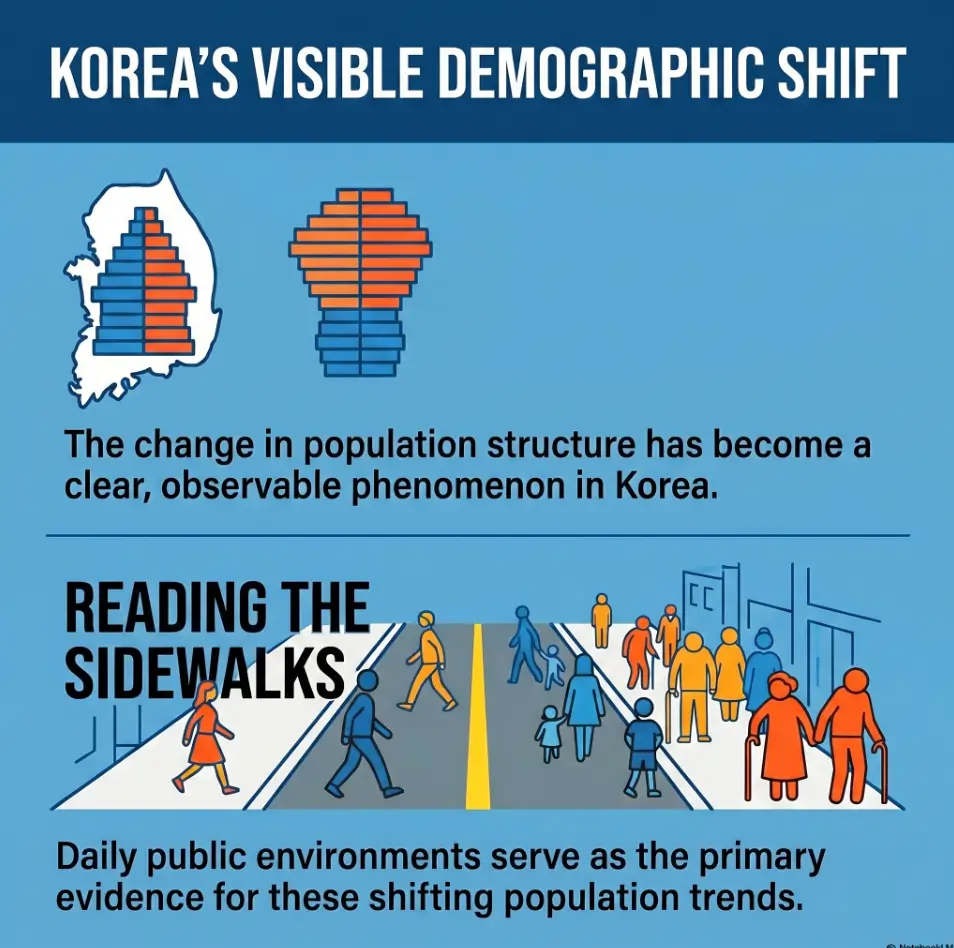
Why the Signs Start Small: Aging Shows Up Before It Announces Itself
Demographic change often appears in street-level routines before it appears in conversation
Population change is rarely theatrical at first. It does not arrive with a drumline and a banner reading “demographic transition, please clap.” It arrives through repetition. The same woman pauses at the same bench each morning. The pharmacy opens early because its regulars do. A welfare van becomes part of the weekday clock. A side street that once carried schoolchildren now carries walkers, carts, and careful knees.
That is why foreigners often miss the shift. They look for large, dramatic evidence: empty towers, giant policy slogans, sudden collapse. Korea’s ageing story often takes a quieter route. It shows up in neighborhood timing, in what businesses survive, in what small public objects get installed, and in how far people seem willing to walk before stopping. These are not decorative details. They are social facts wearing ordinary clothes.
The same block can look ordinary to visitors and profoundly different to longtime residents
A longtime resident notices subtraction. The stationery shop closed years ago. The pediatric clinic moved. The after-school piano noise is gone. What replaced them may be subtle: a hearing aid sign, a rehabilitation office, another internal medicine clinic, a lunch-delivery flyer with giant fonts. To a visitor, the block still “looks Korean.” To someone who has watched it for 15 years, it feels re-tuned.
I once walked through an older neighborhood in a provincial city at 8 a.m. expecting the usual urban hum. Instead, the mood felt like the city had exhaled and decided not to inhale too quickly. That was not stagnation. It was a different social metabolism, the kind of local texture that often matters as much as formal Korean city identity.
Let’s be honest: most foreigners notice trend districts first and demographic clues last
This is understandable. Tourists are drawn to spectacle. Expats, too, often learn a city through the districts designed to be legible, efficient, or fun. But demographic reality usually lives just outside that frame. Seoul’s famous zones, and the glossy apartment complexes that dominate postcards and real-estate fantasies, do not tell the whole national story. Statistics Korea has noted that Korea crossed into super-aged society territory in 2025, meaning people 65 and older now account for more than 20% of the population. That fact does not hover abstractly above the country. It lands on the pavement.
- Notice routines before landmarks
- Compare what disappeared with what arrived
- Treat benches, clinics, and pacing as evidence
Apply in 60 seconds: On your next walk, list three everyday objects that seem designed for slower movement or frequent rest.
Watch the Side Streets: Where Korea’s Rapid Ageing Becomes Visible
Older low-rise neighborhoods often reveal age change more clearly than glossy apartment zones
High-rise apartment districts can be oddly deceptive. They are neat, managed, and often buffered from the rough edges of demographic change. Older low-rise areas, by contrast, are full of clues. Their retail is less filtered. Their residents use the sidewalk more visibly. Their built form reveals which bodies a neighborhood now serves and which ones it no longer expects in large numbers.
In these districts, you may notice gentler slopes mattering more than visual beauty, clinic density mattering more than café novelty, and shade mattering more than design flair. A steep alley becomes a demographic sentence. A level stretch with two benches becomes a tiny welfare state.
Alleyways, market edges, and clinic clusters can tell a fuller story than downtown landmarks
If you want to read age structure, market edges are instructive. So are bus stops near older housing stock. So are small streets near district welfare centers. In these places, movement is not random. It is patterned around medicine, errands, meals, routine sociability, and bodily limitation.
The OECD’s recent Korea survey warns that the country’s old-age dependency ratio is set to rise dramatically over time. That sounds like textbook language until you stand in front of a row where internal medicine, orthopedics, dentistry, and pharmacies appear within a few dozen meters of one another. Then the sentence becomes concrete. The neighborhood is reorganizing around maintenance: blood pressure, joints, refills, short-distance errands, manageable waiting.
Why the most important evidence is often one bus stop away from where tourists stop looking
Tourist districts are edited spaces. They emphasize consumption, spectacle, and flow. One bus stop away, you enter the city’s unwaxed wood. You see who actually occupies daytime hours. You see whether public seating is ornamental or heavily used. You see if a grocery stocks tiny portions, soft foods, cheap socks, and low-cost household basics that suggest a clientele on fixed incomes.
There is a small discipline here: move one stop farther than comfort suggests. Korea often becomes more legible there.
Decision card: Where should you observe if you want the clearest neighborhood signs?
| Tourist or flagship district | Good for seeing branding, mobility flow, and curated convenience | Low value for age-structure reading |
| Older low-rise residential area | Best for clinic mix, benches, walking speed, and local retail clues | High value for demographic reading |
Neutral next step: pick one place from each category and compare them on the same weekday morning.
Morning Rhythms Tell the Truth: Who Is Outside, When, and Why
Early-hour street life can skew older in neighborhoods with shrinking younger populations
Morning is brutally honest. By 8 a.m., a neighborhood tells you who it is built around. In some Korean districts, the younger population is either elsewhere, indoors, commuting long distances, or simply smaller than it used to be. Older residents, meanwhile, are visibly present: heading to clinics, carrying vegetables, sitting briefly before the next errand, joining exercise or walking groups, or simply inhabiting public space in a way office workers cannot.
This is one reason some foreign observers misread older neighborhoods as “empty.” They are not empty. They are active in a slower register. If your eye expects strollers, school uniforms, delivery-bike swarms, and café queues, an elderly-paced morning can look thin. In reality, it may be thick with routine.
Pharmacies, produce shops, welfare vans, and walking groups create a different daily tempo
The tempo matters. A neighborhood with many seniors tends to distribute activity differently across the day. Short trips matter. Repetition matters. Waiting matters. You might see a queue outside a local clinic before the sun feels fully awake, or a produce stand doing brisk business at an hour when younger districts are still rubbing their eyes and pretending coffee is a personality. Part of what foreigners notice as unusual efficiency in these areas also echoes the broader logic behind why Korean clinics are so fast.
I remember noticing how many conversations took place standing still. Not lingering for leisure, exactly. More like resting while exchanging information. The city felt less like a sprint and more like a careful braid of obligation, habit, and mutual surveillance. In ageing neighborhoods, sociability and logistics often happen at the same time.
What looks “quiet” to an outsider may actually be a highly patterned care routine
This is the crucial flip. Quiet does not always mean weak. It can mean scheduled. It can mean the neighborhood is structured around bodies that conserve effort and around families that outsource some care to the block itself: nearby clinics, food shops, day programs, benches, accessible routes, and short, manageable errands. The neighborhood becomes a kind of exoskeleton.
Show me the nerdy details
Ageing changes not only the number of older residents but also the timing and spatial distribution of demand. Planners often look at walkability, clinic proximity, waiting space, crossing safety, and the ratio between daily-need shops and discretionary retail. A neighborhood with similar population density can feel completely different once average walking speed, trip purpose, and resting frequency shift.
Storefront Clues Matter: Retail Changes Foreigners Mistake for Randomness
More hearing aid centers, senior day-care signage, clinics, and small pharmacies are not accidental
Retail mix is a demographic x-ray. A foreigner may glance down a street and think, “That is an oddly random cluster.” It often is not random at all. When you see hearing aid services, orthopedic supports, adult day-care signs, internal medicine clinics, rehabilitation spaces, and multiple pharmacies concentrated around older housing, you are looking at a market responding to age structure.
The logic is practical. Older customers prioritize proximity, routine, trust, and repeat access. Businesses that serve them do well where walking distances are short and needs recur. That is why a street with modest foot traffic can still remain commercially alive. It is serving a stable, local, habitual customer base.
Shops may stock softer foods, mobility aids, and low-cost basics aimed at older regulars
Look at window displays and shelf emphasis. Are there more porridges, tofu, soft breads, inexpensive socks, compression supports, canes, or household basics sold in practical quantities? Is signage large and functional rather than fashionable? Are prices emphasized more than novelty? These details are not merely “old-fashioned.” They often point to a neighborhood where regular customers value reliability over trendiness.
A small anecdote: in one older district market, the most revealing thing was not what was sold, but how it was sold. Quantities felt calibrated for people shopping frequently on foot, not doing one giant weekly haul with a car trunk. The scale of the errand matched the scale of the body. Even the corner retail ecology can feel different from the brighter churn described in a typical Korean convenience store guide.
Here’s what no one tells you: retail mix is often one of the clearest demographic x-rays
Urban observers sometimes over-romanticize architecture and under-read commerce. But storefront survival is often one of the fastest ways to understand who lives nearby, what hurts, what is convenient, and what routines dominate. In Korea’s ageing neighborhoods, the commercial map often shifts from aspirational consumption toward maintenance, access, and regularity.
- Clinic clusters indicate recurring health demand
- Practical low-cost goods suggest fixed-income regulars
- Large-font signage often signals everyday usability
Apply in 60 seconds: On one block, count how many shops help people maintain daily life rather than chase novelty.
Eligibility checklist: Is this block likely shaped by an older customer base?
- Yes or No: Are there 2 or more clinics or pharmacies within one short block?
- Yes or No: Do at least 3 stores emphasize practical basics over lifestyle goods?
- Yes or No: Is the strongest foot traffic older and local rather than tourist and intermittent?
Neutral next step: if you answered “yes” to 2 or more, observe the same block again at a different hour.
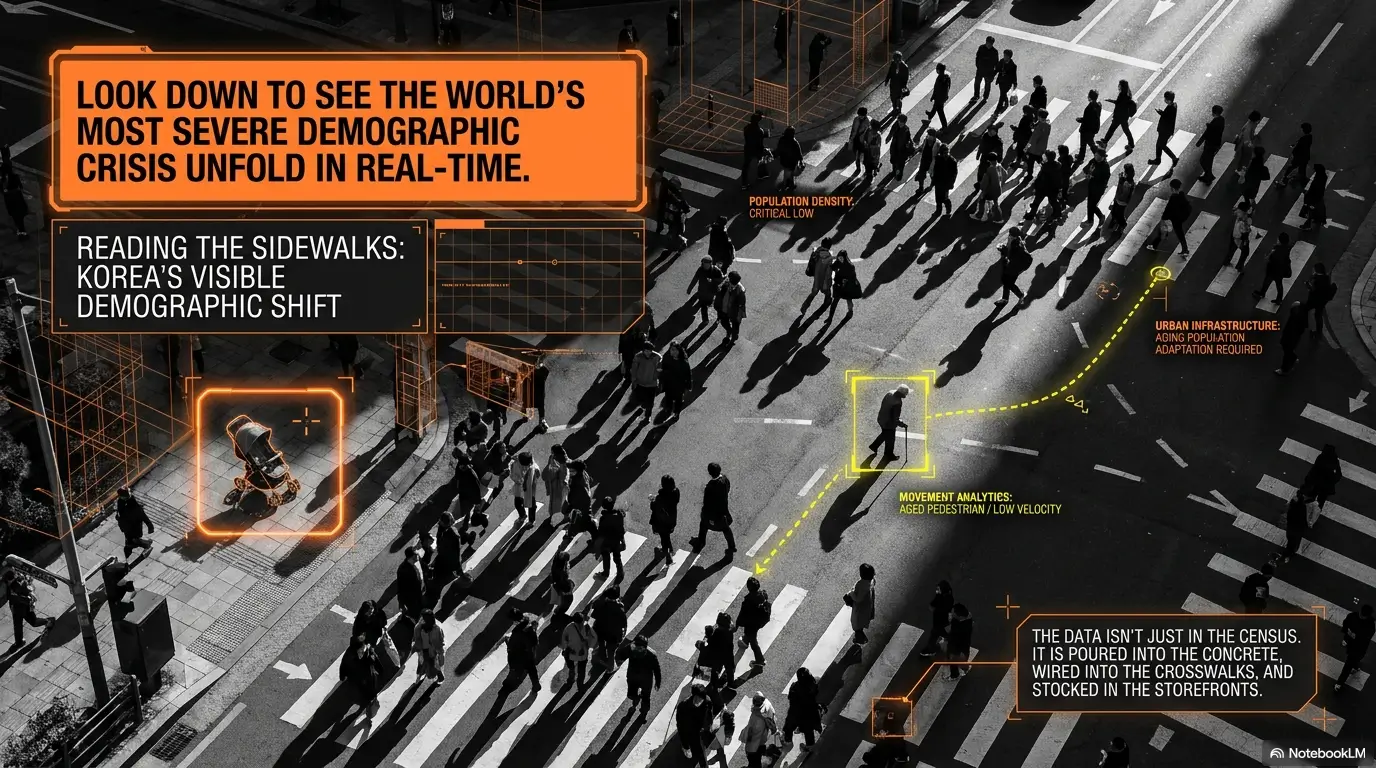
Benches, Handrails, and Rest Stops: The Infrastructure Is Talking
Public seating, curb cuts, railings, and shade structures often reflect an aging local user base
Street furniture is easy to dismiss because it is humble. But humble things often tell the truth. In ageing neighborhoods, benches stop being decorative punctuation and become functional infrastructure. Handrails matter more. Shade matters more. Slopes become policy. Curb cuts become dignity. A short stretch without resting space can become the difference between participation and isolation.
When foreigners say a Korean neighborhood feels unusually oriented toward sitting, waiting, or short walking distances, they are often noticing age adaptation without naming it. Public seating near clinics, outside local markets, beside community centers, or along slight inclines is not filler. It is choreography for endurance.
Small design choices can reveal whether a neighborhood is built for speed or endurance
Some districts are built to move people fast. Others are built to let people remain present despite slower movement. The distinction matters. A fast neighborhood favors throughput: wide crossings, few pauses, long uninterrupted strides, high retail turnover. An endurance neighborhood allows recovery. It assumes some residents need to break a trip into segments.
I have grown suspicious of places that look too frictionless. Human life is not frictionless. A neighborhood that plans for pauses often understands its residents better than one that worships flow.
Why “nothing special” street furniture may actually signal a major population shift
Because major shifts rarely arrive dressed as monuments. They arrive as rails, seats, ramps, and curb geometry. The infrastructure is speaking in a low voice. The question is whether you have learned to listen.
Infographic: 5 neighborhood signs Korea’s ageing is visible at street level
Frequent short rests suggest walking is segmented, not continuous.
Health access is part of daily geography, not an occasional trip.
The street rhythm favors routine, caution, and repetition.
Low birthrates change the soundscape before they change the skyline.
Maintenance often outruns novelty in senior-heavy districts.
Fewer Children, Different Soundscape: What Happens When Youth Density Falls
Some neighborhoods feel quieter not because they are declining, but because age balance has changed
This is one of the easiest mistakes to make and one of the hardest to unlearn. A quieter neighborhood can look “less alive” if your internal template for vitality is child-heavy: stroller traffic, school-cluster noise, teenage drift, after-school academies spilling energy onto sidewalks. When birthrates stay low for years, those sounds thin out. Korea’s fertility rate rose slightly in 2024 to 0.75 after years of decline, according to official data reported widely, but that is still extremely low by replacement standards. The quiet does not vanish because one number nudges upward. If you want the broader household consequences behind that sensory shift, see how Korea’s low birth rate affects everyday life.
What changes first is not always population totals. It is sensory balance. The neighborhood can still function, still trade, still socialize, still care. It simply sounds older.
School routes, playground use, and after-school noise patterns can thin out over time
Listen in the late afternoon. Are there children claiming the alleys with scooters and improvised games, or mostly adults moving with purpose? Are playgrounds full, intermittent, or largely symbolic? Does the route near a school pulse at predictable times, or feel surprisingly modest? These are not sentimental observations. They are clues about age composition and household structure. Even visual markers like Korean school uniform culture become less visible in places where youth density has thinned.
I have stood near Korean playgrounds that were immaculate and almost theatrically underused, like a stage waiting for actors from another decade. The benches were occupied. The swings were not. That contrast lingers.
The absence of children can reshape how foreigners misread a neighborhood’s vitality
Foreign readers, especially from places where suburban family life is a default visual norm, may read fewer children as evidence of decline. Sometimes it is. Often it is simply evidence of demographic imbalance. Korea’s low birthrate and rapid ageing work together. They alter who occupies public space, who shops locally, who needs what services, and how a district feels at the level of sound, speed, and expectation.
Mini calculator: A simple soundscape check
Inputs: count child-focused storefronts, count senior-focused services, count bench users in 10 minutes.
Output: if senior-focused services and bench use clearly outnumber child cues, you may be seeing age-structured quiet rather than simple decline.
Neutral next step: repeat the count at 8 a.m. and 5 p.m. for contrast.
Not Decline, Not Nostalgia: Do Not Read Every Old Neighborhood the Wrong Way
Aging neighborhoods are not automatically abandoned, poor, or socially stagnant
An older neighborhood can be worn without being broken. It can be slower without being dead. It can be modest without being marginal. This distinction matters because foreign observers often bring visual prejudices with them. New equals healthy. Old equals declining. Glass equals future. Tile equals past. Real cities laugh at these equations.
Some Korean neighborhoods with older populations remain economically functional because they support dense, repeat-use, low-glamour services: clinics, pharmacies, food stalls, tailoring, repairs, banking, simple restaurants, day programs, buses, and community facilities. They may not produce the dopamine hit of a design district. They do produce daily life, which is a far harder trick.
Some districts remain deeply functional because older residents support dense local economies
Senior-heavy neighborhoods can have a strong local circulation of small purchases. Frequent, nearby spending keeps certain modest businesses alive. This is especially true where residents still walk locally, know shop owners, and use the district repeatedly rather than treating it as a place to pass through. Economic vitality does not always look like expansion. Sometimes it looks like continuity.
A 2025 OECD country note on Korea again highlighted the vulnerability of many older households, especially around income security. That reality matters. But it does not mean older neighborhoods are socially inert. In fact, financial constraint can intensify local dependence and local familiarity. The block matters more when mobility, income, and support networks are narrower.
The mistake is confusing slower visible motion with urban failure
Motion is a terrible metric when used lazily. A neighborhood where people move more slowly may be more socially dense than a fast district full of strangers who never stop. Slowness can indicate frailty, yes. It can also indicate routine, familiarity, and spatial adaptation. When you read only speed, you miss the meaning.
- Look for functional continuity, not visual novelty
- Value repeat-use services as signs of resilience
- Separate wear-and-age from collapse-and-loss
Apply in 60 seconds: Ask one simple question on your next walk: “What daily needs can be met here within 300 meters?”
Common Mistakes: What Foreigners Get Wrong About Korea’s Aging Neighborhoods
Mistake one: assuming sleek high-rises represent the whole country
Korea exports a very polished visual self. Tower blocks, efficient transit, immaculate convenience, digital ease. All true. None complete. Older low-rise districts, smaller cities, outer-ring neighborhoods, and rural towns reveal a different Korea, one shaped by family change, long life, shrinking school-age populations, and uneven service access. The postcard is not the map.
Mistake two: reading senior-heavy street life as a temporary anomaly
It is tempting to tell yourself, “Maybe I just came at an odd hour.” Sometimes yes. Often no. If older residents dominate visible daytime street life repeatedly, you are probably seeing the normal operation of that area. The World Bank’s fertility data and OECD projections both point to structural, not temporary, pressure. This is not a quirky Tuesday. It is an era.
Mistake three: overlooking how aging and low birthrates work together, not separately
Foreign commentary often splits the story in two: ageing here, low birthrate there. But on the street they arrive together. Fewer children means different sound, school use, and household demand. More seniors means different services, pacing, and infrastructure. The resulting neighborhood does not feel like a simple “older version” of the past. It feels like a place reorganized by two demographic forces at once.
Short Story: A friend once visited Korea for the third time and told me, with absolute confidence, that one district outside Seoul felt “like it had been left behind.” We walked it again the next morning. Within fifteen minutes he had counted four clinics, three benches in active use, two delivery meal notices, one welfare bus stop, and a market doing brisk business before 9 a.m.
What he had read as abandonment was really adaptation. The district was not waiting to come back to life. It was serving the life it actually had. By noon he stopped saying “left behind” and started saying “tuned for older residents.” That shift in vocabulary felt small, but it changed what he could see. Once you stop demanding a youthful rhythm from every neighborhood, the place becomes less mysterious and much more honest.
Quote-prep list: What to gather before you make a judgment about a neighborhood
- Time of day observed
- Visible age mix over 10 minutes
- Clinic, pharmacy, and bench count on one block
- Presence or absence of child routes, uniforms, and playground use
- Retail balance between novelty and maintenance
Neutral next step: gather these five items before calling an area vibrant, declining, or old-fashioned.
Who This Is For, and Who It Is Not
This is for readers who want to understand Korea through lived geography, not only statistics
If you are the kind of reader who learns a place by listening to its sidewalks, this lens will help. It is for people who suspect that a country’s deepest truths often hide in ordinary infrastructure and timing, not just in government releases or trend reports.
This is for expats, travelers, students, and culture-focused readers who notice everyday detail
It is also for anyone who has felt something in a Korean neighborhood before they had language for it. Maybe you sensed that one area felt padded for endurance while another felt tuned for speed. Maybe you noticed clinic density, sitting patterns, or missing child noise and wondered whether you were imagining things. You probably were not.
This is not for readers looking for a purely policy-heavy or investment-only analysis
Policy matters. Housing markets matter. Regional economics matter. But this article is interested in how those forces become visible in daily life. We are reading the social weather, not just the forecast map.
Look Again at “Convenience”: How Services Quietly Reorganize Around Age
Delivery, clinic access, meal services, and neighborhood welfare support can become more important than nightlife
Foreigners often define convenience too narrowly. Good transit, a convenience store, coffee, maybe a gym. In senior-heavy neighborhoods, convenience is something else. It is whether medicine is close. Whether hot food can arrive. Whether a welfare office is reachable. Whether you can sit halfway home. Whether the crossing is survivable in bad weather. Whether there is a pharmacy open at the right hour. Whether a child living elsewhere can worry a little less. Even family logistics that feel mundane, like how Korean childcare pickup works, make more sense when you notice how everyday services and care responsibilities are distributed across neighborhoods.
That is why a neighborhood can look unglamorous and still be highly functional. Convenience shifts from speed and variety toward continuity and manageability. Ageing redefines what counts as “good location.”
Aging changes what counts as a “useful” neighborhood even when the map looks unchanged
The map may show the same roads, same buildings, same bus lines. But the hierarchy of value has changed. A late-night café matters less. An internal medicine clinic matters more. A flight of stairs becomes a problem. A rail becomes an asset. The district’s usefulness is being rewritten by bodies, not by branding.
I think of this whenever people speak about neighborhoods as if they were fixed products. They are not. They are agreements between time, bodies, money, and distance. Change one of those, and the whole place means something new.
Why service density may matter more than trendiness in senior-heavy districts
Trendiness draws visitors. Service density sustains residents. In ageing neighborhoods, the latter often wins. That can produce streets that look visually modest but socially indispensable. The glamour economy may pass them by. The maintenance economy will not.
Coverage tier map: How neighborhood usefulness changes with age structure
| Tier | Primary convenience signal | What residents likely value most |
|---|---|---|
| 1 | Nightlife and novelty | Choice and speed |
| 2 | Transit and retail variety | Flexibility |
| 3 | Daily-need density | Routine efficiency |
| 4 | Clinic and pharmacy access | Maintenance and reliability |
| 5 | Short walking distances plus resting space | Endurance and care |
Neutral next step: decide which tier best describes the block you are observing, then ask who benefits most from that setup.
One More Layer: Aging Does Not Land the Same Way Everywhere
Rural towns, old urban districts, and outer-ring neighborhoods can show very different aging patterns
There is no single Korean ageing neighborhood. Rural towns may show more visible thinning, deeper service scarcity, and stronger dependence on cars or limited buses. Old urban districts may show dense service adaptation without much visual polish. Outer-ring neighborhoods may reveal a hybrid pattern: older residents remaining while younger families commute elsewhere or leave altogether.
Jeonnam and other regions with older populations have long highlighted how uneven the country’s demographic story is. What ageing looks like in a Seoul district with decent transit is not what it looks like in a smaller county town. The rhythm, infrastructure stress, and social supports differ.
Wealth, housing form, transit access, and family structure change how aging is experienced locally
An older homeowner in a walkable district does not experience ageing the same way as a renter in a hilly neighborhood with poor access to services. A multi-generational household does not experience it the same way as a solitary widow. A wealthy apartment complex with elevators, clinics, and delivery ease will look very different from a low-rise area with steep lanes and scattered support. Demography is always filtered through class, housing, and kinship. Even the contrast with newer residential expectations can become clearer if you think about something as practical as a Korean apartment move-in checklist, which quietly assumes a different kind of household setup and mobility pattern.
The real story is uneven aging, not one national mood painted flat
That is why simplistic descriptions fail. Korea is not uniformly grey, uniformly quiet, or uniformly burdened in the same way. Some places are adapting elegantly. Some are patching holes. Some are losing children faster than they are building elder support. Some are doing the opposite. The country’s ageing is real, but it is uneven in texture. That unevenness is the story.
Next Step: Walk One Korean Neighborhood Like a Demographer, Not a Tourist
Pick one non-tourist residential area and observe clinics, benches, walking speed, storefront mix, and school presence
This is where the article turns practical. Choose a non-tourist neighborhood. Not the district you would use to sell Korea to a first-time visitor. Pick one that seems ordinary. Walk slowly. Count things. Notice proportion. Ask what daily life seems optimized for.
Here is a useful starting list:
- How many clinics or pharmacies appear within 300 meters?
- How many benches are present, and how many are used?
- Do people move in uninterrupted strides or in staged, resting sequences?
- What proportion of storefronts serve maintenance rather than novelty?
- Do you hear or see many children at likely school or play hours?
Compare what you notice at 8 a.m., 2 p.m., and early evening
One observation window is not enough. Morning shows routine care. Afternoon shows errands and waiting. Early evening reveals whether younger households return in visible numbers or whether the district remains senior-weighted in feel. Time is the hidden variable. Without it, you can mistake one neighborhood for three, or three for one.
Write down five signs of aging you would have missed on a first pass
This sounds simple. It is not. The act of writing forces you to see. Perhaps your first pass noticed “quiet.” Your second pass notices why. Perhaps you first saw “older shops.” Then you realize those shops are precisely tuned to local survival. Perhaps you first saw “too many clinics.” Then you understand they are the neighborhood’s spine.
- Pick an ordinary block
- Observe at multiple hours
- Record signs of adaptation, not just signs of loss
Apply in 60 seconds: Put “8 a.m. / 2 p.m. / evening” in your notes app and create three empty slots before your next walk.

FAQ
Why does Korea’s aging population feel more visible in some neighborhoods than others?
Because ageing is uneven. Housing type, wealth, transit access, local service density, and whether younger families have stayed or left all change what the street looks like. Older low-rise districts often show the shift more clearly than curated, newer apartment zones.
Do older neighborhoods in Korea always mean poorer neighborhoods?
No. Some are lower-income, but many are simply older in housing stock and resident age profile. A visually worn district can still be highly functional, commercially stable, and socially dense.
Why are there so many clinics and pharmacies in certain Korean residential areas?
Because repeated, nearby health access matters more in senior-heavy neighborhoods. Clinic and pharmacy clusters often reflect recurring needs, short walking distances, and a local customer base that values trust and convenience over novelty.
Is Korea’s low birthrate part of why some neighborhoods feel unusually quiet?
Yes. Fewer children mean different school routes, less playground use, thinner after-school noise, and less family-oriented retail demand. That changes the sensory feel of a district, even when buildings remain the same.
How can foreigners tell the difference between aging, decline, and ordinary neighborhood variation?
Observe multiple clues together: age mix, clinic density, benches in active use, child presence, storefront type, and walking pace across different times of day. Decline usually involves service loss without replacement. Ageing often involves service replacement and adaptation.
Are aging patterns more visible in rural Korea or in cities?
Both, but differently. Rural areas may show ageing through thinning populations and service scarcity. Cities often show it through denser adaptation: more clinics, more practical retail, more resting infrastructure, and senior-heavy daytime routines.
Why do some Korean neighborhoods seem designed around sitting, waiting, and short walking distances?
Because they increasingly are. Benches, railings, shaded pauses, and short-distance service access help older residents remain active in daily life. What looks like excessive waiting space can actually be a dignity system.
What should foreigners pay attention to if they want to understand demographic change in Korea?
Watch side streets, not just flagship districts. Count clinics and pharmacies. Notice bench use, walking speed, child presence, and what shops prioritize. Compare one area at multiple hours. The neighborhood often explains the demographic chart before you ever read it.
Does Korea’s rapid ageing affect local businesses in visible ways?
Absolutely. It can shift business survival toward practical goods, health-related services, soft foods, mobility supports, delivery-oriented offerings, and repeat-use neighborhood commerce.
Are tourist neighborhoods a bad place to learn what everyday Korea looks like?
Not bad, just incomplete. They show one edited version of Korean urban life. To understand how ageing shapes ordinary daily geography, you need at least one non-tourist residential walk.
Conclusion: What the Quiet Streets Are Actually Saying
The curiosity loop from the beginning closes here: the neighborhood was speaking all along. Not in slogans, not in skyline drama, but in the humble language of pace, benches, clinic clusters, child absence, and practical retail. Korea’s rapid ageing is visible precisely where many foreigners forget to look. It does not always look tragic. It often looks adaptive, uneven, and quietly consequential.
If you have 15 minutes, try the simplest field exercise possible. Pick one ordinary Korean block. Walk it once like a tourist, then once like a demographer. On the second pass, count clinics, benches, child cues, and maintenance-oriented shops. Notice where people stop, not just where they go. That one comparison will teach you more about contemporary Korea than a dozen smooth district montages, especially if you already think you understand Korea mainly through headline subjects like Korean office lunch culture, youth trends, or fast-moving urban etiquette.
Last reviewed: 2026-04.