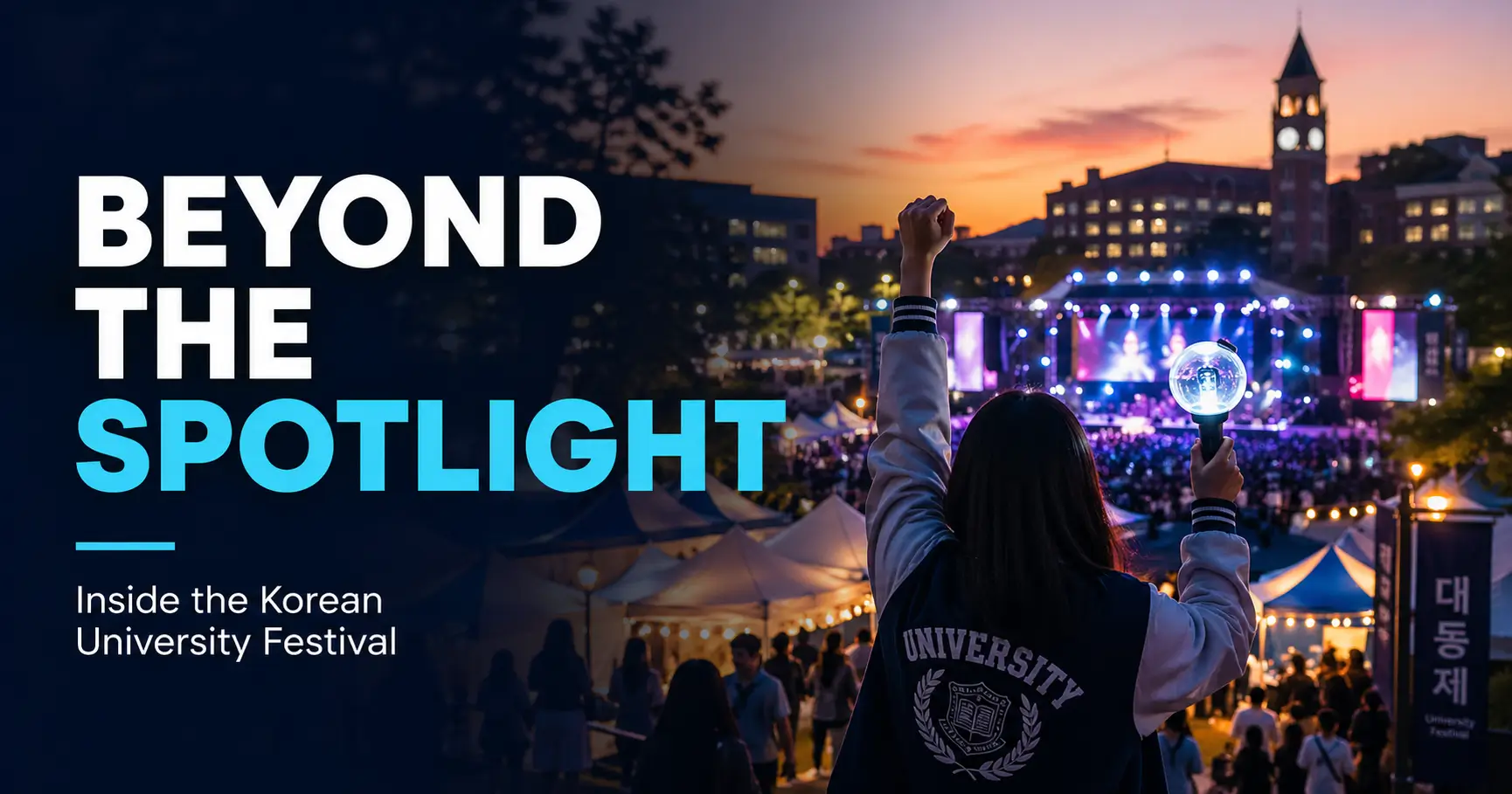
Beyond the Spotlight: Decoding the Korean University Festival
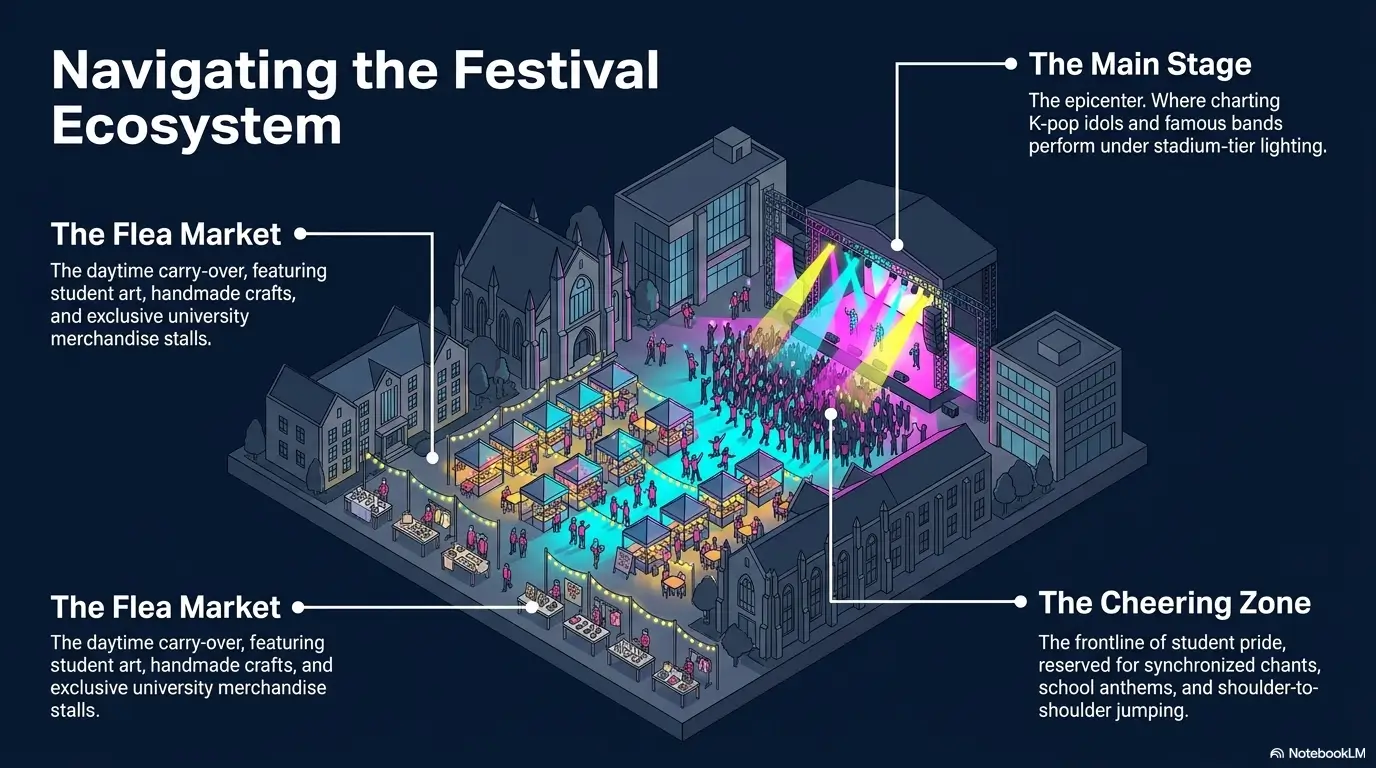
A Korean university festival can look, at first glance, like a campus accidentally rented a music-awards show: stage lights, idol screams, food smoke, and students moving through the night in bright little currents.
But university festival season in Korea feels different from many Western campuses because the real story is not just K-pop. It is Daedongje, student councils, food booths, department pride, cheering culture, and a campus briefly turning into a public square.
For Anglo-American visitors, exchange students, and curious travelers, a few viral fancams can make the whole thing look like “free concert culture.” However, the deeper rhythm is collective identity under festival lights. To view it only as a celebrity schedule is to miss the student-made cultural space.
Table of Contents
Fast Answer: University festival season in Korea feels different from Western campuses because it blends student identity, public performance, K-pop culture, food booths, school pride, and city-like crowd energy into one concentrated campus event. Unlike many Western campus traditions centered on sports, clubs, Greek life, or alumni weekends, Korean festivals often feel like a miniature cultural district unfolding for a few nights.
Start Here: Korean Campus Festivals Are Not Just “College Parties”
Calling a Korean university festival a “college party” is a little like calling a symphony hall “a room with chairs.” Technically, there may be music. Technically, there may be people. But the label misses the architecture of feeling.
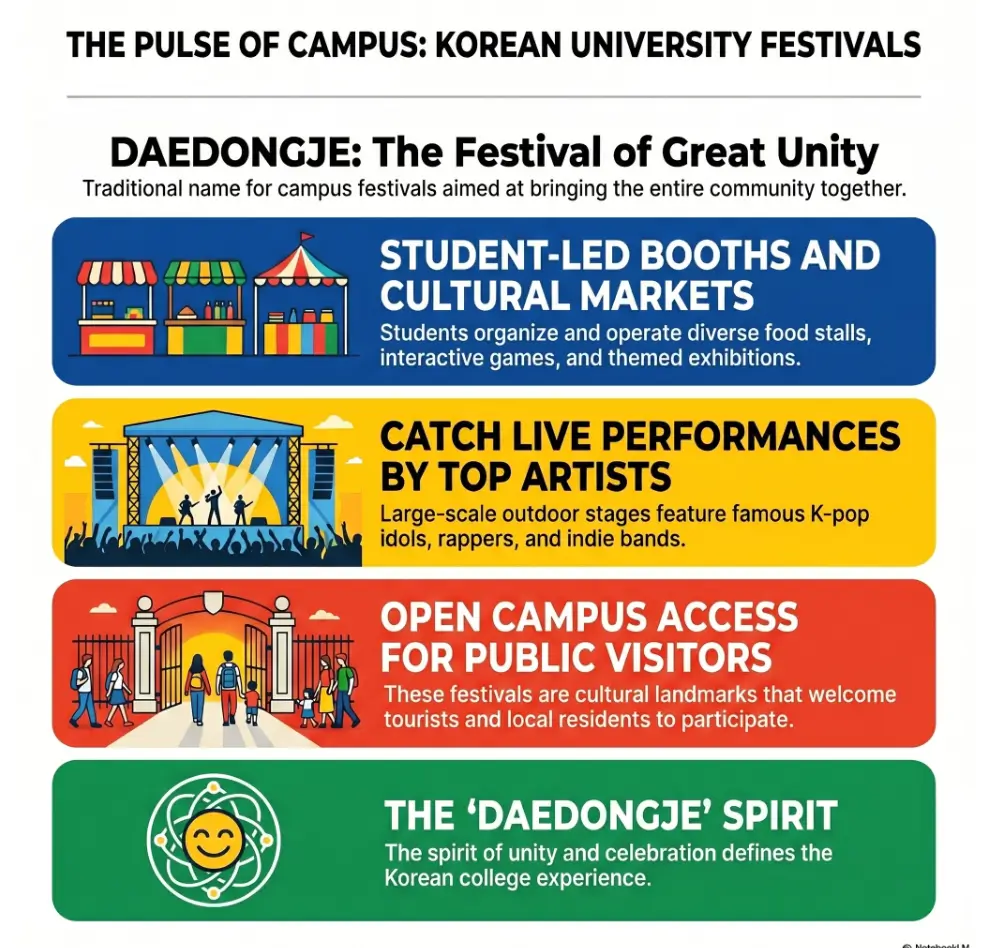
In Korea, many university festivals are organized as large campus-wide events, often with booths, student performances, outside performers, club programs, night markets, cheering culture, and temporary public energy. The University of Seoul describes its Daedongje as a spring festival where students, faculty, staff, and the local community come together to share culture and passion. That one sentence matters. It tells you this is not only about students blowing off steam after class.
Why the word “festival” carries more weight than “event”
In many Western campus contexts, “event” can mean a poster on a bulletin board, a room reservation, pizza, and 37 folding chairs with one suspiciously loud projector. A Korean campus festival often feels more spatial. It uses the whole campus as a stage.
The paths, gates, sports fields, student union areas, lawns, stairways, and food zones become part of the experience. You do not merely attend. You move through it.
The campus briefly becomes a public square, concert venue, and food street
This is the key difference: the campus stops behaving like a private academic machine and starts behaving like a temporary neighborhood. A walkway becomes a food lane. A field becomes a concert venue. A department booth becomes a tiny diplomacy desk where students sell snacks, games, or themed experiences with the seriousness of people running a pop-up empire.
I once watched a Korean campus path change personality in under 2 hours. At 4 p.m., it looked like a normal route between buildings. By 6 p.m., it had become a river of paper cups, grilled food smoke, student jackets, and people texting friends the classic festival sentence: “Where are you? I’m near the booth with the lights.” If you want to understand that coordination layer, Korean campus life often makes more sense after reading about Korean group chat culture, where location, timing, and group feeling are negotiated in tiny digital bursts.
What US readers often miss when they only see idol fancams
Fancams show the fireworks. They rarely show the wiring. Behind the idol stage is student labor, department pride, campus politics, sponsorship decisions, safety planning, crowd control, and a semester’s worth of anticipation.
- Visible layer: famous performers, cheering, lights, food, viral clips.
- Hidden layer: student councils, club preparation, school identity, social coordination.
- Emotional layer: relief after pressure, belonging, youth, memory-making.
- Read the space, not just the stage.
- Notice who organized each booth or performance.
- Watch how students move in groups, not only as individuals.
Apply in 60 seconds: When watching a festival video, pause once before the singer appears and look at the signs, booths, and crowd layout.
Daedongje Explained: The Unity Idea Behind the Noise
The Korean word often used for university festivals is Daedongje. The feeling inside the word is closer to “coming together” than “campus entertainment product.” Of course, modern festivals have sponsors, lineups, posters, lighting rigs, and social media countdowns. The old idea still hums underneath.
That hum is important because Korean university life can be intense. Students may spend long years preparing for entrance exams, competing for internships, navigating department culture, and managing social expectations. The festival gives the campus a sanctioned exhale.
Why “coming together” matters in Korean university culture
In the US, students often build identity through many overlapping circles: residence halls, sports teams, Greek organizations, majors, clubs, part-time jobs, campus ministries, activist groups, and friend networks. Korean campus identity can also be diverse, but festivals often give the whole university a more collective frame.
You see it in department jackets, banners, chants, matching booth decorations, and the way groups travel together. The festival says, for a few nights, “This campus is not just a place where you take classes. It is a shared body.”
How student-led planning changes the emotional texture of the festival
Many Korean university festivals rely heavily on student councils and student organizers. This changes the emotional texture. The event is not simply delivered to students by an administrative office. Students help make the stage, the booth map, the atmosphere, and sometimes the headaches.
That matters. A student-run booth has a different charm from a polished corporate activation. It may have crooked tape, overly ambitious menu names, and a payment sign written with the energy of someone who slept 4 hours. It feels human. It feels earned. For a wider view of how student identity forms before the festival even begins, Korean university orientation culture gives useful context for the rituals, introductions, and group belonging that shape early campus life.
The old-school meaning hiding under the modern stage lights
When the lights go up and the crowd screams for a performer, the modern layer is obvious. But Daedongje also carries a social promise: a serious academic space can temporarily become playful without losing its dignity.
That is why the atmosphere can feel so different from a random concert. The singer may be famous, but the campus is the container. The crowd is not only consuming a show. It is performing a version of itself back to itself.
Mini Infographic: The Korean Campus Festival Stack
Fields, gates, paths, student union spaces.
Councils, clubs, departments, volunteers.
Chants, jackets, booths, shared memories.
K-pop stages, lighting, crowds, viral clips.
Read it upward: the spectacle makes sense only when you see the campus layers underneath it.
K-Pop Changes Everything, But It Is Not the Whole Story
Let’s be honest: famous performers are a huge reason Korean university festivals travel online. A shaky phone clip of a major idol group on a university stage can make the campus look like it accidentally swallowed a music awards show.
But if you make K-pop the whole story, you flatten the culture. You end up reading a whole novel by staring at the glitter on the cover.
Why celebrity lineups make Korean university festivals feel unusually big
High-profile artists can turn a campus festival into a regional magnet. Students check lineups, outsiders watch social media, and local businesses near campus may feel the foot traffic. Some universities have famous festival identities partly because people associate them with strong performance lineups, cheering culture, or iconic campus atmosphere.
Korea JoongAng Daily has reported on major university festival lineups drawing intense public attention, including star-studded spring events at schools such as Yonsei University. That kind of coverage reinforces the sense that Korean campus festivals are not tucked quietly inside student life. They can become part of the broader entertainment conversation.
The strange magic of seeing major artists on an ordinary campus field
The magic comes from contrast. A campus field is usually a practical place. Students cross it with backpacks, iced Americanos, and mild academic dread. Then, for one night, the same field holds light towers, security lines, screaming fans, and artists who normally appear on professional stages.
That contrast makes the experience feel oddly intimate. Not small, exactly. More like the glamorous thing has wandered into everyday life wearing stage makeup.
Here’s what no one tells you: the crowd is watching the school, too
Visitors may come for the celebrity, but they also absorb the school. They see the student jackets. They hear chants. They learn which campus has fierce cheering culture, which has a stylish crowd, which has an open layout, and which feels like a pressure cooker with fairy lights.
Decision Card: Are You Watching a Concert Clip or a Campus Culture Clip?
| If you focus on… | You will notice… | Better question |
|---|---|---|
| Only the performer | Stage quality, song choice, crowd volume | Why this artist, here, for this school? |
| The crowd | Group movement, chants, student zones | Who seems to belong naturally? |
| The campus edges | Booths, signs, barriers, visitor flow | How public is this event allowed to become? |
Neutral action: Before comparing festivals, save 2 clips from different universities and watch the first 30 seconds without sound.
Western Campuses Feel Different Because Their Rituals Are Spread Out
One reason Korean festivals feel so concentrated is that many Western campus rituals are distributed across the calendar. The US college experience may include homecoming, football weekends, club fairs, spring concerts, alumni reunions, residence hall events, commencement week, Greek life events, and department gatherings. Each has its own orbit.
Korean university festivals often compress many kinds of campus feeling into a few days. The result can feel denser, louder, and more cinematic.
Homecoming, tailgates, club fairs, concerts, and Greek events are often separate
On a US campus, school pride may peak at a homecoming game. Student organization energy may appear at a club fair. Music may happen at a ticketed campus concert. Alumni life may have its own schedule. Greek life, where present, may create another social world entirely.
This does not make Western campuses less meaningful. It makes the ritual map different. The emotional furniture is spread across more rooms.
Why US campus life usually has more fragmented social scenes
US students often belong to different micro-communities. Two students at the same university may have wildly different social lives depending on housing, major, sports, work schedules, finances, and personality. One person’s campus is a library and a lab. Another person’s campus is a stadium and a fraternity house. Another person’s campus is a commuter parking lot and a part-time job.
Korean festivals do not erase differences, but they create a shared calendar moment. Even students who do not love crowds know the festival is happening. The noise finds you.
The Korean version compresses the semester’s emotional weather into a few nights
Think of it as weather, not decoration. The semester carries stress, hierarchy, assignments, exams, job anxiety, romance, loneliness, ambition, and caffeine. Festival season releases some of that pressure into one bright front.
I remember standing near a booth where students were selling simple snacks with the intensity of a Michelin operation. One student kept checking the cash box, the grill, the queue, and her phone. She looked exhausted. She also looked completely alive. That is the paradox of festival labor: it can be tiring and still become a memory people keep.
Show me the nerdy details
For cultural comparison, avoid treating “Korean festival” and “Western campus” as equal categories. Korea is a country with its own higher education traditions, while “Western campuses” can include the US, Canada, the UK, Australia, and Europe, each with different student cultures. The useful comparison is not “Korea vs. the West” as a slogan. It is ritual concentration versus ritual distribution.
Student Identity Feels More Collective in the Korean Festival Frame
Korean university festivals often make student identity feel collective before the headliner even appears. You see it in department jackets, group seating, student council booths, school colors, cheering teams, banners, and the choreography of belonging.
This is one of the hardest things for US readers to understand from clips alone. The crowd is not just a crowd. It is a map.
Why school pride shows up through chants, departments, booths, and shared rituals
In Korea, school pride can be carried through small visible codes: department apparel, school logos, cheering songs, and the way students refer to their campus as a shared identity. At some universities, cheering traditions are a major part of student culture, especially around rival events or major festivals.
Korea University’s official English pages describe major student events such as the Great Granite Tower Festival and annual Korea-Yonsei Games, noting how colleges, departments, clubs, alumni, and local community members can be drawn into broader campus celebration. That gives you a useful clue: student identity is not only about personal preference. It is also about belonging to a layered institution. That same layered belonging also appears in Korean campus clubs, where friendship, hierarchy, schedules, and identity often gather under one student-group roof.
How group belonging shapes the atmosphere before anyone steps onstage
Before the singer appears, the group has already assembled itself. Friends coordinate arrival times. Departments plan booths. Clubs rehearse. Student organizers debate logistics. Visitors try to figure out where they are allowed to stand. The festival atmosphere is built from hundreds of tiny agreements.
That is why the night can feel orderly and chaotic at the same time. The crowd has rules, but not all of them are written on signs.
The quiet pressure: being part of the crowd without disappearing inside it
Collective energy can be beautiful. It can also be heavy. Not every student wants to be swallowed by school spirit. Some students attend because friends are going. Some help at booths because their department expects it. Some love the festival for exactly 43 minutes and then need to flee to a convenience store for emotional oxygen.
That tension is part of the truth. Korean festivals can feel warm because they create belonging. They can feel intense because belonging sometimes arrives wearing a whistle and carrying a schedule.
Eligibility Checklist: Should a Visitor Attend a Korean University Festival?
- Yes/No: You checked whether the event is open to non-students.
- Yes/No: You are comfortable with dense crowds and long standing times.
- Yes/No: You can follow campus rules even when other visitors seem casual.
- Yes/No: You are interested in campus culture, not only celebrity access.
- Yes/No: You have a simple exit plan near a subway station or main road.
Neutral action: If you answer “no” to 2 or more, consider visiting the campus during daytime festival hours instead of peak stage time.
Food Booths Turn the Campus Into a Night Market
Food is where the festival becomes tactile. You can watch 100 videos of a stage, but the smell of grilled skewers, instant noodles, fried snacks, paper cups, and warm pavement tells a different story.
Food booths make the campus feel less like an institution and more like a temporary street. The night becomes edible. That sounds poetic until you spill sauce on your sleeve, at which point it becomes anthropology with laundry consequences.
Why temporary food stalls make the festival feel less like a school function
A formal university event usually has registration tables, name tags, and someone saying “networking opportunity” with dangerous sincerity. A festival food booth has students shouting prices, friends laughing over small tables, and the cheerful instability of temporary infrastructure.
This changes the social mood. People linger. They wander. They compare booths. They make small decisions every 5 minutes: eat now, meet friends, watch a stage, buy a drink, take photos, find a bathroom, escape the crowd, return to the crowd because apparently we are all complicated.
The sensory difference: smoke, paper cups, folding tables, and neon campus paths
Western campus events can certainly have food trucks and outdoor fairs. But Korean university festivals often fold food into the night atmosphere in a way that resembles local street culture. The combination of temporary seating, compact crowds, illuminated booths, and late-evening movement makes the campus feel urban. For readers who want the broader city-and-neighborhood lens, Korean city identity helps explain why streets, campuses, districts, and public rhythms can feel so closely braided together.
For travelers, this can be the most accessible layer. You may not understand every chant. You may not recognize every performer. But you understand the universal language of someone carefully carrying hot food through a crowd with the face of a bomb technician.
What Western visitors should understand before calling it “just street food”
Do not reduce the booths to snacks. Booths can be fundraising tools, department showcases, social bonding devices, and student labor in public form. The menu may be simple, but the booth may represent weeks of preparation.
- They slow people down and create conversation zones.
- They let departments and clubs become visible.
- They turn campus paths into temporary public streets.
Apply in 60 seconds: In any festival vlog, count how many non-stage scenes involve food, lines, tables, or student-made signs.
The Public-Private Blur Makes the Experience Feel Bigger
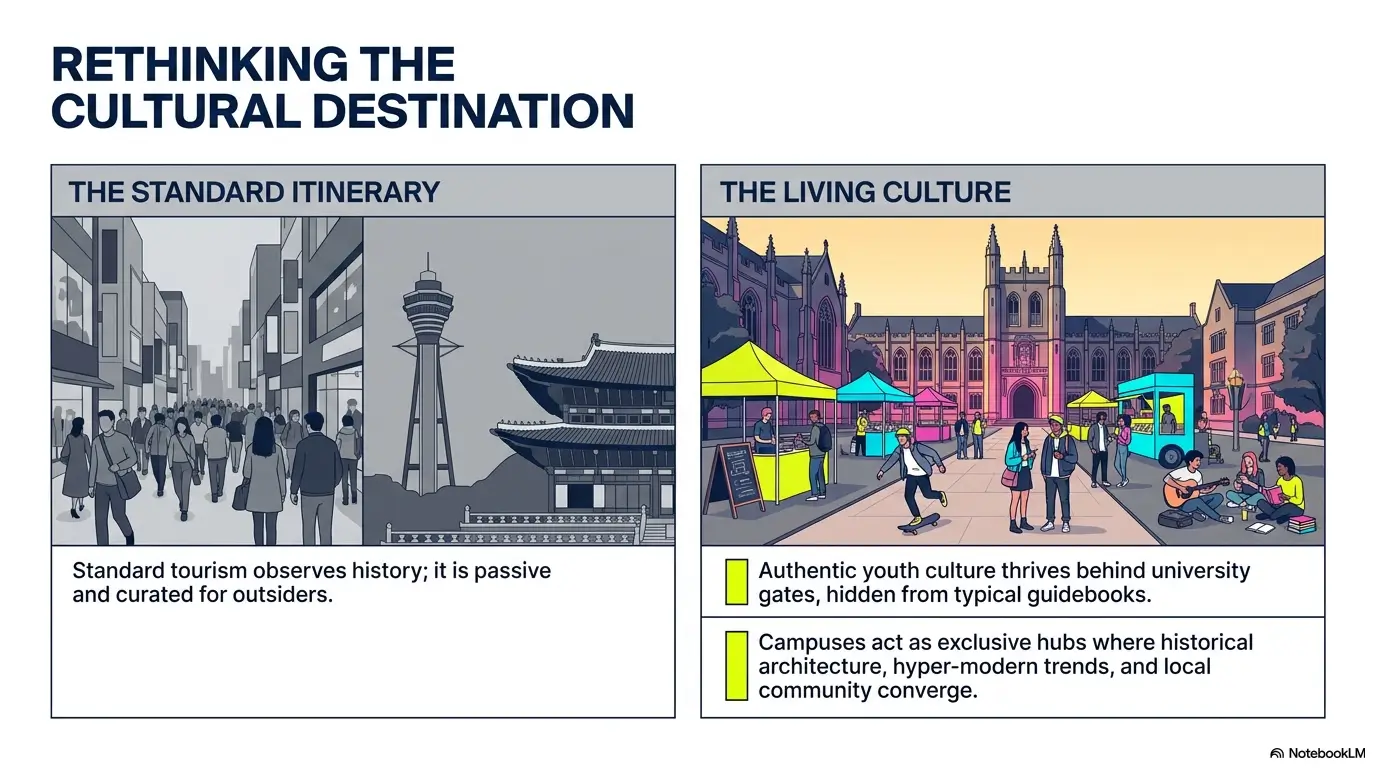
A university is private in one sense: it belongs to students, staff, and faculty. But many Korean campuses, especially in Seoul, are physically woven into the city. Subway stations, cafes, alleys, shopping streets, and campus gates sit close together. During festival season, that boundary can soften.
This public-private blur is one reason Korean university festivals feel larger than a campus event. The city seems to lean over the fence.
Why some Korean university festivals attract outsiders, not only students
Visitors may come because of K-pop performers, campus beauty, neighborhood energy, friends who attend the school, or plain curiosity. Korea Tourism Organization has even introduced university campus visits in Seoul as part of youth culture and travel interest, while also warning that festival events may be crowded and mainly geared toward students.
That warning is practical. A campus festival may be open in some areas but still emotionally designed for insiders. Visitors should not assume every space, seat, or performance zone is meant for them.
How campus boundaries feel softer during festival season
In a dense city, a campus can already feel porous. During festival season, the visual signals change: booths near paths, banners at entrances, music traveling beyond the field, groups arriving from subway exits, and social media posts turning a local event into a public invitation.
This is thrilling if you like urban energy. It is exhausting if you expected a tidy campus tour with birdsong and one polite coffee kiosk.
Let’s be honest: the visitor energy can be thrilling and overwhelming
The same openness that makes festivals exciting can make them stressful. Crowds may move slowly. Popular stages may fill early. Restrooms may have lines. Phone batteries disappear with operatic drama. If you are short, tired, anxious in crowds, or responsible for a teenager, the romance of “just go with the flow” gets old by minute 11.
Mini Calculator: Your Festival Crowd Tolerance Score
Give yourself 0, 1, or 2 points for each question.
- Standing: Can you stand comfortably for 60–90 minutes?
- Noise: Can you handle loud music and cheering without feeling trapped?
- Exit: Can you leave early without feeling you “wasted” the night?
Output: 0–2 points means choose daytime booths. 3–4 means attend briefly with an exit plan. 5–6 means peak-stage energy may suit you.
Neutral action: Decide your exit point before entering the densest crowd, not after you are already tired.
Common Mistakes US Visitors Make When Reading Korean Festival Culture
The biggest mistake is assuming familiarity. A campus, a stage, food, students, music: it all looks easy to decode. Then you realize the social grammar is different.
Here are the mistakes that cause the most cultural static.
Mistake 1: Assuming the festival is only about drinking or partying
Yes, some festival areas may involve drinking, depending on the school, rules, year, and event structure. But reducing the festival to alcohol misses the wider frame: student identity, performance, club culture, food booths, cheering traditions, and relief after academic pressure.
A better lens is “temporary campus commons.” That phrase sounds less exciting, but it is more accurate. The festival gives many campus groups a way to become visible at once.
Mistake 2: Treating idol performances as the entire meaning of the event
Idol performances are powerful, and they can dominate attention. But the festival does not begin when the headliner steps on stage. It begins when students start planning, building, decorating, rehearsing, arguing, texting, taping, cooking, and wondering why the extension cord has vanished.
Mistake 3: Ignoring student councils, department booths, and campus hierarchy
Student councils often matter. Departments matter. Clubs matter. Seniority and group membership may shape who organizes what, who works which booth, and how people participate. You do not need to decode every relationship, but you should know the festival is not socially flat.
Mistake 4: Expecting Western-style personal space in a Korean crowd
Dense crowds in Korea can feel different from what many US visitors expect. People may stand closer, move in waves, and tolerate crowd compression that feels intense if you are used to more space. That does not mean you must endure discomfort. It means you should plan wisely.
- Arrive early if you care about stage views.
- Stand near edges if you dislike crowd pressure.
- Carry less than you think you need.
- Keep your phone charged and your meeting point simple.
- Check access rules before going.
- Do not block student areas for photos.
- Remember that the campus is someone else’s daily life.
Apply in 60 seconds: Before attending, find the student council or university festival notice and read the rules, not just the lineup.
Who This Is For, and Who It Is Not For
This guide is for readers who want the meaning behind the lights. If you only want a schedule of which artist performs where, this article will feel too slow. It is wearing sensible shoes and carrying a notebook.
But if you are trying to understand Korean campus culture, study abroad life, or why these festivals feel so emotionally charged, you are in the right room.
This is for readers who want cultural context, not just a lineup calendar
A lineup calendar tells you who performs. Cultural context tells you why people care. The second question lasts longer. It helps you understand why a student might remember a festival booth more vividly than a lecture, even if the lecture was objectively more useful and had fewer smoke machines.
This is for study-abroad students trying to decode campus life before arrival
If you are preparing to study in Korea, festival season can be both exciting and confusing. You may wonder whether you are allowed to attend, how to join friends, whether booths accept cards, where to stand, and whether your Korean is “good enough.”
You do not need perfect Korean to observe respectfully. You do need patience, humility, and the ability to laugh gently when your plan dissolves because everyone changed meeting spots 3 times. It also helps to understand Korean texting formality, because even simple festival messages can carry small signals of age, closeness, and respect.
This is not for readers looking only for ticket hacks or celebrity schedules
Some events are open. Some are student-priority. Some are student-only. Some require tickets or reservations. Some change rules from year to year. Any article promising universal hacks is probably selling you fog in a shiny bottle.
Prep List: What to Check Before Comparing Festival Options
- Official university or student council notice.
- Whether non-students can enter the campus or stage zone.
- Festival dates, start times, and last subway timing.
- Payment expectations for booths or tickets.
- Weather, restroom access, and crowd exit routes.
Neutral action: Compare 2 universities by access rules first, then by performer lineup.
What Feels So “Korean” About the Festival Season?
The most Korean-feeling part is not one object. It is the combination: order and release, pressure and brightness, group identity and individual joy, study culture and sudden spectacle.
Korean university festivals often feel like a zipper opening on a tightly packed semester.
The mixture of order and emotional release
Korea is often described through discipline: exams, work culture, hierarchy, speed, pressure. Those descriptions can be too blunt, but they point toward something real. Many students know what it means to live inside expectation.
Festival season does not erase that pressure. It gives it a temporary costume. The campus still has hierarchy, schedules, and rules. But for a few nights, seriousness allows music to sit on its shoulders.
The way a serious campus briefly permits collective brightness
A university is usually built around evaluation: grades, entrance scores, resumes, research, rankings, internships. During a festival, the campus permits other forms of value: cheer, taste, performance, stamina, friendship, visual creativity, and the ability to find your friend near a booth described only as “the one with the blue thing.”
That shift feels larger in cultures where academic seriousness carries heavy symbolic weight. The same pressure-and-release pattern becomes easier to see when you look at Korean exam day rituals, where education, family hope, luck, and social attention gather around a single high-stakes moment.
The cultural contrast between exam pressure and festival looseness
The looseness matters because it is not endless. It appears, blooms, and disappears. After the booths come down, the campus returns to ordinary time. That temporary nature makes the festival glow brighter in memory.
Short Story: The Night the Campus Changed Its Accent
A friend once took me through a Korean campus on the first evening of festival week. In daylight, the place had been all angles: library windows, bicycle racks, stone steps, students walking with the private weather of deadlines over their heads. By night, the same path had changed its accent. A booth sold spicy food under a handmade sign.
Someone in a department jacket was yelling into a megaphone with heroic lack of embarrassment. A group of students rehearsed a chant, forgot the middle, and laughed so hard the chant became better. Nothing about the campus had physically moved. But the meaning had shifted. That is when I understood why these festivals feel different. They do not simply add entertainment to a university. They reveal the university as a living crowd.
FAQ
When is university festival season in Korea?
Many Korean universities hold major festivals in spring, often around May, though some campuses also have fall festivals or school-specific schedules. Always check the university or student council announcement for the exact year because dates, lineups, and access rules can change.
Are Korean university festivals open to non-students?
Sometimes, but not always. Some campus areas may be open to visitors, while certain stages, seating zones, or ticketed events may prioritize or restrict access to enrolled students. Treat every festival as school-specific rather than assuming one rule applies everywhere.
Why do famous K-pop idols perform at university festivals?
University festivals offer artists energetic young audiences, strong social media visibility, and a lively performance setting. For universities, celebrity performances can raise excitement and make the festival feel larger. Still, K-pop is only one layer of the festival, not the whole cultural meaning.
Is Daedongje the same at every Korean university?
No. Daedongje is a common festival term, but each university has its own traditions, layout, student culture, budget, access rules, and atmosphere. A festival at a large Seoul campus may feel very different from one at a smaller regional university.
How are Korean university festivals different from US homecoming?
US homecoming often centers on alumni, sports, school history, and weekend traditions. Korean university festivals often concentrate booths, student performances, food stalls, celebrity stages, and student-led identity into a few campus nights. Both build school pride, but the ritual structure feels different.
Do Korean students actually care about the festival beyond the celebrity lineup?
Many do. Some care deeply because they organize booths, perform with clubs, join department activities, or treat the festival as a major social memory. Others attend mainly for friends or performers. Like any campus tradition, enthusiasm varies, but the festival’s meaning is broader than the lineup.
Are university festivals in Korea safe for international visitors?
They can be enjoyable, but dense crowds, late-night travel, language barriers, and changing access rules require planning. Visitors should check official notices, keep valuables secure, avoid pushing into student-only zones, and choose a clear meeting point and exit route.
What should a foreign visitor avoid doing at a Korean campus festival?
Avoid treating the campus as a theme park. Do not block paths for photos, ignore staff instructions, push into student areas, film people intrusively, or assume performer access is guaranteed. The simplest rule is elegant: enjoy the atmosphere without making students manage you.
Next Step: Watch One Festival Like a Cultural Field Note
The opening clip showed a campus field glowing under stage lights. Now the loop closes: the light is not the whole story. The difference is in what the light reveals.
Watch one Korean university festival video again, but do not begin with the performer. Begin with the edges. Look at who is selling food, who is wearing department jackets, who is guiding the crowd, where outsiders stand, how students move in groups, and what the campus becomes after dark.
Choose one university festival video and look beyond the stage
Pick one video from a university festival, preferably one that includes walking footage, booths, or crowd scenes. Do not choose only the cleanest performance clip. Perfect stage footage is beautiful, but it is often too polished to teach you the culture.
Notice the booths, crowd behavior, school chants, signs, and movement patterns
Use a small field-note method. Write 5 observations without judging them. For example: “students wear matching jackets,” “outsiders stand behind a barrier,” “food booths use handwritten signs,” “crowd moves in waves,” or “the campus path becomes a market street.”
Use this question: “What kind of belonging is being performed here?”
That question is the key. Korean university festivals feel different because they perform belonging in public: through food, sound, effort, pressure, celebrity, school identity, and temporary freedom. Western campuses have their own powerful rituals, but they often distribute them across sports, clubs, alumni events, and private social scenes.
So the next step is simple and useful: spend 15 minutes watching one festival like a cultural field note. Not as a fan trying to catch a perfect stage angle. Not as a tourist hunting a secret hack. As a reader of public life, noticing how a serious campus briefly turns bright.
Last reviewed: 2026-04.