Navigating Korean Meeting Etiquette
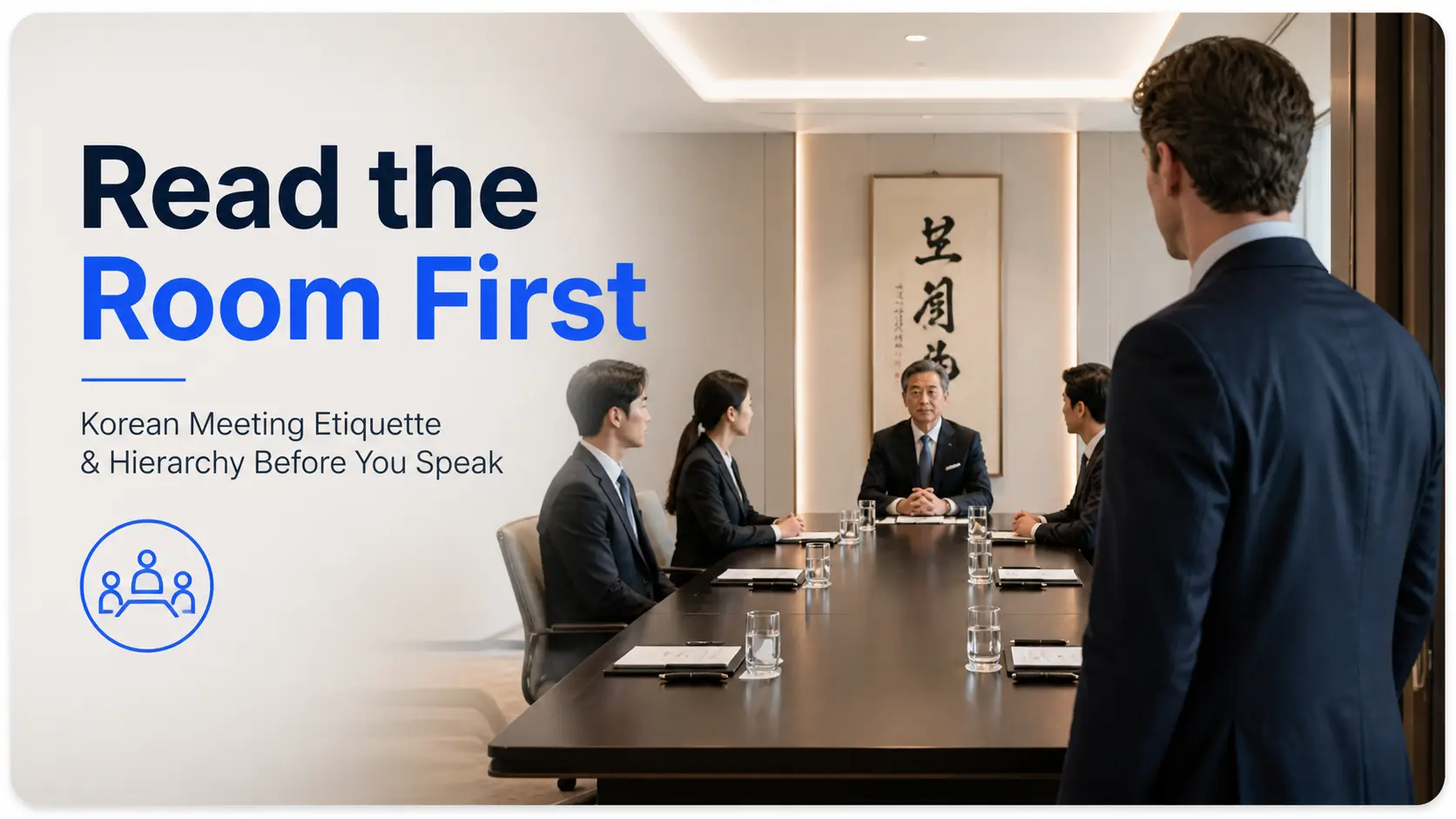
You can walk into a Korean meeting room and feel the conversation has already started, even while everyone is still adjusting chairs, placing papers, and greeting softly.
For Anglo-American professionals, that quiet first minute can be deceptively tricky. Korean meeting hierarchy often appears before anyone speaks, through seating, arrival order, business cards, eye contact, silence, and who waits for whom. Miss those signals, and you may not offend anyone dramatically. Worse, you may create a small chill in the room without knowing where it came from.
That matters because trust, authority, and decision flow are often being negotiated before the agenda begins.
This guide will help you read Korean business meeting etiquette with more calm and less guesswork, so you can enter the room respectfully, avoid accidental power moves, and collaborate with Korean clients, executives, vendors, or teams more smoothly.
The method here is practical pattern-reading: notice repeated cues, not stereotypes.
Start with the chair.
Then watch the pause.
Then notice who everyone quietly protects.
By the time the first slide appears, the room may have already told you more than the agenda ever could.
Table of Contents
The Room Speaks First: Why Korean Meeting Hierarchy Starts Before Words
The invisible agenda behind the visible agenda
In many US workplaces, a meeting begins when someone says, “Let’s get started.” In many Korean business settings, the meeting begins earlier: when people enter, choose seats, exchange greetings, place documents, check who has arrived, and adjust their tone around senior people.
That does not mean every Korean room is stiff or old-fashioned. Seoul startup teams, global manufacturers, university labs, government offices, chaebol affiliates, creative agencies, and remote product squads can all feel different. Still, one pattern often remains: relational position matters before content begins.
I learned this the clumsy way once, watching an American colleague cheerfully sit at the center of the table before the client’s senior executive arrived. Nobody scolded him. Nobody even blinked dramatically. The room simply developed a tiny weather system. Chairs moved. Smiles tightened. A junior manager quietly rescued the arrangement with the grace of someone defusing a teacup.
Why US-style “just jump in” energy can misread the room
US professionals often prize speed, openness, and direct contribution. Those instincts can be useful. They can also become a cultural trombone in a string quartet. In Korea, fast participation may read as confidence in some rooms, but in others it may feel like you are skipping the social calibration that helps people feel safe.
The difference is not “Americans are casual, Koreans are formal.” That is too flat. The better distinction is this: US meetings often reward visible initiative early. Korean meetings often reward accurate social reading early, especially when nunchi at work in Korea quietly shapes how people read timing, mood, and rank.
The first signal is not rank alone, but relational position
Hierarchy in Korean meetings is shaped by title, age, company role, client/vendor relationship, host/guest status, and sometimes language ability. A senior person from the vendor side may still defer to a younger client. A fluent English speaker may not be the decision-maker. A quiet director may outrank the lively manager doing most of the talking.
- Notice who others wait for before sitting or speaking.
- Separate English fluency from authority.
- Assume the room has already started communicating.
Apply in 60 seconds: Before you speak, identify the host, the senior-most person, and the person others glance toward.
Seat Placement Tells a Story: Where Power Quietly Sits
The senior seat is rarely accidental
In Korean business meetings, seating can carry meaning. The most senior or honored participant may be placed at a central seat, a seat farthest from the door, a seat facing the entrance, or a seat with the clearest view of the screen. The exact logic changes by room, company, and host, but the deeper principle is stable: the best seat is often assigned by respect, not convenience.
For a US visitor, the safest move is beautifully simple: do not rush the chair. Pause. Let the host gesture. If no one gestures, ask, “Where would you like me to sit?” That one sentence saves more awkwardness than a 40-slide cultural training deck with tiny icons.
Doors, windows, screens, and the subtle geography of respect
The table is a map. In some rooms, the host team sits on one side and the visiting team on the other. In others, senior people face one another. Sometimes the person closest to the screen is the presenter, not the senior person. Sometimes the person at the end of the table is quietly running the meeting, even if they say little.
This logic is not limited to boardrooms. The same cultural instinct appears in homes, restaurants, and family gatherings, which is why a broader guide to Korean seating hierarchy can make business rooms feel less mysterious.
Look for these signals before claiming a seat:
- Which chair remains open while others settle?
- Where does the host place the senior guest?
- Who sits near the most senior person?
- Who has documents arranged in front of them already?
- Who avoids sitting until someone else sits first?
Don’t do this: sitting anywhere because “we’re all casual here”
“We’re casual” can mean different things. In a US startup, it may mean sneakers, first names, and a meeting room named after a breakfast cereal. In a Korean workplace, casual may still include unspoken sequencing, title awareness, and quiet deference around senior people.
I once watched a visiting consultant say, “I’ll just grab this spot,” then take the chair clearly left for the client’s executive. The Korean team solved it gently, but the consultant spent the first 10 minutes explaining strategy while unknowingly wearing the room’s invisible crown. Nobody wants to be accidentally crowned. It ruins the posture.
Money Block: 30-Second Seating Decision Card
| Situation | Best move | Why it works |
|---|---|---|
| Host gestures to a seat | Take it with a brief thanks | You accept the room’s order without fuss. |
| No one gestures | Ask where to sit | It shows humility and prevents seat stealing. |
| You are hosting Koreans | Guide senior guest first | Respect becomes visible before the agenda. |
Neutral action line: Before the meeting, choose one person on your team to handle seating cues.
Arrival Order Matters: Who Waits, Who Enters, Who Is Received
Early arrival can signal preparation, humility, or lower status
Punctuality matters in Korean business settings, but arrival order can carry additional meaning. Junior employees may arrive first to prepare the room, check materials, test the projector, set water bottles, and make sure no senior person has to wrestle with a cable while everyone watches in theatrical silence.
For US professionals, early arrival is usually read as preparedness. In Korean settings, it can also show respect for the host, the meeting, and the people with more senior responsibility. Arriving 5 to 10 minutes early is a small behavior with a large social footprint.
When the most senior person arrives, the room may reset
Watch what happens when a senior person enters. People may stand slightly, shift posture, pause conversation, bow or nod more formally, or re-open greetings even if smaller greetings already happened. The room may reset its volume and attention.
This is not theater. It is a way of acknowledging responsibility and position. The senior person’s arrival may signal that the meeting can now move from warm-up to official frame. In some cases, no one wants to begin real business until the correct person is present.
Here’s what no one tells you: the meeting may begin emotionally before it begins officially
Before the agenda starts, people are already asking quiet questions: Are these visitors patient? Do they respect the host? Did they prepare? Do they understand who matters in the room? Will they rush us? Will they embarrass someone?
A calm arrival answers those questions better than a speech. Place your phone away. Have your materials ready. Greet people in order as much as possible. Do not launch into the proposal while someone is still taking off a coat. The spreadsheet can wait 90 seconds. It has survived worse.
- Arrive early enough to settle without creating a small tornado.
- Notice whether the room changes when someone enters.
- Do not start substance before the host signals readiness.
Apply in 60 seconds: When the senior person enters, pause your side conversation and let the greeting happen cleanly.
Greetings Before Content: The Bow, Nod, Handshake, and Pause
Why the greeting is part of the negotiation
In Korean meetings, greetings are not decorative. They are the first negotiation over distance, respect, and tone. A small bow, a measured handshake, a two-handed gesture, a polite nod, and a short pause all help establish the social temperature of the room.
US professionals sometimes treat greetings as a doorway to “the real thing.” In Korea, the doorway is part of the house. Rushing through it can feel like walking in with muddy shoes.
You do not need to perform a dramatic bow. In most international business settings, a slight bow with a handshake is enough. If the Korean counterpart bows first, return the gesture. If they offer a handshake, accept it. If both happen, fine. Humans are adaptive creatures; we have survived fax machines and airport coffee.
How mixed Korean-US teams blend bows, handshakes, and English greetings
Global Korean teams often blend etiquette. You may hear English greetings, see light bows, then handshakes. Some younger professionals may be relaxed; senior executives may prefer more formality. The best approach is responsive, not theatrical.
A simple greeting can sound like this:
- “Good morning. Thank you for having us.”
- “It’s a pleasure to meet you.”
- “Thank you for making time today.”
- “Please let us know where you’d like us to sit.”
Mistake to avoid: overcorrecting into theatrical politeness
Overdoing politeness can be its own awkward opera. A deep bow, exaggerated two-handed gestures, and nervous over-explaining may make people uncomfortable. Respect should feel steady, not like you swallowed an etiquette manual and it is trying to escape.
When unsure, choose calm restraint. Smile lightly. Bow slightly. Use titles if you know them. Let the host lead. Matching the room beats performing a culture. If you want a broader foundation before you walk into the room, review these practical notes on Korean business etiquette and adapt them to the specific company, industry, and seniority level in front of you.
Business Cards as Micro-Ceremony: Small Paper, Big Signal
How card order can reveal who matters in the room
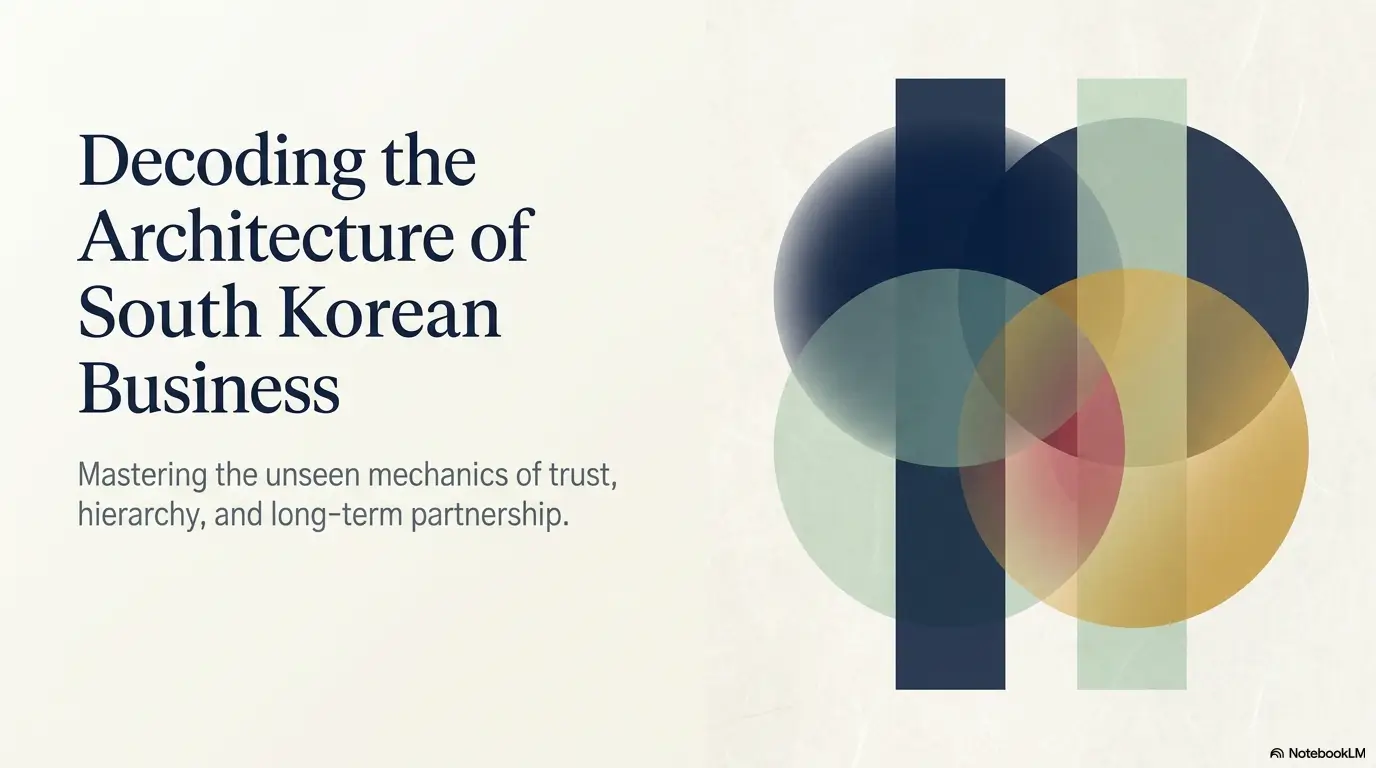
Business cards still matter in many Korean professional settings, especially in more traditional industries, government-adjacent work, consulting, manufacturing, finance, education, and senior-client meetings. A card is not just contact information. It carries title, department, company, and status.
Card exchange can reveal hierarchy quickly. Senior people may exchange cards first. People may look carefully at titles. Someone may arrange cards on the table according to seating, using them as a quiet map of names and rank.
If you come from a US environment where LinkedIn replaced half the card ritual, this may feel quaint for 3 seconds. Then you realize the card is doing work your CRM cannot: it is locating each person inside the room’s social architecture.
Why studying the card for two seconds can feel respectful
When you receive a card, take it with both hands or with the right hand supported by the left. Look at it. Read the name and title. You do not need to stare at it like it contains submarine codes. Two or three seconds of attention is enough to show that the person’s identity and role matter.
Place the card on the table neatly if you are seated. Avoid writing on it, folding it, tapping it, or immediately stuffing it into your back pocket. The back pocket move is especially risky because it can feel like you sat on someone’s professional identity. Not ideal diplomacy.
The quiet damage of pocketing a card too quickly
In a US context, pocketing a card may simply mean, “Great, I’ll save this.” In a Korean context, doing it too quickly can suggest dismissal. The damage is rarely loud. It is the small kind: a subtle loss of warmth, a slightly cooler response, a door that opens 10 percent less.
The same careful handling logic shows up in other exchanges too, from envelopes to payments to formal gifts. For a wider etiquette pattern, see how Koreans often hand money, gifts, and business cards politely with small gestures that carry more meaning than their size suggests.
Money Block: Business Card Readiness Checklist
- Do you have enough cards? Bring more than you think you need; running out looks unprepared.
- Is your title clear? Korean counterparts may use it to understand authority and responsibility.
- Can you receive cards respectfully? Use both hands, read briefly, and place the card neatly.
- Can you pronounce key names? Practice before the meeting when possible.
- Do you have a card case? It prevents the “wallet archaeology” moment nobody enjoys.
Neutral action line: Before departure, prepare one clean card case and a short title explanation.
Who Looks at Whom First: Eye Contact, Permission, and Deference
The glance that asks, “May I proceed?”
One of the most useful pre-speaking signals is gaze. Watch who looks toward whom before answering, sitting, presenting, or disagreeing. A junior employee may glance at a senior manager before responding. A fluent English speaker may look to a director before giving a firm answer. A host may check whether the senior guest is ready before moving to the agenda.
This glance is not always fear. Often it is coordination. It can mean, “Should I answer?” “Is this the right level of detail?” “Do we want to say this now?” or “Are we aligned?”
Why junior team members may not answer even when they know the answer
US professionals often interpret silence as lack of knowledge. In Korean meetings, silence from junior members may mean they are waiting for the proper person to speak first, avoiding public contradiction, protecting group harmony, or saving a more candid comment for a smaller setting.
That brilliant analyst sitting quietly may know the system better than anyone. But answering too directly before a senior person frames the issue could feel socially risky. If you want their input, route the invitation carefully.
Try this:
- “Would it be helpful to hear the technical view after we cover the business context?”
- “Who would be the best person to speak to the implementation details?”
- “We’d welcome the team’s view whenever it is appropriate.”
Let’s be honest: silence is not always confusion
Silence can mean thinking, disagreement, discomfort, respect, calculation, translation, or strategic patience. It can also mean confusion, of course. The trick is not to assign one meaning too fast.
I once saw a US manager fill every 4-second pause with more explanation. By minute 12, the Korean team had not had enough silence to think. The manager thought he was being helpful. The room looked like it wanted to open a window and release the extra words. This is why understanding Korean silence in conversation can save a meeting from becoming a verbal traffic jam.
Infographic: The 4 Quiet Signals Before Speech
①
Seat
Who gets guided, centered, or protected from inconvenience?
②
Arrival
Who prepares early, and whose arrival resets the room?
③
Gaze
Who looks to whom before answering or proceeding?
④
Objects
Where do cards, papers, laptops, and notebooks point attention?
Use it gently: One signal can mislead. Three repeated signals usually tell a clearer story.
Documents, Laptops, and Notebooks: The Status Signals on the Table
Printed packets can signal seriousness and preparation
Documents are not neutral props. In Korean meetings, printed materials can show preparation, respect, and seriousness, particularly when senior executives, clients, public-sector partners, or traditional industries are involved. A crisp packet can say, “We came ready.” A missing packet can say, “We thought the projector would carry our dignity.” Risky.
US teams often default to screens, shared links, and “I’ll send it after.” That may work in many settings. But when meeting Korean stakeholders, especially senior ones, a printed summary can help people follow hierarchy and discussion flow. It gives decision-makers a stable object to review, mark, and pass along.
Laptop-open culture may feel different across generations and industries
An open laptop can mean productivity in one room and distraction in another. Younger Korean teams in tech may expect laptops everywhere. Senior executives in formal settings may read laptop screens as a barrier, especially if only junior people are typing while senior people speak.
Match the room. If everyone opens laptops, you can too. If senior people are using printed materials and notebooks, consider keeping your laptop partly closed unless presenting. The goal is not antique cosplay. The goal is attention that looks like attention.
When the person without a laptop still controls the meeting
Do not assume the person typing is the most important person. They may be the note-taker, translator, project manager, or junior lead. The person without a laptop, sitting quietly with a single printed agenda, may be the real decision center.
Look for who receives summaries, who is asked for approval, who others avoid interrupting, and who makes the final small nod before the meeting moves forward.
Show me the nerdy details
In high-context communication environments, meaning is often distributed across setting, relationship, timing, gesture, and indirect cues, not only spoken words. Korean workplaces vary widely, but many retain role-sensitive communication patterns. In practice, that means objects on the table can function as coordination tools: business cards identify rank, printed packets create shared reference points, laptops separate presenters from reviewers, and notebooks signal listening. None of these signals is universal alone. The method is pattern recognition: watch for repeated alignment among seating, gaze, object placement, and turn-taking.
- Printed materials can show seriousness in formal rooms.
- Laptops can help or distance, depending on the audience.
- The quietest person may still hold the decision key.
Apply in 60 seconds: Bring a one-page printed summary for senior or first-time Korean meetings.
The Pre-Meeting Chatter: Where Hierarchy Softens Without Disappearing
Coffee, weather, travel, and the gentle testing of distance
Small talk before a Korean meeting can feel light, but it often carries weight. Weather, travel, lunch, jet lag, family, company history, or how long you have been in Korea can help people test warmth and distance without rushing into disagreement or negotiation.
For US professionals, small talk may feel like a polite wrapper around the “real” topic. In Korea, it may be part of relationship-building. A few calm minutes can make the later business conversation smoother. Think of it as oiling the hinge before opening a heavy door.
This relationship-first rhythm also appears outside offices, from shared meals to team routines, which is why Korean office lunch culture can teach foreigners a surprising amount about rank, warmth, and group belonging.
Why small talk can be safer than direct agenda pressure
If you begin with “So, can we confirm the final decision today?” before the room has settled, you may create unnecessary pressure. Korean counterparts may prefer to build context first, especially when senior approval, internal alignment, or face-saving matters are involved.
Better openings are gentle and useful:
- “Thank you again for meeting with us today.”
- “We appreciate the time your team spent reviewing the materials.”
- “We’re happy to follow your preferred flow for the discussion.”
- “Would you like us to begin with the summary or the details?”
Pattern interrupt: the “real meeting” may be hiding in the warm-up
Important signals often appear before the agenda. Who jokes with whom? Who remains formal? Who explains context to the senior person? Who translates? Who avoids a topic? Who seems to be protecting a relationship?
One cup of coffee can reveal the decision path better than 20 minutes of slides. Not always. But often enough to deserve attention.
Short Story: The Coffee That Changed the Slide Order
At a Seoul office years ago, I watched a US founder prepare to open with pricing. He had the kind of deck that looked expensive even in PDF form. Before the meeting, the Korean host asked about his flight, his first visit to Korea, and whether he had tried the office coffee. During that gentle exchange, the host mentioned that the senior director was “very interested in long-term reliability.”
The founder caught it. He quietly moved the pricing slides behind the case study and opened with operational stability instead. The room softened. The director asked three questions, then nodded once. Nothing magical happened. No gong sounded. But the meeting had found its proper first note before the first slide appeared. The lesson was small and durable: sometimes pre-meeting chatter is not delay. It is a map folded inside courtesy.
Who This Is For / Not For
For US professionals working with Korean clients, vendors, executives, or teams
This guide is for people who need practical cultural interpretation: founders pitching Korean partners, managers working with Korean subsidiaries, consultants visiting Seoul clients, sales teams meeting Korean manufacturers, and remote teams joining Korean-led calls.
It is also useful if you work with Korean American colleagues, Korean headquarters, Korean investors, Korean universities, or cross-border teams where seniority and group harmony shape meeting flow.
For expats, study-abroad students, and remote workers joining Korean-led calls
Hierarchy does not disappear on Zoom. It simply changes clothes. On video calls, watch who joins early, who waits muted, who opens the meeting, whose camera remains off, who summarizes decisions, and who receives the final confirmation.
Remote meetings can make hierarchy harder to read because the room has become 12 rectangles and one unstable microphone. Still, the signals remain. They are just pixelated.
Not for stereotyping every Korean workplace as identical
This guide is not permission to flatten Korea into a single meeting personality. A gaming startup in Pangyo may feel different from a public agency in Sejong. A Korean team with years of US experience may operate differently from a domestic supplier. A younger founder may prefer direct debate. A senior engineer may be informal but still expect role awareness.
Use this guide as a lens, not a label maker.
Not for manipulating status signals to look more important than you are
Reading hierarchy should make you more respectful, not more performative. Do not use seating, greetings, or business cards to inflate your own status. People can usually smell that sort of thing, and it has the fragrance of a conference badge left in a taxi.
Money Block: Cross-Cultural Fit Mini Calculator
Use this quick self-check before a Korean meeting. Score each item from 0 to 2.
- Seating awareness: 0 = I sit anywhere, 1 = I pause, 2 = I ask or follow host cues.
- Speaking patience: 0 = I fill silence, 1 = I pause briefly, 2 = I let the room process.
- Authority mapping: 0 = I follow the loudest speaker, 1 = I notice titles, 2 = I track who others defer to.
Result: 0–2 = slow down before the meeting; 3–4 = functional but watchful; 5–6 = ready to read patterns without overthinking.
Neutral action line: Pick the lowest-scoring item and practice it in your next meeting.
Common Mistakes US Professionals Make Before the Meeting Starts
Mistake 1: treating informality as universal friendliness
A Korean counterpart may speak excellent English, laugh easily, and use first names in email. That does not automatically mean the meeting room has become culturally flat. Informality may be a bridge, not a demolition of hierarchy.
Keep warmth. Add respect. That combination travels well.
Mistake 2: speaking first because silence feels inefficient
US professionals often treat silence as a gap to fill. In Korea, silence may be doing useful work. People may be thinking, translating, aligning, or checking whether a senior person wants to frame the response.
Try counting 3 full seconds before jumping in. It may feel like a tiny eternity. You will survive. Your sentence may even improve.
Mistake 3: ignoring the most senior person while bonding with the most fluent English speaker
This is common and understandable. The fluent English speaker feels easiest to engage. But if you direct all warmth, eye contact, and explanation to that person, you may accidentally sideline the decision-maker.
Use the English speaker as a bridge, not a replacement for the room. Include senior people visually and verbally, even if interpretation is happening through someone else. This is especially important because Korean titles versus first names can carry authority signals that are easy to miss when everyone is speaking English.
Mistake 4: assuming hierarchy means people lack ideas
Hierarchy is not the same as passivity. Korean teams can be intensely creative, fast, and technically sharp. The ideas may simply move through different channels: pre-meetings, internal chats, manager summaries, private follow-ups, or carefully staged discussion.
If you only reward loud, immediate contribution, you may miss the best insight in the room.
Mistake 5: rushing the room before trust has had time to sit down
Trust often arrives slowly, removes its coat, and looks for a chair. If you push for decisions too early, the conversation may become polite but unproductive. Build the frame first. Confirm process. Let the host guide sequence.
- Do not confuse English fluency with authority.
- Do not treat silence as empty space.
- Do not mistake hierarchy for lack of ideas.
Apply in 60 seconds: Before presenting, ask, “Would you prefer a brief summary first or the detailed version?”
Reading the Room Without Becoming Weird About It
Notice patterns, not one-off gestures
The danger in cultural learning is becoming too certain too quickly. One bow does not prove a hierarchy. One quiet person does not prove discomfort. One senior-looking person may not be the decision-maker. Humans are not museum labels.
Look for repeated patterns across at least 3 signals: seating, greeting order, gaze, speaking sequence, business cards, document flow, and who summarizes decisions. The more signals align, the more confident you can be.
Use humility as your safest default setting
Humility is not weakness. In Korean meetings, it often reads as professionalism. Let the host seat you. Let senior people be acknowledged. Ask process questions. Avoid public contradiction when a private question would work better.
One of the most useful sentences is: “Please let us know the best way to proceed.” It is simple, respectful, and blessedly free of corporate fog.
Ask process questions when hierarchy affects decisions
When you are unsure who decides, ask without cornering anyone. Instead of “Who has the authority to approve this?” try “What would the review process usually look like from here?” That wording lets people explain hierarchy without exposing internal politics.
Good process questions include:
- “Who else should be included before the next step?”
- “Would a written summary help your internal discussion?”
- “What timing would be comfortable for your team?”
- “Should we follow up through one point of contact?”
The goal is smoother collaboration, not cultural mind-reading
You are not trying to become a meeting detective with a magnifying glass and suspicious eyebrows. You are trying to make collaboration less brittle. Read enough to avoid avoidable friction. Then return to the work.
That same principle applies to language. A phrase may sound vague or hesitant to a US ear while still doing precise social work in Korean. If you work across both cultures, it helps to understand why Korean “maybe” can carry more context than uncertainty alone.
Money Block: Respectful Collaboration Tier Map
| Tier | Behavior | Likely effect |
|---|---|---|
| 1 | Rush in, sit anywhere, start pitching | Creates avoidable friction. |
| 2 | Use polite greetings but miss authority cues | Friendly, but uneven. |
| 3 | Follow seating and greeting cues | Safe and professional. |
| 4 | Map decision flow and ask process questions | Improves alignment. |
| 5 | Adapt pace, format, and follow-up to the room | Builds durable trust. |
Neutral action line: Aim for Tier 3 in the first meeting and Tier 4 after you understand the relationship.
FAQ
Why do Korean meetings feel formal before anyone talks?
Korean meetings can feel formal early because hierarchy, respect, and relationship distance are often established through nonverbal cues before the agenda begins. Seating, greeting order, business cards, and who waits for whom can all help the room understand roles. It is not always rigidity. Often, it is social calibration.
Where should I sit in a Korean business meeting?
Do not choose the most central or comfortable-looking seat unless invited. Wait for the host to guide you, or ask, “Where would you like me to sit?” If you are hosting, guide senior guests first. Seating can signal respect, so a 5-second pause is better than an accidental power move.
Should I bow, shake hands, or do both?
In many Korean business settings, a light bow plus a handshake works well, especially in international meetings. Follow the other person’s cue. Avoid exaggerated bowing unless the situation clearly calls for deep formality. Calm, modest respect is better than theatrical politeness.
Why might junior Korean colleagues stay quiet in meetings?
Junior colleagues may stay quiet because they are deferring to senior people, avoiding public disagreement, waiting for permission, or saving details for a smaller follow-up. Silence does not always mean they lack knowledge. Invite input through process-friendly language instead of putting someone on the spot.
Is hierarchy still important in modern Korean startups?
Yes, but it varies. Some Korean startups are very informal, especially in tech or global teams. Still, age, title, founder status, investor relationships, client position, and senior responsibility may shape behavior. Do not assume hoodies erase hierarchy. They simply make it harder to see at first glance.
How should Americans handle business cards in Korea?
Bring clean cards, present and receive them with both hands or with your right hand supported by your left, read the card briefly, and place it neatly on the table during the meeting. Avoid stuffing it away immediately, writing on it casually, folding it, or treating it like a receipt from a sandwich shop.
What does silence mean in a Korean meeting?
Silence may mean thinking, translating, disagreement, respect, uncertainty, or internal alignment. It can also mean confusion, but do not assume that too fast. Give people time. If needed, ask a gentle clarifying question instead of filling the pause with more explanation.
How can I show respect without acting unnatural?
Use small, steady behaviors: arrive early, wait for seating guidance, greet senior people respectfully, handle cards carefully, avoid interrupting, and ask process questions. You do not need to become someone else. You just need to make respect visible enough that the room can relax.
Next Step: Do a 60-Second Hierarchy Scan Before Your Next Korean Meeting
Notice seating, greetings, gaze, and who others wait for
Before your next Korean meeting, run a quiet 60-second scan. This is not staring. This is orientation. Notice the room before you try to move the room.
Use this simple sequence:
- Seat: Who is guided to which chair?
- Greeting: Who is greeted first or most formally?
- Gaze: Who do people look to before answering?
- Objects: Where are cards, papers, and laptops placed?
- Pause: Who waits before speaking?
Choose one respectful behavior to practice, not ten
Trying to perfect every etiquette detail at once turns you into a nervous chandelier. Pick one behavior. Maybe it is waiting for seating guidance. Maybe it is handling business cards more carefully. Maybe it is pausing before answering.
One practiced behavior beats 12 memorized rules that vanish the moment the projector fails. And if language level is part of the room’s hierarchy, a basic grasp of Korean honorifics for foreigners can help you recognize why a title, ending, or form of address changes the mood so quickly.
Write down what you observed after the meeting, before memory edits the scene
After the meeting, write three quick notes: who seemed senior, how decisions flowed, and which pre-speaking signal mattered most. Do it within 15 minutes, before memory starts redecorating the room.
- Scan before speaking.
- Practice one behavior at a time.
- Record patterns after the meeting.
Apply in 60 seconds: Make a note titled “Korean meeting signals” and add three bullets after your next call.
Conclusion: Let the Room Introduce Itself First
The quiet before a Korean meeting is not empty. It is full of small introductions: the chair left open, the card studied for a moment, the pause before someone answers, the glance toward a senior colleague, the printed packet placed just so.
That was the loop from the opening: the conversation had already begun before the first sentence. Now you know where to listen.
You do not need to become flawless. You do not need to perform Korean culture or apologize for being American. You need a calmer first minute. Let the host guide seating. Greet with restraint. Watch who others wait for. Give silence room to breathe. Ask process questions when decisions feel layered.
Within the next 15 minutes, create a tiny pre-meeting checklist with four words: seat, greet, gaze, pause. Use it before your next Korean meeting. Not to control the room. To enter it well.
Last reviewed: 2026-05.
Tags: Korean business culture, Korean meeting etiquette, workplace hierarchy, cross-cultural communication, South Korea business
Meta description: Learn how Korean meeting hierarchy appears before words through seating, greetings, cards, silence, gaze, and room signals.