
A Korean family can look calm from the outside while quietly running three clocks at once: a parent’s health clock, an adult child’s work clock, and the family’s money clock. When those clocks stop matching, long-term care and elder care anxiety in Korean family decisions stops being an abstract demographic topic and becomes Tuesday night at the kitchen table.
The worry is modern and specific. A daughter in Los Angeles is trying to understand a hospital update from Seoul. A son in Busan is juggling work, school pickup, and his mother’s medication list. A Korean American spouse is learning that “helping the parents” may mean money, housing, documents, and emotional diplomacy.
Delay has a cost. Families lose options, siblings harden into teams, and older parents may be forced into rushed choices after a fall, infection, or dementia scare.
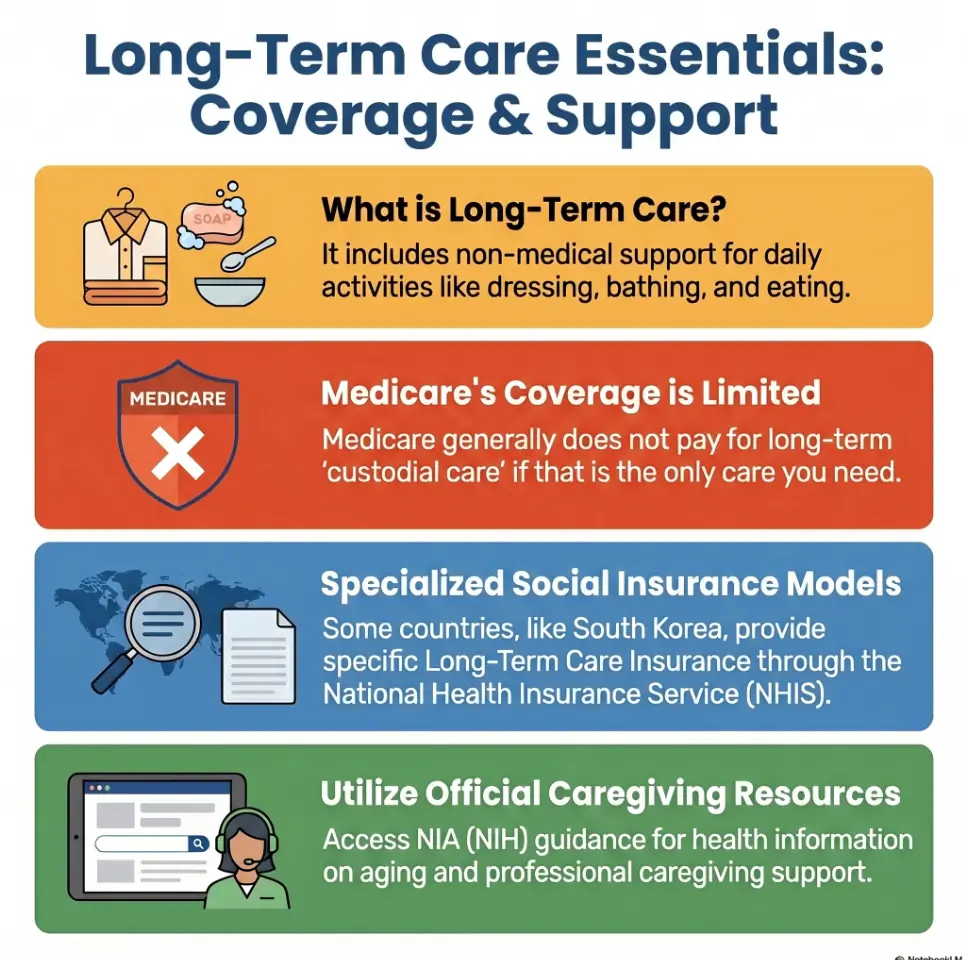
Long-term care means ongoing help with daily life, health monitoring, mobility, meals, hygiene, medication, supervision, transportation, or safe housing when aging or illness makes ordinary routines difficult. It can happen at home, in a day-care center, through visiting care, or in a facility.
Good planning does not remove grief. It gives grief fewer sharp edges.
The Care Decision Is Really Four Decisions Wearing One Coat
Most families think they are deciding between home care and facility care. Usually, they are also deciding who has authority, who pays, who loses time, and what “dignity” means when safety changes. For Korean families, those choices often sit inside filial duty, in-law expectations, migration, sibling order, and the old question no one wants to ask out loud: who can actually show up?
Contents — choose a section
Table of Contents
Safety and Planning Boundaries
This guide is general education for families, spouses, and caregivers. It is not medical, legal, insurance, immigration, tax, or financial advice. Before making decisions about dementia care, facility placement, long-term care insurance, power of attorney, guardianship, inheritance, property transfers, or cross-border documents, speak with qualified professionals in the relevant country.
That sentence may sound like a beige office wall, but it matters. Elder care decisions often mix love with law, memory loss with money, and family duty with paperwork. The soup gets thick quickly.
Use this article as a planning map, not a verdict. It can help your family ask better questions, organize facts, and reduce panic before a crisis turns everyone into a tired project manager with snacks in their bag and three missed calls from an uncle.
- Use professionals for diagnosis, legal authority, and financial commitments.
- Use family meetings for roles, communication, and values.
- Write down decisions before memory and stress distort them.
Apply in 60 seconds: Create one shared note titled “Parent Care Questions” and add health, money, documents, housing, and emergency contacts.
Korea’s Care Clock Is Ticking Faster Than Families Expected
Why “someday” became a family calendar problem
For many Korean families, elder care used to live in a mental drawer labeled “later.” Later after the kids finish school. Later after the apartment loan feels lighter. Later after the parents stop insisting they are “fine” while carrying groceries like heroic little mountain goats.
Now later has become a date. South Korea crossed into super-aged society status when people aged 65 and older reached more than 20% of the population. By 2025, official population reporting showed more than one in five Koreans were 65 or older. That is not a distant forecast. That is a family group chat with a battery at 7%.
The pressure is not only age. It is speed. Families are adjusting to longer life spans, smaller sibling groups, lower birth rates, high housing costs, and careers that do not bend easily around caregiving.
The super-aged society threshold, explained without panic
A super-aged society is commonly understood as one where at least 20% of the population is 65 or older. The label sounds dramatic, but it simply describes a new care math. More older adults need support, while fewer younger relatives are available to provide it.
That does not mean every older Korean person needs care. Many older adults are healthy, active, and gloriously opinionated. The point is that the number of families facing frailty, dementia, falls, isolation, transportation limits, and medication complexity is rising.
What US-based Korean families may misunderstand from afar
Distance makes care look cleaner than it is. From the US, a parent may sound steady on KakaoTalk. The apartment may look familiar on video. A sibling in Korea may say, “I’ll handle it,” because saying otherwise feels unfilial or weak.
But elder care is often made of small frictions: picking up prescriptions, translating doctor instructions, checking whether the gas stove is off, noticing weight loss, arguing gently about hearing aids, and finding transportation after a clinic visit. One task is manageable. Thirty-seven tiny tasks become a second job.
If you are trying to understand how Korean aging is reshaping neighborhoods, housing, and local routines, the social context in Korea’s aging neighborhoods helps explain why care pressure can feel visible on one street and invisible on the next.
The quiet difference between aging, frailty, and long-term care need
Aging is a birthday. Frailty is a pattern. Long-term care need is a practical threshold where daily life becomes unsafe or unmanageable without support.
A parent can be older but independent. Another parent can be younger but need help because of stroke, Parkinson’s disease, dementia, severe arthritis, cancer treatment, vision loss, or repeated falls. Families should avoid using age alone as the trigger. Watch function.
Money Block: Early Care Risk Checklist
Use this yes/no check before the family starts arguing about “too soon.”
- Has the parent fallen, nearly fallen, or started avoiding stairs?
- Are bills, medication refills, or appointments being missed?
- Is there new confusion, wandering, repeated questioning, or unsafe cooking?
- Has weight, hygiene, sleep, mood, or social activity changed?
- Does one relative now provide help several times a week without a written plan?
Neutral action line: If two or more answers are yes, schedule a medical review and a family planning call before the next crisis chooses for you.
The New Family Question: Who Can Actually Show Up?
Adult children, only children, and the shrinking sibling backup plan
Older family scripts assumed siblings. Someone lived nearby. Someone had flexible time. Someone’s spouse could help. Someone’s daughter-in-law would quietly absorb the work. That “someone” was often not named because naming the labor would make it harder to pretend it was natural.
Today, many Korean families have one child or two children. Adult children may live in another city, another country, or an apartment too small to absorb a parent safely. The backup plan has shrunk from a net into a thread.
This is why long-term care anxiety now enters conversations about where to live, whether to marry, how close to stay to parents, and whether overseas work is worth the emotional cost.
When filial duty meets full-time work, childcare, and distance
Filial duty is powerful. It can also be vague. “Take care of your parents” sounds noble until Monday morning arrives with a school lunchbox, a manager’s message, a clinic appointment, and a parent who refuses a walker because it looks “old.”
Love does not create extra hours. It does not make a job flexible. It does not pay for home modifications. It does not translate medical forms while a toddler is throwing cereal like confetti.
Korean families often need a kinder vocabulary: not “who loves Mom most,” but “who can do which task reliably?”
Let’s be honest: love does not create extra hours
The family member who lives nearest is often treated as the default caregiver. The family member abroad may become the default payer. The eldest child may become the default coordinator. None of this is automatically wrong. It becomes dangerous when it is assumed instead of agreed.
A fair plan may not mean equal tasks. It means visible tasks. One sibling may handle appointments. Another may manage money tracking. Another may call daily. Another may pay for a private aide once a week. Equality is not the goal. Durability is.
How families can separate emotional responsibility from daily task responsibility
Try this sentence: “We all share responsibility for Mom’s dignity and safety, but we need to divide the daily work by time, location, money, and skill.”
That sentence lowers the temperature. It tells the family that care is not a loyalty contest. It is a system.
- List weekly tasks, not vague intentions.
- Assign backups for medical visits, money, and emergencies.
- Review the plan monthly when health is changing.
Apply in 60 seconds: Write the names of the top three care tasks and the person currently doing each one.
Elder Care Anxiety Is Changing Marriage, Housing, and Career Choices
Why couples now discuss parents before wedding halls
In Korean relationships, family is rarely background music. It is often part of the arrangement, sometimes gentle, sometimes operatic. Couples are increasingly discussing aging parents before marriage because the question is practical: will we live near them, support them financially, host them, visit weekly, or coordinate care from abroad?
For non-Korean spouses, this can be bewildering. A dating relationship may suddenly contain hospital logistics, holiday duty, inheritance expectations, and the emotional weather of in-law hierarchy. A calm guide to Korean in-law expectations can help couples see which pressures are cultural, which are family-specific, and which need boundaries.
The apartment decision hiding inside the caregiving decision
Housing is not just square footage. It is care architecture. Is there an elevator? Is the bathroom safe? Can a parent live nearby without becoming socially isolated? Can an adult child reach them in 20 minutes? Is the neighborhood walkable, clinic-rich, and winter-safe?
Some families choose to live near parents. Others choose separate housing with scheduled support. Some consider multigenerational living, which may work beautifully in one family and become a pressure cooker in another. The rice cooker can only steam so much.
The rise of Korean adults living with parents shows how housing, money, and family obligation can overlap long before formal elder care begins.
Career pauses, overseas jobs, and the guilt tax nobody budgets for
Care anxiety can make a promotion feel complicated. An overseas job may bring income but add distance. A career pause may solve a short-term crisis while weakening a caregiver’s future savings.
The “guilt tax” is real. It is the emotional surcharge families pay when decisions are made without clear roles. The sibling who stays may feel trapped. The sibling who leaves may feel accused. The spouse watching from the side may wonder when the marriage became a care committee.
How elder care anxiety can delay, reshape, or pressure life milestones
Long-term care anxiety can affect marriage timing, fertility decisions, home purchases, migration plans, and retirement. It can also influence whether adult children feel safe taking risks, starting a business, or moving abroad.
These are not selfish questions. They are capacity questions. A family that ignores capacity often ends up spending more money, more emotion, and more trust later.
Money Block: Couple Conversation Card
Use this before engagement, moving in, relocation, or a major home purchase.
| Decision | Question to Ask | Trade-off |
|---|---|---|
| Live near parents | Does proximity create support or daily obligation? | Faster help, less privacy |
| Move abroad | Who handles emergencies in Korea? | Career upside, care distance |
| Share housing | What boundaries protect the marriage? | Lower costs, higher friction |
Neutral action line: Pick one likely parent-care scenario and discuss it before signing a lease, mortgage, or wedding contract.
Don’t Assume the Old Family Script Still Works
Mistake: believing the eldest child will naturally coordinate everything
Birth order still carries emotional weight in many Korean families. But birth order does not determine schedule, skill, money, mental health, or distance. The eldest child may be responsible, but responsibility without support becomes a quiet injury.
If the eldest child coordinates, give them authority and relief. If they do not coordinate, name another person clearly. “Everyone helps” often means one person helps while everyone else sends thumbs-up emojis.
Mistake: treating daughters and daughters-in-law as invisible care infrastructure
Women still carry a disproportionate share of family care in many households. In Korean families, daughters, daughters-in-law, and wives may be expected to notice, organize, soothe, cook, visit, remember, and translate emotion into action.
This invisible labor causes conflict because it is often praised but not shared. Praise is nice. A scheduled ride to the clinic is nicer.
For families navigating Korean family manners, meeting Korean parents with cultural awareness is one doorway into understanding how respect, speech, and expectations can shape difficult care conversations.
Mistake: waiting until a fall, hospitalization, or dementia diagnosis forces action
Crisis makes poor architects. A rushed hospital discharge can force facility placement before the family has visited options. A fall can trigger apartment changes with no budget. A dementia diagnosis can expose missing documents at the worst possible hour.
Start with facts before a crisis. Not because you are pessimistic. Because you are merciful to your future self.
The better script: assign roles before emotions start driving the bus
A better family script names roles:
- Medical lead: tracks diagnoses, doctors, medications, and hospital updates.
- Money lead: tracks care costs, parent income, insurance, and emergency reserves.
- Document lead: organizes IDs, insurance records, property records, and legal papers.
- Local lead: checks the home, visits facilities, and meets providers.
- Communication lead: updates siblings and keeps decisions in writing.
Illustrative Scenario: The Brother Who Kept the Receipts
Min, a Korean American software manager in Seattle, thought his younger sister in Daegu was “checking on Dad sometimes.” Then his father slipped outside a clinic, and the family discovered “sometimes” meant three pharmacy runs a week, two hospital visits a month, meal deliveries, laundry, and a growing stack of unpaid taxi receipts. Nobody had meant to exploit her.
They had simply mistaken silence for capacity. During one tense video call, Min asked her to share every recurring task, even the tiny ones. The list filled a page. They split the work: Min paid for weekly home help and organized documents, his brother handled calls, and his sister kept local medical authority but stopped being the family’s unpaid emergency department. Their father still needed care. The difference was that the care finally had walls, windows, and a door.
The lesson is simple: if one person’s kindness is the plan, the plan is already cracking.
Long-Term Care Insurance in Korea Changes the Conversation, Not the Whole Burden
What public long-term care support can help cover
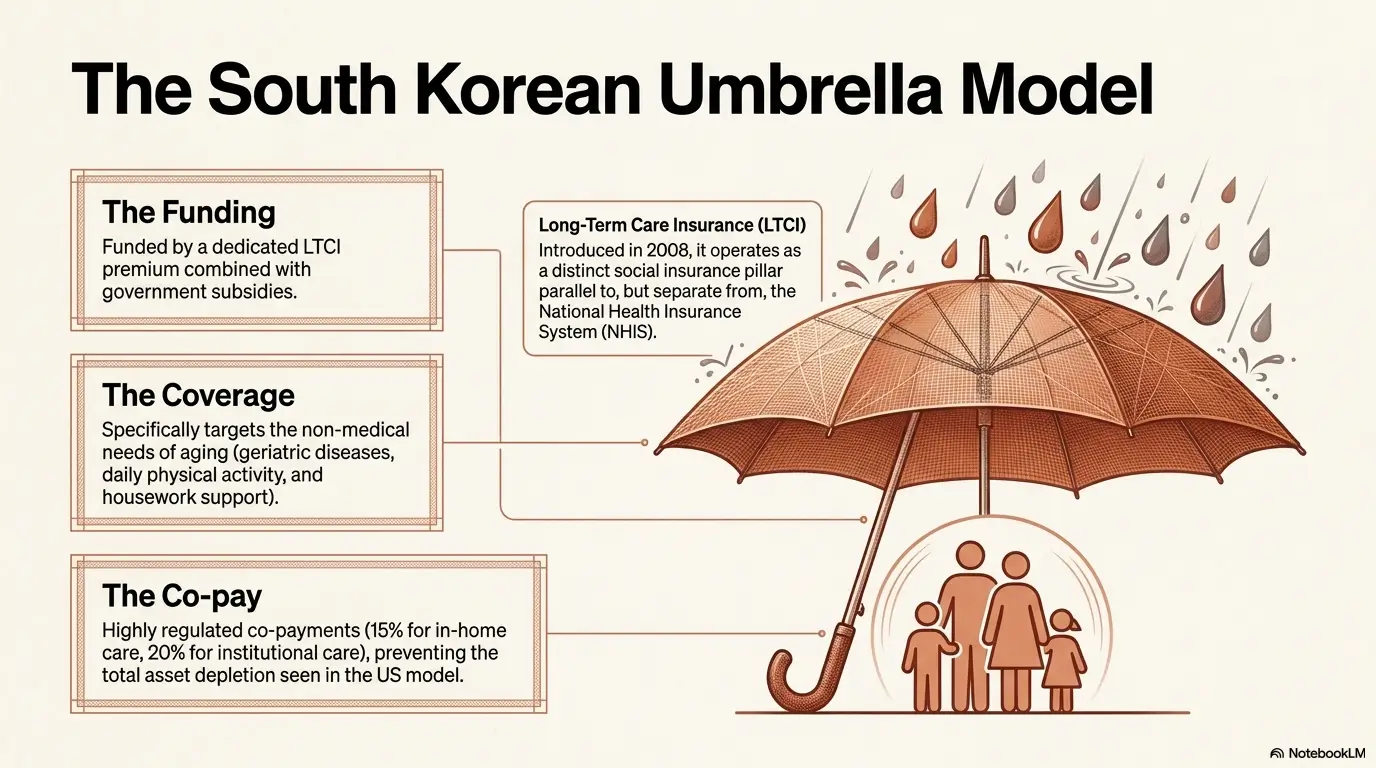
South Korea’s Long-Term Care Insurance system, administered through the National Health Insurance Service, supports older people who have difficulty taking care of themselves for an extended period due to age-related illness or frailty. Benefits may include home-visit care, bathing support, nursing support, day and night care, assistive equipment, or facility care depending on assessment and eligibility.
This is a major comfort. It means families are not entirely alone. It also means families must learn how assessment, grading, co-payments, service availability, and local providers work. A system is not the same thing as a solved Tuesday afternoon.
Why eligibility, assessment, and service limits still matter
Public support usually depends on functional need, not just age. Families may need assessments, medical documentation, applications, and periodic reviews. A parent who is proud, private, or anxious may understate difficulty. Another may perform well during one assessment and struggle badly at night.
Keep a written care diary. Note falls, missed meals, wandering, medication errors, bathing difficulty, nighttime confusion, and caregiver hours. Boring documentation can become the family’s lantern.
The gap between “there is a system” and “our family has a plan”
A family plan still needs answers:
- Who applies for benefits?
- Who attends assessments?
- Who compares providers?
- Who pays co-costs or uncovered services?
- Who responds if the parent refuses help?
- Who reviews safety every three to six months?
Without these answers, families may be rich in concern and poor in execution.
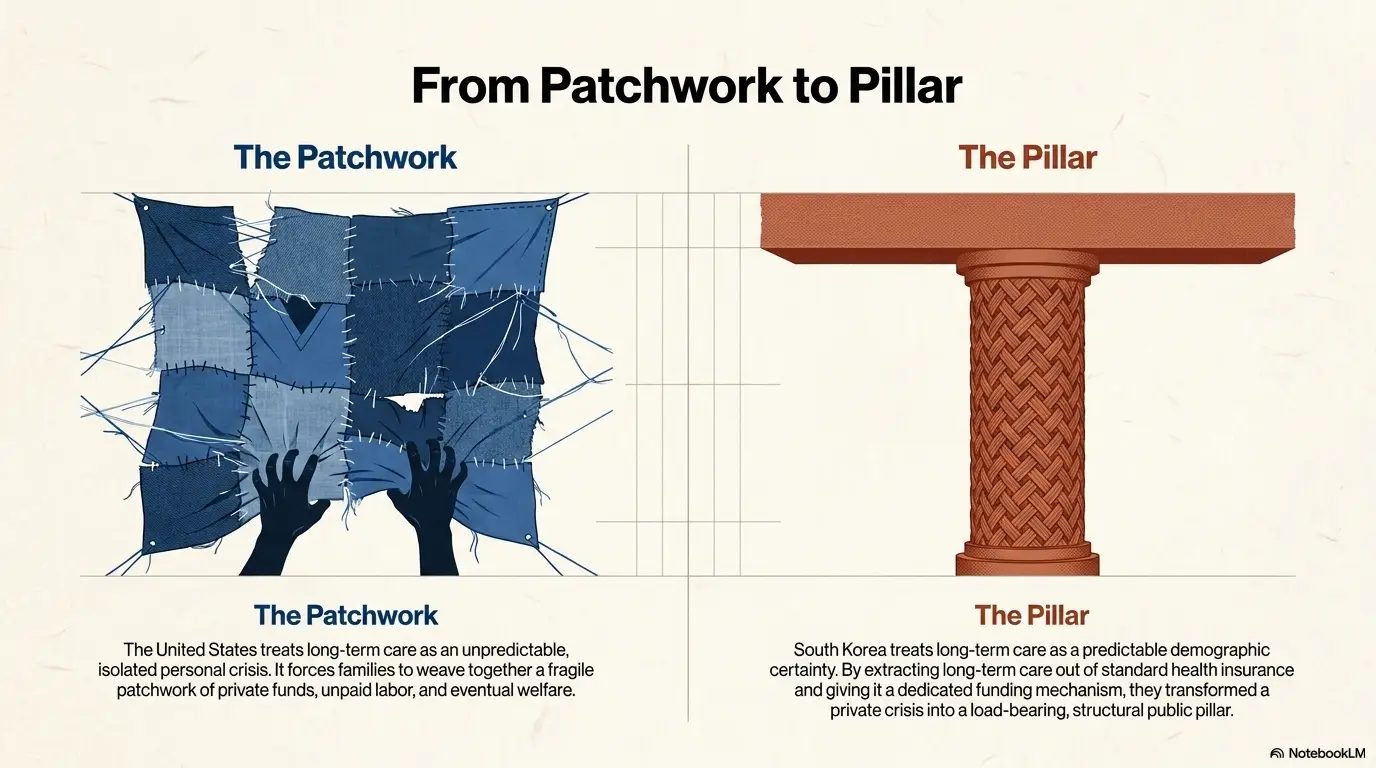
How US readers should compare Korea’s care model with Medicare, Medicaid, and private LTC expectations
US-based readers sometimes assume Medicare works like a broad long-term care program. It generally does not. Medicare may cover skilled medical care under specific conditions, but it does not usually pay for ongoing custodial care, such as help with bathing, dressing, meals, and supervision.
Medicaid can cover long-term services for eligible people, but rules vary by state and often involve income and asset limits. Private long-term care insurance depends on policy terms. Korea’s system has a different structure, but no system removes the need for family coordination.
Show me the nerdy details
When comparing care systems, separate four questions: eligibility trigger, covered setting, family co-payment, and service availability. Eligibility trigger asks what condition or functional limit qualifies the person. Covered setting asks whether home care, day care, facility care, equipment, or nursing support is included. Family co-payment asks what share remains private. Service availability asks whether the approved service can be found nearby, at the needed time, with reliable staffing. Many families compare only “covered or not covered,” but the real answer often lives in the overlap of all four.
Money Block: Coverage Tier Map
| Tier | Care Need | Family Planning Question |
|---|---|---|
| Tier 1 | Independent but aging | What documents and emergency contacts are ready? |
| Tier 2 | Light help with errands or appointments | Who coordinates weekly tasks? |
| Tier 3 | Daily help or supervision | Can home care remain safe? |
| Tier 4 | High physical or cognitive need | Is facility care more stable than family labor? |
| Tier 5 | Crisis or unsafe living situation | Who has authority to act today? |
Neutral action line: Place your parent in one tier today, then list what would move them to the next tier.
Facility Care vs Home Care: The Decision Families Whisper About
Why nursing homes can trigger shame, relief, fear, and realism at once
Facility care is emotionally loaded in Korean families. Some relatives hear “nursing home” and think abandonment. Others hear it and think safety, trained staff, predictable meals, and fewer midnight emergencies. Both reactions can be honest.
The old moral frame says good children keep parents at home. The practical frame asks whether home is safe, staffed, affordable, and sustainable. Good children should be allowed to use the practical frame without wearing shame like a wet coat.
Home care sounds warmer, but the staffing math can be colder
Home care can protect familiarity. It can preserve routines, neighbors, religious community, pets, and the beloved chair by the window. But home care can become fragile when a parent needs overnight supervision, lifting, toileting help, wandering prevention, or complex medication support.
The question is not whether home feels nicer. The question is whether home can be made safe without breaking the caregiver.
Here’s what no one tells you: the “best” choice may change every six months
Care needs change. A parent may recover after surgery. Dementia may progress. A caregiver may burn out. A facility may be excellent for rehabilitation but wrong for long-term living. Home may work until nighttime wandering begins.
Build review dates into the decision. “We will try home care for three months and reassess safety, cost, caregiver capacity, and parent distress.” That sentence can save a family from treating every choice as permanent.
A decision lens: safety, dignity, caregiver capacity, and cost
1. Safety
Falls, wandering, medication, cooking, bathing, nutrition, emergency access.
2. Dignity
Privacy, routines, language, food, respect, meaningful choice, social connection.
3. Capacity
Caregiver time, strength, sleep, skill, backup support, distance, burnout risk.
4. Cost
Monthly fees, uncovered services, transport, home changes, lost income, emergency reserves.
Use all four parts. Safety without dignity can feel cold. Dignity without safety can become dangerous. Capacity without money may collapse. Money without trust becomes family thunder.
- Review the decision every three to six months.
- Do not treat facility care as moral failure.
- Do not treat home care as automatically gentle or affordable.
Apply in 60 seconds: Rate home care from 1 to 5 on safety, dignity, capacity, and cost.
Money Anxiety Is Often Care Anxiety Wearing a Suit
Parent assets, adult-child income, and the unspoken family ledger
Families often talk about love because money feels too blunt. But money is already in the room, sitting politely with tea.
Care can involve parent pensions, savings, property, adult-child contributions, insurance, co-payments, facility fees, transport, supplies, home repairs, and lost wages. When families avoid the ledger, they do not avoid conflict. They postpone it.
South Korea’s broader demographic pressure also sits beside low birth rates and shrinking future support networks. The family economics behind Korea’s low birth rate effects helps explain why adult children may feel squeezed from both directions: caring upward while worrying about their own future.
When inheritance expectations collide with monthly care bills
Inheritance assumptions can poison care decisions. A sibling may resist selling property because they expected a future share. Another may demand that parent assets be used first. Another may pay quietly and later feel betrayed.
The cleanest rule is usually this: parent resources should support parent care before adult-child expectations. Legal and tax details can be complex, especially across borders, so families should seek professional advice before transfers or property sales.
Why vague promises create more conflict than honest numbers
“We’ll all help” sounds warm. “Each sibling contributes a specific amount or task for the next six months” sounds less poetic but works better.
A promise without numbers is a candle in the rain. Pretty for a moment. Not reliable.
A family budget map: medical costs, care labor, housing, transport, emergency reserves
Money Block: Family Care Budget Map
| Cost Bucket | What to Include | Who Tracks It? |
|---|---|---|
| Medical | Appointments, medication, tests, supplies | Medical lead |
| Care labor | Home aide, day care, respite, facility fees | Money lead |
| Housing | Repairs, safety bars, elevator access, moving | Local lead |
| Transport | Taxi, ambulance, caregiver travel, flights | Communication lead |
| Emergency reserve | Hospital discharge, sudden aide need, urgent repairs | Family group review |
Neutral action line: Estimate one ordinary month and one crisis month before committing to a care setting.
Cross-Border Korean Families Face a Double Care Burden
The US-based child who manages Korean care through phone calls
Cross-border caregiving has a strange texture. You can be emotionally present and physically useless in the same hour. You can send money instantly but not help your father stand up from the floor. You can understand the family drama but not the clinic paperwork.
US-based Korean children often become remote coordinators. They call hospitals, message siblings, research facilities, send money, track documents, and live with a low hum of dread. Their phone becomes a tiny care office with a cracked screen protector.
Time zones, hospital updates, document access, and decision fatigue
Time zones turn urgency into sleep loss. A hospital update in Korea may arrive during a US workday or just before midnight. Documents may sit in a drawer in Seoul. A parent may not know how to scan an ID. A local sibling may be too exhausted to explain everything twice.
Build systems before stress peaks:
- Shared folder for IDs, insurance, medication lists, diagnoses, facility contacts, and doctor names.
- Emergency contact tree with local neighbor, building office, sibling, cousin, and hospital.
- Decision authority notes for who can speak with providers.
- Monthly call to review health, money, and documents.
Korean administrative systems can feel dense to outsiders, so understanding Korea’s resident registration basics may help families anticipate why addresses, IDs, and household records matter in practical care logistics.
When “I’ll fly over if needed” becomes too late
Flying over is not a plan. It is a response. It may be necessary, but it is expensive, slow, and sometimes too late for the decision that needed to happen yesterday.
Create a “before flight” plan. Who checks the apartment? Who talks to the doctor? Who can approve temporary care? Who can stay overnight? Who has keys? Who knows the building passcode?
Practical bridge plan: local advocate, shared folder, emergency contact tree
Money Block: Cross-Border Quote-Prep List
Gather these before comparing home care, day care, facility care, or private help in Korea.
- Parent’s full name, date of birth, address, and contact details.
- Current diagnoses, medications, allergies, mobility limits, and fall history.
- Insurance status and any long-term care assessment records.
- Daily routine: meals, bathing, toileting, sleep, wandering, and social needs.
- Language, food, religion, privacy, and gender preferences for care.
- Budget range, payment source, and who can approve changes.
Neutral action line: Put these items in one shared folder before calling providers, so every quote starts from the same facts.
- Name one local person who can physically respond.
- Store documents where approved family members can find them.
- Decide what situation triggers a flight.
Apply in 60 seconds: Write the name and phone number of the person who can reach your parent fastest in Korea.
Common Mistakes That Turn Elder Care Stress Into Family Conflict
Don’t wait for consensus before collecting facts
Consensus is lovely. It is also slow. Families do not need full agreement to collect medication lists, facility options, insurance information, emergency contacts, and monthly cost estimates.
Facts are not betrayal. They are preparation.
Don’t let one sibling become the unpaid project manager by accident
The accidental project manager is easy to spot. They know the doctor’s name, the pharmacy hours, the building guard’s personality, and which aunt will complain if she hears news second. They may also be one bad day away from snapping at a rice paddle.
Give that person help, money, authority, and rest. Do not give them only gratitude in a decorative envelope.
Don’t confuse parent preference with parent safety
A parent’s preference matters. It matters deeply. But preference must be balanced with safety. “I want to live alone” may be reasonable for an independent parent and dangerous for a parent who leaves the stove on or wanders at night.
The kindest answer may be: “We want you to stay at home as long as it is safe. Let’s define what safe means together.”
Don’t make promises during a crisis that you cannot keep for three years
After a hospitalization, families may promise anything. “We will never use a facility.” “I will come every day.” “Money is no issue.” These promises are understandable. They can also become traps.
Use time-limited commitments instead. “We will try this for eight weeks and review.” “I can visit twice a week through July.” “We can cover this cost for three months while we compare options.”
For families already feeling intergenerational pressure, generational conflict in Korea offers useful context for why older and younger relatives may hear the same care sentence in entirely different emotional keys.
Who This Is For / Not For
For Korean adult children trying to plan before a crisis
This guide is for adult children who feel the ground shifting under ordinary family routines. Maybe a parent is still independent, but you notice slower walking, repeated stories, unopened mail, or a new fear of stairs. You are not overreacting by planning. You are listening early.
For US-based families with aging parents in Korea
This is also for US-based Koreans, Korean Americans, spouses, and mixed-culture families who are trying to coordinate care across time zones. The emotional math is different when you cannot simply drive over with soup, documents, and a stern but loving look.
For spouses navigating Korean in-law care expectations
Spouses need language for this conversation too. A Korean spouse may feel torn between parents and partner. A non-Korean spouse may feel confused by expectations that were never spoken directly. Both need a plan that protects the marriage from becoming the family’s shock absorber.
Not for readers seeking diagnosis, legal rulings, or facility endorsements
This article cannot diagnose dementia, recommend a specific facility, interpret Korean law, settle inheritance disputes, or tell your family whether to sell property. It can help you know which doors to knock on, and in what order.
When to Seek Help Before the Family Reaches Its Breaking Point
Seek medical help when memory, mobility, falls, medication errors, or nutrition changes appear
Medical help is urgent when you see repeated falls, sudden confusion, weight loss, medication mistakes, unsafe cooking, wandering, depression, dehydration, or rapid personality changes. A health checkup can be a practical starting point, and families unfamiliar with local routines may benefit from understanding how health checkups in Korea work.
Memory changes deserve special care. The US National Institute on Aging notes that some memory changes can be part of aging, but others may signal conditions that need evaluation. Families should not diagnose from a group chat.
Seek legal help for guardianship, power of attorney, inheritance disputes, or cross-border documents
Legal help becomes important when a parent may lose decision-making capacity, when siblings disagree about property, when overseas family members need authority, or when documents must work across countries. Family registry, identity, and household records may matter, so background on the Korean family registry system can help readers understand why paperwork can feel personal as well as administrative.
Do not rely on cousin advice, social media comments, or one dramatic story from a neighbor’s aunt. Those may be colorful. They are not counsel.
Seek financial guidance before selling property, transferring assets, or committing to long-term facility payments
Large care decisions can affect taxes, inheritance, eligibility, family fairness, and retirement security. Before selling property, transferring money, changing ownership, or committing to facility payments, speak with qualified financial, legal, or tax professionals.
US families should also understand that Medicare generally does not cover most long-term custodial care. That single misunderstanding can crack a retirement plan like thin ice.
Seek emotional support when resentment becomes the loudest person in the room
Caregiving can make good people brittle. If resentment, panic, insomnia, guilt, or anger starts shaping every family conversation, seek support. That may mean therapy, caregiver support groups, respite care, pastoral care, or simply a structured family meeting with a neutral facilitator.
Resentment is not proof that you are a bad child. It is often proof that the system is underbuilt.
- Call doctors when function changes.
- Call legal and financial professionals before major commitments.
- Call emotional support when guilt becomes the family manager.
Apply in 60 seconds: Name one professional your family would call first in a medical, legal, and financial care crisis.
FAQ
Why are Korean families more anxious about elder care now?
Korean families are more anxious because aging is accelerating while family size, housing patterns, and work schedules are changing. Fewer adult children may be available to share care, and many live far from parents. The old assumption that family care will “naturally” happen no longer fits many households.
How does long-term care affect Korean adult children living in the US?
US-based adult children may manage care remotely through phone calls, money transfers, shared documents, and emergency flights. They may also struggle with time zones, limited authority, language nuance, and guilt. A local advocate in Korea is often essential.
Is home care usually better than facility care for aging parents in Korea?
Not always. Home care may preserve comfort and routine, but it can become unsafe if a parent needs constant supervision, lifting, dementia support, or overnight help. Facility care may offer more structure. The better choice depends on safety, dignity, caregiver capacity, and cost.
What should siblings discuss before a parent needs daily care?
Siblings should discuss medical contacts, documents, monthly budget, emergency authority, likely care settings, task division, and how decisions will be recorded. They should also name the person who coordinates updates so one sibling does not become the default project manager by accident.
How can families talk about elder care without sounding disrespectful?
Use safety and dignity language. Instead of saying, “You can’t live alone,” try, “We want you to stay independent as long as it is safe, so let’s talk about what would help.” Respect does not require silence. It requires tone, timing, and honesty.
What documents should cross-border families organize early?
Families should organize identification, insurance information, medication lists, doctor contacts, diagnoses, hospital records, emergency contacts, property information, banking access rules, and any legal authority documents. Cross-border families should ask professionals which documents are valid in each country.
How does elder care anxiety affect marriage and housing decisions?
It can influence where couples live, whether they move abroad, how close they stay to parents, whether they share housing, and how they divide money and time. Couples should discuss parent care expectations before major commitments, especially when Korean in-law duties are part of the family culture.
When should a family start planning for long-term care?
Start when a parent is still stable enough to participate. Early planning should begin when you notice falls, memory changes, medication mistakes, isolation, mobility problems, unpaid bills, or one family member quietly doing more care than everyone realizes.
Build a care plan around tasks and the older person’s wishes
List the help needed during an ordinary day, who is willing and able to provide it, and where professional assessment is needed. Include the older person’s preferences about privacy, daily routine and decision-making. In a constructed family plan, one relative may coordinate appointments while another handles transport; neither role establishes that someone can provide every night of care. Confirm service eligibility, actual availability and charges separately rather than treating family agreement as a completed arrangement.
| Focus | What to check |
|---|---|
| Needs | Daily tasks and issues requiring professional assessment. |
| Preference | The older person’s wishes and participation. |
| Capacity | Real availability, costs and a backup for gaps. |
A reader question: What if relatives disagree about home care and facility care?
Compare specific care needs, the person’s wishes, staffing, costs and feasible support. Ask appropriate professionals to assess unresolved needs rather than deciding from a cultural expectation alone.
Next Step: Hold the 30-Minute Family Reality Meeting
Pick one parent, one likely care scenario, and one decision deadline
Do not begin with the whole future. That is too large. Begin with one parent and one realistic scenario: “What if Mom needs help bathing within a year?” or “What if Dad cannot drive to appointments after surgery?”
Then choose one deadline. A meeting without a deadline is a family cloud. Pretty shape, no rain.
Ask four questions: safety, money, time, and authority
Use four questions:
- Safety: What could harm the parent in the next six months?
- Money: What costs can we estimate now?
- Time: Who can give hours, and how often?
- Authority: Who can make calls, sign forms, and speak to providers?
Write down roles before opinions multiply
Opinions multiply faster than socks in a dryer. Roles keep the meeting grounded. Assign one person to write notes. Assign one person to collect documents. Assign one person to contact a doctor, care office, or local agency.
Do not leave the meeting with “we should.” Leave with names, dates, and the next task.
End with one action: book an assessment, gather documents, or name the family coordinator
The meeting should end with one action, not a fog of good intentions. Choose one:
- Book a medical review.
- Gather documents into a shared folder.
- Call the long-term care insurance office or local care provider.
- Visit two facilities or day-care centers.
- Name the family coordinator for the next 90 days.
Money Block: 30-Minute Meeting Mini Calculator
Estimated unpaid hours per helper: Use the calculator.
Neutral action line: Use the result to discuss capacity, not guilt.
Conclusion: Plan Before Love Gets Tired
The quiet truth from the beginning is still the truth at the end: Korean elder care is no longer a “someday” issue hiding politely in the corner. It is shaping marriage, housing, work, migration, sibling roles, money, and the emotional architecture of families.
But anxiety does not have to run the meeting.
A family can honor parents without pretending one person has unlimited time. A spouse can respect Korean family culture while still asking for boundaries. A US-based child can help meaningfully without imagining that emergency flights are a care system. Home care and facility care can both be discussed without shame. Money can be named without becoming the enemy.
Do one concrete thing in the next 15 minutes: create a shared document with five headings: health, safety, money, documents, and roles. Add one known fact under each heading. That small act turns fear into structure. Structure is not cold. In elder care, structure is one form of tenderness.
Last reviewed: 2026-05.
Practical example and reader question added October 20, 2026. Existing source dates are retained; this addition is not a fresh verification of every earlier claim.