
Korean Digital Life, Explained
Why So Many Korean Services Still Feel Built Around
One Mobile App Ecosystem
You open an English-language reservation page, choose a time, enter your details, and reach the final screen. Then the door quietly changes shape. A Korean mobile number is required. A local identity check appears. The payment window prefers a domestic card. Customer support points toward a messenger account you have not yet created.
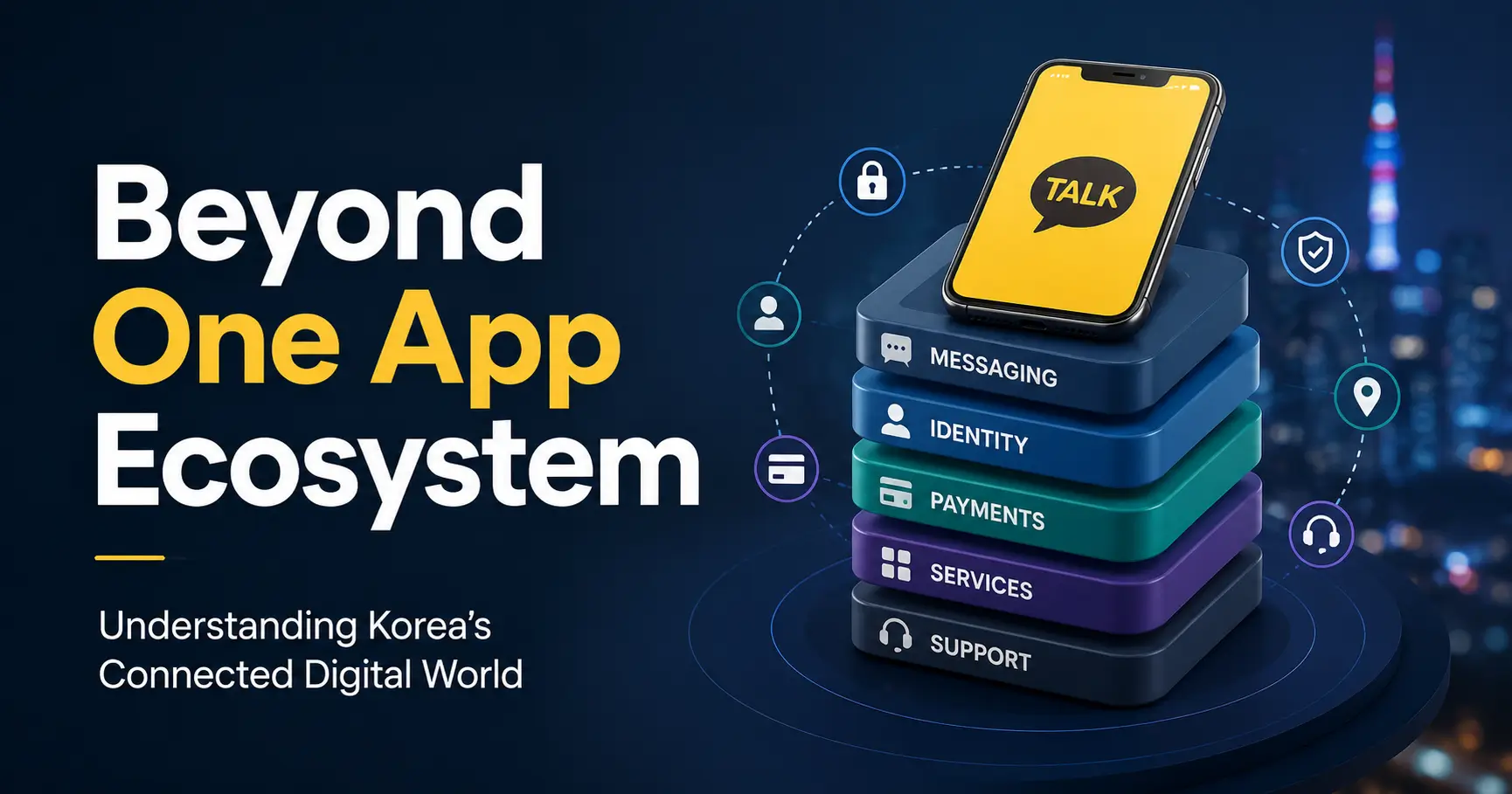
To a visitor, the experience can feel as though half the country has been built inside one enormous app. Yet the real structure is more interesting. Messaging, identity, banking, payments, maps, shopping, transportation, reservations, and support are often separate services connected by shared assumptions about who the user is and which credentials that user already possesses.
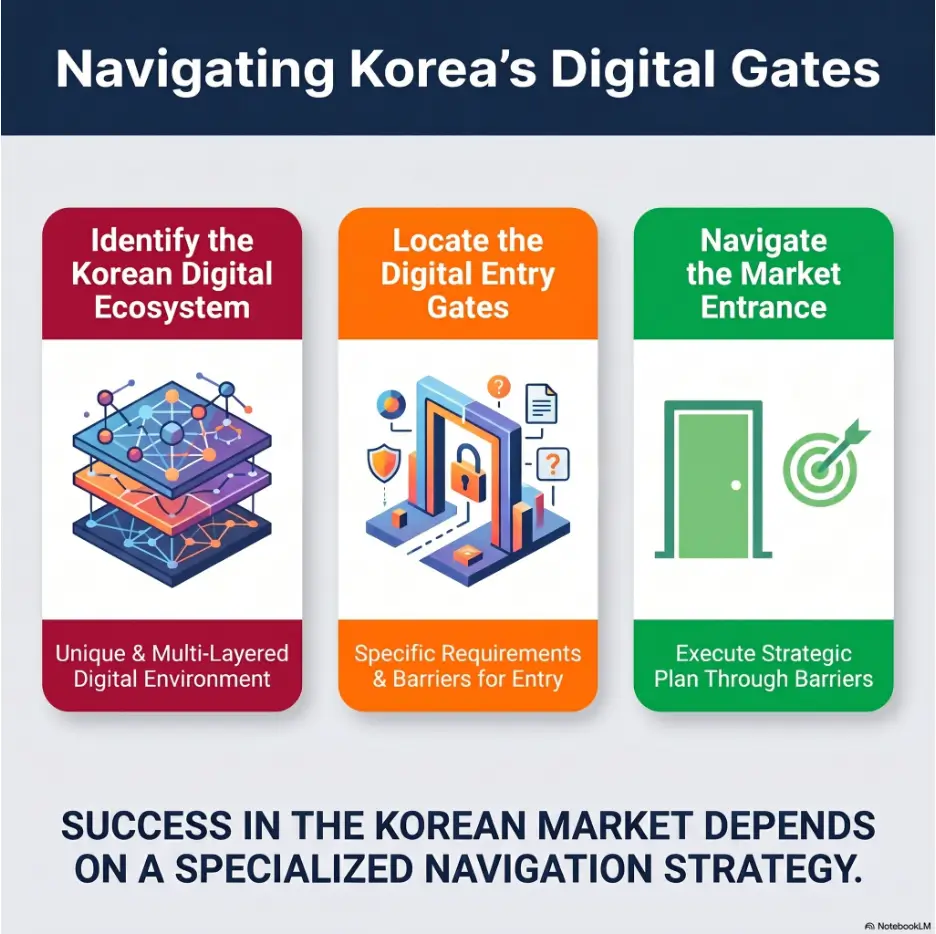
This guide maps those assumptions. It explains why the system became so efficient for enrolled users, why the same efficiency can turn brittle at the edges, and how travelers, foreign residents, founders, and product teams can identify the exact gate blocking a transaction instead of blaming “the app” as one mysterious machine.
🧭 The fastest route through Korea’s digital city begins by naming each gate separately.
Article snapshot
This guide is for travelers, expatriates, foreign residents, founders, researchers, and product teams who keep encountering local app, phone, verification, or payment requirements in South Korea. You will learn how to map a blocked service into four practical gates: account, identity, payment, and support.
Table of Contents
The “One App” Feeling Is Actually a Stack of Dependencies
A Korean service may appear to ask for only one familiar app, but that app is often the visible handle attached to several deeper systems. The screen shows a yellow login button, a green payment option, or a carrier-verification window. Behind it sit databases, legal consent records, financial credentials, notification channels, and customer-service routines.
This distinction matters because uninstalling one app or switching to another rarely removes the underlying requirement. A user may avoid a particular messenger but still need a Korean phone number. They may create an account successfully yet remain unable to complete real-name verification. They may pass identity checks but discover that the merchant accepts only domestic payment methods.
Messaging is only the visible front door
Messaging platforms occupy a central place because businesses already use them for alerts, promotional notices, appointment reminders, digital receipts, chat support, and account recovery. For a local customer, this is wonderfully economical. One familiar inbox replaces a small flock of emails, text messages, and standalone support portals.
The messenger is not necessarily processing the payment or deciding whether the customer is legally eligible. It may simply carry the notification, display the login prompt, or host a lightweight service page. The result still feels unified because the transition between companies is smooth enough that the seams fade from view.
Four layers usually sit beneath the interface
- Account: Can you create and recover a profile using the accepted email address, phone number, or social login?
- Identity: Can the service confirm that the name, birth date, residency status, and phone subscription belong to the same person?
- Payment: Can you use a supported card, bank account, wallet, or billing identity?
- Support: Can you reach a human through a channel that does not depend on the failed account?
When all four layers work, the service feels almost frictionless. When one fails, the interface can become strangely circular. The login page sends you to verification. Verification sends you to the carrier. The carrier tells you to confirm your registered name. Support then asks you to sign in before opening a ticket. It is a digital roundabout with excellent lane markings and no visible exit.
Key takeaway
Do not ask only, “Which app is required?” Ask which of the four gates the app is carrying: account access, identity proof, payment authorization, or customer support.
A quick diagnostic table for blocked services
| What you see | Likely hidden dependency | Useful next check |
|---|---|---|
| “Enter a valid mobile number” | Domestic number format or carrier account | Check whether prepaid, tourist, or overseas numbers are accepted |
| “Information does not match” | Name or birth-date mismatch | Compare the exact carrier registration with the service form |
| Account created, checkout rejected | Domestic payment authorization | Look for international-card or browser payment options |
| English menus disappear at payment | Partial translation rather than full foreign-user support | Test the complete transaction before relying on the service |
| Support requires login | Support tied to the same account system | Find a public telephone, email, or in-person channel |
Korea Did Not Simply Copy the Western App Model
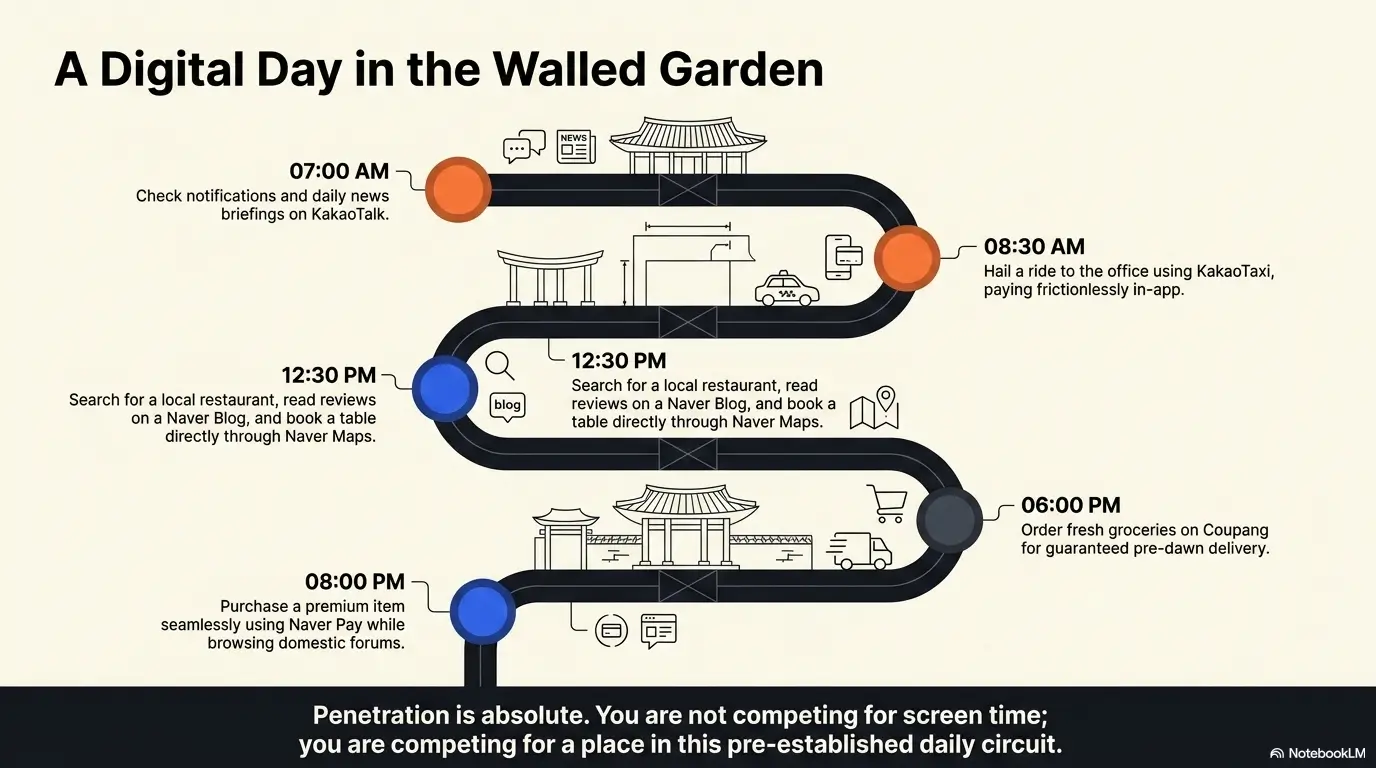
Korea’s mobile habits did not begin with smartphones. Before app stores became the default distribution channel, large domestic web portals already combined search, news, communities, maps, shopping, entertainment, email, blogs, and question-and-answer services. Users learned to experience the internet through broad service gateways rather than a loose collection of narrowly defined websites.
When smartphones arrived, those habits did not evaporate. They folded into mobile products. The portal became an app. The messenger became a service shelf. The payment provider became a login method. The map became a restaurant-discovery layer, review archive, transit planner, reservation tool, and local advertising channel.
Desktop portals trained users to expect connected services
In many Western markets, the mental model of the web was a constellation of separate destinations. Search took you to an independent newspaper, retailer, travel site, forum, or bank. Korea also had independent services, but domestic portals held a particularly strong role as the place where users began and often remained.
That history shaped expectations. A useful platform was not merely a tool that performed one task well. It was a dependable district of the internet where identity, content, recommendations, transactions, and communication could reinforce one another.
Domestic companies solved local problems before global firms did
Korean language search, address formats, dense transit systems, apartment-based delivery, real-name practices, domestic banking, local merchant relationships, and cultural communication patterns created needs that were not always priorities for global technology companies.
A local platform could improve quickly because it understood the surrounding institutions. It knew how addresses were entered, how users searched for restaurants, how merchants confirmed bookings, how carriers verified subscribers, and how customers expected to receive alerts. A foreign competitor might offer a polished universal product while missing three small local details that determined whether the final transaction worked.
Dense cities rewarded fast, integrated, real-time services
In Seoul and other major cities, daily life produces a high volume of small, time-sensitive decisions. Which subway exit is closest? Has the bus already passed? Can dinner arrive before the meeting ends? Is the clinic still accepting walk-ins? Does the café have a waiting list? Where is the parcel?
Integration has unusually visible value in that setting. A map that knows the transit network, a delivery app that understands apartment entrances, or a reservation system connected to local messaging can save minutes repeatedly. Those minutes accumulate into a strong habit. Once millions of users and merchants share the habit, integration becomes less a feature and more a public expectation.
Apparent uniformity can hide considerable fragmentation
The experience may feel centralized even when many firms, government bodies, telecom carriers, banks, merchants, and payment processors are involved. One login window may open inside another app. One wallet may rely on a separate card issuer. One identity check may call a carrier database. A reservation may be confirmed by a small business using yet another management system.
This is why “Korea uses one super-app” is a useful first impression but an incomplete explanation. The country has several major platforms, many specialist apps, and numerous institutional systems. What creates the one-app sensation is not total corporate ownership. It is the repeated reuse of a small set of credentials and channels.
How the ecosystem feels unified
Search, map, social feed, or recommendation
Social login, messenger account, or phone number
Name, birth date, carrier, resident credential
Card, bank transfer, stored wallet, or billing profile
Receipt, notification, review, refund, and support
The process feels like one product because each stage hands the user smoothly to the next. The seams become visible mainly when a credential is missing.
The Flywheel That Makes a Dominant App Hard to Avoid
A platform does not become central merely because people like its interface. It becomes central when users, merchants, developers, advertisers, banks, public agencies, and customer-service teams all receive practical advantages from meeting in the same place.
This creates a flywheel. Users go where businesses already respond. Businesses set up accounts where customers already spend time. Developers integrate the login and payment methods with the largest audience. More integration then gives users another reason to stay.
Users go where businesses already answer
Imagine two messaging services. One has a cleaner interface. The other is where your family group, apartment manager, school notices, clinic reminders, bank alerts, coworkers, delivery updates, and neighborhood store already appear. Interface elegance quickly loses the argument.
Communication tools are especially resistant to individual choice because their value depends on other people. A notes app can be replaced privately. A messenger cannot be replaced unless the people you need are willing to move with you.
Businesses integrate where customers already spend time
For a small restaurant, salon, tutor, clinic, or repair shop, building a complete standalone digital system may be unnecessary. A profile on a major map, a booking widget, a chat channel, and a familiar payment method can provide discovery, scheduling, communication, and conversion without the cost of a custom app.
This is one reason integrated platforms can support small businesses rather than merely swallow them. The platform supplies infrastructure that a local merchant could not easily build alone. The trade-off is dependence. Changes to ranking, verification, fees, account rules, or messaging access can affect the business immediately.
Identity and payment turn popularity into infrastructure
A popular app becomes much harder to avoid once it carries trusted identity or stored payment credentials. At that point, it is not simply where users chat or browse. It is part of how they prove who they are, authorize a purchase, collect loyalty rewards, receive a refund, or sign a digital document.
The cost of leaving is therefore measured in more than lost contacts. The user may lose accumulated purchase history, saved addresses, merchant relationships, digital coupons, identity certificates, support records, and familiar recovery methods.
Show me the nerdy details
Platform power grows through several reinforcing effects. Direct network effects make a communication service more useful as more people join. Indirect network effects attract merchants and developers because users are present. Data effects improve recommendations, fraud checks, routing, and personalization as activity increases. Switching costs rise when users store payment methods, transaction histories, identity credentials, memberships, and social connections.
Korea’s experience is especially strong because these effects often cross product categories. A user may begin with messaging, encounter a merchant through search or maps, verify through a phone-linked process, pay with a stored wallet, and receive support in the original messaging channel. Each successful loop makes the next loop easier.
This does not mean the market is literally controlled by one product. It means the marginal convenience of remaining inside a familiar set of services is high, while the friction of constructing an alternative path is paid repeatedly.
Short Story: The reservation that failed after it succeeded
Maya found a popular restaurant through an English search result. The booking page accepted her name, email, preferred time, and party size. A confirmation message appeared, so she closed the tab and planned the evening.
Ten minutes later, she noticed a second message asking her to verify through a Korean phone number. Her tourist SIM received data but could not complete the required identity process. The reservation was automatically released.
She initially blamed the restaurant’s English page. The real failure sat elsewhere: the booking account existed, but the anti-no-show system required a locally verifiable number.
Maya called the restaurant from her hotel, and the staff recorded the booking manually. The lesson was simple. An English interface may translate the visible journey without changing the credentials underneath it. Testing the final confirmation matters more than admiring the first screen.
Identity Verification Is the Real Gatekeeper
Many frustrating Korean app experiences are described as phone-number problems, but the phone number is often only the lookup key. The deeper task is matching a person across records: name, date of birth, telecom subscription, residency information, and sometimes nationality or account status.
For a Korean citizen whose information is consistently recorded, this process may take seconds. For a foreign resident, the same process can fail because of spacing, order, capitalization, truncated names, hyphens, middle names, recently changed visa records, or differences between the carrier and immigration documents.
Why a phone number can function like a digital passport
A domestically registered mobile subscription offers more than a place to receive a code. It can connect the user to a telecom account that has already collected identity information. Services can use that connection to reduce fraud, confirm age, limit duplicate accounts, authorize sensitive actions, and maintain records of consent.
This is why receiving an ordinary SMS is not always enough. An overseas number, data-only SIM, short-term tourist SIM, business line, or number registered under another person may not carry the identity relationship the service expects.
Foreign names meet databases with different ideas about a “match”
A name can be correct to a human and still be wrong to a database. One record may store surname first. Another may omit spaces. A third may limit the number of characters. A fourth may use the machine-readable passport format. The user sees the same identity; the system sees several strings.
When verification fails, copy the exact spelling and order shown in the record connected to the phone account rather than improvising a more natural version. Do not assume the app wants the form of your name you use socially or professionally.
A verification troubleshooting sequence that saves time
- Confirm that the phone plan supports identity verification, not merely calls, texts, and data.
- Check whose legal name is attached to the subscription.
- Compare the carrier’s name format with the name entered in the service.
- Check birth date, nationality selection, spacing, hyphens, and capitalization.
- Turn off automatic translation if it changes names or form values.
- Try the service’s browser version if the app embeds an outdated verification window.
- Ask the carrier whether the identity record needs correction.
- Use a public support channel that does not require the blocked login.
Key takeaway
A phone that receives verification codes is not automatically a phone that can complete identity verification. The service may be checking the subscriber record, not the handset.
For readers setting up long-term life in Korea, the practical sequence matters. Establishing a correctly registered local phone account early can make later tasks easier, including banking, delivery, medical services, reservations, and public administration. The related guide to Korean phone plans for Americans explains why plan type and registration status matter beyond monthly data allowances.
Payments Reveal Where the Ecosystem’s Walls Begin
Payment is often the moment when an apparently global experience becomes unmistakably local. A service may accept an overseas email address, display English menus, and allow foreign users to browse freely. Checkout then requests a domestic card, locally registered billing identity, bank authentication, or wallet connected to Korean credentials.
This boundary is not always visible until the final minute. That makes payment failure feel personal and arbitrary, particularly after the user has spent time selecting products, entering passenger details, or arranging a reservation.
Local cards, bank accounts, and wallets form a reinforcing loop
Domestic wallets are convenient because they can store trusted cards, addresses, receipts, loyalty benefits, and refund routes. Merchants benefit from familiar fraud controls and settlement processes. Customers benefit from fewer fields and faster repeat purchases.
The loop works beautifully for enrolled users. The problem appears when the service treats the local wallet not as one payment choice but as the only practical path. A foreign-issued card may be technically valid yet unavailable in the mobile checkout. A card may work in person while failing online because the payment gateway expects domestic authentication.
Why “just use a credit card” may not solve checkout
Card acceptance has several layers. The merchant may accept the card network, but the online gateway may reject foreign billing information. The card issuer may flag the transaction. The checkout may require an authentication method unavailable to the visitor. The app may expose international cards only in a separate “global” version.
When a card fails, check whether the problem is the merchant, gateway, card issuer, billing address, app version, or transaction type. Repeating the same payment five times rarely teaches the system new manners.
Payment routes and their likely friction points
| Payment route | Best suited to | Common obstacle | Possible fallback |
|---|---|---|---|
| Domestic credit or debit card | Residents with Korean banking | Card authentication or billing-name mismatch | Confirm card registration and exact account name |
| Local mobile wallet | Frequent users inside the platform | Requires local identity and supported funding source | Use direct card checkout when offered |
| Foreign-issued card | Travelers and new arrivals | Not shown or rejected by local gateway | Look for “global,” desktop, or international checkout |
| Bank transfer | Residents with local accounts | Time limit, account verification, Korean instructions | Ask the merchant whether manual transfer is possible |
| Pay in person | Restaurants, clinics, shops, and small providers | Not available for delivery or limited inventory | Call ahead and reserve manually |
The two-minute checkout test
Before investing time in a service, add a low-cost item or begin a sample booking and advance to the payment-selection screen. You do not need to complete the purchase. You are checking whether the required payment route appears and whether foreign credentials are accepted.
This is especially useful for transportation passes, event tickets, limited restaurant bookings, medical appointments, and delivery platforms. Discovery is not the same as access. A service that lets you browse is not necessarily a service that lets you buy.
Key takeaway
Test the last screen first. For time-sensitive purchases, confirm the payment path before comparing every option or building an entire itinerary around the service.
Convenience Inside the Network Creates an Outsider Tax
Integrated systems are often judged through two incompatible experiences. A long-term local user taps twice and finishes. A newcomer opens six tabs, translates three error messages, borrows a phone, and finally calls a friend. Both reports can be accurate.
The difference is not necessarily digital literacy. It is enrollment. Once the expected phone, identity, bank, wallet, address, and messaging relationships are in place, the system rewards continuity. Before they are in place, every dependency introduces another branch where the transaction can fail.
Established users receive speed, continuity, and social proof
A known account can remember addresses, previous purchases, preferred payment methods, loyalty balances, review history, refund destinations, and notification preferences. A verified identity reduces repeated form-filling. A common messenger allows immediate confirmations. A familiar map connects discovery to navigation and booking.
This continuity is not cosmetic. It reduces cognitive load. The user does not need to evaluate a new provider, create another password, learn another refund process, or wonder where the receipt went. The platform acts as memory.
Newcomers inherit every exception at once
A visitor may have an overseas phone number, foreign card, unfamiliar address format, no local identity record, no domestic bank account, and limited Korean. Each factor alone may be manageable. Combined, they turn a three-minute local task into an afternoon project.
Foreign residents can experience a different version of the same problem. They may possess all necessary credentials but find that one database formats their name differently. They are inside the system legally and socially, yet a character mismatch leaves them standing on the digital doorstep.
Outsider-tax scorecard
Count one point for each missing credential
- No Korean mobile number registered in your own name
- No locally usable identity-verification route
- No domestic card, bank account, or supported wallet
- No Korean address entered in the required format
- No access to the platform’s preferred messaging channel
- No Korean-language support available during the final transaction
0–1 points: Most services should be manageable. 2–3 points: Expect occasional workarounds. 4–6 points: Prioritize services with explicit visitor support, in-person payment, public telephone help, or browser-based alternatives.
An English interface is not the same as an international transaction path
Translation can solve comprehension while leaving eligibility untouched. The labels may be English, but the form may still require a local number. Instructions may be translated, but the payment gateway may remain domestic. Customer support may answer in English but lack permission to override the verification system.
Evaluate international accessibility from beginning to end: discovery, account creation, verification, payment, confirmation, cancellation, refund, and support. A translated homepage proves only that the homepage has been translated.
Transportation offers a useful example because visitors often encounter both excellent public infrastructure and app-specific limitations. The guide to Korea bus arrival apps shows why local and international tools may provide different levels of detail, reliability, and account access.
Do Not Treat Korea as Just Another Localization Project
For a product team entering Korea, translation is necessary but rarely sufficient. The product must connect to the practical systems through which Korean users establish trust, receive notifications, verify identity, pay, request refunds, and contact support.
The reverse is also true. A Korean company serving international users cannot become globally accessible by translating menus while preserving a local-only credential chain underneath them.
Translation cannot repair a missing identity pathway
A beautifully translated form still fails when it accepts only locally verifiable names and phone records. Product teams should document which users are legally and technically eligible before writing interface copy.
That documentation should distinguish citizens, long-term foreign residents, short-term residents, business users, overseas Koreans, and temporary visitors. These groups may arrive with very different credentials even when they all speak fluent Korean.
A global login button does not guarantee a global checkout
Allowing users to sign in with an international email or device account can create false confidence if payment later requires a domestic identity. The service has widened the top of the funnel without widening the transaction itself.
A more honest design tells the user early which credentials will be required. Clear eligibility language may reduce account creation numbers, but it also prevents abandoned carts, support requests, and damaged trust.
Build the fallback before polishing the happy path
The happy path is the journey taken by a user with the expected device, local number, verified name, supported payment method, and fluent language. It deserves care, but it is already the easiest journey to complete.
The expensive failures occur elsewhere. What happens when the name does not fit? Can the user reserve by telephone? Can an overseas card be processed through a browser? Can support inspect the transaction without asking the user to log into the broken account? Can a refund return through another route?
Korea product-readiness checklist
- Test Korean and non-Korean names at maximum practical length.
- Test citizens, foreign residents, and visitors as separate user groups.
- Document whether tourist SIMs and prepaid plans work.
- Confirm domestic and foreign card behavior on mobile and desktop.
- Provide a support route outside the primary messenger.
- Explain verification errors in plain language rather than returning a generic mismatch message.
- Test cancellation and refund flows, not only successful purchases.
- Use real external testers rather than only bilingual local employees.
- Confirm that accessibility features and alternate devices do not break embedded verification windows.
- Publish eligibility requirements before the user enters lengthy personal information.
Key takeaway
Localization changes words. Market access changes identity, payment, support, recovery, and refund routes. A product needs both.
Common Mistakes When Judging Korean Digital Services
Blocked users naturally search for one clean explanation. The service is outdated. Korea is closed. The app hates foreign cards. Everything requires one messenger. None of these claims is entirely imaginary, but each can flatten a complicated failure into a slogan.
A better assessment separates poor interface design from legal eligibility, business choice, fraud prevention, payment infrastructure, and missing international support.
Mistake 1: assuming every inconvenience is outdated design
Some interfaces are unquestionably awkward. Tiny pop-up windows, unclear errors, repeated consent screens, and app-only steps deserve criticism. Yet other friction comes from a system doing exactly what it was designed to do: confirm identity, prevent duplicate accounts, enforce age restrictions, or connect a payment to a verified person.
Critique the design precisely. “The service should explain that foreign-issued cards are unsupported before checkout” is more useful than “Korean websites are old-fashioned.” Precision points toward a fix.
Mistake 2: treating one failed app as proof that the country is digitally closed
Korea contains local-only services, visitor-friendly services, government systems, international versions, browser fallbacks, manual options, and merchants willing to help by phone. One failure may reveal a narrow product decision rather than a national rule.
Before generalizing, test another provider in the same category. A competing booking service may accept overseas numbers. A direct merchant site may accept an international card. A physical transit card may work even when the mobile version does not.
Mistake 3: expecting a global device or wallet to be accepted everywhere
Owning a globally popular phone does not guarantee that every local function is enabled. Payment support can depend on local banking agreements, merchant terminals, regulatory arrangements, device models, carrier settings, and the service’s own implementation.
Likewise, a card stored in a global wallet may still be treated as a foreign-issued card by the merchant or gateway. The familiar logo on the screen does not erase the funding source beneath it.
Mistake 4: installing unofficial workarounds before checking eligibility
Unofficial app packages, borrowed identities, rented verification numbers, and payment intermediaries can create privacy, account-recovery, fraud, and refund problems. They may also violate service rules.
First determine whether you are eligible and whether the failure comes from formatting, registration, or an unsupported credential. A legitimate carrier correction or official visitor version is safer than forcing the expected answer into a system that was not built for it.
Mistake checklist before declaring the service “broken”
- Did you reach the final verification and payment screens?
- Is the phone plan registered in your own name?
- Does the service accept your residency category?
- Is there a separate global or visitor version?
- Does the browser version offer more payment choices?
- Can the merchant complete the task manually?
- Is the error caused by a name mismatch rather than language?
- Have you tested one competing provider?
What Korea’s Integrated Model Gets Surprisingly Right
It is easy to notice a system’s walls when standing outside them. It is equally important to understand why people inside continue using it. Korean digital services often compress complicated daily tasks into brief, familiar interactions.
The model offers real advantages in speed, continuity, trust, and small-business access. A balanced analysis should not pretend those benefits are merely propaganda for closed platforms.
High-frequency tasks collapse into a few familiar interactions
Ordering food, checking transit, reserving a table, finding a clinic, sending money, collecting a parcel, authenticating an account, and contacting a shop can follow recognizable patterns. Familiarity lowers the time needed to learn each new merchant’s system.
For busy users, this matters more than theoretical openness. A parent collecting a child after work does not want to create a new account, verify another email, compare five payment processors, and search for a receipt. The integrated route may be the difference between a manageable task and an evening of administrative crumbs.
Trust travels through known accounts and verified identities
Verified accounts can reduce anonymous abuse, duplicate registrations, fraudulent promotions, and certain payment risks. They can also make age-sensitive or identity-sensitive services easier to administer.
The trade-off is that trust becomes closely tied to enrollment. A legitimate user without the expected credentials may be treated as riskier than a familiar account, even when the person is standing physically inside Korea with valid identification.
Small businesses can operate without building full standalone systems
A neighborhood shop can gain searchable visibility, reviews, directions, reservations, chat, notifications, and payments through established platforms. That reduces technical cost and allows a tiny business to offer functions once associated with large chains.
Customers also benefit because they do not need to decide whether an unfamiliar merchant’s website is trustworthy. The platform provides a common frame for reputation, location, payment, and dispute handling.
The unresolved trade-off is efficiency versus portability
Integration is efficient when users remain inside the same network. Portability matters when they switch devices, change phone numbers, move abroad, use accessibility tools, separate personal and business identities, or prefer competing services.
A mature ecosystem should not have to choose one value absolutely. It can preserve fast local flows while offering exportable records, alternate identity methods, browser access, and support channels that do not depend on the dominant platform.
Key takeaway
The important question is not whether integration is good or bad. It is whether convenience remains available without making one credential failure fatal.
What Could Loosen the System Without Breaking Its Convenience
Opening a digital system does not require dismantling everything users value. The goal is not to replace fast local services with slow universal forms. It is to add side doors that are secure, understandable, and genuinely usable.
Those side doors matter to tourists, foreign residents, older users, people with disabilities, small overseas businesses, residents changing carriers, and anyone whose data does not fit the default record.
More interoperable identity options
Users should be able to prove identity through more than one approved route when the service does not legally require a specific method. A resident credential, verified banking relationship, mobile identity, in-person check, or other trusted method may serve different user groups.
Interoperability also reduces the danger of a single failure spreading across daily life. Losing access to one phone number should not automatically disable banking alerts, medical access, transportation accounts, shopping records, and customer support at the same time.
Separate visitor, foreign-resident, and citizen pathways
“Foreigner” is not one technical category. A tourist may have a passport and overseas card. A student may have a residence card but no credit history. A long-term employee may have a local bank account and phone yet still experience name-format mismatches.
Services should state which groups are supported and tailor the required evidence accordingly. Asking a tourist for resident-grade credentials creates dead ends. Treating a long-term resident as a temporary visitor removes functions they should be able to use.
Browser-based fallbacks for essential transactions
Apps are convenient, but essential services should avoid making one operating system, app store, or device configuration the only entrance. A secure browser route can assist travelers, users with limited storage, people on managed work phones, and those using accessibility technology.
The browser version should not be a decorative copy missing payment, cancellation, or account recovery. A fallback is useful only when it completes the task.
Transparent explanations when verification fails
“Information does not match” is often technically true and practically useless. A safer message can explain which category is inconsistent without exposing sensitive data: subscriber name, date of birth, phone-plan eligibility, unsupported nationality record, or temporary service error.
Good error copy should also state the next action. Contact the carrier. Re-enter the name exactly as registered. Use the foreign-resident pathway. Wait until the identity record update is complete. Call a public support number. Clarity converts frustration into movement.
FAQ
Why do so many Korean websites ask me to install an app?
The app may carry login credentials, identity verification, stored payment methods, notifications, membership benefits, or customer support. Mobile use is deeply established, so some companies invest more heavily in the app than in a complete browser transaction.
Is KakaoTalk required for everyday life in South Korea?
It is not legally required for ordinary life, but it is widely used for personal communication, group chats, business channels, alerts, and support. Long-term residents may find it difficult to avoid because other people and organizations already use it.
Social expectations inside the messenger can be as important as technical access. The guide to KakaoTalk etiquette explains how response timing, group chats, profile choices, and message tone can shape daily communication.
Why do Korean services require a local phone number?
A local number can support account recovery, fraud prevention, age checks, identity matching, delivery contact, and transaction notices. Some services need only SMS access, while others require a number registered to the user through a supported Korean carrier plan.
Can foreigners use Korean payment, delivery, and reservation apps?
Many can, especially foreign residents with a locally registered phone number and supported payment method. Availability varies by service. Tourists are more likely to need global versions, international-card checkout, hotel assistance, telephone booking, or payment in person.
Why does an English-language signup page still fail at verification?
The interface may be translated while the underlying identity system remains designed around Korean carrier and residency records. Translation helps you read the form but does not change which credentials the service accepts.
Are Korean services designed only for Samsung or Android phones?
No. Major services commonly support both Android and iPhone devices. However, a particular payment feature, identity module, transit function, or device-specific technology may work differently depending on the phone model, operating system, carrier, and local agreements.
Is Naver more important than Google in Korea?
Both are useful, but they often excel at different tasks. Domestic platforms may provide richer local business listings, reviews, maps, blogs, reservations, and Korean-language context. Google remains valuable for international information, English searches, travel planning, and services connected to its wider account system.
Will global wallets and identity services make Korean apps easier to access?
They may reduce some friction, but wider access also depends on merchant support, local financial agreements, identity rules, fraud controls, and product decisions. A global wallet cannot solve a service that still requires a Korean subscriber identity or resident-only eligibility.
What is the safest workaround when an app blocks me?
Use an official alternative: a global version, browser checkout, public support number, in-person payment, direct merchant reservation, or corrected carrier record. Avoid borrowed identities, unofficial app files, rented verification accounts, and unknown payment intermediaries.
Map One Failed Service in the Next 15 Minutes
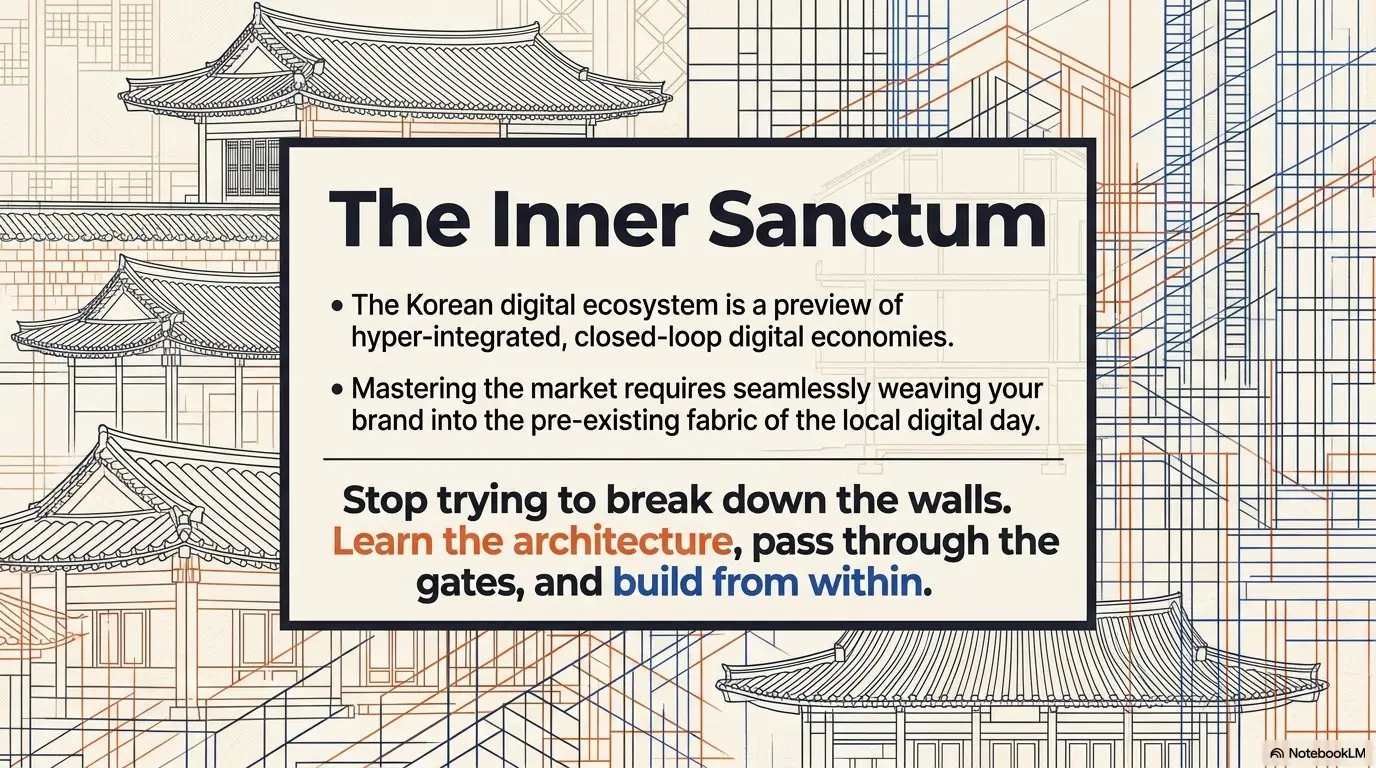
The Korean digital ecosystem is not one giant app. It is a city of separate buildings connected by enclosed walkways. Local users move through those walkways so often that they stop noticing the doors. Newcomers discover every lock.
You do not need to understand the entire system to solve one blocked task. Choose a service that recently failed and create a four-line dependency map.
Your 15-minute dependency map
- Account: Write the accepted login methods and recovery channel.
- Identity: Record the exact phone, name, residency, or age check required.
- Payment: List the cards, accounts, wallets, or in-person options actually offered.
- Support: Find one route that works without logging into the blocked account.
Then circle the first failed gate. That is the problem to solve. Everything after it is noise until that gate opens.
If the account works but identity fails, compare registered records. If identity works but payment fails, search for an international or offline route. If the transaction works but support is inaccessible, save a public contact method before you need a refund. The vague complaint “Korean apps do not work for me” becomes one specific, testable sentence.
That sentence might be: “This reservation platform accepts my account but requires a phone plan capable of Korean identity verification.” Or: “The app accepts my identity but offers only a domestic payment gateway.” Once the dependency has a name, the problem becomes smaller.
Korea’s integrated services can feel astonishingly fast or needlessly sealed, depending on where you enter. The fairest question is not whether the system is advanced, closed, convenient, or frustrating. It is this: Who receives the shortcut, and what usable route remains for the person sent back to the gate?
Last reviewed: 2026-06