
Korea Business Immigration Guide
Korea D-8 Investor Visa:Capital Is Only the Opening Move
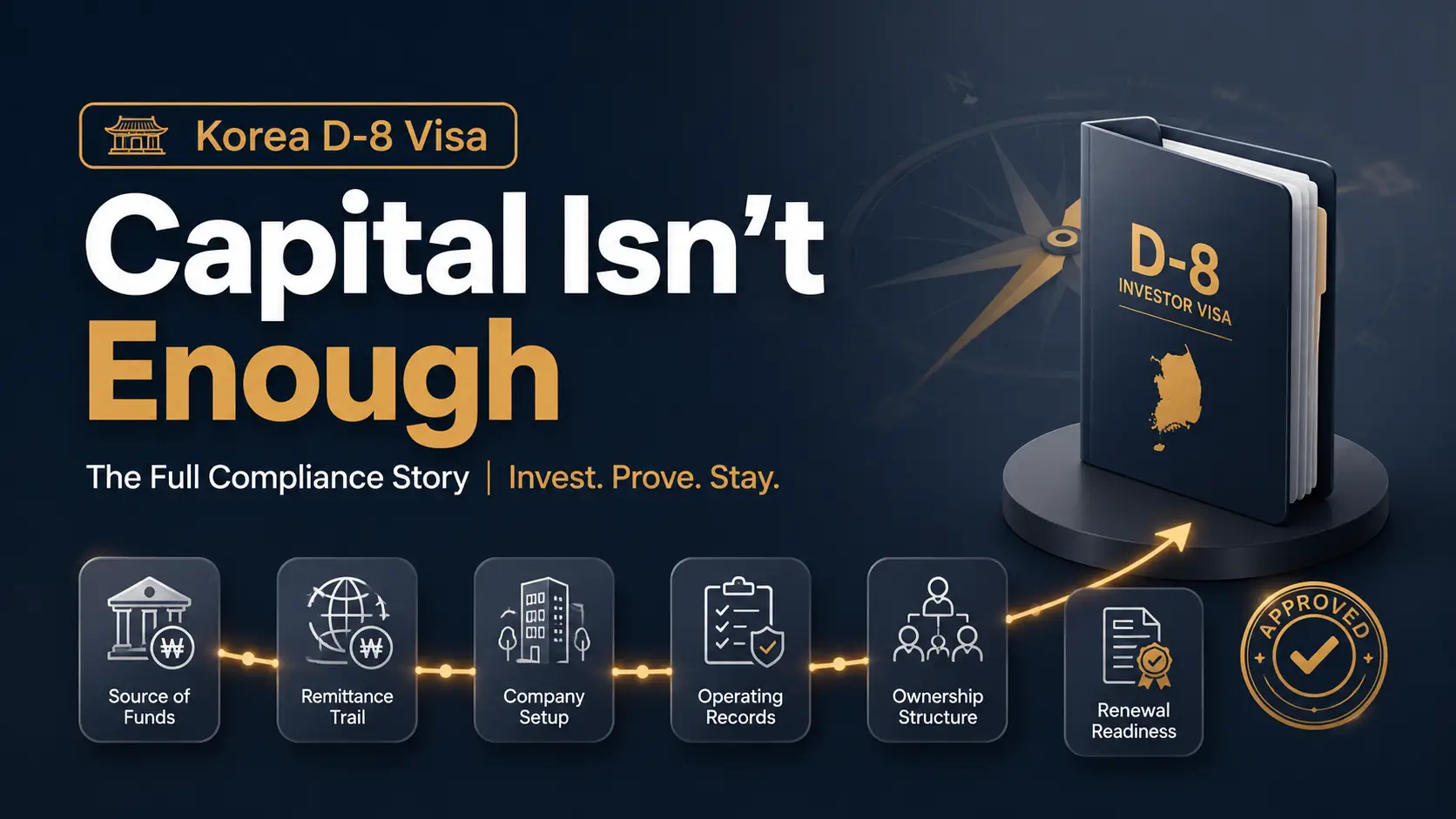
The familiar headline is simple: bring at least KRW 100 million into Korea, establish or invest in a qualifying company, and apply for a D-8 business investment visa. The actual file is less tidy. Immigration may read your remittance records, office lease, shareholder register, tax filings, bank transactions, receipts, contracts, and business activity as chapters of one continuous story.
That story must make sense from both ends. The foreign source must connect cleanly to the Korean investment, and the Korean company must behave like the business described in the application. A polished incorporation certificate cannot rescue unexplained third-party transfers, a contradictory office, dormant banking activity, or a cap table that quietly moved the investor below a required ownership level.
This guide follows the capital after the wire arrives. It explains route selection, the KRW 100 million threshold, source-of-funds evidence, legitimate capital spending, renewal preparation, ownership dilution, and the moments when professional review may cost less than repairing a fractured filing later.
Trace the capital
Connect the investor, remittance, corporate deposit, and each material business expense.
Protect the structure
Check voting rights, director changes, premises, permits, and business-purpose updates before filing.
Prepare for renewal
Build monthly proof of operations instead of reconstructing a year of activity under deadline pressure.
The useful question is not merely “Did the money arrive?” It is “Can a stranger understand what happened next?” 🧭
Snapshot
For: Foreign founders, overseas executives, investors, and small-business operators considering Korean residency through business investment. Problem solved: Understanding why the minimum capital is not the whole visa test. Next: You will be able to map your route, evidence trail, operating records, and professional-review needs before transferring funds.
Table of Contents
Before You Act: Treat the Visa, Company, Bank, and Tax File as One Project
Safety / Disclaimer
This article provides general educational information, not individualized Korean immigration, legal, banking, accounting, foreign-exchange, or tax advice. Requirements can vary by D-8 subtype, nationality, current status of stay, investment method, ownership structure, business activity, and reviewing office. Confirm the current procedure and document list with the appropriate immigration office, foreign-exchange bank, KOTRA, and qualified Korean advisers before transferring capital or signing binding agreements.
What this guide can do
It can help you identify the questions that should be answered before money moves: who is investing, which entity will receive the capital, which D-8 route is being considered, how ownership will be recorded, where the company will operate, and how business spending will be documented.
It can also help you compare a simple founder-led case with a higher-risk structure involving family funds, related companies, loans, trusts, cryptocurrency proceeds, existing Korean shareholders, regulated activities, or several countries.
What must be confirmed for your own case
- The correct D-8 subtype and qualifying role
- The permitted investment and remittance method
- The required voting rights and shareholder records
- Whether an in-country change of status is available
- Business licensing, office, tax, payroll, and reporting obligations
- The documents requested by the reviewing diplomatic mission or immigration office
Korean administration often involves several institutions that see different pieces of the same transaction. A foreign-exchange bank may focus on the remittance. A registry office records the corporation. The tax office registers the business. Immigration considers whether the applicant and business satisfy the relevant status-of-stay rules.
Treating each visit as an isolated errand creates gaps. Treating them as one evidence system creates a file that can be read without guesswork.
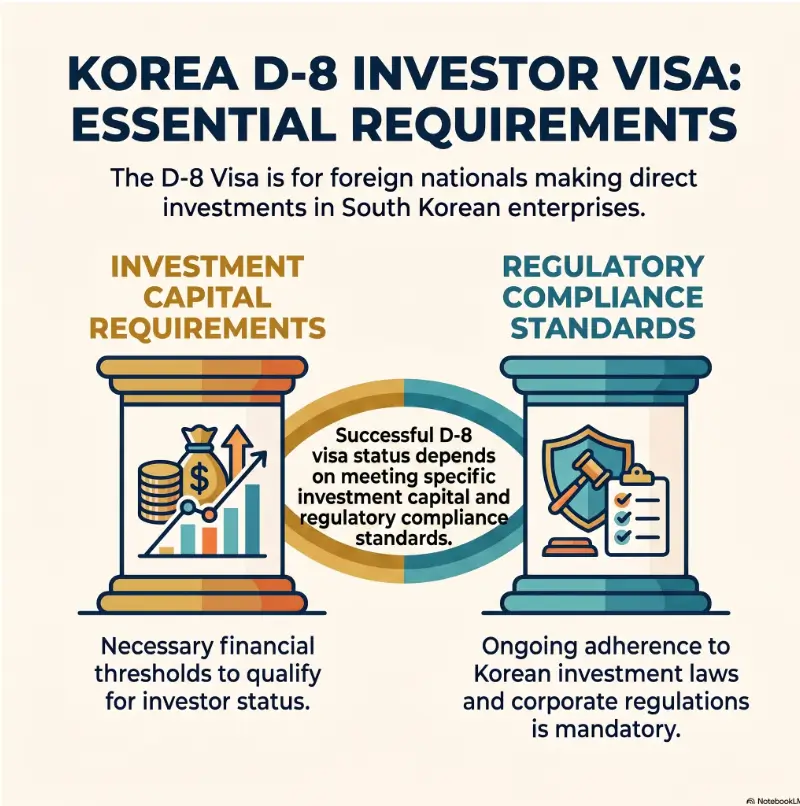
Key takeaway: A D-8 application is not merely an immigration form attached to a corporation. It is the intersection of immigration status, foreign investment, company law, banking evidence, tax compliance, and actual business activity.
Choose the Correct D-8 Route Before Building the Company
“D-8 investor visa” is convenient search language, but D-8 is not one universal checklist. A corporate investor, a dispatched executive, a joint private-business operator, and a technology founder may stand beneath the same broad category while needing different qualifying evidence.
D-8-1: The conventional corporate-investment route
This is the route most readers have in mind. A foreign investor brings qualifying capital into a Korean corporation recognized as a foreign-invested company and takes an active role connected to operating or managing the business.
The company, investment, ownership, and applicant’s role should fit together. A person described as directing the company should have corporate authority and evidence consistent with that position. A dispatched executive or specialist should have a genuine managerial, technical, production, research, or other qualifying professional function, not a decorative title pasted over routine work.
D-8-3: A joint private business with a Korean national
A foreigner entering a joint private-business arrangement with a Korean national is not simply using the standard corporation route with a different label. The investment amounts, ownership ratio, business registration, and joint representative status require separate review.
KOTRA guidance describes a structure in which the foreign investor and Korean participant each make qualifying investments, the foreign investor owns at least the applicable portion of the total investment, and the foreigner is registered as a joint representative. Do not borrow a D-8-1 checklist and assume it covers this arrangement.
Venture and technology paths use different proof
Some founder routes are connected to venture-company confirmation, intellectual property, advanced technology, education, startup credentials, or recommendations from a competent authority. In these cases, capital may still matter, but the legal doorway is not defined only by the conventional KRW 100 million corporate-investment structure.
A technical founder should first ask which qualification is actually being relied upon. Otherwise, months can be spent assembling excellent evidence for the wrong test.
A subsidiary, branch, and liaison office are not interchangeable
A Korean subsidiary is a domestic corporation separate from its foreign investor. A Korean branch remains part of the foreign company and is generally handled under a different foreign-exchange framework. A liaison office is ordinarily limited to non-sales functions such as market research and business contacts.
A branch can conduct profit-making activity, but KOTRA’s business-establishment guidance states that it is legally a foreign corporation and is not recognized as a foreign-invested company under the same framework as a qualifying Korean subsidiary. That distinction can reshape both immigration and tax planning.
| Structure | Basic identity | Typical activity | D-8 planning question |
|---|---|---|---|
| Korean subsidiary | Separate Korean corporation | Operating business in Korea | Does the investment and applicant qualify under the chosen D-8 route? |
| Foreign company branch | Part of the overseas company | Profit-making Korean operations | Is another status or dispatched-personnel route more appropriate? |
| Liaison office | Non-sales presence of overseas company | Research, contacts, support | Can the planned activity legally remain non-commercial? |
| Joint private business | Individual business arrangement | Business operated with Korean participant | Are investment, ownership, and joint-representative requirements satisfied? |
Founders unfamiliar with local procedures may also find it useful to review how Korean business communication works before meeting banks, accountants, landlords, and public offices. Clear written follow-up is especially valuable when several institutions give instructions using slightly different vocabulary.
The KRW 100 Million Threshold Is a Gate, Not an Approval
A new Korean corporation
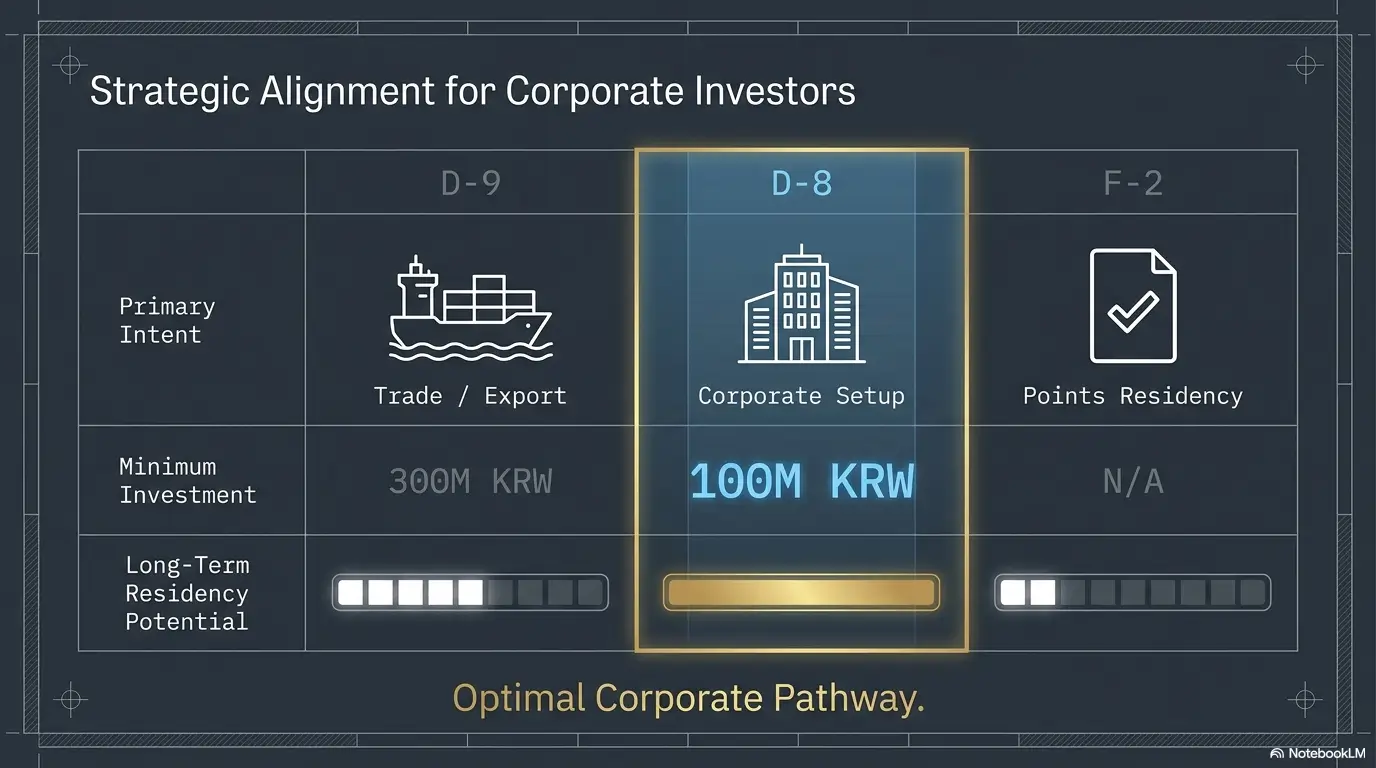
For the conventional route, current KOTRA guidance generally describes an investment of at least KRW 100 million as the minimum needed for a newly established Korean corporation to be recognized as a foreign-invested company.
This number is a statutory threshold, not a quoted price for residency. It does not automatically prove that the applicant has the correct role, that the money came from a documented source, that the business premises are credible, or that the company will remain compliant.
An investment in an existing Korean company
When investing in an already established corporation, the conventional foreign-investment test generally combines an investment of KRW 100 million or more with acquisition of at least 10% of voting shares.
The voting-rights element matters. A contract promising economic benefits may not equal registered voting ownership. Preferred shares, convertible instruments, side agreements, nominee arrangements, and later financing rounds should be reviewed for their actual effect on the investor’s position.
Minimum capital is not the operating budget
A business can satisfy a legal minimum and still be financially underbuilt. The founder may need funds for rent deposits, professional fees, equipment, software, insurance, inventory, payroll, permits, marketing, translation, accounting, and several months of runway.
Before transferring money, prepare two separate figures:
- Qualifying investment capital: The amount and structure intended to satisfy the foreign-investment and visa framework.
- Operating runway: The additional cash needed to make the company function without draining the qualifying capital in a way that looks temporary or artificial.
Individual investments below KRW 300 million may receive closer documentary review
KOTRA’s visa guidance lists additional documents for individual investors investing less than KRW 300 million. These may include proof of capital expenditure, domestic account activity, business premises, signage, office photographs, and relevant business experience.
This does not mean an investment below KRW 300 million is improper. It means the applicant should expect to show the substance behind the number with unusual neatness.
Capital reality check
The minimum answers “Can this investment enter the qualifying framework?” It does not answer “Is the visa guaranteed?” or “Does the business have enough cash to operate?” Keep those questions separate.
Build a Capital Bank Trail That Survives a Stranger Test
Document the source before the first wire
The cleanest evidence trail begins outside Korea. The investor’s bank statements should connect to lawful income, retained earnings, an asset sale, a dividend, a disclosed loan, a gift, or another explainable source.
The right documents depend on the source. A salary-funded investment may require income and bank records. An asset sale may require the sale agreement and proof of receipt. A company-funded investment may require corporate approvals and evidence that the investing entity owns and transferred the money.
Borrowed, gifted, trust-held, cryptocurrency-derived, or related-company funds are not questions to answer casually after the transfer. They require early review of ownership, disclosure, tax consequences, exchange documentation, and repayment terms.
Keep the remittance sequence intact
KOTRA describes foreign investment notification, remittance, incorporation, business registration, transfer of paid-in capital, and registration of the foreign-invested company as connected stages. The names, amounts, dates, accounts, and documents should align across those stages.
The Capital Evidence Chain
1. Foreign source
Bank statements, income, asset sale, company resolution, loan, or gift records.
2. FDI notification
Investor, recipient, amount, share acquisition, and declared investment method.
3. Entry into Korea
Remittance receipt, foreign currency certificate, or customs declaration.
4. Corporate capital
Paid-in capital evidence, incorporation records, shareholder ledger, and corporate account.
5. Business use
Invoices, rent, payroll, contracts, equipment, inventory, and accounting entries.
Review the Official KOTRA Incorporation Procedure
A remitter mismatch can create a very large question
Common problems include inconsistent English spellings, money sent by a parent or spouse, transfers from an affiliated company rather than the named investor, unexplained intermediary accounts, and payment descriptions that do not identify investment capital.
A minor spelling difference may be explainable. An unexplained difference in who owned and sent the money is more serious. The safest approach is to compare every identity field before initiating the transfer:
- Passport name
- Foreign bank account holder
- FDI notification
- Korean temporary or designated account
- Share subscription and shareholder records
- Foreign-invested company registration
- Visa application documents
Hand-carried capital needs customs evidence
KOTRA’s procedure allows investment funds to be remitted through a foreign-exchange bank or physically carried into Korea. When foreign currency is carried in, it should be declared to customs and supported by the resulting declaration certificate.
Cash without a clean customs and banking trail may be physically present while remaining evidentially weak. A stack of currency is not self-authenticating, however photogenic it may appear in a briefcase.
Show me the nerdy details
Four records that look similar may answer different legal questions. The corporate registry shows that the company and its registered shares exist. The shareholder ledger records ownership internally. The foreign-invested company registration connects the company to the foreign-investment framework. The immigration file asks whether the applicant qualifies to stay and perform the proposed activities.
A discrepancy may therefore remain invisible in one system while creating trouble in another. Reconcile the records rather than assuming one certificate automatically updates every institution.
Key takeaway: Do not pay startup expenses personally and hope to reconstruct the transaction later. Preserve the connection from the declared investor to the Korean company and from the company account to the documented business expense.
Prove a Real Business, Not Merely a Registered Company
The premises should match the work
The office, shop, warehouse, factory, studio, or laboratory should be appropriate for the registered business. The lease should identify the correct company, address, term, and permitted use. Rent payments, tax invoices, sublease consent, access rights, signage, and photographs may all become relevant.
A virtual office is not automatically disqualifying in every situation, but it can be a weak choice where the business model requires inventory, customer visits, employees, production, regulated facilities, or secure equipment. Ask whether the address proves the actual operation or merely receives envelopes.
Licensing may involve a district office, health center, ministry, or another authority depending on the activity. The guide to local district offices in Korea can help foreign founders understand why a municipal office may matter even after the corporation has been registered.
Make the business model consistent across every surface
The company’s registered purposes, website, contracts, lease, equipment, spending, inventory, staffing, permits, and founder experience should tell the same basic story.
A software consultancy with laptops, cloud-service expenses, client proposals, and a modest office may be coherent. A manufacturing company with no production arrangement, no equipment, no outsourcing contract, and a mail-only address invites questions. A retailer without inventory, supplier records, online sales infrastructure, or customer-facing space faces the same problem in a different costume.
Build capital-expenditure proof while the receipts are still warm
Investment capital is not necessarily required to sit untouched forever. It may be used for legitimate company purposes after the relevant corporate steps are completed. The danger is not ordinary business spending. The danger is spending that cannot be connected to the company, business plan, accounting records, or supporting documents.
| Expense category | Useful supporting records | Question the evidence should answer |
|---|---|---|
| Office deposit and rent | Lease, bank transfer, tax invoice, landlord or owner consent | Does the company genuinely control suitable premises? |
| Equipment and furniture | Invoice, receipt, warranty, asset register, corporate card record | Was the purchase made for the stated operation? |
| Software and technology | Subscription invoice, license, contract, accounting entry | Does the expense fit the company’s service or product? |
| Inventory or production | Supplier contract, import record, warehouse record, payment proof | Can the company show a real supply chain? |
| Payroll and contractors | Employment or service agreement, withholding record, bank transfer | Was genuine work performed and properly reported? |
| Professional fees | Engagement letter, invoice, tax invoice, payment record | Was the service related to incorporation or operations? |
Real-world example: The clean company with the messy evidence
A founder wires qualifying capital from a personal overseas account and completes incorporation correctly. The company is genuine, the product is being built, and the founder has relevant experience.
During the first three months, however, the founder pays the office deposit personally, buys computers on a family credit card, reimburses contractors in cash, and pays a developer from an older overseas business account. The Korean corporate account shows only a few withdrawals and no clear operating pattern.
Nothing in the business is imaginary, but the evidence has become foggy. Each transaction now needs an explanation, reimbursement record, contract, accounting entry, and proof that the expense belonged to the Korean company.
The practical lesson is quiet but expensive: genuine activity does not automatically create good evidence. Build the accounting trail at the same time as the business.
Prepare for D-8 Renewal From the First Month
Initial approval and extension ask different questions
The initial filing often asks whether the investment, company, applicant, and proposed business satisfy the route. An extension asks what happened after approval.
The company’s activity may be examined through sales, tax filings, financial statements, corporate banking, employment records, lease payments, shareholder changes, imports, exports, contracts, and the investor’s income records. The exact request can vary, and reviewing authorities may ask for additional evidence.
Build a renewal evidence stack
- Foreign-invested company registration certificate
- Recent corporate registry extract
- Business registration certificate
- Shareholder-change statement and current shareholder ledger
- VAT records, corporate tax filings, and financial statements
- National and local tax-payment certificates
- Sales, customer, export, or import evidence where applicable
- Corporate bankbook and transaction history
- Employment-insurance subscriber records where applicable
- Business lease and rent-payment evidence
- Applicant income, withholding, and tax records
- Documents explaining major changes, delays, or unusual transactions
Official KOTRA guidance states that an extension application can generally be made from four months before the current period of stay expires. Use that window as a preparation horizon, not permission to ignore the file until the fourth month arrives.
Open KOTRA’s Visa Guide for Investing in Korea
Low revenue needs an explanation, not fictional sales
A pre-revenue company may still have substantial business activity. Product development, prototypes, regulatory applications, signed pilot agreements, customer negotiations, import delays, hiring, certifications, intellectual property work, and manufacturing preparation can all help explain the company’s stage.
Organize the evidence chronologically. Show what was planned, what was completed, what was delayed, why the delay occurred, how money was spent, and what happens next.
Do not manufacture invoices, recycle money through friendly companies, or create staged transactions when renewal becomes urgent. A weak but truthful operating year can sometimes be explained. False evidence can create a much more serious immigration and legal problem.
Use a monthly compliance archive
| Monthly folder | Save these records |
|---|---|
| Banking | Corporate statements, foreign-currency statements, explanations for large transfers |
| Revenue | Invoices, contracts, receipts, platform statements, export or import evidence |
| Expenses | Receipts, tax invoices, payroll, contractor payments, asset purchases |
| Tax and payroll | VAT, withholding, payroll reports, insurance records, filing confirmations |
| Premises | Rent payments, utility records, updated photographs, sublease consent |
| Corporate | Board resolutions, shareholder changes, director changes, permits |
| Operations | Product milestones, customer pipeline, project files, staff activity |
Key takeaway: Renewal should be a file-export exercise, not an archaeological expedition through old messaging apps, personal cards, and unlabeled screenshots.
Stop Ownership Drift Before It Rewrites the Visa Case
Watch the 10% voting-rights line
Where the conventional 10% voting-share requirement applies, dilution can matter. New share issuance, employee options, preferred-stock conversions, founder transfers, acquisitions, and investment rounds may reduce the foreign investor’s voting percentage.
A financing transaction can be commercially attractive and still damage the immigration structure. Calculate the post-transaction percentage before signing the term sheet, not after the registry and bank documents have changed.
Shareholder records should agree everywhere
Compare the corporate registry, shareholder ledger, tax shareholder-change statement, foreign-investment notification, foreign-invested company registration, bank records, subscription agreement, and immigration submissions.
Not every document records ownership in exactly the same format, but the underlying facts should reconcile. Conflicting percentages, dates, share classes, or investor names should be corrected and explained through the proper process.
Director, workplace, and business changes are not cosmetic
A change in representative director, the applicant’s organizational affiliation, work location, company name, address, business activity, or executive authority may trigger corporate, tax, foreign-investment, banking, licensing, or immigration reporting.
Do not assume that changing the corporate registry automatically updates immigration. Create a change checklist that assigns responsibility to a named adviser or employee and records the filing deadline for each institution.
The cap-table rule
No shares should be issued, transferred, converted, or cancelled until someone has checked the post-transaction voting percentage and the required updates across corporate, tax, banking, foreign-investment, and immigration records.
Eight Mistakes That Turn Clean Capital Into a Compliance Mess
Mistakes 1 to 4: The formation-stage traps
- Treating KRW 100 million as guaranteed approval. The amount does not eliminate review of the applicant’s role, source of funds, voting rights, premises, or business substance.
- Recycling or withdrawing the capital without a clear purpose. Temporary deposits, circular transfers, immediate shareholder repayments, or unexplained cash withdrawals can make the investment appear unstable or artificial.
- Mixing personal and corporate spending. Personal cards and unrelated accounts create evidentiary fog, even when the expense was genuinely business-related.
- Choosing premises that contradict the business. A warehouse business without storage, a factory without production arrangements, or a retailer at an unsuitable address may fail the common-sense test.
Mistakes 5 to 8: The operating-stage traps
- Skipping tax filings because the company made no profit. No profit does not necessarily mean no VAT, withholding, payroll, corporate tax, local tax, or reporting obligations.
- Allowing ownership to change unnoticed. Fundraising, informal transfers, nominee arrangements, and conversions can affect registered voting rights.
- Creating activity only after receiving an extension notice. Retroactive invoices, staged photographs, hurried contracts, or unexplained deposits may create more questions than reassurance.
- Assuming every visitor can automatically change to D-8 inside Korea. Korean rules generally restrict changes from short-term status, although D-8 can be treated as an exception in qualifying cases. Availability is not automatic, so confirm the applicant’s exact status and circumstances before relying on an in-country change.
Foreign founders also encounter practical friction after receiving Korean residence documentation, particularly with banking, telecom services, payment platforms, and online authentication. The guide to Korean identity verification for foreigners explains why names, phone accounts, and residence records often need to match precisely.
| Risky shortcut | Safer alternative |
|---|---|
| Send money from whichever account is convenient | Confirm the named investor, remitter, description, recipient, and required evidence before transfer |
| Pay company costs personally | Use the corporate account and corporate payment methods whenever possible |
| Choose the cheapest available address | Choose premises that fit the licensed activity and operating model |
| File taxes only when revenue arrives | Ask an accountant which returns and reports apply during pre-revenue periods |
| Approve fundraising first | Model voting dilution and reporting duties before signing |
| Prepare only when renewal approaches | Archive bank, tax, lease, payroll, and operating evidence every month |
DIY, Accountant, or Immigration Counsel: Choose Help by Risk
When a careful DIY approach may be enough
A founder may be able to coordinate much of the process directly when the structure is simple: one investor, personal funds held for a long period, a newly established Korean corporation, a standard cash remittance, clear voting ownership, an ordinary non-regulated business, suitable premises, and no adverse immigration history.
DIY does not mean improvising. It means confirming written requirements with the bank and competent offices, maintaining a document index, and using a Korean accountant for filings that require local expertise.
When paid review may prevent a costly repair
- Funds come from a spouse, parent, trust, loan, affiliate, cryptocurrency account, or asset sale
- The investment involves an existing Korean company
- Several investors, share classes, options, or convertible instruments are involved
- The applicant wants to change status while already in Korea
- The business requires special permits or unusual premises
- The company has weak sales, missing tax records, or unexplained bank activity
- Shares, directors, business purposes, or workplaces will change
- Immigration has requested supplementation or raised a status concern
- The file involves a prior refusal, overstay, unauthorized activity, or disputed document
Good, Better, Best: A practical support comparison
| Support level | Best suited to | What it may include | Main limitation |
|---|---|---|---|
| Good: Founder-managed | Simple, low-conflict structure | Official checklists, direct bank coordination, accountant for routine filings | Founder must reconcile every institution and deadline |
| Better: Coordinated professional setup | Most first-time foreign founders | Accountant, incorporation support, document review, remittance planning | Advisers may work in separate silos unless one person coordinates |
| Best: Integrated legal and compliance review | Existing-company investment, complex funds, dilution, refusal, or status risk | Immigration, corporate, tax, foreign-exchange, contract, and evidence review | Higher cost and more preparation, but useful where mistakes are expensive |
Professional fees vary by scope, city, language support, company complexity, permits, translations, notarization, tax work, and whether the adviser handles only document filing or full strategic coordination. Ask for a written engagement scope instead of comparing headline prices alone.
Questions to ask before paying an adviser
- Which D-8 subtype are you evaluating, and why?
- Who will review the source and remittance path before the transfer?
- Does your scope include corporate, foreign-investment, tax, and immigration coordination?
- Who checks the office lease and licensing requirements?
- Who prepares shareholder and voting-rights records?
- What is excluded from the quoted fee?
- Will I receive a document index and copies of every filing?
- How will post-approval reporting and renewal preparation be handled?
- What happens if immigration requests additional evidence?
Check KOTRA’s Official Foreign Investor Visa Information
Key takeaway: Buy professional help for complexity, not ceremony. A simple file may need disciplined coordination. A complex file may need one adviser who can see how banking, ownership, tax, and immigration facts collide.
FAQ: Korea D-8 Investor Visa Capital and Compliance
Is KRW 100 million enough to receive a D-8 visa?
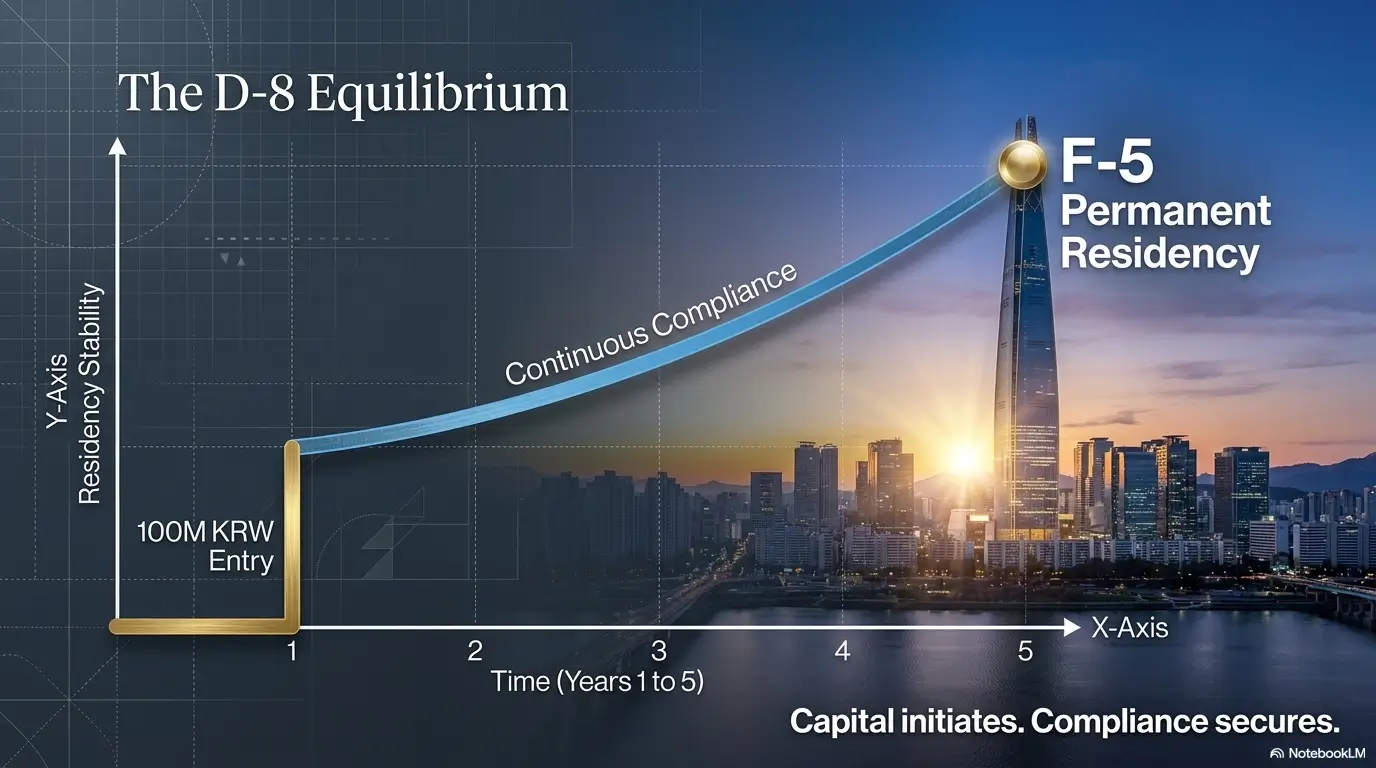
It is generally a central minimum for the conventional corporate-investment route, but it does not guarantee approval. The application may also be reviewed for qualifying ownership, the applicant’s role, source and transfer of funds, business premises, capital expenditure, corporate records, and the credibility of the planned operation.
Does every D-8 subtype require KRW 100 million?
No. D-8 includes corporate investment, venture, technology-founder, joint-business, and dispatched-professional situations. Each route requires its own eligibility analysis and supporting documents.
Can the company spend the investment capital?
Qualifying capital is not necessarily frozen after the proper corporate procedures are completed. It may generally be used for legitimate business purposes. Use the corporate account, retain invoices and contracts, classify the expense correctly, and preserve a clear connection between the payment and the company’s stated operations.
Can borrowed or gifted money be used?
A universal answer would be unsafe. Confirm lawful ownership, disclosure, tax treatment, repayment terms, source-of-funds evidence, foreign-exchange documentation, and whether the named investor is properly introducing the capital. Review the structure before the money moves.
Can a home address or virtual office qualify?
It depends on the business activity, building rules, lease rights, licensing requirements, customer or inventory needs, and the evidence of genuine operations. A mail-only address may be difficult to reconcile with a business requiring staff, storage, production, regulated facilities, or regular client visits.
Does the company need sales before its first extension?
Sales and tax records are important evidence, but a business may be reviewed in light of its stage and documented activity. A pre-revenue company should preserve credible proof of development, contracts, customer discussions, permits, hiring, expenses, prototypes, import arrangements, or other milestones. Limited sales require explanation, not invented revenue.
What happens if voting ownership falls below 10%?
Where the 10% voting-share requirement applies, dilution may affect foreign-investment recognition or the immigration structure. Obtain case-specific advice before issuing, transferring, converting, or cancelling shares.
How early can a D-8 extension be filed?
KOTRA guidance states that an extension may generally be requested from four months before the current period of stay expires. Confirm appointment availability, jurisdiction, and the current document list through the official immigration system.
Visit the Official Hi Korea Immigration Portal
Your 15-Minute Next Step: Start a Capital Evidence Ledger
Open a spreadsheet and create three columns: Source of Capital, Entry Into Korea, and Business Use. You are not completing the application today. You are finding the missing bridges before the transfer turns them into expensive questions.
| Source of Capital | Entry Into Korea | Business Use |
|---|---|---|
| Investor bank statement or asset record | Remittance receipt or customs declaration | Corporate bank transaction |
| Income, sale, loan, gift, dividend, or company-resolution documents | Foreign currency purchase or deposit certificate | Invoice, lease, payroll, receipt, or contract |
| Investor name and account details | Date, amount, currency, exchange rate, and receiving account | Business purpose and accounting category |
| Proof explaining how the investor obtained the funds | FDI notification and paid-in capital records | Tax treatment, asset record, and approval where relevant |
Add one document link to every important transaction
Each row should point to the underlying bank statement, remittance certificate, customs record, invoice, contract, receipt, lease, payroll document, tax filing, or corporate resolution. Use consistent file names such as 2026-08-14_office-deposit_KRW-amount.pdf.
Run the stranger test
Imagine an immigration officer opening the file without hearing your explanation. Can that person identify who owned the money, how it entered Korea, which shares were acquired, where the company operates, what the company purchased, and whether the transactions match the business plan?
Circle any row that needs verbal rescue. Those circles are your agenda for the bank, accountant, KOTRA, immigration professional, or Korean attorney. Fifteen quiet minutes now can prevent the capital story from becoming a box of unrelated receipts later.
Final checkpoint
Do not transfer the first dollar until the investor name, source documents, remittance route, receiving account, share structure, business premises, and operating budget can be described in one coherent page.
Last reviewed: 2026-08