
2026 U.S. Expat Planning Guide
Moving to South Korea can make American healthcare habits feel oddly heavy. The familiar stack of networks, deductibles, prior authorizations, and surprise invoices gives way to a public insurance system that is often faster and less expensive, but not nearly as simple as the phrase “universal healthcare” suggests.
The important question is not merely whether Korea has national health insurance. It is when you become eligible, how you will be enrolled, what will be deducted, and what remains outside coverage. An employee, a graduate student, a freelance consultant, and the spouse of a Korean worker can arrive on the same flight and face four different insurance timelines.
This guide turns that administrative fog into a practical sequence. You will map your enrollment route, estimate a realistic 2026 budget, prepare for clinic bills, compare temporary private coverage, and leave with a one-page timeline you can verify before surrendering your old insurance card.
Know your route
Employee, regional subscriber, or dependent.
Budget honestly
Premiums, copays, non-covered care, and transition gaps.
Move with continuity
Protect prescriptions, dependents, and planned treatment.
The goal is not perfect prediction. It is a dated, documented handoff with no uninsured trapdoor. 🧭
Snapshot
This article is for Americans planning long-term employment, study, family residence, or independent work in South Korea. It explains how NHIS enrollment paths differ, what the 2026 employee rate means, where copayments remain, and how to arrange temporary coverage. By the end, you will be able to build a practical insurance timeline and know which questions require confirmation from NHIS, your employer, or a medical provider.
Contents — choose a section
Table of Contents
Before You Act
This guide provides general educational information. It cannot determine your individual eligibility, visa consequences, payroll treatment, dependent status, medication access, or coverage for a planned procedure. Rules and administrative practices can change. Confirm important dates and documents with the National Health Insurance Service, your employer, an immigration professional, or a qualified medical provider before cancelling existing coverage or committing to treatment.
The Enrollment Fork: Employee, Regional Subscriber, or Dependent?
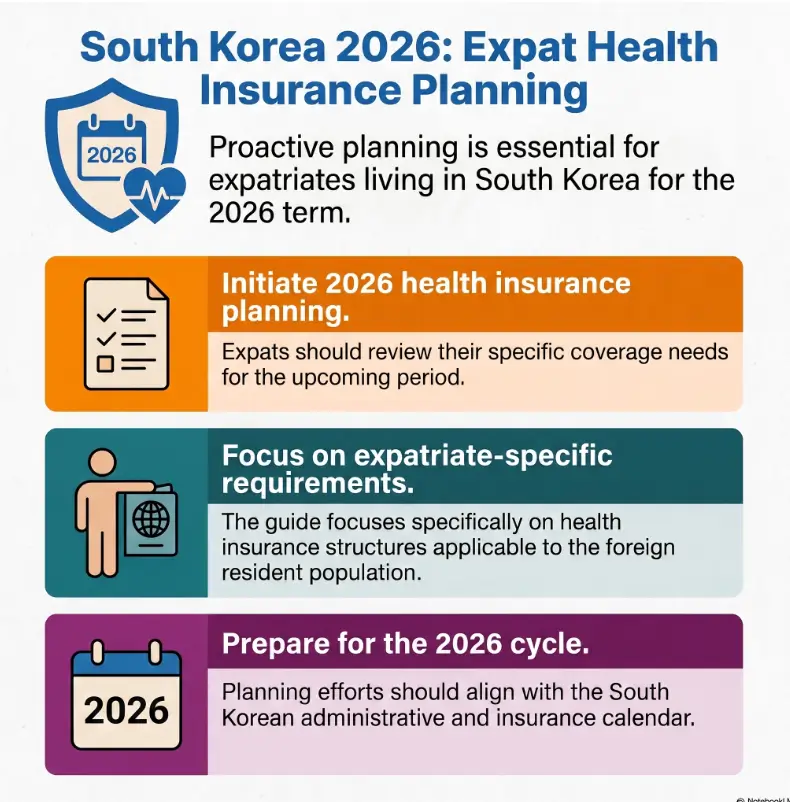
American newcomers often begin with the wrong question: “Do expats have to join Korean health insurance?” A more useful question is, “Which enrollment category applies to me on which date?”
Korea’s National Health Insurance Service, usually shortened to NHIS, separates people into different coverage routes. Your route affects the timing of enrollment, who reports your eligibility, how premiums are calculated, and whether family members can be added.
Employee enrollment may begin before six months
Foreign residents working for a workplace covered by NHIS are generally enrolled as employee-insured subscribers. In that situation, the employer normally reports the employee’s eligibility and deducts the employee share of the premium through payroll.
This is why the six-month rule should not be treated as a universal waiting period. A newly hired engineer, teacher, researcher, or office employee may enter NHIS through the workplace route without first spending six months as an uninsured resident.
Key takeaway
Ask the employer for the expected NHIS eligibility acquisition date, not merely whether “insurance is included.” Those phrases can conceal several weeks of onboarding, reporting, or document processing.
Regional enrollment follows a different clock
Many registered foreign residents who are not insured through a workplace become mandatory regional, or self-employed, subscribers after staying in Korea for more than six months. The rule applies only within the qualifying residence and visa framework, so it should not be reduced to “every foreigner is enrolled on day 181.”
Students, freelancers, family-visa holders, business owners, and people between jobs need to examine this route carefully. Visa category, immigration registration, residence history, and changes of status can affect the practical result.
Dependent status is not automatic for spouses
A spouse or other eligible relative may be recognized as a dependent of an employee-insured subscriber, but marriage alone does not complete the process. NHIS applies relationship, support, income, property, residence, and documentation requirements.
The general statutory income ceiling is KRW 20 million or less per year for the specified income categories, together with additional rules for business income, housing rental income, property, marital status, and cohabitation. Where the proposed dependent is married, both spouses may need to meet the relevant income conditions.
The Korean dependent-criteria annex uses an inclusive ceiling. Exactly KRW 20 million is therefore not excluded solely by that boundary, but meeting it does not establish dependent status: the other income, property, support and foreign-resident conditions must still be checked.
| Possible route | Typical situation | Who usually starts the process | First question to ask |
|---|---|---|---|
| Employee-insured | Works for an NHIS-covered employer | Employer or payroll team | What is my reported eligibility date? |
| Regional subscriber | Long-term resident without workplace coverage | NHIS, based on residence records | Which date starts my six-month calculation? |
| Dependent | Supported spouse or qualifying family member | Employee and employer, with documents | Which income, property, and relationship documents are required? |
| Temporary private coverage | Waiting for NHIS or protecting travel outside Korea | Individual applicant | Does it cover the exact dates and countries I need? |
Foreign residents who are still arranging their residence card may also find it helpful to review this guide to Korea resident registration. Insurance, banking, telecommunications, and medical administration often begin to click into place only after the identity records agree with one another.
The Six-Month Clock Has a Trapdoor
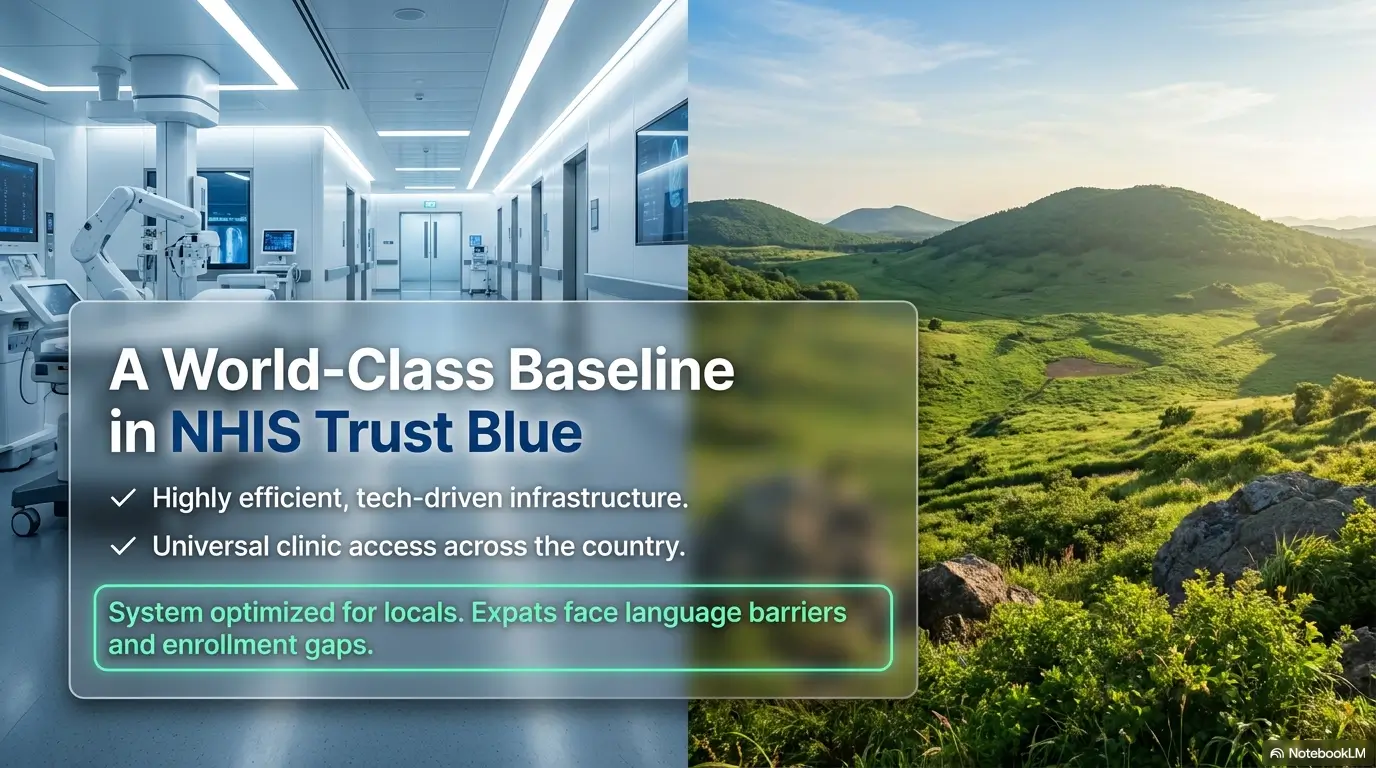
The phrase “after six months” sounds wonderfully solid. Unfortunately, real moves contain visa changes, overseas trips, delayed registration, job starts, resignations, and family members arriving on different dates.
The date you remember as moving day may not be the decisive administrative date. NHIS works from official eligibility and residence information, not from the day your suitcases crossed the apartment threshold.
When the countdown usually matters
For someone planning regional enrollment, the safe approach is to list every date that could affect eligibility: arrival, visa issuance, foreigner registration, employment, departure, re-entry, and status changes. Then ask NHIS which date governs the case.
This matters especially for Americans who make exploratory visits before relocating permanently. A short trip, a later long-term entry, and a period spent outside Korea should not be blended into one homemade calculation.
Employment can change the answer quickly
Starting an NHIS-covered job may move a person into employee insurance. Leaving that job can create a new question: whether the person becomes a regional subscriber, qualifies for another arrangement, or has an administrative gap that must be covered temporarily.
Do not assume that coverage follows you smoothly because your visa remains valid. Employment eligibility and immigration permission are related pieces of the move, but they are not the same switch.
Real-world example: The two-date problem
Imagine an American consultant who arrives in Seoul on March 4, receives a residence card in April, and begins salaried employment on June 1.
She has been told that foreigners must wait six months, so she buys private insurance through September. Her employer, however, reports her for employee coverage beginning in June.
The private policy may still provide useful benefits, particularly for travel or non-NHIS expenses, but she now has overlapping premiums she did not plan to pay. The reverse problem is worse: assuming workplace coverage starts immediately, cancelling a US plan, and discovering that payroll registration is incomplete.
The lesson is simple. Do not plan around one “Korea arrival date.” Plan around a chain of dates, and attach written confirmation to each handoff.
The Coverage Handoff Framework
1. Identify
Employee, regional subscriber, dependent, or temporary visitor.
2. Date
Record arrival, registration, employment, and policy end dates.
3. Bridge
Cover any period before NHIS becomes active or while status changes.
4. Verify
Keep the call date, representative guidance, and employer confirmation.
Your 2026 Premium Starts With a Fork, Not a Flat Price
There is no single monthly “expat health insurance price” that can be copied from a forum post. Employee premiums begin with wages. Regional premiums are assessed under a different method. Dependents may not pay a separate premium when properly recognized, but they must first satisfy the rules.
Employee premiums begin with salary
For 2026, NHIS lists the employee health insurance contribution rate as 7.19% of the monthly average wage. In a standard company arrangement, the employer and employee generally split that amount equally, so the employee portion is approximately 3.595% before the separate long-term care insurance contribution is added.
| Illustrative monthly wage | Total health premium at 7.19% | Approximate employee half | Remember |
|---|---|---|---|
| KRW 3,000,000 | KRW 215,700 | KRW 107,850 | Long-term care contribution is additional |
| KRW 4,000,000 | KRW 287,600 | KRW 143,800 | Payroll base may differ from a casual gross-pay estimate |
| KRW 6,000,000 | KRW 431,400 | KRW 215,700 | Confirm taxable and reportable wage treatment with payroll |
These examples are planning illustrations, not payroll quotes. Bonuses, non-wage income, adjustments, contribution ceilings, delayed reporting, and other factors can affect the actual deduction.
Regional premiums use household financial information
Regional premiums involve income and property assessment, with special minimum-contribution and reduction rules for some foreign subscribers. Do not add a separate vehicle-based health premium using an old checklist: the Ministry of Health and Welfare’s reform summary confirms that the automobile component was abolished. The published 2026 value per property contribution point is not a flat monthly premium or a complete formula for every income component. Ask NHIS to identify the assessment categories, period and foreign-subscriber rule used on your own notice.
This is where old expat discussions become dangerous budgeting tools. Two people with similar visas may receive different bills because their income, household status, property records, reporting history, or assessment period differs.
Money-saving mistake to avoid
Do not cancel temporary insurance because another expat reports paying a low NHIS premium. Their category, household assessment, employment arrangement, or bill year may be different from yours.
Give the first invoice breathing room
A sensible relocation budget includes more than one ordinary monthly premium. Keep a buffer for the first invoice, long-term care contributions, possible retroactive assessment, dependent-document delays, and private coverage that overlaps briefly with NHIS.
For employees, ask payroll for a sample deduction showing health insurance and long-term care insurance separately. For regional subscribers, request a case-specific estimate or explanation directly from NHIS rather than trying to reverse-engineer the bill from a social-media screenshot.
What NHIS Covers, and What Still Reaches Your Wallet
NHIS supports a broad range of medically necessary care, including diagnosis, testing, treatment, medical materials, surgery, hospitalization, rehabilitation, preventive care, and health checkups. The crucial distinction is that a covered service can still require a patient copayment.
“Covered” is not the same as “free”
Under the general structure published by NHIS, inpatient covered treatment usually carries a 20% patient copayment, with lower rates for certain registered serious or rare conditions. Outpatient cost sharing varies by the type and level of medical institution.
Non-covered services, often marked in Korean as 비급여, sit outside the ordinary NHIS benefit calculation. Private rooms, elective treatments, certain materials, convenience services, and some specialized procedures can add substantial amounts even when the core medical visit is insured.
Hospital level changes the bill
Korea’s system gives patients considerable freedom to seek care, but the copayment structure discourages everyone from beginning at the most advanced hospital. A neighborhood clinic generally carries lower outpatient cost sharing than a hospital, general hospital, or tertiary hospital.
| Care setting | General published outpatient share | Often suitable for | Cost question |
|---|---|---|---|
| Clinic | About 30% of covered expenses | Common illness, follow-up care, basic prescriptions | Is today’s service covered by NHIS? |
| Hospital | About 40% | Specialist care and broader diagnostics | Do I need a referral or additional test? |
| General hospital | About 45% to 50% | More complex conditions and multiple departments | Which items are covered and non-covered? |
| Tertiary hospital | About 60%, plus applicable expenses | Severe, complex, or highly specialized care | Will a referral affect access or cost? |
| Pharmacy | Generally around 30% of covered expenses | Prescription dispensing | Is there a covered generic or ingredient-equivalent option? |
These percentages describe the general published framework, not a guaranteed price for every service. The payable amount depends on the covered fee, medical category, institution, patient status, and any non-covered additions.
Planned care needs a coverage check
Americans relocating with pregnancy care, dialysis, cancer treatment, psychiatric medication, a scheduled operation, or a rare-disease therapy should not rely on a general statement that NHIS covers pre-existing conditions.
NHIS eligibility is not usually determined through the same kind of medical underwriting used by private American plans. That does not guarantee coverage of every drug, device, provider, room, technique, or treatment schedule.
- Confirm whether the treatment itself is an NHIS benefit.
- Ask whether the preferred hospital accepts the case and requires a referral.
- Check the Korean availability of each medication by active ingredient.
- Request an estimate separating covered and non-covered charges.
- Plan how medical records, pathology, imaging, and prescriptions will be transferred.
- Keep temporary insurance active until the treatment handoff is confirmed.
For a closer look at paperwork and inpatient logistics, see this guide to Korean hospital admission. Readers managing language barriers may also benefit from preparing a medical translation plan in Korea before an urgent visit turns vocabulary into a second diagnosis.
Show me the nerdy details
A patient’s final bill is not simply the hospital’s sticker price multiplied by one copayment percentage. The bill may contain covered benefit expenses, selectively covered items, full patient-pay items, and non-covered services.
NHIS also operates an annual copayment-ceiling system tied to contribution level, but several categories can be excluded from that protection, including non-covered services and other specified charges. This is why a patient with extensive treatment should keep itemized receipts and ask which charges count toward the ceiling.
When discussing a procedure, ask the provider to mark each major item as covered, partially covered, or non-covered. That three-column conversation is more useful than asking only, “Does NHIS cover this?”
Should You Keep American or International Insurance?
Korean NHIS, American domestic insurance, travel insurance, and international medical insurance solve different problems. Choosing between them requires a map of where you will receive care, not a contest to find the lowest monthly premium.
Three reasonable transition strategies
| Approach | Best suited to | Main advantage | Main weakness |
|---|---|---|---|
| Good: Short bridge policy | Healthy newcomer with a confirmed workplace enrollment date | Protects the known pre-NHIS gap | May offer limited benefits or strict exclusions |
| Better: Temporary overlap | Family, frequent traveler, or person with administrative uncertainty | Reduces the risk of a failed handoff | Two premiums may be paid for a period |
| Best for complex needs: International continuity plan | Person receiving specialized treatment or moving between countries | May support broader geographic access and evacuation benefits | Higher price, underwriting, limits, and claim complexity |
A simple travel policy may be enough for a brief and clearly defined gap. It may be a poor substitute for international medical coverage when someone needs ongoing specialist treatment, medical evacuation, or repeated care during visits to the United States.
Foreign insurance does not automatically cancel NHIS
Certain employee-insured foreigners may apply for exclusion from Korean employee health insurance when they can prove equivalent medical benefits under foreign law, foreign insurance, or an employer contract. This is a formal eligibility and evidence process, not a personal decision to stop payroll deductions.
NHIS states that supporting documents and the appropriate withdrawal application are required. The timing of the filing can also matter. Do not direct payroll to remove deductions until the exclusion has been reviewed and approved.
Questions to ask before paying for private coverage
- What exact start and end dates are insured?
- Does the plan cover routine care, emergencies only, or both?
- Are pre-existing conditions excluded or subject to a waiting period?
- Is care in South Korea covered on a direct-billing or reimbursement basis?
- What happens during visits to the United States?
- Are prescription drugs, mental health care, pregnancy, or specialist visits restricted?
- Does the policy include evacuation or repatriation?
- Must treatment be preauthorized?
- Can the policy be cancelled or shortened after NHIS enrollment?
- Which documents are required for a claim made outside the insurer’s home country?
Key takeaway
Temporary double coverage is not automatically wasted money. It can be the price of avoiding a much larger uninsured loss while your visa, employer, residence card, or dependent documents are still moving through separate systems.
Travel policies can still matter after NHIS begins because Korean domestic coverage should not be treated as comprehensive insurance for medical treatment in the United States. Compare geographic coverage carefully using a guide such as this overview of travel insurance for South Korea.
Before Your First Clinic Visit, Learn the Korean Care Ladder
The Korean system can feel startlingly quick. A patient may register, see a doctor, pay, collect a prescription, and visit a pharmacy within a compact slice of the afternoon. Speed is useful, but it rewards preparation.
Start local unless the condition requires otherwise
A neighborhood clinic is often the practical first stop for common illness, medication review, minor injuries, and routine follow-up. More complex cases may need a hospital, general hospital, or tertiary referral.
This is not identical to the US primary-care and in-network referral model. Still, beginning at the appropriate level can reduce cost and help a patient enter the higher-level system with better records.
Bring more than your symptoms
- Passport or accepted identification.
- Residence card when available.
- Current medications listed by active ingredient, dose, and schedule.
- Drug, food, and contrast allergies.
- Major diagnoses and previous operations.
- Recent laboratory results or imaging reports.
- Emergency contact details.
- A translated sentence explaining the main symptom and when it began.
US medication brand names do not always travel well. A clinician or pharmacist can work more reliably from the generic ingredient and dosage. For practical dispensing steps, review this guide to filling prescriptions in Korea and the related guide to Korean pharmacies for foreigners.
Ask three questions before an expensive test
- Is this service covered by NHIS?
- Is any part of it 비급여, meaning non-covered?
- Can I receive an itemized estimate or receipt?
For a minor clinic visit, this may feel excessive. For an MRI, surgery, private room, dental procedure, fertility treatment, dermatology package, or elective service, it can prevent a small misunderstanding from blooming into a large invoice.
Useful Korean billing phrases
건강보험 적용돼요? Is this covered by national health insurance?
비급여가 있어요? Are there any non-covered charges?
진료비 세부내역서를 받을 수 있어요? May I receive an itemized medical bill?
Five Mistakes That Turn a Move Into an Insurance Scramble
Most insurance problems during relocation are not caused by rare legal puzzles. They begin with an ordinary assumption that goes unverified for one week too long.
| Common mistake | Why it causes trouble | Safer alternative |
|---|---|---|
| Assuming every employee waits six months | Workplace enrollment follows a different route | Request the employer’s reporting and eligibility dates |
| Assuming a spouse is automatically covered | Income, property, relationship, and document tests apply | Obtain a written dependent-document checklist |
| Cancelling US coverage before NHIS confirmation | Visa, registration, and payroll dates may not align | Create a dated overlap or bridge period |
| Believing every hospital charge is insured | Non-covered tests, rooms, materials, and treatments remain | Ask for covered and non-covered estimates |
| Ignoring Korean-language NHIS mail | The notice may involve premiums, arrears, or missing documents | Translate and respond promptly |
Documents can be correct and still be unusable
A marriage certificate or birth certificate may need authentication, translation, recent issuance, or a specific format. The document that proved a relationship for a visa application may not automatically satisfy an NHIS dependent review.
Ask which original, translation, authentication, and issuance-date rules apply. Photographing an old certificate on the kitchen table is rarely the administrative master key one hopes it will be.
Your registered address is part of the insurance system
Update your official address after moving. Important notices can concern eligibility, premium assessment, unpaid amounts, dependent evidence, or changes in subscriber status.
If you live in a building where mail is easily misplaced, use a repeatable routine: check the mailbox, photograph official envelopes, translate them the same day, and record any call made in response.
Key takeaway
The most expensive insurance mistake is often not choosing the wrong policy. It is failing to document the date one policy ends and another actually becomes active.
When a Phone Call Is Better Than Another Search
Online guides are useful for understanding the system. They are poor substitutes for case-specific confirmation when your residence history, employment, household, or medical needs do not fit a clean example.
Call NHIS when the eligibility date is unclear
NHIS lists foreign-language consultation in English, Chinese, Uzbek, and Vietnamese through 1577-1000, extension 6, or 033-811-2000 within Korea. Its overseas number is +82-33-811-2001, and published service hours are 9 a.m. to 6 p.m. Korea time.
- You have changed visa categories.
- You previously lived in Korea and may have an old NHIS account.
- You plan to leave and re-enter during the six-month period.
- You have a Korean employer and a separate foreign health plan.
- Your spouse or children need dependent recognition.
- You received a bill covering an unexpected earlier period.
- You have unpaid contributions or a disputed eligibility date.
- Your job is ending and you need to understand the next coverage route.
Ask the employer for written confirmation
- What date will my employee eligibility be reported?
- When should the first deduction appear?
- Does the estimate include long-term care insurance?
- What document proves that enrollment is active?
- Who handles dependent applications?
- What happens to coverage if the contract ends early?
- Are any foreign-insurance exclusion procedures available in this arrangement?
Know when professional help earns its fee
A straightforward employee enrollment usually does not require paid assistance. A short call to payroll and NHIS may be enough.
Professional guidance becomes more valuable when a decision crosses several systems at once. Examples include immigration status changes, substantial foreign insurance, disputed premiums, cross-border tax questions, complex dependent documentation, high-cost planned treatment, or an employment contract that promises private medical benefits.
| Situation | DIY may be enough | Consider qualified help |
|---|---|---|
| Standard salaried job | Employer confirms enrollment and deductions | Employer refuses required reporting or dates conflict |
| Simple dependent application | Documents clearly meet the checklist | Foreign records, prior marriages, property, or income create uncertainty |
| Temporary bridge coverage | Short fixed gap with no ongoing care | Pregnancy, chronic illness, or international treatment continuity |
| Regional premium question | NHIS explains the assessment clearly | Large retroactive bill or disputed financial records |
| Foreign insurance exclusion | Employer and NHIS provide a clear procedure | Material coverage or contract rights depend on the outcome |
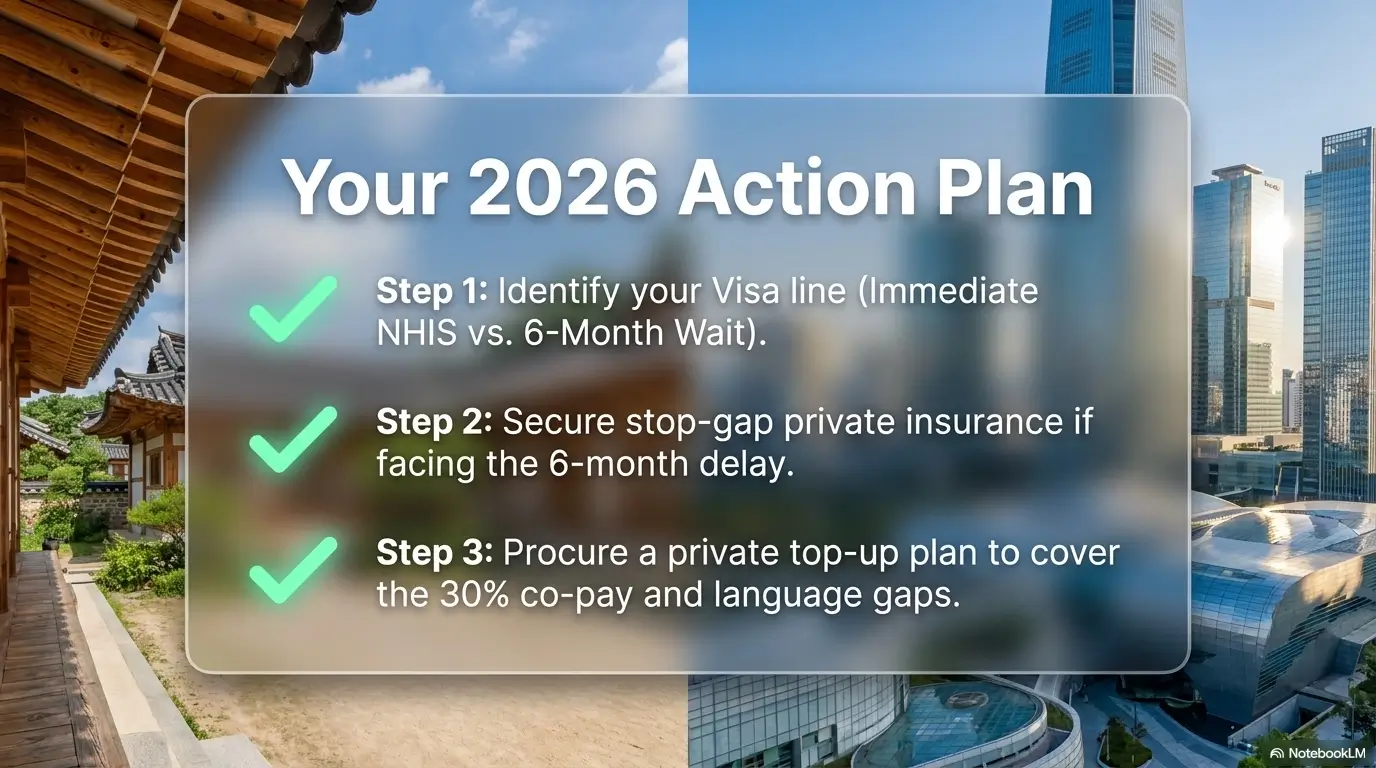
FAQ: Korea National Health Insurance for American Expats
Do Americans have to join Korean National Health Insurance?
Nationality alone does not decide the answer. Employment, visa category, residence period, registration, and dependent status determine whether you must enroll and which route applies. Employees at covered workplaces are generally enrolled through work, while many qualifying long-term foreign residents become regional subscribers after more than six months.
Does NHIS start the day I arrive in Korea?
Not necessarily. An employee may acquire eligibility through an NHIS-covered workplace, while a regional subscriber follows a residence-based timeline. Your flight date, residence-card date, job start, employer report, and NHIS eligibility date may differ.
How much does NHIS cost through a Korean employer in 2026?
The published 2026 employee health insurance rate is 7.19% of monthly average wages, generally split equally between employer and employee in a company. The employee’s approximate health-insurance share is therefore 3.595%, with a separate long-term care insurance contribution also added.
Can my American spouse join as my dependent?
Possibly, but not automatically. The spouse must satisfy the applicable relationship, support, income, property, residence, and documentation conditions. Ask for the current document checklist before arranging translations or authentication.
Can I use American health insurance instead of NHIS?
Foreign private coverage does not automatically replace mandatory NHIS enrollment. A limited exclusion procedure may be available to certain employee-insured foreigners who prove equivalent medical benefits and complete the required application. Approval should be confirmed before deductions are stopped.
Does NHIS cover pre-existing conditions?
NHIS eligibility is not generally based on a US-style private medical underwriting questionnaire. However, that does not mean every treatment, prescription, device, provider, or optional service is covered. Confirm planned care and non-covered costs individually.
Will NHIS cover me when I visit the United States?
Do not treat Korean domestic health insurance as comprehensive American medical coverage. Compare travel or international insurance for US visits, especially for emergencies, hospitalization, prescriptions, evacuation, and ongoing treatment.
What happens if I do not pay NHIS premiums?
Insurance contributions are a legal payment obligation, and NHIS may pursue collection under the applicable rules. If a bill appears incorrect, contact NHIS promptly rather than ignoring it. Ask for the eligibility period, assessment basis, payment deadline, and dispute or correction procedure.
Build Your One-Page Coverage Timeline in 15 Minutes
The Korean system becomes easier when you stop treating insurance as a single yes-or-no question. It is a sequence of dates, documents, categories, and handoffs.
Open a blank page and complete the following list. Do not estimate a date when you can confirm it. Write “unknown” and place the name of the person or agency that must answer.
- Korean arrival date.
- Visa category and issuance date.
- Residence-card application and registration dates.
- Korean employment start date.
- Employer’s expected NHIS eligibility date.
- Estimated regional-enrollment date, if relevant.
- Last day of American, travel, or international coverage.
- Coverage plan for every day between policies.
- Dependent documents still required.
- Medication and planned-treatment confirmations.
- Expected employee or regional premium.
- NHIS call date, representative guidance, and case reference.
Your 15-minute next step
Circle the first date on your page that is still uncertain. Then send one email or make one call to confirm only that date.
Once the first hinge is fixed, the rest of the timeline becomes less like fog and more like a train map: still busy, but finally readable.
Keep the finished page with your passport copies, employment contract, residence documents, insurance certificates, and medication list. Revisit it whenever you change employers, visas, addresses, or household status.
Last reviewed: 2026-09
Targeted review: October 17, 2026. Removed the outdated vehicle-premium component and corrected the dependent-income boundary. Actual bills and dependent eligibility require NHIS confirmation.