
Korean rules, translated into decisions.
Korea Dental Implant Cost for Foreigners: Insurance, Quotes and Revision Risk
A Korean dental implant quote can look pleasantly simple until the words bone graft, custom abutment, sedation, temporary crown, or revision appear. For foreigners, there is another layer: National Health Insurance eligibility, overseas insurance paperwork, limited time in Korea, and the uncomfortable question of who fixes the implant if something goes wrong after you fly home.
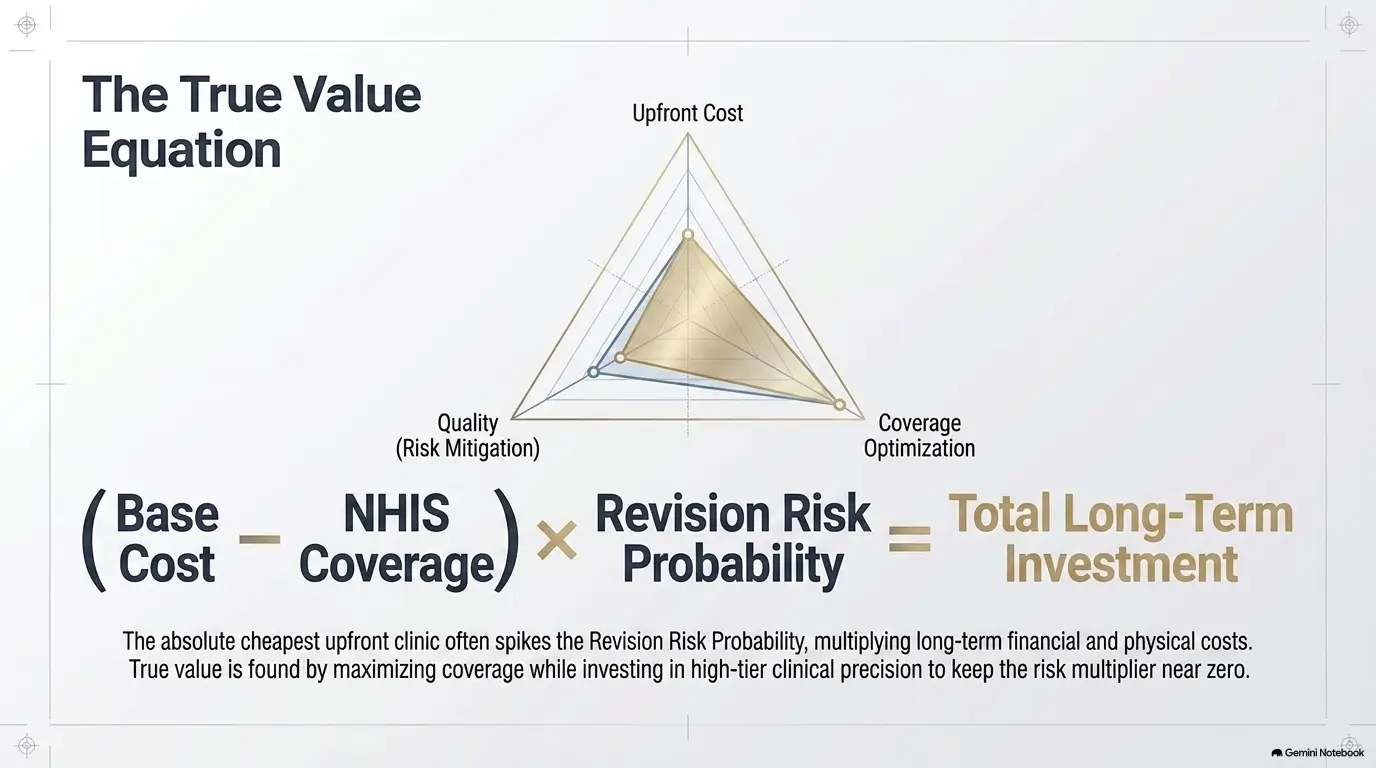
The useful number is therefore not the clinic’s advertised “per implant” price. It is the total treatment cost from diagnosis through a functioning final crown, plus the financial consequences if healing or the prosthetic work does not go according to plan. This guide shows you how to build that number and compare clinics without pretending that every implant case is interchangeable.
Start here: get the diagnosis first, confirm whether NHIS applies, then obtain an itemized written quote. Do not compare promotional implant prices before those three pieces are clear.
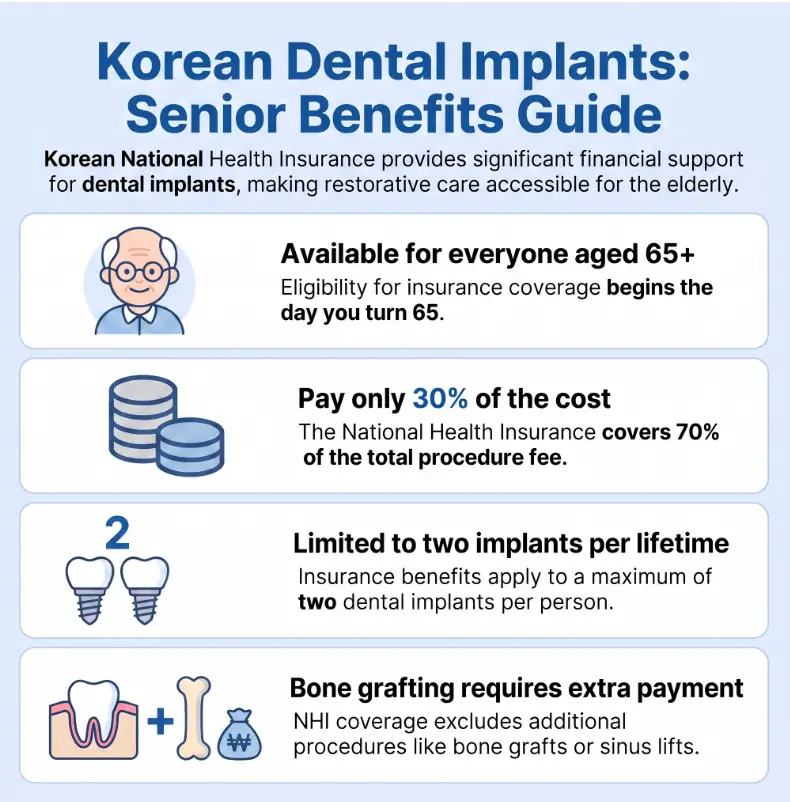
This is for foreign residents and overseas patients comparing dental implants in South Korea. If you are an eligible NHIS member aged 65 or older, qualifying implants can receive insurance benefits, generally with a 30% patient share and a lifetime limit of two implants. Many foreigners, younger patients, tourists, additional implants, bone-grafting procedures and treatments outside the benefit criteria remain self-pay. Your first job is to determine which bucket you are actually in before comparing prices.
Table of Contents
This article can help you compare costs, insurance rules, treatment scope and follow-up risk. It cannot determine whether you need an implant, whether a tooth can still be saved, whether bone grafting is necessary, or which surgical technique is appropriate for your anatomy. Those decisions require examination and imaging by a dentist. A second clinical opinion is especially sensible when the proposal involves extensive grafting, sinus surgery, multiple implants, removal of an existing implant, significant bone loss or competing recommendations from different clinics.
A Realistic Cost Framework Starts With the Whole Treatment, Not One Implant
There is no single official “foreigner price” for dental implants in South Korea. For non-covered treatment, clinics set their own charges, and the final bill depends heavily on what has to happen before the implant can support a usable tooth.
This makes a national price range less useful than it first appears. One patient’s straightforward implant can involve adequate bone and healthy gums. Another patient may need extraction, periodontal treatment, bone augmentation, a sinus-related procedure, temporary restoration or a different prosthetic design. Calling both treatments “one implant” hides the expensive part of the story.
Korea’s Health Insurance Review & Assessment Service, or HIRA, provides an official non-covered medical fee comparison service. It can be useful for checking institution-level disclosed prices rather than relying entirely on advertisements.
There is an important freshness caveat in August 2026: HIRA states that it is collecting and verifying 2026 non-covered fee information from April through August, so some displayed information may differ from a clinic’s current operating price. Treat the portal as a comparison tool, then obtain a current written quote directly from the clinic before paying.
A useful quote should make it possible to identify at least the following cost layers.
- Initial examination and treatment planning
- Panoramic imaging or cone-beam CT when clinically required
- Extraction of the existing tooth, if necessary
- Treatment of active periodontal disease or infection
- Bone grafting or related augmentation procedures
- Implant fixture placement
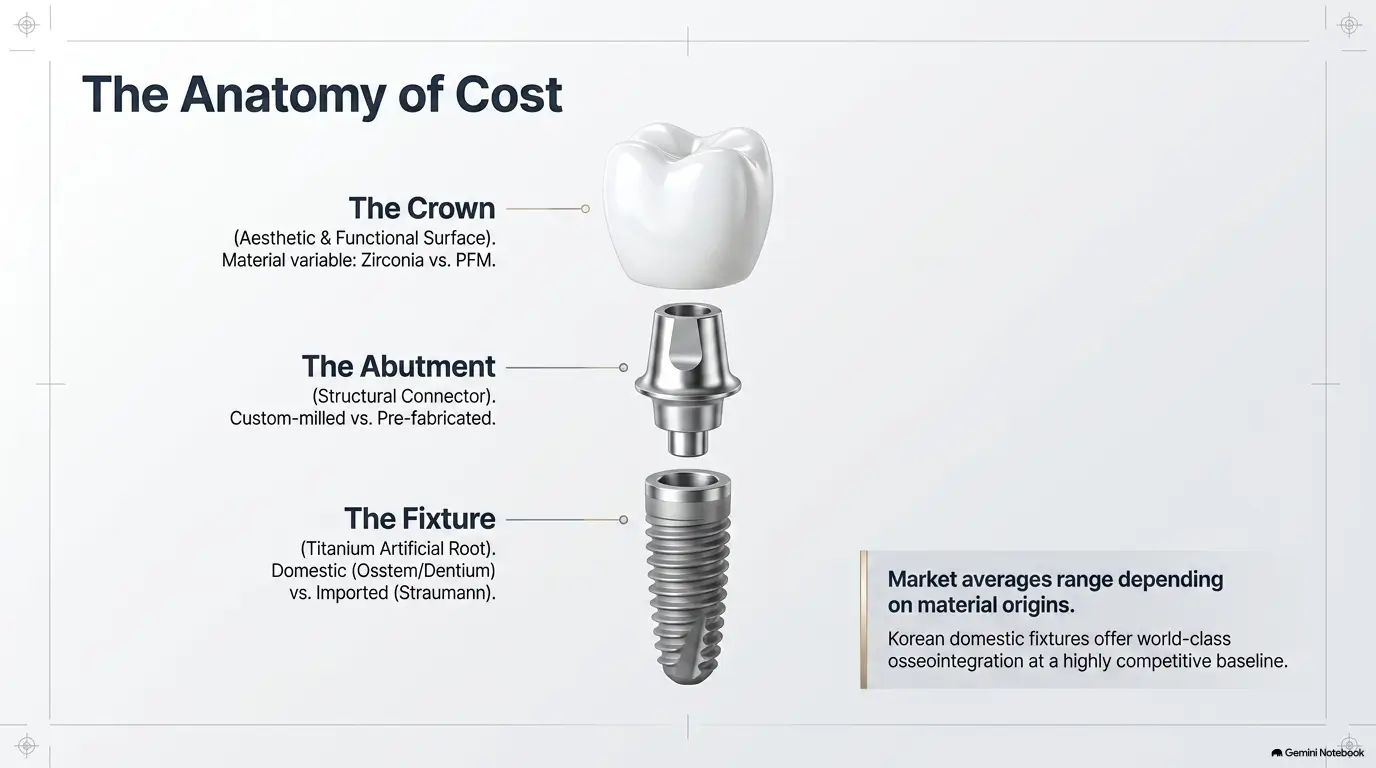
- Abutment, including whether a standard or custom abutment is planned
- Final crown and the crown material
- Temporary tooth or temporary prosthesis, when required
- Sedation or anesthesia beyond ordinary local anesthesia, when used
- Prescribed medication
- Follow-up examinations and imaging
- Repair, remaking or reimplantation rules if the treatment fails
If one clinic bundles several of these items while another quotes only the implant fixture and basic restoration, the cheaper headline price may not be the cheaper treatment.
When Korea’s National Health Insurance Can Cover a Foreign Patient’s Implant
Foreign nationality by itself neither grants nor blocks Korean National Health Insurance benefits. The first question is whether you are currently enrolled in Korea’s National Health Insurance Service and eligible for benefits when treatment is provided.
NHIS states that foreigners working at workplaces covered by the system can become employee-insured. Many eligible foreign residents in the self-employed category become subject to mandatory enrollment after staying in Korea for more than six months, although residence status and specific exceptions matter. The current rules for foreigners are available in the NHIS English guidance for foreign residents.
That means an expat who is actively enrolled in NHIS should not automatically assume that dental implants are “foreigner self-pay.” Conversely, a tourist does not acquire NHIS implant coverage merely by arriving in Korea for treatment.
The current NHIS implant rules are narrower than “insurance covers implants”
Under HIRA’s current benefit criteria for people aged 65 or older, qualifying dental implants are generally limited to partially edentulous patients and to two implants per person over a lifetime. For an ordinary health-insurance subscriber, the patient share is generally 30% of the covered benefit cost.
The current HIRA criterion, effective from February 1, 2025, recognizes qualifying treatment using a separable fixture and abutment with either a PFM crown or a zirconia crown, provided the other coverage conditions are met. You can review the current official criteria through HIRA’s dental implant benefit standard.
Several situations can move treatment outside the implant benefit. HIRA specifically identifies complete edentulism, zygomatic implantation, one-piece implant materials and restoration materials outside the currently recognized PFM or zirconia categories as circumstances in which the implant treatment falls outside this benefit framework.
Just as important, additional surgery performed for the purpose of implant treatment, including bone graft surgery, is generally non-covered. A custom abutment can also remain non-covered even when the implant procedure itself qualifies.
| Situation | What to expect | What to confirm |
|---|---|---|
| Foreign resident under 65 | Implant itself will generally not qualify for the age-based NHIS implant benefit | Ask for a non-covered written quote |
| NHIS member aged 65+ | May qualify if the clinical and material criteria are met | Ask the clinic to check and register eligibility before treatment |
| Qualifying NHIS implant | Ordinary insured patient generally pays 30% of covered benefit cost | Separate covered items from non-covered extras |
| Bone graft for implant | Generally non-covered | Get its price separately in writing |
| Custom abutment | Can be non-covered | Ask whether the quote uses standard or custom abutment |
| More than two lifetime covered implants | Additional implants are outside the two-implant lifetime benefit limit | Verify remaining registered implant benefit count |
NHIS-covered implant treatment is also handled in stages: diagnosis and treatment planning, fixture placement, and prosthetic restoration. The clinic normally checks eligibility and handles the registration process before covered treatment proceeds.
One more budget detail is easy to miss: NHIS identifies the patient’s implant co-payment as an amount excluded from the ordinary annual co-payment ceiling calculation. Do not assume that a large implant co-payment will later be absorbed through that ceiling.
Show me the nerdy details: what happens if a covered implant fails?
Current HIRA criteria distinguish between routine follow-up, prosthetic maintenance and failure of osseointegration. Within three months after the prosthesis is fitted, maintenance under the covered implant framework is generally limited to the examination fee. After that period, maintenance involving the prosthetic restoration itself is non-covered, while treatment for diseases such as peri-implant periodontal problems may be billed under the applicable covered treatment items.
HIRA also provides a specific rule for re-surgery after failure of osseointegration following fixture placement: one reimplantation can be recognized at 50% of the stage-two procedure score, with the recognized fixture material handled under the rule. This should not be read as a promise that every future revision, crown replacement or implant failure will be repaired free of charge.
For that reason, an NHIS patient still needs the clinic’s written aftercare and revision policy.
What Actually Changes a Dental Implant Quote in Korea
Once insurance has been sorted out, the next task is diagnostic. The implant fixture is only one component of a larger reconstruction.
Bone condition can change the treatment more than the implant brand
If adequate bone is already present, treatment can be relatively straightforward. If bone volume or quality is insufficient, the plan may require grafting or another augmentation procedure. For an upper posterior tooth, the relationship to the maxillary sinus can also affect treatment complexity.
This is why a promotional quotation made before appropriate imaging has limited value. It may accurately describe the clinic’s starting price while saying little about your likely final bill.
The crown and abutment are not clerical details
The fixture sits in bone, the abutment connects the fixture to the restoration, and the crown is the visible and functional tooth. A clinic may quote these as a package or separately. If a custom abutment, different crown material or laboratory upgrade is recommended later, the total can change.
Timing can create a second cost layer for overseas patients
Implant treatment is not always a one-visit purchase. Seoul National University Hospital’s patient information explains that osseointegration and healing can require months, with longer healing commonly needed when bone grafting is involved. Individual timing depends on the jaw, bone quality, surgery and clinical plan.
For someone who lives overseas, a “cheaper” implant that requires another international trip may have a higher real cost than a more expensive local quote at home.
How to Compare Korean Dental Implant Quotes Line by Line
The easiest way to compare clinics is to turn each quote into the same checklist. If one clinic cannot tell you whether an item is included, treat it as unknown rather than zero.
| Quote item | Question to ask | Why it changes the decision |
|---|---|---|
| Diagnosis | Is consultation and treatment planning included? | A promotional price may begin only after diagnosis. |
| Imaging | Are panoramic X-rays or CBCT included? | Imaging can reveal grafting or anatomical issues. |
| Extraction | If the tooth remains, is extraction included? | The implant price may begin after extraction. |
| Bone graft | Is grafting expected, optional or priced separately? | This is a common source of quote divergence and is generally non-covered when performed for implant treatment. |
| Fixture | Which implant system and model will be used? | You may need compatible components years later. |
| Abutment | Standard or custom? | A custom abutment can create a separate charge. |
| Crown | Which crown material is included? | It affects both cost and, for eligible NHIS cases, benefit criteria. |
| Temporary restoration | Is a temporary tooth included if needed? | Useful when appearance or function matters during healing. |
| Sedation | Is anything beyond local anesthesia planned? | May be an additional service rather than part of the implant package. |
| Follow-up | How many post-operative and prosthetic checks are included? | Important for patients leaving Korea. |
| Revision | What happens if the implant does not integrate or the crown needs remaking? | A warranty headline is meaningless without exclusions and duration. |
A quote becomes far more useful when the clinic marks every line as included, separately charged, not expected, or cannot be determined until surgery.
Real-world example: imagine two clinics offering the same missing-tooth replacement. Clinic A advertises the lower implant price but has not yet priced the bone graft, temporary restoration or custom abutment. Clinic B’s headline number is higher but includes those expected components after reviewing the scan. Comparing the first number would make Clinic A look cheaper. Comparing the actual treatment plan may reverse the result.
Revision Risk Is Part of the Price Even When Nothing Goes Wrong
An implant can fail biologically, mechanically or prosthetically. That does not mean implants are inherently unsafe. It means that “success rate” is a poor substitute for asking what happens to you if healing, components or the final restoration need additional treatment.
Seoul National University Hospital’s implant guidance describes potential complications including infection, sensory disturbance, sinus problems, bone loss, failure of integration, implant mobility and peri-implant inflammation. It also emphasizes oral hygiene, smoking avoidance and appropriate load because long-term maintenance affects implant survival.
You can review the hospital’s patient education material on dental implants and possible complications.
Revision does not always mean removing the implant
A loose screw, damaged crown, bite problem or soft-tissue issue is not the same as a failed implant fixture. Some problems may be managed by adjusting or replacing a prosthetic component. Others may require periodontal treatment, additional surgery or removal and reimplantation.
That distinction should appear in the clinic’s aftercare policy. Ask separately about:
- failure of osseointegration before the final crown,
- implant fixture fracture or mobility,
- loose or fractured abutment screws,
- fractured or chipped crowns,
- bite adjustment,
- peri-implant disease,
- bone loss,
- esthetic dissatisfaction,
- removal and reimplantation, and
- laboratory remake fees.
For an overseas patient, also ask whether covered revision work must be performed at the original Korean clinic. A free crown remake in Seoul has a very different value if you live in London, Toronto or Sydney and must purchase another long-haul ticket to use it.
Foreign Patients Need a Plan for the Part That Happens After Korea
Cross-border dentistry adds costs that do not appear on a treatment-room invoice: travel, accommodation, repeat visits, lost work time, records transfer and coordination with a dentist at home.
If you are coming to Korea primarily for treatment, do not buy a return itinerary around an advertisement promising fast completion. Ask the treating dentist for the expected surgical, healing and prosthetic sequence first. Implant integration can take months, particularly when grafting is involved, and an unexpected complication can change the schedule.
Leave Korea with a dental file, not just a receipt
Before your final departure, request enough information for another dentist to understand what was placed and what happened during treatment. Depending on your case, useful records may include:
- diagnosis and treatment plan,
- pre-treatment and post-treatment radiographs or CBCT data when available,
- implant manufacturer and system,
- fixture and abutment specifications available from the clinic,
- crown material,
- operative or treatment summary,
- medication information,
- itemized invoice and payment receipt,
- recommended maintenance schedule, and
- written revision or warranty policy.
This is particularly valuable if a crown screw loosens years later and your home dentist needs to identify compatible tools or components.
Overseas or private insurance is a separate contract
Do not assume that being insured abroad means a planned Korean implant will be reimbursed. Coverage can differ dramatically between accident-related dental treatment, emergency dental benefits, elective or planned implant treatment, pre-existing tooth loss and routine restorative dentistry.
Before committing, send the insurer the diagnosis and itemized estimate and ask for a written answer covering preauthorization requirements, exclusions, annual or dental limits, required claim documents and whether treatment outside your home country is eligible.
A Korean clinic’s ability to provide English paperwork is helpful, but it is separate from the insurer’s decision to reimburse you. If travel insurance is part of your plan, our South Korea travel insurance guide can help you identify the policy questions worth checking before relying on a claim.
Questions to Ask a Korean Dental Clinic Before Paying
For a straightforward single-tooth implant, you do not need a procurement department. You need a disciplined conversation.
Send the same questions to every clinic you are seriously considering so that you are comparing treatment rather than sales language.
- What diagnosis makes an implant the preferred option? Ask whether alternatives such as preserving the tooth, a bridge or another restoration are clinically reasonable.
- Who will perform the surgery? Ask for the treating dentist’s name, role and relevant training or specialty background.
- Who will design and fit the final crown? Surgery and prosthetic planning need to agree on the final tooth position.
- What implant system will be used? Ask for manufacturer and system information rather than accepting “premium implant” as the specification.
- Do you expect bone grafting or another additional procedure? Ask whether that conclusion is already visible on imaging or may only be known during surgery.
- What exactly does the written quote include? Work through the cost table in this article.
- If I qualify for NHIS, which parts are covered and which remain non-covered? Ask for them to be separated.
- How many visits are expected? Foreign patients should ask for the treatment sequence, not simply the earliest possible completion date.
- What happens if the implant does not integrate? Ask who pays for removal, replacement fixture, grafting and the new crown.
- What happens if the crown or screw fails after I leave Korea? Ask whether the clinic will coordinate with a dentist overseas.
- Which records will I receive? Make sure implant system information and imaging can travel with you.
- What would make the final price higher than today’s estimate? This question has a remarkable talent for finding the hidden edges of a quote.
Foreign patients who are specifically traveling to Korea for treatment can also use the government-supported Medical Korea registered hospitals directory as an administrative starting point for identifying institutions registered to handle foreign patients.
Registration should not be treated as a guarantee of implant quality or the right treatment plan. It simply gives you another layer of institutional verification before you investigate the actual dentist, diagnosis, quote and follow-up arrangements.
When one second opinion is worth paying for
Organizing quotes yourself is reasonable for many uncomplicated cases. An independent second dental opinion becomes much more economically sensible when:
- one clinic says the tooth can be saved and another recommends extraction,
- clinics disagree substantially about bone grafting,
- multiple implants or a full-arch reconstruction are proposed,
- the implant is near important sinus or nerve anatomy,
- you already have pain, bone loss or a failing implant,
- you have significant periodontal disease,
- you have medical conditions or medications that may affect surgery or healing, or
- the treatment would require another international trip if it fails.
In those situations, a consultation that changes an unnecessary extraction, graft or multi-implant plan can be more valuable than chasing a small discount on the fixture itself.
The Implant Mistakes Most Likely to Cost You Twice
The most expensive mistakes usually occur before the surgery begins. They happen when price, insurance or travel is decided before the treatment scope is clear.
Mistake 1: comparing advertisements instead of final treatment plans
A “one implant” promotion tells you very little if your case requires extraction, grafting or a custom prosthetic component. Diagnose first, compare second.
Mistake 2: assuming NHIS means the entire case costs 30%
The 30% ordinary patient share applies to qualifying covered implant treatment. Non-covered components and procedures do not magically inherit that percentage.
Mistake 3: choosing a clinic before asking who performs the treatment
Brand recognition, neighborhood and English-language marketing tell you less about your treatment than the identity of the clinician responsible for surgery and prosthetic planning.
Mistake 4: treating “lifetime warranty” as a complete sentence
Ask what is warranted, for how long, under which maintenance conditions, and whether surgery, components, laboratory fees and grafting are included. Also ask what happens when you are outside Korea.
Mistake 5: leaving without implant identification and records
Your future dentist needs more than “I had an implant in Seoul.” Keep the implant system information and treatment records with your long-term medical documents.
Mistake 6: compressing treatment around a flight
The calendar should follow healing, not the other way around. A clinic may have efficient scheduling, but biological integration still happens on biological time. If the pace of Korean outpatient medicine feels unfamiliar, our guide to why Korean clinics can feel so fast explains some of the system behind that experience.
- HIRA: current dental implant benefit criteria for age, treatment, material and re-surgery rules.
- HIRA non-covered fee information for comparing disclosed institutional charges.
- NHIS guidance for foreigners for current enrollment and eligibility rules.
- Medical Korea registered hospitals directory for foreign-patient institution searches.
What to Check Next
Check exclusions, preauthorization and overseas treatment rules before paying. Start with our South Korea travel insurance guide.
Prepare your questions before the appointment with our explanation of why Korean clinics can feel unusually fast.
FAQ
Do foreigners pay more for dental implants in Korea?
There is no single national “foreigner implant price.” Non-covered prices vary by provider and treatment scope. International-patient services may also be packaged differently, so ask clinics to separate the clinical treatment cost from any concierge, translation or administrative services and compare itemized written quotes.
Can a foreigner use Korean National Health Insurance for a dental implant?
Yes, when the foreign patient is actually enrolled and the treatment satisfies the benefit criteria. For the age-based implant benefit, the patient generally must be 65 or older and meet the clinical requirements. Confirm active NHIS eligibility with the clinic or NHIS before treatment begins.
How many dental implants does NHIS cover?
The current benefit limit is generally two qualifying implants per person over a lifetime. The limit is not two per year or two per jaw.
Does Korean health insurance cover zirconia implant crowns?
Current HIRA benefit criteria effective February 1, 2025 include qualifying implant restoration with either PFM or zirconia crowns, provided the other coverage conditions are satisfied.
Does NHIS cover a bone graft for a dental implant?
Bone-grafting and other additional surgery performed for the purpose of implant treatment are generally non-covered. Ask the clinic to quote those procedures separately even when the implant itself qualifies for NHIS benefits.
What if an NHIS-covered implant fails?
Coverage depends on what failed and when. Current HIRA rules contain a limited re-surgery provision for failure of osseointegration after fixture placement, but prosthetic maintenance and later revision do not all become free. Ask the clinic for both the NHIS treatment explanation and its own written revision policy.
Can a dental implant be completed during one trip to Korea?
Sometimes treatment can be accelerated in carefully selected cases, but conventional implant healing can take months and grafting can extend the process. Do not choose flights based on a generic “one-day implant” message. Ask what is appropriate for your anatomy and whether the final crown will actually be completed during the same visit.
Should I choose a Korean or imported implant brand?
Country of manufacture alone is a weak decision rule. Ask about the specific system, clinician experience with it, availability of replacement components, long-term documentation and whether a dentist in your home country can readily identify and service it.
Before You Pay the Clinic Deposit
Spend 15 minutes making a one-page implant comparison sheet before transferring money.
Write the clinic name at the top, then record only these seven things:
- your diagnosis and whether the tooth can reasonably be saved,
- whether you have active NHIS eligibility and whether this specific implant qualifies,
- the total expected treatment price rather than the promotional implant price,
- which items could still be added after imaging or surgery,
- the implant system, abutment and crown included,
- the expected number and timing of visits, and
- the written financial rule if the implant, crown or healing process requires revision.
If you cannot fill in one of those lines, you have found the next question to ask. That is usually more valuable than finding another clinic advertising a slightly smaller number.
Korean dentistry can be efficient, technologically sophisticated and comparatively accessible, but an implant is still a device intended to remain in your body and function for years. Buy the treatment plan, the documentation and the follow-up arrangement together. The fixture is only the metal in the middle.
Last reviewed: 2026-09