
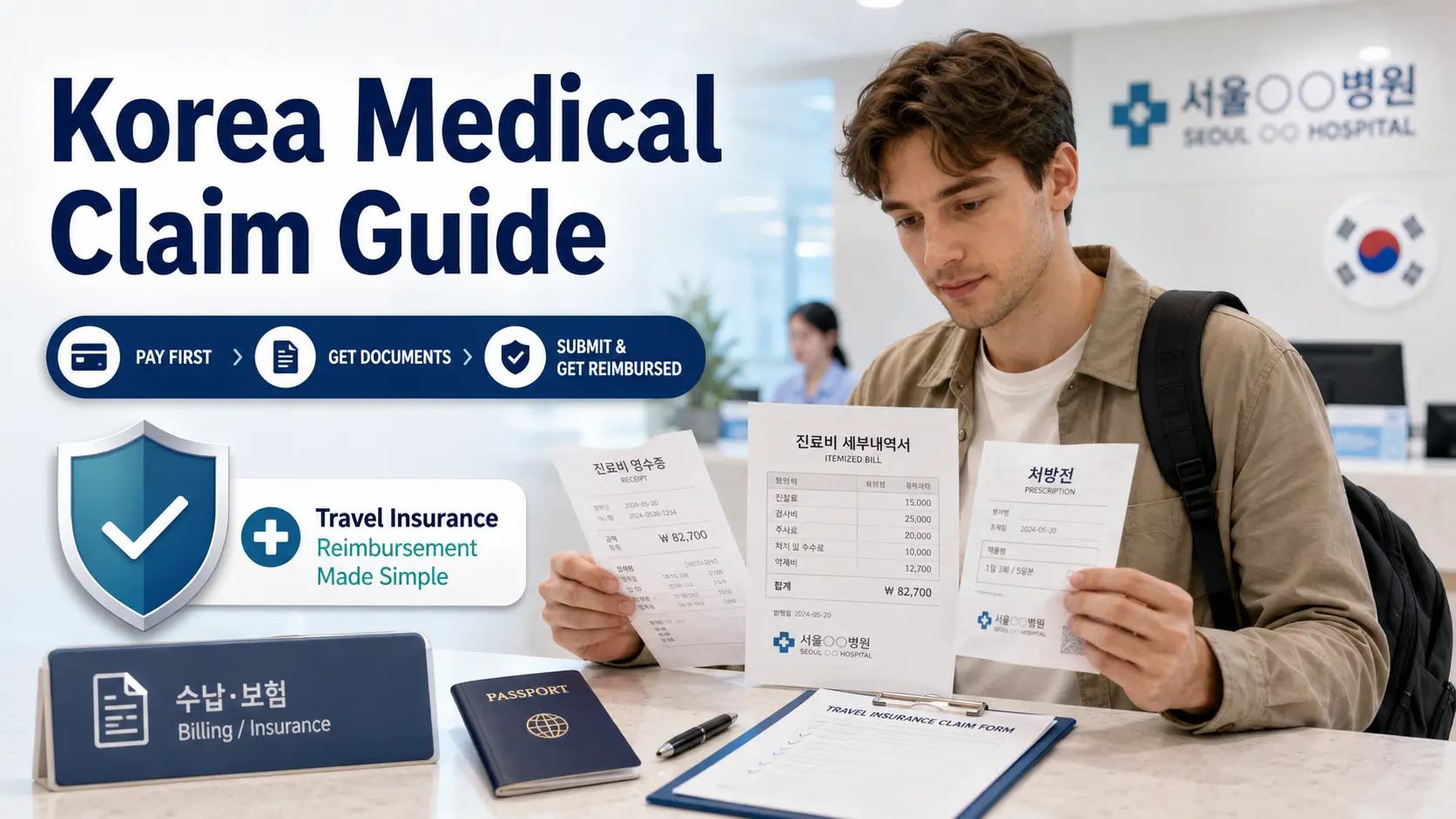
If you paid a Korean clinic, hospital, emergency room, or pharmacy yourself, the usual travel-insurance route is pay first, collect Korean medical documents, then claim reimbursement from your insurer. Korea does not decide whether your travel insurer must reimburse you. The Korean provider proves what happened and what you paid; your insurance policy determines whether that expense is covered.
The most expensive mistake is leaving Korea with only a credit-card slip or a one-line receipt. Before you leave the medical facility, try to secure an itemized bill, proof of payment, and enough clinical documentation to show why treatment was medically necessary. For larger claims, contact the insurer before discharge if you can.
Table of Contents
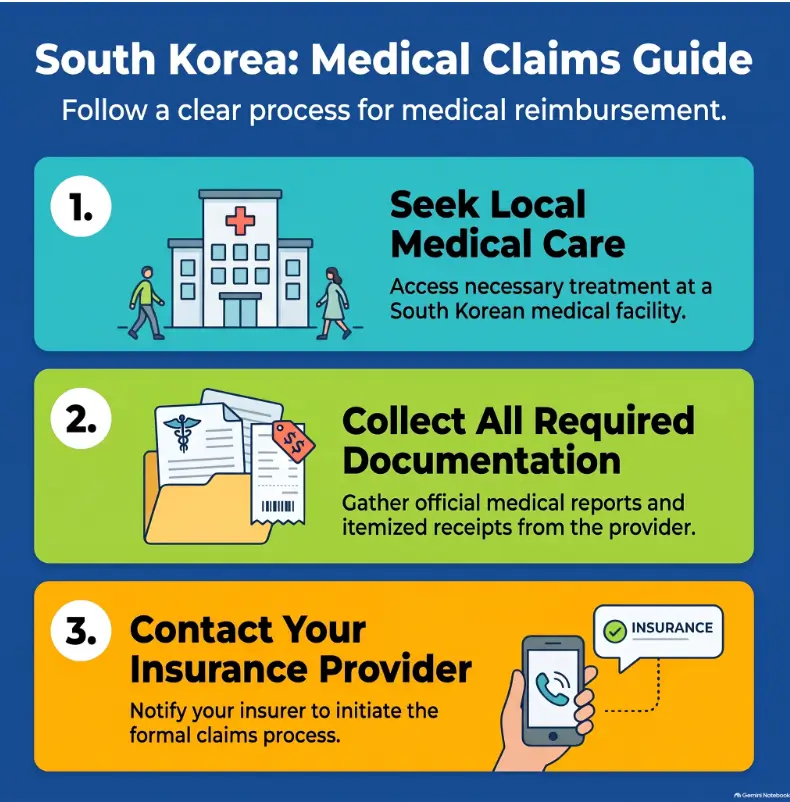
The Korean Hospital and Your Travel Insurer Have Different Jobs
A travel-insurance medical claim crosses two systems that should not be confused.
| Who | What They Control | What You Need From Them |
|---|---|---|
| Korean hospital or clinic | Diagnosis, treatment, billing and medical records | Receipt, itemized charges and relevant medical documentation |
| Korean pharmacy | Dispensed prescription medication and pharmacy payment | Prescription-related receipt and, where available, dispensing details |
| Your travel insurer | Coverage, exclusions, deductible, preauthorization and reimbursement | Exact claim-document requirements and submission instructions |
| Assistance company or direct-billing network | Payment coordination where contracted | Guarantee of payment or confirmation of direct billing |
This distinction matters because a Korean doctor can confirm that treatment was necessary without determining whether your policy covers it. Conversely, an insurer can request additional evidence but does not rewrite the Korean medical record.
Large Korean hospitals sometimes have direct-billing arrangements with international insurers or assistance companies. Seoul National University Hospital, for example, describes a process in which an insurer may issue a guarantee of payment; if that guarantee is not obtained, the patient may have to pay and seek reimbursement afterward. You can see its current process on the SNUH billing and insurance page.
First Determine Whether This Is Direct Billing or Reimbursement
The first decision is not which claim form to download. It is whether the medical provider expects you to pay.
- Direct billing: the hospital coordinates with an insurer or assistance company and may receive payment directly, subject to approval.
- Pay and claim: you pay the Korean provider and later request reimbursement from the insurer.
- Partial direct billing: the insurer pays an approved portion while you remain responsible for a deductible, coinsurance, excluded services or another patient share.
Do not assume that showing an insurance card creates direct billing. The hospital may require a formal guarantee of payment, sometimes called a GOP, from the insurer. If that authorization is unavailable when treatment is completed, self-payment may still be required.
For an emergency, treatment comes first. For a planned admission, expensive diagnostic work or non-emergency procedure, however, calling the insurer before treatment can prevent a documentation or preauthorization problem later.
The Documents Most Likely to Matter for a Korea Medical Claim
Your insurer’s checklist controls the claim, so there is no universal document package. Still, several Korean documents are especially useful because together they answer three questions: what happened, what treatment was provided, and what you actually paid.
| Document | Korean Term You May See | Why It Matters |
|---|---|---|
| Medical expense receipt | 진료비 계산서·영수증 | Shows the provider and amount charged or paid |
| Itemized medical bill | 진료비 세부내역서 | Shows individual tests, treatments, materials and other charges |
| Medical certificate | 진단서 | May document diagnosis, treatment and medically relevant dates |
| Admission/discharge confirmation | 입퇴원확인서 | Useful when hospitalization dates must be proved |
| Outpatient confirmation | 통원확인서 | May establish dates of outpatient treatment |
| Prescription | 처방전 | Connects prescribed medication to the treatment |
| Pharmacy receipt | 약제비 영수증 | Proves a separate pharmacy expense |
| Medical record copy | 진료기록 사본 | Useful when the insurer requests deeper clinical evidence |
Do not automatically buy every available certificate. Some medical documents carry separate issuance charges, and your insurer may not need all of them. Ask the insurer what satisfies its proof requirement before ordering an expensive bundle of records.
A particularly useful document is the itemized statement, or 진료비 세부내역서. It gives substantially more information than a simple payment receipt. Korea’s Health Insurance Review & Assessment Service also refers to the itemized statement when explaining how individual medical charges can be identified.
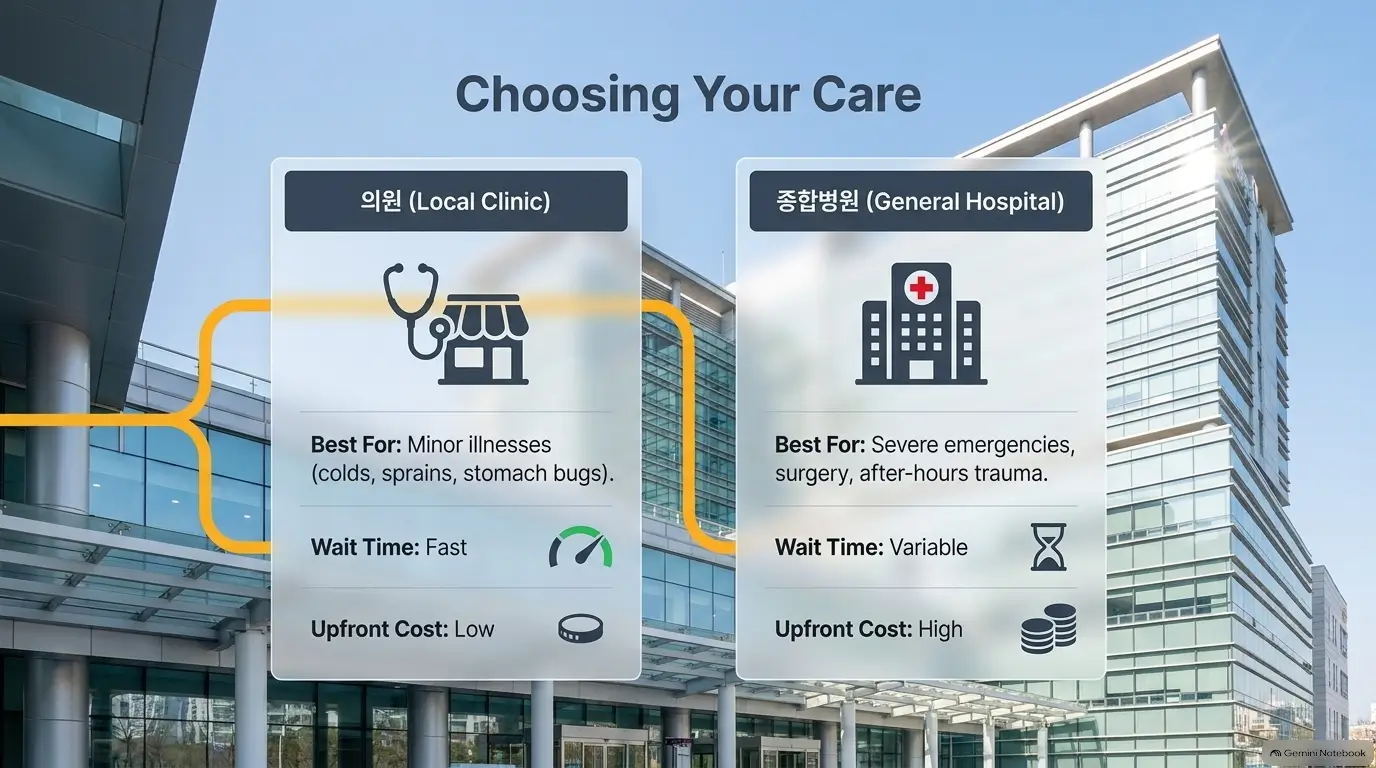
Ask for the Itemized Bill Before You Leave Korea
If you remember only one document, make it the combination of proof of payment plus an itemized bill. A card receipt proves that money changed hands. It may not explain what the money purchased.
At the billing counter, you can ask for:
진료비 영수증하고 진료비 세부내역서 주세요.
Please give me the medical expense receipt and the itemized medical bill.
If the claim is substantial, also ask whether your insurer requires a diagnosis or medical certificate before leaving the hospital. Obtaining an additional physician-issued certificate after you have returned overseas can be more cumbersome than obtaining it during the original episode of care.
Korean law gives patients an important foundation here. Under Article 21 of the Medical Service Act, a patient may request access to or copies of their own medical records, subject to the applicable rules. The current provision can be checked through the Korean National Law Information Center.
That does not mean every hospital must produce every document in English. Access to your medical information and provision of an English translation are different questions.
English Documents Are Helpful, but They Are Not Universal
Some Korean hospitals serving international patients issue English receipts or medical certificates. Others may provide Korean originals and offer English documentation only for certain forms, departments or patients.
The government-supported Medical Korea directory shows this variation directly: some listed international hospitals expressly advertise English receipts or medical certificates. You can check participating institutions through the Medical Korea accredited hospital directory.
Before paying for translation, ask your insurer one precise question: “Will you accept the original Korean document, or do you require an English translation?”
Some claims teams can process foreign-language records themselves. Others may request translation, particularly when the diagnosis, procedure or medical necessity cannot be understood from the billing codes alone. If you do need help converting Korean clinical material into usable English, see the guide to medical translation in Korea.
If translation is required, keep the Korean original. The translation should accompany the source document rather than replace it.
Your 10-Minute Claim File Before Leaving the Hospital
Open a folder on your phone before you leave the medical facility and build one claim file while the paperwork is still within reach.
- Photograph or scan the hospital receipt. Make sure the provider name, treatment date and amount are legible.
- Obtain the itemized statement. Do not rely solely on the credit-card authorization slip.
- Check whether the diagnosis is documented. If it is not clear from the paperwork, ask whether your insurer wants a medical certificate.
- Save every prescription. A pharmacy payment may be separate from the hospital bill.
- Collect pharmacy receipts. Keep each one connected to the relevant prescription where possible.
- Save insurer communications. Keep claim numbers, authorization messages, emails and call notes.
- Record the treatment timeline. Note when symptoms began, when you sought care and when you were discharged.
- Back everything up. Keep a second digital copy before handing any original document to another party.
For an injury rather than an illness, add evidence of the incident when relevant: an accident report, police document, photographs, tour-operator report or other record connecting the injury to the event. Only collect what actually relates to the claim.
Hospital Bills and Pharmacy Bills May Need to Be Claimed Separately
A foreign visitor can easily leave a Korean outpatient appointment with several pieces of paper and two separate payments. The medical facility may charge for consultation, tests or treatment, while a pharmacy later charges for prescribed medication.
Do not submit the hospital receipt and assume the medication is automatically visible to the insurer. If you paid a pharmacy separately, include the pharmacy evidence required under your policy.
The same principle applies to other separate expenses. An ambulance, imaging center or another medical provider may generate its own documentation. If emergency transport is part of the claim, the guide to ambulance costs in Korea explains why the type of ambulance service matters.
Hospitalization Requires More Than a Receipt
For a minor outpatient visit, the claim may be relatively simple. Hospitalization raises the stakes because insurers are more likely to examine medical necessity, admission dates, treatment details, exclusions and authorization requirements.
If you are admitted and medically able to do so, contact the insurer or its emergency-assistance provider as early as practical. Ask whether it can arrange direct billing or a guarantee of payment, and what documents it wants before discharge.
For readers unfamiliar with the Korean admission process itself, the separate guide to hospital admission in Korea covers the practical hospital side of the experience.
If a medical emergency occurs while you are in Korea, call 119. The Korea Tourism Organization maintains current emergency information and traveler assistance details on its Emergency Situations page.
What Actually Determines How Much You Get Reimbursed?
The amount you paid in Korea and the amount your insurer reimburses can be different. The decisive document is your policy, not the hospital invoice by itself.
- whether the illness or injury is covered;
- whether the condition is considered pre-existing under the policy;
- whether the treatment was medically necessary;
- whether emergency or non-emergency treatment is treated differently;
- whether prior authorization was required where reasonably possible;
- your deductible or excess;
- coinsurance or other cost-sharing;
- medical benefit limits or sublimits;
- excluded treatments, activities or circumstances;
- whether medication and follow-up care are eligible;
- how the insurer handles KRW currency conversion;
- coordination with another health-insurance plan, where applicable.
This is where a home-country assumption often causes trouble. A Korean hospital’s willingness to treat you does not mean your overseas insurer has approved the treatment. Nor does “travel insurance included with my credit card” necessarily mean every overseas medical charge is reimbursable.
Read the medical-expense section of the policy for the event that actually occurred. Search specifically for terms such as emergency treatment, outpatient care, hospitalization, pre-existing conditions, excess or deductible, notification, preauthorization, proof of loss and claims deadline.
Do Not Confuse Korean National Health Insurance With Travel Insurance
A visitor paying for treatment with travel insurance is dealing with a different arrangement from a foreign resident enrolled in Korea’s National Health Insurance Service.
If Korean National Health Insurance was applied to your bill, the Korean receipt may show a patient share rather than the provider’s entire underlying charge. Whether a separate travel or international policy reimburses any remaining eligible amount depends on that policy’s coordination rules.
Do not submit the amount you imagine the treatment would have cost without NHIS. Submit the actual documents and actual amounts, then let the insurer apply its contractual rules.
How to Submit the Claim Without Creating an Avoidable Delay
A clean claim lets the reviewer reconstruct the medical event without guessing. Arrange the documents in chronological order rather than uploading a loose stack of receipts.
- Complete the insurer’s claim form or online claim.
- Enter the Korean provider’s name exactly as shown on the medical document where practical.
- Report the amounts in KRW when the form permits the original transaction currency.
- Attach the medical receipt and itemized bill.
- Add diagnosis or clinical documentation required by the policy.
- Attach prescription and pharmacy evidence for medication claims.
- Add relevant accident evidence if the claim arose from an injury.
- Include authorization or assistance-company correspondence where applicable.
- Keep a complete copy of everything submitted.
- Record the submission date and claim reference number.
Do not alter a Korean medical document to make it easier to understand. If explanation is necessary, attach a separate translation or note while preserving the original.
The Currency Conversion on Your Reimbursement May Not Match Your Card Statement
A Korean hospital normally bills in KRW. Your credit-card issuer may convert that transaction into USD, GBP, CAD, AUD or another currency, while your insurer may apply a different contractual conversion method when settling the claim.
That can create a small difference between the foreign-currency amount visible on your card statement and the reimbursement calculation. Do not silently replace the KRW amount on the Korean receipt with your own exchange-rate calculation unless the insurer specifically tells you to do so.
If the difference is material, ask the insurer to identify the exchange-rate date and methodology used under the policy or claims procedure.
If the Insurer Asks for More Korean Medical Evidence
An additional-document request is not necessarily a denial. It often means the reviewer can see that money was spent but cannot yet verify an eligibility question.
Ask exactly what is missing. “More medical records” is too vague. Determine whether the insurer needs:
- a diagnosis;
- doctor’s medical certificate;
- full itemized charges;
- admission and discharge dates;
- clinical notes;
- test results;
- prescription information;
- proof that you paid;
- an English translation;
- evidence explaining how an accident occurred.
If you are still in Korea, request the specific missing item rather than purchasing every document the records department can produce. If you have already returned home, ask the hospital’s international center or medical-records office what identity verification and authorization it requires for remote issuance.
If Your Korea Medical Claim Is Denied, Find the Exact Reason First
A denial should be separated into one of two broad problems: the insurer says the event is not covered, or the insurer says the evidence is insufficient. Those are different fights.
| Denial Issue | What to Check Next |
|---|---|
| Missing itemized bill | Request the 진료비 세부내역서 from the provider |
| No diagnosis evidence | Ask what specific clinical document the insurer accepts |
| Preauthorization issue | Check the policy language and whether the circumstances were an emergency |
| Pre-existing-condition exclusion | Compare the denial explanation with the policy definition and relevant medical history |
| Expense deemed non-covered | Ask for the policy clause applied to that exact charge |
| Currency discrepancy | Request the insurer’s conversion calculation |
Do not begin an appeal with a long narrative if the actual problem is one missing Korean document. Conversely, another receipt will not solve a denial based on a policy exclusion.
If reimbursement has already been refused, use the separate Korea travel insurance claim denied guide to work through the denial reason, evidence gap and appeal path.
When Paying for Professional Help Is Actually Justified
Most straightforward outpatient reimbursement claims should not require a lawyer or paid claims professional. Start with the hospital documents, your policy and the insurer’s claims department.
DIY may be enough
Handle the claim yourself when the amount is manageable, the medical event is uncomplicated, the insurer has provided a clear checklist and there is no coverage dispute.
One paid service may solve a narrow problem
Translation help may be rational when the insurer specifically requires English medical evidence and the Korean records are clinically complex. A single professional consultation may also make sense where policy wording is unclear but you can manage the claim afterward.
More substantial help may be justified
Consider more specialized assistance when a large claim is denied, an insurer disputes medical necessity, several jurisdictions or insurers are involved, a serious injury creates additional legal claims, or a contractual deadline threatens your ability to recover a meaningful amount.
The spending test is simple: identify what the professional can resolve that you cannot first verify from the policy, insurer and Korean provider for free.

Korea Travel Insurance Medical Claim FAQ
Can I claim after I have already left South Korea?
Often, yes, if your policy still permits submission and you can obtain the required evidence. The practical difficulty is retrieving missing Korean medical documents remotely. Check your policy’s claim-notification and submission deadlines immediately rather than assuming you can file indefinitely.
What if my Korean hospital documents are only in Hangul?
Ask the insurer whether the originals are acceptable before paying for translation. Some Korean international medical centers can issue certain documents in English, but English-document availability is provider-specific. If translation is required, retain both the Korean original and the translation.
Should I send the insurer my original Korean medical documents?
Follow the insurer’s instructions, but preserve complete digital copies before surrendering originals. Many modern claim systems accept electronic uploads, while particular high-value or disputed claims may require additional verification.
What if I used an emergency room without calling the insurer first?
Submit the claim and explain the circumstances accurately. Do not assume an emergency automatically eliminates every policy requirement, but do not assume lack of advance contact automatically defeats the claim either. The policy language, urgency of the medical event and insurer’s rules matter.
Can I claim follow-up treatment after returning home?
Possibly, but this is a separate policy question. Some policies distinguish emergency treatment during the trip from continuing treatment after the trip ends. Check the policy before assuming that a covered Korean emergency makes later home-country care automatically reimbursable.
Before You Leave the Hospital
Spend ten minutes checking the paperwork before you walk away from the billing counter. Put the medical receipt, itemized statement, diagnosis evidence if required, prescriptions and pharmacy receipts into one digital folder and photograph every page.
Then send one short question to your insurer: “Is anything else required for reimbursement of this Korean medical treatment?”
That small check closes the gap between the Korean medical system and the insurance contract that will actually decide whether your money comes back.
Last reviewed: 2026-10