
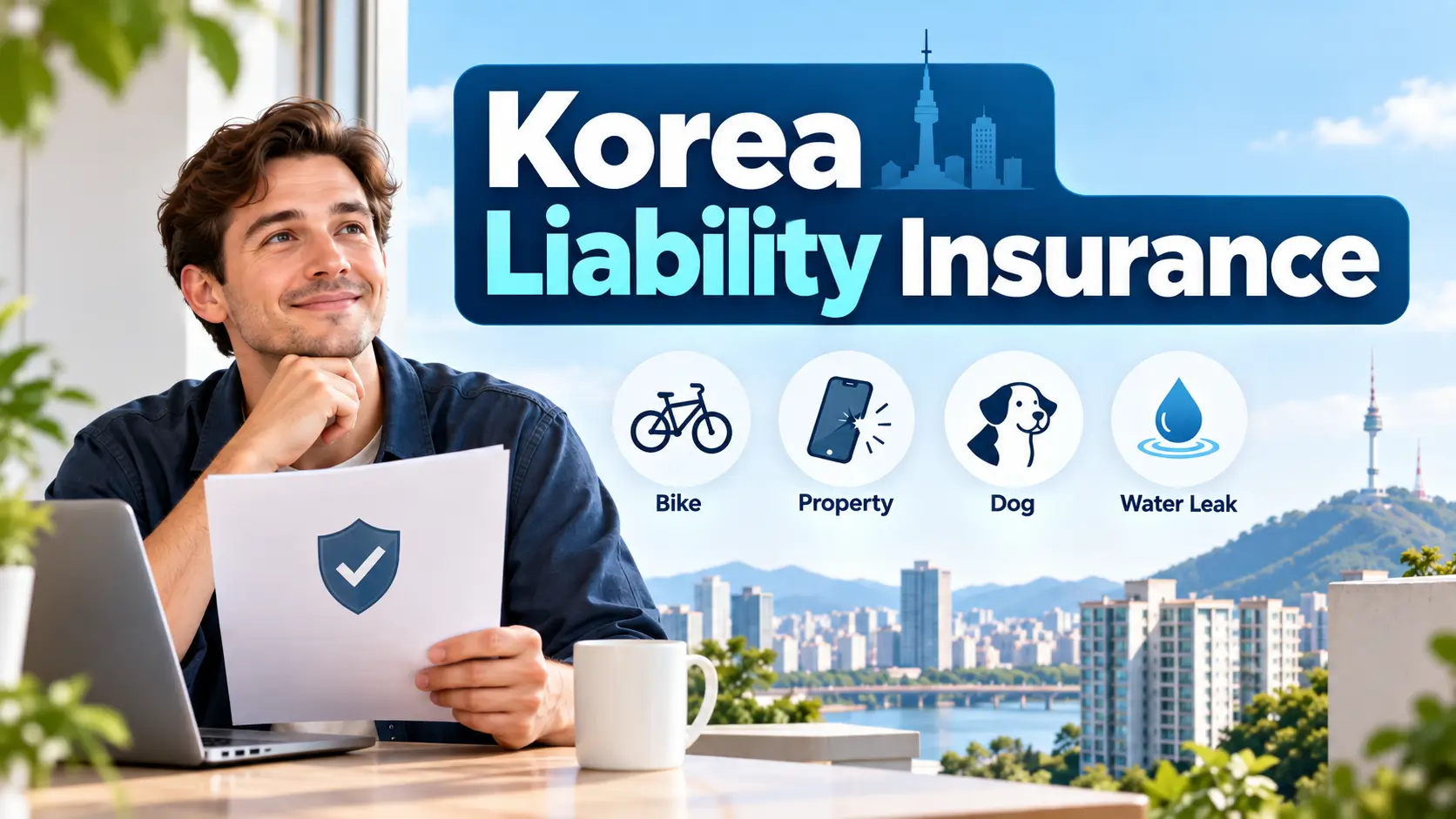
If you live in South Korea and are looking for the equivalent of personal liability insurance, the Korean term to know is ilsangsaenghwal baesang chaegim boheom (일상생활배상책임보험), usually translated as daily-life liability insurance.
It can help when an accidental everyday event leaves you legally responsible for another person’s injury or damaged property. Think of a bicycle collision, your child breaking someone else’s property, a dog injuring another person, or water from a home causing damage downstairs.
There is one important catch: in Korea this coverage is commonly sold as a special rider, or teukyak (특약), attached to another non-life insurance policy rather than as the familiar stand-alone personal-liability policy an American, British, Canadian, or Australian resident might expect.
The most important rule: damage alone does not trigger the insurance. You normally need both a covered accident and a legal obligation to compensate the other person.
Foreign nationality adds another layer. The coverage concept is the same, but whether you can purchase a particular product, complete the application online, or include family members can depend on the insurer, sales channel, identification method, residence status, and the wording of the individual policy.
Table of Contents
The Korean Insurance Product You Are Actually Looking For
When speaking to an insurer, ask specifically about 일상생활배상책임 or 가족일상생활배상책임, meaning family daily-life liability coverage.
The General Insurance Association of Korea’s insurance education center describes liability insurance as coverage for legal liability arising when a person causes bodily injury or property damage to another person. Its examples include accidentally injuring someone while riding a bicycle or spilling a hot drink on another person.
Korean policies have historically been offered in variants based on who is insured, including individual, child, and family forms. The family version is particularly important for expat households, because an accident involving a spouse or child may be far more relevant than an accident involving only the named policyholder.
Do not assume that the word “family” automatically covers everyone who lives with you. Definitions vary by policy. Before paying, ask the insurer to show you the exact Korean clause defining 피보험자, the insured persons.
The Decision Hinge: Are You Legally Responsible for the Damage?
Personal liability insurance is not simply a repair-payment card. The insurer first looks at whether you have a legal liability to the injured person or property owner and whether that liability falls within the policy.
Under Korea’s Civil Act, different liability rules can become relevant depending on what happened. Article 750 contains the general tort rule for damage caused through an unlawful intentional or negligent act. Other provisions address responsibility for persons requiring supervision, defective structures, and animals.
This distinction becomes surprisingly important in everyday disputes. A damaged ceiling does not automatically mean the tenant upstairs owes the money. A child causing damage does not always produce the same legal analysis as an adult doing it. A dog incident may raise different questions from a collision involving a bicycle.
| What happened? | The key question | What to check in the policy |
|---|---|---|
| You accidentally break another person’s phone | Are you legally liable for the accidental property damage? | Third-party property damage and deductible |
| Your child damages property | Does legal responsibility fall on the child, parent, or another supervisor? | Definition of insured family members |
| Your dog injures a person or another pet | What liability does the keeper bear under the circumstances? | Pet-related liability and exclusions |
| Water damages the apartment below | Was the cause your responsibility, the landlord’s responsibility, or a building issue? | Named dwelling, leakage coverage, deductible |
| You hit someone with a pedal bicycle | Did negligence create legal liability? | Non-motorized bicycle coverage |
| You cause an accident with a car or powered mobility device | Does another insurance regime apply? | Vehicle and powered-device exclusions |
| You damage something while doing your job | Did the accident arise from professional or occupational activity? | Work-related exclusion |
This is why one of the best questions to ask an insurer is not simply, “Is this kind of accident covered?” Ask instead: “If Korean law makes me responsible for this accident, which clause covers or excludes that liability?”

What Korea Personal Liability Insurance Can Commonly Cover
Subject to the individual contract, Korean daily-life liability insurance can cover a surprisingly broad collection of ordinary accidents.
- Accidentally damaging another person’s belongings.
- Accidentally causing bodily injury to another person.
- Liability arising from a child covered under the applicable policy wording.
- Certain injuries or property damage caused by a household dog.
- Accidents involving an ordinary bicycle powered solely by the rider.
- Certain third-party water damage arising from a dwelling listed or otherwise covered under the policy.
The phrase third-party damage matters. Personal liability coverage is designed principally to pay for the loss you are legally required to compensate someone else for. It is not normally insurance for your own damaged phone, your own wall, or your own injury.
Coverage also does not mean that every amount demanded by the other person will automatically be paid. Liability, causation, depreciation, repair documentation, the injured person’s own contribution to the accident, policy limits, and deductibles can all affect the final claim.
What It Usually Does Not Replace
The costly mistake is assuming that one inexpensive liability rider is a universal shield. It is not.
- Your own loss: damage to property belonging to you is generally a different insurance problem.
- Loss within an excluded family relationship: policies may exclude liability for injury or damage involving certain relatives or members of the same household.
- Intentional acts: deliberate damage should not be treated like an accidental daily-life event.
- Work or professional activity: ordinary personal liability coverage is generally not designed for accidents arising directly from your occupation or business.
- Motor vehicle liability: damage arising from your car belongs primarily in the automobile-insurance system.
- Powered mobility devices: Korean daily-life liability wording can exclude accidents arising from powered vehicles such as electric scooters and certain electric bicycles.
- Extra liability created only by contract: agreeing privately to pay more than the liability that would otherwise exist can create coverage problems.
If you drive in Korea, treat automobile liability as a separate decision. The site’s guide to car insurance in Korea for foreigners explains that system in its proper context.
A particularly useful Korean distinction is between a normal pedal bicycle and powered mobility. Financial supervisory guidance has treated accidents involving human-powered bicycles differently from accidents involving powered devices. Never assume that “bike insurance” logic follows the object rather than its propulsion system.
Renters, Landlords, and Water Leaks: The Expensive Korean Trap
For many foreign residents, the most financially significant use of daily-life liability insurance is not a broken phone. It is water running through an apartment ceiling.
Suppose water from the unit where you live damages wallpaper, flooring, furniture, or electrical work in the apartment below. Before asking what the insurer pays, determine who is legally responsible for the cause of the leak.
If the problem came from an embedded building pipe that falls within the owner’s responsibility, a tenant may not have the legal liability necessary to trigger the tenant’s personal liability rider. If the cause instead came from something under the tenant’s control or negligent use, the analysis may be different.
That distinction is easy to miss if you bring a home-country renters-insurance model to Korea. The question is not merely, “The leak came from my apartment, so is it my claim?” The better sequence is:
- Identify the physical source of the leak.
- Determine whether responsibility belongs to the tenant, landlord, building management, contractor, or another party.
- Check whether the relevant person is an insured under the policy.
- Check whether that dwelling is the dwelling contemplated by the policy wording and insurance certificate.
- Only then calculate the covered third-party loss and deductible.
There is also a contract-date issue. Korean daily-life liability wording changed in April 2020 in relation to certain homes owned by an insured person but occupied by someone else with permission, such as a rented-out property. Older and newer contracts can therefore produce different results.
Do not reduce this to a simple rule that “post-2020 policies cover rental properties.” The actual result can still depend on the policy wording, the dwelling shown on the insurance certificate, the property’s use, the cause of the damage, and who legally bears responsibility.
For a leak claim, preserve photographs, videos, building-management reports, plumber findings, repair estimates, invoices, messages with the landlord or downstairs resident, and any document identifying the source of the water. The plumbing diagnosis may matter more than ten pages of argument about who “feels responsible.”
Can Foreigners Buy Personal Liability Insurance in Korea?
There is no useful one-word answer because the real gate is the insurer and the product channel.
Foreign residents participate in Korea’s insurance market, and insurers now provide standardized information for non-Korean insurance consumers. At the same time, a particular direct-to-consumer product may restrict foreign applicants or fail because its digital identity process cannot handle the applicant’s status.
Therefore, an online rejection should not automatically be interpreted as “foreigners cannot get personal liability insurance in Korea.” It may mean that the specific online product or authentication channel does not accept you.
If a website stops the application, contact the insurer and ask whether the same coverage or another policy containing a family daily-life liability rider can be purchased through a staffed channel.
Expect the insurer to ask for identification and information needed for customer verification and underwriting. What is accepted can differ by company. If you are still getting used to the Korean residence-card system, the Korea residence card guide for foreign residents explains the broader identification context.
Ask These Seven Questions Before You Buy
Do not begin with the premium. Begin with the wording. A cheap rider that excludes the person, property, or accident you actually care about is only inexpensive on paper.
- What is the exact Korean name of the rider? Ask the insurer to show it on the proposal or certificate.
- Who counts as an insured person? Confirm yourself, spouse, children, and any other household members individually.
- Which dwelling is covered? This matters especially if you move, own more than one property, or rent out a home.
- What is the liability limit per accident? Do not assume different insurers use the same amount.
- What deductible applies? Ask separately about ordinary property damage and water-leak claims.
- Which vehicles and mobility devices are excluded? Mention bicycles, electric bicycles, scooters, and any device you actually use.
- What must be reported after a move or ownership change? Get the answer before your address changes rather than during a claim.
Ask for the policy wording and insurance certificate, not merely a sales summary. A summary tells you what the product is supposed to do. The wording tells you whether your accident fits through the door.
Check Whether You Already Have the Coverage Before Buying Another Rider
This is one of the easiest places to waste money.
Daily-life liability insurance generally works on an indemnity basis. If the actual covered liability is a certain amount, holding several similar policies does not normally let you collect that same loss several times and turn the accident into a profit. Insurers can share the covered loss according to the applicable contracts.
Start by checking existing Korean insurance contracts through the industry-supported Find My Insurance service. Because a contract list does not necessarily tell you every detail of every rider, use it as a map rather than the final answer.
Then contact each relevant insurer and ask:
- Do I currently have 일상생활배상책임 or 가족일상생활배상책임 coverage?
- What is the current insured-person definition?
- What home address or property is registered?
- What is my current limit?
- What deductible applies to ordinary property damage?
- What deductible applies to water leakage?
- Has any move or ownership change created a notification issue?
Only after answering those questions does it make sense to consider another policy.
How to Compare Two Korean Liability Riders
Two policies can carry nearly identical English descriptions while behaving differently at claim time. Compare the contractual mechanics rather than the marketing name.
| Check | Why it matters | Question to ask |
|---|---|---|
| Insured persons | A spouse or child may cause the accident | “Please show me exactly who is 피보험자.” |
| Covered dwelling | Leaks and property claims may depend on the listed home | “Which address is currently registered?” |
| Liability limit | Serious injury or property damage can exceed a small limit | “What is the maximum for one covered accident?” |
| Deductible | A small claim can be heavily reduced | “How much do I pay first for this type of accident?” |
| Water-leak wording | Housing claims are particularly fact-sensitive | “How does the policy treat leakage from my dwelling?” |
| Mobility exclusions | Powered devices may fall outside ordinary coverage | “Does my electric bicycle or scooter count as an excluded vehicle?” |
| Occupational exclusion | Freelancers may blur personal and work activity | “Would this still be covered if I were performing paid work?” |
| Move notification | An outdated dwelling record can create a dispute | “What must I report when I move?” |
For an expat, add one more comparison point: Can I actually administer the policy? English-language assistance, usable authentication methods, claim channels, and the ability to update an address without wrestling with a Korean-only digital process can be worth more than a tiny premium difference.
What to Do Immediately After You Damage Someone Else’s Property
The first hour after an accident is for evidence and damage control, not improvising a legal settlement in KakaoTalk.
- Prevent additional damage. Shut off water, move a dangerous object, or take another reasonable safety measure if necessary.
- Photograph the scene before repair changes it. Capture the damaged property, surrounding area, and possible cause.
- Exchange contact information. Record the injured or affected person’s details and any witnesses.
- Preserve objective records. Keep repair estimates, medical documents, receipts, building reports, CCTV availability, and relevant messages.
- Notify the insurer promptly. Give facts rather than guessing about fault.
- Ask before signing a final settlement. A private agreement may affect what remains disputed or recoverable.
- Keep proof of any urgent payment. If immediate spending was necessary to prevent greater loss, document why it could not wait.
Insurers may need to investigate legal responsibility, causation, the extent of damage, depreciation, or competing fault. The KB Insurance claim information page, for example, provides claim procedures and dedicated guidance for non-Korean insurance consumers. Use your own insurer’s current procedure for the actual claim.
Personal Liability Insurance Is Not the Same as Travel Liability Insurance
An expat who already bought travel insurance may reasonably wonder whether another liability rider is redundant. Usually, these products solve different time-and-place problems.
Travel insurance may contain liability protection tied to a covered trip and its own territorial, duration, activity, and deductible rules. Korean daily-life liability coverage is designed around ordinary life under the applicable domestic policy wording.
Do not assume either automatically replaces the other. If you are comparing protection for visitors, short stays, and resident life, see the separate guide to travel insurance in Korea.
When Professional Help Is Actually Worth Paying For
DIY May Be Enough
A straightforward accidental property-damage claim may not justify paying a lawyer or independent claims professional. If liability is clear, the loss is modest, evidence is available, and the insurer is handling the claim normally, start with the insurer.
One Professional Consultation May Be Enough
A targeted consultation becomes more useful when the dispute is not really about insurance but about who is legally responsible. Apartment leakage involving an owner, tenant, building defect, and contractor is a good example.
One consultation can sometimes answer the expensive question, “Whose liability is this?” without turning the entire matter into full representation.
Full Help May Be Rational
Consider more substantial professional assistance when there is serious bodily injury, substantial property damage, conflicting technical evidence, litigation, a large uninsured portion, a disputed policy exclusion, or several potentially responsible parties.
Do not pay a professional merely because the Korean terminology is unfamiliar. First identify the precise unresolved problem. Translation confusion is cheaper to solve than a real liability dispute.
FAQ About Korea Personal Liability Insurance for Expats
Can a tourist buy Korean daily-life liability insurance?
Do not assume that a product designed around Korean resident insurance contracts will accept a short-term visitor. Product eligibility and identity requirements are insurer-specific. A visitor should compare the liability section of appropriate travel insurance rather than assuming a resident-oriented Korean rider is available.
Does a family liability rider automatically cover my foreign spouse?
Not merely because the person is your spouse. What matters is whether the spouse falls within the policy’s definition of an insured person and whether any applicable underwriting or contractual requirements were satisfied. Ask for written confirmation from the insurer if the family member is central to your reason for buying the rider.
Will the insurance pay if my dog damages property at a boarding facility?
Possibly, but do not assume every pet-related loss is ordinary household liability. Who had custody of the animal, what caused the incident, the facility contract, legal responsibility, and the policy wording can all matter. Commercial pet-care liability is also a different insurance problem from the owner’s personal liability.
What happens if I move apartments and forget to update the insurer?
A move can become particularly important when the policy ties housing-related liability to a dwelling identified in the insurance certificate. Notify the insurer when you move and ask for confirmation that the relevant address information has been updated rather than waiting for a leak claim to expose the mismatch.
Should I buy two liability riders to double my payout?
Not for that reason. This is generally indemnity coverage, so multiple contracts do not normally allow total payment above the covered loss you actually bear. Additional coverage may still matter for limits or differences in scope, but duplicate insurance should be evaluated deliberately rather than accumulated accidentally.
Your 10-Minute Liability Check Tonight
Before asking an insurer for another quote, open the insurance documents you already have and search for these Korean words:
- 일상생활배상책임
- 가족일상생활배상책임
- 피보험자
- 자기부담금
- 보험가입금액
- 주택
If you find the rider, write down four things on one line: who is insured, which dwelling is recorded, the liability limit, and the deductible.
If any one of those four answers is unclear, call the insurer and ask for the current answer from your actual contract. That ten-minute check is more useful than collecting five new quotes for coverage you may already own.
Last reviewed: 2026-10