*This article was updated with the latest information on December 22, 2025.

In a quiet museum gallery, one hairpin can read like a full sentence—rank, duty, grief, belonging—compressed into lacquer and silk.
Decoding Korean Hair History
That’s why Korean hair history feels so confusing on first contact: modern eyes see “pretty,” but the past often meant “public.” You pause a K-drama bun, squint at a topknot, notice a hat or ornament…and you’re still guessing.
Keep guessing, and you’ll keep misreading people—turning ritual into “fashion,” court ideals into everyday life, and real history into accidental cosplay.
This post helps you decode Korean hairstyles faster and more honestly: what a style likely signaled (age, marriage, class, moral pressure) and what you can’t claim from a single image. You’ll learn the few forces that actually changed hair over centuries—power, philosophy, and tools—without memorizing dynasties.
No vibes-only takes. A simple context-first method:
- Slow down—this gets good. Start with what the image is trying to prove.
- Then read the “vocabulary”: form, ornaments, headgear.
- And only then decide how confident you can be.
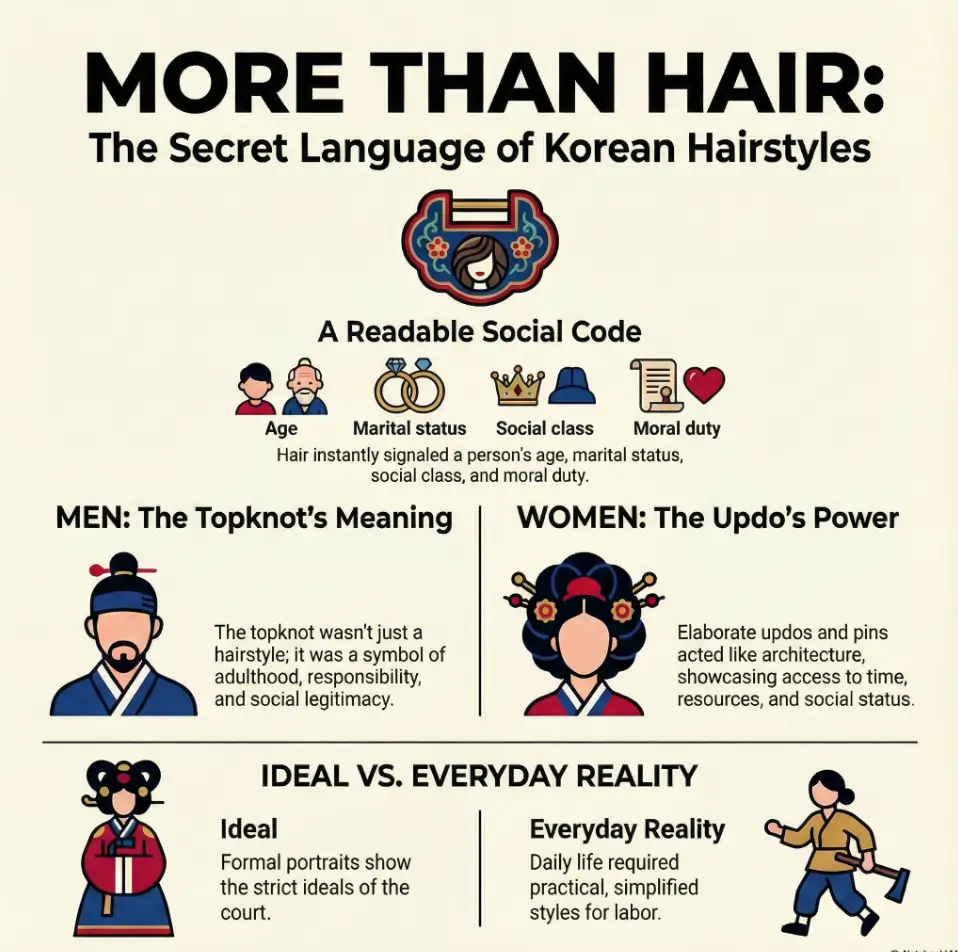
Korean hair history isn’t just “old styles.” For thousands of years, hair signaled age, marital status, class, and moral expectations—sometimes more loudly than clothing. Across eras, what changed hairstyles most wasn’t taste; it was power, philosophy, and tools (courts, Confucian ideals, hats, pins, trade). The “shocking truth” is simple: hair often worked like a social contract, not a free-choice accessory.
Table of Contents
1) Who this is for / not for
For you if you’re trying to connect K-beauty to deeper history (without a textbook)
If you like K-beauty, K-drama, museum exhibits, or family-history rabbit holes, this will feel like someone finally handed you the legend for the map. We’ll talk about what hair meant—not just what it looked like.
For you if you want symbolism: status, marriage, mourning, identity
Hair is one of the quickest visual signals humans read. In historical Korea, it could quietly say: “adult,” “married,” “in mourning,” “court-connected,” or “trying to look like you are.” That last one? Surprisingly common.
Not for you if you only want modern salon trends (this is roots, not tutorials)
This isn’t a “how to recreate an updo” post. It’s the story behind the styles—so you can spot meaning without turning history into a costume rack.
- Hair communicated identity faster than words.
- Meaning changed by context: court vs street, ritual vs daily life.
- We’ll keep each section stand-alone so you can jump around.
Apply in 60 seconds: The next time you see a historical hairstyle, ask: “What would this be trying to tell a stranger?”
2) Hair-as-identity: the hidden “rules” behind the beauty
Why hair mattered more than we assume (family, virtue, belonging)
Modern hair is often “my style.” In many premodern societies, hair was closer to “our rules.” In Korea, philosophical ideas (especially Confucian moral frameworks) treated the body as something inherited and respected—hair included. That doesn’t mean everyone obeyed perfectly. It means the ideal was loud, and the exceptions were interesting.
Here’s the big mental shift: hair wasn’t just aesthetics. It was a visible promise—about propriety, adulthood, even gratitude to family. And once you see hair that way, the “shocking truth” stops being shocking and starts being… obvious.
The social signals: age, marital status, rank, and ritual
- Age: styles could mark childhood vs adulthood.
- Marital status: hair arrangements and accessories could change after marriage.
- Rank & occupation: court norms and headgear could signal position.
- Ritual moments: mourning, ceremonies, and rites could require restraint or specific forms.
Curiosity gap: the one “hair rule” that quietly controlled everyday life
It’s not the bun. It’s not the pin. The quiet rule was this: hair carried moral weight. If the community believed your grooming reflected your virtue, hair became a social surface—something others felt entitled to comment on, regulate, or shame. That’s the part modern readers don’t expect.
- Yes/No: Can you tell whether you’re looking at a ritual scene or daily life?
- Yes/No: Do you separate “court ideal” from “common reality”?
- Yes/No: Do you look for accessories/headgear as part of the hairstyle?
Apply in 60 seconds: If you answered “no” to any item, keep reading—but start treating hats and pins as part of the message.
Pick a context. You’ll get a one-line reading prompt (not a verdict—just a smarter next question).
Neutral action: use the prompt to guide what you research next (museum captions beat social captions).
3) Before the dynasties: what 4,000 years really implies
What historians can and can’t claim (artifacts, murals, texts)
“4,000 years” is a great hook—and also a gentle trap. Deep timelines often stitch together different kinds of evidence: archaeological finds, artistic depictions, and later written descriptions. Each has limits. Art can be symbolic. Text can be prescriptive (“people should…”) instead of descriptive (“people did…”). Artifacts can survive unevenly.
So when you hear sweeping claims like “everyone did X,” treat them like a suspiciously perfect hairstyle on a windy day. The smarter move: look for patterns that repeat across evidence types—hair tied up for work, formal grooming for elites, accessories as visible rank markers, and changing norms when power structures shift.
How early grooming becomes cultural code (not just hygiene)
Hair care starts as survival and comfort. Then it becomes identity. Once a community agrees that a certain grooming standard equals maturity, respectability, or belonging, hair becomes an easy place to enforce norms. That enforcement can be subtle (approval) or harsh (stigma). Either way, it leaves tracks in art and commentary.
Let’s be honest… most timelines start too late (and miss the setup)
Many articles start at a dynasty label and skip the “why.” But the “why” is where the meaning lives: hair became readable because it sat at the intersection of body, family, and social order. Once that triangle exists, styles don’t just change—they negotiate.
Show me the nerdy details
When you’re evaluating claims, separate (1) material evidence (tools, ornaments), (2) representational evidence (murals, paintings), and (3) prescriptive evidence (moral or court texts). If all three point in the same direction, confidence rises. If only one category supports a claim, treat it as “possible,” not “proven.”
Short Story: You’re standing in a quiet gallery, the kind where footsteps sound like apologies. A portrait stares back—hair arranged with such patience it feels like time itself was combed into order. You lean in, not for beauty, but for meaning. The pin isn’t just decoration; it’s a sentence. The hat isn’t just a hat; it’s a title. You realize the painting isn’t asking, “Do you like this style?” It’s asking, “Do you understand who this person must appear to be?” And suddenly, the hairstyle stops being aesthetic. It becomes biography—compressed into silk, lacquer, and a few disciplined strands.
4) Three forces that changed everything (and kept changing it)
Politics: courts, uniforms, and what “proper” looked like
When power consolidates, appearance becomes policy. Courts tend to standardize. Officials tend to signal. And hairstyle—because it sits right on the face—becomes a fast way to communicate order. This doesn’t mean the state controlled every strand. It means the ideal image (especially for elites) could become a template people copied, adapted, resisted, or quietly ignored.
- Courts create “proper.”
- “Proper” spreads through institutions (schools, offices, ceremonies).
- People mimic upward—then simplify for daily life.
Religion & philosophy: Confucian ethics vs lived reality
Confucian moral frameworks emphasized duty, social harmony, and respect for what one receives from family. Hair fits neatly into that worldview: it’s visible, inheritable, and easy to judge. But real life is sweaty, busy, and often inconvenient. Which is why the tension between “virtue” and “practicality” shows up again and again.
Tech & trade: combs, pins, textiles, dyes, imported aesthetics
Tools change styles. A stronger pin or improved comb isn’t dramatic—until it enables a more structured updo or a more stable arrangement. Trade also brings new materials and new tastes. Even when a culture values tradition, new options sneak in through the hands: artisans, merchants, and the people who want to look like they’re doing well.
Curiosity gap: when the “ideal” style wasn’t actually what people wore
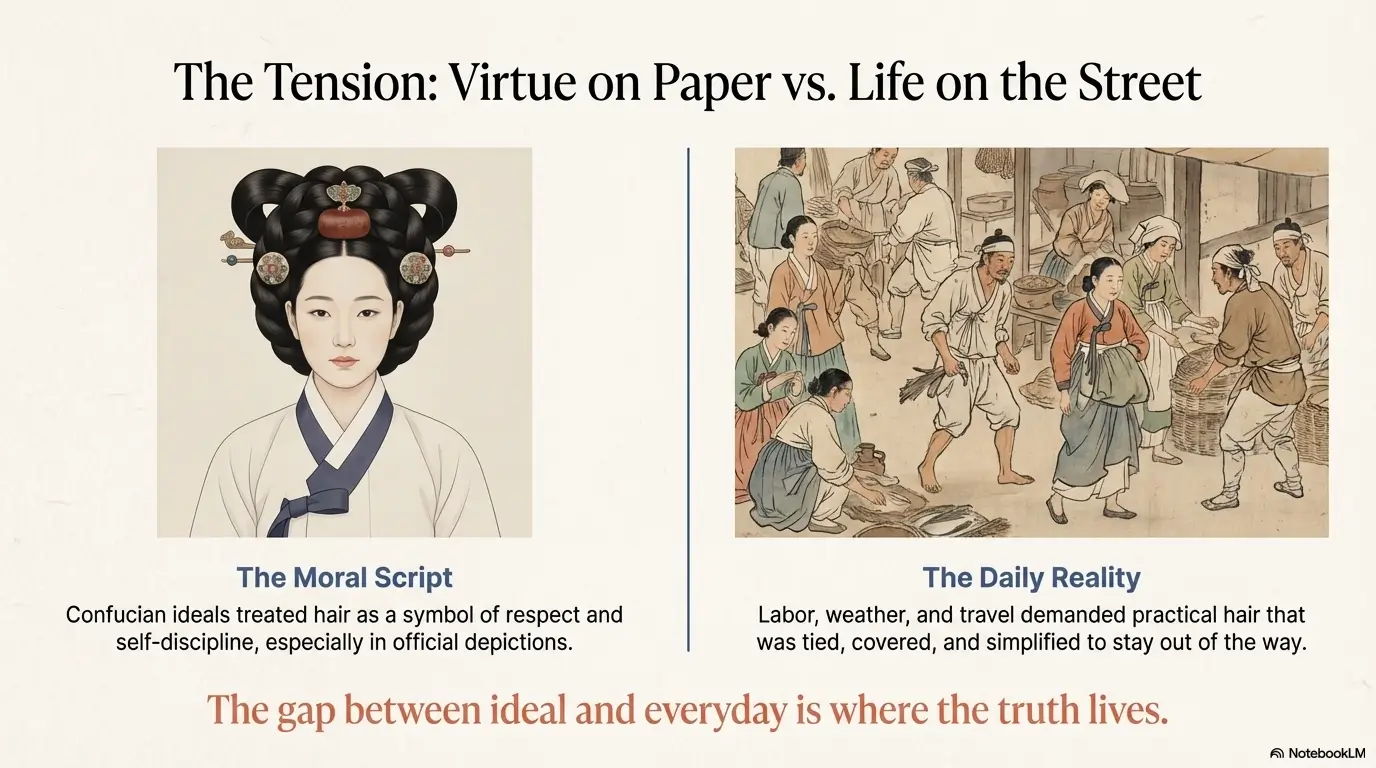
The most revealing question isn’t “What did people wear?” but “Who is being shown?” Court portraits aren’t street photography. If you want real life, look for scenes that depict work, travel, markets—or for practical compromises (hair covered, tied, simplified). The gap between ideal and everyday is where the truth lives.
- When A (history): You’re using museum captions, academic exhibits, or primary-like descriptions to understand meaning.
- When B (styling): You’re using modern media screenshots as “proof” without checking the era or context.
- Time trade-off: A takes 10 minutes; B takes 10 seconds—and costs accuracy.
Apply in 60 seconds: If your reference is a drama still, add one museum or institutional caption before you form a conclusion.
5) Women’s hair: power, protection, and public meaning
Updos, pins, and the architecture of status
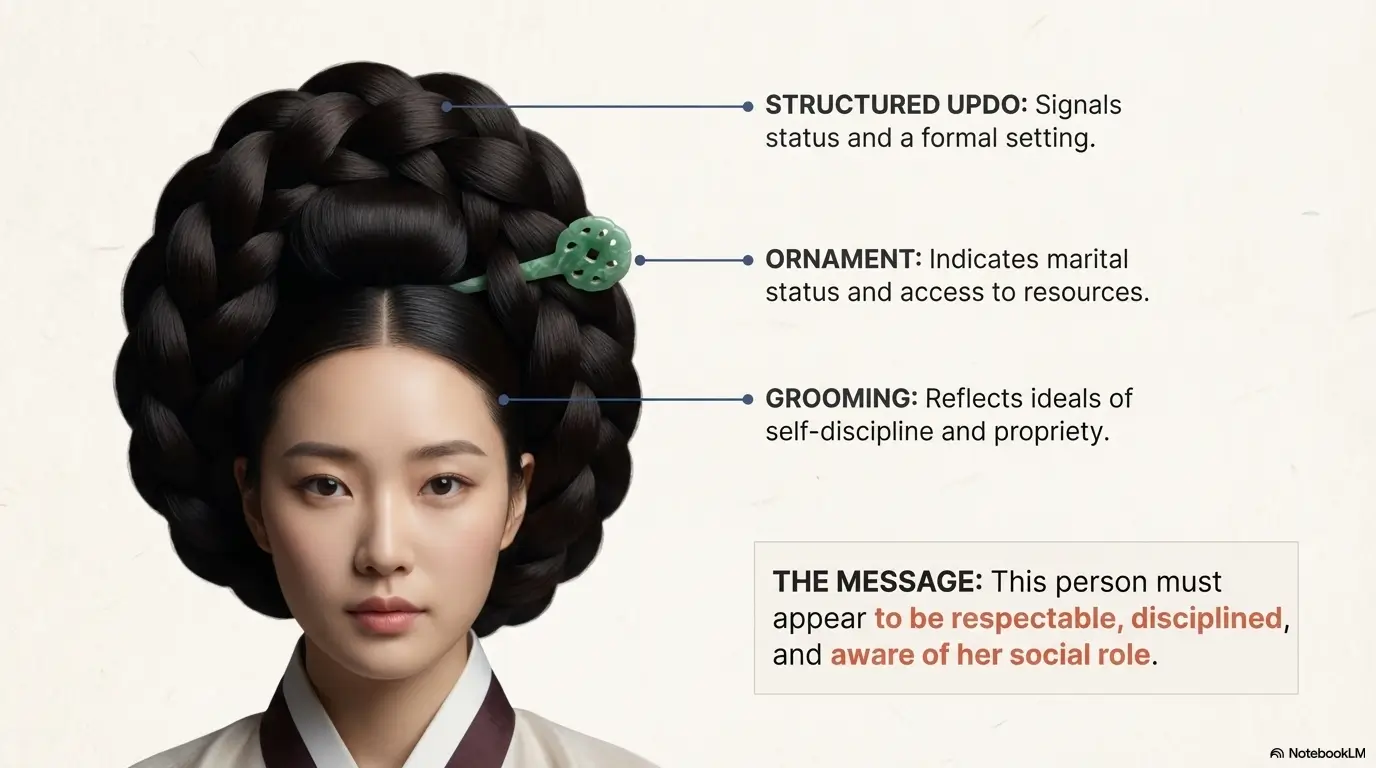
Many historical women’s styles look like architecture for a reason: they’re engineered. Structured hair can show time, resources, and access to tools. It can also signal restraint: the discipline to look composed, even when life isn’t. Accessories—like hairpins—can function like punctuation marks, adding clarity to the message.
One helpful way to read women’s hair is to separate three layers:
- Form: loose vs structured (mobility, control, ceremony).
- Tools: pins, combs, wraps (access and craft).
- Context: daily life vs formal display (what the scene is trying to show).
Marriage signals: what changed after “yes”
In many societies, marriage shifts how a woman is read in public. Korean hair traditions frequently reflect that kind of social shift: styles and accessories can imply adult status, household role, or ceremonial readiness. The key is not to memorize a single “married hairstyle,” but to learn the habit of asking, “Is this meant to signal a life stage?” If you want a practical companion lens, compare hair signals with the way Korean wedding customs communicate family roles and formality.
Mourning & restraint: when simplicity wasn’t a choice
Simplicity can mean humility, grief, or moral seriousness—especially in ritual contexts. If a scene looks restrained, don’t assume it’s “minimalist taste.” It may be social expectation. It may be a rule of mourning. It may be the visual language of respect.
Here’s what no one tells you… “pretty” was often a policy
Beauty standards don’t float in the air. They get taught, repeated, and rewarded. When a society attaches moral value to grooming, “pretty” can turn into “proper.” And “proper” can turn into pressure. That’s not Korea-specific—that’s human—but Korean hair history makes it visible.
Pull-quote: A hairstyle can be an outfit for the head—or a rulebook you wear without noticing.
6) Men’s hair: the topknot isn’t just a topknot
The topknot as adulthood, duty, and legitimacy
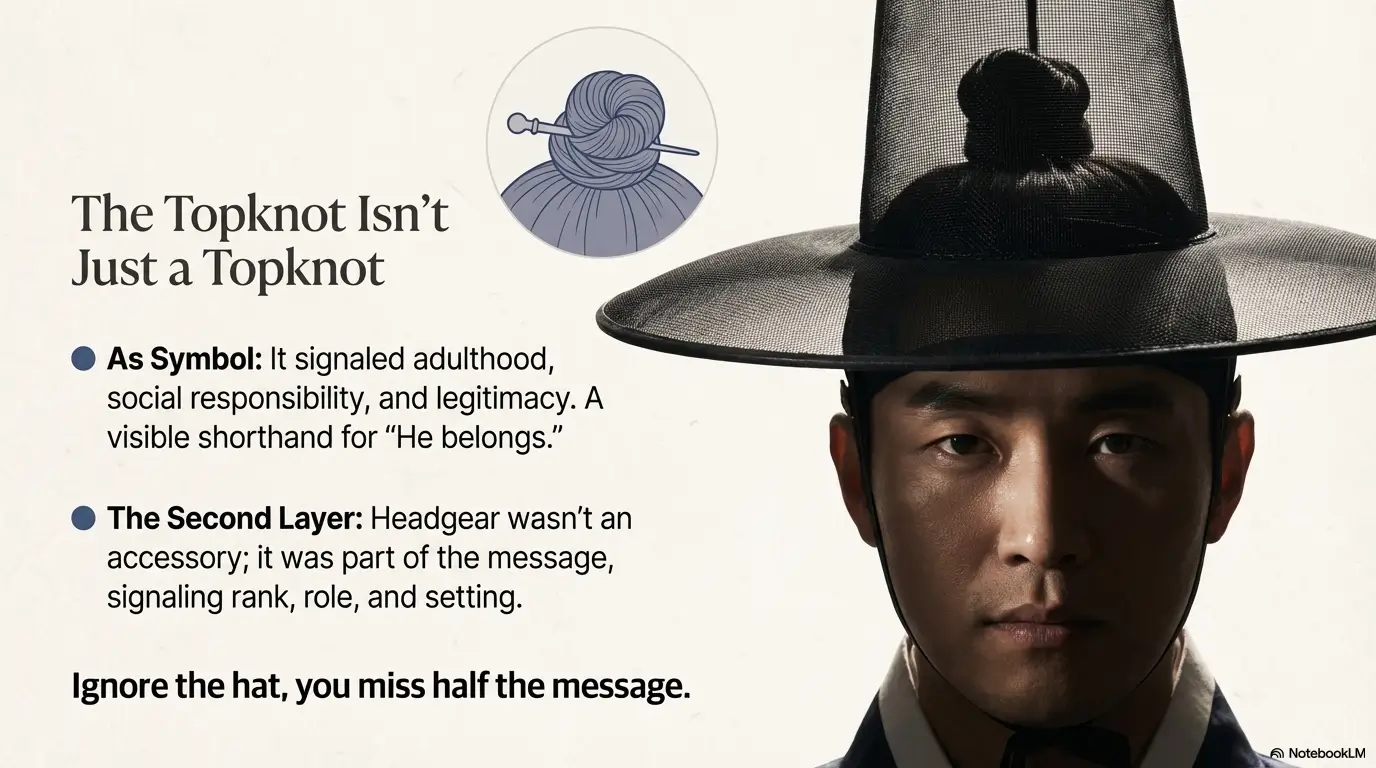
The topknot reads simple to modern eyes: hair tied up. Historically, it could signal adulthood and readiness to be treated as responsible. It could also mark conformity to social expectations. When hair becomes tied to legitimacy, changing it isn’t just a style swap. It can look like dissent—or like modernity—depending on the moment.
If you’ve ever seen a period drama where the camera lingers on a topknot like it’s a plot device… that’s not accidental. Hair can be a visible shorthand for: “He belongs,” “He’s grown,” “He’s respectable,” or “He’s refusing the script.”
Hats/headgear as hair’s “second layer” (and why that matters)
Headgear isn’t an accessory; it’s part of the hairstyle system. Hats can signal rank, role, and setting. They can also hide practical hair arrangements underneath. If you ignore hats, you miss half the message. The hair and the headgear work together like a front-of-house sign and a back-of-house structure—much like how Hanok design decisions hide engineering beneath beauty.
Curiosity gap: when hair became the battleground for loyalty
When regimes change, outward signals get political fast. Hair becomes a battleground when it’s used to sort “traditional” from “modern,” “loyal” from “suspect,” or “in-group” from “outsider.” That’s why hair reforms—where they occur—tend to feel emotional and urgent. It’s identity made visible.
7) Joseon-era tension: virtue on paper vs life on the street
The moral script: hair as inherited, protected, and regulated
Joseon society is often discussed alongside Confucian ideals—especially around family ethics and social order. Within that worldview, hair can symbolize filial respect and self-discipline. “Protected hair” isn’t just about vanity; it’s about moral presentation. The closer you are to institutions (court, officialdom), the more the moral script tends to show up in the visual record—especially in Joseon-era portraits and art conventions.
The reality: labor, weather, travel, practicality
Now the street-level truth: people worked. People sweated. People carried water, hauled goods, cooked, traveled, and tried not to freeze. Practical hair is hair that stays out of your way. That’s why tied hair, covered hair, and simplified arrangements matter. They tell you what bodies actually did, not just what portraits preferred to show.
A quick “day-in-the-life” scene that makes the era feel real
Picture a morning that starts before the sun. A hair arrangement is done quickly, not for beauty, but because loose strands are a hazard near fire and tools. A head covering goes on—not to hide, but to protect. Later, a formal moment requires a different look, a slower hand, a stricter posture. Same person. Two hairstyles. Two social settings. One body trying to survive both.
Pattern interrupt: Wait—so why did people still bend the rules?
Because rules are written for ideals. People bend rules for life. Also: aspiration is real. If looking “proper” buys you trust, work, marriage prospects, or safety, you don’t need to be forced—you’ll choose the look that keeps doors open. That’s the quietly modern part of this story—and it pairs neatly with the way Korean bowing etiquette (jeol) signals respect even when life is messy.
- Portraits and court depictions prioritize moral presentation.
- Daily-life scenes reveal practicality and compromise.
- The tension between the two is the point, not a problem.
Apply in 60 seconds: Ask “ideal or everyday?” before you interpret a single accessory.
8) Modern shocks: when hairstyles became “history” overnight
Modernization and the speed of change (law, school, work)
In modern transitions, cultural signals can flip quickly. Hairstyles that once felt “normal” can become “traditional” in one generation. Schools, workplaces, and national identity projects can accelerate change—sometimes gently, sometimes harshly. The point isn’t that “modern is better.” The point is that hair’s meaning shifts when the social contract shifts.
When tradition becomes performance (ceremony vs daily life)
One of the strangest modern feelings is seeing what used to be everyday become ceremonial. Hairstyles that were once lived can become staged—worn on holidays, in weddings, in performances, in photo studios. That isn’t fake. It’s memory. But it does mean modern images often compress many eras into one “traditional vibe,” which can confuse readers—especially if they haven’t seen how modern vs traditional Korean weddings deliberately package older signals for a new setting.
What survived: the symbols that didn’t die, just moved
Even when daily hair changes, symbolic hair persists: the idea that grooming reflects respect, the association of hair with life stages, the use of accessories to mark formality. Traditions don’t always disappear; they relocate—from the street to the ceremony, from daily life to identity expression.
9) Common mistakes people make when reading Korean hair history
Mistake #1: treating one dynasty’s style as “all of Korea”
Korea isn’t one freeze-frame. If you flatten centuries into one look, you’ll misread symbols and overgeneralize. The fix is simple: tie your interpretation to an era and a context, even loosely.
Mistake #2: assuming “women’s hair = fashion,” “men’s hair = utility”
Both men and women used hair to signal identity. Both used hair for practical reasons. Both were subject to norms. Gendered stereotypes make you miss the real story: hair as social messaging for everyone.
Mistake #3: mixing up class signals (court vs commoner cues)
Elites had access to time, tools, and formal settings. Commoners had work, weather, and practical limits. That difference shows up in hair, accessories, and headgear. If you apply elite signals to everyday scenes, you’ll “discover” symbolism that isn’t there.
Mistake #4: copying a drama look and calling it “accurate”
K-dramas are designed to communicate quickly to modern eyes. Costume teams often blend influences to make characters readable. That’s not wrong—it’s storytelling. But it is not the same as historical evidence.
- One institutional caption (museum, cultural center, university exhibit).
- One image type: portrait, ritual, or daily-life scene (don’t mix yet).
- Three visible features: hair form, accessory, headgear.
- One sentence on context: “This is meant to show ____.”
Apply in 60 seconds: Save one museum caption next to one drama screenshot and label them “evidence” vs “interpretation.”
10) The “shocking truth” in one sentence (and what to do with it)
The thesis: hair was a visible language—sometimes enforced
Here it is, clean and undramatic: hair functioned like a readable language, and communities often treated that language as morally meaningful. Once you accept that, a lot of confusing details snap into place. Pins, buns, headgear, tied hair—these aren’t random. They’re vocabulary.
And the open loop from earlier? The “quiet rule” was moral weight. When hair becomes a moral surface, it becomes something others feel allowed to interpret—and regulate. That’s why hair can turn political, why it can mark adulthood, and why “proper” can become pressure.
What this changes about how you watch K-dramas / read portraits
You stop asking, “Is this cute?” and start asking, “What does the story want me to understand instantly?” That one question makes you a smarter viewer. It also makes you kinder to history: you’re less likely to mock, more likely to decode.
Next step: one concrete action
Next step (do this today): Pick one era (start with Joseon if you want the clearest “virtue vs life” tension). Save three reference images from an institutional source (museum or cultural organization). For each image, write five lines: who, status, life event, tools, symbol. You’ll be surprised how quickly the “hair language” becomes readable.
| Tier | What you have | How to use it |
|---|---|---|
| 1 | Drama screenshot only | Treat as inspiration, not evidence |
| 2 | One image with no caption | Ask “ideal or everyday?” before claiming meaning |
| 3 | Institutional caption or exhibit text | Use for cautious interpretation |
| 4 | Multiple institutional sources agree | High confidence for general meaning |
| 5 | Material + depiction + text align | Strongest claims allowed (still avoid absolutes) |
Apply in 60 seconds: Move one claim you “believe” up by one tier by adding an institutional caption.
FAQ
Did Koreans historically believe cutting hair was disrespectful?
In many Confucian-influenced contexts, the body (including hair) was framed as something received from one’s parents and therefore treated with respect. That idea can shape norms around grooming and cutting. In practice, people’s choices still varied by era, circumstance, and social pressure—especially when family duties (like ancestor rites and household expectations) shaped what “respect” looked like.
What did a topknot mean in Korea, and who wore it?
A topknot can signal adulthood and social legitimacy in certain historical contexts, especially when paired with appropriate headgear and dress. Meaning depends on era and setting—formal depictions may emphasize ideals more than daily life does.
How could you tell if a woman was married by her hair?
Hair arrangements and accessories sometimes reflected life stage, including marriage, but there isn’t a single universal “married look” across all centuries. The safer approach is to read hair alongside context: clothing, setting, and whether the image is formal, ritual, or everyday. If you want a modern mirror for how signals evolve, see how wedding symbolism shifts between traditional and modern contexts.
What’s the difference between court hairstyles and commoner hairstyles?
Court depictions tend to show standardized ideals, often with more elaborate structure and accessories. Everyday hair usually prioritizes practicality and may be simplified, covered, or adapted for work and weather. If you’re unsure, ask: “Is this meant to display status or depict life?”
Were hair ornaments just decoration, or did they signal rank?
Ornaments can serve both purposes. In formal contexts, they may indicate status, access, and ceremony. In daily life, they may be functional (holding hair secure) while still carrying aesthetic meaning. Treat accessories as part of the “message,” not a footnote. If you enjoy seeing how materials become status, you’ll probably like the way Silla goldwork makes hierarchy visible.
How accurate are K-drama hairstyles compared to real history?
Dramas prioritize clarity and character storytelling, so they may simplify or blend influences. That doesn’t make them “bad”—it makes them a different genre of truth. If you want accuracy, pair drama visuals with museum or cultural institution explanations.
When did short hair become common in Korea?
Short hair becomes more visible with modernization pressures and shifting social institutions (schools, workplaces, public identity). The exact timing varies by region and community, so it’s best approached as a gradual change rather than a single “switch day.”
Did hairstyles differ by region within Korea?
Regional variation is common in hair traditions, but many popular summaries flatten it. If regional detail matters to you, look for museum exhibits or cultural center materials that specify locality and time period rather than broad “traditional” labels.
What hair tools were used historically (pins, combs, oils)?
Tools like combs and hairpins are common across many eras, with materials and craftsmanship reflecting access and social setting. When you see a structured hairstyle, assume tools and technique were involved—even if the image doesn’t list them. For a parallel “objects tell stories” rabbit hole, browse how Korean ceramics and porcelain encode status and taste in everyday forms.
Where can I see reliable examples of historical Korean hairstyles?
Start with major museum collections and cultural institutions that provide English exhibit text and curated context. These sources help you separate “what we know” from “what we assume.” If you want a beautifully contextual starting point, pair hairstyle research with grand Korean palace history, because court settings explain why “proper” looked the way it did.
12) A clean wrap that doesn’t waste your time
The two takeaways you’ll remember a week from now
First: Korean hair history becomes easy when you stop reading hair as “fashion” and start reading it as signal. Who is being shown? In what setting? With what social pressures?
Second: The “shocking truth” is not exotic. It’s human: when hair carries moral weight, it becomes a shared language—praised, judged, and sometimes enforced.
A final image: hair as a quiet archive you can actually read
Next time you see a historical bun, a pin, a topknot, or a formal hat, don’t rush to label it. Pause. Ask the one question that keeps you honest: What does this person need others to believe about them? That question turns confusion into clarity. And it makes the past feel less like a museum glass case—and more like a room you can walk into.
15-minute next step: Open one institutional page (museum/cultural center), pick one image, and write a single sentence that separates what you see from what you infer. That one habit will keep your curiosity sharp—and your claims true.
Last reviewed: 2025-12.