
The Korean Apartment Move-In Playbook: Beyond “Common Sense” to Total Control
The fastest way to turn move-in day into a week-long headache is to treat a Korean apartment like it runs on “common sense.” It doesn’t. It runs on posted rules, building-by-building systems, and receipts with opinions.
If you’re juggling frictions like building fees (관리비) that change by complex, recycling rules that feel like a certification exam, and quiet-hour norms, stop guessing.
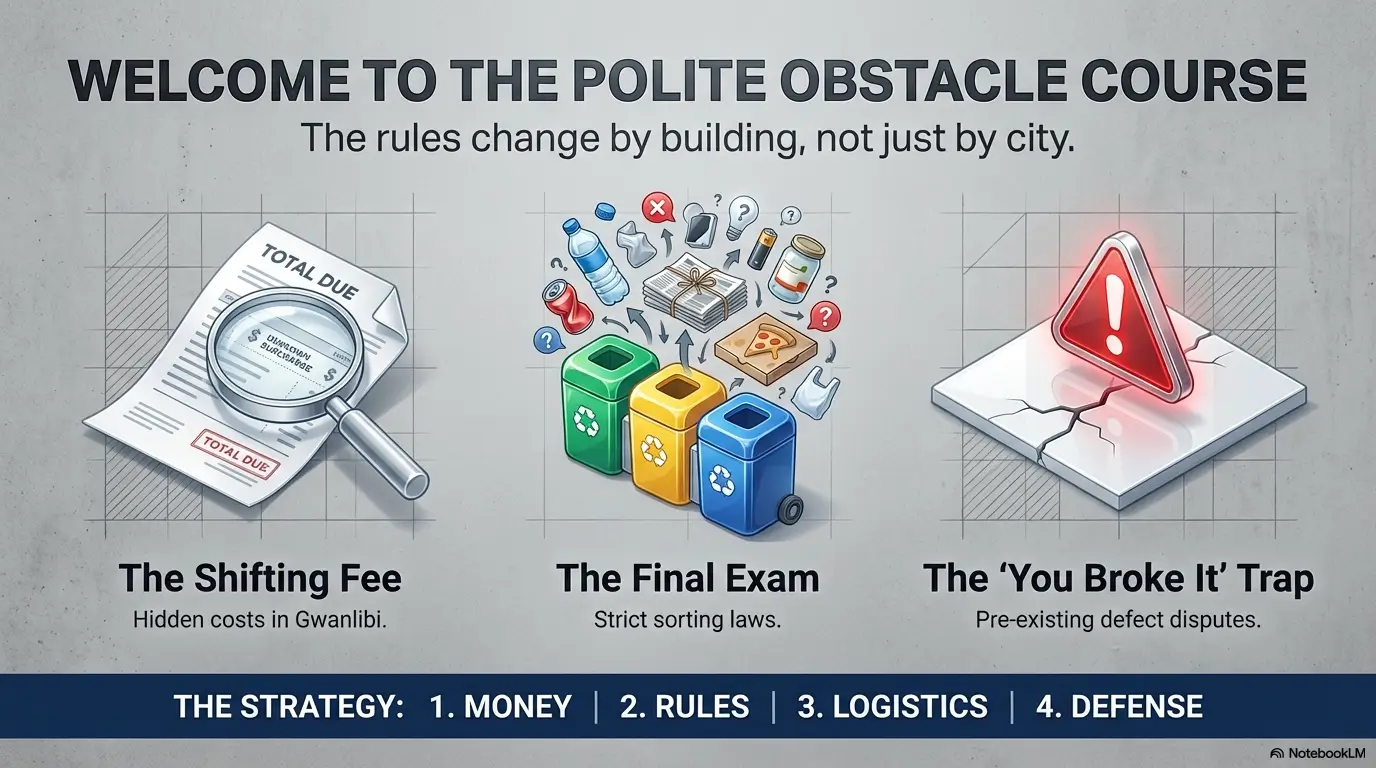
Keep guessing, and you pay twice: once in surprise monthly charges, and again in repair disputes that magically become “your responsibility.”
What is 관리비? It’s the monthly maintenance fee for security, cleaning, and elevators. Since inclusions vary, the only reliable move is to confirm the breakdown in writing.
The Strategy: Two photos first. One message same day. Then you unpack in peace.
Fast Answer (Snippet Target)
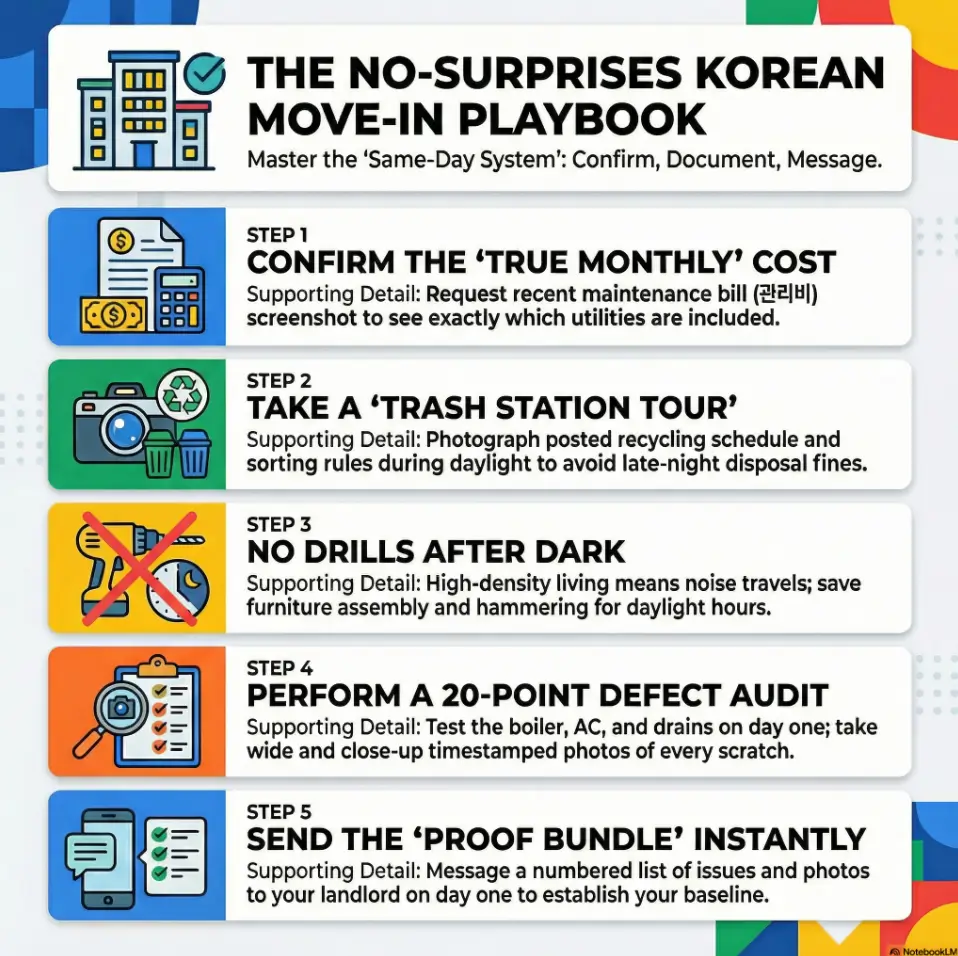
To move into a Korean apartment smoothly, confirm building fees (관리비) + what’s included, learn your recycling schedule and sorting rules, check quiet hours and elevator/moving reservations, and do a same-day defect inspection with photos, timestamps, and a written issue list sent to the landlord/agent. Handle internet/utility handoff early, and you’ll avoid the two most common traps: surprise monthly charges and “you caused it” repair disputes.
Table of Contents
1) Start here: Who this is for / not for
For: first-time renters in Korea, short-term expats, students, families, remote workers
If you’re moving into a Korean apartment and you want a system that prevents “surprise bills” and “you broke it” debates, you’re in the right place. This is especially useful if you’re juggling:
- A lease you signed fast (because the good units disappear quickly)
- Jet lag and a moving truck timetable that doesn’t care about your feelings
- Building rules that vary wildly from one complex to the next
Tiny personal confession: my first move-in, I assumed “maintenance fee” meant “building lobby plants.” It did not. It meant a recurring monthly bill with line items that looked like a mystery novel. Lesson learned. Receipts earned.
Not for: buying property, major renovations, or legal disputes already in progress
This checklist is logistics and prevention, not a legal battlefield guide. If you’re already in a serious dispute (deposit withholding, major structural issues, or threats), you’ll likely need specialized help. Here, we focus on clean documentation, clear communication, and avoiding the most common operational mistakes.
If your lease is complex: consider a bilingual helper or relocation service (time-saving, not fancy)
“Helper” can mean a bilingual friend, a coworker who’s done this before, a university international office staffer, or a relocation service. The value is not luxury, it’s translation + speed + reduced misunderstanding. If you’re time-poor, that’s a real ROI lever.
- Confirm fees and rules in writing
- Tour the trash area before your first late-night disposal attempt
- Build an evidence folder before anything breaks “on paper”
Apply in 60 seconds: Create a folder on your phone named “Move-In Evidence” and pin it to your home screen.
2) Before keys: The 30-minute “fees + rules” confirmation call
Building fee (관리비) reality check: what’s included vs billed separately
관리비 (building maintenance fee) is the most frequent “why didn’t anyone tell me” moment. It can include things like shared cleaning, security, elevator maintenance, common-area electricity, sometimes water, sometimes not. The catch: it changes by building, not by country logic.
Operator trick: ask for a recent bill screenshot (with personal info blurred). Not a promise. Not a vibe. An actual bill format. This is where you stop guessing and start knowing.
Ask these 7 questions: utilities, parking, security, cleaning, elevator rules, pets, trash tags
- 관리비: “What does it include? Any fixed minimum?”
- Electricity: billed separately? (Often yes. Provider typically KEPCO for electricity.)
- Gas: city gas billed separately? Who sets up? (Often separate, sometimes building-specific.)
- Water: included in 관리비 or separate meter bill?
- Parking: included, discounted, or paid monthly?
- Trash: do you need official bags? RFID bins? designated days?
- Moving: elevator reservation required? padding rules? guard desk process?
Here’s what no one tells you… the “관리비 includes what?” answer changes by building
Even two buildings on the same street can run different systems: different cleaning schedules, different shared-utility splits, different garbage stations, different “quiet hours” enforcement. Treat the building like its own micro-country with its own laws posted on a corkboard near the mailboxes.
Show me the nerdy details
Why variability is high: Korean apartment complexes often contract services (security, cleaning, elevator maintenance) separately, and shared utilities (lobby lighting, common water pumps, heating for common areas) may be allocated using different rules. Your strategy is to request artifacts: bill screenshot, posted rules photo, or a building office contact you can verify with.
3) Surprise charges: Building fees, deposits, and the monthly math
Typical line items you’ll see: elevator/security, cleaning, maintenance, shared utilities
Think of 관리비 as the “keep the building alive” bundle. It can include security staff, CCTV maintenance, cleaning crews, elevator upkeep, and shared electricity for hallways and parking areas. Sometimes it includes water. Sometimes water arrives like a separate plot twist.
I once moved into a place where the lobby looked like a hotel and the monthly building fee reflected that ambition. Gorgeous? Yes. Cheap? No. The important part is not judging it, it’s budgeting it.
Separate bills that can blindside you: electricity, gas, water, internet, TV, parking
Common separate bills you should assume exist unless told otherwise: electricity (often via KEPCO), gas (city gas provider), internet (KT, SK Broadband, LG U+ are common), and sometimes parking. If you work remotely, internet is not a “nice-to-have.” It’s your paycheck’s oxygen.
Don’t do this: assuming “utilities included” because it was true in your last country
The “utilities included” assumption is a classic expat trap because it feels normal elsewhere. In Korea, the rent structure varies: sometimes a higher rent quietly “bakes in” convenience, sometimes it absolutely does not. Ask. Document. Save yourself from budget whiplash.
- Ask for a written 관리비 breakdown
- Confirm which utilities are separate and how billing works
- Budget a buffer for month one (setups and deposits happen)
Apply in 60 seconds: Text yourself a single line: “Rent + 관리비 + utilities + internet + parking = true monthly.”
Money Block: The “monthly math” table (use as a budgeting scaffold)
| Cost item | Typical billing style | Notes (what to verify) |
|---|---|---|
| Rent | Fixed monthly | Confirm due date + payment method |
| 관리비 (building fee) | Monthly, varies | Ask what’s included and request a recent bill format |
| Electricity | Metered, monthly | Confirm handoff, any outstanding balance, account name |
| Gas (city gas) | Metered, monthly | Confirm boiler type and who to call for safety checks |
| Water | Included or separate | Ask: included in 관리비? building office handles? |
| Internet | Monthly contract | KT / SK Broadband / LG U+ availability by building |
| Parking | Included, discounted, or paid | Ask for monthly rate and registration process |
Neutral next step: Copy this table into a note and fill “confirmed / unknown” before move-in day.
Money Block: Mini calculator (estimate your true monthly total)
Enter up to three numbers. This is for quick planning, not precision accounting.
Estimated monthly total: 0
Neutral next step: Compare this number to your budget before committing to furniture or a long internet contract.
4) Trash day decoded: Recycling rules that feel like a final exam
The core categories (and what confuses people): food waste, plastics, vinyl, glass, cans, paper
Korean waste sorting can feel intense because it’s not one national “one-bin fantasy.” It’s a system with categories that matter. The usual suspects:
- Food waste (음식물쓰레기): often separate bins or special systems
- Plastics vs vinyl/film: the “this feels like plastic” confusion zone
- Glass, cans, paper/cardboard: generally straightforward, but packaging residue matters
My first night: I stood in front of the trash station holding a greasy takeout container like it was a live animal. I did the worst thing: I guessed. That guess lived on in the form of a stern posted note the next day. Learn from my shame.
Building-specific systems: designated days, stations, RFID bins, or bags only
Some buildings have designated stations, some have specific days, some require official bags, and some use RFID or controlled bins. The point isn’t to memorize Korea. The point is to follow your building’s rules.
Let’s be honest… the biggest recycling mistake happens at 11:30 PM with a greasy container
Late-night disposal is when mistakes happen: you’re tired, you want the smell out, and the signs are in Korean. The fix is simple: do a trash station tour during daylight and save photos of posted rules.
“What to do tonight” mini-check: find the trash area, take a photo of posted rules, ask the guard
- Locate the trash/recycling area (usually near parking or a side entrance)
- Photograph the posted sorting guide and the disposal schedule
- If your building has a guard desk, politely ask: “Trash rules? Recycling days?”
- Find the station first, then dispose
- Save photos of posted rules and schedules
- When unsure, rinse and separate rather than guessing
Apply in 60 seconds: Add “Trash station photo” to your move-in checklist and do it tonight.
5) Quiet hours + neighbor peace: Avoid your first-week friction
Quiet hours norms (and why your building may enforce stricter rules)
Quiet hours in Korean apartments are often socially enforced even when the rules aren’t posted like commandments. Some complexes have formal quiet hours. Others operate on strong norms: late-night drilling, loud music, dragging furniture, and hallway noise can trigger complaints fast.
The reason it matters: density. You’re sharing walls, floors, and sometimes the acoustic properties of a drum. Your goal is not perfection. Your goal is to avoid being “the new neighbor story” people tell for months.
Moving noise etiquette: elevator reservations, padding, hallway timing, cleanup
- Book the elevator if required (some buildings insist)
- Use padding or blankets to protect elevator walls
- Keep hallway clear and clean as you go
- Time heavy moves earlier in the day if possible
I once assembled furniture at night because jet lag convinced me it was “still afternoon somewhere.” My downstairs neighbor disagreed. They were correct.
Don’t do this: assembling furniture late because you’re jet-lagged and “it’s just one drill”
“Just one drill” is a lie you tell yourself right before you become an apartment legend. If you must do something late, make it silent: unpacking clothes, organizing kitchen items, setting up Wi-Fi. Save drilling and hammering for daylight.
Money Block: Decision card (When A vs B)
Choose A: Move earlier in the day
- Lower complaint risk
- Easier to get staff support
- More time to spot defects in daylight
Choose B: Move late (only if forced)
- Keep noise minimal
- Do silent tasks only (unpack, Wi-Fi)
- Plan defect inspection first thing next morning
Neutral next step: Pick A or B now, then message your mover/building office accordingly.
6) Move-in day logistics: Elevator booking, parking, and the guard desk script
How to reserve the elevator (and what to say if you don’t speak Korean)
Some buildings require a reservation to protect elevators and manage traffic. If your Korean is limited, you don’t need a speech. You need a short, polite script plus your move-in date/time written clearly.
Loading zone basics: double-parking risks, cones, timing, building staff expectations
Loading zones can be strict. Some complexes have cones, assigned lanes, or staff who will redirect you. Don’t treat it like a suggestion. Treat it like an airport runway. If you can, arrive with:
- Move time confirmed (written or text screenshot)
- Elevator padding/blankets (or ask if building provides)
- Parking instructions for the moving truck
Personal note: I once assumed “five minutes” of double-parking was fine. It was not fine. It was a full-body lesson in local enforcement and neighbor patience.
Micro-script kit: 3 polite phrases that solve 80% of move-in interactions
Micro-script kit (use with a smile)
- “이사 왔어요. 엘리베이터 예약했어요.” (I’m moving in. I reserved the elevator.)
- “쓰레기 분리수거 규칙이 어디에 있어요?” (Where are the recycling rules?)
- “이거 확인 부탁드려요.” (Please help me check this.)
If you prefer English: show the date/time on your phone and point to the elevator schedule or rules sign. Visuals are a universal language. If you want a deeper feel for how Korean “polite but efficient” actually works in real buildings, keep Korean indirect communication cues in your back pocket and you’ll sound calmer even with short sentences.
Show me the nerdy details
The “guard desk” is often a control point for building operations: elevator usage, trash compliance reminders, visitor access, and noise complaints routing. Being politely proactive can prevent friction later because staff often become your fastest channel for clarifying building-specific rules. (If you’re unsure which honorific level to use with staff or agents, this Korean honorifics for foreigners guide helps you stay respectful without overthinking it.)
7) The gold standard: Move-in defect inspection that protects you later
The 20-point walkthrough: walls, floors, windows, locks, mold, drains, AC, boiler, outlets
Do your defect inspection the same day you get keys, before your life expands into boxes and furniture. Your goal is not paranoia. Your goal is a clean baseline. Here’s a practical 20-point list:
- Entry door: lock works smoothly
- Intercom / doorbell
- Windows: open/close, seals
- Window screens
- Walls: cracks, stains
- Floors: scratches, swelling
- Ceilings: water marks
- Bathroom: mold smell
- Toilet: flush + leaks
- Sink: drainage speed
- Shower: hot water, pressure
- Kitchen sink: leaks, drainage
- Under-sink cabinet: water stains
- Boiler/thermostat: turns on
- AC: cold air + noise
- Outlets: test 2–3
- Lights: flicker or dead
- Gas smell (if applicable): note immediately
- Balcony drain (if present)
- Pests signs (droppings, gaps)
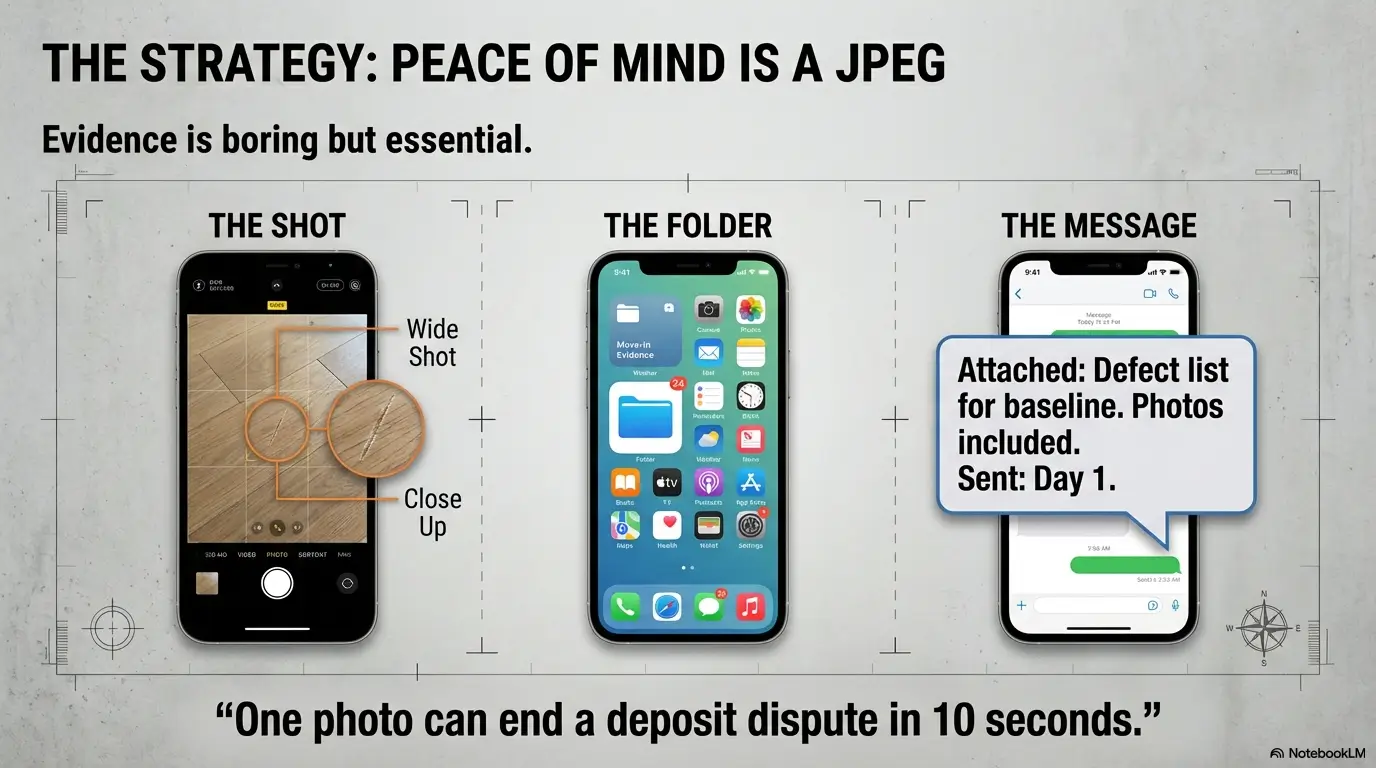
Photo/video protocol: wide shot + close-up + timestamp + location note
Your evidence should be boring, clear, and undeniable. For each issue:
- Wide shot (shows location context)
- Close-up (shows the defect clearly)
- Timestamp (phone metadata is fine, but also add it in your message)
- Location note (e.g., “Bedroom window frame, left corner”)
One of my best “future me” favors was photographing a tiny pre-existing floor scratch. Months later, a repair conversation happened. The photo ended it in 10 seconds. Peace is sometimes a JPEG.
The “proof bundle”: one folder, one checklist, one message to send same day
The “proof bundle” is the whole strategy. Make it stupid simple:
- One folder: “Move-In Evidence”
- One note: issue list (bullets, numbered)
- One message: sent to landlord/agent same day with photos attached or linked
Pattern interrupt: You are not being picky, you’re preventing a bill you didn’t earn
This is where many renters hesitate: “I don’t want to be difficult.” Operator truth: you’re not being difficult. You’re establishing a baseline. The baseline is what prevents a future “we think you caused it” repair charge. If your lease involves a large deposit (especially jeonse-style structures), it’s worth understanding jeonse deposit protection basics so your documentation habits match the financial stakes.
Short Story: The scratch that tried to become my bill (120–180 words) …
On my second apartment in Korea, the place looked immaculate at first glance. New paint smell. Shiny floors. I was tempted to do the “quick glance, sign, celebrate” routine. But I forced myself to run the 20-point check anyway. In the living room, near the balcony door, I spotted a faint floor scratch that caught the light only at one angle. I photographed it, wide and close-up, and added a single bullet in my same-day message.
Months later, when I prepared to move out, the agent pointed to that exact spot like it had personally insulted them. “This damage,” they said, gently but firmly. I opened the folder, pulled up the timestamped photo from move-in day, and sent it in the chat. The conversation changed tone immediately. No drama, no raised voices. Just a quiet, mutual understanding that the timeline mattered.
8) Same-day fixes: What to report immediately vs what can wait
Report now: leaks, mold, broken locks, non-working boiler/AC, electrical issues, pests
These are “same-day” items because they affect safety, security, or habitability. Report immediately and keep the message factual:
- Water leaks (under sink, bathroom, ceiling marks with dampness)
- Mold odor or visible mold
- Broken entry lock or door misalignment
- Boiler not working / no hot water
- AC not cooling or making alarming noise
- Electrical issues (sparks, burning smell, dead outlets)
- Pest signs
Report soon: peeling wallpaper, cracked tiles, loose fixtures, poor drainage
These matter because they can become “wear and tear” arguments later. Document them and report within a few days, ideally still in week one. The earlier your baseline, the safer your deposit story.
When to escalate: agent/landlord follow-ups, building office, repair timelines (keep it factual)
If you don’t get a response, escalate in clean steps:
- Reply to the same message thread with a polite follow-up and the original photos
- Call the agent during business hours and reference the written list
- If building systems are involved (e.g., shared plumbing, building elevator damage), ask the building office/guard desk who handles it
A small lived-experience note: escalation works best when your tone is boring. No blame. Just facts, photos, and a specific request: “Please confirm repair timeline.” If you’re doing follow-ups via chat, borrowing a few moves from KakaoTalk etiquette in Korea can keep messages crisp and effective without sounding harsh.
9) Common mistakes: The top 12 move-in errors (and the clean recoveries)
Mistake #1: not asking for a 관리비 breakdown in writing
Recovery: Ask for a written breakdown and a recent bill format screenshot. If you’re already moved in, request clarification for next month’s budget planning.
Mistake #2: skipping the trash station tour
Recovery: Take 3 photos: station overview, posted rules, schedule. Then follow that, not your instincts at 11:30 PM.
Mistake #3: waiting a week to report defects (“you did it” risk)
Recovery: Send a “late 발견” message with photos and a calm line: “Noticed during unpacking; sharing for baseline.”
Mistake #4: moving without elevator booking or padding
Recovery: Ask if you can book retroactively for heavy items. Use blankets immediately. Document any accidental scuffs you caused and report, because integrity beats surprise later.
Mistake #5: assuming quiet hours are “suggestions”
Recovery: Shift noisy tasks to daytime. If you already caused noise, a simple apology to the guard desk or a neighbor (if you meet them) can reset the vibe.
Mistake #6: not documenting meter readings at handoff (when applicable)
Recovery: Photograph meters as soon as you can (electric/gas/water if visible). Send to the agent: “For move-in baseline.”
Your recovery playbook: what to message, what to attach, what to track
Keep one template message you can reuse. Attach the three essentials:
- Issue list (numbered)
- Photos/videos (labeled by room)
- Desired next step (confirm timeline, confirm fee breakdown, confirm rules)
Money Block: Quote-prep list (before you compare services)
If you’re comparing internet or movers, gather these so you don’t get upsold by confusion:
- Your exact building address and unit number
- Move-in date and preferred installation window
- Whether your building has an existing line/provider restriction
- Your work needs: video calls, upload-heavy work, gaming, etc.
- Contract length preference (short-term vs long-term)
Neutral next step: Screenshot this list and send it to the provider/mover so quotes are comparable. (If you’re still searching for a place, this guide on apartments for rent in Seoul can help you sanity-check listings and expectations.)
FAQ
What is 관리비 (building maintenance fee) and what does it usually include?
관리비 is a monthly building fee that often covers shared services like cleaning, security, elevator upkeep, and common-area utilities. What it includes varies by building, so ask for a written breakdown and, if possible, a recent bill format screenshot.
How much are typical Korean apartment building fees per month?
There isn’t one universal number because fees depend on building size, amenities, staffing, and shared utility structure. The practical approach: ask “What was the last 2–3 months range?” and budget using that range instead of a single guess.
Do I need special bags for trash in Korea, and where do I buy them?
Many areas use official waste bags for certain trash types, while recycling and food waste can be handled through stations or bins. Your building’s trash station and posted rules will tell you exactly what’s required. If bags are required, they’re commonly sold at convenience stores or supermarkets in your neighborhood.
What is food waste (음식물쓰레기) and how do I dispose of it correctly?
Food waste is separated because it’s handled differently from general trash. Many buildings have dedicated food waste bins or controlled systems. Scrape liquids, avoid mixing with plastics, and follow your building’s specific instructions and schedule to avoid rejection or complaints.
What are quiet hours in Korean apartments, and how strict are they?
Quiet hours may be formally posted or informally enforced by social norms and building staff. They can be strict in high-density complexes. The safest move is to do noisy tasks (drilling, hammering, furniture dragging) during daytime and keep late-night activity quiet and contained.
How do I reserve the elevator for moving in a Korean apartment building?
Ask your agent/landlord or the guard desk/building office if reservations are required. If yes, provide your move date and time window. If language is a barrier, show the date/time on your phone and use a short script like “이사 왔어요. 엘리베이터 예약했어요.”
What should I document during a move-in defect inspection in Korea?
Use wide shots and close-ups, note the room/location, and send a numbered issue list to your agent/landlord the same day. Prioritize water leaks, mold signs, lock issues, boiler/AC function, drainage, and visible damage on floors/walls.
Who do I contact for repairs: landlord, agent, or building office?
For unit-specific issues, start with your agent/landlord in writing. For building system issues (common plumbing, elevator policies, trash station rules), the building office or guard desk often directs you to the right channel. Keep messages factual and attach your photos.
11) Next step: Your 15-minute “Tonight Checklist” (one concrete action)
Do this now: make a “Move-In Evidence” folder + take 10 required photos
Here’s the fast win you can do tonight, even if you’re exhausted:
- Create folder: Move-In Evidence
- Take 10 photos: entry door, thermostat/boiler panel, AC unit, bathroom sink cabinet, shower drain, kitchen sink cabinet, window frames, floors in each room, any existing damage, trash station rules sign
I promise: future-you will treat present-you like a hero for this.
Send one message tonight: fee breakdown request + defect list + recycling/quiet-hours confirmation
Copy/paste message template (keep it short)
Hi, I moved in today. Could you please confirm (1) the monthly 관리비 amount and what it includes, (2) the recycling/trash disposal rules and schedule for this building, and (3) any quiet hours or moving/elevator rules I should follow? Also, I’m sharing a move-in defect list with photos for baseline documentation. Thank you.
If you worry about tone, think “short + polite + specific.” This is the same social muscle you use when navigating Korean personal questions etiquette: clarity without friction.
Set one reminder: 7-day follow-up for unresolved repairs (with your photo bundle attached)
Set a reminder for day 7: “Follow up on repairs.” Attach your proof bundle again. You’re not nagging. You’re tracking.
Money Block: Eligibility checklist (Are you move-in ready?)
- Yes/No: I have a written 관리비 breakdown (or I requested it)
- Yes/No: I know where the trash station is and saved the posted rules photo
- Yes/No: I confirmed elevator reservation rules (or confirmed none are needed)
- Yes/No: I completed a same-day defect inspection and sent the list
- Yes/No: I know how internet/utility handoff will happen (provider or building office)
Neutral next step: Any “No” becomes your task list for the next 24 hours.
Conclusion: Close the loop, keep the proof
Remember the two traps from the top? Surprise monthly charges and repair disputes. You beat both with the same quiet weapon: a simple system. Confirm fees and rules in writing. Tour the trash station in daylight. Respect quiet hours with practical timing. And do the same-day defect inspection like you’re creating a baseline for your future self, because you are.
The curiosity loop closes here: the “secret” isn’t being fluent or culturally perfect. It’s being operational. Korea rewards operational people. Your new apartment will too. (If your move is part of a longer stay, it can also help to keep a small “language safety net” like a Korean digital nomads phrasebook for repairs, delivery, and building conversations.)
Infographic: The No-Surprises Move-In System (printable logic)
1) Confirm
관리비 breakdown, utilities, parking, elevator rules, trash system
2) Tour
Trash station, posted schedule, how food waste is handled
3) Inspect
20-point walkthrough, test boiler/AC/drains/locks
4) Document
Wide + close-up + timestamp + location note
5) Message
One same-day message: fees + rules + defect list
6) Follow up
Day 7: unresolved repairs, attach proof bundle again
If you only do one thing in the next 15 minutes, do this: make the folder, take the 10 photos, and send the one message. That single act turns your move-in from “hope” into “control.”
Last reviewed: 2026-02-19.