

Mastering the Art of Korean Waste Sorting
In Korea, one empty yogurt cup can turn into three separate disposal decisions in under ten seconds.
That is why recycling rules in Korea catch so many foreigners off guard: the bins look familiar right up until the moment your old instincts stop working. The real problem is not laziness. It is that Korean waste sorting expects cleaner separation, sharper item-by-item judgment, and more local variation than many Anglo-American readers are used to, especially around food waste, clear PET bottles, delivery packaging, and apartment building routines.
Keep guessing, and you do not just risk a small mistake. You risk uncollected trash, awkward corrections, and a daily chore that starts feeling weirdly stressful.
This guide helps you make sense of the system without turning your kitchen into a legal seminar. You will learn how to sort faster, avoid the most common recycling mistakes, and build a simple home setup that matches real district rules and shared housing habits.
It is grounded in the logic the body follows throughout: official guidance, lived routine, and the small practical decisions that actually make Korean recycling easier. Because this is where most people get stuck, not at the bin, but at the moment they have to decide what the item really is.
Let’s make that part easier first.
Fast Answer: Foreigners often struggle with recycling rules in Korea not because the system is irrational, but because it expects item-by-item judgment, cleaner separation, and more local variation than many people expect. The hardest part is usually not “Which bin?” It is knowing what must be rinsed, stripped, flattened, bagged, weighed, or treated as ordinary trash depending on food residue, housing type, and district practice.
Table of Contents
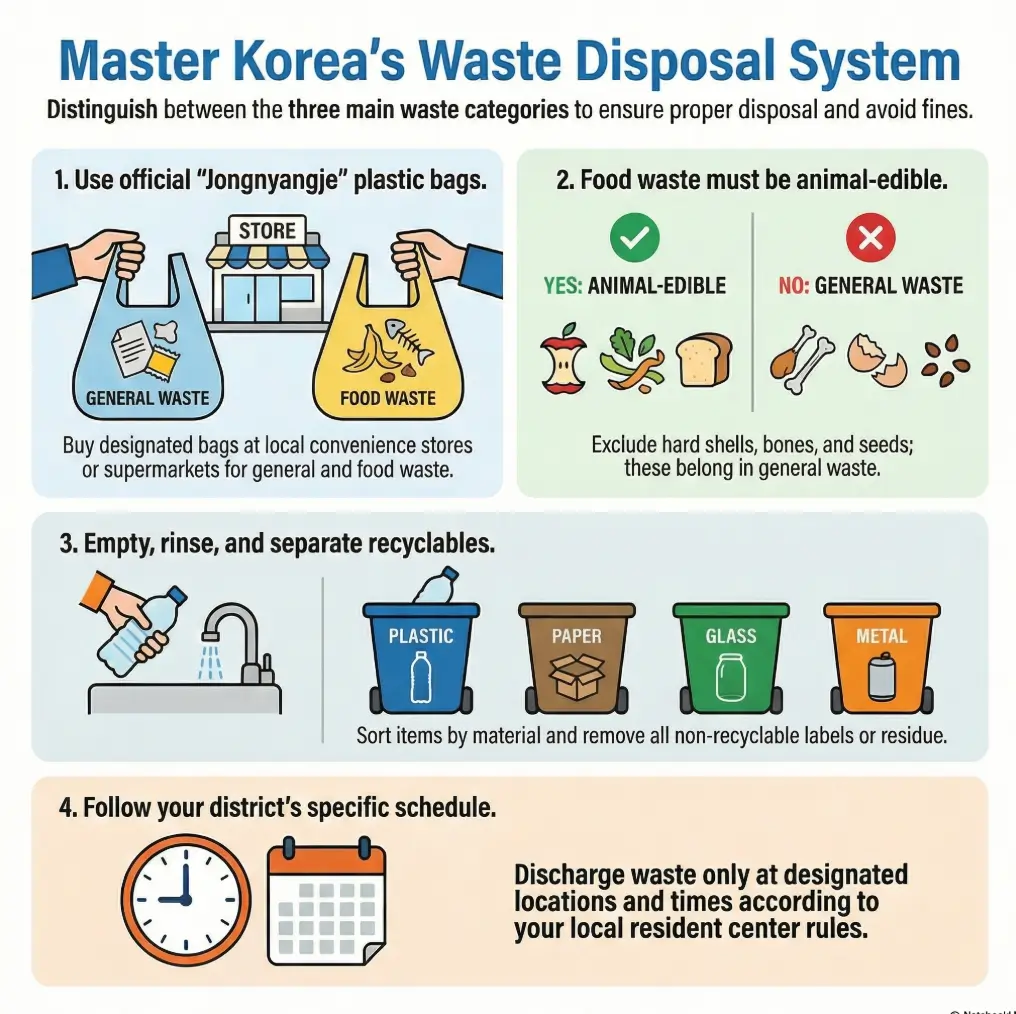
Start Here First, Why Korean Recycling Feels Harder Than It Looks
The first mistake many foreigners make is emotional, not practical. They assume that if they are intelligent adults who have recycled before, they should be able to decode Korea’s waste rules in one glance. Then they meet the real system: clear PET separated from other plastics, food waste treated differently from regular trash, labels removed from bottles, liquid drained from scraps, special bags, district rules, apartment rules, and a disposal area that somehow looks both orderly and mildly judgmental.
That friction is real. It is also predictable. South Korea’s waste system rests on long-running separate disposal and volume-based trash policies, and official Seoul guidance makes a point of telling residents to empty containers, rinse off residue, remove labels or tape, and sort by material rather than by vague intention. In other words, “recyclable-looking” is not enough. Cleanliness and separation matter.
I have seen this play out in the most ordinary way possible: one person holds a yogurt cup over the sink for ten seconds and thinks, “Surely this is good enough,” while the other person notices the foil, the sticky rim, and the sleeve and realizes the cup is actually three separate decisions wearing one innocent face. Korea’s system rewards that second kind of noticing.
Let’s be honest: this is why foreigners often feel foolish faster than they feel informed. The problem is not stupidity. It is that local knowledge in Korea is often embedded in routine, not explained in a big friendly paragraph.
- Visual familiarity does not equal disposal familiarity
- Residue, labels, and mixed materials change the category
- “Recyclable” often means “recyclable only when prepared correctly”
Apply in 60 seconds: Pick one item from your kitchen right now and identify its body, lid, label, and leftover residue as separate disposal questions.
Eligibility checklist: Is this guide the right fix for your problem?
- Yes: You live in Korea and deal with household trash in an apartment, villa, dorm, or shared house
- Yes: You feel unsure about food waste, plastic, delivery packaging, or district rules
- No: You need business waste, renovation debris, or industrial disposal rules
- No: You are looking for legal advice about a fine already issued
Next step: If you checked the first two, keep going. Your issue is probably routine design, not legal complexity.
The Real Friction, Why “Recycling” in Korea Is Actually Several Different Jobs
Many foreigners say, “I’m bad at recycling in Korea,” when what they really mean is, “I am trying to do four jobs with one mental shortcut.” That shortcut breaks quickly.
How general trash, food waste, recyclables, and oversized disposal follow separate logics
In Korea, household disposal is rarely one stream. General waste is often handled through pay-as-you-throw bags. Food waste may go into special bags or a machine, especially in multi-family housing. Recyclables are sorted by material. Bulky items can require stickers, booking, or separate collection steps. Seoul’s English recycling guide and district-level English pages repeatedly separate these pathways instead of treating them as one bin problem.
Why foreigners often fail before they even reach the bin area
Because the real work happens upstairs. If you walk downstairs holding one bag that contains food scraps, a drink cup with ice still inside, a delivery box with tape, and a plastic tray slick with sauce, you are already late to the decision. The sorting area cannot rescue a rushed kitchen.
What feels like one routine is actually four different decisions
Try this mental model instead:
- Decision 1: Is this food waste, ordinary trash, or a recyclable material?
- Decision 2: If recyclable, is it clean enough?
- Decision 3: If it has multiple materials, what must come apart?
- Decision 4: Does my building require a specific place, day, chute, card, or bag?
That is why the same coffee cup can produce a tiny existential opera. The cup body, plastic lid, paper sleeve, leftover liquid, and sticky stirrer do not all live the same afterlife.
Show me the nerdy details
Official Seoul guidance distinguishes material streams in unusual granularity for new arrivals: paper cups can become regular waste if contaminated or too few in number; boxes should have tape and invoice stickers removed; plastic containers should be emptied and rinsed; clear PET bottles are handled separately from other plastics in many settings; detached homes versus apartment complexes may follow different collection methods or timing. That is why copying a one-bin system from another country produces so much friction here.
Bold truth: if you treat Korean recycling like “trash, but greener,” you will stay confused much longer than necessary.
Local Rules Change Fast, Why One Correct Habit in One Neighborhood Fails in Another
This is the part that makes smart people mutter into the sink. You finally learn one building’s routine, feel slightly heroic for three days, and then discover that another neighborhood does it differently. Welcome to the very Korean combination of national structure and local execution.
How apartment complexes, districts, and building managers can shape the routine
Official English district pages already hint at this variation. One district may describe apartment food waste going into an RFID disposal chute, while another page emphasizes designated collection areas, time windows, or bags for detached homes. Seoul’s own guide distinguishes detached housing from apartment units for some disposal categories.
Why copying what you learned in one city can backfire in the next
A habit that works in one building can fail elsewhere for three reasons:
- The collection day is different
- The acceptable method is different
- The building has its own management routine layered on top
I once watched two neighbors do opposite things with what looked like the same bottle, and both were right in context. One building had an exclusive clear PET stream. The other had a broader plastics setup that still required cleaning and removal of attachments. From far away, it looked like contradiction. Up close, it was system layering.
Here’s what no one tells you… “the rule” is often partly a building rule
Foreigners often search for one universal answer. What they need is a stack of answers:
- Korean waste law and broad municipal rules
- Your district’s collection method
- Your building’s practical workflow
Miss layer three, and you can still get side-eyed in a perfectly legal way.
Decision card: When should you trust a national guide, and when should you trust your building?
- Use a national or city guide when learning categories, cleaning rules, and basic disposal logic
- Use your district page when checking collection days, bag systems, and detached-home rules
- Use your building notice when checking exact bins, RFID access, and where items physically go
Neutral action: Save one source from each level on your phone so you are not relying on memory alone.
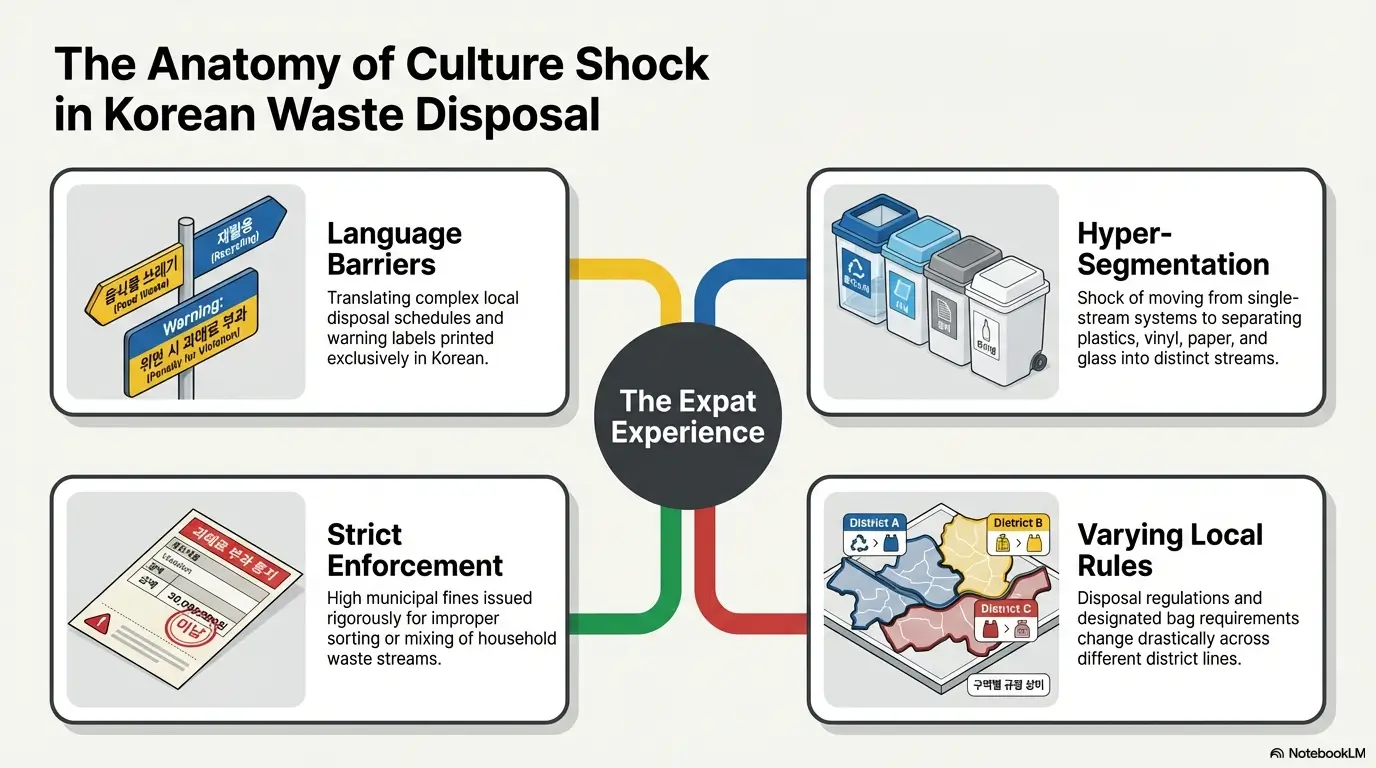
Packaging Traps First, The Items That Confuse Foreigners Most
If Korean recycling has villains, they are rarely dramatic. They are quiet little shapeshifters: sleeve-on bottles, film-covered trays, sauce-streaked delivery containers, mixed paper packs, and “plastic” items that are only partly plastic in the way that matters.
Why delivery containers, plastic film, mixed-material packaging, and cups create hesitation
Modern life arrives gift-wrapped in mixed materials. Delivery culture makes this more intense. A single order can produce cardboard, tape, invoice labels, plastic trays, clear lids, black plastic, sauce packets, film, and food residue. Seoul’s official guide explicitly tells residents to remove tape and labels from boxes and to rinse containers before disposal. That sounds simple until it is 10:40 p.m. and your noodles have become a packaging taxonomy exam. The same daily rhythm that makes Korean delivery culture feel so efficient is also what creates this dense little afterparty of packaging decisions.
How food residue changes whether something is recyclable in practice
This is where foreigners lose confidence. In many places, people are taught broad recycling optimism: toss the container in, and the system figures it out. Korea asks for more preprocessing. Contaminated paper cups may become regular waste. Plastic containers that cannot be properly rinsed can also cross the line out of recycling.
Why labels, caps, lids, sleeves, and soft plastics turn a simple item into a sorting puzzle
The body of the item is not the whole story. A clear PET bottle may require label removal, collapsing, and closing the lid. Vinyl and film may be grouped differently from rigid plastics. Soft packaging, clingy wrap, and pouches often confuse people precisely because they feel too flimsy to count, yet too synthetic to ignore. Seoul’s guide separates clear PET and vinyl in ways many foreigners do not expect.
Quick sanity rule: when an item feels “annoyingly composite,” slow down. That annoyance is usually accurate.
- Delivery packaging creates the highest confusion density
- Residue often decides whether recycling is realistic
- Labels, tape, foil, and sleeves are small but important
Apply in 60 seconds: Keep one pair of scissors near the sink so label and tape removal becomes routine instead of a negotiation.
Reader-friendly rule of thumb: If a container still smells like dinner, Korea may not consider your recycling attempt finished.
Don’t Start With the Bin, Start With the Kitchen Counter Instead
The easiest way to make Korean recycling feel less punishing is almost comically domestic: redesign the place where your trash first lands. Not the alley. Not the basement room. The kitchen counter.
Why recycling success is decided before you leave the apartment
By the time you reach the disposal area, you should already know where each item belongs. A rushed downstairs sort invites mistakes, spills, and that specific kind of social panic where you pretend to study a sign while internally reciting the life choices that brought you here.
How a bad in-home setup creates rushed sorting mistakes downstairs
The bad setup looks like this: one open bin, one plastic bag, no rinse space, and a growing mountain of “I’ll deal with it later.” The later becomes nighttime. Nighttime becomes confusion. Confusion becomes wishful sorting.
What small prep habits make the system feel dramatically easier
These tiny changes matter more than most newcomers expect:
- Keep a small rinse zone near the sink
- Separate food waste immediately, not at the end of the day
- Flatten boxes when empty, not before disposal day
- Use one “uncertain items” box so confusion does not contaminate everything else
A lot of foreigners think the goal is memorization. It is not. The goal is reducing decision fatigue. In practice, this belongs beside the same kind of domestic groundwork that makes a Korean apartment move-in checklist so useful: tiny household systems prevent larger daily stress.
Mini calculator: How many home sorting zones do you actually need?
If you live alone and cook lightly, start with 4 zones: food waste, general trash, recyclables, uncertain items.
If 2 or more people live together or you order delivery often, add 1 extra cardboard zone.
Neutral action: Count your most common waste streams for 3 days, then set up only the zones you actually use.
Infographic: The 4-Zone Home Setup That Makes Korean Recycling Easier
Zone 1
Food Waste
Drain liquid. Remove bones, shells, and non-food bits based on local rules.
Zone 2
General Trash
Use approved bags where required. Put contaminated, non-rinsable items here.
Zone 3
Recyclables
Rinse, separate, flatten, remove labels and tape, then group by material.
Zone 4
Uncertain Items
Pause here. Check building signs before guessing.
Common Mistakes That Make Foreigners Look Careless Even When They Are Trying
One painful truth about shared disposal areas is that effort is not always visible. Intent does not sit inside the bin waving a tiny flag. Only the result does. That is why well-meaning newcomers can look careless even when they are genuinely trying.
Throwing away containers that are technically recyclable but still dirty
Official guidance from Seoul repeatedly emphasizes emptying, rinsing, and removing foreign matter. Dirty containers do not just make one item less recyclable. They can reduce the quality of the whole stream.
Assuming all plastic belongs together
This is the classic trap. Korea often separates clear PET bottles from other plastics and distinguishes vinyl or film from rigid plastic containers. A foreigner who hears “plastic” may imagine one family. Korea often sees a whole neighborhood of cousins who should not all sit at the same table.
Mixing food waste with regular trash because the item “looks organic”
Food waste in Korea is its own system because it is processed separately and, in many places, charged separately. District guidance in English tells residents to remove liquids and foreign substances, and some apartment complexes use RFID-based systems rather than ordinary trash bags for food waste.
Using the wrong bag and not realizing the problem until collection day
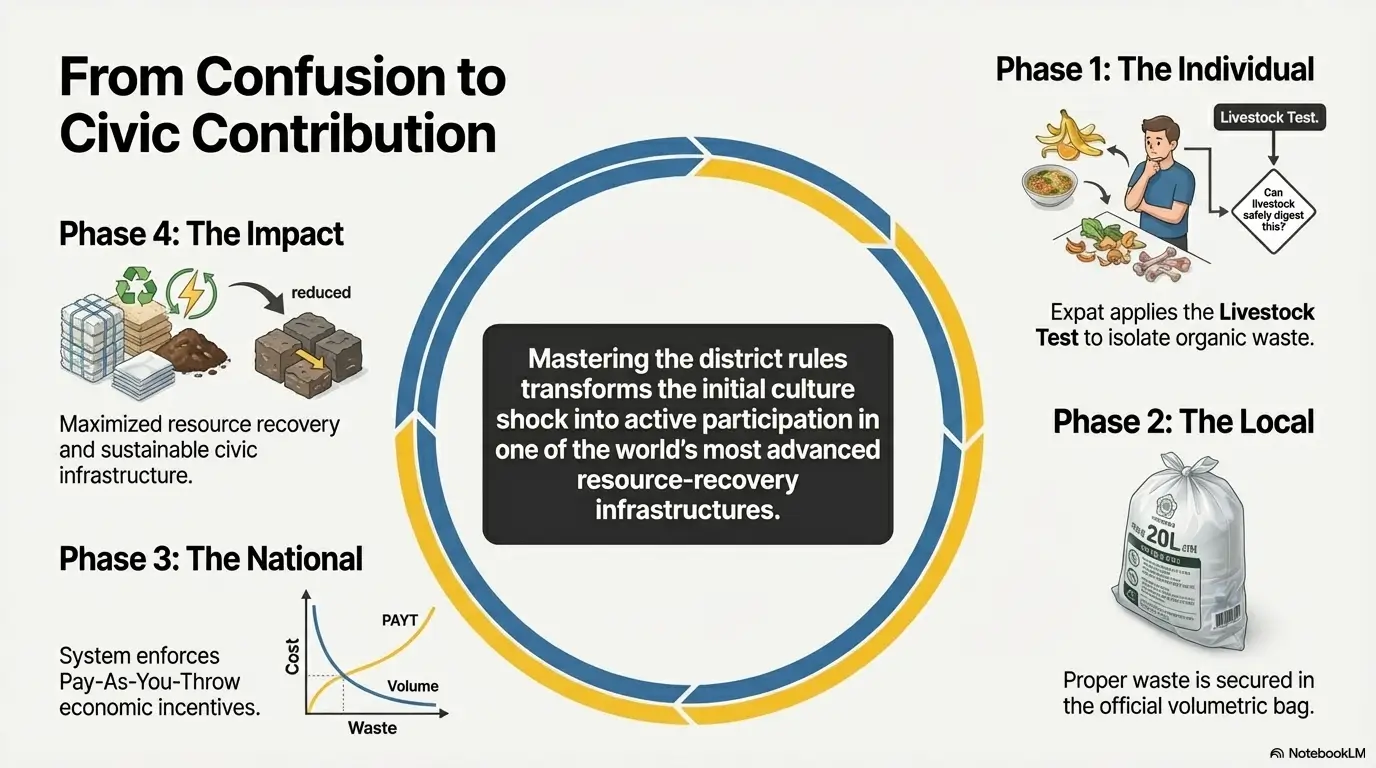
Pay-as-you-throw logic can feel fussy until you understand the point: general waste is not supposed to disappear invisibly into any random bag. The system is designed to price disposal and encourage sorting. Korea’s Ministry of Environment describes volume-based garbage fees as one of the pillars of the country’s waste management system.
Don’t do this:
- Do not assume English signs explain every practical detail
- Do not sort by color alone
- Do not copy one neighbor blindly
- Do not call an item recyclable just because it was recyclable before it met sauce
A small anecdote here. In one shared housing setup, the “most careful” resident was the one who caused the most confusion because she over-sorted everything into the most optimistic category. The calmest resident was the one who sometimes said, “This cannot be cleaned properly, so today it is ordinary trash.” That second instinct was less glamorous and more correct.
- Dirty items create avoidable problems
- Plastic is not one category in practice
- Correct bags and correct streams both matter
Apply in 60 seconds: Put a sticky note above your sink that says “Clean? Separate? Building rule?”
The Social Layer, Why Recycling in Korea Feels More Public Than Foreigners Expect
This part is easy to underestimate if you come from a place where trash disappears into a private curbside ritual. In Korea, disposal often happens in a shared, visible, repeated space. That changes the emotional weather of the whole task.
How shared housing spaces quietly increase pressure to get it right
Apartment recycling areas, villa collection points, and dorm disposal spaces compress the gap between private habit and public consequence. Your sorting choices are not abstract. They are legible. Sometimes very legible.
Why embarrassment, not difficulty, often becomes the real barrier
Many foreigners are not actually confused about every item. They are scared of being corrected in public. They dread being the person standing under fluorescent lights, holding a dripping tray, while a manager, landlord, or neighbor explains a rule at medium volume and high accuracy.
How community visibility changes behavior faster than official instructions
That is why shame travels faster than guidance. The system may be procedural, but the experience feels social. A newcomer can go from “I do not fully understand this” to “I must not be the problem person in this building” in about nine seconds.
There is a cultural layer here too. Shared spaces in Korea often carry strong expectations about not burdening others. Waste is not just your waste once it enters a common area. It becomes a small public test of coordination. That sounds severe when written down, but in real life it is often ordinary courtesy wearing a stricter coat. Readers who have already noticed this atmosphere in everyday Korean politeness or in the way silence works in Korean conversation will recognize the same social texture here.
Humbling but useful insight: foreigners often improve fastest not when they memorize more categories, but when they reduce the chance of public guesswork.
Best mindset shift: treat the disposal area like a shared kitchen, not a trash graveyard. Precision starts making more emotional sense.
What Foreigners Often Misread, Why the System Feels Stricter Than It Is
Foreigners often describe Korean recycling as harsh, strict, or unforgiving. Sometimes it is strict. But just as often, what feels harsh is actually a mix of unfamiliarity, visibility, and local precision.
How precision can feel punitive even when the goal is order
When a system demands more steps than you expect, correction can feel moral even when it is administrative. “You must remove the label” lands differently when you are already tired, newly arrived, and guessing in a second language.
Why correction from a landlord or neighbor may feel personal when it is usually procedural
Many corrections are not really about you. They are about keeping the stream clean, preventing smells, avoiding collection problems, or matching the building’s rules. The tone may still sting. But the logic is often maintenance, not personal attack.
What cultural expectations about shared responsibility do to the learning curve
In some places, waste systems are designed around forgiving consumer behavior. In Korea, the system more often assumes that households will participate actively. That is one reason the Ministry of Environment frames waste reduction, separate disposal, and volume-based fees as core pillars rather than optional extras.
I think this is where many expatriates, students, and long-stay visitors exhale for the first time: the system is not punishing you because you are foreign. It is expecting you to join a routine that locals themselves had to learn, mostly by repetition, correction, and a fair amount of kitchen-side muttering. In that sense, the pattern resembles Korean indirect communication more than open scolding: much of the rule is carried by context, routine, and the expectation that you will gradually read the room.
What to gather before asking your manager, landlord, or building office
- A photo of the disposal area
- A photo of the item confusing you
- Your building name and unit type
- One clear question, not six vague ones
Neutral action: Send these together once, and you will usually get a much better answer than “How does trash work here?”
A Better Way In, How to Learn Korean Recycling Rules Without Feeling Overwhelmed
Here is the good news hiding inside all this detail: you do not need to master everything at once. You need a repeatable entry point.
Start with the highest-risk categories first
Begin with the categories most likely to create daily mistakes:
- Food waste
- General trash bags
- Clear PET and other plastics
- Delivery packaging with residue
If you get these four mostly right, your life improves fast.
Build a repeatable weekly disposal routine instead of memorizing everything at once
The brain loves ritual more than loose information. Set one short routine for weekdays and one for larger disposal tasks. For example: rinse and separate at dinner, flatten boxes immediately, move sorted items downstairs every other evening, check uncertain items once a week.
Use signs, neighbors, and local office guidance as confirmation, not your only plan
This matters. Signs help. Neighbors help. District pages help. But the strongest system is still your own. Seoul even published multilingual guidance for foreign residents on food waste separation, which tells you something important: public institutions know newcomers need extra support because the rules are not intuitive on day one.
Short Story: The photo that solved the problem
A foreign student in Seoul kept getting stuck on the same ritual every Sunday night. She knew the broad categories. She even knew the Korean words for food waste and general trash. But downstairs, with bags in hand, every package became a tiny courtroom case. One week she did something wonderfully unglamorous:
she took a photo of the disposal area in daylight, then laid three common items on her kitchen table that evening, a PET bottle, a delivery tray, and a greasy paper cup. She matched each one to the signs before the next trash run. That was it. No grand breakthrough. No perfect multilingual manual descending from heaven. Just one quiet act of preparation. Within two weeks, her stress dropped because the sorting stopped being public improvisation. It became private rehearsal followed by a boring, successful routine. In Korea, boring is often the real luxury.
Who this is for: this guide is best for exchange students, teachers, military families, remote workers, long-stay visitors, and expats handling ordinary household waste. It is not enough for business waste streams, renovation debris, or commercial disposal obligations.
- Learn the top four high-friction categories first
- Use photos and repeatable routines
- Treat signs as confirmation, not rescue
Apply in 60 seconds: Create one note on your phone called “Building Trash Rules” and save photos, collection days, and your three most confusing items.
FAQ
Why is recycling in Korea so confusing for foreigners?
Because the difficulty is not the idea of recycling itself. It is the specificity. Korea often expects items to be cleaned, separated by material, and disposed of according to housing and district routines. Newcomers are often missing the local habit layer, not the intelligence layer.
Do recycling rules in Korea change by apartment or neighborhood?
Yes, the broad system is consistent, but the method can vary by district and building. Detached homes, villas, and apartment complexes may use different bag systems, collection times, or food-waste methods such as RFID disposal in multi-family housing.
Do I need to wash recycling before throwing it away in Korea?
Very often, yes. Official Seoul guidance tells residents to empty, rinse, and remove foreign matter or labels before disposal. Dirty containers are a common reason foreigners think they have sorted correctly when the system disagrees.
What happens if I throw recycling away the wrong way in Korea?
Often the first consequence is practical rather than dramatic: your trash may not be collected, a landlord or manager may correct you, or neighbors may point out the issue. The exact enforcement level depends on local practice, but the day-to-day effect is usually friction, not cinematic punishment.
Is food-stained plastic recyclable in Korea?
Not always. If it cannot be cleaned properly, it may need to go into general trash instead of recycling. The decisive question is not what the item once was, but whether it can enter the recycling stream cleanly enough to be processed.
Why do Korean trash rules feel stricter than in the US?
Because many Americans are used to broader curbside collection and less visible sorting. Korea’s system often pushes more of the sorting burden back to the household and makes the routine more public in shared spaces.
Are foreigners expected to know local recycling rules right away?
In social reality, people may hope you learn quickly. In institutional reality, cities know new residents need help. Seoul has published multilingual waste guidance for foreign residents, which suggests the learning curve is widely recognized.
What is the easiest way to learn recycling rules after moving to Korea?
Start with your building’s actual disposal area, your district’s English page if available, and the four categories you handle most: food waste, general trash, recyclables, and uncertain items. Build a simple home sorting system first, then refine it.
Conclusion
The hook at the beginning of this article was simple: recycling in Korea can feel like a test you never meant to take. Here is the closure to that feeling. The test is not really about environmental virtue or flawless Korean. It is about routine architecture. Once you stop chasing one universal answer and start building a home system that matches your building’s logic, the stress begins to thin out.
The biggest difference you can make this week is not memorizing every edge case. It is creating a four-zone setup at home for food waste, general trash, recyclables, and uncertain items, then taking one clear photo of your building’s disposal area. That one move turns a public guessing game into a private reference system.
For people who are busy, embarrassed, or simply tired, that matters. It means fewer messy last-minute decisions. Fewer “Is this probably fine?” moments. Fewer tiny failures that feel bigger than they are. And in a country where shared routines often carry social weight, that kind of calm is worth a lot.
Next step in 15 minutes: write a one-page household checklist with your building’s collection rules, the items you confuse most often, and the exact path each one takes. If you live with other people, tape it inside a cabinet door. Recycling gets easier when memory stops doing all the work. And if you are still settling into the wider rhythm of domestic life, pairing this with a practical read on Korean shoe etiquette at home can help the whole space feel less improvised and more legible.
Last reviewed: 2026-03.