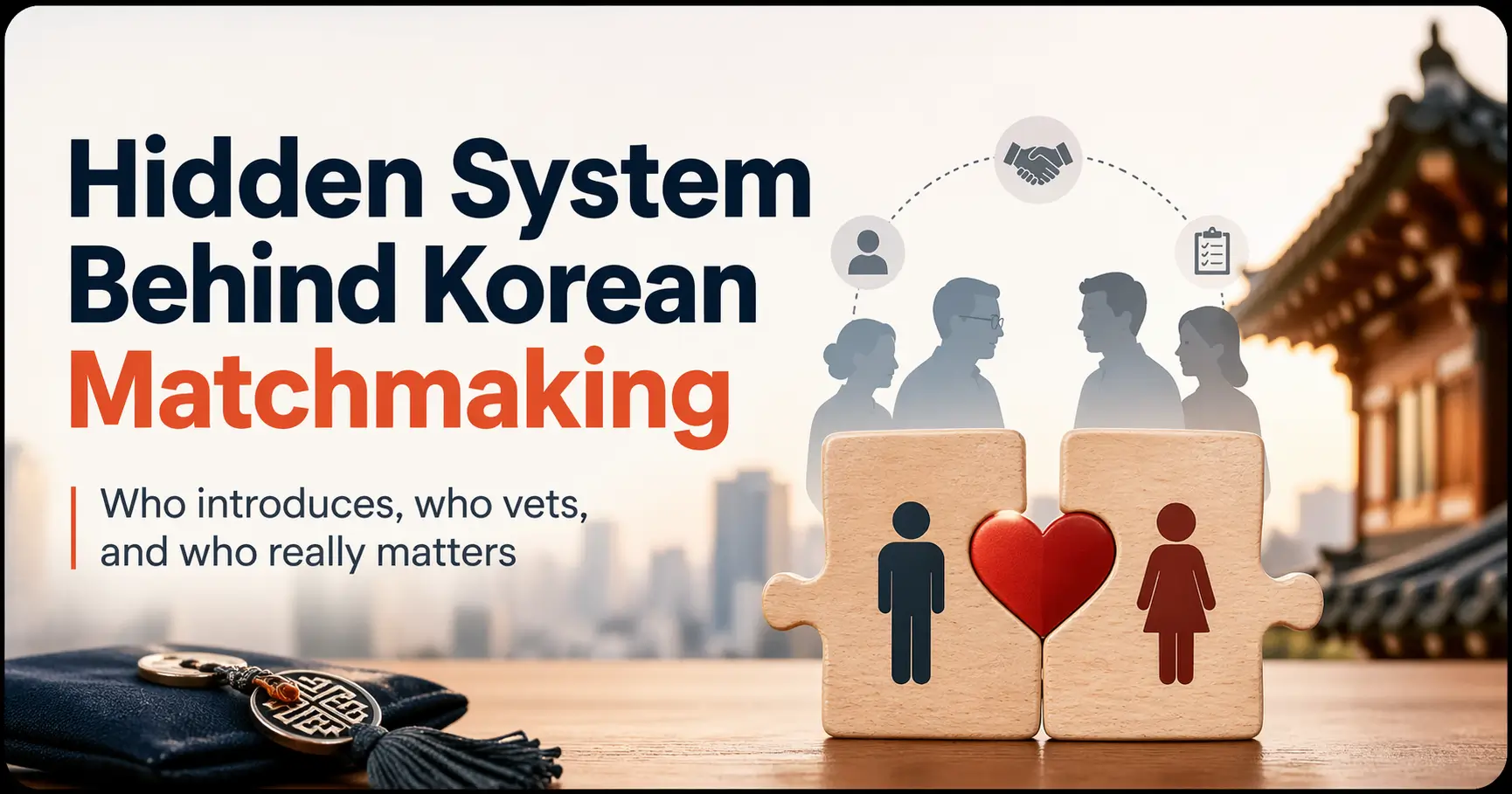
The Hidden Architecture of Korean Romance
Modern Korean matchmaking rarely announces itself. It slips in through a friend’s “casual introduction,” a parent’s carefully worded suggestion, a coworker’s convenient setup, or a dating app profile already humming with status signals.
From the outside, South Korea can look fully individualistic and app-driven, but the confusion usually comes from expecting old matchmaking to disappear. In reality, it has simply gone discreet. To understand these relationships, one must look beyond simple attraction to the underlying forces of timing, stability, and family approval.
This guide helps you decode the culture by tracing the real interpretive map:
- 🔹 The Introduction: Who initiated the connection?
- 🔹 The Vetting: Who performed the social filtering?
- 🔹 The Stakes: Who matters once things become serious?
The Objective
Not the stereotype. The mechanism. Once you see it, modern Korean romance starts making far more sense.
Fast Answer: Matchmaking in modern Korea has not disappeared so much as changed costumes. It often survives through family introductions, social vetting, workplace networks, dating apps filtered by status cues, and quiet pressure around marriage timing. What looks informal on the surface can still carry the logic of older arranged matching: compatibility screened through family, education, stability, and social fit.
Table of Contents
Why It Still Matters: The Old System Did Not Vanish, It Went Quiet
Matchmaking today often looks like “just an introduction”
In modern Korea, matchmaking often survives by avoiding the word itself. Nobody stands up in the living room and announces a grand social arrangement with a brass band. Instead, a friend says, “I know someone nice.” A mother says, “He has a stable job, just meet once.” A coworker forwards a profile with the energy of a person pretending not to be involved while being, in fact, extremely involved.
The old architecture remains recognizable. Two people are introduced through a trusted channel. Information is lightly pre-screened. The first meeting does not begin at zero. By the time the pair sits down for coffee, several invisible hands have already adjusted the chairs.
I once listened to someone describe such a meeting as “basically blind dating, but safer.” That one sentence does a lot of work. It captures the mood of contemporary Korean matchmaking better than most dramatic explanations do. The form looks casual. The logic is still curated.
What changed is visibility, not necessarily structure. The system no longer needs to be formal to be powerful.
Family logic still survives inside modern dating language
Part of the confusion for outsiders is linguistic. The language of modern dating sounds individualistic. People talk about chemistry, values, vibe, timing, lifestyle. All of that is real. But inside that vocabulary, older questions often remain quietly active: Is this person dependable? Does the family seem stable? Is marriage realistically possible? Will this choice create friction later?
That is why the old system did not disappear when Korea modernized, urbanized, digitized, and began swiping left in fluorescent subway light. It simply became more conversational. The social logic slipped into friend groups, office circles, alumni networks, church communities, and app behavior. Even ordinary communication habits, such as the layered indirectness explored in Korean indirect communication, can make social pressure easier to deliver softly and harder for outsiders to notice.
The shift is not from arranged to free, but from explicit to discreet
Foreign readers often imagine two opposite worlds. In one, elders arrange everything. In the other, autonomous adults choose freely and family stays out of it. Real life, stubborn as a sock under a sofa, rarely cooperates with that clean diagram.
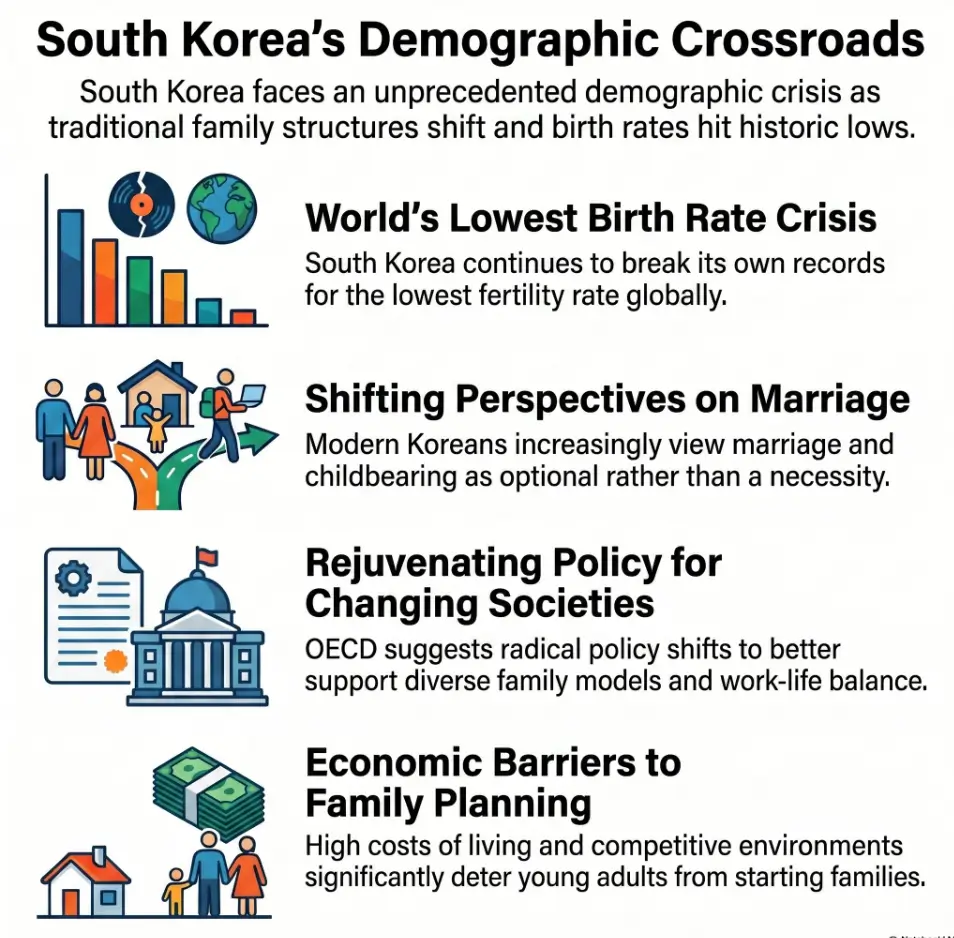
Modern Korean matchmaking is better understood as a spectrum. Some people date freely with minimal family input. Others move through heavily filtered introductions. Many live somewhere in the middle, making personal choices while still navigating family expectations, economic realities, and marriage timelines. OECD analysis of Korea’s changing family patterns notes that Koreans are marrying later than before, or not at all, while marriage still carries strong social expectations compared with many other settings.
- Introductions may look casual but arrive pre-screened
- Family logic can hide inside modern dating language
- The key shift is from explicit arrangement to subtle filtering
Apply in 60 seconds: When you hear “someone introduced us,” ask who vetted whom before the first coffee.
Who This Is For, and Who It Is Not For
This is for readers trying to understand Korean dating beyond stereotypes
This article is for readers who have noticed a pattern but do not want to cheapen it. Maybe you are dating a Korean partner. Maybe you have watched Korean dramas and sensed something real beneath the melodrama. Maybe you keep hearing about parental approval, “good backgrounds,” or introductions that feel oddly strategic. You are not looking for gossip. You are looking for a map.
This is for people puzzled by family involvement, social vetting, or marriage pressure
It is also for readers who keep tripping over a recurring contradiction. Korea looks modern, educated, urban, digitally fluent, globally connected. So why do family approval, age, job stability, and educational pedigree still appear so often in relationship talk? The answer is not that modernity failed. The answer is that modernity arrived and began negotiating with older social priorities rather than bulldozing them overnight.
This is not for readers looking for gossip-level generalizations about all Koreans
It is not for readers who want one lazy sentence to explain 50 million people. Korea contains regional, class, religious, generational, and personal differences. Seoul is not every town. One household is not a national constitution. One awkward dinner with a boyfriend’s mother is not a peer-reviewed journal.
Eligibility checklist: Is this framework useful for your question?
- Yes: You want to understand social patterns behind modern dating behavior
- Yes: You are trying to decode family involvement without caricature
- No: You want a claim that all Korean relationships work one way
- No: You want scandal, not social explanation
Next step: Read for mechanisms, not morality plays.
The Real Change: From Formal Matchmakers to Social Filtering
Traditional brokers matter less, but gatekeeping still happens
Formal matchmakers still exist in Korea, especially for marriage-minded adults and wealthier clients, but they are no longer the only or even the most culturally revealing channel. The more common modern story is softer. A friend recommends someone. A cousin makes a setup. A parent asks around. A church elder keeps an eye out. A senior at work makes a suggestion that somehow feels like both kindness and surveillance.
This is where “social filtering” becomes the useful phrase. The filtering is dispersed. No single person may be acting as a professional matchmaker, yet the network collectively performs a similar function.
Introductions now move through friends, parents, coworkers, and alumni circles
These networks matter because they reduce uncertainty. In a society where marriage can still be seen as a life-stage milestone with financial and familial consequences, random choice may feel romantic but not always efficient. A socially connected introduction comes with metadata. Not perfect metadata, of course. Human beings remain gloriously buggy. But the network can often answer questions before the couple has to ask them directly.
That matters more than many outsiders realize. Knowing someone’s school, profession, family situation, or reputation through mutual ties can function like a social credit check, minus the spreadsheet and with more coffee. This is part of why seemingly separate environments, from university life to alumni culture, matter so much. The social scaffolding described in Korean university orientation and Korean campus clubs does not only organize student life. It also builds the networks through which later introductions can travel.
Compatibility is often pre-screened before romance even begins
In many modern Korean introductions, romance enters a room that has already been partially arranged. The pre-screening may involve age range, work stability, educational background, religion, hometown compatibility, or marriage intention. That does not guarantee success. It merely means the first date is sometimes less an open wilderness and more a fenced garden.
That is a major clue for understanding subtle matchmaking: compatibility is often defined before attraction gets a vote.
Show me the nerdy details
Social filtering lowers information costs. In practical terms, networks supply early signals about reliability, lifestyle fit, and family expectations. That does not eliminate emotional uncertainty, but it narrows the field before emotional investment gets expensive.
Decision card: Direct dating vs socially introduced dating
| Path | What you gain | What you trade away |
|---|---|---|
| Direct dating | More autonomy, wider pool, less supervision | Higher uncertainty, less early vetting |
| Social introduction | More context, faster trust signals, marriage-minded clarity | Less spontaneity, more social expectation, narrower pool |
Neutral action: Ask which uncertainty matters more to the people involved, emotional or social.
Status Signals First: Why “Personal Preference” Is Not the Whole Story
Education, job stability, family background, and age still carry weight
One of the easiest mistakes foreign readers make is assuming that if two adults choose each other, only personal taste is at work. In reality, personal preference often shares the stage with social legibility. Education can signal diligence and class location. Job stability can signal future safety. Family background can signal fewer future surprises. Age can signal urgency or timing. None of these factors are unique to Korea, but they can be unusually visible there because marriage still often carries a wider family and economic meaning.
I remember hearing a Korean acquaintance describe a blind date not by saying, “He is funny,” but by saying, “He is solid.” That adjective sounded almost architectural. It was not the language of butterflies. It was the language of load-bearing walls.
Dating choices can reflect household expectations, not just individual desire
This does not mean everyone marries like a strategist at a merger desk. Many people resist these pressures. Many deliberately date outside them. But even resistance reveals the force of the thing being resisted. A person who insists, “I do not care what my parents think,” usually says so because parental opinion has some gravitational mass.
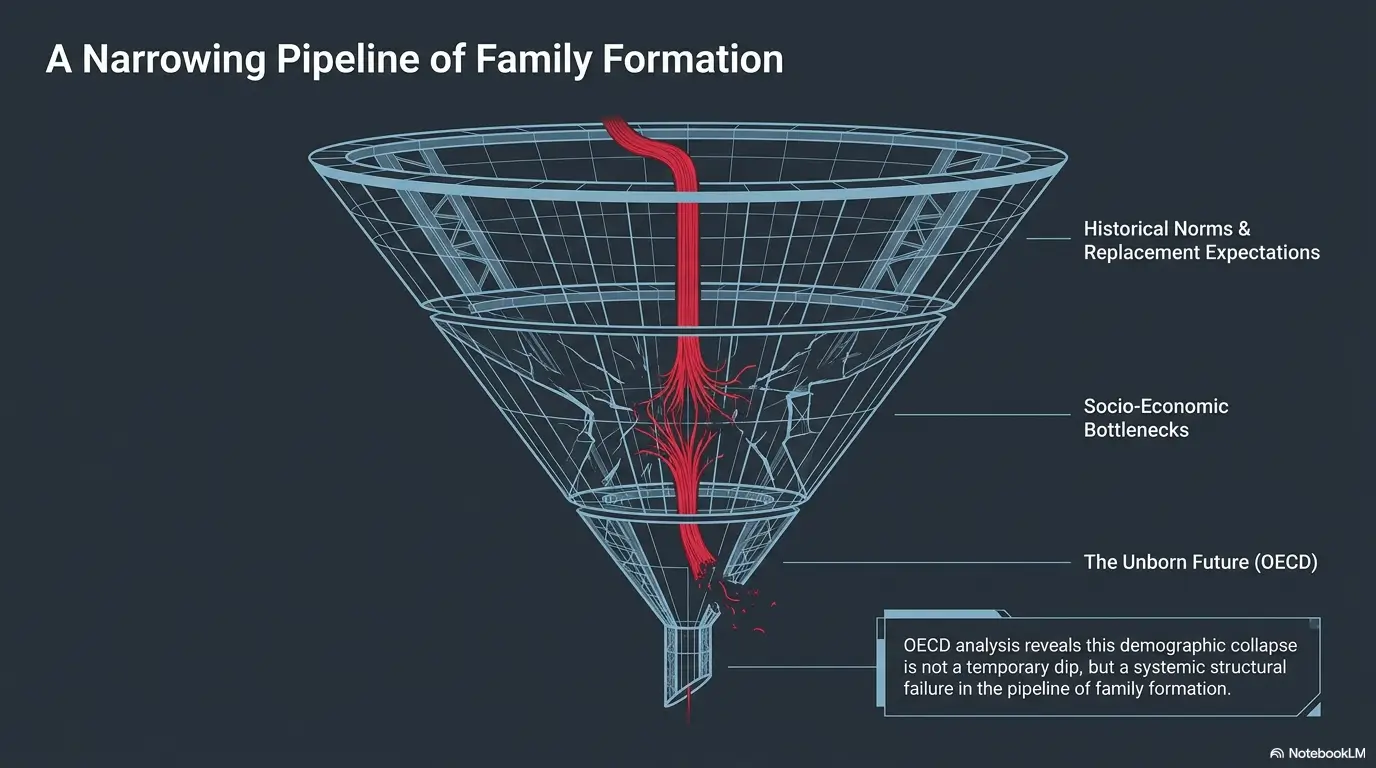
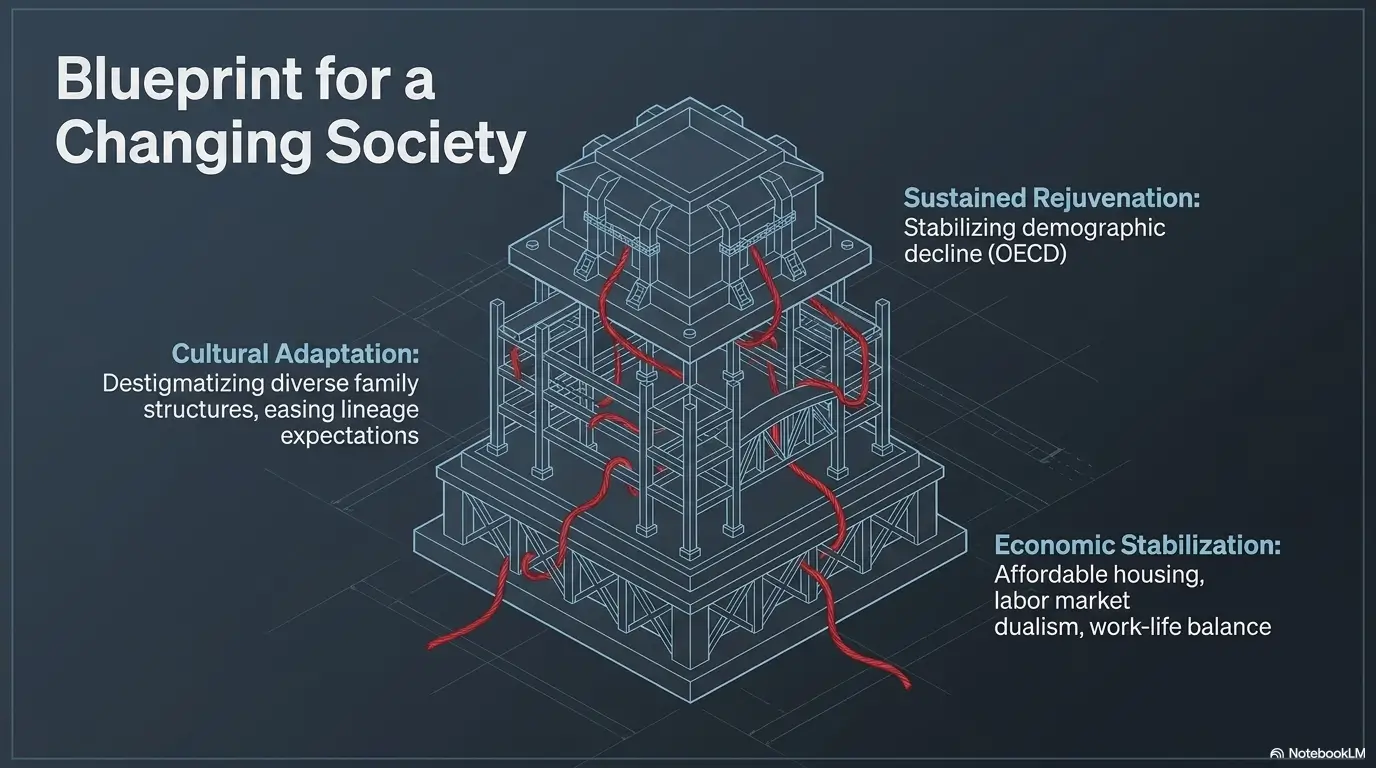
OECD work on Korea repeatedly links marriage behavior to broader structural pressures such as housing costs, career-family tradeoffs, and strong expectations around family formation. In other words, the stakes around choosing a partner are not purely romantic. They are social, economic, and practical as well. Those pressures sit inside the same demographic weather discussed in Korea’s low birth rate effects, where family formation becomes not just intimate but also publicly consequential.
Here’s what no one tells you: subtle matchmaking often begins before two people meet
By the time one person says yes to an introduction, somebody has often already performed a quiet audit. Is the other person “serious”? Are they marriage-minded? Is the family likely to approve? Does the timeline make sense? Does this look like a dead-end romance or a viable life path? Those questions may never be spoken aloud on date one. Still, they hover like weather.
- “Preference” may include practical and family-based filters
- Stability can be valued as much as spark
- Pre-screening often begins before the first meeting
Apply in 60 seconds: Replace “What do they like?” with “What risks are they trying to reduce?”
Family Influence Now: Softer Voice, Same Gravity
Parents may not choose the partner, but they can shape the shortlist
Modern Korean parents often do not issue commands. Many know their children would rebel, sulk, or simply disappear into the app economy. So the influence changes tone. Instead of choosing, they suggest. Instead of forbidding, they worry. Instead of ordering, they “just ask a few questions.” Anyone who has ever been lovingly interrogated over fruit and tea knows that soft power can still be power.
The shortlist matters because access matters. A parent who introduces someone from a family friend network is not selecting a spouse directly, but they are shaping the universe of visible options. That is influence with plausible deniability. It is the social equivalent of moving furniture while insisting the room arranged itself.
Approval pressure often appears as concern, advice, or timing questions
Pressure rarely arrives dressed as pressure. It arrives as concern about age. Advice about marriage timing. Curiosity about job prospects. Questions about whether someone is “serious.” Polite concern over whether two families are a good fit. That tone matters. Outsiders may miss the force because the words are gentle. But a gentle question asked 18 times across 6 holidays acquires its own percussion section.
Let’s be honest: “Are you seeing anyone?” is sometimes a screening tool, not small talk
When parents ask about a relationship, they may be measuring more than emotional happiness. They may be checking whether the relationship seems legible inside family expectations. Does it look stable? Does it seem respectable? Is it likely to move somewhere socially recognizable? If not, the concern can intensify. Not always dramatically. Sometimes just enough to make dinner taste like an exam.
Statistics Korea has even discussed adding census items related to marriage intention and family planning in the 2025 population census, which is a small but telling sign of how publicly salient marriage and family questions remain in Korea’s policy imagination.
Apps Changed the Surface, Not Always the Selection Logic
Dating apps can widen access while preserving class and status sorting
Apps look like liberation machines. In some ways, they are. They expand access beyond the friend-of-a-friend universe. They allow women and men to search outside neighborhood, office, and family networks. They create room for more autonomous choice. But they do not automatically erase status logic. They often digitize it.
Profiles carry clues. School names. Job titles. Photos signaling lifestyle. Language choices signaling polish. Age displayed with merciless clarity. Intentions implied through tone. What older systems handled through aunties, alumni groups, or coworkers can now be sorted through interface design and user behavior.
Profile cues often replace older face-to-face vetting rituals
Older matchmaking asked a network to do the vetting. Apps let users perform much of that work themselves. But the criteria can remain familiar. Education, salary proxies, neighborhood signals, height, manners, family-mindedness, even the style of photos can function like coded indicators. The software is new. The social reading is old enough to have opinions about your posture. Even text style can matter. Readers who want to understand how tone quietly carries status and intimacy may notice parallels with Korean texting formality and the softer, ambiguity-rich patterns described in what “maybe” can mean in Korean.
Digital freedom and social filtering can coexist without contradiction
This is the point many analyses miss. Apps do not automatically equal free individualism. They can create a larger market while still rewarding conventional signals of social worth. So yes, technology changed the surface. It widened the hallway. It did not necessarily remove the bouncers.
Modern Korean matchmaking is often hybrid. A person may swipe independently, accept a parent-arranged introduction, and ask friends to screen both options. That is not hypocrisy. That is adaptation.
Mini calculator: How much filtering happened before the first date?
Count three inputs: who introduced you, what they already knew, and what criteria were mentioned before meeting. If the answer is more than 3 meaningful signals, you are not starting from pure chance. You are starting from curated possibility.
Neutral action: Use this to compare app matches with introduced matches.
Not Just Romance: Marriage Timing Still Shapes the Conversation
The pressure is often less about love than about life schedule
One reason subtle matchmaking persists is brutally simple: for many people, the issue is not only love. It is schedule. When should marriage happen, if at all? Before what age? Before which career threshold? Before parents age further? Before housing becomes even less affordable? Once dating gets tied to life sequencing, matchmaking starts to look less like tradition for tradition’s sake and more like a scheduling technology with emotional side effects.
That sounds unromantic because it is. But real adult life often is. The rent is due. Parents worry. Careers consume daylight. The question quietly shifts from “Whom do I like?” to “Whom can I realistically build a life with on a plausible timeline?”
Age norms, career timing, and family expectation still intersect
Modern Korea has seen major changes in marriage behavior. People marry later. Many postpone or opt out. Yet the social meaning of marriage remains strong enough that age and timing still shape conversations, especially when people move into what families consider the serious years. OECD reporting on Korea’s population decline explicitly links very low fertility to declining marriage and notes the structural pressures surrounding work and family formation.
Why subtle matchmaking rises when marriage feels “late”
Once someone is perceived as “late” for marriage, even if they do not feel late themselves, family and social networks may intensify their efforts. Introductions become more frequent. Questions sharpen. Dating becomes less recreational in the eyes of surrounding adults. The atmosphere changes from open-ended exploration to “serious consideration.” Work culture can deepen this feeling too, especially in settings where timing, stability, and future planning are read through adult responsibility. For readers trying to understand that broader pressure, annual leave culture in Korea helps reveal how adulthood is often managed through collective expectations rather than purely private preference.
Coverage tier map: How strong is marriage-timing pressure?
- Tier 1: Casual dating phase, little family involvement
- Tier 2: Family curiosity begins, questions about seriousness
- Tier 3: Frequent introductions, emphasis on age and stability
- Tier 4: Strong comparison of candidate fit, family approval more active
- Tier 5: Relationship judged mainly through marriage viability
Neutral action: Notice the tier before interpreting one awkward conversation too broadly.
Short Story: A friend once told me about her cousin in Seoul, a woman with a demanding office job and no shortage of opinions. She did not want a formal setup. She wanted “a normal relationship,” by which she meant one untouched by parental choreography. Then she turned 33, moved apartments, and watched three things happen at once: housing costs rose, her workload expanded, and family questions became less decorative.
An aunt introduced someone “only because he seemed kind and not chaotic.” The cousin rolled her eyes, accepted the coffee, and spent the ride home insisting this was not matchmaking. Yet before the meeting, she already knew his age, job type, religion, whether he wanted children, and how his parents were described by the aunt. Nothing was forced. Everything was shaped. That is the modern pattern in miniature: autonomy intact, atmosphere altered, options gently pre-arranged.
Common Mistakes When Interpreting Korean Matchmaking
Mistake: assuming all matchmaking is forced or old-fashioned
The first mistake is melodrama. Many outsiders hear “matchmaking” and imagine coercion, patriarchs, tears, and a tragic soundtrack hovering just off-camera. Real life is usually less theatrical. Many introductions are voluntary. Some are welcomed. Some feel efficient. Some are annoying but harmless. Some are deeply stressful. The point is variation.
Mistake: assuming modern dating erased family influence
The second mistake is overcorrecting. Because Korea is modern and digitally connected, some observers assume family influence is now mostly symbolic. It often is not. Families may not dictate, but they can still shape possibilities, timelines, and interpretations. A relationship can be personally chosen and socially evaluated at the same time.
Mistake: reading every introduction as purely romantic rather than socially strategic
The third mistake is treating every setup as if the only question were attraction. Sometimes introductions are also about marriage suitability, social reassurance, family diplomacy, or time-saving. This does not make the feelings fake. It simply means the introduction may be doing more than one job.
- Many introductions are voluntary but socially shaped
- Family influence can be real without being absolute
- Romance and strategy often travel together
Apply in 60 seconds: When a story sounds contradictory, assume mixed motives before assuming hypocrisy.
Don’t Flatten It: What Foreign Readers Often Get Wrong
Do not confuse subtle pressure with identical experience across all households
Not every Korean family treats dating and marriage the same way. Class matters. Religion matters. Region matters. Gender matters. Family history matters. Some households are highly involved. Others are relaxed. Some younger Koreans actively reject parental screening. Others quietly prefer the efficiency of it, especially if they are dating with marriage in mind.
Do not treat Korea as uniquely controlling without noticing class and family patterns elsewhere
Another mistake is exoticizing Korea for things that exist elsewhere under different names. In the United States, families also judge partners through class, education, income, politics, religion, and “good family” language. They may just pretend they are being purely spontaneous while doing it. Korea can make some of these filters more visible, but visible is not the same as unique.
The mistake is not curiosity, but overconfidence after one anecdote
One cross-cultural date, one viral video, one in-law horror story, one office rumor, and suddenly a grand thesis appears. Better to proceed more modestly. Ask what mechanism is visible in the story. Who introduced whom? What was being screened? What future risk was being managed? What part was family, what part was economics, and what part was simple personal preference?
I have found that the most useful questions are often the least glamorous. They do not ask, “Is Korea traditional or modern?” They ask, “Who has veto power, who has influence, and who is trying not to look influential?” That is where the live wire usually is. The same interpretive caution helps in many other social situations too, including the hidden rules behind Korean personal questions etiquette and the subtle pauses explained in Korean silence in conversation.
The Hidden Trade-Off: Why Some People Still Accept These Systems
Social vetting can reduce uncertainty for marriage-minded daters
For some adults, especially those who are busy, cautious, or dating with explicit marriage intent, social vetting can feel useful rather than oppressive. A trusted introduction can reduce uncertainty about basic compatibility. It can prevent investing months in a relationship that was never aligned on family expectations, children, religion, or timeline. That relief is not imaginary.
Family-approved introductions may feel safer, faster, or more efficient
There is also a safety logic. A socially introduced date may feel less random, more accountable, and easier to explain to family. That matters in environments where relationship choices can ripple outward into family life. Some people genuinely prefer this. Not because they lack individuality, but because they are trying to date efficiently under real constraints.
The same system that offers reassurance can also narrow personal freedom
Still, the trade-off is clear. The more a system reduces uncertainty, the more it can restrict surprise. The more it rewards social fit, the more it can punish unconventional but meaningful choices. The system can protect people from chaos and simultaneously keep them from possibilities that would have made them happy. A velvet fence is still a fence.
Quote-prep list: What to gather before judging a socially introduced relationship
- Whether the couple wanted marriage soon or later
- How much family approval mattered in practice
- What was screened before the first meeting
- Whether both people experienced the setup as helpful or restrictive
Neutral action: Gather context first, then interpret the introduction.
But Wait, There Is a Contradiction
Many Koreans want autonomy and still value social reassurance
Here is the contradiction that keeps subtle matchmaking alive: many people want personal choice and social reassurance at the same time. They want to choose freely, but not blindly. They want chemistry, but not chaos. They want autonomy, but not a family war. They want romance, but also a future that makes practical sense. This is not a uniquely Korean contradiction, though Korea often stages it more openly.
Individual choice and collective approval are often negotiated, not simply opposed
Once you grasp that, a lot of modern Korean dating behavior becomes easier to read. Individual choice and collective approval are not always enemies. Often they are under negotiation. A person may fall for someone independently, then seek family acceptance. Another may accept an introduction, then insist on choosing for themselves after the first meeting. Another may reject the whole machinery, then later borrow parts of it when dating fatigue sets in. Humans are wonderfully inconsistent. Social systems survive partly because they know this.
This is why subtle matchmaking persists without always being named
The label can feel old-fashioned, so the behavior migrates into modern forms. That is why subtle matchmaking persists without being loudly acknowledged. It is not always a formal institution anymore. Often it is a recurring pattern of vetting, nudging, comparing, timing, and approving. The music changed. The choreography kept a few familiar steps. Once relationships become visible in public, that choreography often overlaps with rituals and expectations already familiar from Korean couple culture.
Infographic: How subtle matchmaking works in modern Korea
Friend, parent, coworker, alumni tie
Age, education, job, family fit, intent
Presented as casual, kind, low-pressure
Chemistry plus social viability
Personal choice meets family reaction
Bottom line: The process feels modern because it is informal, but it still performs some of the old matching functions.
Next Step: Start With the Mechanism, Not the Stereotype
When explaining Korean matchmaking, trace who introduces, who vets, and who quietly approves before calling it “modern” or “traditional”
If you want a better explanation of matchmaking in modern Korea, do not begin with a stereotype. Begin with the mechanism. Ask three questions. Who introduced the pair? Who did the early screening? Who mattered when the relationship became serious? Those three questions will usually teach you more than an hour of dramatic cultural clichés.
This brings us back to the opening puzzle. Why does matchmaking still exist in a society that is modern, urban, educated, and app-driven? Because uncertainty still exists. Family stakes still exist. Marriage timing still exists. Economic pressure still exists. And human beings, no matter how digitally upgraded, still like shortcuts when the choice feels consequential.
The old system did not vanish. It went quiet. That is the whole riddle, and also most of the answer.
- Look for networks, filters, and approval channels
- Treat apps and introductions as possibly complementary
- Interpret pressure through timing, not just romance
Apply in 60 seconds: Use the three-question test: who introduced, who vetted, who mattered when it got serious?
FAQ
Is matchmaking in Korea still common today?
Yes, but often in quieter forms. Formal matchmaking services still exist, yet many modern cases happen through family contacts, friends, workplace networks, church communities, or app behavior shaped by status signals. It is often less visible than outsiders expect.
Is modern Korean matchmaking the same as arranged marriage?
No. In many cases, people still choose whether to meet, continue dating, or marry. The modern version is better described as socially filtered dating rather than fully arranged marriage. The degree of pressure varies widely.
Do Korean parents still influence who their children date?
Often, yes, especially when relationships begin to look marriage-relevant. The influence may appear as introductions, advice, approval pressure, or repeated questions about timing and compatibility. It is frequently softer than command-and-control stereotypes suggest.
Are dating apps replacing traditional matchmaking in Korea?
Apps have changed the surface of dating, but not always the underlying logic. They expand access and autonomy while still allowing users to sort by signals that older matchmaking systems also cared about, such as stability, education, age, and lifestyle fit.
Why do job, school, and family background matter so much?
Because dating is often read not just as romance, but as a future household decision. Those signals are used as shortcuts for predictability, social fit, and long-term practicality. They reduce uncertainty, though sometimes at the cost of flexibility and freedom.
Is this only true for wealthy or conservative families?
No. Wealth and conservatism can intensify certain patterns, but subtle matchmaking shows up across many settings. The form, intensity, and vocabulary differ by household, region, generation, and personal values.
Do younger Koreans reject matchmaking completely?
Some do, absolutely. Others reject formal versions but accept casual introductions. Still others combine independent dating with selective family or friend vetting. Younger generations are not one bloc. The interesting question is not whether they reject it in theory, but which parts they still use in practice.
Why can matchmaking feel invisible to outsiders?
Because it is often disguised as ordinary social help. An introduction can look casual even when much of the filtering happened earlier. The influence is frequently distributed across networks instead of concentrated in one obvious matchmaker.
Is subtle matchmaking unique to Korea?
No. Many societies practice status-based partner screening through family or class-coded norms. Korea is distinctive not because it invented this behavior, but because the interaction between modern autonomy, family expectation, and marriage timing can remain especially visible.
Does family approval matter more for marriage than casual dating?
Usually, yes. Family influence often intensifies when a relationship starts to look durable, public, or marriage-oriented. Casual dating may be tolerated with less scrutiny than someone seen as a serious long-term candidate.
Before you leave with a neat label, keep the useful discomfort. The reason matchmaking still exists in modern Korea is not that modern people secretly live in the past. It is that modern life did not erase uncertainty, family consequence, or timing pressure. It only changed the costume rack. In the next 15 minutes, try this small exercise: take one Korean dating story you know and map three things, the introducer, the filters, and the approvers. You will usually see more truth in that tiny sketch than in a stack of clichés.
Last reviewed: 2026-04.