
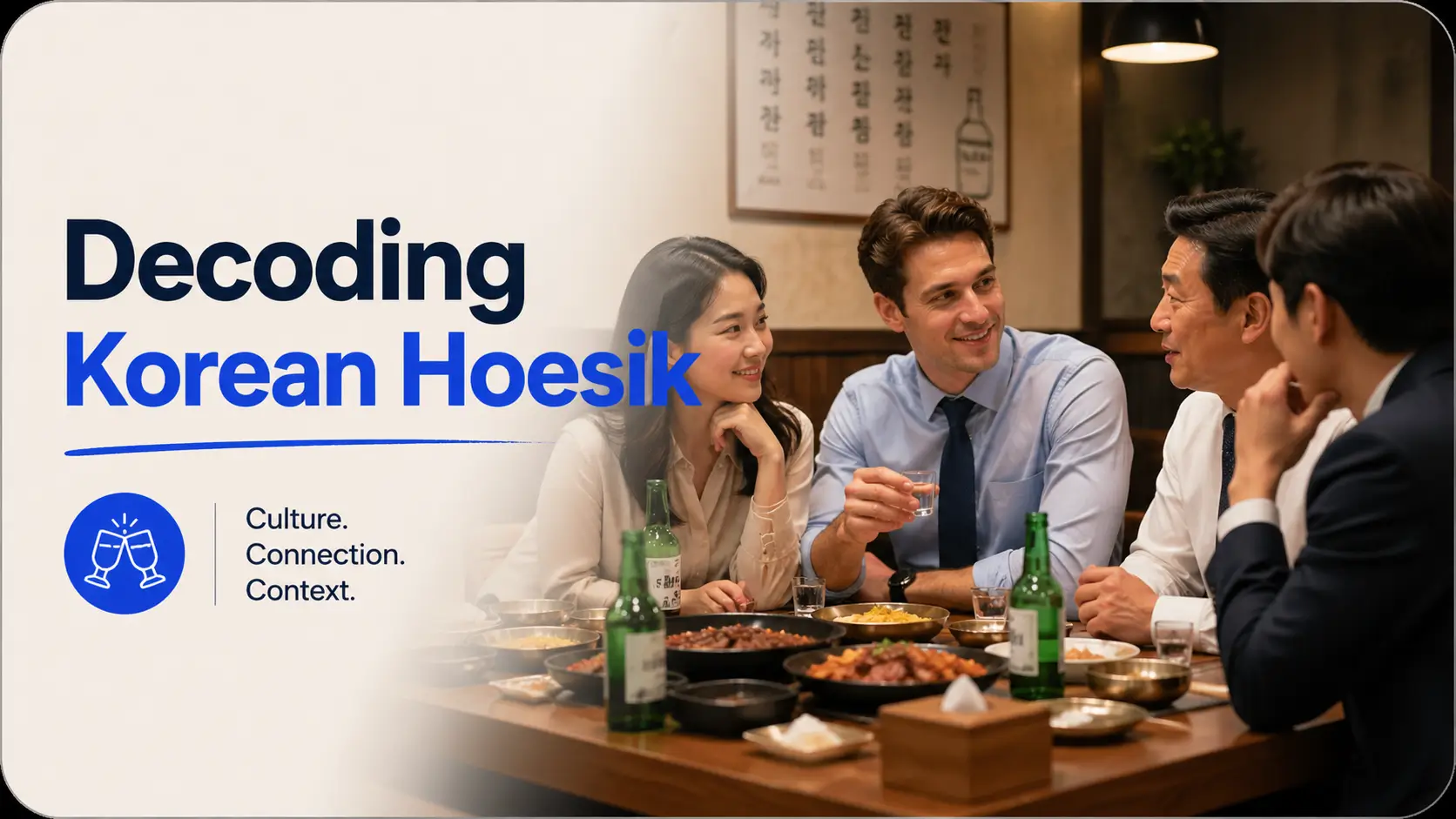
Decoding the Korean Hoesik
Master the art of the Korean company dinner, where the real office culture is served.
You can learn a Korean office faster at a dinner table than in three polished meetings, especially when the invitation is “optional” but everyone still seems to understand its weight.
“For Anglo-American readers, the puzzle is knowing when a casual-looking hoesik is just food, and when it has slipped into pressure wearing a friendly smile.”
Hoesik (회식) is a team meal used to build trust and soften hierarchy. While modern culture shifts toward shorter, lunch-style versions, misreading the signal can lead to missed context or social exhaustion.
This guide offers a practical lens on hierarchy, alcohol pressure, and the subtle social signals foreigners often miss.
Table of Contents
Fast Answer
After-work dinners still matter in some Korean companies because they can function as informal trust-building spaces, not just meals. Even as younger workers push back against mandatory drinking and late-night bonding, hoesik can still signal team belonging, help junior employees read workplace dynamics, and give managers a softer channel for relationship-building. The culture is changing, though: shorter, optional, non-drinking, and lunch-style gatherings are increasingly replacing old pressure-heavy formats.
- Old-school hoesik often tested obedience.
- Modern hoesik works best when it builds trust without pressure.
- The safest approach is selective participation plus clear boundaries.
Apply in 60 seconds: Before accepting, ask whether this dinner is mainly social, relational, political, or restorative.
Start Here: Hoesik Is Less Mandatory, But Not Meaningless
The Old Rule Was Attendance; the New Rule Is Interpretation
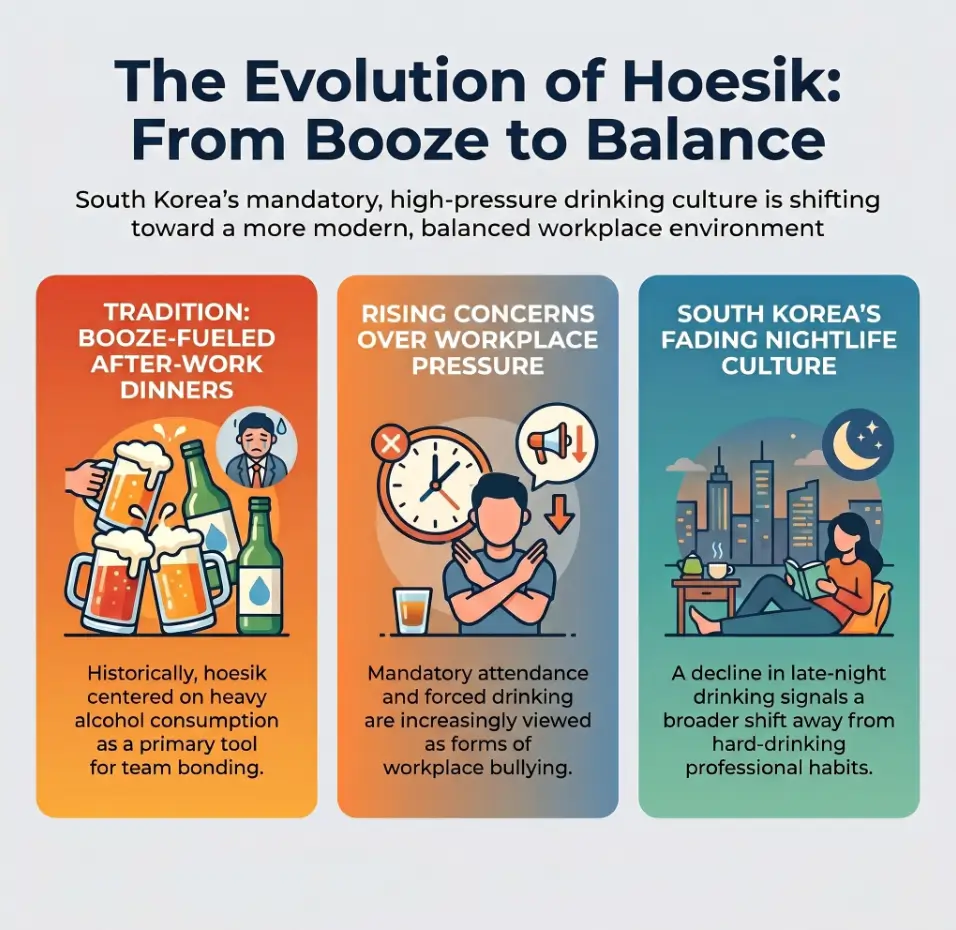
For years, many workers understood hoesik through a blunt little rule: show up, drink something, laugh at the boss’s jokes, and do not be the first person reaching for your coat. It was not always written down. It did not need to be. The room did the paperwork.
That older pattern is changing. In many Korean companies, especially younger teams, attendance is less openly forced. Employees are more likely to question unpaid time, late-night rounds, and alcohol pressure. Managers also know that a dinner can become a workplace risk if it turns into coercion, harassment, or a loyalty test with grilled pork smoke drifting through it.
But “less mandatory” does not mean “socially empty.” This is the part US readers often miss. A team dinner may no longer be a formal command, yet it can still carry meaning. Who attends, who leaves early, who organizes the meal, and how the manager behaves can all become tiny workplace signals.
Why US Readers Misread the Room
In many US offices, after-work drinks are treated as optional social overflow. Nice if you go. Usually fine if you do not. Korean hoesik can work differently because it grew inside a workplace culture where relationships, hierarchy, age, tenure, and group rhythm often shape daily communication. If you are new to the country, it helps to understand how Korean indirect communication often works between the lines before treating every dinner invitation as a simple yes-or-no calendar item.
I once watched a foreign colleague decline a dinner with the cheerful confidence of someone turning down a pizza coupon. The Korean team accepted it politely. Nothing exploded. But the next day, he was surprised that the inside jokes, project hints, and small emotional thaw had moved forward without him. He had skipped the meal. He had also skipped a soft briefing.
The Quiet Tension: Optional on Paper, Awkward in Practice
The honest middle is this: some hoesik invitations are truly casual, some are semi-important, and some are still wrapped in old pressure. The calendar may say optional, but the atmosphere may say, “We will remember who came.”
That is why the question is not only “Do I have to go?” The better question is: “What does this dinner mean in this team, with this manager, at this moment?”
Modern Hoesik Signal Map
Casual team meal, many people absent, no project tension.
New boss, new team, recent deadline, or guest from HQ.
Conflict repair, promotion season, client aftermath, team reset.
Practical reading: the meal matters most when work relationships are still forming or recently strained.
Who This Is For, and Who Should Be Careful
For Expats Joining Korean Companies
This guide is for foreign employees who want to understand Korean office dinners without handing over every evening like a tribute basket. You may be new to Korea, newly hired by a Korean company abroad, or working in a global team where Seoul headquarters sets the rhythm.
Your practical problem is not “Korean culture is confusing.” That is too vague to help. Your real problem is usually smaller and more useful: which dinners should I attend, how long should I stay, and how do I avoid looking cold when I need a boundary?
For US Managers Working With Korean Teams
This is also for US-based managers, founders, and team leads who work with Korean colleagues. If you dismiss every after-work dinner as unprofessional, you may miss how relationship-building actually happens in some teams. But if you copy the worst version of old hoesik, you may create resentment faster than a printer jams before a board meeting.
A good manager does not need to recreate a 1990s drinking table. The smarter move is to understand the function, then design a healthier format.
Not For Anyone Excusing Pressure, Hazing, or Alcohol Coercion
Understanding culture is not the same as defending every practice that travels under its name. Forced drinking, sexual comments, pressure to stay late, punishment for skipping, or humiliation framed as bonding should not be softened into “just how things are.”
Korean coverage has repeatedly discussed concerns around hoesik-related bullying, forced attendance, and harassment. The Korea Herald has reported on workplace dinner complaints connected to pressure and abusive behavior, while Korean labor guidance has treated forced drinking as a workplace bullying concern.
Eligibility Checklist: Should You Treat This Hoesik as Important?
- Yes/No: Is it your first month on the team?
- Yes/No: Is a new manager or senior stakeholder attending?
- Yes/No: Did the team just finish a stressful project?
- Yes/No: Is the invitation framed as “everyone should come”?
- Yes/No: Do colleagues mention it more than once?
Neutral next step: If you checked 2 or more, consider attending the main meal and leaving clearly before later rounds.
The Real Reason: Work Trust Often Starts Outside the Meeting Room
Formal Meetings Don’t Always Carry the Whole Message
In a formal meeting, people may speak carefully. The junior employee waits. The senior manager chooses neutral language. The team lead says “we will review internally,” which can mean anything from “good idea” to “please bury this in a quiet drawer.”
Hoesik can change the texture of communication. The hierarchy does not disappear, but it may loosen by one notch. People ask small questions. A junior person hears why a decision was made. A manager senses who is burned out. Someone finally admits the project timeline is wearing fake eyebrows and needs help.
The Korea JoongAng Daily has described hoesik as a sub-communication channel for bonding and team kinship. That framing matters because it explains why the practice did not vanish the moment workers started wanting better evenings. A flawed channel can still carry useful signals.
“One Dinner” Can Mean “I’m Willing to Be Part of the Team”
For an expat or new hire, one dinner can quietly say, “I am not only here for tasks. I am willing to know the humans attached to the tasks.” That signal can be useful, especially in teams where trust is built slowly, through repeated low-pressure contact.
I learned this the unglamorous way: not through a dramatic toast, but over a plate of scallion pancakes that nobody had ordered confidently. A senior colleague explained a client’s history in 8 minutes. That context saved me two days of confused email archaeology later.
Here’s What No One Tells You…
The most important conversation may happen before the food arrives or while walking to the subway afterward. Not every meaningful moment comes with a raised glass. Sometimes it comes with someone saying, “By the way, when he says urgent, he means before Friday, not tomorrow morning.” Tiny sentence. Huge oxygen.
Show me the nerdy details
Hoesik often works as a weak-tie strengthening mechanism. It increases repeated informal contact, lowers the friction of asking small questions, and gives employees access to contextual information that may not be documented. The risk is that this informal channel can exclude people who cannot attend, do not drink, have caregiving duties, or feel unsafe in late-night settings.
Hierarchy Still Has a Table Seat
Seniority Shapes the Invitation, Even When Nobody Says It Out Loud
Korean workplace hierarchy is not only about titles. Age, tenure, hiring class, and team history can all affect who speaks first, who pours, who pays, and who gets to leave without explanation. Even in modern companies, the table may carry more hierarchy than the Slack channel admits. The same social logic appears in everyday spaces too, which is why Korean seating hierarchy can quietly shape who sits where, not only at restaurants but also in cars, meetings, and family gatherings.
For US readers, this can feel odd because American workplaces often prefer the language of flatness, even when power is quietly sitting in the good chair. Korea is usually more willing to let hierarchy wear a name tag.
At dinner, that hierarchy can become visible. The senior person may choose the restaurant. The manager may pay. Juniors may wait before eating or pouring. Some teams treat these rituals lightly. Others turn them into a small etiquette maze with chopsticks.
The Boss’s Mood Can Change the Whole Dinner
A healthy manager can make hoesik feel relaxed and useful. They set an end time, make non-drinking normal, avoid invasive questions, and do not turn attendance into a moral report card.
An unhealthy manager can make the same event feel like a pressure cooker wearing a restaurant apron. The food may be excellent. The mood may still be unsafe.
Manager quality is the hinge. In many cases, the question is not “Is hoesik good or bad?” The sharper question is: “Does this leader use informal time to include people or control them?”
Why “Just Say No” Is Not Always Simple
Some advice aimed at foreigners is too clean: “Just say no.” It sounds brave. It also ignores social math.
Declining once may be fine. Declining every time, without building trust elsewhere, may be read as distance. That may not be fair, but it can be real. You do not have to obey every social expectation. Still, you need to know when your absence may be interpreted as more than schedule conflict.
- Watch who organizes, pays, and speaks first.
- Notice whether non-drinkers are protected or teased.
- Judge the manager’s behavior more than the menu.
Apply in 60 seconds: At your next invite, identify the highest-ranking attendee and the real purpose of the gathering.
The New Hoesik: Shorter, Softer, and Less Soju-Centered
First Round Only Is the New Safety Valve
The older image of hoesik often includes multiple rounds: dinner, bar, karaoke, then a final mysterious location chosen by someone whose judgment left after round two. That still exists in some places, but it is no longer the only script.
More teams now stop after the first round. That matters. A predictable ending protects people with long commutes, families, health limits, early calls, or simple human tiredness. It also makes attendance less threatening. A 90-minute meal is one thing. An open-ended night safari through neon and obligation is another animal entirely.
Shorter hoesik also helps managers. The longer alcohol and hierarchy mix, the more risk climbs. Ending early is not boring. It is operational wisdom with side dishes.
Lunch Hoesik, Café Hoesik, Bowling Hoesik
Modern teams increasingly use lighter formats: lunch gatherings, coffee chats, dessert cafés, bowling, escape rooms, team walks, or early dinners with a clear finish. These versions preserve the relational function without making alcohol the admission ticket. For readers trying to understand the daytime version of this same office rhythm, Korean office lunch culture often reveals the quieter side of workplace bonding.
I have seen a lunch hoesik do more good than a late drinking session because everyone was awake enough to be kind. Nobody had to perform. Nobody had to calculate subway timing like a military withdrawal. People simply ate, talked, and returned to work slightly less armored.
What Changed After Younger Workers Pushed Back
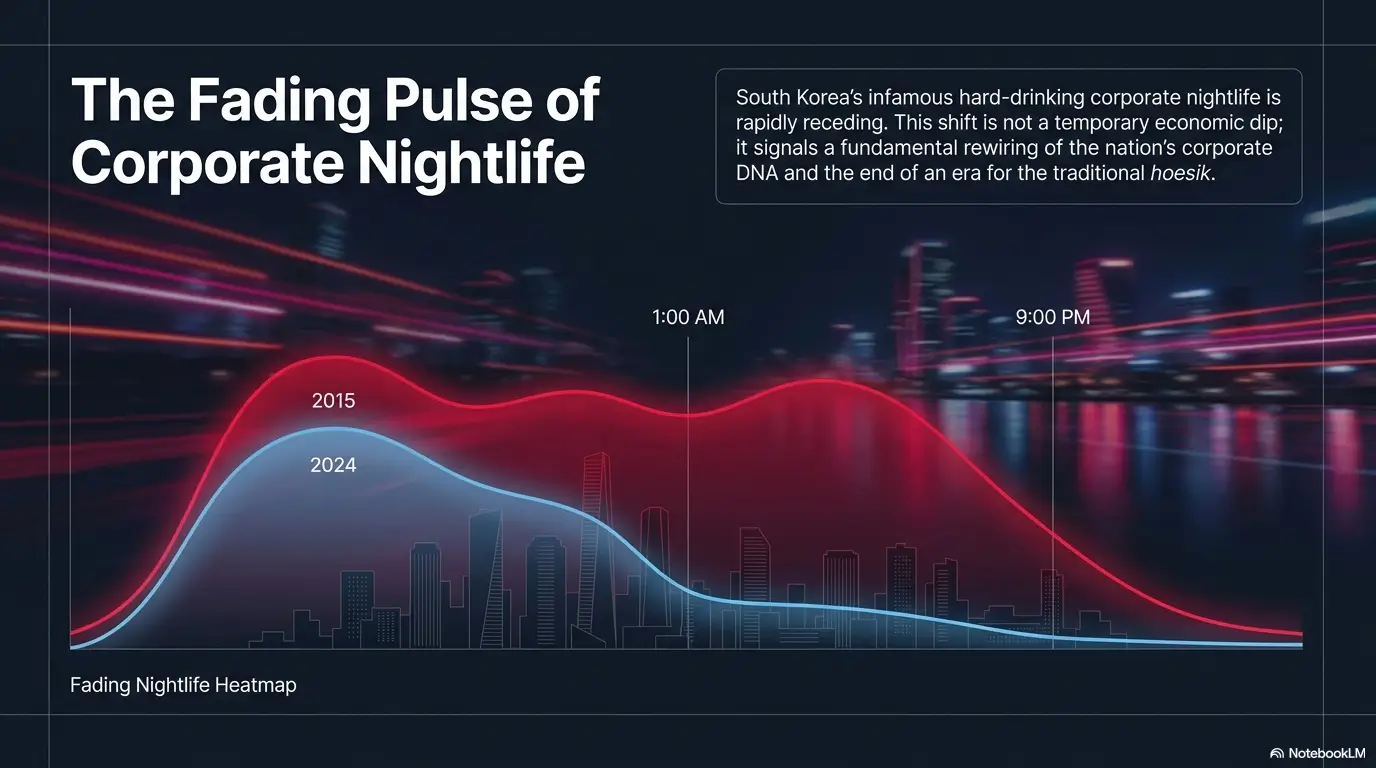
Younger Korean workers are more likely to defend personal time, question unpaid after-hours culture, and reject forced drinking. Reuters has reported that South Korea’s hard-drinking nightlife has weakened partly because corporate after-work drinking sessions have slowed, alongside broader changes in social habits, health consciousness, and spending patterns.
This does not mean all younger workers hate hoesik. It means the default bargain has changed. The new question is not “How late can the team stay out?” It is “Can we build connection without making people pay with exhaustion?” The same shift also shows up in debates around annual leave culture in Korea, where personal time, workplace expectations, and group sensitivity can rub against each other like stiff new shoes.
| Format | Works Best When | Main Risk | Neutral Action |
|---|---|---|---|
| Late multi-round dinner | Rare celebration with true opt-in | Alcohol pressure and fatigue | Set an end point before starting |
| First-round dinner only | Team bonding after a project | Still awkward if manager pressures people | Announce the finish time |
| Lunch or café hoesik | Mixed teams, parents, non-drinkers, new hires | Less “special” for some old-school teams | Use it for regular connection |
Don’t Assume “Optional” Means “Nobody Notices”
Mistake: Treating Every Invite Like a Casual Happy Hour
A Korean team dinner may look casual from the outside. The invitation may be phrased lightly. The restaurant may be ordinary. But context changes the meaning.
A random Thursday meal after a calm week may be low signal. A dinner with a visiting executive, a new team lead, or a post-crisis project group may carry more weight. The same invitation can mean different things depending on timing.
This is where expats sometimes trip. They hear “optional” and translate it as “irrelevant.” Better translation: “You may decline, but understand what you are declining.” That is not a threat. It is a map. For a related language trap, the Korean habit of softening answers can also make the Korean “maybe” meaning more complicated than it first sounds.
Mistake: Saying Yes to Everything Until You Burn Out
The opposite mistake is just as common. A foreign employee decides to be culturally respectful and says yes to everything. Two weeks later, they are tired, resentful, behind on laundry, and quietly wondering whether kimchi stew has become a scheduling system.
Respect does not require total availability. In fact, a pattern of thoughtful participation usually works better than heroic compliance. Attend the important dinners. Join lighter gatherings. Offer lunch. Build rapport during work hours. Leave before later rounds when needed.
Let’s Be Honest…
The hardest part is not the dinner. It is knowing which dinner matters and which one is just calendar confetti.
Mini Calculator: Your Hoesik Boundary Score
Use this quick self-check before accepting. It does not store anything.
Enter your numbers and calculate.
Neutral next step: Use the result to choose a dinner, lunch, coffee, or polite decline.
Alcohol Is No Longer the Whole Story
Drinking Used to Carry the Bonding Ritual
Older hoesik culture often revolved around alcohol. Pouring etiquette mattered. So did pacing, toasts, seniority, and the strange choreography of refusing politely while not offending the person offering. For some workers, this created warmth. For others, it created dread with a side of grilled garlic.
The old ritual also gave managers a way to read employees outside formal performance. Who loosened up? Who showed loyalty? Who stayed? Who served others? That kind of informal judging is exactly why many people now push back.
Why Sober Participation Is More Normal Now
Non-drinking is more accepted than it used to be in many Korean workplaces. Health consciousness, religious reasons, medical needs, pregnancy, driving, personal preference, and younger workers’ habits have all widened the space for sober participation.
You may still encounter teasing in old-fashioned settings. But the direction of travel is clear: a dinner that cannot include non-drinkers is not modern team-building. It is a narrow ritual pretending to be culture.
The Line Nobody Should Cross
Pressuring someone to drink, stay late, sing, endure sexual comments, or accept invasive personal questions should not be defended as “Korean culture.” It is not relationship-building. It is power using informality as camouflage.
A safe hoesik gives people choices without punishing them for using those choices.
- Non-alcoholic choices should be normal.
- Managers should stop jokes before they become pressure.
- Employees can join the relationship without joining the drinking pace.
Apply in 60 seconds: Prepare one calm line: “I’m not drinking tonight, but I’m glad to join the meal.” For more wording options, save a few phrases from this guide to how to refuse alcohol in Korea before you need them at the table.
The Hidden Function: Hoesik Can Repair Friction Faster Than Email
Small Conflicts Sometimes Need a Non-Meeting Setting
Email is terrible at warmth. It can carry decisions, documents, and the occasional polite grenade, but it rarely repairs friction well. After a tense deadline, a difficult client, or a misunderstood decision, a meal can lower the emotional temperature.
That does not mean dinner should replace proper feedback. It means humans sometimes need a lower-stakes setting before they can speak plainly again. A team that has spent 2 weeks living inside urgent messages may need one calm table where nobody is presenting slides.
Shared Food Can Create a Temporary Truce
Food has a disarming quality. The act of sharing banchan, passing tongs, or deciding who gets the last dumpling can briefly make people less sharp-edged. It is not magic. It is rhythm, proximity, and a shared task that is not the cursed spreadsheet.
I have seen colleagues who barely made eye contact in a meeting become more generous after 40 minutes at dinner. Not transformed. Not suddenly best friends. Just human again. Sometimes that is enough to restart work without every message sounding like a tiny lawsuit.
But Repair Is Not the Same as Silence
This is the boundary: hoesik can soften friction, but it should not bury harm. If there is harassment, discrimination, unsafe drinking pressure, wage issues, or retaliation, dinner is not a solution. It may even make things worse by moving a formal problem into an informal space.
Use hoesik for relationship repair, context, and morale. Use management, HR, documentation, or legal channels for serious workplace problems. Mixing those up is how “team bonding” becomes a fog machine for accountability.
Common Mistakes US Readers Make About Korean Company Dinners
Mistake 1: Calling It “Just Drinking Culture”
Calling hoesik “just drinking culture” is tidy, fast, and incomplete. Alcohol has played a major role, yes. But the deeper system includes hierarchy, belonging, informal mentoring, information flow, and the desire to make work relationships feel less mechanical.
When US readers reduce everything to drinking, they miss why some workers still attend even when they do not love the format. The meal may give them access to context, visibility, and a sense of being inside the team’s emotional weather.
Mistake 2: Romanticizing It as Deep Team Harmony
The opposite mistake is romanticizing hoesik as beautiful collectivism in a stainless-steel bowl. Not every dinner is meaningful. Some are dull. Some are exclusionary. Some are expensive for the company and exhausting for everyone else.
Healthy team culture should not require people to donate their evening every week. If harmony depends on silence, alcohol, or fear of disappointing seniors, that is not harmony. That is a choir holding its breath.
Mistake 3: Ignoring Gender and Power Dynamics
After-work settings can become risky when power, alcohol, and informality mix. Korean media has documented concerns around harassment and inappropriate behavior linked to hoesik contexts, including cases where women or junior workers felt trapped by hierarchy.
Foreign employees should understand this without turning every dinner into a danger story. The point is not panic. The point is adult clarity: informal does not mean consequence-free. The same adult clarity helps when navigating Korean personal questions etiquette, because some questions can sound casual while still touching private boundaries.
Mistake 4: Refusing Without Offering Any Relational Alternative
If you skip every dinner and offer no other way to connect, you may create distance without meaning to. A softer path is usually better: attend occasionally, join lunch, suggest coffee, send a thoughtful follow-up, or be visibly helpful during work hours.
You are not required to attend everything. You are responsible for not disappearing relationally.
Boundary Prep List: What to Decide Before the Dinner
- Your latest acceptable leaving time.
- Your non-alcoholic drink line.
- Your reason if you need to leave early.
- One colleague you want to have a sincere conversation with.
- One alternative touchpoint if you decline, such as lunch or coffee.
Neutral next step: Write your leaving line before you arrive, not while your coat is trapped behind 6 chairs.
How to Attend Without Losing Your Boundaries
Go Early, Leave Clearly
The easiest way to participate without losing your whole evening is to attend the main meal and leave before later rounds. Arrive on time. Be warm. Talk to people. Thank the host. Then exit clearly.
Try this: “Thank you for dinner. I’m glad I could join the first round. I need to head out now, but I’ll see everyone tomorrow.”
Do not over-explain. Long explanations invite negotiation. A clear sentence is sturdier than a paragraph wearing tap shoes.
Choose Non-Alcoholic Confidence
If you are not drinking, order something simple and hold your tone steady. Soda, tea, sparkling water, juice, or alcohol-free beer can all work depending on the place. You do not need a courtroom defense.
Try: “I’m not drinking tonight, but please enjoy.” Then shift attention back to the group. Ask a question. Pass food. Participate in the meal, not the alcohol pressure.
Use the “One Good Conversation” Rule
Do not try to perform socially all night. That is how people become exhausted and start nodding with the haunted patience of airport furniture.
Aim for one good conversation. Ask a colleague about their role, a project lesson, a neighborhood recommendation, or what surprised them when they joined the company. One sincere exchange can do more than 3 hours of loud table theater.
- Join the main meal when it matters.
- Set your exit before later rounds begin.
- Use one sincere conversation as your social anchor.
Apply in 60 seconds: Save this line: “I’m glad I could join dinner. I need to head out now, but thank you for organizing.”
What Managers Should Learn From the Culture Shift
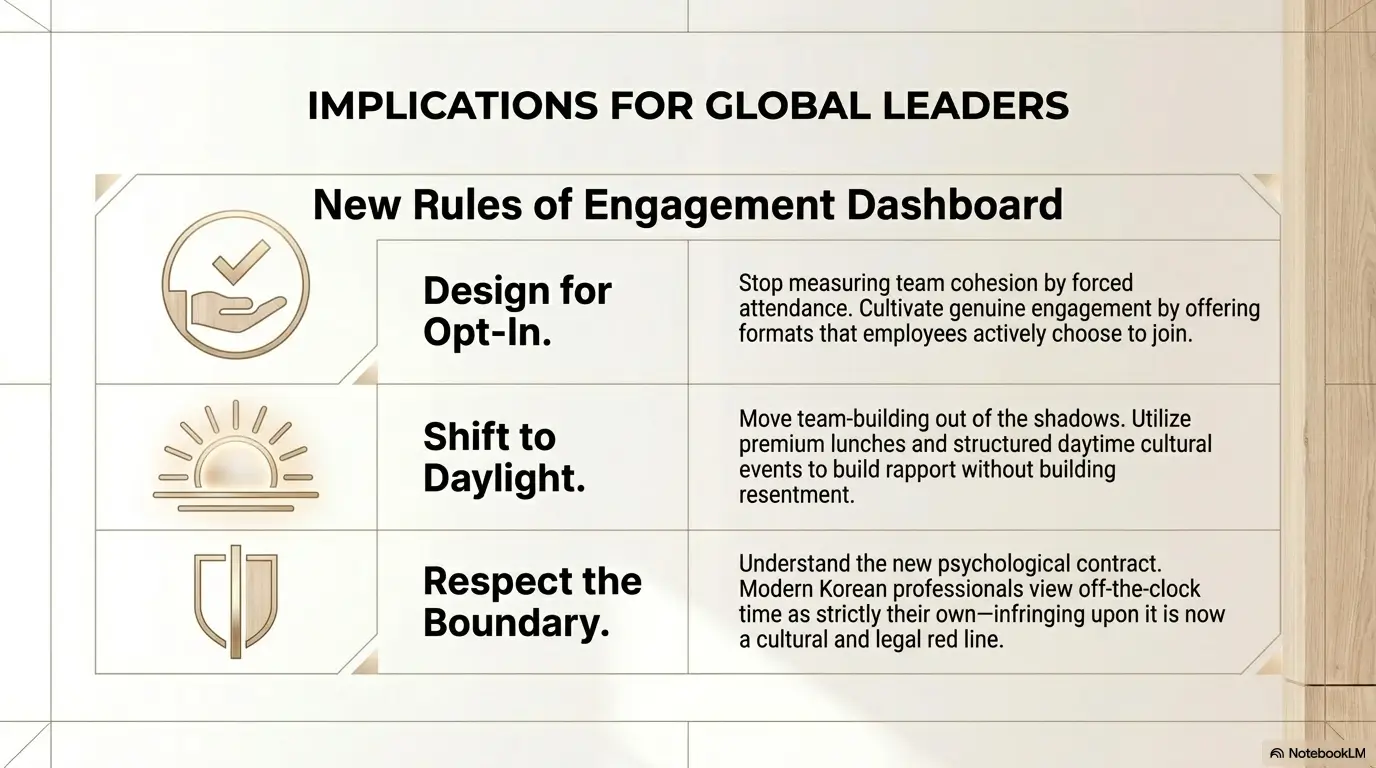
Make the Invitation Truly Optional
If you manage a Korean team, a Korea-facing team, or a mixed global team, the first rule is simple: do not make attendance a loyalty test. Employees can smell fake optionality from across a conference room.
Do not track who came. Do not reward the people who stayed late. Do not punish quiet employees, non-drinkers, parents, caregivers, or people with health limits. If the dinner is optional, let it be optional all the way down.
End Before the Team Gets Tired
Short, predictable gatherings are kinder and more effective. A 75 to 90-minute dinner with a clear end can build connection without turning the next workday into a gray little fog bank.
Managers often overestimate how much bonding happens late at night. After a certain point, people are not becoming closer. They are becoming trapped, hungry again, or deeply invested in finding the nearest taxi.
Design for the Quiet Person, Not the Loudest Drinker
A modern hoesik should include non-drinkers, introverts, parents, caregivers, new hires, people with religious reasons for avoiding alcohol, and employees who simply want a life outside work. Inclusion is not a poster. It is logistics.
Choose places with non-alcoholic options. Avoid forced seating rituals. Keep speeches short. Give people a clear finish time. Rotate formats. Try lunch. Try coffee. Try a team activity that does not require anyone to explain their private choices.
Next Step: Use the “Dinner Signal” Test
Ask One Question Before You Decide
Before accepting or declining, ask: “Is this dinner mainly social, relational, political, or restorative?”
That answer tells you what to do. A purely social dinner may be skippable. A relational dinner may be worth attending for the first round. A political dinner may require careful visibility. A restorative dinner after a hard project may be a smart place to rebuild trust.
This closes the loop from the beginning: the meal matters less for the food than for the signal. Sometimes the signal is light. Sometimes it is loud. Your job is not to obey every signal. Your job is to read it before you respond.
A Simple Script for Saying Yes With Limits
Use this when you want to attend but protect your time:
“I’d be happy to join dinner. I may need to leave after the first round, but I’m glad to spend time with the team.”
A Simple Script for Saying No Without Disappearing
Use this when you cannot attend but still want to preserve connection:
“I can’t make dinner tonight, but I’d love to join lunch or coffee with the team this week.”
Coverage Tier Map: How Much Should You Participate?
| Tier | Situation | Best Move |
|---|---|---|
| 1 | Random casual invite | Skip or join lightly |
| 2 | Regular team bonding | Attend sometimes |
| 3 | New team or new boss | Join the main meal |
| 4 | Post-conflict or post-deadline repair | Attend with a clear exit |
| 5 | High pressure, unsafe, or coercive | Set boundaries and document concerns if needed |
Neutral next step: Place the next invitation into one tier before deciding.
FAQ
Are Korean Company Dinners Still Mandatory?
They are less formally mandatory than they used to be in many workplaces, especially among younger teams and larger companies with stronger HR awareness. Still, social pressure can exist depending on the manager, industry, team age, company culture, and whether the dinner is tied to a project or senior visitor. The safest reading is: not always mandatory, but not always meaningless.
What Does Hoesik Mean in Korean Work Culture?
Hoesik refers to a company or team meal, often after work, traditionally used for bonding, communication, and group identity. It has often involved alcohol, but the meaning is broader than drinking. In some teams, it functions as an informal space for trust-building, mentoring, conflict repair, and reading workplace dynamics. Those dynamics also connect with everyday language habits, including why Korean titles often matter more than first names in professional and social settings.
Is It Rude to Skip a Hoesik?
It depends on context. Skipping once with a polite reason is usually fine. Repeatedly declining every gathering, especially as a new employee, may be interpreted as distance unless you build relationships another way. A good compromise is to attend important first-round dinners and suggest lunch or coffee when you cannot join at night.
Do You Have to Drink Alcohol at Korean Work Dinners?
No. Drinking is less obligatory than before in many Korean workplaces, and non-drinking is more accepted now. That said, pressure can still appear in old-fashioned teams. A calm line works best: “I’m not drinking tonight, but I’m happy to join the meal.” Good managers should protect that choice without teasing or negotiation.
Why Do Korean Companies Still Hold Hoesik?
Some companies still hold hoesik because informal meals can build trust, soften hierarchy, share context, welcome new employees, and repair tension after difficult work. The best versions help people connect without coercion. The worst versions turn unpaid personal time into a loyalty test. The difference usually comes down to leadership behavior.
How Can Foreign Employees Handle Hoesik Politely?
Attend selectively, especially early in your time with a team or after major projects. Join the main meal, have one sincere conversation, thank the host, and leave clearly if needed. If you decline, offer another relational option: lunch, coffee, or a short team check-in. Avoid mocking the practice, even if you choose not to participate often. When the gathering moves online afterward, understanding Korean group chat culture can also help you avoid missing the quieter follow-up signals.
Are After-Work Dinners a Workplace Risk?
They can be. Risks include alcohol pressure, harassment, exclusion, retaliation for nonattendance, unpaid time expectations, and blurred boundaries between work and private life. Modern companies should make gatherings optional, shorter, inclusive of non-drinkers, and free from attendance tracking or pressure.
What Is Replacing Traditional Hoesik?
Common replacements include lunch gatherings, café meetings, first-round-only dinners, alcohol-light meals, team activities, bowling, dessert cafés, and shorter gatherings with clear end times. These formats keep the relationship-building function while reducing fatigue, alcohol pressure, and resentment. When teams still choose karaoke as a later round, a little noraebang etiquette can help foreign employees understand the room without treating every microphone as a career test.
Conclusion
The strange thing about hoesik is that the food is often not the real meal. The real meal is interpretation: who is trying to build trust, who feels pressured, who is included, who is quietly excluded, and whether the manager understands the difference between bonding and control.
After-work dinners still matter in some Korean companies because work trust does not always grow inside meetings. It grows in small side conversations, repeated gestures, shared context, and moments when hierarchy loosens enough for people to speak like humans. But the old version, the one built on forced drinking, late nights, and junior discomfort, deserves to fade.
The modern answer is not “always go” or “always refuse.” It is sharper: read the signal, protect your boundaries, and offer connection in a form you can sustain. Within the next 15 minutes, look at your next team invitation and label it social, relational, political, or restorative. Then choose your response with warmth, not panic.
Last reviewed: 2026-04.