
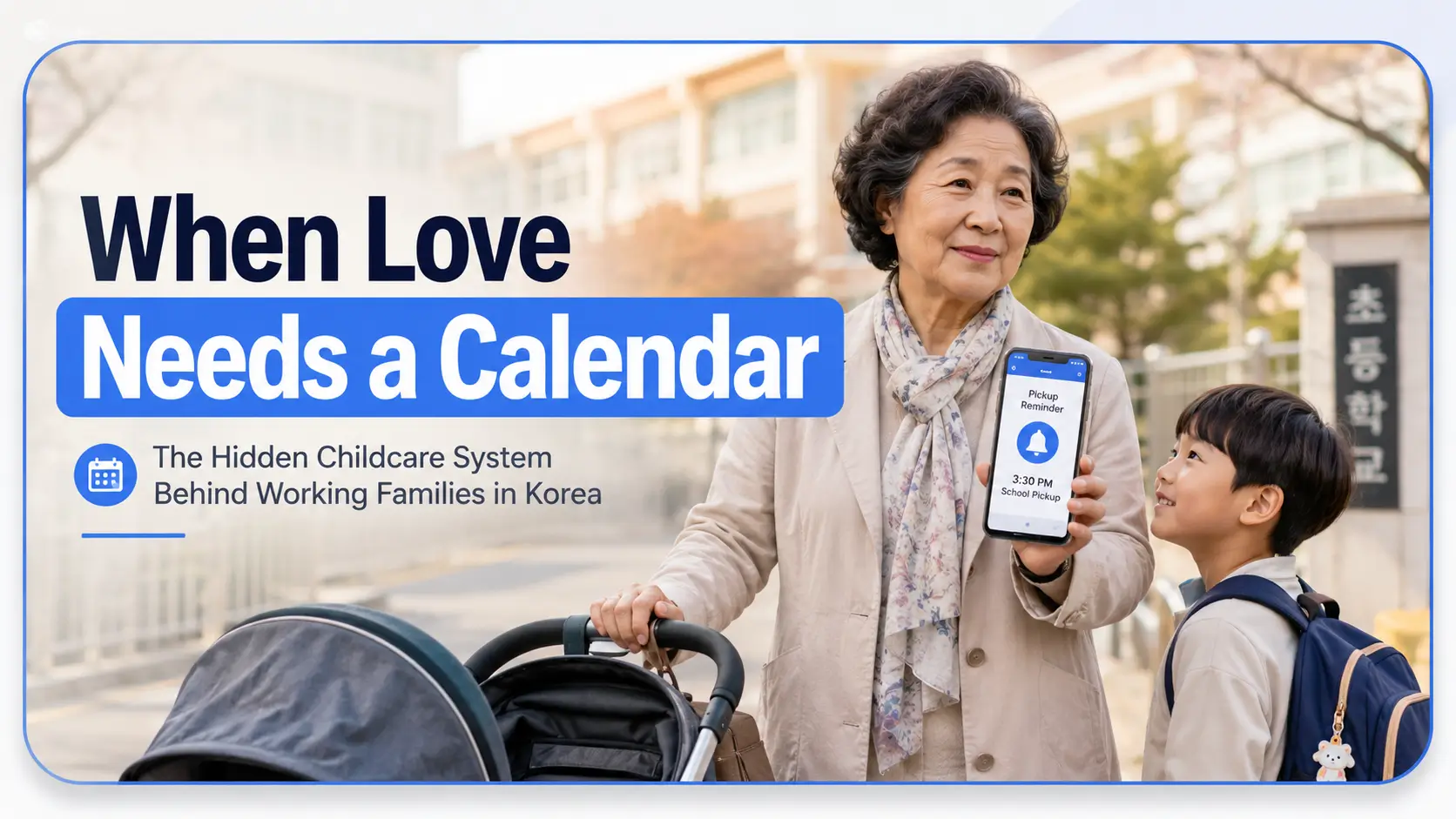
When Love Needs a Calendar
A grandparent with a stroller in one hand and a school pickup alarm buzzing in the other is not “just helping out.” In many Korean families, that small afternoon favor quietly becomes the childcare system holding work, school, meals, and family peace together.
The pressure is modern and specific: dual-income schedules, after-school gaps, and the deep Korean expectation that family shows up before the outside world does. When nobody names the workload, love can start carrying more than it can safely hold.
The cost of guessing is not only exhaustion. It can become resentment, health strain, and guilt that settles into the house like dust.
This guide explores the practicalities of the Korean caregiving landscape—from policy signals to trade-offs. We provide a framework to discuss hours, money, health, and boundaries without making the conversation feel cold.
Because the village needs a schedule, too. Here’s where the quiet work begins.
Table of Contents
The Invisible Village: Why Korean Grandparents Became the Backup Childcare System
The family safety net that never got a formal job title
In many Korean families, grandparent childcare does not begin with a contract. It begins with a sentence that sounds small: “Can you watch her just this afternoon?” Then Tuesday becomes Thursday. Then school pickup becomes dinner. Then dinner becomes bath time. A tiny favor grows legs and starts commuting.
That is how many Korean grandparents become the hidden childcare system. They are trusted, nearby, emotionally invested, and usually willing to stretch themselves before admitting they are tired. In family life, the most reliable person often gets promoted without a meeting.
Why trust matters more than convenience in Korean childcare decisions
Parents do not only need someone to keep a child alive until 6 p.m. They need someone who knows the child’s food habits, allergies, homework battles, sleep rituals, and emotional weather. A paid caregiver may be skilled. A grandparent may know that the child calms down after three bites of rice, one mandu, and a dramatic sigh.
For Korean American families, this trust layer can be even stronger. Grandparents may preserve Korean language, food, manners, and family stories. A child does not just get supervision. They get kimchi pancakes, old lullabies, and a living bridge to the family’s past.
Here’s what no one tells you: “helping out” can become a full-time schedule
The trouble is that family care often hides its own weight. Nobody clocks in. Nobody writes down mileage. Nobody calculates the cost of a grandparent skipping exercise class, doctor visits, church meetings, friends, rest, or a long-awaited quiet afternoon.
- Trust is valuable, but it does not erase workload.
- Family help still needs boundaries, hours, and backup plans.
- The earlier the family names the arrangement, the easier it is to protect everyone.
Apply in 60 seconds: Write one sentence: “Grandma/Grandpa currently helps on these days and hours.”
I have seen families whisper around this topic as if naming the labor would bruise the love. It does not. Naming the work is how love stops wearing itself down to the bone.
Work Comes First, Then the Pickup Line: How Dual-Income Pressure Pulls Grandparents In
Why after-school gaps create the hardest hours of the day
The most fragile part of a childcare schedule is often not the morning. It is late afternoon, that strange little cliff between school ending and parents finishing work. A child is done at 2:30 or 3:00. A parent’s meeting ends at 5:30. Traffic has opinions. The calendar laughs into its sleeve.
This is where grandparents become essential. They cover the hours that formal childcare may not fully absorb. They pick up, feed, supervise homework, transport to hagwon or activities, and keep the household from tipping over like a grocery bag with one weak handle. For a closer look at that daily pressure point, see how Korean childcare pickup routines can shape the entire family schedule.
The commute problem: when parents cannot arrive before daycare closes
Korea’s work culture has been changing, but long hours and commuting pressure still shape family life. Statistics Korea data reported in Korean media showed that married households with children under 18 had a dual-income rate of 58.5% in 2024. That number matters because two working parents often means two calendars, two bosses, two commute routes, and one child who still needs dinner.
For Korean American readers, the pattern may feel familiar in a different accent. A nurse on a 12-hour shift, a restaurant owner closing late, a tech worker trapped in a deployment, a teacher grading after school: the pickup line does not care how noble your work is.
Why one sick day can collapse the whole childcare plan
A child’s fever can turn a carefully planned week into confetti. Daycare may require the child to stay home. School may call at 10:17 a.m. A parent may have no paid leave left. That is when many families call the grandparent first, because grandparents are trusted and because the system does not always have a soft place to land.
| Pressure Point | Typical Family Problem | Why Grandparents Get Called |
|---|---|---|
| After-school gap | Child finishes before parent leaves work | Grandparent can bridge 2–4 hours |
| Sick day | Formal care may not accept child | Family trust feels safer |
| Commute delay | Parent cannot arrive before closing | Grandparent can respond fast |
| Evening work | Dinner, bath, and bedtime overlap with work | Grandparent already knows the routine |
Neutral action: Compare your hardest three weekly hours before deciding whether grandparent help is occasional or structural.
The Cost Squeeze: Why Paid Childcare Does Not Always Solve the Problem
Housing, tutoring, daycare, and the quiet math of family survival
Families rarely choose grandparent childcare because they dislike professional care. Many choose it because the household budget already has teeth. Housing, food, transportation, school supplies, medical costs, and private education can crowd the table before childcare even sits down.
In Korea, the private education shadow is especially long. Once children enter school, childcare does not simply disappear. It often changes costume. There are pickups, academies, snacks, homework, test prep, and the delicate diplomacy of “Did you practice piano or merely look at the piano?” Families trying to decode that world may also find it useful to understand Korean hagwons for foreign families, because after-school education often becomes after-school logistics.
Why “just hire help” can sound simple but feel impossible
For busy families, paid help may solve one problem while creating another: cost, availability, trust, scheduling, language, or distance. A caregiver who is wonderful on paper may not be available on the exact Tuesday when a parent has a late meeting and a child has a cough.
Grandparents are often more flexible than paid systems. That flexibility is precious. It is also the part that can quietly become unfair.
The private academy shadow: childcare does not end when school begins
Many outsiders imagine childcare ends at kindergarten or elementary school. Parents know better. School-age children still need logistics. A 7-year-old cannot manage a transit transfer, snack, homework, and emotional self-regulation with the crisp efficiency of a tiny office manager.
Mini Calculator: Is Grandparent Help Occasional or Daily Care?
Use this quick worksheet. No app, no storage, no suspicious digital goblin.
Neutral action: If the number is above 10 hours weekly, discuss schedule, transportation, meals, and rest as a real caregiving plan.
I once watched a grandmother describe her “small help” and then list five pickups, three dinners, laundry folding, and Saturday morning care. The room went quiet. The math had finally spoken.
Culture Still Whispers: How Filial Duty and Grandparent Love Shape the Choice
Why Korean grandparents may feel responsible even when nobody asks directly
Korean family culture often carries a deep sense of intergenerational responsibility. Parents sacrifice for children. Adult children honor parents. Grandparents protect grandchildren. These values can be beautiful. They can also create invisible pressure, especially when nobody wants to sound selfish.
A grandparent may say yes because they love the child. They may also say yes because refusing feels like failing the family. The difference matters. A yes given from love can still need limits. A yes given from guilt needs even more care.
The difference between affection, obligation, and emotional debt
Family care becomes complicated when affection and obligation braid together. A grandmother may adore her grandchild and still resent being expected every weekday. A parent may be grateful and still feel ashamed about asking. A child may thrive and still sense tension at dinner.
Emotional debt is tricky because it rarely sends an invoice. It appears later as sighs, silence, passive comments, or the immortal family phrase: “Do whatever you want.” That phrase has more weather systems than a small ocean. Similar emotional pressure can appear in Korean in-law expectations, where love, duty, politeness, and hierarchy often sit at the same crowded table.
Let’s be honest: love can wear an apron and still feel exhausted
We do grandparents no honor by pretending they are endlessly available. Many are managing their own health, marriages, finances, grief, aging bodies, and dreams for retirement. Grandparent love is powerful, but it is not a public utility.
The Grandparent Childcare Pressure Map
Parents need coverage when jobs and school schedules do not match.
Paid care may be helpful but not always affordable or flexible.
Grandparents know the child, food, language, routines, and moods.
Family duty can make help feel natural, expected, or hard to refuse.
Public systems may not cover every real household hour.
Written expectations protect the child, parents, and grandparents.
Not Just Babysitting: What Grandparents Actually Do Each Week
School pickup, meals, bath time, homework, snacks, and emotional weather reports
Calling this “babysitting” can shrink the truth. Many grandparents are doing transportation, meal prep, clothing changes, homework supervision, snack negotiation, bath time, bedtime preparation, and emotional repair after a hard school day.
A grandparent may know which teacher praised the child, which friend caused tears, which worksheet went missing, and which snack is currently sacred. This is not passive sitting. It is household command work with more sticky fingers.
Why caring for one grandchild can mean managing an entire household rhythm
One child’s schedule changes the rhythm of several adults. Someone must plan dinner earlier, keep medicine on hand, wash the backup uniform, remember the library book, and manage the small domestic details that make childhood feel stable.
In Korean households, food can become part of care identity. A grandparent may feel responsible not only for feeding the child but feeding them properly. Soup must be warm. Fruit must be cut. Rice must not be “lonely.” I respect this deeply and also suspect many grandmothers deserve a union.
The “second parent” role nobody writes into the family calendar
When grandparents provide daily care, they may become second parents in practice, even if nobody says it aloud. The child may seek comfort from them first. Teachers may know them better than the parents. The grandparent may notice developmental changes before anyone else.
Eligibility Checklist: Is This Really a Grandparent Childcare Arrangement?
- Yes/No: Does the grandparent help at least once every week?
- Yes/No: Does the family rely on that help to keep work possible?
- Yes/No: Does the grandparent handle meals, transport, or homework?
- Yes/No: Would a missed grandparent day create a family crisis?
- Yes/No: Has the arrangement lasted more than one month?
Neutral action: If you answered yes to three or more, treat it as a real care plan, not a loose favor.
Show me the nerdy details
Family care systems often become invisible because they are not priced, scheduled, or documented. Economists may call this unpaid care work; families may call it “help.” The practical problem is measurement. If a grandparent provides 15 hours weekly for 40 weeks, that is 600 hours a year. Even without assigning a wage, the time cost affects health, leisure, appointments, travel, and retirement flexibility.
Who This Is For / Not For: Read This Before You Judge the Arrangement
For Korean American readers trying to understand family expectations
This article is for Korean American readers who have felt the quiet cross-cultural confusion around childcare. In the United States, many families frame childcare as a paid service, a parental responsibility, or an individual household decision. In Korean families, it may also be a family identity question.
That does not make one approach superior. It means the conversation carries extra layers. A request for pickup may sound practical to the parent but symbolic to the grandparent. Beneath the schedule sits a larger question: “Are we the kind of family that shows up?”
For adult children deciding whether to ask grandparents for childcare help
If you are an adult child considering grandparent help, you are not automatically selfish. Modern parenting can feel like trying to fold a fitted sheet during a windstorm. You may genuinely need support. The key is to ask honestly, not vaguely.
Vague asks create vague resentment. Clear asks create room for negotiation. “Can you help sometimes?” is fog. “Can you do Tuesday pickup from 3 to 6 for eight weeks while we test this schedule?” is a lantern.
Not for blaming parents, grandparents, or Korean culture with one blunt hammer
This is not a tidy morality tale. Parents are not lazy. Grandparents are not saints carved from pear wood. Korean culture is not the villain. The issue is structural, economic, emotional, and practical at the same time.
Decision Card: Ask Grandparents vs Use Paid Care
- The hours are predictable.
- The grandparent truly wants the role.
- Health and transportation are manageable.
- Parenting rules can be discussed calmly.
- The schedule is long or physically demanding.
- Family conflict is already high.
- The grandparent feels pressured.
- Backup care needs professional consistency.
Neutral action: Choose the option that protects the child’s stability and the caregiver’s long-term wellbeing.
The Grandparent Trade-Off: What Families Gain and What They Risk Losing
Children gain continuity, language, food memory, and emotional security
Children often gain something precious from grandparent care: continuity. The same face appears at pickup. The same voice says, “Wash your hands.” The same kitchen smells like doenjang jjigae, toasted seaweed, or cut fruit waiting in a bowl.
For bilingual or bicultural families, grandparents can also carry language and memory. A child may learn Korean not from a workbook but from being told to put on socks before the floor steals their body heat. This is pedagogy with slippers. The same emotional thread appears in stories about Korean grandmothers and halmeoni culture, where care often arrives through food, touch, language, and memory.
Parents gain work stability, but may also gain quiet guilt
Parents gain the ability to keep working, attend meetings, recover from emergencies, and breathe between responsibilities. That stability can protect income, careers, and mental health. It can also come with guilt.
The guilt may sound like: “Are we asking too much?” “Are they secretly tired?” “Would they tell us if they were?” These questions deserve daylight. Guilt becomes less useful when it stays private and more useful when it becomes a better plan.
Grandparents gain closeness, but may lose rest, health time, and retirement freedom
Many grandparents genuinely cherish daily closeness. They get jokes, hugs, school stories, and the sweet authority of being the snack minister. But closeness can cost them rest. It can crowd out medical appointments, exercise, social life, travel, and simple silence.
- Children need stable care.
- Parents need honest support.
- Grandparents need time that still belongs to them.
Apply in 60 seconds: Ask, “What part of this schedule feels heavy right now?” Then stay quiet long enough to hear the answer.
Don’t Romanticize It: The Mistakes Families Make When Grandparents Help Raise Kids
Mistake 1: Calling it “occasional help” when it happens every weekday
Language shapes expectations. If grandparents help every weekday, it is not occasional. It is a care schedule. Calling it casual may feel polite, but it can prevent the family from discussing compensation, rest days, backup care, and emergency plans.
This is where many families get tangled. Everyone is trying to be generous. Nobody wants to sound transactional. Then the arrangement starts running on assumption fumes.
Mistake 2: Avoiding money talks because family should “just understand”
Money talks can feel awkward in Korean families, especially when elders are involved. But silence does not make costs disappear. Transportation, groceries, extra utilities, outings, and lost personal time are real.
Payment may not always be appropriate or wanted. Some grandparents refuse money. Still, families can offer grocery support, transportation costs, health-related support, scheduled breaks, or paid backup care. Respect is not always cash, but it should become visible somehow.
Mistake 3: Letting parenting rules become a silent tug-of-war
Grandparents and parents may disagree about screen time, snacks, discipline, sleep, language, tutoring, or manners. These differences are normal. The danger is pretending they do not exist until a child learns to play both sides like a tiny courtroom attorney.
Quote-Prep List: What to Gather Before Comparing Childcare Options
- Weekly hours needed, including commute buffers.
- Backup plan for sick days and school closures.
- Transportation needs and distance.
- Food, medication, allergy, and nap requirements.
- Parenting rules that matter most: screens, snacks, discipline, bedtime.
Neutral action: Gather these details before asking grandparents or comparing paid childcare, so the decision is based on reality rather than panic.
Illustrative Scenario: The Wednesday Pickup That Became a Job
At first, Mrs. Han picked up her grandson only on Wednesdays. She liked the walk, the small hand in hers, the way he asked for fish-shaped bread from the corner stand. Her daughter called it “a huge help,” and it was. Then Wednesday became Monday and Wednesday. Then Friday, because traffic was bad. By spring, Mrs. Han had a child seat in her car, extra socks in her purse, and no time for her water aerobics class.
Nobody meant harm. That was the painful part. One evening, she gently placed a calendar on the table and marked every hour in blue pen. Her daughter stared at it and cried. Not from anger. From recognition. The family did not end the help. They changed it: three fixed days, taxi money, one backup sitter, and Sunday dinner with no childcare talk.
Policy Is Catching Up: Why Korea Is Starting to Treat Grandparent Care More Seriously
From private sacrifice to public childcare support
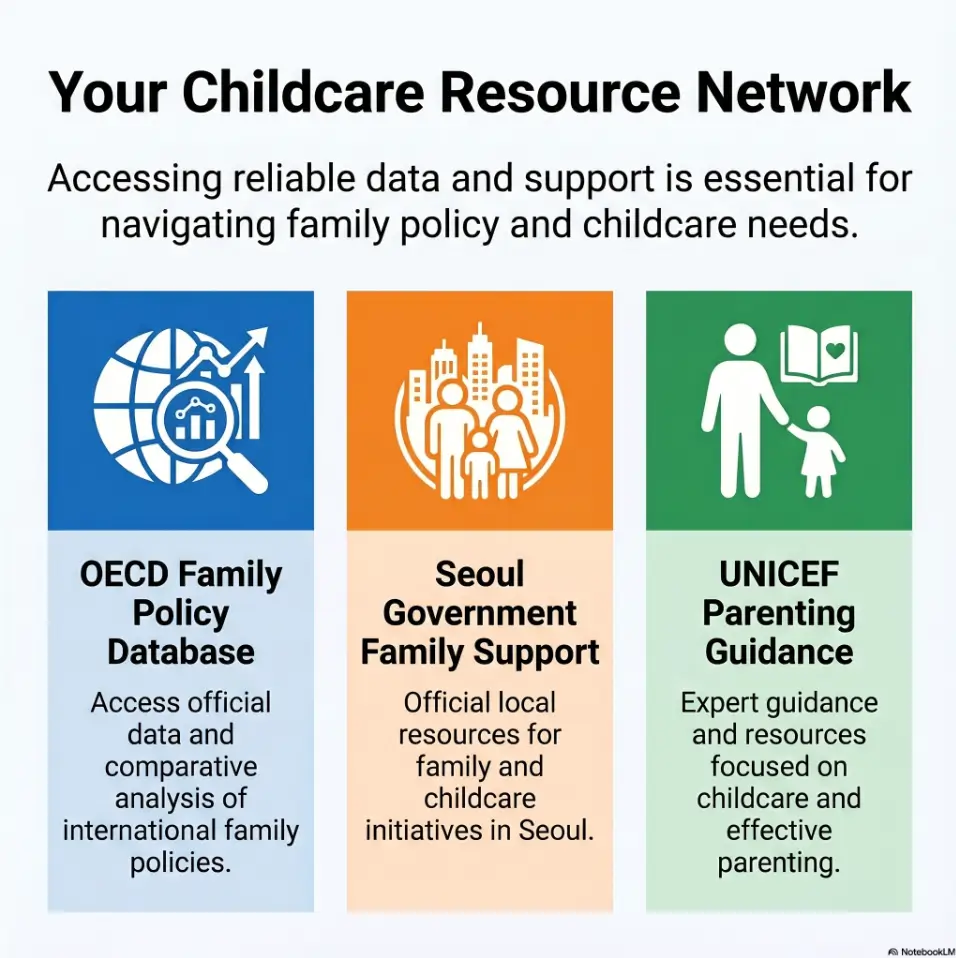
Some local programs support eligible family-care arrangements, but availability and conditions can change by place and year. Check the current local notice and application decision before counting on a payment. A past announcement or a reported satisfaction score does not establish that your family qualifies today.
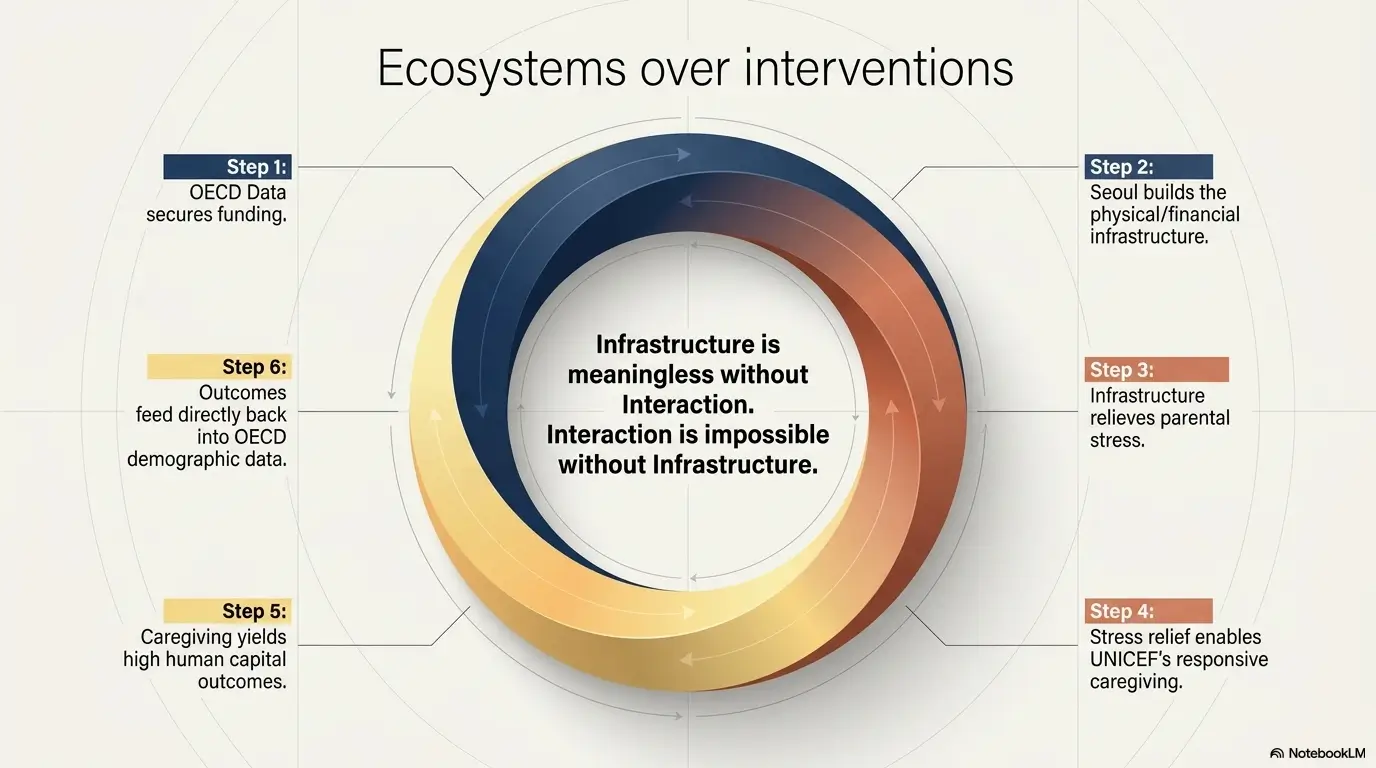
The signal is important. When local governments pay attention to grandparent childcare, they are admitting what families have known for years: unpaid family care is part of the childcare infrastructure.
Why local stipend programs signal a bigger demographic anxiety
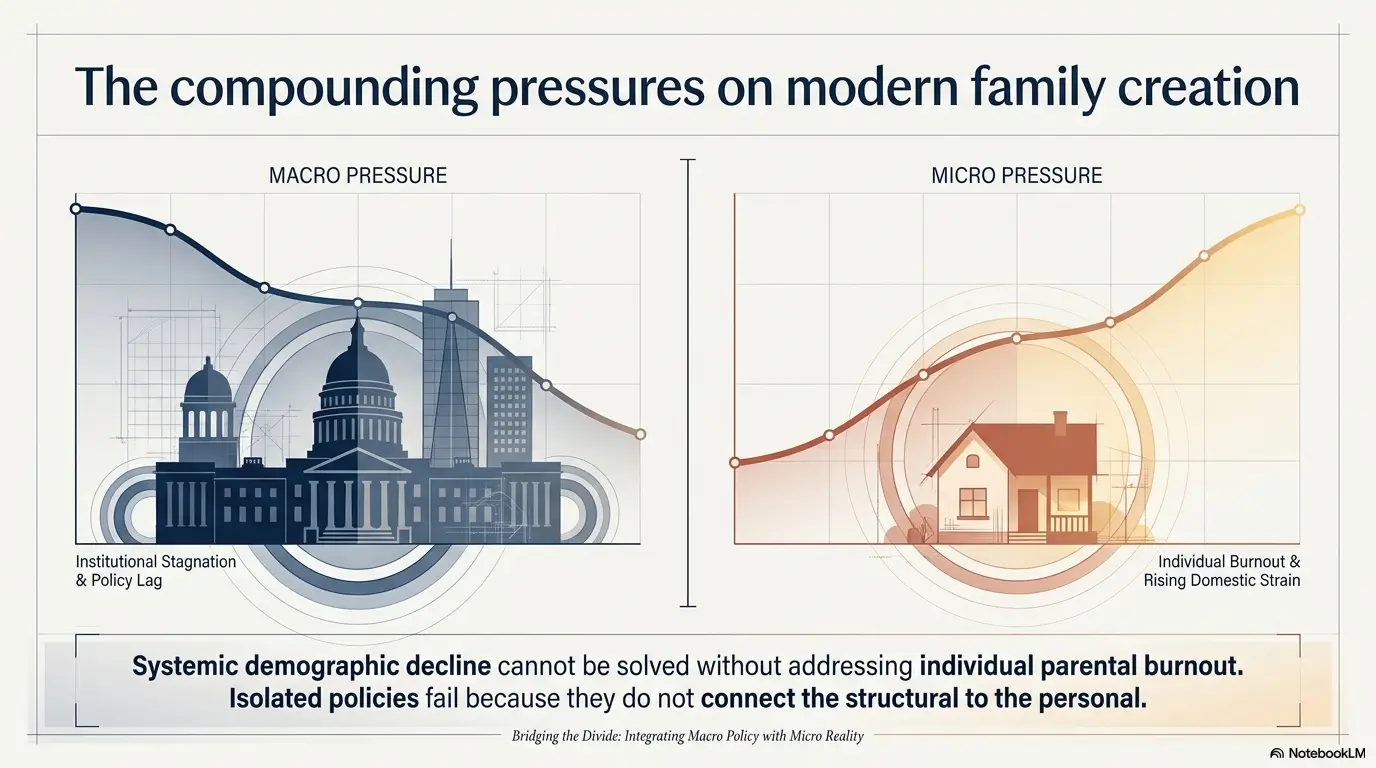
Korea’s low fertility problem is not only about whether people want children. It is also about whether they can imagine surviving the schedule, cost, career penalty, housing pressure, and emotional load of raising them. For broader context, Korea’s family caregiving pressure sits inside the larger story of Korea’s low birth rate effects, where private household choices become national policy questions.
Grandparent care sits inside that larger demographic knot. If parents cannot work and raise children without family rescue, the country has a systems problem, not a grandmother problem.
The fertility question: why supporting grandparents is also about Korea’s future
Policy cannot simply assume grandparents will absorb the difference forever. Many grandparents are aging, working longer, or managing their own care needs. A sustainable family policy has to support parents, children, and older caregivers together.
- Stipends recognize care that was once treated as private sacrifice.
- Policy support can reduce guilt, but it does not replace boundaries.
- Family care should be one option, not the only working option.
Apply in 60 seconds: Check whether your city, state, province, or local government offers caregiver, childcare, or family support programs.
The Boundary Blueprint: How Families Can Make Grandparent Childcare Healthier
Set hours before resentment starts collecting dust
The healthiest grandparent childcare plans usually begin with time. Not feelings. Not vague gratitude. Time. Which days? Which hours? What happens if the parent is late? What happens during school holidays? Who covers appointments?
Write it down. A written plan does not make the family cold. It makes the care safer. Even a simple note on the fridge can prevent three months of misunderstanding.
Create a money, meals, and transportation agreement
Money is not the only form of support, but the family should discuss costs clearly. Does the grandparent buy snacks? Drive daily? Pay for parking? Cook dinner? Use more utilities? Cancel paid activities? These are not tiny details. They are the pebbles that eventually make the shoe unbearable.
Protect grandparent health as part of the childcare plan, not an afterthought
Build health into the schedule. Grandparents need doctor appointments, exercise, rest, and social time. If a grandparent has arthritis, vision changes, diabetes, back pain, fatigue, or mobility concerns, the childcare plan should adapt. This becomes even more urgent as Korea’s aging neighborhoods reveal how elder care, childcare, housing, and daily mobility increasingly overlap.
Coverage Tier Map: A Healthier Grandparent Childcare Plan
| Tier | Arrangement | Best Use |
|---|---|---|
| Tier 1 | Emergency-only help | Sick days, rare delays, sudden closures |
| Tier 2 | One fixed day weekly | Predictable bonding without overload |
| Tier 3 | Two to three scheduled days | Regular support with written boundaries |
| Tier 4 | Daily after-school care | Requires compensation, backup, and health checks |
| Tier 5 | Full-time caregiving role | Needs a formal family agreement and relief care |
Neutral action: Identify your current tier, then decide whether the support plan matches the workload.
FAQ
Why do Korean grandparents help raise grandchildren so often?
Korean grandparents often help because families face long work hours, high costs, childcare schedule gaps, and strong intergenerational expectations. Trust is also a major factor. Parents may feel safer relying on grandparents who know the child, family values, food routines, language, and emergency needs.
Is grandparent childcare common in South Korea?
Yes, it is common enough that public policy has started to recognize it more directly. Seoul and other local governments have discussed or offered support for eligible families using grandparent or relative care. This does not mean every family uses grandparents, but the pattern is visible and socially important.
Do Korean grandparents usually get paid for childcare?
Many grandparents are not formally paid by their adult children, especially when the care is framed as family help. Some families provide money, groceries, transportation support, gifts, or shared expenses. In certain Korean local programs, eligible families may receive allowances when grandparents or relatives provide qualifying childcare.
Why do Korean parents rely on grandparents instead of daycare?
Daycare can help, but it may not cover early mornings, late evenings, sick days, school holidays, commutes, or after-school logistics. Grandparents may offer flexible, trusted care that fits messy real life. The trade-off is that this flexibility can become too demanding without clear boundaries.
How does grandparent childcare affect Korean mothers’ careers?
Grandparent childcare can help mothers stay employed, return to work, or manage demanding schedules. But it can also hide the deeper problem: workplaces and childcare systems may still assume families have private backup. When that backup is usually a grandmother, gender expectations can quietly continue across generations. The pressure begins early for many mothers, especially after childbirth, which is why Korea’s birth recovery centers also reveal how postpartum care, family expectations, and maternal labor are closely connected.
What problems can happen when grandparents become daily caregivers?
Common problems include caregiver exhaustion, unclear money expectations, parenting disagreements, health strain, resentment, and confusion about authority. Children may also receive mixed rules if parents and grandparents do not coordinate. Most problems become easier to manage when hours, rules, costs, and backup plans are discussed early.
How can Korean American families talk about childcare boundaries respectfully?
Start with gratitude, then move to specifics. Instead of saying, “You seem tired,” try, “We realized this is 14 hours a week, and we want to make it healthier.” Discuss hours, transportation, food, money, screen rules, sick days, and rest. Respect is clearer when it becomes a plan.
Are Korean childcare policies starting to support grandparents?
Yes, some local policies have begun recognizing grandparent or relative care. Seoul’s grandchild care allowance is one widely discussed example. These programs signal that family care is not merely private kindness; it is part of how many households survive modern work and childcare pressure.
Next Step: Have the 30-Minute Family Meeting Before the Schedule Becomes Permanent
Write down the real weekly childcare hours
The hook of this story was the grandparent with the stroller, grocery bag, and school pickup alarm. The loop closes here: that moment is not small if it happens every day. It is care work. It deserves language, respect, and a plan.
Before the next week gets swallowed by habit, write down the actual schedule. Include pickup, driving, meals, homework, bath time, sick days, errands, and waiting time. Waiting is still time. Grandparents do not become furniture just because they are sitting in a school lobby.
Name three non-negotiables: health, money, and parenting rules
Every family should name at least three non-negotiables. First, health: what the grandparent can and cannot safely do. Second, money: what costs will be covered. Third, parenting rules: what must stay consistent for the child.
This meeting may feel awkward for the first 7 minutes. That is normal. Many good family conversations begin with someone clearing their throat and pretending the tea is very interesting.
Choose one change this week that protects both the child and the grandparent
Do not try to fix everything in one grand heroic spreadsheet. Choose one change: one rest day, one paid backup sitter, one transportation adjustment, one grocery contribution, one clearer pickup time, or one shared rule about screens.
- Write the hours down.
- Protect grandparent health before exhaustion becomes the messenger.
- Make one change within 15 minutes, not someday in the fog.
Apply in 60 seconds: Text the family: “Can we talk for 30 minutes this week about making the childcare schedule easier for everyone?”
Grandparents can be part of the village. They should not have to be the entire village, the road, the roof, and the emergency generator. The goal is not to remove them from the child’s life. The goal is to keep the relationship warm enough to last.
Last reviewed: 2026-05.
Tags: Korean grandparents, childcare, Korean American families, family caregiving, parenting support
Meta description: Why Korean grandparents often provide childcare, what families gain and risk, and how to set healthier boundaries.