
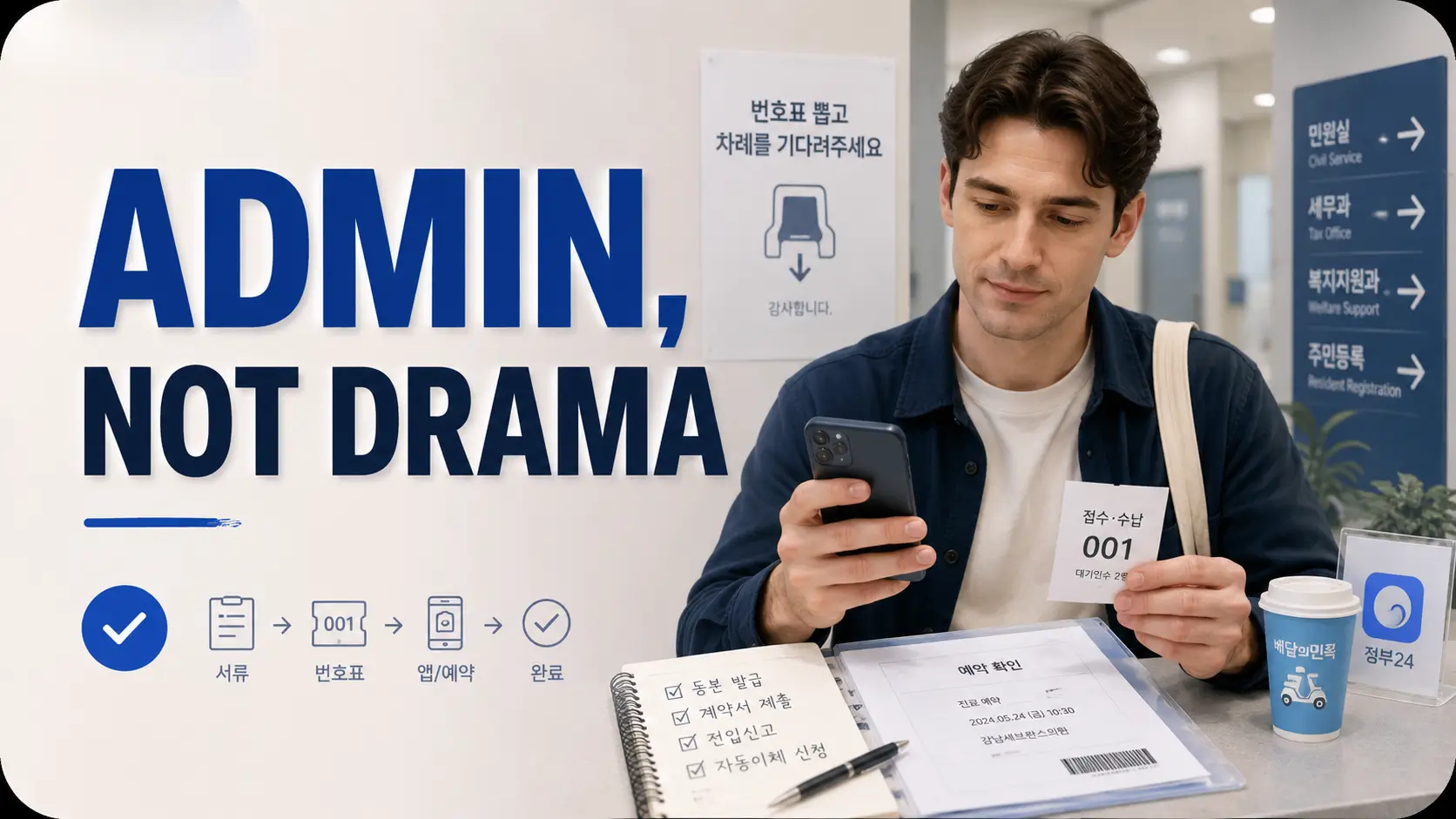
Navigating the Quiet Friction of Everyday Korean Admin
A delivery is late, the elevator has a notice taped inside, your clinic booking disappeared, and the person at the counter keeps asking for a number you swear you never received. Welcome to the small, paper-cut kind of confusion that makes everyday problems in Korea feel like admin, not drama.
The friction is not imaginary. It can be tiring, especially for expats, travelers, remote workers, study-abroad families, and Korea-curious readers used to solving problems by explaining the whole story first. In Korea, daily life often asks for a different opening move: find the channel, gather proof, identify the 담당자 (person in charge), and ask for the next step.
That sounds dry. It is also strangely powerful. Because once you understand the workflow, many problems stop feeling like a locked room and start looking like a hallway with too many doors.
Everyday Korean admin culture is the habit of turning small friction into trackable steps: apps, queue numbers, receipts, screenshots, building offices, call centers, official forms, and civil complaint channels. The emotion is real, but the container is procedural.
The Quick Map: Korea’s Small-Problem Operating System
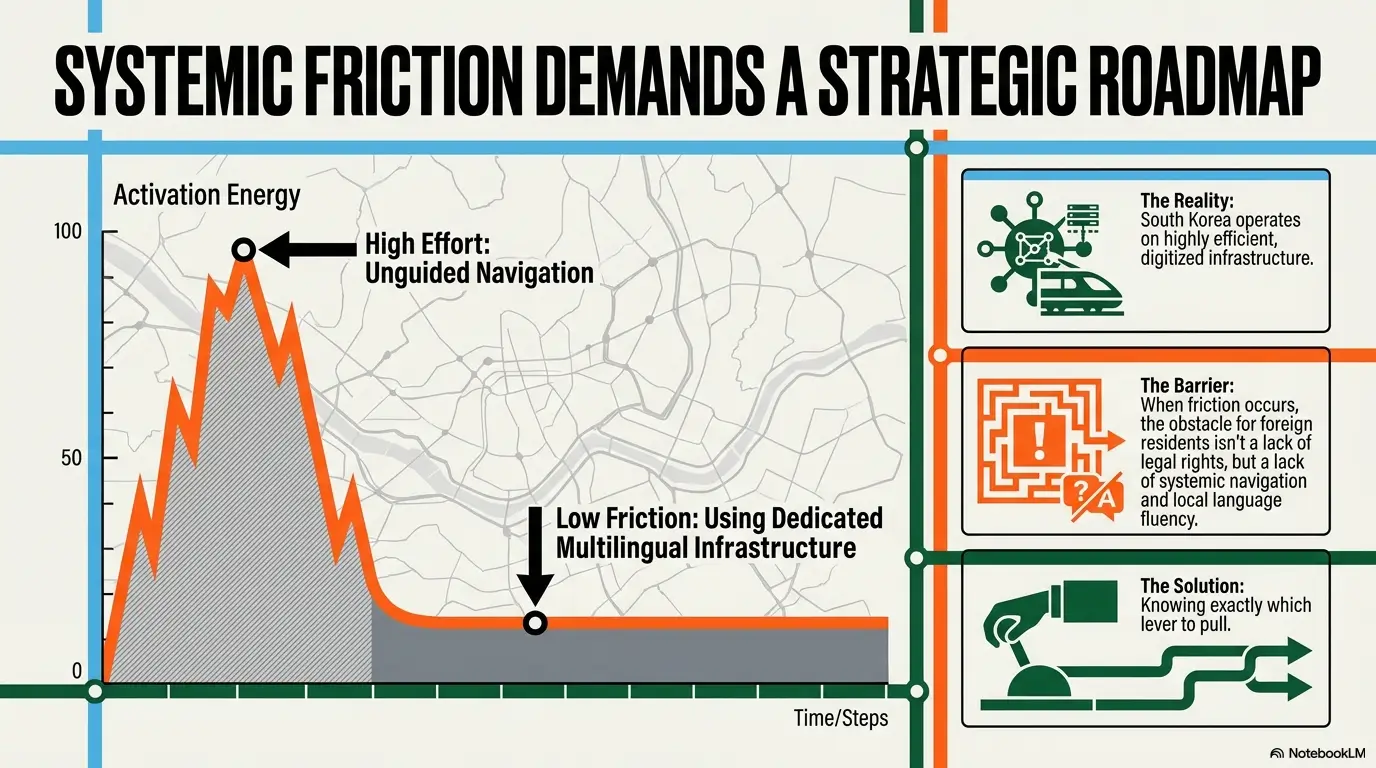
Think of Korean daily friction as a station with many platforms. The train does move, but only after you find the correct line. For most non-emergency problems, your best sequence is simple: document the issue, locate the responsible channel, ask for the person in charge, confirm the required proof, and request a clear next action.
It is not about becoming colder. It is about carrying your frustration in a folder instead of a thundercloud.
Table of Contents
The Korea Friction Code: Why “Who Do I Talk To?” Comes First
In many parts of Korean daily life, the first question is not “How angry am I allowed to be?” It is “Who owns this problem?” That shift matters. A broken delivery, housing repair, school form, clinic appointment, parking dispute, or utility charge often begins with locating the responsible desk, office, app category, or 담당자.
The hidden question behind small problems
A cracked tile in an apartment hallway may not belong to “the landlord” in a general sense. It may belong to the building management office, a maintenance vendor, a resident committee, or a city safety channel depending on where it sits. A refund problem may not belong to the cashier who smiled at you. It may belong to the app platform, the payment processor, the branch manager, or the consumer center.
That is why Korean problem-solving can feel like a treasure hunt designed by a filing cabinet. The map is there, but it is rarely handed to you with a brass band.
담당자 culture without the jargon headache
담당자 means the person in charge. In practice, it is less mystical than it sounds. It means the person, team, or office with authority to process the issue. For a foreign resident or long-term visitor, this is one of the most useful Korean concepts to learn because it turns a vague request into a route.
Instead of asking, “Can somebody help me?” try asking, “Who is the 담당자 for this?” That small change can move the conversation from sympathy to action.
Here’s what no one tells you…
The fastest person is not always the loudest person. It is often the person who knows which channel counts. This is true in Korean business communication, apartment management, clinics, delivery apps, and school offices. The person with the clean timeline and the right receipt may outrun the person with the grand speech.
- Ask which office or app category handles the issue.
- Ask for the 담당자 when a general answer stalls.
- Keep your request specific enough to be transferred.
Apply in 60 seconds: Save this phrase: “Who is the 담당자 for this issue?”
Not Cold, Just Procedural: The Emotional Temperature of Korean Problem-Solving
Americans often enter a complaint through story. We describe what happened, how it affected us, why it felt unfair, and why the company or office should care. That can be effective in the US, where “advocating for yourself” is practically a civic sport with comfortable shoes.
In Korea, the first layer may feel less emotionally responsive. The person may ask for a booking number, screenshot, resident card, phone number, receipt, or previous message before reacting to the human part. That can feel chilly. Often, it is simply procedural.
Why calm process can look distant to Americans
US service culture often rewards visible urgency. A customer might ask for a manager, explain the inconvenience, and frame the situation as a fairness problem. Korean service settings can reward sequence: first verify identity, then classify issue, then check record, then transfer, then process.
Neither culture is pure logic or pure emotion. Both are human. But the opening rhythm differs.
The form absorbs the feeling
Receipts, screenshots, queue numbers, building notices, and official apps do something subtle. They absorb the heat. Instead of two people battling over whose memory is correct, the case becomes a record.
That does not mean the process is always fair or fast. It means the system prefers a trackable shape. Your irritation may be valid, but the system asks it to wear shoes before entering the room.
When politeness sounds like a locked door
Some Korean service phrases can sound final when they are actually redirects. “That is difficult” may mean “not through this desk.” “Please check the app” may mean “the app record is required before we can process it.” “You need to contact the other office” may not be dismissal. It may be routing.
This connects to broader patterns of Korean indirect communication, where the practical meaning can sit beside the literal wording like a teacup beside a kettle.
The Paper Trail Habit: Why Receipts, Screenshots, and Numbers Matter
If there is one practical habit that lowers Korean admin stress, it is this: save proof before you need proof. Screenshots are not paranoia. They are tiny umbrellas for future weather.
Evidence is the social lubricant
Documentation helps because many offices and service desks need a visible record before they can act. Rentals, deliveries, refunds, clinics, schools, banks, phone plans, parking registration, and apartment repairs all become easier when you can show dates, names, amounts, messages, and confirmation numbers.
This is especially useful for foreigners navigating phone plans, identity verification, and contracts. If telecom or SIM issues are part of your daily setup, Korean phone plans for Americans are worth understanding before your number becomes the missing key to every app door.
The tiny screenshot that saves the afternoon
Imagine your food delivery says “completed,” but your door is lonely. A broad complaint like “My food never came” may trigger several questions. A stronger version is: “Order placed at 6:42 p.m., order number 1842, app shows delivered at 7:18 p.m., no package at door, photo attached.”
Now the issue has bones. It can stand upright.
Don’t do this: explain first, prove later
A long emotional explanation without order numbers, dates, photos, or names can stall the process. Not because people do not care, but because the system cannot grab the issue. It is like handing someone fog and asking them to file it alphabetically.
Money Block: The Five-Proof Checklist
Use this before contacting a service desk, office, clinic, school, or building manager.
- Yes / No: Do you have the date and time?
- Yes / No: Do you have the place, app, office, or branch name?
- Yes / No: Do you have a receipt, reservation number, order ID, or contract clause?
- Yes / No: Do you have screenshots, photos, or message history?
- Yes / No: Do you know what outcome you want?
Neutral action line: If two or more answers are “No,” gather proof before escalating.
Apps as Gatekeepers: When Daily Life Moves Through Digital Doors
Korea’s convenience is famous, but convenience often has a login screen. Banking, maps, food delivery, transport, hospital bookings, public services, school notices, and apartment announcements often move through apps. When everything works, it feels smooth enough to make a vending machine blush. When it fails, the app becomes the front desk, the hallway, and the locked door.
Korea’s convenience has a login screen
Many daily services connect to your Korean phone number, identity verification, payment method, address format, or resident status. For visitors, this can feel excessive. For residents, it becomes ordinary infrastructure.
A clinic appointment, for example, may depend on the right app, name format, phone number, and confirmation message. A bank task may require app authentication before the branch can proceed. A delivery issue may depend on the chat record inside the platform.
“Just call them” is not always the magic key
Phone calls can help, especially when timing is urgent. But the app record may carry more weight than the conversation. A chat thread, booking ID, automated category, or complaint submission can create a trail that a phone call does not.
This is why Korean phone etiquette can matter more than outsiders expect. A call may open the door, but the written record often keeps it from swinging shut. The pattern also appears in Korean phone call culture, where timing, role, and wording shape what happens next.
Let’s be honest… the app is sometimes the front desk
The app is not just a tool. Sometimes it is the gatekeeper. It decides which category exists, which proof can be uploaded, which answer is automatic, and which human you can reach. This is efficient until you meet Korean-only menus, identity verification loops, or account restrictions. Then the app becomes a very polished maze.
Show me the nerdy details
Digital admin works because it standardizes intake. A form forces the user to provide fixed fields such as date, category, location, account, payment, and proof. That makes routing easier for the receiving office, but it can make unusual cases harder to describe. The trade-off is speed for standard issues and friction for edge cases, especially when language, identity verification, or foreign documents do not fit the expected pattern.
Apartment Life as Admin Theater: Notices, Guards, Fees, and Rules
Korean apartment life can feel like a tiny city with its own weather system. There are notices, guards, management offices, recycling rules, parking stickers, elevator repairs, utility fees, and announcements that appear with the quiet authority of a judge in slippers.
The building office is its own little government
The management office may handle maintenance requests, fee statements, parking registration, move-in rules, elevator reservations, common-area repairs, and recycling instructions. The security desk may receive packages, monitor access, relay notices, or redirect residents to the proper office.
For foreigners, the surprise is not that rules exist. The surprise is how often the route goes through the building system rather than direct neighbor-to-neighbor discussion. A move-in checklist can save real stress, especially for renters using a Korean apartment move-in checklist before the boxes arrive and the elevator schedule becomes a small opera.
Why neighbors may not knock first
Noise, trash, parking, smoking, pet issues, and shared-space complaints often travel through notices, guards, apps, or management. Direct confrontation can feel too personal, too risky, or simply less efficient. A notice lets the system speak so the neighbor does not have to.
This can be good. It can also be frustrating. You may feel accused by a paper taped near the elevator even when it says “all residents.” The paper did not name you. Still, somehow it has eyebrows.
The quiet note on the wall is not casual
Posted notices in Korean buildings often carry more social force than outsiders expect. They can announce new recycling rules, water shutoffs, elevator maintenance, parking enforcement, pest control, cleaning schedules, or complaints about shared behavior.
Ignore them too often and daily life becomes expensive in tiny ways: missed repairs, wrong trash days, awkward guard conversations, or fees you could have avoided.
- Check elevator and lobby notices regularly.
- Ask the management office before assuming a neighbor is ignoring you.
- Keep photos of repair requests and fee statements.
Apply in 60 seconds: Take a photo of your building office phone number and save it under “Apartment admin.”
Public Complaints Without Fireworks: How Minwon Thinking Shapes Daily Fixes
민원, often romanized as minwon, means a civil complaint, petition, or public service request. In daily life, it can be as humble as reporting a broken sidewalk, an illegal parking problem, a streetlight outage, unsafe trash pile, or noise issue.
From annoyance to case number
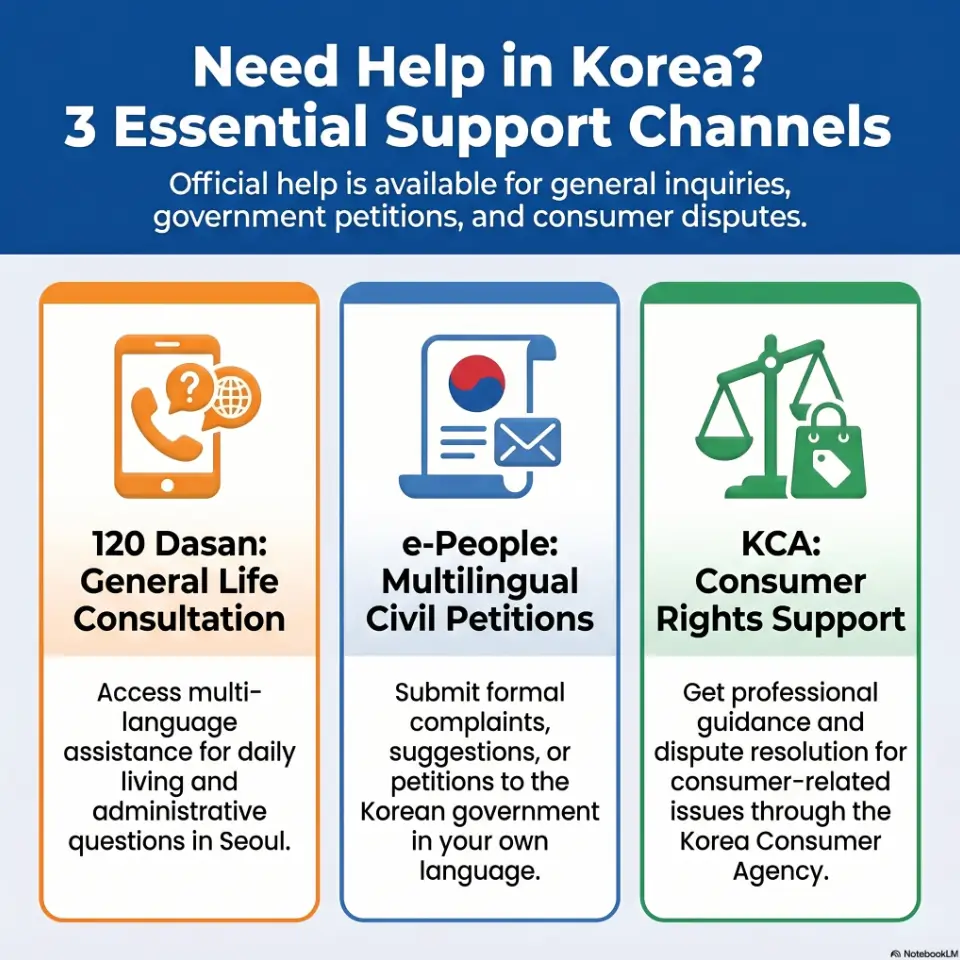
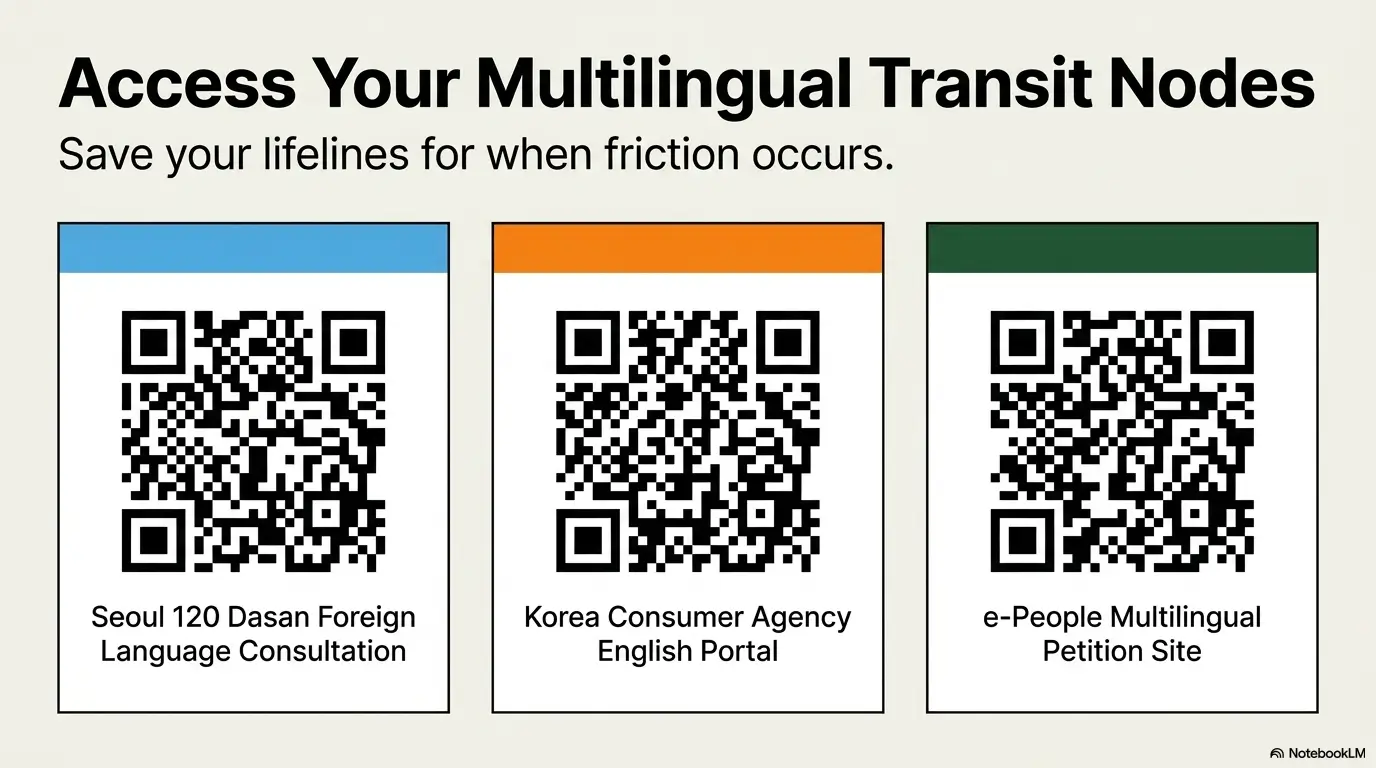
The key idea is that frustration can become a submission. Seoul’s 120 Dasan Call Center provides administrative counseling and city information, including foreign-language support through designated routes. e-People, operated as a government-wide online petition channel, also allows foreigners to submit certain petitions in multiple languages.
This does not mean every problem belongs in a public complaint system. Your missing socks do not need a national portal, tragic though the loss may be. But it does show how Korean civic problem-solving often turns “someone should fix this” into “submit it through the correct channel.”
Why “someone should fix this” becomes “submit it here”
Consider a broken streetlight. In a US neighborhood, someone might complain on a local Facebook group, call city hall, or tell a council member. In Korea, the stronger move may be to report the location through a municipal channel or app, attach a photo, and receive a case number.
The same mindset appears with illegal parking, street damage, sanitation issues, and safety concerns. The point is not emotional denial. It is administrative conversion.
The twist: admin can be empowering
Formal channels can feel stiff, but they can also protect ordinary people from needing social power. You do not have to know someone. You do not have to perform outrage. You can submit the problem into a visible system and ask for status.
Money Block: Public Complaint Decision Card
Use a service desk or building office when: the issue is private, commercial, apartment-related, or tied to a specific contract.
Use a city or public channel when: the issue affects public roads, safety, sanitation, public facilities, or local administration.
Use a consumer help route when: the issue involves a business transaction, refund dispute, service failure, or consumer harm.
Neutral action line: Start with the narrowest responsible channel, then escalate only when the first route cannot handle it.
The Language Layer: Why Translation Is Only Half the Battle
Translation helps. Workflow literacy helps more. You can translate every word perfectly and still fail to solve the problem if you do not know the category, sequence, hierarchy, or proof needed.
Words are not the whole workflow
A sentence like “My payment did not work” may be grammatically correct, but the office may still need the payment date, amount, method, app name, error message, branch, and confirmation number. Language opens the window. Process tells you which building you are in.
This is why phrasebooks are useful but incomplete. For remote workers and long-stay visitors, a Korean digital nomads phrasebook is stronger when paired with admin habits: screenshot, summarize, confirm, and request the next action.
“Can you help me?” versus “Where should I submit this?”
Broad emotional wording can produce sympathy but not movement. Process-oriented questions produce routes. Try shifting from “Can you help me?” to “Where should I submit this?” or “Which document is missing?” or “Could you tell me the next step?”
That small shift keeps the conversation from floating away.
Useful phrases that reduce friction
- Responsible person: “Who is the 담당자 for this?”
- Required proof: “Which document or screenshot do you need?”
- Submission route: “Where should I submit this request?”
- Case record: “Can I receive a case number or confirmation message?”
- Receipt: “Could I get a receipt or written confirmation?”
- Next step: “What should I do next?”
Name the issue plainly.
Save proof: photo, receipt, ID, message.
Find the app, desk, office, or 담당자.
Request one clear next action.
Keep the case number or reply.
Common Mistakes: Small Moves That Make Korean Admin Feel Worse
The hardest part of Korean admin is not always the form. Sometimes it is the emotional translation: realizing that a delay, redirect, or request for proof is not necessarily a personal insult.
Mistake 1: treating every delay as personal disrespect
System delays, unclear ownership, and identity checks often feel personal because they block your day. But the person in front of you may have limited authority. They may be following a script, waiting for another department, or unable to act without a record.
This is not a call to become a doormat. It is a call to aim your energy where it can work.
Mistake 2: skipping the first channel
Going straight to anger, public posts, senior staff, or a government complaint can backfire if the basic form, app category, or local desk was never used. Many systems ask, in effect, “Did you try the normal route first?”
Try the normal route. Save the proof. Then escalate with a clean trail.
Mistake 3: using too much story and too little timeline
Story matters, but sequence solves. A useful timeline looks like this:
- Date: May 8, around 3:10 p.m.
- Place: Building lobby, delivery app, clinic desk, bank branch, school office.
- Person or channel: Staff name, app chat, management office, call center.
- Issue: What went wrong in one sentence.
- Proof: Receipt, screenshot, photo, message, notice, contract line.
- Request: Refund review, repair visit, correction, written confirmation, transfer.
Mistake 4: assuming “no” means forever
Sometimes “no” means wrong department. Sometimes it means missing document. Sometimes it means the person has no authority. Sometimes it means not today, not here, not like this.
Ask a follow-up that leaves a doorway: “What should I prepare?” “Which office handles this?” “Is there another channel?” “Can I receive that answer by message?”
Short Story: The Elevator Notice That Wasn’t About Me
On my second month in a Korean apartment, a notice appeared in the elevator about food waste bags being tied incorrectly. I read it with the moral panic of a person caught stealing pears from a royal orchard. Was it me? Had I offended the entire building with one soggy knot? I asked the guard, expecting a stern lecture.
He pointed to the notice, then to the proper bin area, and explained that several residents had been confused after the pickup schedule changed. No drama. No accusation. Just a system trying to correct a pattern without knocking on twenty doors. The lesson stayed with me: in Korean apartment life, a notice is often not a personal arrow. It is a public steering wheel. Read it, adjust, and keep your dignity intact.
- Ask what is missing before assuming refusal.
- Convert story into timeline.
- Escalate only after creating a record.
Apply in 60 seconds: Rewrite one current problem as: date, place, issue, proof, request.
Who This Is For / Not For: Read This Before You Overgeneralize
Any cultural explanation can become a cardboard mask if handled badly. Korea is not one personality. The goal here is navigation, not stereotyping.
This is for practical observers
This guide is for US readers living in Korea, visiting long-term, teaching, studying, dating or marrying into Korean family systems, working remotely, writing about Korean daily life, or simply trying to understand why a tiny problem sometimes needs five steps and a login.
It is also useful for people comparing Korean habits with US customer service, office etiquette, apartment systems, and public complaint routes.
This is not a master key to every Korean person
Region, age, class, institution, urgency, language ability, personality, and power all matter. A small town office may behave differently from a Seoul platform company. A hospital may differ from a school. A landlord may differ from a management office.
Also, individuals improvise. Some people are warm and flexible. Some are rigid. Some are angels with stamp pads. Some are thunderstorms in cardigans.
The goal is navigation, not stereotyping
Systems shape behavior, but people still live inside those systems with patience, fatigue, humor, shortcuts, and judgment. The humane lens is this: when a person seems procedural, ask what the system requires before deciding what the person feels.
The American Contrast: Why US Problems Often Become Personal Stories
To understand Korea’s admin feel, it helps to contrast it with the US. American complaint culture often invites the personal narrative. “This disrupted my workday.” “I have been a customer for ten years.” “My child needs this fixed before school.” These details can help because US service culture frequently allows discretionary judgment.
In the US, “advocating for yourself” can mean performing urgency
US customer service escalation, insurance disputes, school meetings, medical billing calls, and landlord conversations often reward persistence. A person may need to explain impact, ask for a supervisor, document hardship, or repeat the case across departments.
The American script can sound like courtroom theater performed over hold music.
In Korea, credibility often travels through sequence
In Korea, a neat sequence can be more persuasive than a dramatic account. A request with date, place, proof, category, and desired outcome feels easier to process. That is why people who understand nunchi at work in Korea often notice the room before pressing the point. They read channel, role, timing, and authority.
Same frustration, different container
The emotion exists in both cultures. The container changes. In the US, frustration may become a story. In Korea, frustration may become a form, a screenshot, a queue number, or a case submission. Neither is automatically better. But if you carry the wrong container, the problem spills.
The Admin Survival Kit: What to Prepare Before You Ask for Help
The goal is not to become a bureaucratic monk. The goal is to make help easier to give. A good admin survival kit is boring, clean, and surprisingly comforting.
Build a five-line problem summary
Use this template whenever you contact a Korean office, app desk, clinic, apartment manager, school office, phone provider, bank, or service center:
1. What happened: One sentence.
2. When it happened: Date and time.
3. Where it happened: Place, app, branch, or building.
4. What proof you have: Screenshot, receipt, contract, photo, message.
5. What you want: Correction, refund review, repair visit, written confirmation, transfer, or case number.
Keep the evidence folder boring and beautiful
Create a folder on your phone called “Korea Admin.” Inside it, keep screenshots of reservations, receipts, apartment notices, repair requests, contract clauses, clinic bookings, payment errors, previous messages, and case numbers.
It may feel excessive until the day it saves you two hours and a blood pressure spike.
Ask for the next action, not a miracle
A miracle is hard to process. A next action is not. Instead of asking “Can you fix this?” ask for one specific movement: “Could you confirm the required document?” “Could you transfer me to the 담당자?” “Could you send a written confirmation?” “Could you schedule a repair visit?”
Money Block: Before You Compare Help Options
Use this when deciding whether to ask a friend, translator, management office, agency, call center, or public channel.
- Gather your ID name format as used in the service.
- Save the Korean and English version of the address.
- Collect screenshots in chronological order.
- Write your desired outcome in one sentence.
- Check whether the issue is private, commercial, apartment-related, or public.
Neutral action line: Choose the helper who can access the correct channel, not simply the person who speaks the most English.
FAQ
Why do small problems in Korea often require forms or apps?
Because many services use structured intake. A form or app category collects the basic fields needed for routing: identity, date, service type, payment record, location, and proof. It can feel impersonal, but it helps offices process repeated problems without starting from zero every time.
Is Korean customer service less emotional than American customer service?
Not necessarily. Korean customer service may show concern through procedure rather than expressive empathy. A staff member asking for a receipt or queue number may not be dismissing your frustration. They may be trying to place the issue inside the system that can actually act on it.
What does 담당자 mean in everyday Korean problem-solving?
담당자 means the person in charge. In daily life, it refers to the person, office, or team responsible for handling a specific matter. Asking for the 담당자 can help when a general desk cannot answer or when your issue needs an authorized decision.
Why do Koreans use screenshots so often for complaints or requests?
Screenshots preserve app records, payment details, booking confirmations, delivery status, notices, chat messages, and error screens. They reduce confusion and make it easier for another person to verify what happened without relying only on memory.
Should foreigners in Korea complain directly or go through official channels?
Start with the channel closest to the problem: app support, service desk, building office, school office, clinic desk, or seller. If that does not work, keep the record and consider a higher channel such as a consumer help route or public petition channel when appropriate.
Why do apartment problems in Korea often go through the management office?
Many Korean apartment complexes manage shared spaces, parking, recycling, repairs, elevator use, notices, and resident complaints through a central office. This reduces direct neighbor conflict and keeps a record, though it can feel formal to newcomers.
What should I prepare before contacting a Korean office or service desk?
Prepare a five-line summary: what happened, when, where, proof, and what you want. Add screenshots, receipts, booking numbers, Korean address details, and previous messages. A short, organized request usually works better than a long emotional explanation.
Does “admin culture” mean Koreans avoid conflict?
No. Conflict still exists. It is often routed through systems, notices, intermediaries, formal channels, or documented requests. The disagreement may be real, but the preferred container may be procedural rather than confrontational.
Can I use English when filing complaints in Korea?
Sometimes. Some public services and major platforms offer English support, and e-People provides multilingual petition options for foreigners in certain cases. For private businesses, hospitals, schools, and buildings, English access varies widely.
How long should I wait before escalating a Korean admin issue?
It depends on urgency. For safety, medical, housing, legal, or financial harm, do not wait casually. For ordinary service issues, first use the proper channel, save proof, ask for a response timeline, and escalate if the route fails or the answer is unclear.
Next Step: Make One Problem Easier Before It Becomes a Saga
The mystery at the start was never that Korea has no emotion in daily problems. Of course it does. Anyone who has stared at an app error in a subway station with 7% battery knows the soul has weather.
The real insight is that many Korean problems move when they find the right channel. A delivery issue needs an order number. An apartment issue needs the management office. A public issue may need a case submission. A clinic issue may need the booking record. A phone issue may need the identity path that matches the account.
Create your “Korea admin note” today
Open a note on your phone and title it “Korea Admin.” Add three reusable templates: repair request, refund issue, and appointment or service problem. Keep them plain. No poetry required, though the heart may quietly protest.
The 10-minute version
Copy this sentence structure:
“On [date], at [place/app], [problem] happened. I have [proof]. Could you please tell me the correct next step?”
That sentence will not solve every problem. It will, however, stop many problems from becoming fog.
Close the loop gently
In Korea, many everyday problems do not disappear through drama. They move when they find the right groove, like water slipping through a narrow line in stone. Your job is not to erase frustration. Your job is to give it a route.
Within the next 15 minutes, make one folder, save one screenshot, and write one five-line summary for a current or likely future problem. Tiny admin, large peace.
Last reviewed: 2026-05.