
Korea city life guide
Why Delivery Motorbikes Make Korean Streets
Feel Different From Western Cities
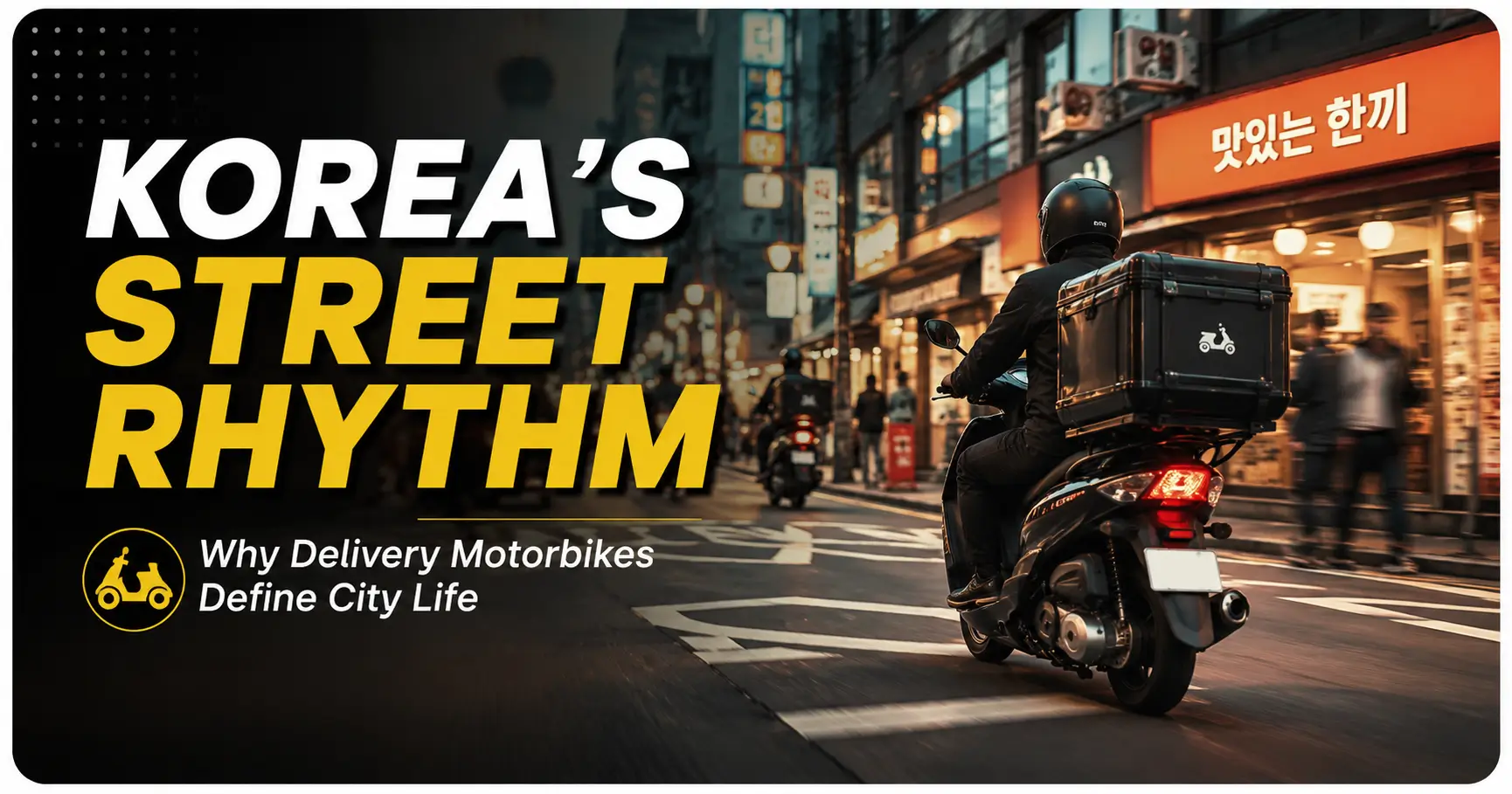
The first thing many visitors notice in Korea is not a palace roof, a neon sign, or a bowl of bubbling stew. It is motion. A delivery motorbike slips past a restaurant door, another hums near an apartment entrance, and a third appears from an alley that looked quiet five seconds ago. The street does not merely carry traffic. It breathes in short, quick pulses.
For US and UK readers, Korean delivery motorbikes can feel startling because they sit at the crossing point of density, convenience, apps, apartment living, restaurant clusters, narrow streets, and the famous ppalli-ppalli rhythm. This article explains that feeling without turning riders into caricatures or treating Korean streets as chaos with a helmet.
You will learn why the last mile looks different in Korea, where pedestrians should stay extra alert, why Western comparisons often miss the point, and how to walk through Seoul, Busan, or a busy neighborhood district with more confidence. Think of this as a street-reading guide: part culture note, part practical safety map, part small lantern for the urban night.
Understand the rhythm
See why Korean delivery traffic feels close, fast, and constant.
Walk smarter
Learn where visitors usually misread sidewalks, alleys, and curb space.
Compare fairly
Separate rider behavior from infrastructure, app pressure, and urban form.
🍜 The street makes more sense when you stop asking “Why so many bikes?” and start asking “What kind of city produces this rhythm?”
Snapshot
This guide is for first-time Korea visitors, expats, urban-culture readers, and anyone comparing Korean city life with Western cities. It explains why delivery motorbikes shape the sound, spacing, timing, and emotional texture of Korean streets. By the end, you will know what to notice, where to stay alert, and how to interpret the street without panic or lazy stereotypes.
Table of Contents
Fast Answer: Why the Street Feels Different
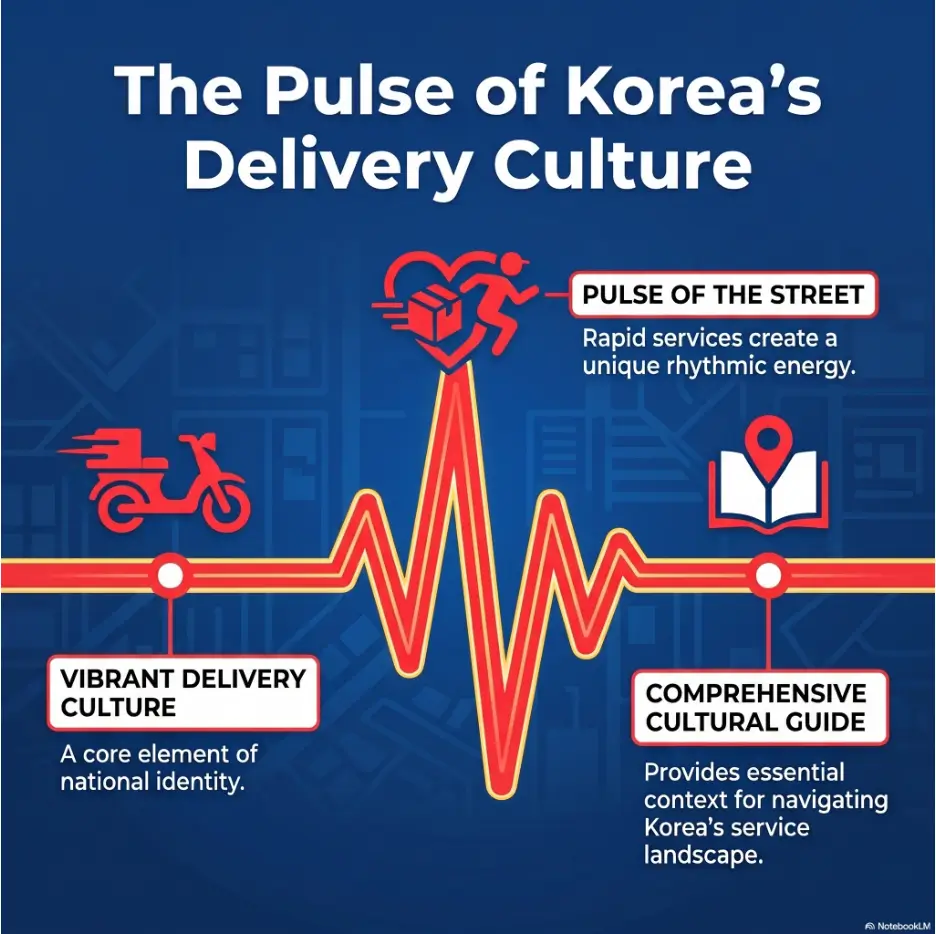
Delivery motorbikes make Korean streets feel different because they are woven into ordinary city rhythm, not treated as background traffic. In dense neighborhoods, riders move between restaurants, apartment towers, convenience stores, subway exits, office buildings, and narrow alleys with striking frequency.
For many Western visitors, the difference is not simply speed. It is proximity. A motorbike may pass closer to your body than you expect, appear from a smaller side street than you noticed, or idle beside a restaurant entrance while you are still deciding where to stand.
That sensation comes from several forces working together: high residential density, compact food districts, delivery-app expectations, apartment tower layouts, quick restaurant turnover, narrow streets, and a culture where convenience often operates in real time. The result is a city that feels less like a still map and more like a live operating system.
Key takeaway
Korean delivery motorbikes are not just vehicles. They are visible signals of how dense housing, food culture, app convenience, and street design meet in daily life.
It Is Not Just Traffic; It Is Urban Choreography
In a typical Western suburb, food delivery often feels like a private transaction. A car pulls into a driveway, someone carries a bag to the door, and the street barely changes. The delivery event is quiet, spaced out, and easy to miss.
In a Korean city district, delivery is public before it becomes private. You may see the pickup, hear the scooter, watch the rider check an app, and notice the bike rejoin the street within seconds. The transaction leaves a trace in shared space.
The Visitor Feeling: “Why Is Everything So Close?”
Many visitors do not have the vocabulary for the difference at first. They may say Korean streets feel intense, crowded, loud, busy, or efficient. All of those words catch one corner of the fabric.
The more precise answer is that Korean streets often compress functions that Western cities separate. Eating, shopping, commuting, parking, delivery pickup, apartment access, late-night errands, and pedestrian movement happen in the same small pieces of space.
A Quick Korea vs Western City Comparison
| Street feature | Common Korean city pattern | Common Western pattern |
|---|---|---|
| Food delivery vehicle | Motorbike or scooter appears frequently in dense districts | Car, van, bicycle, e-bike, or scooter depending on city type |
| Pickup location | Restaurant rows, alleys, mixed-use buildings, apartment entrances | Storefront curb, parking lot, suburban restaurant, delivery bay |
| Pedestrian feeling | Close, alert, fast-changing | More separated in suburbs, more varied in big cities |
| Street rhythm | Short bursts of movement | Longer spacing between delivery events |
| Main surprise for visitors | Motorbikes feel integrated into daily walking space | Delivery may feel more hidden inside car traffic |
Safety First: Calm Awareness, Not Fear
This article is a cultural and practical guide, not legal advice, traffic enforcement guidance, or a claim that every rider behaves the same way. Street behavior varies by neighborhood, time of day, weather, local rules, enforcement, rider training, platform pressure, and simple human judgment.
If you are walking in Korea, the goal is not to become tense or suspicious. The goal is to stay lightly awake to your surroundings. Think of it as switching from “park stroll mode” to “busy transit hub mode.” Your shoulders can stay relaxed, but your attention should not be asleep at the wheel.
Visitors with children, mobility limitations, hearing loss, low vision, heavy luggage, or strong jet lag should give themselves extra margin. A tired traveler standing in the wrong place outside a restaurant door is basically a traffic cone with a passport.
Safety note
Use this guide for everyday awareness only. Follow local signs, traffic signals, hotel or host advice, and official safety information. If you feel unsafe, step into a shop, station area, hotel lobby, or wider pedestrian zone before checking your phone or map.
The Most Useful Rule: Do Not Freeze in Flow
The biggest pedestrian mistake is not walking slowly. Slow walking is fine. The problem is stopping suddenly in a narrow active zone without looking around first.
Restaurant doors, alley mouths, apartment entrances, curb cuts, and convenience-store fronts often work like little loading docks. If you need to check a map, send a message, or argue tenderly with your travel partner about dinner, move to the side first.
Extra Care With Children, Luggage, and Late Nights
Children often read sidewalks as safe by default. In some Korean districts, a sidewalk may also be a temporary waiting area for bikes, pedestrians, shop signs, delivery bags, and people leaving restaurants.
Large suitcases create a similar issue. A rolling bag changes your turning radius, blocks others from passing, and makes it harder to step aside quickly. In busy areas, keep luggage close to your body rather than trailing behind you like a stubborn plastic duck.
Quick Risk Scorecard for Pedestrians
| Situation | Risk level | What to do |
|---|---|---|
| Wide boulevard with clear signals | Lower | Use normal city-crossing habits and obey signals |
| Restaurant row at dinner time | Medium | Keep one ear available and avoid sudden stops |
| Narrow alley near bars or food shops | Medium to high | Walk predictably and stay close to the side |
| Apartment entrance during meal delivery rush | Medium | Watch for riders entering or exiting quickly |
| Walking while staring at your phone | High | Step aside before checking directions |
The Sound Arrives Before the Rider
In Korean cities, the sound of delivery motorbikes often arrives before the object itself. A low engine note, a brake sound, a quick acceleration, a delivery box rattle, or the faint chirp of an app notification can make the street feel active even before you understand what is moving.
This matters because sound changes how a visitor reads space. In many Western cities, traffic sound may be broad and distant: car lanes, buses, sirens, construction, and highway hum. In dense Korean neighborhoods, the motorbike sound can feel more personal because it moves through smaller corridors.
Sound Makes Proximity Feel Stronger
A delivery bike on a wide road is just one part of traffic. A delivery bike in an alley behind a noodle shop feels different because the sound bounces between walls, storefront glass, signs, parked cars, and apartment gates.
That acoustic closeness can make the street feel busier than it physically is. Your brain hears movement nearby and prepares your body to react. Even when nothing dangerous happens, the nervous system has already put on its tiny reflective vest.
The Street Feels Alive in Shorter Intervals
Delivery motorbikes create short intervals of attention. A rider arrives, parks briefly, checks a phone, lifts a bag, leaves, and disappears. Then another rider appears. The whole event may take less than a minute.
For a visitor, this makes the street feel constantly refreshed. Nothing dramatic needs to happen. The repeated micro-movement is enough to give the city a quickened pulse.
Short Story: The Corner Outside the Gimbap Shop
A first-time visitor in Seoul once stood outside a small gimbap shop with a suitcase, a coffee, and the noble confidence of someone who had survived a fourteen-hour flight. Her map said the guesthouse was two minutes away. Her body said the floor was becoming optional.
She stopped in front of the shop door to zoom in on the map. In thirty seconds, two customers stepped around her, one rider arrived for pickup, and another rider slowed near the curb. Nobody shouted. Nobody was rude. But the corner tightened.
Then she moved three steps to the wall beside a closed storefront. The whole street changed. People flowed. Bikes passed. She could read the map in peace.
The lesson was simple: in Korea, where you stand can matter as much as where you walk.
Korea’s Delivery Density Is the Hidden Engine
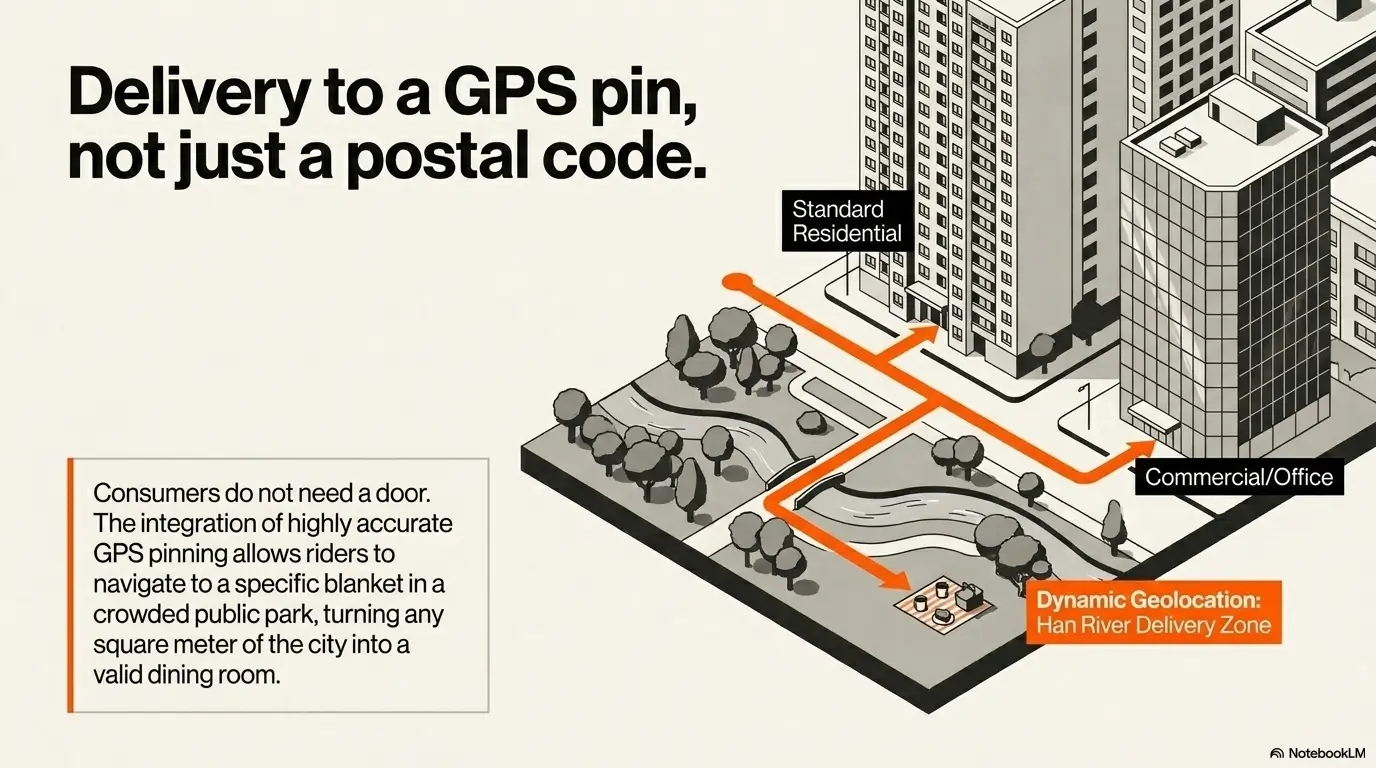
The motorbikes are visible, but density is the invisible engine. Korean cities often place many people, restaurants, cafés, convenience stores, schools, offices, clinics, and apartment buildings within a small radius. That closeness changes everything about delivery.
In a low-density suburb, one delivery route may cover long distances between detached homes, strip malls, and wide parking lots. In a Korean urban neighborhood, a rider may complete several short deliveries in a compact area. The street becomes a network of quick handoffs.
Apartment Towers Create Stacked Demand
Korean apartment complexes can hold hundreds or thousands of residents in a relatively compact area. From a delivery standpoint, that is not just housing. It is stacked demand.
One apartment entrance may serve students ordering late-night chicken, parents ordering dinner after work, older residents receiving groceries, and office workers ordering coffee during a remote-work day. A single address cluster can generate a stream of delivery activity that feels much larger than its footprint.
Restaurants Are Often Closer to Customers
Many Korean neighborhoods have food businesses tucked into ground floors, side streets, basement levels, and upper floors of commercial buildings. That means food options can sit surprisingly close to residential zones.
When restaurants and customers are close together, motorbikes do not need to behave like long-haul delivery vehicles. They become short-distance connectors, darting between points in a dense web.
Apps Turn Private Cravings Into Public Movement
A craving begins privately: fried chicken, jjajangmyeon, iced coffee, tteokbokki, soup, convenience-store snacks. But once an order enters the delivery system, that private desire becomes visible outside.
The app summons a rider. The restaurant prepares a package. The rider appears in shared space. The city briefly reorganizes around someone’s dinner.
Key takeaway
Korean delivery speed is not only about rider pace. It is also about distance. When many restaurants and many customers sit close together, the street naturally fills with short delivery trips.
The Delivery Street Flow at a Glance
Korean Delivery Street Framework
1. Dense demand
Apartment towers, offices, schools, and food districts sit close together.
2. App trigger
A private order becomes a public street movement.
3. Quick pickup
Riders pause near doors, curbs, alleys, or shopfronts.
4. Shared space
Pedestrians, bikes, cars, signs, and delivery bags use tight corridors.
5. Smart walking
Visitors move predictably, pause at the side, and keep one ear available.
Why the Western Last Mile Feels Slower
Western cities are not one thing. New York, London, Los Angeles, Manchester, Chicago, and a small town in Ohio do not share the same delivery pattern. Still, many US and UK readers come from places where delivery is more spread out, more car-based, or more separated from pedestrian movement.
That separation changes the emotional experience. When delivery happens inside car traffic, parking lots, bike lanes, or wide roads, pedestrians may notice it less. The food still moves, but the body does not feel it as closely.
Cars and Vans Hide Delivery Inside Ordinary Traffic
In many Western suburbs, a delivery driver in a car blends into normal traffic. The vehicle looks like every other vehicle. The only visible clue may be someone stepping out with a paper bag.
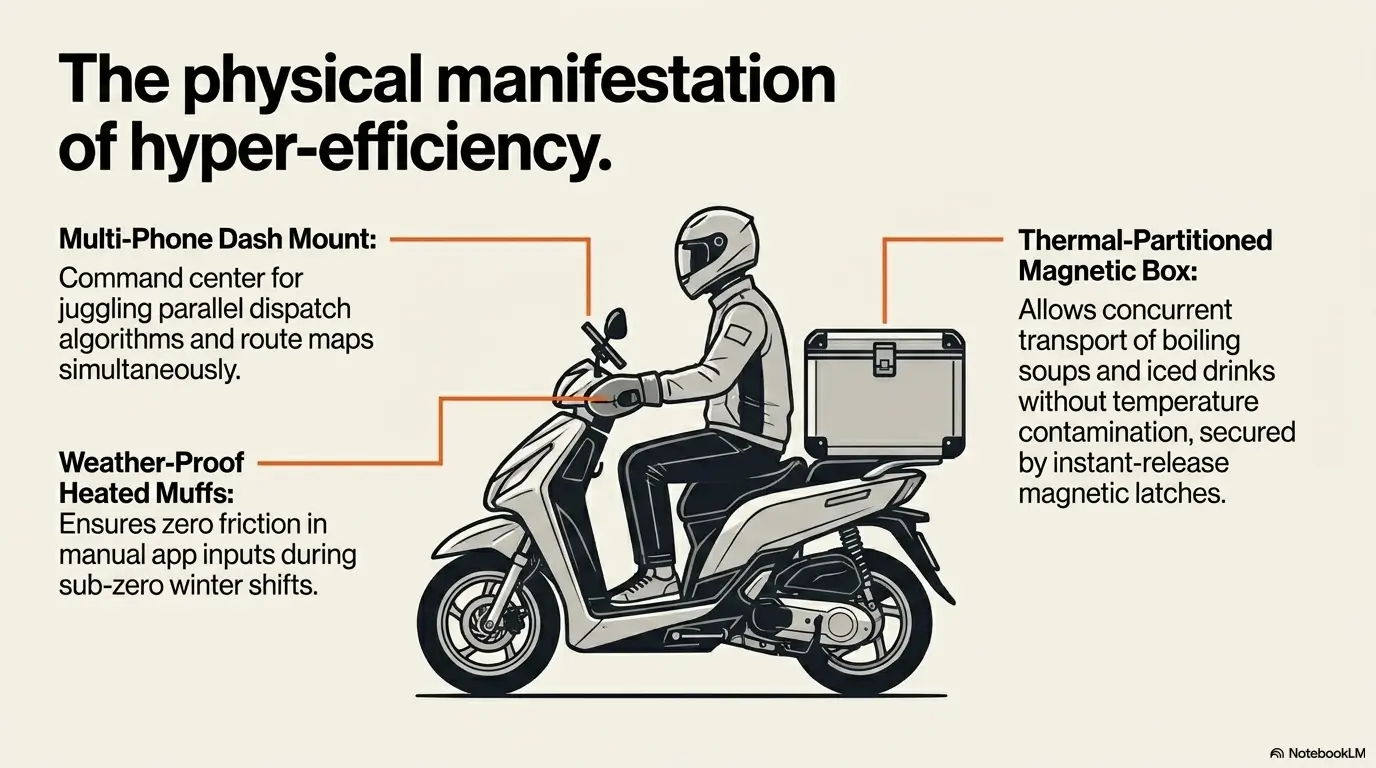
In Korea, the delivery box on the back of a motorbike announces itself. The vehicle is smaller, more nimble, and easier to spot. The delivery function is written on the street in bold marker.
Suburban Spacing Slows the Rhythm
Wide roads, single-use zoning, detached homes, parking lots, and longer travel distances stretch the delivery process. A car may cover more ground between each stop, so the street does not show repeated pickup and drop-off moments in the same visible frame.
That is why a Western visitor can be surprised by a Korean restaurant row at 8 p.m. The number of visible exchanges can feel almost theatrical: bags moving, riders waiting, customers entering, signs glowing, pedestrians weaving around one another.
Curbside Pickup Can Replace Doorstep Urgency
In some Western areas, people drive to collect takeout themselves. The restaurant parking lot absorbs the movement. The customer’s car becomes the delivery vehicle.
In Korea, especially in dense districts, the customer often does not need to leave the apartment, office, study room, or hotel. That convenience puts more of the movement onto the delivery network, and the network becomes visible in the street.
The Ppalli-Ppalli Effect Is Social, Not Just Fast
Ppalli-ppalli roughly means “quickly, quickly,” but reducing it to simple impatience is too thin. In daily Korean life, speed can be a form of service, respect, competition, survival, habit, and social expectation all at once.
Delivery motorbikes express that cultural texture in public. A meal arriving quickly is not just convenient. It confirms that the system works. The app, restaurant, rider, apartment access, payment method, and customer expectation all click together.
Fast Does Not Always Mean Careless
Visitors sometimes make the mistake of reading every fast movement as reckless. Some riding may indeed feel uncomfortable or unsafe. But speed alone does not explain the whole system.
In a dense delivery culture, a rider may be making dozens of small time calculations: where to pause, how to access a building, how long the restaurant will take, how to avoid a blocked lane, where pedestrians are moving, and how to complete the order without losing the next one.
The Clock Is Social, Not Just Digital
Delivery apps show time as a number, but people feel it as trust. If an app says food will arrive in 22 minutes, the customer begins to believe in that promise. The restaurant and rider inherit that expectation.
This is why the street can feel intense even when nobody is angry. Everyone is moving inside a shared clock. The clock is not hanging on the wall. It is buzzing in pockets.
Convenience Becomes an Expectation, Not a Luxury
In places where delivery is occasional, it may feel like a treat. In many Korean neighborhoods, delivery can feel like an ordinary extension of daily life: dinner after work, coffee during study time, late-night snacks during a drama marathon, soup when someone is tired.
When convenience becomes ordinary, the street must absorb it. That is the quiet trade: private ease creates public motion.
Key takeaway
Ppalli-ppalli is not just a speed habit. It is a social expectation that turns quick service into a visible city pattern.
Sidewalks, Alleys, and Crosswalks: Where Visitors Notice It Most
The difference between Korean and Western delivery streets becomes clearest in the spaces pedestrians use most: sidewalks, alleys, crosswalks, storefronts, and apartment entrances. These are not always cleanly separated zones.
A sidewalk may be a walking path, a waiting area, a shop display edge, a place where a delivery rider pauses, and a social space where friends stop to decide what to eat. The street asks everyone to negotiate gently and quickly.
Sidewalks Can Feel Less Predictable Than Expected
In some Western neighborhoods, sidewalks feel clearly pedestrian-only. In Korean cities, most sidewalks are still for pedestrians, but the practical experience can vary by district. Store signs, parked scooters, delivery pickups, crowds, subway exits, and narrow frontage can make the walking line less obvious.
The best habit is to walk predictably. Do not drift sideways while checking your phone. Do not step backward from a storefront without glancing behind you. Do not gather in a doorway while deciding whether the menu looks promising.
Alleys Work Like Shared Corridors
Korean alleys can be wonderfully atmospheric: old walls, glowing signs, tiny restaurants, cats with mayoral confidence, laundry racks, delivery boxes, and apartment gates. But many alleys also carry vehicles, scooters, pedestrians, and delivery movement.
Visitors often misread alleys as quiet pedestrian lanes because they look intimate. The safer reading is “shared corridor.” Walk near one side, listen for movement, and avoid spreading your group across the full width.
Crosswalks Can Feel Alert Rather Than Relaxed
At major intersections, follow signals and look both ways, including for turning vehicles and bikes. At smaller crossings, take an extra beat before stepping out, especially near restaurant clusters or apartment entrances.
The point is not to distrust every rider. It is to avoid acting as if painted lines create a glass dome around your body. Streets are legal spaces, but they are also human spaces, and humans are occasionally soup-brained.
Street Zone Checklist
Before you pause, ask:
- Am I standing in front of a restaurant, convenience store, or apartment entrance?
- Could a rider, customer, or resident need this exact space in the next few seconds?
- Is my suitcase blocking a narrow walking line?
- Can I move two steps to the wall, pillar, or wider corner?
- Do I have one ear available in this busy area?
For more context on the etiquette side of Korean delivery culture, a related guide on Korean delivery etiquette can help readers understand what happens after the rider reaches the door.
Do Not Read Every Rider as Reckless
One of the easiest mistakes is turning every delivery rider into a symbol. The annoyed visitor sees a scooter pass quickly and decides, “Korean riders are reckless.” The romantic visitor sees the same scene and decides, “This city is so efficient.” Both may be missing the human being inside the helmet.
Delivery riders operate inside a system shaped by customers, apps, restaurants, building access, traffic design, income pressure, weather, time limits, and safety norms. Individual choices matter, but the street is not created by individual personality alone.
Some Behavior Reflects Infrastructure, Not Personality
If a street has narrow lanes, limited loading space, crowded sidewalks, few protected bike paths, and restaurant doors opening directly onto pedestrian flow, riders and pedestrians are forced into close negotiation.
That does not excuse unsafe behavior. It does remind us that design decides a great deal before anyone turns the ignition.
Platform Pressure Can Shape the Street
App-based delivery often creates time sensitivity. Riders may feel pressure to complete orders quickly, accept the next job, avoid delays at restaurants, and manage customer expectations. That pressure can become visible as urgency.
A fair reading of the street includes worker wellbeing. The convenience that delights customers can also create stress for the people carrying the bag through rain, heat, cold, traffic, and impatient door codes.
The Better Question: What Is the Street Asking Everyone to Do?
Instead of asking, “Why are riders like this?” ask, “What does this street require from riders, drivers, pedestrians, shops, and customers?” That question opens the scene.
You begin to notice restaurant density, apartment entrances, curb space, sidewalk width, parked vehicles, signal timing, and the way people use pauses. The street becomes legible. It stops being a blur and starts becoming a sentence.
Key takeaway
The most useful interpretation is not “riders are bad” or “Korea is chaotic.” It is “this street is carrying more functions in tighter space.”
Show me the nerdy details
Show me the nerdy details
A street feels different when its “conflict points” multiply. A conflict point is any place where paths may cross: a restaurant door, curb cut, alley mouth, crosswalk, parking entrance, delivery pickup spot, subway exit, or apartment gate. Dense Korean neighborhoods can stack several conflict points within one short block.
The visitor’s brain reads this as intensity because attention must update more often. In a low-density area, you may scan every few seconds. In a busy Korean food district, you may need to scan every step or two.
That does not automatically mean the street is unsafe. It means the street has a higher attention cost. The smarter response is not fear. It is better spacing, clearer pauses, and fewer phone-zombie moments.
Common Visitor Mistakes Around Delivery Motorbikes
Most visitor mistakes are small. They come from bringing the wrong street assumptions into a new place. Nobody lands at Incheon thinking, “Today I shall become an obstacle.” It just happens, usually near snacks.
The good news is that these mistakes are easy to fix once you know what to watch for. A few simple habits can make busy Korean districts feel much calmer.
Mistake: Walking With Headphones Too Loud
Music makes a city cinematic, but full noise-canceling mode in a busy district can remove useful information. You may miss a motorbike, bicycle bell, car turning, or someone saying a quick warning behind you.
In restaurant-heavy areas, keep one ear available or lower the volume. Save the full soundtrack moment for a park, riverside path, train seat, or hotel room.
Mistake: Assuming Every Sidewalk Feels the Same
A sidewalk beside a quiet museum is not the same as a sidewalk beside ten restaurants, a subway exit, and an apartment gate. Same word, different behavior.
Read sidewalks by activity, not by category. If you see delivery bags, restaurant doors, parked scooters, and crowds, switch into alert walking mode.
Mistake: Stopping Suddenly Near Restaurant Entrances
Restaurant entrances are not just for customers. They are also pickup points, waiting zones, staff routes, and sometimes tiny traffic stages.
If you need to study a menu, step to the side. If you are waiting for a friend, avoid blocking the direct line between the door and the curb. This tiny courtesy smooths the whole corner.
Mistake Fix Table
| Visitor mistake | Why it matters | Better habit |
|---|---|---|
| Stopping in front of a restaurant | Blocks riders, staff, and customers | Move to a wall or wider edge |
| Using full noise cancellation | Removes sound cues | Keep one ear aware in busy districts |
| Walking three across in an alley | Leaves no passing space | Walk single file or two across |
| Checking maps while moving | Creates drifting and sudden stops | Pause in a safe side spot |
| Assuming alleys are pedestrian-only | Vehicles and bikes may still pass | Treat alleys as shared space |
How to Walk Smarter in Korean Cities
Walking smarter does not mean walking nervously. It means giving the street enough attention to understand its rhythm. Korean cities reward alertness. Once you learn the cues, the motion feels less like a surprise and more like music with unusual percussion.
The basic method is simple: look ahead, listen lightly, pause at the side, and treat active storefronts as moving zones. You do not need special training. You need a better default setting.
Keep One Ear Available in Busy Districts
This is the easiest upgrade. In places like Hongdae, Myeongdong side streets, Gangnam restaurant alleys, Seomyeon, Haeundae food streets, or university districts, sound gives you early warnings.
You do not need to walk in silence. Just avoid sealing yourself inside a private bubble at the exact moment the street needs conversation.
Pause Before Stepping Out From Storefronts
When leaving a shop, café, restaurant, or convenience store, take half a second before stepping into the walking line. Look both ways, especially if the door opens directly onto a narrow sidewalk.
This small pause protects you from pedestrians, riders, bicycles, and the universal danger of someone carrying iced coffee with the seriousness of a holy relic.
Watch Restaurant Clusters, Not Just Intersections
Western visitors often focus on intersections because that is where traffic rules feel most visible. In Korean delivery streets, restaurant clusters can be just as important.
If several restaurants share a block, expect more pickup activity. Riders may pause briefly, pedestrians may bunch near menus, and cars may slow or turn into small lanes.
A Simple Walking Plan for Busy Areas
- Scan the next half-block before entering it.
- Notice restaurant doors, curb cuts, alleys, and apartment entrances.
- Walk in a steady line rather than drifting.
- Move aside before checking your phone.
- Cross at signals where available and watch for turning movement.
- Keep children and luggage close in tight spaces.
If you are planning routes around buses and transit, this guide to Korea bus arrival apps can help you reduce confused sidewalk pauses while navigating.
Key takeaway
The safest visitor is not the fastest walker. It is the most predictable walker: steady path, side pauses, open ears, and no sudden map-check stops in active zones.
What Western Cities Can Learn From Korea’s Delivery Street
Korean delivery streets are not a simple model to copy. They are a warning, a lesson, and a mirror. They show how powerful convenience can be, but also how much physical pressure that convenience can place on public space.
Western cities expanding app delivery, e-bikes, scooters, ghost kitchens, curbside pickup, and rapid grocery service should pay attention. The delivery future does not live only on screens. It lives at curbs, corners, doors, and crosswalks.
Convenience Has a Physical Cost
Every fast delivery promise becomes a physical route. Someone must stand, wait, ride, park, carry, climb, call, message, and complete the handoff.
When customers think only about speed, they miss the human and spatial cost. A better delivery culture asks not only, “How fast can I get it?” but also, “How can this system work safely for riders, pedestrians, restaurants, and neighborhoods?”
Urban Design Decides Who Feels Safe
Street width, curb rules, loading spaces, bike infrastructure, sidewalk design, building entrances, and restaurant clustering all shape how delivery feels. Good design gives each user enough room to behave well.
Bad design forces everyone to improvise. And improvisation, while charming in jazz, becomes tiring when mixed with hot soup and traffic.
Delivery Speed Should Not Erase Rider Wellbeing
A fair discussion of delivery motorbikes must include the riders. They are not decorative signs of urban efficiency. They are workers managing risk, weather, income uncertainty, customer demands, traffic, and fatigue.
Any city that enjoys fast delivery should also care about safer routes, realistic timing, fair pay structures, rest, insurance, and public respect. Convenience without care becomes a beautiful machine with a tired person trapped inside it.
When to Stop, Step Back, or Ask for Help
Most walks in Korean cities are ordinary, enjoyable, and safe when you pay attention. Still, there are moments when the best choice is to stop moving, step into a safer place, or ask someone for help.
This is especially true if you are new to the area, traveling with children, navigating with luggage, walking at night, or feeling overwhelmed by crowds. There is no prize for pretending to be more comfortable than you are.
Step Back When the Street Feels Too Tight
If a narrow alley has cars, bikes, pedestrians, and delivery riders all moving at once, do not force your way through while staring at your phone. Move to a doorway edge, shopfront side, or wider corner and let the flow pass.
Waiting ten seconds can be smarter than walking into a knot of movement and hoping everyone else solves it for you.
Ask for Help When Navigation Breaks Down
If you are lost near a busy street, step into a convenience store, café, subway station, hotel lobby, or public building before checking your route. Staff may not always speak fluent English, but a map screen and a polite tone can do a great deal of bridge-building.
For emergencies, follow local emergency procedures. For non-emergency confusion, prioritize getting out of the moving line before solving the problem.
Stop-and-Reset Checklist
Use this when you feel overwhelmed:
- Step away from the restaurant door, curb, alley mouth, or crosswalk edge.
- Put your back near a wall or stable side space.
- Lower your phone and scan the street for ten seconds.
- Check your route only after you are no longer blocking flow.
- Choose the wider, brighter route if you are tired or carrying bags.
Visitors can also review local public behavior norms in guides such as Korea public smoking rules, because the same general principle applies: public space in Korea often works through a mix of rules, habits, signs, and social reading.
FAQ
Why are there so many delivery motorbikes in Korea?
There are many delivery motorbikes because dense housing, compact restaurant districts, high delivery-app use, and fast customer expectations create frequent short-distance orders. Motorbikes are useful in tight urban areas where quick pickup and drop-off matter.
Are delivery motorbikes common in Seoul?
Yes, delivery motorbikes are common in many Seoul neighborhoods, especially around apartment areas, office districts, university streets, nightlife zones, and restaurant clusters. The level of activity varies by time, weather, and neighborhood.
Do Korean delivery riders use sidewalks?
Sidewalk experiences vary by location. Pedestrians should not assume every sidewalk will feel empty or separated from delivery activity. In busy districts, stay alert near storefronts, curb cuts, alleys, and building entrances.
Why does food delivery feel faster in Korea than in the US?
Food delivery can feel faster because many customers and restaurants are close together, apartment buildings concentrate demand, and delivery apps have trained people to expect quick service. Shorter distances make frequent delivery movement more visible.
Is it safe to walk around delivery motorbikes in Korea?
Most visitors walk safely by using normal city awareness. Keep one ear available in busy areas, avoid sudden stops, watch alleys and restaurant entrances, obey signals, and step aside before checking your phone.
How are Korean streets different from American streets?
Korean city streets often place more homes, restaurants, shops, transit stops, and delivery activity in close quarters. Many American streets, especially in suburbs, spread these functions farther apart, so delivery movement may feel less visible to pedestrians.
Why do Korean cities feel so busy at night?
Night activity often comes from restaurants, cafés, convenience stores, study culture, office workers, nightlife areas, transit, and delivery demand. Motorbikes amplify that feeling because they keep moving between private orders and public streets.
What should tourists watch for near delivery riders?
Tourists should watch restaurant entrances, alley mouths, apartment gates, curb cuts, and narrow sidewalks. The best habit is simple: walk predictably, pause at the side, and avoid blocking active pickup spots.
Your 15-Minute Street Observation Plan
The fastest way to understand Korean delivery motorbikes is not to argue with the street. It is to watch one small piece of it carefully. Fifteen minutes can teach more than a dozen hot takes.
Choose a safe place near a restaurant row, subway exit, apartment entrance, or café cluster. Stand out of the walking line. Put your phone away for a few minutes. Let the street write itself in front of you.
What to Notice First
- Count how often delivery riders appear.
- Notice where they pause: curb, door, alley, apartment gate, or storefront.
- Watch how pedestrians adjust without speaking.
- Listen for sound cues before you see movement.
- Look for the tightest point on the block.
- Ask what design change would make the space easier for everyone.
Use That Moment as Your Opening Scene
If you are writing about Korea, this observation can become a strong opening scene. Instead of beginning with a broad claim about speed, begin with a corner: the restaurant door, the delivery box, the apartment entrance, the sound arriving first, the pedestrian stepping aside.
Specific scenes make cultural explanation feel honest. They turn “Korea is fast” into something a reader can see, hear, and understand.
Key takeaway
Stand safely near one active block for fifteen minutes. Count the pickups, pauses, sounds, and pedestrian adjustments. The whole system becomes easier to understand when you watch it at human scale.
Korean delivery motorbikes make streets feel different because they reveal a city’s hidden promises: speed, density, service, convenience, and constant adjustment. Once you see those promises clearly, the street stops feeling like random noise. It becomes a living diagram of how urban life is being negotiated, one hot meal at a time.
Your next step is simple: on your next walk through a Korean food district, spend fifteen quiet minutes observing before judging. Keep to the side, listen, watch the entrances, and notice how many people make tiny adjustments so the street can keep moving. That small act of attention is both practical safety and cultural respect.
Last reviewed: 2026-06