
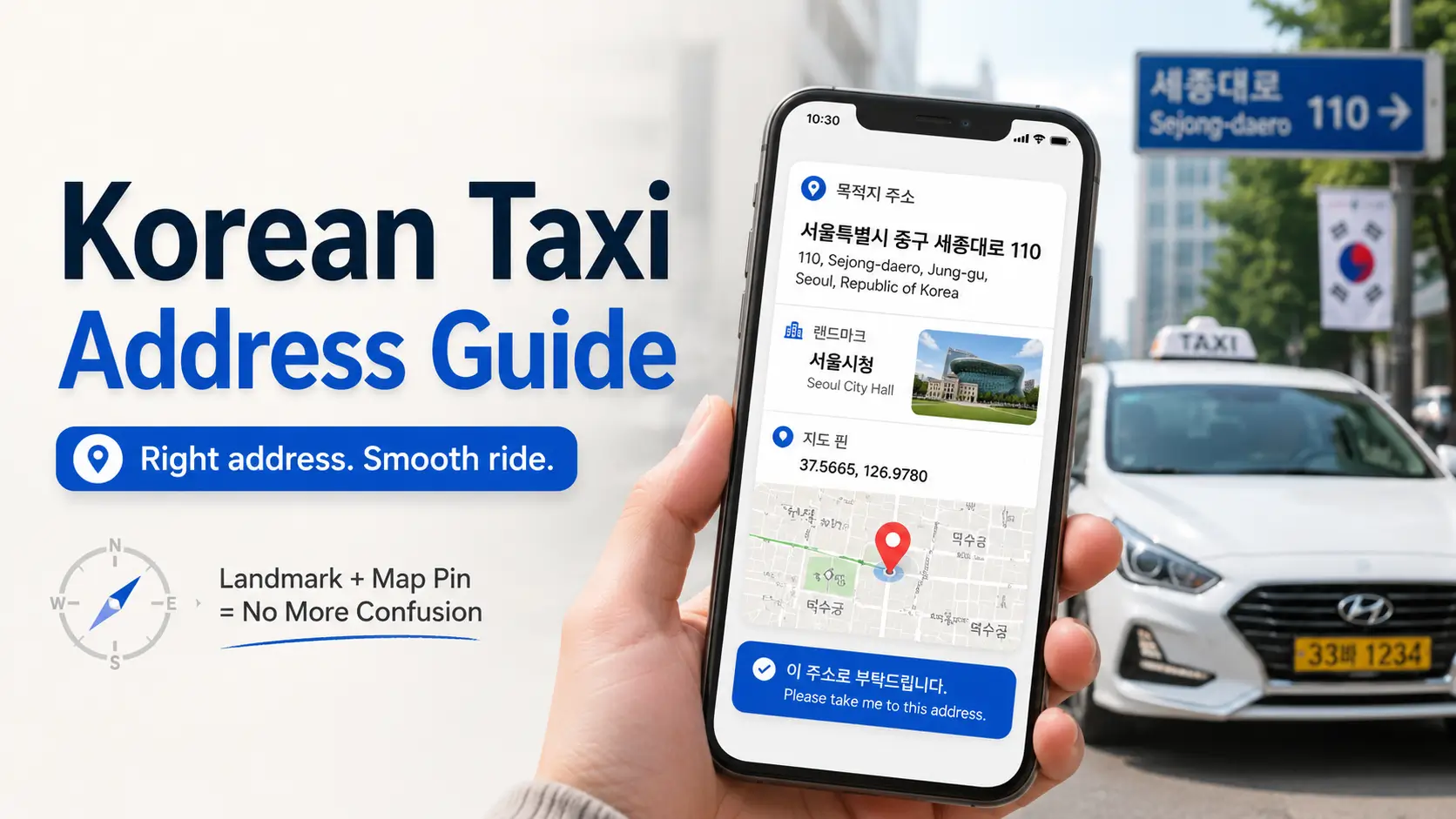
South Korea Taxi Navigation Guide
Why Korean Taxis Feel Easy
Until the Address System Gets Complicated
Korean taxis can feel wonderfully simple at first. The cars are usually clean, the meters are visible, the apps are familiar enough, and in busy districts a cab can appear with the quiet efficiency of a stagehand moving scenery in the dark.
Then the destination gets involved. A hotel name appears one way in English, another way in Korean, and a third way on a map pin. The driver may recognize the neighborhood but not the translated street line. Your Airbnb may have a beautiful address and a practically invisible entrance. The ride is not the puzzle. The last fifty meters are.
This guide gives you a traveler-safe way to handle Korean taxi addresses before you are standing on a curb with luggage, low battery, and a driver asking a perfectly reasonable question you cannot answer. We will build a simple “taxi-proof” destination card, compare apps and street hails, and show you how to use Korean addresses, landmarks, subway exits, and map pins together instead of hoping one magic address will behave.
Avoid wrong drop-offs
Know why entrances, gates, and back alleys matter more than a neat translated address.
Ride with backup
Carry a Korean address, a nearby landmark, and a map pin before the taxi door closes.
Spend less time guessing
Choose when to use an app, when to street-hail, and when to call your hotel or host.
The smoothest Korean taxi ride starts before the meter starts. 🧭
Snapshot
This article is for US and UK travelers using taxis in Seoul, Busan, Jeju, and smaller Korean cities. It solves the practical problem of Korean taxi address confusion: road-name addresses, older neighborhood addresses, building names, map pins, entrances, and landmarks. By the end, you will know how to prepare one clear destination card before your ride and what to do if the driver looks uncertain.
Contents — choose a section
Table of Contents
Before You Ride: A Calm Safety Note
This guide is practical travel help, not legal, emergency, or official transportation advice. Taxi rules, app features, payment options, and local services can change, so confirm important details with your hotel, host, clinic, venue, or an official tourism resource before relying on them. If you ever feel unsafe, end the ride in a public place, contact local help, or ask nearby staff for assistance.
Korean Taxis Feel Easy, Until the Destination Becomes the Problem
For many travelers, taking a taxi in South Korea feels easier than expected. You do not need to negotiate a fare before every ride. You do not need to master a local bus transfer while half-asleep. You can usually pay by card, use a taxi app, or show a destination on your phone.
The surprise is that Korean taxi confusion often begins after the basic taxi problem is already solved. The driver is not necessarily confused about taxis. They may be confused about which version of your destination you mean.
In Korea, a place can live under several identities at once: a road-name address, an older lot-based address, a building name, a neighborhood name, a subway exit, a landmark, and an app pin. Each identity can be technically useful. Each can also betray you a little, like a polite sign pointing to the back door.
Why the ride itself is usually not the hard part
Once you are inside a licensed taxi and the destination is clear, the ride is usually straightforward. The driver follows a route, the meter runs, and you arrive. The friction is more likely to appear at the moment you communicate the destination.
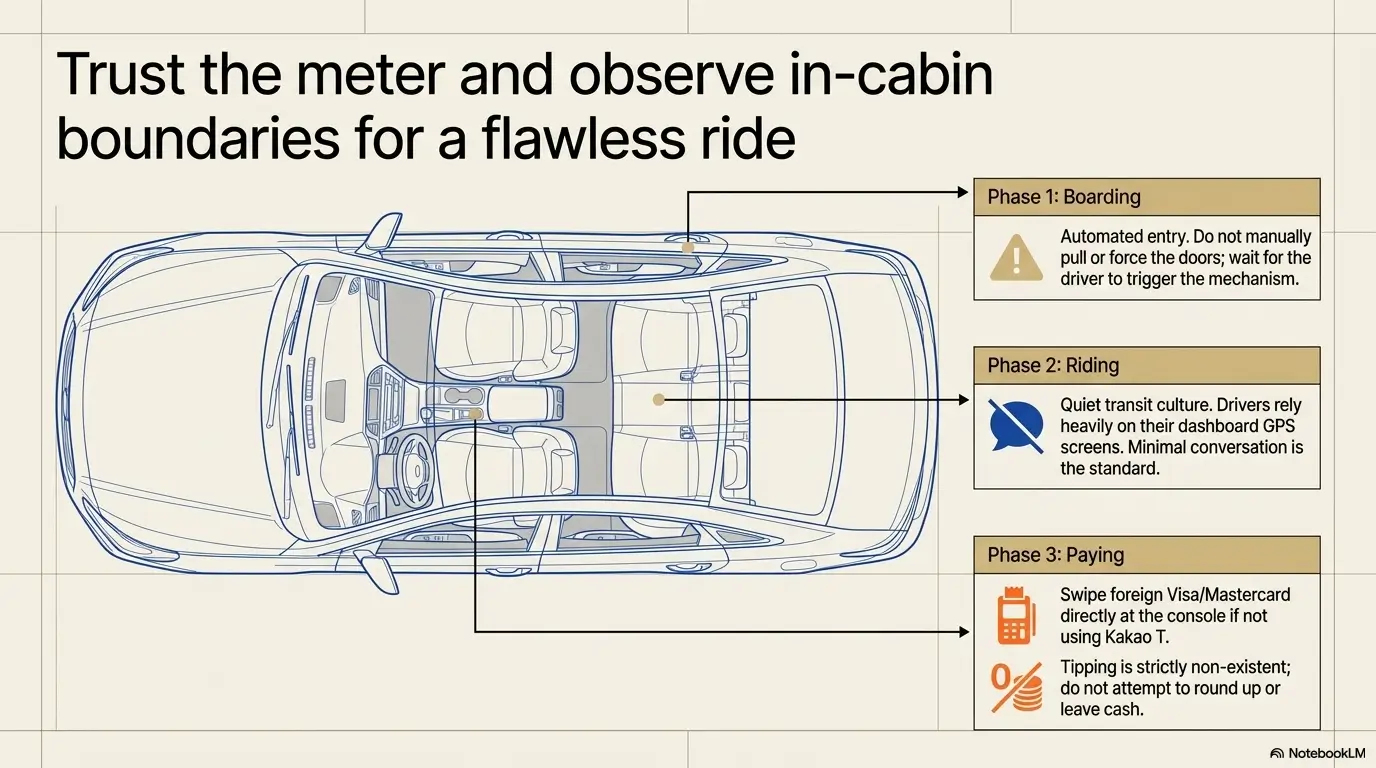
This matters because travelers often prepare for the wrong problem. They worry about tipping, payment, or whether taxis exist at all. Those are worth understanding, and you can pair this guide with a practical primer on tipping in Korea if payment etiquette is on your mind. But the address problem deserves its own spotlight.
The hidden friction: the driver may understand the place, not your address
A taxi driver may know a famous hospital, mall, hotel, university, or subway station immediately. The same driver may not instantly recognize an English-translated street address, especially if the translation does not match common local wording.
Think of the destination as a person wearing several name tags. The driver may know “Hongdae Exit 9,” “Yonsei Severance Hospital,” or “Lotte Department Store main gate” far better than a long Romanized road name. That does not mean the address is wrong. It means the local memory system is richer than the line you copied from your booking email.
Key Takeaway
In a Korean taxi, “correct” is not always the same as “useful.” A destination becomes useful when the driver can connect it to a building, entrance, neighborhood, or landmark they recognize.
The “I have the address” trap travelers fall into
The most common traveler mistake is showing one address and assuming the matter is settled. In the US or UK, a street number plus street name often feels like a complete spell. In Korea, it may be only one piece of the spellbook.
A good Korean taxi destination setup usually has four parts: the Korean-language place name, the Korean address, a nearby landmark, and a map pin checked against the entrance. When those four agree, your ride becomes much calmer.
Address Systems Collide: Road Names, Old Districts, and Building Names
South Korea’s address system is not impossible. It is simply layered. For visitors, the challenge is that official systems, local habits, map apps, and building names do not always speak in one neat voice.
The country uses road-name addresses for official navigation, yet older neighborhood-style references still appear in conversation, local memory, real estate talk, delivery instructions, and older business listings. Add building names and underground entrances, and your taxi destination can become a small administrative opera.
Why Korea’s road-name address can confuse visitors
Korean road-name addresses are built around roads and building numbers. On paper, that sounds friendly to travelers from countries where street addresses dominate. The catch is that travelers often see the address through translation, Romanization, hotel booking platforms, map apps, or screenshots from a host.
Romanized Korean can vary. A neighborhood name may be spelled one way in a travel article and another way on a sign. A building may be known locally by a Korean name that does not look much like its English branding. A road name can be perfectly official and still not be the quickest way for a driver to identify the exact door.
For official address lookup and road-name address information, the Korean road-name address portal can be useful before your trip, especially if you want to verify the Korean form of an address.
Why older neighborhood-style addresses still appear in real life
Older lot-based or neighborhood-style references still have a stubborn real-world afterlife. People may use them because they are familiar, because an older business listing still shows them, or because the destination is known by neighborhood and building rather than by road number.
This is especially relevant for guesthouses, villas, older apartment blocks, small clinics, restaurants, studios, and local offices. If you are staying in a villa, officetel, or apartment-style lodging, the address may look tidy in a booking platform while the actual pickup or drop-off point depends on the building entrance. For more housing context, this guide to Korean villa rentals helps explain why small residential buildings can be harder to identify than a hotel lobby.
Building names can matter more than street numbers
In dense Korean neighborhoods, the building name may be the practical hero. A driver might not care about every digit of the address if the destination is “ABC Tower,” “XX Officetel,” “the clinic building next to the pharmacy,” or “the main entrance of the department store.”
This does not mean you should ignore the street address. It means your destination card should include both. Street address plus building name gives the driver two handles instead of one.
| Destination detail | Why it helps | Best use |
|---|---|---|
| Korean road-name address | Official and searchable | Apps, hotels, clinics, official forms |
| Older neighborhood or lot-style reference | May match local memory or older listings | Older buildings, small businesses, local hosts |
| Building name | Often easier for drivers to recognize | Officetels, clinics, apartments, offices |
| Landmark | Gives the driver a backup anchor | Busy districts, back alleys, nightlife areas |
| Entrance or gate note | Prevents near-but-wrong drop-offs | Hospitals, universities, malls, large complexes |
Show me the nerdy details
Korean destination friction often comes from a mismatch between four databases: official addresses, map app listings, local driver memory, and traveler-facing English names. Each one can be accurate within its own purpose.
The practical fix is not to find one “perfect” address. The fix is redundancy. When the Korean name, address, landmark, and entrance note all point to the same place, the driver has several ways to interpret your destination correctly.
Before You Ride: Build a Taxi-Proof Destination Card
A taxi-proof destination card is a small bundle of information you keep on your phone. It does not need to be fancy. It needs to be readable, Korean-friendly, and useful when Wi-Fi disappears at exactly the wrong time.
The best destination card answers the driver’s real question: “Where exactly should I take you?” Not “What does your booking platform say?” Not “What did your translation app produce at 1 a.m.?” Exactly where.
Save the address in Korean, not just English
Always save the Korean version of your destination. This is the single highest-return habit for Korean taxi rides. English names are useful for you, but Korean text is usually more useful for the driver and local apps.
For a hotel, copy the Korean name and address from the hotel’s official website, not only from a booking platform. For a clinic, ask the clinic to send the Korean address and nearest subway exit. For an Airbnb or guesthouse, ask the host for a taxi-friendly Korean address and a landmark.
Add the building name, floor, gate, or entrance note
Korean cities often hide the important detail in the final instruction. “Third floor,” “main gate,” “rear entrance,” “near Exit 2,” or “building B” may be what prevents you from being dropped on the wrong side of a complex.
This is especially true for hospitals, universities, apartment complexes, department stores, concert venues, campuses, and large underground shopping areas. The destination is not always the building. Sometimes it is the correct mouth of the building.
Keep one nearby landmark as your backup anchor
A nearby landmark can rescue a confusing address. Good landmarks include subway exits, hotel lobbies, department stores, major hospitals, universities, government offices, famous cafés, and large intersections.
Subway exits are especially useful because they are numbered, visible, and widely understood. If your destination is tucked in a side street, “near Exit 3” may be clearer than a translated address line wearing a tiny necktie.
Taxi-Proof Destination Card Template
- Korean place name: The name as shown on the official website, Naver Map, Kakao Map, or host message.
- Korean address: Road-name address whenever possible.
- Building detail: Building name, tower, gate, floor, entrance, or lobby.
- Nearby landmark: Subway exit, hotel, hospital, university, department store, or major intersection.
- Map pin: Checked against the actual entrance, not just the center of the building.
- Return address: Your hotel or lodging saved separately for the ride back.
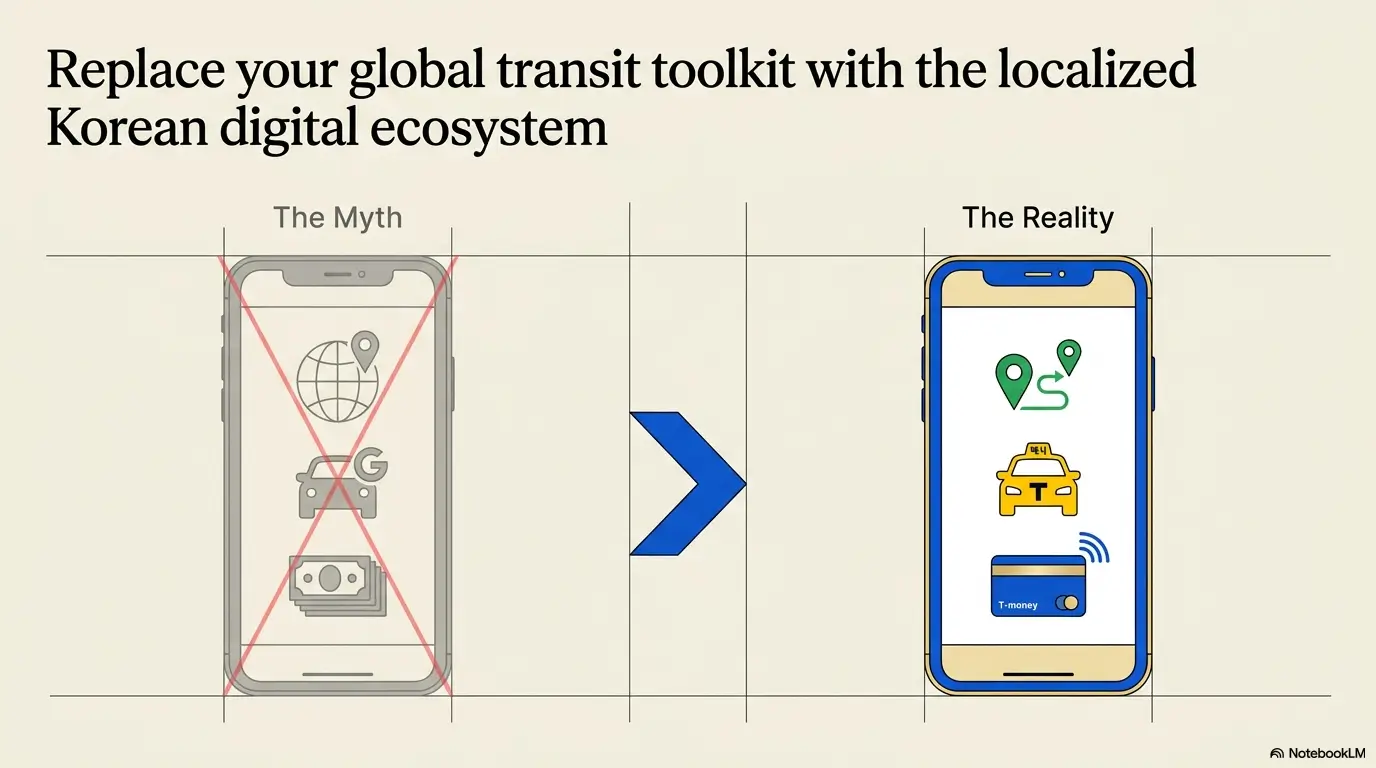
The Map Pin Mystery: Why Your App May Not Match the Driver’s Mental Map
Map pins are powerful, but they are not sacred scrolls. A pin can mark the building center, the business listing, the road-facing side, the delivery entrance, or a place near the destination rather than the door you need.
This is why a taxi app can feel precise until the driver stops near the destination and you realize you still have to solve the final approach. In Korea, the entrance can be the real destination.
One location, three possible labels
A café, clinic, or guesthouse can appear under an English brand name, a Korean business registration name, and a building name. Your app may prefer one label, your driver may recognize another, and the sign outside may show a third.
Before your ride, open the destination in more than one map app if practical. Compare the Korean name, address, and street-view style images when available. The goal is not perfection. The goal is to notice obvious mismatches before you are in motion.
Why English map results can point you near the place, not to the entrance
English search results can be close but slightly awkward. They may send you to the right block, the wrong side of the block, or a related listing. This is most common with small businesses, pop-up venues, clinics inside office buildings, and lodging in residential areas.
When the entrance matters, search the Korean name too. If you cannot read Korean, you can still copy and paste the Korean text into the map app. Korean characters are your little silver key, even if you cannot pronounce every cut in the metal.
Here’s what no one tells you: the entrance is often the real destination
A taxi may legally and practically stop only where road conditions allow. In busy Korean districts, the best drop-off point may be a nearby curb, not the exact doorway. For malls, universities, and hospitals, one building can have several entrances that feel like different planets when you are tired.
If your destination is time-sensitive, such as a clinic appointment, train connection, tour pickup, or concert, choose a clear entrance before the ride. Do not leave the last fifty meters to luck.
The 4-Part Korean Taxi Address Flow
1. Korean Name
Use the local place name, not only the English listing.
2. Korean Address
Show the road-name address or host-provided Korean line.
3. Landmark
Use a subway exit, hotel, hospital, mall, or university as backup.
4. Entrance
Check which gate, lobby, or curbside point you actually need.
App vs Street Hail: Which One Handles Address Confusion Better?
Taxi apps can reduce language pressure, but they do not erase destination ambiguity. Street hails can work beautifully, but only when you are ready to show the driver useful Korean destination information.
The best choice depends on your location, battery, Korean comfort level, destination complexity, payment setup, and how much precision you need at drop-off.
Kakao T and foreigner-friendly apps help when the pin is accurate
Kakao T is widely used in Korea, and traveler-facing taxi app options may help reduce the need to explain a destination aloud. Official tourism resources also describe taxi options and services for visitors, which can be useful when you are planning your trip rather than improvising on a curb.
Still, the app is only as good as the destination you select. If the pin points to the back alley, the taxi can faithfully take you to the back alley. Technology can be obedient in the most inconvenient way.
Street taxis can still work if your Korean destination card is ready
Street hailing is not outdated. In many areas, it is still convenient, especially near stations, hotels, nightlife districts, and major roads. The key is to avoid making the driver interpret your spoken Korean, your English pronunciation, and your translation app all at once.
Show the Korean destination card first. Point to the Korean name and address. Then show the map pin only if needed. This order is calmer than waving a zoomed-out map while saying a Romanized place name neither of you trusts.
The quiet risk: your app pin may route to the back alley
Large buildings and dense alleys are where app pins get sneaky. A venue may have a front entrance on one road, delivery access on another, and a taxi-friendly stopping point around the corner.
Before selecting the destination, zoom in. Look for the road your taxi can actually use. If your destination is a hotel, choose the hotel lobby or main entrance when available. If it is a university, hospital, or complex, choose the specific gate or building.
| Option | Best for | Watch out for | Best traveler habit |
|---|---|---|---|
| Taxi app | Reducing spoken language pressure | Wrong or awkward map pin | Check the Korean name and entrance before booking |
| Street hail | Busy roads, stations, hotels, simple destinations | Driver may not understand English address | Show Korean address and landmark immediately |
| Hotel desk taxi call | Airport transfers, early mornings, luggage, families | May cost more if using special services | Ask staff to write destination details in Korean |
| Host or clinic phone call | Hard-to-find buildings, appointments, guesthouses | Requires working phone or data | Save the contact number before leaving Wi-Fi |
Common Mistakes That Make Korean Taxi Rides Harder Than They Need to Be
Most Korean taxi address problems are not dramatic. They are tiny preventable frictions that pile up at the exact moment your patience is traveling in economy class.
The good news: a few small habits prevent most of them. You do not need fluent Korean. You need better pre-ride information.
Mistake 1: showing only an English address
An English address may help you understand the destination, but it may not help the driver quickly. Even when the driver can read some English, the Korean version is usually faster and less ambiguous.
Safer alternative: keep the Korean place name and address at the top of your screenshot. If the address was sent by a hotel, host, clinic, or venue, save that exact Korean text.
Mistake 2: trusting one map app without checking the building entrance
One map result can be enough for famous hotels and landmarks. It is not always enough for side-street cafés, hidden restaurants, small clinics, and apartment-style lodging.
Safer alternative: open the destination, zoom in, and check whether the pin appears near the entrance. For complex routes across town, it can also help to understand Korea’s public transit rhythm. This guide to Korea bus arrival apps is useful when you are comparing taxi, subway, and bus options for the same trip.
Mistake 3: assuming the driver will know every café, clinic, or Airbnb
Korean taxi drivers often know an astonishing amount about local geography, but they are not walking encyclopedias of every pop-up café, medical office, guesthouse, or private rental.
Safer alternative: pair the small place with a large anchor. “Near Hyundai Department Store,” “near Seoul National University Hospital,” “near Hongdae Exit 8,” or “inside ABC Building” can do more work than the business name alone.
Mistake 4: saying the destination aloud instead of showing it on screen
Spoken place names are risky when you are tired, nervous, or unfamiliar with Korean pronunciation. A driver may hear a different neighborhood, station, or branch location.
Safer alternative: show the screen first. Speak only as backup. Your phone can pronounce nothing and still be perfectly eloquent.
Mistake Checklist: Fix These Before the Taxi Arrives
- I only have the English address.
- I have not checked whether the map pin marks the entrance.
- I do not know the nearest subway exit or landmark.
- My hotel return address is not saved offline.
- My phone battery is low and my destination is not screenshotted.
- I am relying on spoken pronunciation for a place name I have never said before.
Match the taxi destination to an entrance
Keep the destination’s current Korean address, map pin and building name available, then identify the entrance you need. A hospital, campus or large apartment complex may have several vehicle access points. Confirm the destination before departure and ask whether the app’s pickup point matches where you can safely wait. If the route appears different from your expectation, ask calmly about the destination or traffic rather than assuming the driver has the same entrance in mind.
| Focus | What to check |
|---|---|
| Destination | Current address and correct branch. |
| Entrance | Vehicle access and the intended drop-off point. |
| Pickup | A safe location matching the actual booking. |
A reader question: Is a building name alone enough for a taxi journey?
Use the exact address and entrance where possible. Similar names, multiple branches or a large site can make a correct-looking label incomplete.
What To Do When the Driver Looks Confused
A confused look from a taxi driver is not a disaster. It is a signal. The information you gave may be incomplete, mismatched, or not in the form the driver expected.
The worst response is to repeat the same unclear destination louder. Volume is not a translation strategy, though many travelers have tested it in the wild.
Show the Korean address first, then the map pin
Start with the Korean name and address. Give the driver a moment to read. If the driver still seems unsure, show the map pin and zoom out enough to reveal the surrounding district.
A close-up pin with no context can be strangely useless. A slightly wider view showing the nearby station, main road, or landmark can help the driver place it in their mental map.
Offer a nearby landmark instead of repeating the same address
If the driver does not recognize the address, switch to the landmark. Try a subway station exit, hotel, major store, hospital, university, or government office. The landmark is not a surrender. It is a bridge.
For example, instead of insisting on a tiny guesthouse name in an alley, show: “Near Myeongdong Station Exit 4, behind the hotel.” That gives the driver a big target and a final clue.
Use the phone-call option when a hotel, host, or clinic can guide the driver
If your destination is a hotel, clinic, guesthouse, or private rental, save the phone number. In Korea, it is common for local staff or hosts to explain directions by phone when a destination is tricky.
This is especially helpful for medical appointments, late-night check-ins, rural guesthouses, and smaller cities where English signage may be thinner. For medical visits, pairing this with a guide to medical translation in Korea can reduce appointment-day stress.
Driver Confusion Troubleshooting Map
Driver does not recognize the address
Show the Korean name, then a nearby landmark.
Pin appears on the wrong side
Zoom out and point to the entrance or main road.
Destination is inside a large complex
Use gate, building, lobby, or department name.
Still unclear
Call the hotel, host, clinic, or venue and let them explain.
Traveler Scenarios: Hotels, Airbnbs, Clinics, Campuses, and Late Nights
Not every taxi ride needs the same level of preparation. A ride to a famous hotel in central Seoul is different from a ride to a guesthouse on Jeju, a skin clinic inside an office tower, or a campus building with four gates and one very patient security guard.
Here is how to prepare for the most common traveler situations.
Hotels are easiest when you use the lobby name
Hotels are usually the simplest taxi destinations because staff expect travelers to arrive by taxi. Still, large hotels may have multiple entrances, connected malls, underground parking, or separate drop-off zones.
Use the hotel’s Korean name and ask for the lobby or main entrance. Save your hotel address as your “return-home button” before your first outing. This habit is small, tender, and powerful, like putting a candle in the window for your future tired self.
Airbnbs, guesthouses, and villas need extra context
Private rentals can be trickier because the address may not correspond to a visible commercial sign. The taxi may get you near the building, but finding the entrance, keypad, alley, or elevator can still be your job.
Ask your host for a taxi instruction in Korean. A good host message might include the road-name address, building name, nearest subway exit, and a simple phrase such as “drop off in front of the convenience store.”
Clinics, campuses, and event venues need the exact entrance
Clinics may be inside buildings with similar names. University campuses may have gates that change the walking distance by ten minutes. Concert venues may have taxi restrictions near event time.
For time-sensitive trips, call or message ahead. Ask: “Which entrance should I give the taxi driver?” This is the one question that can save a surprising amount of money, sweat, and theatrical sighing.
Illustrative Scenario: The Alley That Wasn’t the Destination
A traveler named Mark landed in Seoul with a hotel card, a screenshot, and the sturdy confidence of a man who had survived three airport coffee prices.
His taxi ride was smooth until the car stopped beside a quiet alley. The map pin said he had arrived. The hotel, however, seemed to have vanished into urban fog. The driver looked at the phone. Mark looked at the alley. The alley offered no comment.
He called the hotel. The front desk explained that the pin marked the rear service road. The real lobby was around the block, beside a large bank. Two minutes later, the taxi rolled up to bright glass doors and a doorman who looked as if he had been expecting this exact human drama all evening.
Mark’s lesson was simple: the destination is not always the pin. Sometimes it is the entrance that knows your name.
Tools, Costs, and Backups Worth Comparing Before You Travel
You do not need to buy a suitcase full of gadgets to take taxis in Korea. But a few tools and services can reduce friction, especially if you are traveling with children, arriving late, visiting clinics, or staying outside major tourist zones.
This is where a practical comparison matters. Free options are often enough. Paid services can be worth it when the cost of confusion is higher than the cost of preparation.
Good / Better / Best setup for Korean taxi addresses
| Setup | What you prepare | Cost level | Best for |
|---|---|---|---|
| Good | Screenshot of Korean address, English name, and map pin | Free | Simple hotel rides and famous landmarks |
| Better | Destination card with Korean address, building name, landmark, entrance note, and return address | Free to low-cost | Most travelers, Airbnbs, clinics, cafés, smaller cities |
| Best | Destination card plus working phone data, saved contact number, and hotel or host support | Low to mid-range | Late arrivals, families, medical visits, rural stays, tight schedules |
Free vs paid help: when is it worth spending?
For a short city trip, free preparation is usually enough: screenshots, Korean addresses, hotel cards, and map pins. For a more complex itinerary, spending on mobile data, a translation service, a concierge-style airport transfer, or a private driver may be reasonable.
Paid help is not about luxury. It is about reducing failure points. A family arriving after midnight with luggage and sleepy children may value a confirmed pickup more than a solo traveler with one backpack and a flexible schedule.
| Traveler type | Free option may be enough when… | Paid or assisted option may be worth comparing when… |
|---|---|---|
| Solo traveler | You stay near stations and use major landmarks | You arrive late, travel rural, or have limited data |
| Family traveler | Your hotel is central and staff can help | You have luggage, strollers, tired children, or airport timing pressure |
| Medical traveler | The clinic is famous and sends clear Korean directions | The appointment is time-sensitive or inside a hard-to-find building |
| Business traveler | The meeting is at a major office tower | You need exact entrance timing, receipts, or no room for delay |
| Budget traveler | You can walk from a subway exit if the taxi stops nearby | Your lodging is in a back alley or your arrival is after transit hours |
Phone data is an address tool, not just a social media tool
Reliable phone data helps you call a host, open a Korean map, show a driver a wider view, or recover when a screenshot is not enough. For many travelers, this is a better use of budget than another travel gadget that will retire into a drawer.
If you are still planning connectivity, compare SIM, eSIM, roaming, and Wi-Fi options before you land. A practical guide to Korean phone plans for Americans can help you decide what level of connection you need for taxis, maps, messaging, and emergency backup.
Questions to Ask Before Paying for Extra Help
- Will I arrive late at night or during bad weather?
- Is my destination a hotel lobby or a hard-to-find private building?
- Do I have working phone data after leaving the airport?
- Can my hotel, host, clinic, or venue answer a driver’s phone call?
- Would a wrong drop-off cause a missed appointment, train, tour, or check-in?
- Am I traveling with luggage, children, older relatives, or mobility limits?
For broader tourist support, official travel resources can help you check transportation basics, visitor services, and current contact options before your trip.
FAQ: Practical Korean Taxi Address Answers
Can I use English addresses in Korean taxis?
You can try, especially at major hotels, airports, and famous tourist sites. Still, the safer habit is to show the Korean address and Korean place name first. English is useful for you. Korean text is usually more useful for the driver.
Should I show the driver a map pin or a written address?
Show both if possible. Start with the Korean written address, then show the map pin if the driver needs location context. A written address gives identity. A map pin gives geography. Together, they behave better.
Why do Korean addresses sometimes look different across apps?
Different apps may show Korean, English, Romanized, road-name, neighborhood-style, business-name, or building-name information. The destination may be the same even when the label changes. When in doubt, verify the Korean name, building, and entrance with the official website, hotel, host, or venue.
What address should I use for an Airbnb in Korea?
Ask the host for a taxi-friendly Korean address, a nearby landmark, and an entrance note. Do not rely only on a translated booking address. For private rentals, the building entrance and nearby landmark may matter more than the street line alone.
Is Kakao T easier than hailing a taxi on the street?
Often, yes, because it can reduce spoken destination confusion. But a taxi app still depends on the accuracy of the pin and listing. Street hailing can also work well when you have a Korean destination card ready.
What should I do if the taxi drops me near the place but not at the entrance?
First, check your map and look for the main road, building sign, or landmark. If you are at a hotel, clinic, restaurant, or guesthouse, call them and ask for walking guidance. For large buildings, ask staff, guards, or nearby shop workers for the entrance rather than wandering deeper into side streets.
Are subway exits good taxi destinations in Korea?
Yes, subway exits are often excellent landmarks because they are numbered, visible, and widely recognized. They are especially useful in Seoul and other major cities. If you are new to transit manners and station flow, this guide to Korean subway etiquette can make the whole station experience smoother.
Should I screenshot my destination before leaving Wi-Fi?
Yes. Screenshot the Korean address, map pin, building name, landmark, and return address. Screenshots are boring until your data drops. Then they become tiny heroic documents.
Make One Screenshot Before Your First Ride
The simplest next step is not downloading five apps or memorizing Korean address history. It is making one clean screenshot before your first taxi ride.
Open your destination. Add the Korean name, Korean address, building or entrance detail, nearby landmark, and map pin. Then save your hotel or lodging address as a separate return-home screenshot. This takes less than fifteen minutes and can save the kind of confusion that makes a trip feel heavier than it is.
Korean taxis are not hard because taxis are mysterious. They get hard when the destination has too many names and your phone shows only one. Give the driver several ways to understand where you mean, and the whole ride becomes softer around the edges.
Your 15-Minute Pre-Ride Action
- Find your destination’s Korean name and Korean address.
- Check the map pin against the likely entrance.
- Add one nearby landmark or subway exit.
- Save the destination phone number if available.
- Screenshot everything, including your return address.
Last reviewed: 2026-07
Practical example and reader question added October 20, 2026. Existing source dates are retained; this addition is not a fresh verification of every earlier claim.